kazuhiko yamazaki, So Nishina (2026). A Framework for the Social Implementation of Visions: Integrating Design, Experimentation, and Culture. In: Intelligent Human Systems Integration (IHSI 2026): Disruptive and Innovative Technologies. AHFE Open Access, vol. 200, pp. 771–777. https://doi.org/10.54941/ahfe1007136
In Japan, corporations and public organizations frequently articulate ambitious visions of desirable futures. However, these visions often remain symbolic statements rather than drivers of systemic transformation. The difficulty arises from a structural gap between ideals and practice, rooted in the lack of experimental mechanisms, institutional adaptability, and cultural openness. The purpose of this study is to address this gap by proposing and examining a framework for the social implementation of visions. This framework aims to move beyond rhetorical vision-setting by offering organizations a structured approach that integrates design, experimentation, and cultural embedding.The research adopts a design-oriented methodology that synthesizes theoretical insights from innovation studies, organizational design, and cultural theory. The proposed framework integrates four interconnected elements: (1) vision design, defined as articulating a “compass” toward a desirable world rather than a fixed roadmap; (2) social experiments and experiential prototypes, which create opportunities for testing and experiencing future possibilities; (3) organizational design, encompassing structures, processes, and systems that sustain change; and (4) culture, understood as shared values and practices that enable collective action. The framework highlights two complementary pathways: a top-down approach, in which visions guide the design of experiments and prototypes, and a bottom-up approach, in which small practices evolve into broader visions. Art-thinking informs the early stage of individual imagination, while design-thinking guides the iterative prototyping and organizational embedding process. To examine applicability, two qualitative case studies were conducted: (1) Money Forward Inc., a fintech company that redesigned its mission, vision, values, and culture (MVVC) to manage rapid growth; and (2) Busshien Social Welfare Corporation, a welfare organization reimagining community through experimental social services. Data were collected through semi-structured interviews, site visits, and analysis of organizational documents.The analysis reveals several insights. First, visions require a starting point in individual imagination and passion, which transform abstract ideals into actionable orientations. At Money Forward, a leader’s personal conviction—“to create a company one can be proud of”—initiated the redefinition of MVVC. This vision was then embedded through experiential practices such as employee assemblies, evaluation systems, and public sharing of a “Culture Deck.” Second, social experiments and experiential prototypes serve as crucial bridges between visions and practice. At Busshien, unconventional initiatives such as community cafés, hot springs, and multipurpose facilities operated by people with disabilities acted as experiential prototypes that reframed welfare as a central element of local life. These experiments not only tested feasibility but also cultivated new social perceptions and cultural norms. Third, organizational design and culture proved indispensable in sustaining implementation. Money Forward established a dedicated “People Forward Division” to integrate culture with HR functions, while Busshien embedded inclusivity into daily operations through flexible roles and participatory governance. Collectively, these findings demonstrate that social implementation depends on iterative cycles of vision creation, prototyping, organizational support, and cultural reinforcement.The study highlights that innovation culminates not in technological invention alone but in long-term processes of societal embedding. For researchers, the framework provides a lens to analyze socio-technical transformation, emphasizing the interplay of individual, organizational, and cultural dimensions. It suggests that successful implementation requires patience, iterative learning, and alignment between micro-level initiatives and macro-level systems.The originality of this research lies in its integration of vision design, social experimentation, organizational design, and cultural embedding into a unified framework. By bridging art-thinking and design-thinking, it offers a systematic approach for moving from individual passion to collective societal transformation. The study contributes to the field of human intelligent systems integration by demonstrating how disruptive and innovative technologies can be enacted not only through technical breakthroughs but also through socio-cultural practices. It provides practical guidance for organizations, policymakers, and communities seeking to translate visions into sustainable societal change.
Currently, changes in the social environment, economy, and lifestyles necessi tate a reconstruction of organizational significance, ideal states, and purpose. In this context, the setting or resetting of visions and purposes is required,
772 Yamazaki and Nishina and there is an increasing expectation for “design” to contribute to the cre ation of these visions.
In Japan, however, it is frequently argued that while technological inno vation has progressed, actual social transformation has not. For instance, it is evident that transformation has stalled in diverse fields such as corpora tions, administration, working styles, medical care, education, human rights, agriculture, and urban planning. Furthermore, it is pointed out that Japan’s competitiveness is declining compared to the international community. The fundamental challenge for Japan is not the lack of innovation or technology itself, but rather the inability to implement these advancements into society effectively to trigger social change.
According to a review by the Mitsubishi Research Institute (2020), “Innovation is completed by social implementation.” Innovation is a contin uous process from invention to societal adoption; it is not achieved solely by genius discoveries or advanced technologies. Rather, it is realized by effec tively combining existing technologies with non-technical elements—such as social systems and cultural values—often over long periods. Therefore, connecting innovation and technology to social implementation is crucial for improving lives and restoring competitiveness.
This paper proposes a comprehensive framework for the social implemen tation of visions, integrating four elements: vision, social experimentation, experience prototyping, and organizational design and culture. To verify this framework, the paper analyzes two distinct case studies: Money Forward, Inc., representing the corporate sector, and Social Welfare Corporation Bussien, representing the social welfare sector. Bussien is particularly noted for its innovative approach to integrating welfare with regional revitaliza tion, offering a compelling example of how visions can transform commu nity structures.
DEFINITIONS AND THEORETICAL BACKGROUND Vision and Social Implementation While “vision” has diverse definitions, this paper defines it as “the ideal future world for creating a better society.” Vision Design is the act of proposing this ideal state. A vision functions like a “compass” rather than a “map.” Unlike a map that provides a specific route to a goal, a compass indicates the direction in which to proceed, allowing for progress even in uncharted territory.
“Social Implementation” is defined here as “activities intended to change society.” It can be viewed through three lenses: (1) Research (utilizing scien tific findings and technologies in society); (2) Business (changing social behav iors through new businesses and administrative services); and (3) Culture (changing societal values and meanings through art and media). In particular, the cultural approach often involves “innovation of meaning” and can be driven by non-experts as well as experts.
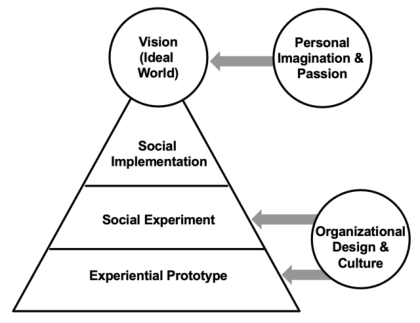
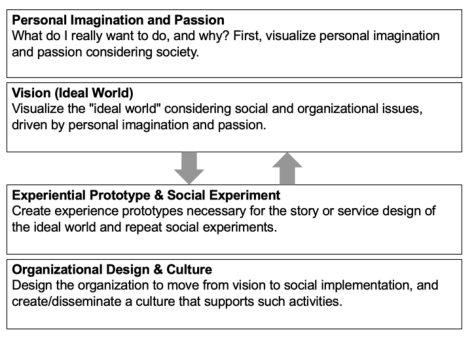
The proposed framework organizes the process of social implementation into a pyramid structure (Figure 1) consisting of four key elements (Figure 2):
Figure 1: Vision and approach to social implementation.Figure 2: The overall picture of vision and approach to social implementation.
Personal Imagination and Passion: The starting point of social implemen tation is not external mandates but the individual’s “delusion” and intense desire. This involves “Art Thinking,” where individuals stretch their ideas beyond current constraints to visualize a “new meaning” for themselves. This passion is deepened through internal dialogue and externalization (e.g., sketches or writing).
Vision (Ideal World): Based on personal passion, the “ideal world” is visualized while considering social and organizational issues. This vision is refined through dialogue between the self, the organization, and society, evolving from “my new meaning” to “our new meaning”.
Social Experiments and Experience Prototypes: To realize the vision, “Experience Prototypes” are created. These are not just functional proto types but are designed to allow users to “experience” the future service or state (e.g., “Wizard of Oz” prototypes or events). “Social Experiments” are then conducted as small-scale, time-limited trials in real societal environ ments to validate these prototypes through dialogue with residents and users.
774 Yamazaki and Nishina Organizational Design and Culture: Sustainable implementation requires appropriate “Organizational Design” (structures, roles, evaluations) and “Culture.” Following Schein’s (2016) definition, culture consists of shared implicit assumptions. “Culture Design” involves strategically transforming these tacit assumptions into explicit shared values (e.g., through culture decks or rituals) to support the vision.
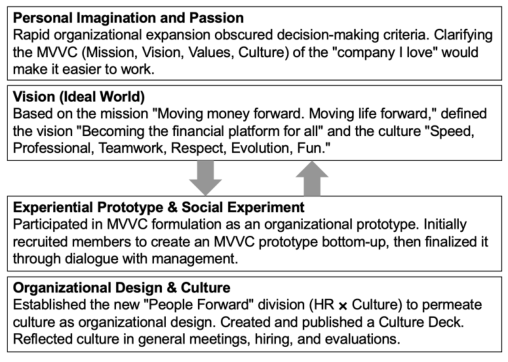
CASE STUDY-1: FINTECH COMPANY Money Forward, Inc. Money Forward, Inc., a FinTech company founded in 2012, provides financial web services to individuals and corporations. The company was analyzed regarding its “Mission, Vision, Values, and Culture (MVVC)” redesign project. Figure 3 is indicated the Vision and Approach to Social Implementation (Case: Money Forward).
Personal Imagination: The project was driven by Ms. Keiko Kanai, who had a background as a designer and art director. Amidst the organization’s rapid expansion, decision-making criteria had become unclear. Motivated by a personal passion to “make this a company I love” and a sense of crisis, she initiated the redesign of the corporate culture.
Vision: The company defined its Mission as “Moving money forward. Moving life forward” and its Vision as “Becoming the financial platform for all.” Crucially, they also established specific Cultural Values to support this: “Speed, Professional, Teamwork, Respect, Evolution, and Fun”.
Figure 3: Vision and approach to social implementation (case: money forward).
Social Experiment: The MVVC formulation process itself was conducted as a social experiment. Instead of a top-down mandate, it involved a bot tom-up approach where prototypes of the philosophy were created by a small team and refined through extensive dialogue with management and employees.
A Framework for the Social Implementation of Visions 775 Experience Prototype: The culture was not just a slogan but was embed ded into tangible “experiences.” For example, the “Culture Deck” was cre ated and published externally to test reactions. Furthermore, the culture was reflected in events (general meetings), hiring criteria, and evaluation systems, functioning as experience prototypes that allowed employees to live the val ues daily.
Organizational Design: To ensure structural sustainability, a new “People Forward” division was established. This division integrated Human Resources with Culture functions, ensuring that organizational design and culture were aligned to drive the vision forward (Kanai, n.d.).
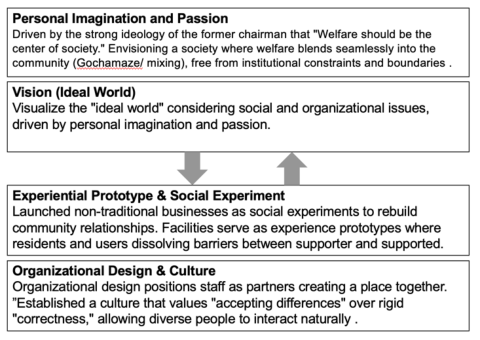
CASE STUDY-2: SOCIAL WELFARE CORPORATION Social Welfare Corporation Bussien Social Welfare Corporation Bussien, based in Ishikawa Prefecture, operates under the vision of “Creating a society where everyone lives together.” Figure 4 is indicated the Vision and Approach to Social Implementation (Case: Bussien).
Personal Imagination: The initiative began with the former chairman, Kazumichi Tada. He held a strong personal ideology that “welfare should be the center of society.” He questioned the segregation of welfare and envisioned a community where welfare blends seamlessly into daily life (“Gochamaze” or mixing).
Vision: The vision is a society where everyone, including those with dis abilities, the elderly, and the socially withdrawn, has a role and pride. They redefined people with disabilities not as “support recipients” but as active contributors to the regional economy and partners in service delivery.
Social Experiment: Bussien launched non-traditional welfare businesses as social experiments to rebuild relationships between residents and wel fare users. Key examples include “Share Kanazawa” and “B’s Gyuzenji,” which feature hot springs, restaurants, and cafes open to the public. These were “small experiments” to see if the community would accept a mixed environment.
Experience Prototype: These facilities function as “Experience Prototypes” for an inclusive society. For instance, when residents visit the hot springs or dine at the restaurant, they naturally interact with staff who have dis abilities. This provides a tangible experience of a “society where everyone lives together,” changing the residents’ perception from “helping” to “being together”.
Organizational Design: To support this, the organization was designed to flatten hierarchies. Staff are positioned not as “supporters” but as “partners creating a place together.” The organizational culture emphasizes “accepting differences” over “correctness,” creating an environment where diverse indi viduals can interact naturally without rigid rules (Yamazaki, 2024).
Figure 4: Vision and approach to social implementation (case: Bussien).
CONCLUSION
This paper presented a framework for the social implementation of visions, connecting personal passion, vision, social experiments, and organizational culture. The analysis of Money Forward and Bussien demonstrates that successful social implementation is not linear but an integrated process. In both cases, the process originated from Personal Imagination (Art Thinking), was crystallized into a clear Vision (Compass), validated through Social Experiments using Experience Prototypes (real-world trials), and sustained by a compatible Organizational Design and Culture. This framework pro vides a comprehensive and practical methodology for organizations aiming to bridge the gap between innovation and true societal change.
ACKNOWLEDGMENT
The author would like to acknowledge Ms. Keiko Kanai and the members of Social Welfare Corporation Bussien for their cooperation and insights in this research. He authors would like to acknowledge.
REFERENCES
Approach toward Social Implementation. Japan Ergonomics Society Argo Design Special Interest Group Concept Case Presentation. Yamazaki, K. (2022). Design Approach Considering Social Experience. Bulletin of JSSD, 63rd Research
Presentation. Yamazaki, K. (2021). Design Approach to Vision and Culture. Japan Ergonomics Society Argo Design Special Interest Group Concept Case. Iwasaki, H. and Sasaki, Y. (2021). Purpose: The Economy of Meaning and Beyond.
NewsPicks Publishing. Kanai, K. (n.d.). Kojien (6th Edition). Iwanami Shoten. Yamazaki, K. (1999). Mitsubishi Research Institute (2020). Innovation is completed by social implemen tation. Monthly Review. Available at: https://www.mri.co.jp/knowledge/mre view/202012.html.
A Framework for the Social Implementation of Visions 777 Money Forward, Inc. (2021). Press Release. Available at: https://prtimes.jp/main/
html/rd/p/000001080.000008962.html. Organizational Culture and Leadership. Shinmura, I. (Ed.) (2008). Ozenc, K. (2024). Rituals for Work. Schein, E.H. (2016). Social Experiment: Methods for Community Development with Citizen Collaboration. Toyo Keizai Inc. Yamazaki, K. (2016). Social Implementation and Social Experiment. HCD Research Presentation.
Yamazaki, K. (2024). The Spiral of Penetration for Mission, Vision, Value, and Culture Born from Empathy.
Available at: https://note.com/keikokanai/n/nfe0ff1d973c1
LISTED IN THE AHFE DIGITAL BOOKSTORE CATALOGUE
Explore the complete digital volume
Intelligent Human Systems Integration (IHSI 2026): Disruptive and Innovative Technologies
Read this individual research paper free through the original publisher, or explore the full digital proceedings book.
ISBN 978-1-964867-76-2
Explore this ISBN in the AHFE Bookstore ↗Listed in the July 2026 bookstore catalogue; search by ISBN to confirm current availability · Digital book purchase optional