Takashi Inaba, Kazuhiko Yamazaki, Shota Hiratsuka (2023). Visioning design for making the law familiar - Four utilization models of the law. In: Design for Inclusion. AHFE Open Access, vol. 75, pp. 239–245. https://doi.org/10.54941/ahfe1003345
The Japanese government has proposed Society 5.0, which is now known as the 4th Industrial Revolution, and the use of open data is attracting more and more attention and rapidly changing society and industrial structure. In line with these changes, the existence of law is also being called upon to change. However, while it is "extremely important to make the judiciary more familiar and accessible to the public," [Note 1] this has yet to be achieved. Rapid innovation has led to the creation and expansion of markets that have no legal system in place, and the law is still left to only a few experts.This study aims to create new social value by exploring the ideal form of law suited to the current social situation. We will also utilize design as a means to achieve this goal, and summarize the results as a case study of initiatives in the fields of law and design.3. This study contentBased on the aforementioned background, we surveyed domestic and foreign cases of advanced efforts regarding the Japanese people's awareness of and relationship with laws, and presented the characteristics of these cases. Based on these characteristics, we proposed a vision of "Law and Design for All. Finally, we will discuss and summarize the process that led to the vision proposal and discuss what is needed for collaboration in the fields of law and design in Japan.In this paper, we show what a "vision utilizing law and design" looks like, based on the current research we have conducted. In addition, the definition of vision in this study is "a desired vision of the future based on an individual's intrinsic motivation.4. research resultsA literature review was conducted to examine the Japanese people's awareness of the law. The survey revealed that they perceive that current laws are made by lawmakers whom they trust but do not trust, and that they are not involved in the process. In addition, they are not aware that they are making the laws, and are only required to decide and abide by them without knowing it. As a result, we believe that the problems are that they do not know that the law exists, they do not know how to use it because they do not know it, and the law is not up to date.We surveyed examples of activities, technologies, and services to solve these problems, and categorized them according to the target areas. As a result, we were able to classify them into LegalTech, OpenGovernment, GovTech, CivicTech, and Others (cases of utilization other than technology). It was found that there is a major trend toward the use of open data and citizen participation.In addition, a workshop was held to survey individuals' awareness of legal issues and use it as a reference for creating a vision. The theme was "issues and desires that you feel in your daily life that you think are related to the law. The participants were asked to write their awareness of legal issues on post-it notes and paste them on imitation papers. The reason for the ambiguity of "I think it is related to the law" was not the fact that the law is actually related to the issue, but rather to find out "what the person who wrote the post-it thinks is related to the law.As a result of the workshop, it can be said that the state that "Law and Design for All" aims for is a state where "people's awareness of the law is changing," "people are becoming more familiar with the law," "people are thinking about creating a better society," and "people feel their personal opinions are reflected in policy and law. It can be said that "people's awareness of the law is changing. We believe that law is subject to change, and that it is necessary to move from passive involvement to active involvement. Based on the above given conditions, we proposed a model in which law is viewed from the perspective of four relationships: "utilize," "protect," "improve," and “create.5. ConclusionBased on a survey of Japanese people's awareness of the law, case studies, and workshops, we have proposed a model that views the law from four perspectives. In the future, we plan to increase the number of cases in which this model is used and elaborate on it.The proposed model will enable us to understand the stages of legal utilization, and to realize the state that "Law and Design for All" aims to achieve through the cycle of the four stages. In other words, the "vision of utilizing law and design" can be described as the creation of a story that utilizes the proposed model.
The fourth industrial revolution is underway, with the government propo- sing Society 5.0 and increased attention being paid to the utilization of open data. As society and the industrial structure rapidly change and the post-war Japanese cyclical model collapses, the way of education and work is being reexamined (Honda, 2014). In response, the education sector aims to equip students with the ability to identify their own challenges, learn on their own, think critically, make their own decisions, and forge a better society and life. Starting in 2020, the teaching guidelines will gradually change from primary school (Government Public Relations Online, 2019). In the legal sector, the civil code was revised in 2017 and implemented in 2020 to respond to chan- ges. In this changing society and industrial structure, the existence of law is also required to change. However, while law remains the foundation of all activities in a rule of law country, it is still considered the domain of experts and it is extremely important to make justice more accessible to the public, yet it remains unfulfilled (MOJ, 1999). It is also pointed out that rapid inno- vation has led to the creation and expansion of markets where legal systems are not yet in place, increasing the need for each company to deal with new
legal issues that they have never experienced before (METI, 2018). As the source of value shifts from “things” and “money” to “people” and “data”, society as a whole is undergoing a major change.
The Legal Design Lab, established by Stanford Law School and the d.school, is an initiative of law and design. The Lab proposes new legal servi- ces, educates law students and professionals in design thinking, and conducts user surveys of legal services.
The Governance Lab (GovLab) at New York University is studying a legis- lative process with citizen participation called “CrowdLaw” and proposes a phase in the policy-making cycle in which citizen participation is required.
In Japan, the Legal Design Lab established at the Keio Research Institute at SFC, Keio University. The institute, led by researchers with diverse exper- tise in law, engineering, and design, states that it will conduct research on the development of legal and social systems with a focus on “people” across disciplines. The institute’s Tasuku Mizuno describes legal design as the idea and method of spontaneous rulemaking on the part of private citizens, rather than following rules set unilaterally by the state. In the “GRP Contract Form” project conducted with the Yamaguchi Center for Arts and Media, the con- tract environment itself was converted into source code and shared on the “Git Hub” in an attempt to make it open source (Mizuno, 2017).
Based on these related studies, we found that citizen participation in the legislative process and the source coding of articles, as co-creation, invo- lves a variety of people, not just legal experts. We believe that design can be effectively utilized by viewing law as a process of co-creation.
Based on the aforementioned background, this study investigates case stu- dies of advanced initiatives regarding the relationship between the general public and law, and proposes a vision of utilizing law and design as a means of co-creation. We will also summarize our findings as a case study of efforts in the fields of law and design, utilizing design as a means of co-creation.
RESEARCH METHODOLOGY A literature review was conducted to examine the legal consciousness of the Japanese people. As a premise, Japan is an indirect democracy with a parlia- mentary system of government, and the Constitution of Japan guarantees the sovereignty of the people. There are two ways to make laws in Japan today: first, the Cabinet submits bills to the Cabinet, and second, the Diet members make bills. In both cases, the people are indirectly involved in the process of legislation, as bills are passed by lawmakers elected by the people. Other methods include public comments, petitions, and petitions after the bills are passed. It has been pointed out that one of the issues with public comments is that there is a disparity in information among consumers and consumers, and that it is impossible to get true opinions (Mihune et al. 2008).
Survey Results on the Japanese and Legal Consciousness The survey results show that the number of people who feel that the actions of the people (voting, demonstrations, petitions, and petitions) have an influ- ence on national politics is decreasing (NHK Broadcasting Culture Research
Visioning Design for Making the Law Familiar 241
Institute, 2019). The percentage of voters by age group in national elections has also been decreasing year by year (MIC, n.d.). It was found that while they do not trust the parliament, the prime minister, political parties, or the government in support of parliamentary democracy, they do trust the police and the judiciary and the courts, as well as the police and the police force as an actual organization (The Genron NPO, 2018).
The above indicates that they perceive the current laws as being made by legislators they trust but do not trust, and that they are not involved in making them. They are not aware that they are making the laws, and are only required to obey them. As a result, we think that the problems are that they do not know the existence of the law, they do not know how to use the law because they do not know the law, and the law is not in step with the times.
Case Study of the Use of the Law We found that there are three problems with the law: people do not know it exists, they do not know how to utilize it, and it is not up to date. There- fore, we surveyed activities, technologies, and services that are trying to solve these problems and collected 60 examples, which we categorized into target areas. As a result, the cases were divided into LegalTech, Open Government, GovTech, CivicTech, and Others (non-technological applications).
From the case studies, we learned that there is a major trend toward the use of open data and citizen participation. It can be expected that the use of open data will not only increase transparency and accountability, but also make administrative procedures more efficient. Laws will become more accessible because they will become more plastic and easier to change than before by making them data-based, the legislative process, which was previously invisi- ble to citizens, will facilitate data and visualization, and citizens will respond if they send in their opinions.
PROPOSED VISION TO MAKE THE LAW MORE ACCESSIBLE A workshop was held to survey individuals’ awareness of legal issues and use it as a reference for creating a vision. The theme was “issues and desires that you feel on a daily basis that you think are related to the law”. The workshop was held from June 20 to July 20, 2019, in the basement of GVA TECH K.K. and participants were asked to write on post-its their awareness of issues related to the law and paste them on the post-its. The reason for the ambiguity of “I think the law is relevant” is not the fact that the law is actually relevant, but rather to find out “what the person who stated this relates to the law.”
We were able to get 91 post-its put up during the period. The opinions expressed included, “I don’t understand what it means to suddenly become a member of society and have to pay social insurance premiums,” and “There are too many things that are not known about the law, even though it is for citizens.” The main subjects of the opinions were relationships in the commu- nity, education, food and drink, weddings and funerals, dissatisfaction with the law and its content, companies, work style, and improvement of public
manners. These opinions were structured using a Laddering Method so that the relationship between each opinion could be seen.
As a result of organizing the relationships, it can be said that the state that “Law and Design for Everyone”aims for is a state where “people’s awareness of the law is changing,” “people are becoming more familiar with the law,” “people are thinking about creating a better society,” and “people feel that their individual opinions are reflected in policy and law. Next, we can say that in a society where these opinions are realized Next, we asked ourselves what the law would be like in a society where these opinions are realized.
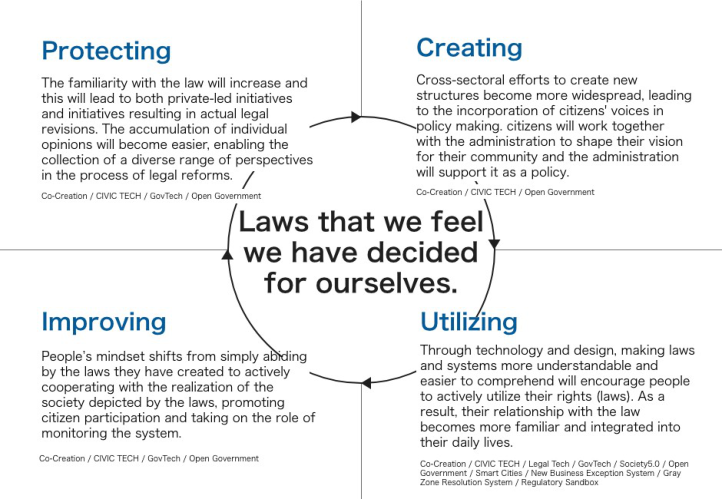
As a result of our thinking, we believe that law is subject to change, that it is transformed from “a thing to be decided” to “a thing to be determined,” and that active involvement is needed instead of passive involvement. Based on the above given conditions, we propose a model that perceives law in terms of four relationships: “utilizing,” “protecting,” “improving,” and “creating” (Figure 1).
Figure 1: Proposed four models of utilization of the law.
RESULTS AND DISCUSSION
According to previous surveys, it was determined that the goal of “Law and Design for All”is to achieve the following: 1) a shift in people’s understanding of the law, 2) an increase in familiarity with the law among the public, 3) a desire among people to build a better society, and 4) incorporation of indivi- dual perspectives into policy and law. In this type of society, it is recognized that laws are dynamic and must be actively evaluated and adapted if neces- sary by individuals themselves. It is also believed that citizen engagement in the creation of laws and their vision is crucial.
Visioning Design for Making the Law Familiar 243
Law needs to shift from being perceived as a ‘fixed entity’ to a ‘decision- making entity’, and from a passive involvement as a ‘created thing’ to an active involvement as a ‘thing to be created and improved’, and from a ‘thing to be obeyed’ to a ‘thing to be utilized’.
It has been pointed out that the subjects of legal consciousness as the social requirement of the designated legal system are both the target and the user of the law (Hiramatsu, 1974), and democracy can be said to exist through the constant monitoring and criticism of the functioning of the system (Maru- yama, 1961). Thus, I propose to approach the law from four perspectives: ‘utilizing’, ‘protecting’, ‘improving’, and ‘creating’.
Therefore, it is suggested to approach the law from four distinct perspe- ctives: “using,” “protecting,” “improving,” and “making.” “Using” refers to the use of technology and design to make the law and institutions easier to understand and for individuals to become more proactive in their utilization. “Protecting” emphasizes the importance of individuals becoming aware of the laws they have created, not merely for compliance but for cooperation in realizing the envisioned society, promoting citizen participation and serving as a watchdog of the system. “Improving”involves increasing familiarity with the law and promoting initiatives, both from the public and private sectors, that lead to revisions of the law and the accumulation of individual opinions in the revision process. “Making” entails a greater emphasis on creating new mechanisms that cross multiple areas and ensuring that citizens’ voices are reflected in policy-making. This approach would involve collaboration betw- een citizens and the government in creating a vision for their community, with the government supporting this vision as policy.
The proposed model will enable us to understand the stages of legal uti- lization, and the cycle of the four stages will make it possible to realize the state that “Law and Design for All” is aiming for. In other words, the “vision of utilizing law and design” can be described as the creation of a story that utilizes the proposed model.
CONCLUSION
In this study, in order to develop a vision for utilizing law and design, we first investigated what the current law is to Japanese people. As a result, it was found that there are three problems in Japan: people regard the law as someone else’s business and do not know it exists, people do not know how to utilize it because they do not know it, and the law is not in step with the times.
From the case studies, it was found that open data is being utilized as a policy. While “not knowing how to utilize the law” and “the law is not up to date” could be improved by making the law open data as well, the problem of “not knowing it exists,” which was mentioned as a problem of the law, would remain.
The workshop revealed individual thoughts and concerns about the law. Based on these results, we made a clear statement of what kind of state “Law and Design for Everyone” is aiming for. The following is a summary of what
we have clearly stated: 1) People’s awareness of the law is changing, 2) People are becoming more familiar with the law, 3) People want to create a better society, and 4) Individuals feel that their opinions are being reflected in policy and law.
In the above-mentioned society, we thought that, based on the premise that laws change, it would be necessary for citizens to be involved in the law from the vision of its enactment, rethinking the law as something that they can think about, actively utilize, and quickly change if it does not fit the actual situation. As a result, we proposed that the law be viewed from the four perspectives of “utilizing,” “protecting,” “improving,” and “creating. We believe that “Law and Design for All” can be realized by repeating this cycle. In addition, by summarizing the case studies from the four perspectives, it will be beneficial to have a common understanding of which areas are involved and in which areas there are many case studies.
As for future development, we will continue to conduct case studies and further clarify the utilization methods, advantages, and disadvantages of the proposed model. In addition, we believe it is necessary to organize and clarify how design can be utilized in the field of law through this activity.
ACKNOWLEDGMENT
I would like to express my appreciation to Professor Kazuhiko Yamazaki for his constructive suggestions.
I would like to thank Lawyer Shota Hiratsuka for useful discussions. We would like to express our gratitude to everyone at GVA TECH K.K. for their cooperation in the workshop.
REFERENCES
Government Public Relations Online. (March 13, 2019) 2020, chil- dren’s learning will evolve! New curriculum guidelines, start!. Government Public Relations Online Website: https://www.gov- online.go.jp/useful/article/201903/2.html(accessed2 November 2019). Hiramatsu, H. (1974), Japan Culture Association (ed.) “Legal Consciousness of the Japanese”, The Sociology of Law, Volume 1974(1974) Issue 27, pp. 165–169 Honda, Y. (2014), Reconnecting Society: Education, Work, and Family to Work
Together, 9th ed., Iwanami Shoten, Chiyoda, TYO. NHK Broadcasting Culture Research Institute, (2019), 10th Annual“Japanese Attitudes” Survey (2018) Summary of Results, NHK Broadcasting Culture Research Institute. Maruyama M. (1961), Japanese Thought (Iwanami Shinsho), 106th ed., Iwanami
Shoten, Chiyoda, TYO. pp. 172–173 Mihune, M. Higuchi, Y. Masuda, J. Uemura, T. and Yamaoka, Y. (2008), Document 4: How public comments should be solicited, available at: https://warp.da.ndl.go.jp/info: ndljp/pid/10311181/www.caa.go.jp/ seikatsu/shin- gikai/kikaku/21th/080128shiryo04.pdf(accessed10 November 2019). Ministry of Economy, Trade and Industry (METI). (2018), Report by the Study
Group for Development of Ideal Approaches to Legal Functions in Japanese Companies for Enhancement of International Competitiveness, Chiyoda, TYO.
Visioning Design for Making the Law Familiar 245
Ministry of Internal Affairs and Communications (MIC). (n.d.), Voter Turnout by Age Group in National Elections, available at: https://www.soumu.go.jp/senkyo/senkyo_s/news/sonota/nendaibetu (accessed10 November 2019). Ministry of Justice. (1999), Summary of Proceedings of the 8th Meeting of the Judicial System Reform Council Handout (Attachment 1), Ministry Of Justice, available at: https://warp.da.ndl.go.jp/info: ndljp/pid/284573/www.kantei.go.jp/ jp/sihouseido/dai8append/append1.html (accessed10 November 2019). Mizuno, T. (2017), Design of Law - Creativity and Innovation Accelerated by Law,
5th ed., Filmart-Sha Co;Ltd, Shibuya, TYO. pp. 46–53 The Genron NPO. (2018), Public Opinion Survey on Japanese Politics and Democracy at: http://www.genron-npo.net/future/archives/6991.html(accessed8 November 2019).
LISTED IN THE AHFE DIGITAL BOOKSTORE CATALOGUE
Explore the complete digital volume
Design for Inclusion
Read this individual research paper free through the original publisher, or explore the full digital proceedings book.
ISBN 978-1-958651-51-3
Explore this ISBN in the AHFE Bookstore ↗Listed in the July 2026 bookstore catalogue; search by ISBN to confirm current availability · Digital book purchase optional