Alessia Brischetto, Ester Iacono, Claudia Becchimanzi, Francesca Tosi (2023). Enhancing Inclusive Experience in Museums: results from a field study. In: Design for Inclusion. AHFE Open Access, vol. 75, pp. 132–144. https://doi.org/10.54941/ahfe1003334
Open access to culture and the possibility to experience and learn about art in museums are human rights that should be granted to everyone. However, very often the information accessible to users through the official channels of museums regarding independent visitation by individuals with a disability generally refers to accessibility in terms of mobility, and they also frequently provide incomplete information. Information related to independent enjoyment by people with sensory disabilities (visually impaired, blind, hearing impaired, deaf) is most often lacking, as the accessibility of the visit route is generally guaranteed in a pre-scheduled way and in the presence of mediators. This aspect limits the free enjoyment of the artworks by people with sensory disabilities and shows the lack of a real inclusive culture and adequate tools to guarantee the full right to visit independently, in their own way and time.This paper presents a part of the project “XAll - Tutta un’altra guida” (XAll - A whole other guide), funded by the TIM Foundation, which partners the University of Florence, the Polytechnic University of Milan, and the referents of 3 Florentine museums: Museo di Palazzo Vecchio, Museo Bardini and Museo Bargello. The overall objective of the project is to create an interactive, customizable and inclusive visit support, aimed at the overall population and designed to encourage a multisensory visit experience, realized by inserting tactile, sound and olfactory stimuli in the visit path of the 3 Museums involved and enhanced by the use of augmented reality. Specific objectives of the project are: to make cultural heritage accessible to visitors with all types of disability; to improve the quality of independent visitation in terms of engagement and customization of the experience; to encourage the dissemination of free applications in museum accessibility projects; and to provide an integrated framework and a set of open source tools for the development of applications in the same area.To achieve the overall objective, the project involved the application of the scientific and methodological approaches of Inclusive Design and Human-Centered Design. In detail, tor define user profiles during the preliminary design phase, the following researches were conducted: (1) On-site investigation of the three museums involved in the project; (2) Survey visits and field observations (in collaboration with experts from the museum institutions) at the three museums involved and with the associations ENS (Italian Association of the Deaf), UICI (Italian Union of the Blind and Visually Impaired), and HABILIA Onlus (Paratetraplegic and Motor Disabled Association); Collection and systematization of feedback and data collected during the observations, based on which it was possible to set up the development of the video guide project and multi-sensory stations to be included within the museums.The study of user profiles allowed to conduct early analysis of User-Museum interaction models through the following activities: identification of the requirements of mobile media and multi-sensory stations; development of User Journey Map and Scenarios; definition of the technical characteristics of the video guide.
Open access to culture and the possibility to experience and learn about art in museums are human rights that should be granted to everyone. However, very often, the information accessible to users through the official channels of museums regarding independent visitation by individuals with a disability generally refers to accessibility in terms of mobility, and they also frequ- ently provide incomplete information. Furthermore, information related to independent enjoyment by people with sensory disabilities (visually impai- red, blind, hearing impaired, deaf) is most often lacking, as the accessibility of the visit route is generally guaranteed in a pre-scheduled way and the pre- sence of mediators. This aspect limits the free enjoyment of the artworks by people with sensory disabilities. Furthermore, it shows the lack of a real inclusive culture and adequate tools to guarantee the full right to visit inde- pendently, in their way and on time. This paper presents a part of the project “XAll - Tutta un’altra guida” (XAll - A whole other guide), funded by the TIM Foundation, which partners the University of Florence, the Polytech- nic University of Milan, and the referents of 3 Florentine museums: Museo
di Palazzo Vecchio, Museo Bardini and Museo Bargello. The overall obje- ctive of the project is to create an interactive, customizable and inclusive visit support aimed at the overall population and designed to encourage a mul- tisensory visit experience, realized by inserting tactile, sound and olfactory stimuli in the visit path of the 3 Museums involved and enhanced by the use of augmented reality. Specific objectives of the project are: to make cul- tural heritage accessible to visitors with all types of disability; to improve the quality of independent visitation in terms of engagement and customiza- tion of the experience; to encourage the dissemination of free applications in museum accessibility projects; and to provide an integrated framework and a set of open source tools for the development of applications in the same area.
RESEARCH OBJECTIVES AND METHODOLOGY OF INTERVENTION To achieve the overall objective, the project involved the application of the scientific and methodological approaches of Inclusive Design (Dong et al., 2012) and Human-Centered Design (ISO 9241-210: 2019). In particular, the study, developed over several stages, envisaged the involvement of various types of museum users, using a participatory design approach aimed at the associations ENS (Italian Association of the Deaf), UICI (Italian Union for the Blind and Visually Impaired) and HABILIA Onlus (Paratetraplegic and Motor Disabled Association) and to the various museum institutions invo- lved in the project. This involvement has made it possible to focus attention on their needs and expectations and the skills and points of view of the profes- sionals involved in the planning and managing of the services offered by the museums. Precisely, the research followed the following operational phases:
Phase 1: Definition of user profiles; Phase 2: Preliminary studies of User/museum interaction models; Phase 3: Development of design solutions and intervention scenarios.
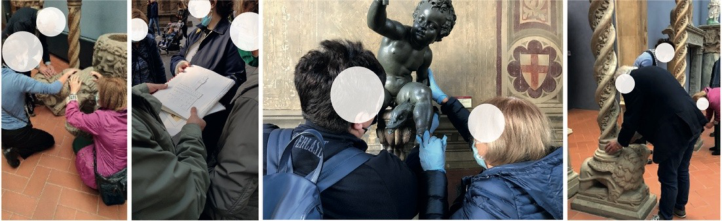
Phase 1: Definition of User Profiles To define user profiles during the preliminary design phase, the following activities were conducted: (1) On-site investigation of the three museums involved in the project; (2) Survey visits and field observations (Stanton et al., 2014), in collaboration with experts from the museum institutions, at the three Florentine museums and with the 3 associations involved (see Figure 1); (3) Collection and systematization of feedback and data collected during the observations (photographic and audio-video material), based on which it was possible to set up the development of the video guide project and multi-sensory stations to be included within the museums.
In this phase, the main objective of the research was to collect opinions and suggestions for the realization of an optimal visit and the information necessary for the design development of the video guide and the multi-sensory stations.
In particular, the specific objectives of this phase were: (a) Identify the visit routes and the works to be tested (which works will be the subject of tactile reproduction and related sensory stimuli); (b) Define critical issues
Figure 1: Sensory explorations (tactile, olfactory, auditory, etc.) of the works of the three Florentine museums and with the involvement of the associations (ENS, UICI, HABILIA Onlus).
related to physical and sensory accessibility; (c) Define the preliminary design requirements of the video guide and multi-sensory stations.
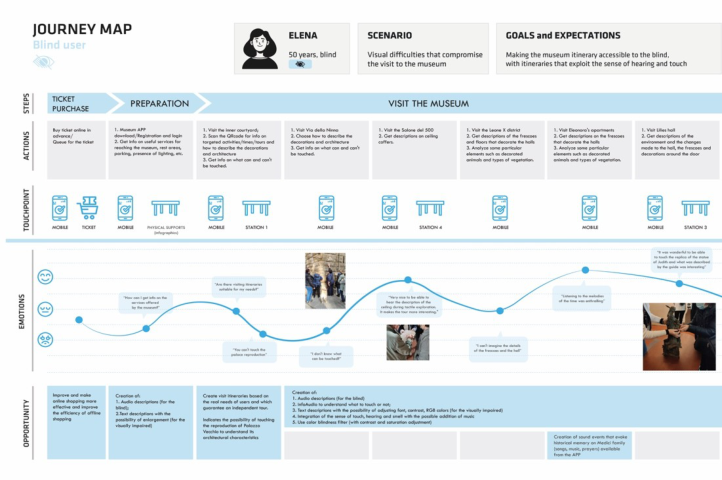
Phase 2: Preliminary Studies of User/Museum Interaction Models The study of user profiles allowed to conduct early analysis of User-Museum interaction models through the following activities and methodologies: (1) literature review and identification of the requirements of mobile media and multi-sensory stations (graphic presentation methods of the works, supports used and construction techniques, technologies) (Chick, 2019; Mäkelä, 2020; Vaz et al., 2020); (2) development of User Journey Maps (Hanington and Martin, 2019) that would visually allow the narration of users’ actions, feelings, perceptions within museums (see Figure 2); (3) construction of sce- narios that represent the current ways of using the works; (4) analysis of the state of the art and of the sector literature for the definition of the technical characteristics of the video guide (method of presenting the contents, narra- tive styles, limits and opportunities of current technologies, etc.) (Moncrief et al., 2022; Musiolik, 2022; Ahmetovic et al., 2021; Hutchinson and Eard- ley, 2021). In particular, the User Journey Maps and the usage scenarios relating to the use of the application and stations by the reference user target, in addition to providing a holistic view of the user experience, have made it possible to reveal critical issues and new opportunities to improve the user’s experience.
Phase 3: Development of Design Solutions and Intervention Scenarios.
The last phase of the research allowed, based on the critical issues that emer- ged in the previous phases of analysis, the formulation and development of new design solutions through (1) the use of Design orienting scenarios (Man- zini and Jégou, 2004) for the development of visions and innovative proposals centered on user needs. This tool made it possible to represent the strategic vision of the research team and favoured (2) brainstorming sessions (Nun- nally and Farkas, 2016) with the individual associations to verify and record the results of the previous research phases. Within these sessions, the features
Enhancing Inclusive Experience in Museums 135
Figure 2: User journey map relating to the museum experience (Palazzo Vecchio) of blind users.
and requirements of the beta version of the Application were presented (video guide), and the first versions of multi-sensory stations were submitted.
RESULTS
Given the complexity and breadth of the research content, only some of the most significant findings from the study have been reported in this paper. Therefore, the results of the main phases described in the previous paragraph are reported here.
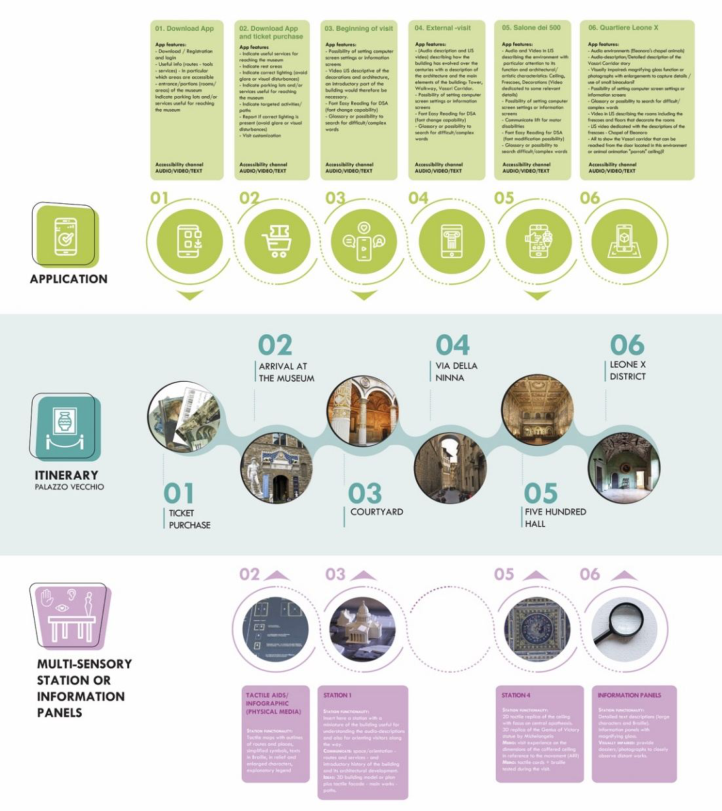
Critical Issues and Design Ideas [Phase 1] In the phase of collecting and systematizing the feedback and collected data [Phase 1], it was possible to identify and define the stages of the video/audio guide and the multi-sensory stations for the three partner museums of the research project. Specifically, maps have been drawn up showing the itine- raries for visiting the museums, with the activities to be carried out within each area envisaged for a visit. At the same time, the user experience with the application and with the multi-sensory stations and information pan- els along the route is described. (see Figure 3). As far as the application is concerned, the map aims to clearly show both the specific accessibility fea- tures that can be used in the vicinity of a specific work or one of the stages of the visit and the interaction between the user and the graphical interface and the flow of activity it can perform. Similarly, as regards the information panels and multi-sensory stations, the map indicates the interaction meth- ods envisaged for users and the possible actions for a visit that is not only accessible but inclusive. Furthermore, in this research phase, it was possible
Figure 3: Summary map of the main stages of the video/audio guide and of the multi- sensory stations for the Palazzo Vecchio museum.
to find helpful information for understanding how the current museum envi- ronments interface with diversified users (visually impaired, blind, hearing impaired, deaf, motor disabled), critical issues relating to physical and sen- sory accessibility, and possible design ideas that can make the museum system genuinely inclusive.
In particular, the following is a summary of some considerations that emerged during the observations, correlated by some ideas and design requirements: ENS - needs, problems and design ideas:
Inability to hear alarms - essential for ENS.
Videos in LIS (Italian Sign Language) and international sign language, with short and simple sentences. Subtitles in Italian and English, taking
Enhancing Inclusive Experience in Museums 137
into account that the deaf does not know Italian well; therefore the need to structure the texts and their format in an adequate way (in particu- lar, avoid sentences that are too long and terms that are too complex) is highlighted.
Videos with subtitles and sign language interpreters are essential for the use of deaf people. Therefore, the collaboration of associations and pro- fessionals in the sector is essential for developing the video guide. It is also necessary to study the most suitable editing methods, particularly the graphic and multimedia structure of the sign language videos and using a green screen.
The association and the interviewees highlighted the need to structure the videos in sign language, focusing on the following aspects: short videos (maximum 2 minutes) and simple theses (otherwise, it risks becoming heavy for users who get distracted and no longer follow the explanations).
The visual and textual supports near the works must consider the structure and complexity of the texts and, above all, the correlation between works and texts. These aspects are fundamental to include everyone regardless of the knowledge of sign language and the language skills of each individual.
The association suggests using, where possible, QRcode systems that offer further explanations. For example, through the QR codes, one (or more) videos in sign language could be activated (Barbosa et al., 2021). These videos would give users more information on the elements of the exhibition than the captions, which are already present in museums.
UICI - needs, problems and design ideas:
[Blind] Need to have an audio guide with “nice” but not excessively long (short and concise) audio descriptions; “preliminary” audio that briefly describes and introduces the museum, its history and the spaces available.
[Blind] Tactile stations with reproductions of the main works and possibly of the museum building to better understand the spaces.
Auditory and olfactory stimuli are much appreciated.
[Blind] The tactile experience allows you to know aspects that have never been explored (for example, the specific morphology of some ani- mals, “tactile experience - Loggia del Verrocchio”). Therefore, you must also pay attention to similar experiences and knowledge of the world of classical art (a practical aspect for structuring the audio descriptions).
[The visually impaired and colour-blind] Use a colour-blind filter (or similar systems) for visual enjoyment based on contrast and saturation adjustment.
[The visually impaired and colour-blind] Take care of graphic and visual aspects, oriented towards customizing screens (for example adjusting font sizes, image contrast, adjusting RGB channels).
Physically disabled - needs, problems and design ideas:
Need to easily find information on parking for the disabled and routes with public transport to reach the museums independently (optimize the wayfinding system with maps/routes to avoid critical itineraries).
Indications visible and placed at a suitable height, especially near the main entrance (for example: as in the case of museums where the “main” entrance is not accessible).
Indications on the location of toilets and essential services (such as lifts) and on how to reach them.
Insertion of videos or photo sequences of the rooms not accessible for people with motor disabilities to show at least part of what is contained inside (for example QR-Code to be scanned with the app).
Insert all the previous indications in the app (in particular, the rooms not accessible for people with motor disabilities), adding feedback that can allow the user to request assistance from museum staff and warn the lat- ter about the presence of the disabled person inside of the museum (to optimize any preparation of ramps or similar solutions).
Need for accessible tactile stations.
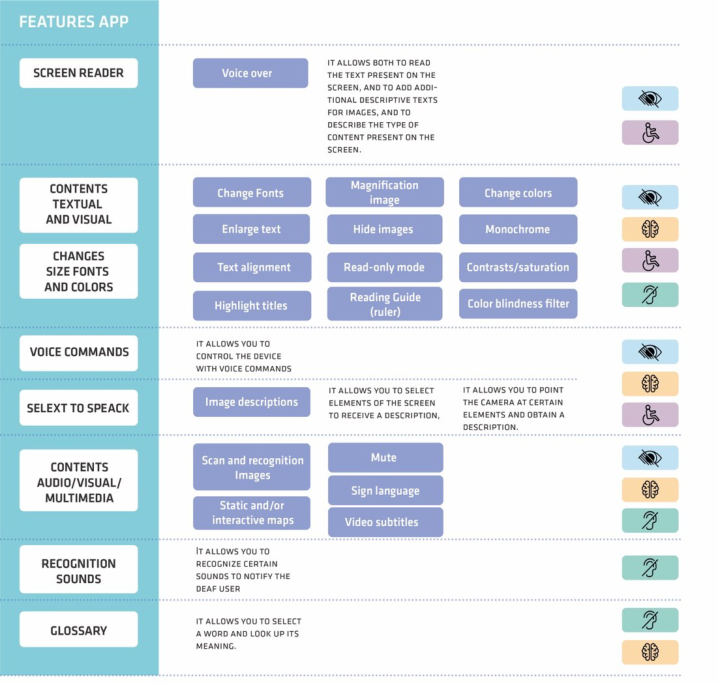
Features and Prerequisites App [Phase 2] Starting from systematic research on the state of the art of the main applica- tions in the museum and cultural fields, phase 2 envisaged a specific focus on museum applications that include features dedicated to motor, visual, hea- ring, and cognitive disabilities and applications designed according to the Inclusive Design approach (Gilbert, 2019; Waller et al. 2015, Kim et al. 2016). Given the number of applications on the market, depending on the spe- cific topic of this research, it was necessary to select only the most effective museum applications in terms of inclusion and accessibility. Therefore, the research results relating to the selected applications were analysed and rew- orked in a summary table (see Figure 4), which shows the functions and accessibility needs the application must satisfy to be considered inclusive.
In particular, mapping the user experience has allowed the detailed defi- nition of all the itineraries envisaged for visiting the three museums and the related functions of the application. For each area of the museum, the following have been identified:
front-end features, therefore relating to the user experience and the usa- bility of the application, or rather its interaction with the application’s User Interface, with a focus on accessibility and inclusion for the four macros-categories of disabilities identified;
back-end features, i.e., relating to development and programming to guarantee the optimal execution of the identified functions.
The features foreseen for the development of the application and the front- end and back-end requirements are briefly described in Table 1.
Features and Prerequisites of Multi-Sensory Stations [Phase 2] Concerning what emerged from phase 2 of the research, it was possible to analyse the best methods of graphic presentation of the works, and the supports used, the construction techniques and the technologies dee- med more inclusive. Therefore, multi-sensory stations characterised by 3D
Enhancing Inclusive Experience in Museums 139
Figure 4: Accessibility features identified as necessary for the development of an inclusive museum application.
and 2D models and technological systems have been hypothesised to sup- port the tactile, visual, and sensorial dimensions. The first design hypotheses of the stations were defined in collaboration with the bodies involved based on the individual routes and the relative stages. The essential requirement of tactile stations is to satisfy the three ≪senses of touch≫and the act of tactile perception itself. These “senses” can be summarised as follows: a) the abi- lity to follow a line, i.e., the sensory recognition capabilities of the fingertip; b) the haptic ability, i.e., knowing and recognizing the position of the hand in the space of the tactile device; c) the ability to recognise and differentiate the roughness of surfaces and therefore the texture. Multi-sensory supports must therefore be able to match the diversity of end users, from motor disabilities to sensory, cognitive and mental disabilities. Furthermore, the supports must embrace the philosophy of Design for All and enhance the use of the works and the related thematic contents of “historical-cultural heritage”. Therefore, the main focus concerned the development of tactile support solutions for blind (and visually impaired) people and integrated by technical and seman- tic (pedagogical) solutions capable of guaranteeing the interaction of people
Table 1. Main features foreseen for the development of the application and front-end and back-end requirements.
Table available in the original PDF paper.
Visual impairments Hearing disabilities
Physical disabilities
Cognitive disabilities
Front- end featu- res
(Visual channel) Descriptive video guide in sign language (LIS) Augmented reality (AR)
(Visual and audio channel) Indications on which areas are accessible - entrance/porti- ons (rooms/areas) of the museum Indicate parking spaces and/or services useful for reaching the museum
(Visual and audio channel) Dynamic font change, with the addition of Easy Rea- ding Font for Specific Lear- ning Disorders (SLD). Glossary or possibility to search for dif- ficult/complex words
(Audio channel) Audio descriptions Ability to change screen settings. For the visually impaired, low-resolution values (e.g. 800x600px make reading easier), possibility of choosing large fonts, points, contrast, etc. vary according to the level of view.
Back- end featu- res
Screen reader (Talk Back/ VoiceOver) Colour filtering for different types of colour blindness or an increase in contrasts. Enlargement of fonts and images for the visually impaired. Voice commands (Voice Access on Android, Voice Control on iOS)
video guide in sign language (LIS) with subtitles Since people born deaf do not understand written Italian like those without the disability, the Glossary feature on Android and iOS allows them to understand more complex words. Sound Recognition (only available on iOS).
Dynamic font change, with the addition of Easy Rea- ding Font for Specific Lear- ning Disorders (SLD). Glossary feature on Android and iOS Possibility of adapting the length of the contents presented, between a “complete” form and a “reduced” form.
QR-Code with video showing the inaccessible area. Map with parking spaces for people with motor disabilities, and routes to reach the museum in safety (including public transport available) Information on which areas of the museum are accessible, and which are not.
with the historical-cultural heritage” in a For All key. Therefore, it was pos- sible to identify the requirements, characteristics and techniques/instruments deemed necessary for developing multi-sensory stations (see Table 2).
Enhancing Inclusive Experience in Museums 141
Table 2. Requirements, objectives and technical features/instruments identified as necessary for developing multi-sensory stations.
Table available in the original PDF paper.
Requirements Goals Technical features “3d scanner” detection Digital return of tangible works “sculptures, monuments, frescoes, architectures”.
Post-production of 3d scans.
Laser specification: (1) laser scanner and/or (2) structured light scanner. In both cases (1 - 2) they are ≪non-invasive≫scanners, i.e. they do not provide for the application of optical references on the surface of the sculpture: in order to preserve the integrity of the object itself. The sensitivity of the device and the scanning precision must be around 0.3mm. Digitization and modelling of the works
Use of 3D modelling software (Zbrush, Rhino) for the calibration and fine-tuning of the detail “touch thresholds” in terms of volume dimensions. 3D printing UV printing or 3D and 2D relief printing, capable of producing artefacts made with materials suitable for museum contexts “in particular for frequent tactile use”.
Colour screen printing, laser printing
Characteristics of the materials: resistance and an aesthetic pleasantness to the final object made with materials such as Corian, Plexiglas, plastic resins such as PLA (or similar). Minimum precision threshold (“usable to the touch”) about 0.6mm. Laser cutting and finishing surface treatments Quality tactile support finishing Colour screen printing, laser printing, also made on 2D reliefs and infographics.
Painting or colour printing of tactile supports and scaled 3D reproductions.
Graphic post-production of the works and signage
Example: simplification of the composite system and/or chromatic restitution for the visually impaired of the constituent levels of a work “background - characters etc.”
2D (digital) graphic optimization of the informative and narrative details of the works and orientation systems Sensory fruition with augmented reality
Integration of technologies to multi-sensory stations
Basic lighting technology, connectivity, basic electronics, RFID and NFC, recorded audio descriptions integrated into the stations. Technical development of olfactory diffusers – to integrate the stations
Creation of olfactory devices and creation of customized essences in the laboratory.
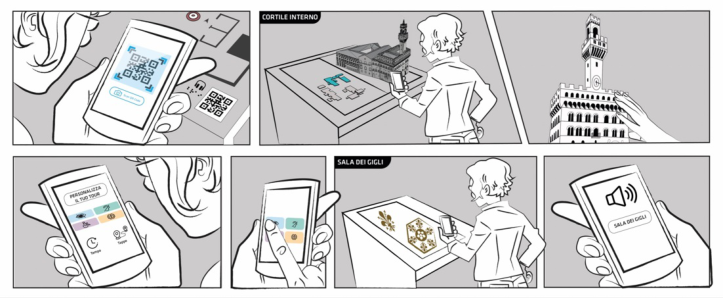
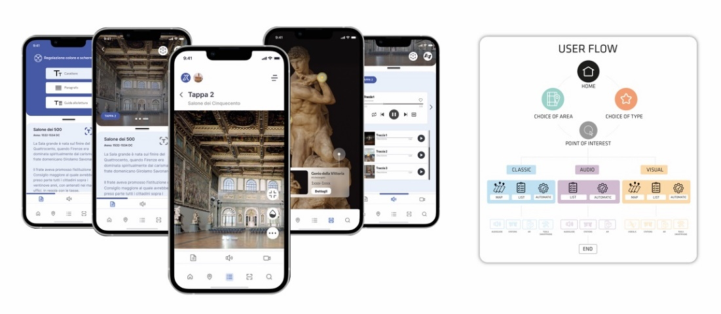
Realization of Analogue and Digital Study Prototypes [Phase 3] The last phase of this study involved the development of a preliminary UI developed with Adobe XD and FIGMA software based on the design requi- rements identified during the field research and analysis activities (described in phases 1-2). This version has considered aspects such as the primary display mode of content and choice of paths, layout and wireframe, and UI intera- ction styles for user categories. Based on possible technical limitations, such as connectivity inside historic buildings and the requirement for the replicabi- lity of the video guide, it was decided to develop an application without any embedded content but connected to a web server that contains all museum materials. Before starting the tour, the user must choose which museum to visit; the application will download all the required material onto the user’s smartphone to make it available locally. For these reasons, multi-sensory sta- tion number 1 within the XALL project will have an essential and strategic role in downloading the app (see Figure 5). Within future museum contexts - where there will be no multi-sensory stations - it will be enough to integrate an information QRcode with the information totems or tickets and guaran- tee a space equipped with a WIFI connection and encourage the download of the app during the online ticket purchase phase. Having defined the nature of the mobile application (web app connected to a web server that contains all the materials of the museum) and the technical functions of the app and its database, it was possible to start the development of the Beta version of the UI/web app, currently in the testing and experimentation phase (see Figure 6).
Figure 5: UX maps/UI scenario relating to the visit itinerary of the Palazzo Vecchio museum with a focus on the “task download” of the web app.
CONCLUSION
The results achieved and reported in this article have demonstrated the poten- tial and effectiveness of applying Human-Centered Design and Inclusive Design methodologies in allowing the evaluation and design of museum envi- ronments that consider human diversity and social inclusion. The analysis and definition of user-profiles and the evaluation of critical issues of existing products/systems have allowed the identification of possible design solutions
Enhancing Inclusive Experience in Museums 143
Figure 6: Development of the Beta version of the UI/web app.
and intervention scenarios, defining the requisites that a museum must have in order to make the cultural heritage accessible to visitors with all types of disabilities and improve the quality of the visit. Based on this experimenta- tion, the importance of validating design concepts is highlighted, both the digital ones (app) simulated in all their steps through Figma and the sensory ones, such as the tactile stations. Thanks to recent low-cost rapid prototy- ping techniques, validating and implementing solutions by involving experts and users before production will be possible. The following articles will pre- sent the results relating to the development and prototyping of the app (video guide) and the multi-sensory stations.
ACKNOWLEDGMENT
The authors would like to thank: the TIM Foundation, which financed the research; the polytechnic of Milan, Department of Electronics, Information and Bioengineering with professor Lanzi Pierluca and dr. Paolo Boffi subse- quently developed the computer system; the Association MUS.e Musei Civici Fiorentini, Florence, Italy (Palazzo Vecchio and Stefano Bardini Museum) and the Bargello National Museum, Florence, Italy; the associations: ENS (Italian Association of the Deaf), UICI (Italian Union of the Blind and Visu- ally Impaired) and HABILIA Onlus (Paratetraplegic and Motor Disabled Association).
Author Contributions: Conceptualization, A.B. and F.T; methodology, A.B., E.I; infographics and data curation, E.I and C.B; writing—original draft preparation, A.B, E.I; writing—review and editing, A.B, E.I and C.B. Supe- rvision, F.T. and A.B.; project administration, F.T.; funding acquisition, F.T. All authors have read and agreed to the published version of the manuscript.
REFERENCES
Ahmetovic, D., Bernareggi, C., Keller, K. and Mascetti, S., (2021). MusA: artwork accessibility through augmented reality for people with low vision. In Proceedings of the 18th International Web for All Conference (pp. 1–9).
Barbosa, P., Amorim, P., Ferreira, S. B. L. and Castro, A., (2021). Supporting Spontaneous Museum Visits by Deaf People: An Augmented Reality Application and a Case Study. In Augmented Reality in Tourism, Museums and Heritage: A New Technology to Inform and Entertain (pp.173–193). Cham: Springer International Publishing. Chick, A., (2019). Improving Intellectual Access for Blind and Partially Sighted
Visitors to Temporary Exhibitions: An Inclusive Design Solution. International Journal of the Inclusive Museum, 12(1). Dong, H., Clarkson, J., Coleman, R., and Cassim, J. (2012). Design forinclusivity: a practical guide to accessible, innovative anduser-centred design. Gower Publishing, Ltd. Gilbert, R. M. (2019). Inclusive design for a digital world: Designing with accessibi-
lity in mind. Apress. Hanington, B., and Martin, B. (2019). Universal methods of design expanded and revised: 125 Ways to research complex problems, develop innovative ideas, and design effective solutions. Rockport publishers. Hutchinson, R. and Eardley, A. F., (2021). Inclusive museum audio guides: ‘guided
looking’ through audio description enhances memorability of artworks for sighted audiences. Museum Management and Curatorship, 36(4), pp. 427–446. ISO 9241–210 (2019). Ergonomics of human-system interaction - Part 210: Human- centred design for interactive systems. Ginevra: International Standard Organization. Kim, W. J., Kim, I. K., Jeon, M. K. and Kim, J., (2016). UX Design guideline for health
mobile application to improve accessibility for the visually impaired. In 2016 International Conference on Platform Technology and Service (PlatCon)(pp. 1–5). IEEE. Mäkelä, A. (2020). Multi-sensory Experience Design in Museums. Manzini, E., and Jégou, F. (2004). “Design degli scenari”, in: Designmultiverso: appunti di fenomenologia del design. Milão: Edizioni POLI.design, 189–207. Moncrief, R., Choudhury, S., and Saenz, M. (2022, June). “Efforts to Improve
Avatar Technology for Sign Language Synthesis”, in: Proceedings of the 15th International Conference on PErvasive Technologies Related to Assistive Envi- ronments (pp.307–309). Musiolik, T. H., (2022). Multisensory Experiences in Digital Media. Neuro marketing in Business: Identifying Implicit Purchase Drivers and Leveraging them for Sales, pp. 1–13. Nunnally, B., and Farkas, D. (2016). UX research: Practical techniques for designing
better products. O’Reilly Media, Inc. Stanton, N. A., Young, M. S., and Harvey, C. (2014). Guide to Methodology in Ergonomics: Designing for Human Use. CRC Press. Vaz, R., Freitas, D. and Coelho, A., (2020). Blind and visually impaired visitors’ expe-
riences in museums: increasing accessibility through assistive technologies. The International Journal of the Inclusive Museum, 13(2), p. 57. Waller, S., Bradley, M., Hosking, I. and Clarkson, P. J., (2015). Making the case for inclusive design. Applied ergonomics, 46, pp. 297–303.
LISTED IN THE AHFE DIGITAL BOOKSTORE CATALOGUE
Explore the complete digital volume
Design for Inclusion
Read this individual research paper free through the original publisher, or explore the full digital proceedings book.
ISBN 978-1-958651-51-3
Explore this ISBN in the AHFE Bookstore ↗Listed in the July 2026 bookstore catalogue; search by ISBN to confirm current availability · Digital book purchase optional