Pedro Chara, Jorge Coque, Juan Briones, Katherine Flores, Rosanna Rivera (2023). Smart furniture for CO2 reduction in public spaces in the center of Guayaquil, Ecuador. Case study: 9 de Octubre Avenue. In: Design for Inclusion. AHFE Open Access, vol. 75, pp. 145–155. https://doi.org/10.54941/ahfe1003335
As a problem experienced worldwide, carbon dioxide (CO2) emissions into the environment are increasingly eminent, affecting ecosystems, leaving them unprotected from the ozone layer that makes public spaces in tropical and coastal areas uninhabitable. Guayaquil, as a city located in the coastal region corresponding to the warm coastal zone, has been affected by these CO2 emissions, which is why the development of materials based on CO2 emissions is proposed in this research section. A quantitative methodology is applied when evaluating Smart accessories within the furniture and a qualitative one for the study of the site and the decision making through the AHP-TOPSIS method that generates criteria and variables in the choice of material, obtaining a polyurethane hybrid in panels with wood. assembled. As a conclusion, there are 8 Smart furniture approaches which display energy saving functions, reduction of CO2 emissions and increase of green area in public spaces. Among the future lines of research, it is proposed that the proposal generate an increase in the urban green index through the use of Smart furniture in unprotected areas and with a deficit of green areas in the city of Guayaquil.
CO2 emissions with the milestone of the Industrial Revolution over time have been increasing due to the excessive activities of production and waste generated, which has prevented the natural cycles of the Earth from obtaining their time of recovery, so that in the last decades climate changes have been seen in disorders of meteorological stations and climatic phenomena that are mainly due to the concentration of CO2 (Suárez, R. Fragoso, 2016) in the atmosphere and the retention of solar rays, increasing the temperatures of the earth.
Carbon dioxide that appears in the atmosphere as a gas generates harmful effects on the environment, generating one of the main consequences, such as the greenhouse effect, which translates into unusual overheating due to how
this gas causes damage to the ozone layer (Rubio-Bellido et al., 2017), this consequence has been analyzed worldwide in search of remediation strate- gies that provide a better quality of life to outdoor spaces in tropical, warm, and coastal areas that are most affected by flooding and overheating effects. Current studies indicate that these greenhouse gases can be transformed into polyurethane raw materials, for which the study of this material as a possible solution is viable since it is a container of this CO2 that avoids the emissi- ons of these gases. Therefore, another of the concepts in vogue indicates that generating a use of the life cycle of materials from a focused study of circular economy will correspond to that viable solution with the environment.
The circular economy focused on measurement translates into the energy use of raw materials and its integration with the environment, for which these two concepts are taken for the development of furniture that contemplates a marked reduction of gas emissions and through the use of natural mate- rials such as wood can obtain increases in the urban green indices (Pelletier, 2019) of the study area to obtain an improvement in the quality of life. As a technological innovation, the implementation of intelligent functions that allow the use of energy prevails as a guideline for a focused circular economy with the use of strategies applied to smart furniture, which can be guided solar panels, curtain walls, green roofs and water collectors. systems that give sustainability to the natural and service components of the furniture.
MATERIALS AND METHODS
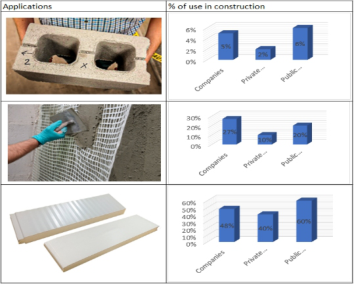
Materials From CO2 Capture According to previous investigations in the Ecuadorian Chamber of Constru- ction, there are 3 applications in the national environment of construction materials obtained from CO2 gas capture (Wilson, 2022). Having as a material immersed in each process of the structure of a building such as concrete, obtaining two applications in the form of solid mineralized car- bonate (CACO3) that is introduced in prestressed concrete and shotcrete (Gebremariam et al., 2020) as a substitute for the aggregate since it gene- rates small particles with a high degree of flexibility; On the other hand, the water in the concrete can be replaced with CO2 gas in the curing phase, obtai- ning a reduction in water consumption and providing properties of greater short-term resistance, compression and elasticity.
Another of the innovations in the field of construction is obtaining high- strength carbon fibers that exceed the mechanical characteristics of steel and concrete both in elasticity and resistance. This carbon fiber component is structured with mineralized and gaseous sources. of CO2 that in continuous fusion give way to obtaining C2CNT (Jung et al., 2021), being these nanotu- bes that can be used as rods in columns and beams or also meshes that can be applied to walls.
CO2 can also be catalyzed and transformed into plastic components, which can be recomposed and reused, which means that recycled plastics can be used and, through catalyzation (Zhu et al., 2022), obtain a greater amount of beneficial aggregate as construction raw material, since it generates better resistance and alloy with assembled materials, as a last property a material is
Smart Furniture for CO2 Reduction in Public Spaces 147
Figure 1: Use of CO2 composite materials in Ecuadorian Construction. Source: Ecua- dorian Chamber of Construction.
generated that captures CO2 and reduces its emissions into the atmosphere. It can be obtained in presentations such as polyurethane, various polymers and abrasive adhesives.
Focused Circular Economy The influencing factors in the circular economy are structured in relation to the life cycles or processes of an element, in the case of materials, their phase of production, use and decomposition, thus allowing the life cycles to be restarted until the decomposition affects the environment in the least percentage (Jabło´nski and Stempski, 2018) is an important point for the study since its cycle of employment or operation is extended. There are raw materials that affect the conditions of the environment in the decomposition phase, among these are batteries, plastic covers, and metals; materials that can decompose in terms of up to 1000 years and that are highly polluting with the soil (Lai et al., 2022).
These materials that are harmful to the environment in the decomposition phase and the CO gas emissions will be the focalizing components of the circular economy structure as they are the problematic aspects of the study.
Smart Furniture New Perspective in Public Spaces In cities called smart cities, the use of intelligent media such as communi- cation and information technologies have been introduced both in furniture and infrastructure, which contributes to the systematization of services and decongestion of the activities of populated centers that usually generate a defi- cit in the quality of life in centers with problems such as traffic congestion or insecurity. Currently, furniture with a smart characterization generates multi- services that contribute to the management and occupation of public space in an orderly manner and that contributes sustainability to the territory by being self-managed and using innovations in both materials and energy savings.
The center of Guayaquil, cataloged as one of the most congested popula- tion centers with vehicles, an urban green index of less than 2 square meters and with an insecurity index due to robberies and assaults that by the year
2022 has reached a historical peak of 48 % only below Guatemala (Hidalgo et al., 2021). What it entails visualizing public spaces from a new perspective that reduces these problems and improves the quality of life of its inhabitants.
AHP-TOPSIS Method The AHP method (Analytic Hierarchy Process) is a decision-making tool used to determine priorities among different criteria, subcriteria and alternatives organized using the TOPSIS technique of multivariable criteria (Naito and Tanaka, 2017). The Technique of Order of Preference by Similarity to the Ideal Solution (TOPSIS) is a multicriteria decision analysis method.
TOPSIS is based on the concept that the chosen alternative should have the shortest geometric distance from the best ideal solution and the longest from the worst ideal solution. Among the analyzes assigned to TOPSIS, 3 of these will be assigned to the study to demonstrate an idyllic choice in decision making: ELECTRE (i), family of multicriteria decision analysis that means elimi- nation and choice translating reality. It is composed of two main parts in an ELECTRE application: first, the construction of one or several overcoming relationships, which aims to comprehensively compare each pair of acti- ons; secondly, an exploitation procedure that develops the recommendations obtained in the first phase.
Usually, the ELECTRE Method is used to rule out some unacceptable alter- natives to the problem. After that, we can use another multi-criteria decision analysis (MCDA) to select the best one. The advantage of using the Ele- ctre Method is that we can apply another MCDA with a restricted set of alternatives, saving a lot of time.
The Weighted Sum Model (WSM), also called Weighted Linear Combina- tion (WLC) or Simple Additive Weighting or SAW (ii), is the best known and simplest Multiple Criteria Decision Analysis (MCDA) method for evaluating various alternatives in terms of decision criteria and the Linear Assign- ment Methodology (iii) determines numerical rankings of results (Bielinskas, Burinskiene and Podviezko, 2018), so both variables operate together.
As a verification method, the Realization of Matrix Consistency (i) will be applied, which uses a priority vector that shows the relative weights between the things that we compare and can be used in the AHP method (Xu et al., 2019). The matrices used in the Analytical Hierarchy Process (AHP) compile expert knowledge as pairwise comparisons between various criteria and alter- natives in decision-making problems. Usually, many items are considered in the same comparison process, so the judgment is not entirely consistent, and sometimes the level of consistency may be unacceptable.
An effective tool to deal with complex decision-making and with multi- ple variations around time and space as occurs on Avenida 9 de Octubre marked by its changes throughout its development. This tool can help the decision maker to establish priorities and make the best decision regar- ding comparisons. In general terms, the AHP model can be divided into
Smart Furniture for CO2 Reduction in Public Spaces 149
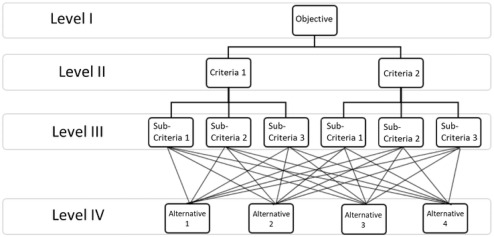
Figure 2: Analytical hierarchical structure.
three stages: decomposition, comparative judgments, and priority synthesis (Irreño Bermudez, 2018).
In the first place, the decomposition consists of structuring the problem at a hierarchical level, where the objective occupies the first level, the attribu- tes occupy intermediate levels, and the last level presents the alternatives to be judged. Fig. 2 illustrates a generic hierarchical structure with four levels, where the objective is related to alternatives through criteria and sub-criteria as linking dynamics that address the decision-making alternatives.
METHODOLOGY
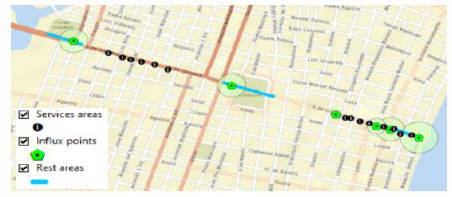
A qualitative/quantitative methodology is used, applying a comparative analysis of the existing furniture and its functionality through instruments such as the user survey and participant observation in tours on Avenida 9 de Octubre in Guayaquil. As a result of this previous comparison, the points with the greatest influx of people were mapped, as well as the rest areas and user service areas to obtain a furniture location diagram. These data were useful for the development of the needs chart for each of the mapped points to propose smart accessories in the new furniture to be designed.
As a second stage of the methodology, using the Decision Radar mathe- matical application, a decision-making scheme was developed for the choice of materials and multicriteria analysis to obtain the hierarchical analyti- cal spectrum. In accordance with these methodological analysis tools, the final proposal for the design of smart furniture was prepared with a self- assembly and coupling element to reduce waste and configure different types of modulations for easy assembly and disassembly.
RESULTS
Furniture: Comparative and Mapping The comparison of the study was carried out under parameters of functiona- lity, climatic comfort, and use, embodied in relation to the mapping of masses or points of influx that determined the spatial needs of the existing furniture.
The results of the survey carried out on a total of 300 users show that there are only 4 types of furniture such as ornamental metal benches, low
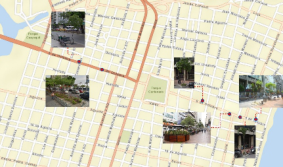
Figure 3: Analysis of existing furniture Ave. 9 de Octubre, Guayaquil.Figure 4: Mapping of public spaces by influx, rest and service areas Ave. 9 de Octubre, Guayaquil.
tree pits with plant species such as palm trees with poor shade coverage, privatized furniture in restaurants made up of low planters, chairs, tables, tents, and central parterres from Calle Pedro Moncayo to Carchi (see Fig. 3). On another aspect, the respondents state that they perceive that 22% of the furniture is functional, 10% generate climatic comfort due to the protection from the sun and only 45% of the users make use of the furniture since they feel that it is unsafe, there is dangerous people and others do not use them because they are in bad condition.
Avenue 9 de Octubre is structured in 6 points of high influx of people, denoted at the intersections with Av. Malecón by merchants and tourists; Pedro Moncayo-Quito by merchants and workers and Tungurahua by uni- versity students. It is seen that there is a convergence of the rest areas with the points already mentioned as a demand for the high number of users who pass through these areas (see Fig. 4). Regarding the services that are genera- ted in the eastern zone, they respond to municipal, institutional, business and banking services; around the west zone respond entirely to banking services and a smaller percentage to business services.
Smart Furniture A scheme is proposed in response to the situations displayed in public spaces highlighted in the areas of greatest influx, rest and service areas. Therefore, a table of smart accessories needs is developed for the furniture to be proposed. For its election, weightings of choice by utility determined by the surveys were considered, being: 3 (greater utility for the public space); 2 (intermediate utility for public space) and 1 (no utility in public space).
Smart Furniture for CO2 Reduction in Public Spaces 151
Table 1. Needs complement smart utilities in public spaces.
Table available in the original PDF paper.
Smart accessories Influx points
Rest areas
Services areas Bike station with secure system 1 2 3 Service availability applications 3 1 3 Eco bathrooms with solar panels 3 3 2 Rest stations with CO2 devices 3 3 3 Smart waste processing stations 3 3 3 Planters with recirculation system 3 3 1 Mobile service stations 1 3 1
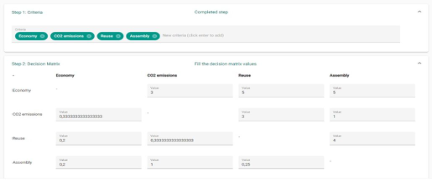
Figure 5: TOPSIS analysis - Decision Matrix.
Decision Radar With the use of the Decision Radar mathematical application, the AHP- TOPSIS calculations can be affected by designating objective options (first level objectives), evaluation criteria or subcriteria to obtain relevant alterna- tives of results to obtain a clear decision-making process. decisions around the established problems. For the hierarchical analytical process, 3 types of order analysis and a multicriteria verification system based on TOPSIS preferences were considered.
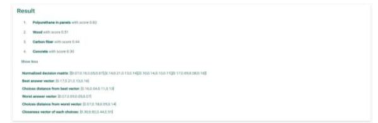
For the initial analysis of TOPSIS, concrete, polyurethane panels, carbon fiber and a last added element, wood, were considered as objective options tested in criteria of economy, CO2 emissions, reuse and assembly as multi- criteria components of analysis designating weights for its weighting of the decision matrix obtaining polyurethane in panels and wood as the selected materials (see Fig. 5). The full spectrum of results demonstrates that the best response vector maintains an acceptable alternative distance.
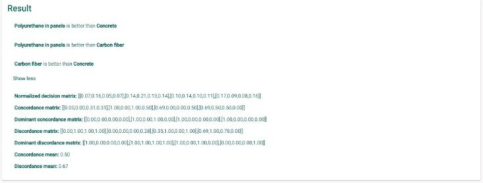
In the construction of overcoming relationships, it can be noted that polyu- rethane in panels has a better application than concrete and carbon fiber, but nevertheless the selection of wood is taken as an irrelevant solution because it is not the best scored, but which is considered discrete as a second option (see Fig. 6). The total spectrum of results demonstrates a mean disagreement of 0.67, which challenges an acceptable concordance matrix.
TOPSIS is based on the concept that the chosen alternative should have the shortest geometric distance from the best ideal solution and the longest from the worst ideal solution. Among the analyzes assigned to TOPSIS, 3 of these will be assigned to the study to demonstrate an idyllic choice in decision making:
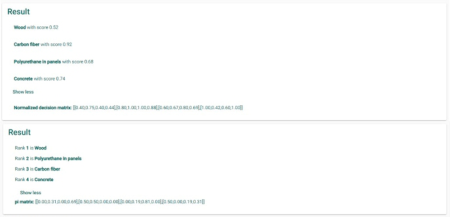
ELECTRE (i), family of multicriteria decision analysis that means elimina- tion and choice translating reality The simple additive weighting (SAW) and the linear prevention method gave as a result that the best alternative is wood and subsequent non- polyurethane in panels that yields the lowest normalized value of total yield (see Fig. 7).
The priority vector of criteria shows that the economic factor and CO2 emissions are important when choosing the material, while reuse and assem- bly are correlated with each other, so the comparison matrix judgment is not consistent among all the criteria.
Proposal After the qualitative and quantitative analysis of materials and criteria, design proposals can be obtained with the use of materials such as polyureth- ane in panels and wood, thus complying with the decision-making method, obtaining furniture for rest and services. mobile and static:
Smart Furniture for CO2 Reduction in Public Spaces 153
Figure 9: Proposed furniture.
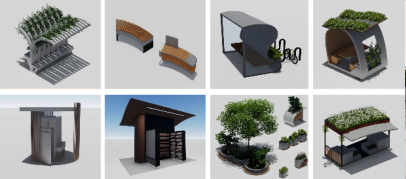
8 types of furniture structured entirely with polyurethane in panels and wood are proposed (see Fig. 9), which have adopted assembly methods as part of the selection criteria using the tenon and box assembly and Jupi- ter’s ray for simple unions (wood to wood) and composite joints (wood to polyurethane).
DISCUSSION AND CONCLUSION The smart accessories used comply with the order of selection that contribute to the reduction of CO2 emissions through capture elements (use of mate- rials) and energy use systems such as water recirculation in planters, solar panels on mobile furniture covers that contribute to improve the quality of the environment, according to the proposal it is stipulated that it will increase by 60% the amount of current green areas that is below 2 square meters per inhabitant.
The composition elements of the furniture such as polyurethane and wood generate a level of contamination well below traditional materials such as concrete, demonstrating that there are varieties of materials that are curren- tly used in Ecuadorian construction, but that are not applied. The adoption of plastic materials generates higher costs than the assembled wooden mate- rials, so a benefit is generated compared to the square meter of concrete construction ($120-$250 for the design for outdoor spaces) of 48%, leading to savings and less quantity. of waste.
As a decision-making method, the AHP and TOPSIS analysis formed the multi-criteria construction for the proposal, proposing decisive decisions such as the choice of polyurethane material with 0.82, an element that meets two basic criteria: economy and CO2 capture due to its composition. egalitarian, on the other hand, in the search for reuse and assembly, the wood with a score of 0.51 contemplates a correlation with the two initial criteria with the greatest weight (economy and CO2 capture).
In conclusion, it was possible to verify by performing matrix consistency that the criteria are not consistent compared to each other, but that their wei- ght for the study are correlational, therefore influencing two pairs of criteria generate a joint solution of materials such as polyurethane in panels. and assembled wood.
With the proposal it is intended that users improve the use of furniture, be perceived functional and generate greater comfort trying to reverse reality below 25% acceptance.
Acknowledgment
A special thanks to the group of researchers that make up this team, where it has been possible to obtain a concise, coherent investigation and with a level of experimentation through decision-making, qualitative analysis of the place and quantitative Smart accessories that contributed effectively to the develo- pment of the proposal. Thanks to the Faculty of Architecture and Urbanism for its management, employment of student and teaching team in its facilities, to achieve such valuable results.
REFERENCES
Bielinskas, V., Burinskiene, M. and Podviezko, A. (2018) ‘Choice of abandoned territories conversion scenario according to MCDA methods’, Journal of Civil Engineering and Management, 24(1), pp. 79–92. Available at: https://doi.org/10. 3846/jcem.2018.303. Gebremariam, A. T. et al. (2020) ‘Innovative technologies for recycling End-of-Life
concrete waste in the built environment’, Resources, Conservation and Recycling, 163. Available at: https://doi.org/10.1016/J. RESCONREC.2020.104911. Hidalgo, D. et al. (2021) ‘Violência urbana e políticas de segurança: Análise em quatro cidades latino-americanas’, Eure, 47(141), pp. 165–182. Available at: http s://doi.org/10.7764/EURE.47.141.08. Irreño Bermudez, C. A. (2018) ‘APLICACION PRACTICA DEL PROCESO DE
ANALISIS JERARQUICO (AHP), PARA LA TOMA DE DECISIONES’, Revista de Ingeniería, Matemáticas y Ciencias de la Información, 5(9). Jabło´nski, K. and Stempski, W. (2018) ‘An attempt to assess the monetary value of carbon absorbed in the Polish forest sector’, Folia Forestalia Polonica, Series A, 60(1), pp. 3–10. Available at: https://doi.org/10.2478/FFP-2018-0001. Jung, M. et al. (2021) ‘Flexible carbon sieve based on nanoporous carbon cloth
for efficient CO2/CH4 separation’, Surfaces and Interfaces, 23. Available at: https://doi.org/10.1016/J. SURFIN.2021.100960. Lai, W. L. et al. (2022) ‘Roadmap to sustainable plastic waste management: a focused study on recycling PET for triboelectric nanogenerator production in Singapore and India’, Environmental Science and Pollution Research, 29(34), pp. 51234–51268. Available at: https://doi.org/10.1007/S11356-022-20854-2. Naito, K. and Tanaka, K. (2017) ‘Proposal of a bus location system based on par-
ticipatory sensing with BLE devices and smartphones’, in WMSCI 2017 - 21st World Multi-Conference on Systemics, Cybernetics and Informatics, Proceedings. International Institute of Informatics and Systemics, IIIS, pp. 105–110. Pelletier, M. R. (2019) ‘Green infrastructure for blue urban watersheds’, in Green Community. Taylor and Francis, pp. 96–103. Available at: https://doi.org/10. 4324/9781351179690-15. Rubio-Bellido, C. et al. (2017) ‘Application of adaptive comfort behaviors in Chi-
lean social housing standards under the influence of climate change’, Building Simulation, 10(6), pp. 933–947. Available at: https://doi.org/10.1007/s12273- 017-0385-9. Suárez, R. Fragoso, J. (2016) Estrategias pasivas de optimización energética de la vivienda social en clima mediterráneo. Available at: https://doi.org/10.3989/ic.15. 050. Wilson, S. M. W. (2022) ‘The Potential of Direct Air Capture using Adsorbents in Cold Climates’, iScience, p. 105564. Available at: https://doi.org/10.1016/J. ISCI.2022.105564.
Smart Furniture for CO2 Reduction in Public Spaces 155
Xu, C. et al. (2019) ‘Benefits of coupled green and grey infrastructure systems: Evidence based on analytic hierarchy process and life cycle costing’, Resources, Conservation and Recycling, 151. Available at: https://doi.org/10.1016/j.resconre c.2019.104478. Zhu, Y. et al. (2022) ‘Membranes constructed with zero-dimension carbon quan-
tum dots for CO2 separation’, Journal of Membrane Science, 664. Available at: https://doi.org/10.1016/J. MEMSCI.2022.121086.
LISTED IN THE AHFE DIGITAL BOOKSTORE CATALOGUE
Explore the complete digital volume
Design for Inclusion
Read this individual research paper free through the original publisher, or explore the full digital proceedings book.
ISBN 978-1-958651-51-3
Explore this ISBN in the AHFE Bookstore ↗Listed in the July 2026 bookstore catalogue; search by ISBN to confirm current availability · Digital book purchase optional