Alessia Brischetto, Ester Iacono, Claudia Becchimanzi (2023). Digital technologies in museums: Critical issues and opportunities for equal access to cultural heritage. In: Usability and User Experience. AHFE Open Access, vol. 110, pp. 32–41. https://doi.org/10.54941/ahfe1003175
The museum experience is characterized by interaction with many different artifacts, including tablets and smartphones, which support the visit by providing access to purpose-built audio guides, site-specific apps designed for the particular museum to visit, etc. They may integrate Augmented Reality (AR) or Virtual Reality (VR) to enrich the visit or otherwise provide for different levels of interaction with the aim of engaging (engagement) people. In terms of inclusivity, major operating systems include built-in Assistive Technologies by default, which are becoming increasingly advanced. In fact, Assistive Technologies now feature most smartphones and have also become pervasive due to the optimization of Vocal User Interfaces and Artificial Intelligence. In particular, in terms of pervasiveness, features such as IOS's "Accessibility settings" (Android also offers similar functionality) in recent years enhanced the modality of access and enjoyment of technology and actually enable millions of people to communicate and practice their right to autonomy as never before (these kinds of features required the installation of accessory plug-ins or the purchase of external peripherals until a few years ago). Audio-guides, although a popular tool, still make knowledge inaccessible to the deaf public. In fact, audio-guides, unlike video-guides, allow visitors only access to audio and exclude other forms of communication support such as text, graphics, route maps, and/or video. To overcome this issue and guarantee access to the widest possible number of people, many museums are adopting customized solutions for the specific category of disability. For example, they use LIS audio guide and video guide on their own tablet devices or provide for their integration within museum apps. This research aims to contribute to inclusive access to culture for all people in museums. This goal is being achieved through the analysis of critical issues and the identification of implementation opportunities for the artifacts with which visitors interact and through which the very experience of visiting is shaped.This paper presents a state-of-the-art study of the main artifacts that are part of the museum visit, with a focus on accessibility. The study includes museum Apps at international level, web accessibility plugins, and the different standard accessibility features offered by the main operating systems (iOS and Android). The results of the research show a lack of tools that provide museum accessibility in terms of full inclusion, i.e., taking into account several disabilities at the same time, including long-term physical, mental, cognitive or sensory impairments, which are often unseen. In fact, apps and artifacts for museum tours have a tendency to divide functions according to disability category (focusing, for example, only on the deaf or only on the blind), thus accentuating the stigmatizing and divisive effect. Moreover, the research highlights that only a few virtuous examples, among those selected, succeed in offering a museum experience according to an inclusive approach, despite the integration of technologies and the support of applications and websites.Lastly, the purpose of this paper is to stimulate a reflection on the topic of accessibility in terms of both technology and design, in order to go beyond mere conformity to standards rather to integrate it with the many qualitative and quantitative tools offered by research in design, so as to disseminate devices and artifacts that make culture fully accessible in the museum setting
The museum experience is characterized by interaction with many different artifacts, including tablets and smartphones, which support the visit by pro- viding access to purpose-built audio guides, site-specific apps designed for the particular museum to visit, etc. They may integrate Augmented Reality (AR) or Virtual Reality (VR) to enrich the visit or otherwise provide for different levels of interaction with the aim of engaging people.
In terms of inclusivity, major operating systems include built-in Assistive Technologies by default, which are becoming increasingly advanced. In fact, Assistive Technologies now feature most smartphones and have also become pervasive due to the optimization of Vocal User Interfaces and Artificial Intelligence. In particular, in terms of pervasiveness, features such as IOS’s “Accessibility settings” (Android also offers similar functionality) in recent years enhanced the modality of access and enjoyment of technology and actually enable millions of people to communicate and practice their right to autonomy as never before (these kinds of features required the installation of accessory plug-ins or the purchase of external peripherals until a few years ago).
Digital Technologies in Museums: Critical Issues and Opportunities 33
Audio-guides, although a popular tool, still make knowledge inaccessible to the deaf public. In fact, audio-guides, unlike video-guides, allow visitors only access to audio and exclude other forms of communication support such as text, graphics, route maps, and/or video. To overcome this issue and guarantee access to the widest possible number of people, many museums are adopting customized solutions for the specific category of disability. For example, they use International Sign (IS) audio guide and video guide on their own tablet devices or provide for their integration within museum apps. This research aims to contribute to inclusive access to culture for all peo- ple in museums. This goal is being achieved through the analysis of critical issues and the identification of implementation opportunities for the artifacts with which visitors interact and through which the very experience of visiting is shaped.
This work presents a state-of-the-art study of the main artifacts that are part of the museum visit, with a focus on accessibility. The study includes museum Apps at international level, web accessibility plugins, and the dif- ferent standard accessibility features offered by the main operating systems (iOS and Android). The results of the research show a lack of tools that pro- vide museum accessibility in terms of full inclusion, i.e., taking into account several disabilities at the same time, including long-term physical, mental, cognitive or sensory impairments, which are often unseen. In fact, apps and artifacts for museum tours have a tendency to divide functions according to disability category (focusing, for example, only on the deaf or only on the blind), thus accentuating the stigmatizing and divisive effect. Moreover, the research highlights that only a few virtuous examples, among those selected, succeed in offering a museum experience according to an inclusive approach, despite the integration of technologies and the support of applications and websites.
Lastly, the purpose of the work is to stimulate a reflection on the topic of accessibility in terms of both technology and design, in order to go beyond mere conformity to standards rather to integrate it with the many qualitative and quantitative tools offered by research in design, so as to disseminate devices and artifacts that make culture fully accessible in the museum setting.
WEB ACCESSIBILITY GUIDELINES: A REVIEW The preliminary phase of the research on accessibility of artifacts for museum visitation included a literature review on standards and guidelines for web accessibility (see Table 1). The objective of the review is to collect and select the main standards for web accessibility applied in museum and cultural heri- tage enjoyment. The literature review was conducted between January and July 2022. In the first stage, different types of publications such as conference proceedings, scientific journal articles, extended abstracts, and journals rela- ted to accessibility and its applications were systematically searched (Zaina et al. 2022; Ballantyne et al. 2018; Calvo et al. 2016; Jones et al. 2016; Díaz- Bossini et al. 2014; Caldwell et al. 2008). Consultation of previous reviews was helpful in identifying the most important references and their correlati- ons; therefore, references from previous reviews were also analyzed, selected, and added to potentially eligible studies.
Table 1. The main standards and guidelines related accessibility for websites and applications.
Table available in the original PDF paper.
Main features
Web Accessibility Standard and guidelines Web Content Accessibility Guidelines (WCAG) 2.1
It is based on EN 301549:2018 but greatly simplifies it. It only deals with accessibility and does not have an inclusive approach.
They identify four principles that serve as pillars of Web accessibility: perceivable, usable, understandable, and robust. In order to meet the needs of different groups and situations, three levels of conformity are defined: A (minimum), AA and AAA (maximum). It should be noted that even content conforming to the highest level (AAA) will not be accessible to all individuals suffering from any type, degree, or combination of disability, particularly in the areas of cognitive language and learning. AgID (2020). Guidelines on the Accessibility of IT tools. Italian Presidency of the Council of Ministers (Valtolina, S. and Fratus, D., 2022).
Designers Italia (2021). Design guidelines for services Public Administration web. (Agid 2021)
They propose a Human-Centered approach for app and web development, deal with accessibility: the goal is to make services accessible to all users, according to a principle of inclusiveness. However, the guidelines are not designed according to a for all approach. Legislative Decree No. 106 of August 10, 2018. (D.L. 106/2018)
Art. 1 makes a number of clarifications related to the issue of disability and accessibility. It considers “accessible” apps and websites with the following requirements: accessibility of service content by the user, usability of information (ease of use, efficiency, effectiveness and satisfaction). Harmonised European Standard EN 301 549 V 3.2.1 (2021-03), Accessibility requirements for ICT products and services. (European Telecommunications Standards Institute, 2021)
The purpose is to enable people to locate, identify, and use ICT regardless of their physical, sensory, or cognitive abilities. It mainly takes into account visual impairments, but Annex D of the standard indicates additional resources related to improving accessibility for users with limited cognitive, language, and learning abilities. Approach related to accessibility and not so much to inclusion. Convention on the Rights of Persons with Disabilities. United Nations, Department of Economic and Social Affairs - Disability. (United Nations, 2006)
The Convention points the way for the states of the world to ensure the rights of equality and social inclusion of all citizens with disabilities. It talks about accessibility; the approach is to make society accessible to people with disabilities but a for all and inclusive approach is not strongly present. European Accessibility Act. (European Parliament, 2019)
The Accessibility Act, by establishing accessibility principles for products and services (including web-based apps) aims to dismantle barriers between member states due to different national accessibility requirements that are emerging. The approach is one of reducing barriers but not for all.
Continued
Digital Technologies in Museums: Critical Issues and Opportunities 35
Table 1. Continued
Table available in the original PDF paper.
Main features Web Accessibility Standard and guidelines
Strategy on the rights of persons with disabilities 2021-2030. (European Commission, 2021)
There are seven principles, and they include all the guidelines for universal design.
The goal of the new strategy is to make progress to ensure that all people with disabilities in Europe, regardless of their gender, racial or ethnic origin, religion or belief, age or sexual orientation, can: enjoy their human rights; have equal opportunities and equal access to society and the economy; be able to decide where, how and with whom they live; move freely in the EU regardless of their care needs; and no longer be victims of discrimination. This new enhanced strategy considers diverse disabilities, including long-term physical, mental, intellectual or sensory impairments, which are often invisible. Principles of Universal Design for websites (Zheng, 2022)
The search was mainly performed on online databases such as IEEE digital library (Xplore), ACM digital library, ProQuest, JSTOR, Science Direct, Web of Science, Google Scholar. No publication date restrictions were applied. Databases were selected primarily for their indexing of international publications and accessibility by the University of Florence.
The keywords searched, in order to reduce the likelihood of excluding rele- vant publications, were mainly related to users (e.g., people who are blind, deaf, etc.), objectives (e.g., museum visit), and general topic (web accessibi- lity). The asterisk character (*) used below indicates a prefix (e.g. access* becomes “accessibility,” “accessible,” etc.). A number of search strings rela- ted to standards and best practices for accessibility of web interfaces and services and mobile applications for cultural heritage were selected, so the search included the following types of keywords, including mainly the terms “access∗”, “app∗web∗”, “digital∗interfac∗”, “museum*”, and “cultural heritage”. In addition, to avoid excluding related studies, the names of speci- fic museums or case studies were also used. Regarding the inclusion/exclusion criteria, publications in English and Italian were considered. The other inclu- sion criteria relate to affinity with the goals and themes of the review, such as web accessibility but especially of mobile applications, areas of focus, i.e., museums, and interaction of any kind.
From the data collected and systematized during this review, a series of summary sheets were produced for each identified standard. Subsequently, the standards selected as most relevant were subjected to further analysis and systematization and were organized for reference in Table 1.
The review was also useful as a function of subsequent research on museum app accessibility features and the state of the art of audio/video guides.
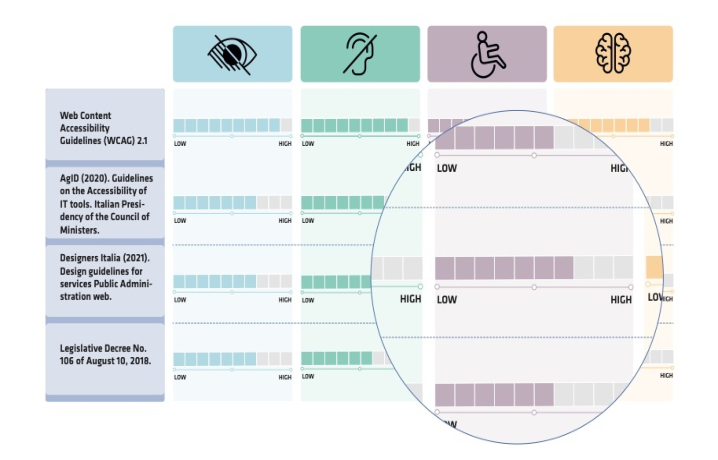
Furthermore, the research results were analyzed and reworked into a summary scheme, which is useful to visualize the effectiveness and level of satisfaction of people’s accessibility needs (see Figure 1). Figure 1 shows the methodological approach applied, whereby each app and web standard
Figure 1: Inclusion level of accessibility standards and guidelines. Methodological approach.
and/or guideline is related to the macro-category of disability for which it provides instructions, guidelines, or regulations to be followed to ensure accessibility.
The picture clearly shows, with few exceptions, the impossibility of achi- eving total inclusion of all types of disabilities as the tendency to meet only specific types of needs persists, even at the regulatory level. However, impor- tant efforts to apply the inclusive approach to the design of applications and websites are also present.
AUDIO/VIDEO GUIDES FOR CULTURAL HERITAGE From the literature review about web accessibility standards, it was possi- ble to structure a systematic research on the state of the art of the main applications in the museum and cultural field internationally. This phase of the research included the analysis of applications supported by IOS and Android mobile devices (Mobile App - especially those downloadable on per- sonal smartphones) and web applications (web App). The choice to analyze audio guides supported by personal and mobile devices such as smartphones is related to the following objectives: (1) to encourage the diffusion of free applications in museum accessibility projects, in order to facilitate and make sustainable the adoption of inclusive supports by Museums, in terms of eco- nomics and human resources; (2) to provide an integrated framework and a set of open source tools for the development of applications in the same field.
This research included a specific focus on museum applications that include features dedicated to motor, visual, hearing, and cognitive disabilities
Digital Technologies in Museums: Critical Issues and Opportunities 37
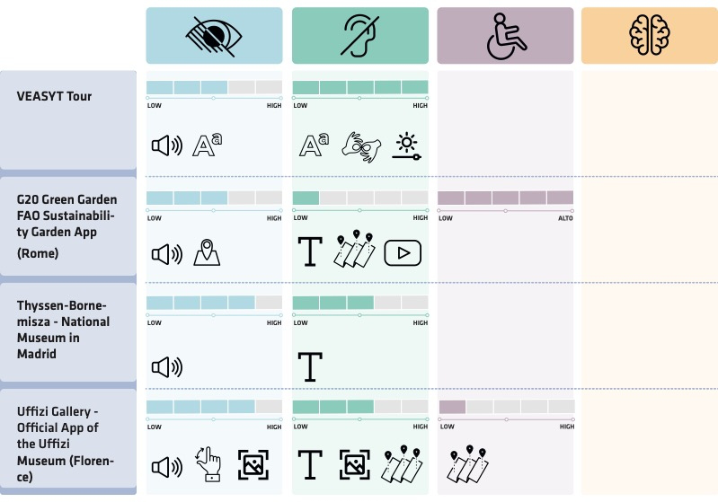
Figure 2: Selected museum accessibility applications and their functions in relation to the disability macro-category. Methodological approach.
and/or applications designed according to the Inclusive Design approach (Gilbert, 2019; Waller et al. 2015, Kim et al. 2016; Chisholm and May, 2008).
Given the amount of applications on the market, depending on the spe- cific topic of this research, it was necessary to select only the most effective museum applications from an inclusion and accessibility perspective, sum- marizing the main functionalities and strengths in relation to each identified disability.
The results of the research, then, were systematized and reworked into a summary scheme, useful for effectively visualizing the functionality of each application and, most importantly, the accessibility needs they satisfy (see Figure 2). Figure 2 shows the methodological approach used to systematize the collected data. Twelve applications were selected, namely:
VEASYT - Accessible Multimedia Guide: is proposed as the accessible “reinterpretation”of traditional paper guides. Features include: visual and hearing disabilities;
NearIT: allows for easy creation and sharing, personalized and contextu- alized content. Features cover all disabilities.
G20 Green Garden - FAO Sustainability Garden App (Rome): the purpose of the application is to accompany the visitor to discover the installati- ons located in the garden. The functionalities concern visual, hearing and motor disabilities;
Thyssen-Bornemisza - National Museum in Madrid: the purpose of the application is to accompany the visitor to discover the museum. The functionalities concern visual and hearing disabilities;
Uffizi Gallery - Official App of the Uffizi Museum (Florence): the purpose of the application is to accompany the visitor to discover the museum. Features address visual and hearing disabilities;
Louvre - Virtual Guide to the Louvre Museum (unofficial): the purpose of the app is to accompany the visitor to discover the museum. Features cover visual, hearing and cognitive disabilities;
British Museum - Unofficial app: the purpose of the app is to accompany the visitor to discover the museum. Features cover visual, hearing and cognitive disabilities;
British Museum Audio Buddy - Unofficial app: the purpose of the app is to accompany the visitor to discover the museum. Features cover visual and hearing disabilities;
Dt. Museum - App of the Deutsches Museum (Munich): the purpose of the app is to accompany the visitor to discover the museum. Features cover visual, hearing and cognitive disabilities;
Useeum - App dedicated to several museums in Northern Europe: the pur- pose of the app is to accompany the visitor to discover the museums. The functionalities concern visual, hearing and motor disabilities;
MuCA - App of the Museum of Anagni: the purpose of the application is to accompany the visitor to discover the museum. The functionalities concern visual and cognitive disabilities;
Mrt - app of the Royal Museums of Turin: the purpose of the application is to accompany the visitor to discover the museum. The functionalities concern visual and hearing disabilities.
ACCESSIBILITY FEATURES FOR MOBILE APPLICATIONS Contemporary smartphones are very competitive in terms of performance, and over time the level of basic performance has increased significantly, the same with regard to their deployment. In addition, the ability to update appli- cations over time, and has become an added value and allows developers to modify and implement features and content also based on feedback from end users.
In addition, the ability to access “Accessibility settings” allows those museum-use applications that were not designed with inclusion in mind to be made partially or fully accessible. In addition to the native accessibility features of the iOS and Android operating systems, numerous web and app plugins have been developed with the same goal in mind: that is, to make websites and apps that have not been designed with best practice accessibility principles accessible to all.
Following the review on the state of the art of the most accessible applica- tions, a systematic research was carried out on the state of the art of the main plug-ins for website accessibility. The purpose of this research is to encourage the dissemination of tools for ensuring total accessibility to cultural heritage. There are two plugins that are most efficient and widespread internationally: they implement the accessibility of websites and ensure their adherence to current international regulations.
Digital Technologies in Museums: Critical Issues and Opportunities 39
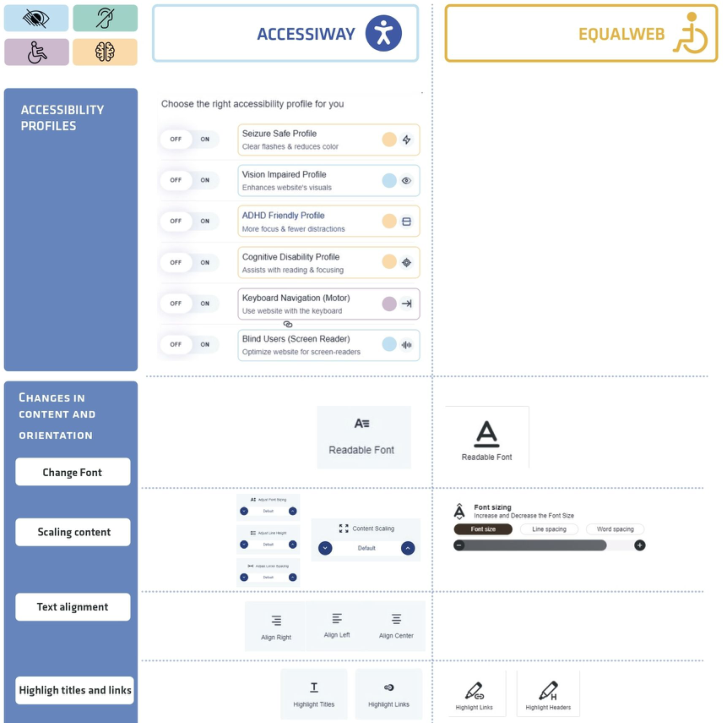
Figure 3: Example of a major feature analysis for an accessible website and application.
The research results were categorized according to the level of accessi- bility for each disability macro-category. Figure 3 shows the plugins and related features dedicated to motor, visual, hearing and cognitive disabilities and/or on applications designed according to the Inclusive Design approach. The main functions for accessibility possessed by the plugins and analyzed according to the method shown in Figure 3, are as follows:
The research was also useful for the purpose of collecting and schemati- zing the main accessibility features to be ensured, and possibly implemented, within future applications to be developed. The plugins selected and shown in the schematic are:
AccessiWay: allows anyone with a website to make it accessible for a wide range of disabilities, in full adherence to WCAG 2.1, European and national standards;
EqualWeb: analyzes the domain of websites to discover any problems that might hinder accessibility or pose a risk of violation. It is fully customizable and easily adapts to each website.
CONCLUSION
This research aims to improve access to culture for all in museums, through the analysis of critical issues and the identification of margins of imple- mentation of the artifacts with which visitors interact and through which the experience of the visit is defined. In fact, the purpose is to stimulate a reflection on the topic of accessibility from a technical and design point of view, in order to go beyond mere compliance with the legislation but to integrate it with the countless qualitative and quantitative tools offered by research in design, so as to disseminate tools and artifacts that make culture fully accessible in the museum environment. Noteworthy, recent IT adva- nces will increasingly offer concrete opportunities for inclusion, also thanks to the technological implementation of mobile devices and related opera- ting systems. In this evolving scenario, it will be necessary to design ways of accessing and using the contents oriented towards overcoming the concept of accessibility and increasingly oriented towards enhancing the user’s experie- nce. Further insights and targeted evaluation tests will be carried out in this direction, as to achieve a satisfactory level of inclusion and meet the needs of the largest number of people.
ACKNOWLEDGMENT
The authors would like to thank: the TIM Foundation, which financed the research and Professor Francesca Tosi (scientific director of the research).
Author Contributions: Conceptualization, A. B.; methodology, E.I and C.B; infographics and data curation, E. I and C.B; writing—original draft preparation, A. B, C. B; writing—review and editing, A. B, C. B and E. I. Supervision, A. B. All authors have read and agreed to the published version of the manuscript.
REFERENCES
Agid (2021). Linee guida di design per i servizi web della Pubblica Amministrazione. Website: https://docs.italia.it/italia/design/lg-design-servizi-web/it/versione-c orrente/index.html Assembly, U. G., (2006). Convention on the Rights of Persons with Disabilities.
United Nations. UN general assembly 2006 13 December.
Digital Technologies in Museums: Critical Issues and Opportunities 41
Ballantyne, M., Jha, A., Jacobsen, A., Hawker, J. S. and El-Glaly, Y. N., (2018), November. Study of accessibility guidelines of mobile applications. In Procee- dings of the 17th international conference on mobile and ubiquitous multime- dia (pp. 305–315). Caldwell, B., Cooper, M., Reid, L. G., Vanderheiden, G., Chisholm, W., Slatin,
J. and White, J., (2008). Web content accessibility guidelines (WCAG) 2.0. WWW Consortium (W3C), 290, pp. 1–34. Calvo, R., Seyedarabi, F. and Savva, A., (2016), December. Beyond web content accessibility guidelines: expert accessibility reviews. In Proceedings of the 7th international conference on software development and technologies for enhancing accessibility and fighting info-exclusion, pp. 77–84. Chisholm, W. and May, M., (2008). Universal design for web applications: Web
applications that reach everyone. O’Reilly Media, Inc. Decreto Legislativo 10 agosto 2018, n. 106, Riforma dell’attuazione della direttiva (UE) 2016/2102 relativa all’accessibilità dei siti web e delle applicazioni mobili degli enti pubblici. Gazzetta Ufficiale 211 del 11 settembre 2018, p. 1 Díaz-Bossini, J. M. and Moreno, L., 2014. Accessibility to mobile interfaces for older
people. Procedia Computer Science, 27, pp. 57–66. EN 301 549 V 3.2.1:2021, Accessibility requirements for ICT products and services.
European Telecommunications Standards Institute (ETSI) Technical Commit- tee Human Factors (HF). Website: https://www.etsi.org/deliver/etsi_en/301500_ 301599/301549/03.02.01_60/en_301549v030201p.pdf European Commission (2021). Union of Equality: Strategy for the Rights of Persons with Disabilities 2021–2030. European Union, Brussels. Web- site: https://ec.europa.eu/social/main.jsp?catId=738&langId=en&pubId=8376& furtherPubs=yes European Parliament (2019). European Accessibility (Directive EU 2019/882. Website: https://eur-lex.europa.eu/eli/dir/2019/882/oj# Gilbert, R. M. and Gilbert, R. M., 2019. Designing with Accessibility in Mind. Inclu-
sive Design for a Digital World: Designing with Accessibility in Mind, pp. 1–20. Jones, N. and Moffitt, M., (2016). Ethical guidelines for mobile app development within health and mental health fields. Professional Psychology: Research and Practice, 47(2), p. 155. Kim, W. J., Kim, I. K., Jeon, M. K. and Kim, J., (2016), February. UX Design guideline
for health mobile application to improve accessibility for the visually impaired. In 2016 International Conference on Platform Technology and Service (PlatCon) (pp. 1–5). IEEE. Valtolina, S. and Fratus, D., (2022). Local Government Websites Accessibility: Evaluation and Finding from Italy. Digital Government: Research and Practice, 3(3), pp. 1–16. W3C, Web Content Accessibility Guidelines (WCAG) 2.0 (2008). Website: www.w3.org/ TR/WCAG20 W3C, Web Content Accessibility Guidelines 2.0. Website: www.w3.org/TR/WCAG Waller, S., Bradley, M., Hosking, I. and Clarkson, P. J., (2015). Making the case for
inclusive design. Applied ergonomics, 46, pp. 297-303. Web Accessibility Initiative. Retrieved from: www.w3.org/WAI Zaina, L. A., Fortes, R. P., Casadei, V., Nozaki, L. S. and Paiva, D. M. B., (2022). Preventing accessibility barriers: Guidelines for using user interface design patterns in mobile applications. Journal of Systems and Software, 186, p. 111213. Zheng, R. (2022). Learn to Create Accessible Websites with the Pri- nciples of Universal Design. Interaction Design Foundation. Website: https://www.interaction-design.org/literature/article/learn-to-create-accessib le-websites-with-the-principles-of-universal-design
LISTED IN THE AHFE DIGITAL BOOKSTORE CATALOGUE
Explore the complete digital volume
Usability and User Experience
Read this individual research paper free through the original publisher, or explore the full digital proceedings book.
ISBN 978-1-958651-86-5
Explore this ISBN in the AHFE Bookstore ↗Listed in the July 2026 bookstore catalogue; search by ISBN to confirm current availability · Digital book purchase optional