Daniel A Muñoz (2025). Inclusion Through Sound: A Systematic Review of Spatial Audio, Sonification, and Interaction Design in Immersive Technologies for Blind and Visually Impaired Users. In: Human Factors in Design, Engineering, and Computing. AHFE Open Access, vol. 199, pp. 1035–1045. https://doi.org/10.54941/ahfe1006916
Publisher statistics will load when you open Metrics.
AHFE OPEN ACCESS OPEN ACCESS CONFERENCE PROCEEDINGS PAPER
Inclusion Through Sound: A Systematic Review of Spatial Audio, Sonification, and Interaction Design in Immersive Technologies for Blind and Visually Impaired Users
Immersive technologies such as virtual and augmented reality increasingly depend on sound-based interaction. For blind and visually impaired (BVI) users, audio-first design has become not an enhancement but a requirement, enabling orientation, navigation, training, and equitable participation in environments that are otherwise inaccessible. This review synthesizes nearly 1,900 works retrieved from OpenAlex and Crossref through a reproducible Python-based pipeline, which was further refined through thematic classification into six major domains: spatial audio and head-related transfer functions (HRTFs), assistive technologies for navigation, sonification and auditory displays, auditory cognition, immersive system design and evaluation, and inclusive design frameworks. The analysis reveals that spatialized audio and multimodal interfaces consistently enhance presence and reduce workload, yet the field continues to face unresolved challenges, including the absence of scalable methods for personalizing HRTFs, the lack of unified evaluation standards for auditory interaction, and limited integration of accessibility frameworks into immersive design pipelines. This review provides an updated state-of-the-art synthesis, identifies underexplored questions, and highlights the necessity of embedding inclusion into immersive sound research. The methodological contribution of a transparent and extensible Python pipeline ensures the reproducibility of this review and establishes a foundation for ongoing meta-analysis in sound interaction and accessibility research.
The role of sound in human–computer interaction has evolved from a marginal, signalling channel into a central medium for immersive and inclusive design. Early foundational work in auditory display and sonification framed non-speech audio as a distinct class of interaction that enables eyes-free access and continuous conveyance of information (Perkis and Kramer, 1995). Over the last two decades this tradition has fused with advances in sonic interaction design and multisensory HCI,
producing a research agenda in which sonic affordances are treated not as embellishments but as full-fledged interaction primitives (Franinovi´c and Serafin, 2013). In virtual and mixed reality contexts, spatialized audio is tightly coupled with the phenomenology of presence; experimental studies show that ambient soundscapes and interactive sound events significantly increase self-reported presence and perceived realism in VR, and detailed reviews argue that interactive audio is a principal channel by which users experience “being there” (Nordahl and Nilsson, 2014; Kern and Ellermeier, 2020). Multisensory and multimedia work further confirms that audio combined with haptics and contextual cues improves task performance and situational awareness in immersive settings (Saleme et al., 2020).
For blind and visually impaired (BVI) users the implications are particularly consequential: auditory interfaces are frequently the primary, and sometimes the only, channel through which spatial information, object identity, and navigational instructions can be delivered. Longstanding work in nonvisual navigation and orientation documents how auditory and haptic cues support path integration, landmark use, and wayfinding for blind individuals (Loomis, Klatzky and Golledge, 2001; Schinazi, Thrash and Chebat, 2016). Applied research in orientation and mobility (O&M) and in assistive systems (e.g., SWAN, PERCEPT, and NAVIG) demonstrates that spatial audio and non-speech auditory cues materially improve route following and confidence when paired with localization technologies (Wilson et al., 2007; Ganz et al., 2012; Katz et al., 2012). These empirical and applied strands make a compelling case for treating sound not as an optional accessibility overlay but as a design axis that can enable equitable participation in XR experiences.
Concurrently, substantial technical advances have lowered practical barriers to immersive audio production. Ambisonics rendering and high-order spherical harmonic pipelines enable six degrees of freedom spatialization suitable for head-tracked VR, and comprehensive treatments of ambisonics make these methods accessible to practitioners (Zotter and Frank, 2019). Standards-level work such as MPEG-H and related MPEG/JAES contributions have created object-based, interoperable formats for immersive audio production and distribution, facilitating consistent rendering across platforms (Herre et al., 2015; Herre and Disch, 2023). Research on individualized head-related transfer functions (HRTFs) further shows that listener-specific filtering materially improves externalization and localization, important perceptual outcomes for both sighted and BVI users, although scalable personalization remains difficult to operationalize outside laboratory settings (Jenny and Reuter, 2020).
The sonification and auditory display communities have also matured: web-based sonification toolkits and production workflows (e.g., Highcharts Sonification Studio and WebAudioXML/WAST) reduce technical entry barriers and support participatory, web-deliverable auditory interfaces (Cantrell, Walker and Moseng, 2021; Lindetorp and Falkenberg, 2021). Moreover, auditory cognitive neuroscience has produced robust, objective measures of listening effort and attentional state, most notably EEG alpha activity and pupillometry, that can be deployed to evaluate and adapt
Inclusion Through Sound: A Systematic Review 1037
immersive audio systems (Haro et al., 2021). Despite these convergences, existing literature reviews tend to examine spatial audio, sonification, auditory cognition, and accessibility independently rather than as an integrated, inclusion-oriented research program (Ghali et al., 2012). The present study therefore synthesizes the literature at their intersection, with the explicit goal of mapping both technical progress and the extent to which inclusion has been embedded into immersive sound practices.
This paper makes three contributions. First, it reports a reproducible, Python-based retrieval and screening pipeline that assembled a corpus of roughly 1,900 records from major repositories; the pipeline and metadata support transparent re-analysis and future updates. Second, it organizes the corpus into six analytic clusters, spatial audio, navigation and accessibility, sonification and auditory displays, auditory cognition, XR systems and evaluation, and inclusive/universal design and synthesizes each cluster’s methods, evidence types, and representative findings. Third, it identifies concrete gaps and research priorities, scalable HRTF personalization, multimodal and physiological evaluation protocols, and the embedding of accessibility into authoring and standards workflows, that, if pursued, will accelerate translation of immersive audio research into broadly inclusive practice. The remainder of the paper describes the pipeline and screening procedure, reports thematic and quantitative results, and situates the findings within the broader HCI and accessibility literatures.
RESEARCH OPPORTUNITY Despite rapid growth in immersive audio research, gaps persist in translating technical innovation into inclusive, scalable solutions for BVI users. Three issues are particularly acute:
Fragmentation: Studies on HRTF personalization, navigation systems, and sonification often proceed independently, limiting cross-pollination.
Evaluation: Protocols vary widely, with few standard measures of auditory workload, presence, or transfer in inclusive contexts.
Integration: Accessibility is often a retrofit rather than a design principle embedded in XR pipelines.
MAIN RESEARCH QUESTION What is the current state of the art in sound design, sonification, and spatial audio for immersive interaction technologies, and how do these approaches advance inclusion for blind and visually impaired users?
OBJECTIVES This study aims to:
1. Synthesize the state of the art in audio-first immersive interaction for BVI users. 2. Classify and analyze literature into thematic clusters, identifying trends and cross-cutting insights. 3. Highlight underexplored questions and research gaps. 4. Present a transparent, reproducible Python pipeline for systematic retrieval and screening.
1038 Muñoz
METHODS
To ensure rigor and reproducibility, the literature review was guided by a computational pipeline implemented in Python. The pipeline queried OpenAlex and Crossref using carefully constructed search terms that combined references to visual impairment and blindness with concepts from immersive technology, sound design, sonification, and spatial audio. This process generated a raw corpus of 1,878 records spanning from the 1940s to 2025. Duplicates were removed by consolidating entries based on DOI and title similarity, after which a heuristic screening was applied. Screening criteria included publication venue, ensuring representation from leading outlets such as CHI, IEEE VR, ICAD, the Journal of the Audio Engineering Society, and the I3DA series, as well as topical relevance through keyword matches for concepts such as navigation, sonification, and HRTFs.
The resulting dataset was exported into structured CSV files for coding. Records were manually reviewed and organized into thematic clusters through a combination of inductive reasoning, which allowed emergent patterns to shape the classification, and deductive reasoning, which drew on categories established in earlier surveys. This approach resulted in six clusters: spatial and immersive audio, assistive navigation systems, sonification and auditory displays, auditory cognition, XR system design and evaluation, and inclusive design frameworks. Each cluster was then analyzed not only for its internal contributions but also for its intersections with other clusters, reflecting the interdependent nature of immersive sound research.
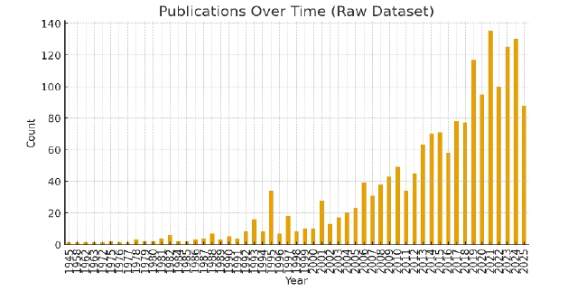
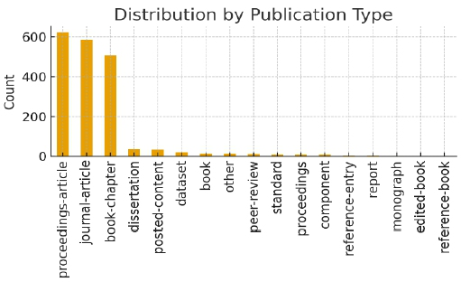
The dataset provides an overview of the field’s evolution and distribution. The temporal analysis shows that immersive sound research has grown steadily since the early 2000s, with notable acceleration after 2010 in tandem with the rise of consumer VR. Publication types were dominated by conference proceedings (622), journal articles (586), and book chapters (506), reflecting both the technical and applied character of the field. The most common venues included Lecture Notes in Computer Science (76 publications), Presence: Teleoperators and Virtual Environments (39), Virtual Reality (37), and the proceedings of I3DA (62 combined across 2021 and 2023). Figures 1 and 2 illustrate these distributions, underscoring the centrality of conference outlets in disseminating advances in sound-based interaction.
RESULTS
The corpus analysis identified approximately 1,900 publications at the intersection of immersive technology, sound interaction, and inclusion. Of the 1,878 retrieved records, 1,237 (≈65.9%) were assigned to one of six analytical clusters; the remainder fell into an “Other” category comprising tangential work, non-indexed book reviews, and publications lacking substantive overlap with our inclusion criteria. Proceedings dominate dissemination (622 items, 32.8%), followed closely by journal articles (586, 31.2%) and book chapters (506, 26.9%), reflecting the field’s hybrid identity between engineering prototyping and applied evaluation. Temporal trend analysis indicates steady growth since the early 2000s with accelerated
Inclusion Through Sound: A Systematic Review 1039
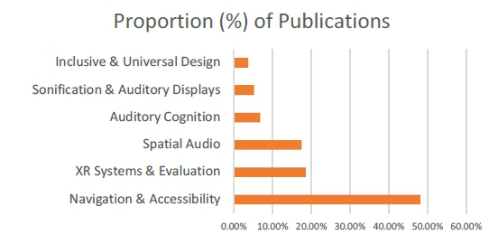
publication after 2010, consistent with the consumer-VR and ambisonics production pipeline expansion documented in standards literature. The distribution across clusters reveals strong asymmetries in research priorities. Navigation and accessibility systems dominate the field, accounting for 596 works (48.2%), followed by XR systems and evaluation (230, 18.6%) and spatial audio research (217, 17.5%). Auditory cognition (84, 6.8%), sonification and auditory displays (64, 5.2%), and inclusive and universal design frameworks (46, 3.7%) represent smaller but significant areas of inquiry. This uneven distribution illustrates both the historical centrality of navigation and rendering studies and the relative marginalization of explicitly inclusive frameworks. Figure 2. visualizes these proportions, while Table 1 synthesizes the clusters with representative subthemes, methods, and findings.
Figure 1: Distribution of publications over time.Figure 2: Clusters of publications distribution.
Research in spatial audio reflects decades of engineering advances in HRTF personalization, ambisonics rendering, and codec standardization. Works such as Jenny and Reuter (Jenny and Reuter, 2020) demonstrate that individualized HRTFs significantly improve externalization and presence in VR, while Zotter and Frank (Zotter and Frank, 2019) provide scalable ambisonics pipelines for six-degrees-of-freedom rendering. Parallel
1040 Muñoz
standardization efforts, notably MPEG-H (Herre et al., 2015; Herre and Disch, 2023), have ensured interoperability in production workflows. Yet despite this technical maturity, large-scale deployment remains hindered by the difficulty of personalization and the variability introduced by head- mounted displays and room acoustics.
Table 1: Clusters distribution count, representative work, methods, and main findings.
Table available in the original PDF paper.
Clusters Distribution and Major Works Cluster Count Subthemes Representative Works (Sample Titles)
From Vision to Sound: Enhanced Object Localization for Blind Navigation | Mobile-AI-Based Docent System for Visually Impaired Gallery Visitors | Audio-Tactile Maps for Orientation
XR Systems & Evaluation
vr; ar; xr; presence; hmd
Empirical; Review
Audio modulates presence and sickness; evaluation standards varied
230 Presence; Simulator Sickness; Training Transfer; Authoring
Audio Technology for Improving Social Interaction in XR | Accessible Virtual Shooting Games with Spatial Audio | Simulator Sickness Mitigation in AR/VR hrtf; binaural; ambisonics; spatial audio
Mobility Aid for the Visually Impaired Using Machine Learning and Spatial Audio | Spatial Audio Training for Visually Impaired Users Navigation in VR | Strong and Weak Head-Related Transfer Functions: The eHRTF Framework
Review; Policy Proactive inclusive design reduces retrofit; underrepresented in XR
Accessibility and Universal Design in XR | Inclusive Virtual Campus for the Visually Impaired | Universal Design in Workplace Training
The largest body of work concerns navigation and accessibility for blind and visually impaired users. From early prototypes such as SWAN (Wilson et al., 2007), PERCEPT (Ganz et al., 2012), and NAVIG (Katz et al., 2012) through to recent mixed-reality testbeds (Real and Araujo, 2021) and BIM-integrated AR navigation systems (Messi et al., 2025), research consistently shows that non-speech spatial cues and audio–haptic integration support orientation and mobility. The concentration of publications in
Inclusion Through Sound: A Systematic Review 1041
proceedings venues reflects a field still characterized by rapid prototyping and experimental deployments, with relatively few longitudinal adoption studies.
Figure 3: Types of publications distribution.
Sonification and auditory displays form a smaller but growing cluster. Toolkits such as Highcharts Sonification Studio (Cantrell, Walker and Moseng, 2021) and WebAudioXML (Lindetorp and Falkenberg, 2021) have lowered technical barriers, enabling participatory design and wider adoption. These systems demonstrate that spatialized sonification can increase salience for tasks such as mapping and data analysis, yet evaluation practices remain fragmented, often restricted to task performance or subjective scales without converging on shared protocols.
Auditory cognition research explores the relationship between immersive sound and human perceptual load. Clinical and experimental studies demonstrate that EEG alpha power and pupil dilation are reliable markers of listening effort (Haro et al., 2021), complementing psycholinguistic work on speech-in-noise perception (Jacks and Haley, 2015). Despite their promise, such physiological measures remain underused in immersive system evaluation, limiting their potential to inform adaptive soundscapes that dynamically regulate cognitive load.
The cluster on XR systems and evaluation includes empirical studies and reviews examining presence, simulator sickness, training transfer, and authoring workflows. Evidence shows that sound significantly modulates cybersickness and strengthens presence (Sevinc and Berkman, 2020; Doerner et al., 2022). However, inclusion is rarely foregrounded: accessibility concerns are typically addressed retrospectively, rather than being integrated into XR pipelines from the outset.
Finally, the smallest but perhaps most consequential cluster is inclusive and universal design. Works in this area, such as Spina’s (2021) policy- oriented review, underscore the benefits of proactive accessible design in reducing costs and enhancing equity. Nevertheless, only 46 works in the corpus explicitly address universal design or accessibility standards, and major technical specifications such as SMPTE or MPEG-H continue to prioritize interoperability and fidelity over accessibility constraints.
1042 Muñoz
Taken together, these results present a picture of technical robustness coexisting with social and institutional fragmentation. Navigation and spatial audio research have reached a level of maturity where translation to practice is possible, yet inclusive design remains underrepresented, leaving accessibility vulnerable to being treated as an afterthought rather than a guiding principle.
DISCUSSION
The synthesis of six clusters reveals a gradient of maturity across the field. Spatial audio research is among the most established, supported by robust psychoacoustic theory, standardized codecs, and mature rendering pipelines. These observations indicate a classic translation gap: robust engineering primitives (ambisonics rendering, object-based codecs, HRTF methods) coexist with underdeveloped evaluation ecosystems and sparse accessibility policy integration, creating a situation in which technology readiness does not automatically imply inclusive deployment. However, the unresolved challenge of scalable personalization continues to limit equitable deployment, particularly for diverse user populations whose anthropometric variability affects HRTF performance (Jenny and Reuter, 2020). Similarly, XR evaluation studies consistently show that audio mitigates cybersickness and enhances presence (Sevinc and Berkman, 2020), but these findings have not yet translated into accessible authoring pipelines where inclusion is a design driver rather than an afterthought.
Navigation systems illustrate both promise and limitation. Their prevalence reflects strong societal and funding incentives, and results from prototypes such as SWAN (Wilson et al., 2007) and NAVIG (Katz et al., 2012) confirm the utility of auditory cues. Yet the dominance of short- term, proceedings-based studies indicates a lack of longitudinal validation, raising questions about adoption, scalability, and equity when deployed in real urban environments. Similarly, the methodological progress visible in sonification toolkits (Cantrell, Walker and Moseng, 2021; Lindetorp and Falkenberg, 2021) has not yet been matched by standardized evaluation metrics. Physiological measures from auditory cognition research (Haro et al., 2021) could provide precisely the kind of multimodal evaluation needed, but cross-cluster integration remains limited.
Perhaps the most striking gap lies in the marginal presence of inclusive frameworks. Despite clear policy imperatives (Luce, 2022), only a handful of works in the corpus explicitly embed WCAG, UDL, or universal design into immersive sound design. This mismatch between technical innovation and accessibility requirements reflects a broader institutional inertia: technical standards bodies prioritize fidelity, while inclusive design remains peripheral to specification processes. Without systematic embedding of accessibility into standards, immersive systems risk perpetuating inequities even as they advance in technical sophistication.
These findings suggest several research opportunities. First, scalable personalization of spatial audio remains an open frontier, requiring hybrid approaches that combine anthropometric modelling, statistical prediction,
Inclusion Through Sound: A Systematic Review 1043
and machine learning. Second, evaluation protocols should evolve beyond task accuracy and subjective reports to incorporate multimodal evidence, including physiological, behavioural, and qualitative data. Third, cross- cluster synthesis is urgently needed: for instance, sonification toolkits could be applied to assistive navigation systems, while auditory cognition metrics could inform XR evaluation frameworks. Finally, accessibility should be embedded at the pipeline level, influencing authoring tools, codecs, and distribution standards rather than being appended through ad hoc adaptations.
In sum, the field of immersive sound for inclusion is characterized by technical maturity in spatial rendering and navigation, methodological advances in sonification, and promising insights from auditory cognition. Yet these advances remain fragmented, and inclusive design remains underrepresented. By systematically integrating accessibility into research, design, and standardization, the community can transform immersive sound from a set of promising prototypes into a cohesive, equitable, and impactful paradigm of interaction.
CONCLUSION
Sound is a foundational enabler of inclusion in immersive systems. Through a systematic review of nearly 1,900 works, this study demonstrates that spatial audio, sonification, and multimodal interaction consistently support blind and visually impaired users, enhancing presence, reducing cognitive load, and facilitating navigation. However, challenges of personalization, evaluation, and integration persist, limiting the translation of research into widely accessible systems. Future research must prioritize adaptive auditory interfaces, participatory co-design with BVI communities, and the embedding of accessibility into XR standards and production pipelines. The computational pipeline developed for this review contributes not only to methodological transparency but also to the ongoing evolution of the field by enabling iterative updates and refinements. By combining technological progress with inclusive design imperatives, immersive sound research can realize its potential as a truly equitable paradigm of interaction.
REFERENCES
Cantrell, S. J., Walker, B. N. and Moseng, Ø. (2021) ‘Highcharts Sonification Studio: An Online, Open-Source, Extensible, and Accessible Data Sonification Tool’, in Proceedings of the 26th International Conference on Auditory Display (ICAD 2021). ICAD 2021: The 26th International Conference on Auditory Display, Virtual Conference: International Community for Auditory Display, pp. 210–216. Available at: https://doi.org/10.21785/icad2021.005. Doerner, R. et al. (eds) (2022) Virtual and Augmented Reality (VR/AR): Foundations
and Methods of Extended Realities (XR). Cham: Springer International Publishing. Available at: https://doi.org/10.1007/978–3-030–79062-2. Franinovi´c, K. and Serafin, S. (2013) Sonic interaction design. Cambridge, Massachusetts: The MIT Press.
1044 Muñoz
Ganz, A. et al. (2012) ‘PERCEPT Indoor Navigation System for the Blind and Visually Impaired: Architecture and Experimentation’, International Journal of Telemedicine and Applications, 2012, pp. 1–12. Available at: https://doi.org/ 10.1155/2012/894869. Ghali, N. I. et al. (2012) ‘Virtual Reality Technology for Blind and Visual Impaired
People: Reviews and Recent Advances’, in T. Gulrez and A. E. Hassanien (eds) Advances in Robotics and Virtual Reality. Berlin, Heidelberg: Springer Berlin Heidelberg (Intelligent Systems Reference Library), pp. 363–385. Available at: https://doi.org/10.1007/978–3-642–23363-0_15. Haro, S. et al. (2021) ‘EEG Alpha Power and Pupil Diameter Reflect Endogenous Auditory Attention Switching and Listening Effort’. Neuroscience. Available at: https://doi.org/10.1101/2021.07.29.453646. Herre, J. and Disch, S. (2023) ‘MPEG-I Immersive Audio – Reference Model
For The Virtual/Augmented Reality Audio Standard’, Journal of the Audio Engineering Society, 71(5), pp. 229–240. Available at: https://doi.org/10.17743/ jaes.2022.0074. Herre, J. et al. (2015) ‘MPEG-H 3D Audio—The New Standard for Coding of Immersive Spatial Audio’, IEEE Journal of Selected Topics in Signal Processing, 9(5), pp. 770–779. Available at: https://doi.org/10.1109/JSTSP.2015.2411578. Jacks, A. and Haley, K. L. (2015) ‘Auditory Masking Effects on Speech Fluency
in Apraxia of Speech and Aphasia: Comparison to Altered Auditory Feedback’, Journal of Speech, Language, and Hearing Research, 58(6), pp. 1670–1686. Available at: https://doi.org/10.1044/2015_JSLHR-S-14–0277. Jenny, C. and Reuter, C. (2020) ‘Usability of Individualized Head-Related Transfer Functions in Virtual Reality: Empirical Study With Perceptual Attributes in Sagittal Plane Sound Localization’, JMIR Serious Games, 8(3), p. e17576. Available at: https://doi.org/10.2196/17576. Katz, B.F.G.et al. (2012) ‘NAVIG: augmented reality guidance system for the visually
impaired: Combining object localization, GNSS, and spatial audio’, Virtual Reality, 16(4), pp. 253–269. Available at: https://doi.org/10.1007/s10055–012- 0213–6. Kern, A. C. and Ellermeier, W. (2020) ‘Audio in VR: Effects of a Soundscape and Movement-Triggered Step Sounds on Presence’, Frontiers in Robotics and AI, 7, p. 20. Available at: https://doi.org/10.3389/frobt.2020.00020. Lindetorp, H. and Falkenberg, K. (2021) ‘Sonification for Everyone Everywhere -
Evaluating the WebAudioXML Sonification Toolkit for Browsers’, in Proceedings of the 26th International Conference on Auditory Display (ICAD 2021). ICAD 2021: The 26th International Conference on Auditory Display, Virtual Conference: International Community for Auditory Display, pp. 15–21. Available at: https://doi.org/10.21785/icad2021.009. Loomis, J. M., Klatzky, R. L. and Golledge, A. R. G. (2001) ‘Navigating without Vision: Basic and Applied Research’:, Optometry and Vision Science, 78(5), pp. 282–289. Available at: https://doi.org/10.1097/00006324–200105000- 00011. Luce, D. L. (2022) ‘Spina, C. (2021). Creating Inclusive Libraries by Applying
Universal Design: A Guide: Rowman & Littlefield. 189 pp., $45.00, ISBN: 978–1- 5381–3978-3’, Journal of Web Librarianship, 16(3), pp. 185–186. Available at: https://doi.org/10.1080/19322909.2022.2116967. Messi, L. et al. (2025) ‘An Audio Augmented Reality Navigation System for Blind and Visually Impaired People Integrating BIM and Computer Vision’, Buildings, 15(18), p. 3252. Available at: https://doi.org/10.3390/buildings15183252.
Inclusion Through Sound: A Systematic Review 1045
Nordahl, R. and Nilsson, N. C. (2014) ‘The sound of being there: presence and interactive audio in immersive virtual reality’. Available at: https:// academic.oup.com/edited-volume/37182/chapter/324107151 (Accessed: 9 October 2025). Perkis, T. and Kramer, G. (1995) ‘Auditory Display: Sonification, Audification, and
Auditory Interfaces’, Computer Music Journal, 19(2), p. 110. Available at: https:// doi.org/10.2307/3680606. Real, S. and Araujo, A. (2021) ‘VES: A Mixed-Reality Development Platform of Navigation Systems for Blind and Visually Impaired’, Sensors, 21(18), p. 6275. Available at: https://doi.org/10.3390/s21186275. Saleme, E. B. et al. (2020) ‘Mulsemedia DIY: A Survey of Devices and a Tutorial for
Building Your Own Mulsemedia Environment’, ACM Computing Surveys, 52(3), pp. 1–29. Available at: https://doi.org/10.1145/3319853. Schinazi, V. R., Thrash, T. and Chebat, D. (2016) ‘Spatial navigation by congenitally blind individuals’, WIREs Cognitive Science, 7(1), pp. 37–58. Available at: https:// doi.org/10.1002/wcs.1375. Sevinc, V. and Berkman, M. I. (2020) ‘Psychometric evaluation of Simulator Sickness
Questionnaire and its variants as a measure of cybersickness in consumer virtual environments’, Applied Ergonomics, 82, p. 102958. Available at: https://doi.org/ 10.1016/j.apergo.2019.102958. Wilson, J. et al. (2007) ‘SWAN: System for Wearable Audio Navigation’, in 2007 11th IEEE International Symposium on Wearable Computers. 2007 11th IEEE International Symposium on Wearable Computers, Boston, MA, USA: IEEE, pp. 1–8. Available at: https://doi.org/10.1109/ISWC.2007.4373786. Zotter, F. and Frank, M. (2019) Ambisonics: A Practical 3D Audio Theory for
Recording, Studio Production, Sound Reinforcement, and Virtual Reality. Cham: Springer International Publishing (Springer Topics in Signal Processing). Available at: https://doi.org/10.1007/978–3-030–17207-7.
LISTED IN THE AHFE DIGITAL BOOKSTORE CATALOGUE
Explore the complete digital volume
Human Factors in Design, Engineering, and Computing
Read this individual research paper free through the original publisher, or explore the full digital proceedings book.
ISBN 978-1-964867-75-5
Explore this ISBN in the AHFE Bookstore ↗Listed in the July 2026 bookstore catalogue; search by ISBN to confirm current availability · Digital book purchase optional