Anabela Simoes, Ling Suen (2023). Service Quality of Inclusive, Sustainable and Resilient Community Transport Systems. In: Human Factors in Transportation. AHFE Open Access, vol. 95, pp. 470–477. https://doi.org/10.54941/ahfe1003832
The paper aims at presenting a conceptual framework integrating a Service Quality Assessment Concept in a methodological approach towards inclusive, safe, sustainable, and resilient transport systems to accommodate everyone’s mobility needs. Despite the improvement of public transport systems around the world, many users perceive: 1. Poor accessibility in most public transport systems; 2. Existence of physical barriers to free mobility in urban walking areas; 3. Increasing frequency of unexpected incidences as new norm in this 21st century (floods, earthquakes, terrorist attacks, pandemics, etc.).Furthermore, as transport operations are dynamic, increasing the level of uncertainty, the entire system is susceptible to extreme stresses that could propagate shocks throughout the entire network. Such risks highlight the importance of safety and comfort along each trip, such as providing seats for all, avoiding crowds in the vehicle, on stops, stations, and waiting areas, with contingency transport services in case of incidents.Meeting individual and collective mobility needs within a community is influenced by the existing and planned land use and depends on the available transport services. Furthermore, the enormous dispersion of individual limits to a free mobility related to a disability, older age or any temporary or occasional impairment or condition, accessible and inclusive transport services are required to fit the user’s mobility needs. The steps of the planned trip, like connections to other vehicle or network, could impose some difficulties that should be previewed, offering solutions to avoid exclusion. Finally, a barrier-free walking environment to reach or leave a transport network should complete the requests for the provision of transport services to accommodate everyone’s activity limits.The proposed Service Quality Assessment model is based on the quality loop involving the users’ feedback and the transport operators’ awareness of the planned and actual service level. Innovative technology supporting an Immersive Virtual Environment as a design, testing, and demonstration tool, will be described to identify new needs, design, test and to apply new solutions.
It is the object of the submitted poster to present a conceptual framework integrating a “Service Quality” concept and the methodological approach towards inclusive, safe, resilient, and sustainable transport systems serving communities under the same UN 11th SDG approach (UN, 2021). These qualities should be reflected in providing transport services with frequent connections to other communities in rural or urban areas. The 11th Goal from the 17 Sustainable Development Goals (SDG) adopted by the UN in 2015 General Assembly has a major interest to the development of inclusive and safe transport systems for everyone. Although it may seem that these community-related goals are far from inclusive transportation services, it was concluded at the Second Global Sustainable Transport Conference Report (2021), that Sustainable Transportation is not an end itself, but a means to
The Service Quality of Inclusive, Sustainable and Resilient Community Transport Systems 471
achieve sustainable development. Thus, the 11th SDG requires the develo- pment of high-quality transportation systems to achieve the targeted goals for the entire community.
The mobility needs of people living in urban or rural environments exert a major impact on their well-being, quality of life, as well as personal and social development. Thus, mobility should be viewed as a human rights issue as expressed in the Universal Declaration of Human Rights (UN, 2015), requiring the transport service operators to provide inclusive, safe and reliant services in sustainable and resilient services.
Despite the improvement of public transport systems around the world, many users express the following feedback: 1. a lack of inclusion in most available transport services; 2. the existence of physical barriers in most com- munity walking areas to each a transport mode; 3. the increasing frequency of unexpected service disruptions in this 21st century resulting from floods, earthquakes, terrorist attacks, pandemics, etc.
Transport operations are dynamic in nature. Therefore, the entire system is susceptible to uncertainties that could propagate shocks throughout the entire network. Such risks highlight the importance of safety and com- fort conditions provided to passengers along each trip, e.g., providing seats for all, avoiding crowds in the vehicle, on stops, stations, and waiting areas, and providing contingency transport services during incidents or accidents.
This poster presents a conceptual framework integrating a Service Quality Concept and a methodological approach towards the provision of inclusive, safe, sustainable, and resilient transport services to accommodate everyone’s mobility needs. This framework outlines the development of an assessment model of the provided service quality based on a quality loop approach. The users’ feedback in terms of satisfaction of their mobility needs and the service providers’ awareness of the planned and actual level of services, allow for the identification of gaps along the entire trip.
THE USERS’ MOBILITY NEEDS Mobility is a human right representing the freedom of movement from one place to another towards to accomplishing any human activity (work, sch- ool, health, leisure, social or shopping). This was expressed in the Universal Declaration of Human Rights (https://www.un.org/en/about-us/universal-d eclaration-of-human-rights). People need easy access to work and to essential services to live decent and independent lives.
Aiming at providing efficient, safe, and sustainable mobility to citizens, transport authorities create the required frameworks for the provision of transport services to meet the demand generated by the existing and/or planned land use. Due to the enormous diversity of individual impairments resulting from a disability, older age or any temporary or occasional condi- tions, inclusive transport services are required to meet every user’ mobility needs.
It should be highlighted that most disabled or older people can live an independent life, but they need inclusive and safe transport services to meet
472 Anabela and Ling
their mobility needs. This requires special adaptations that should cover, not only, the access to the vehicle and the transportation infrastructure, or the ticketing system, but instead, the entire journey from door to door.
As referred in Rupprecht (2019), Mobility focuses on the satisfaction of needs, while transportation (including vehicles, infrastructure, and traffic rules) is the required instrument for the concrete realization of mobility. Due to the spatial separation of activities, a demand for transport services arises requiring a high-quality service in terms of accessibility, reliability, safety and appropriate comfort along the entire travel chain (Alexopoulos and Wyro- wski, 2015). Using different alternative or complementary modes, transport systems provide both the way and conditions to meet the mobility needs of every potential user. Being permanently, temporarily, or occasionally limited on their independent and free activity, some people require, on their own side, some motor, sensory or cognitive support to perform their daily life activities, together with a barrier-free environment and inclusive technology.
TRAVEL REQUIREMENTS TO MEET THE USERS’ MOBILITY NEEDS Traveling involves a series of steps, from trip planning to the exit of the transport network. Overcoming each one of these steps may impose diffi- culties to the users with permanent, temporary or occasional impairment. However, some personal remaining capabilities could overcome the found obstacles with some effort and/or slight adaptations. Other users, being more dependent on specific help, require special adaptations to the entire system to make it usable by every potential user, so that no one will be left behind. Thus, an inclusive mobility for all users is required, as recommended by the European Commission to decision-makers: transport systems must be acces- sible, affordable, safe, convenient, efficient, empowering, empathetic, and gender equitable (European Commission, 2020).
The Users and Their Diversity Being permanently, temporarily, or occasionally limited on their independent and free activity, some people may require certain motor, sensory or cognitive aid to perform their daily activities, within a barrier-free environment and assistance from inclusive technologies.
One way to mitigate each user’s limitations to free mobility requires pro- fessional counseling to identify the specific travel needs and to propose the required solutions. From the local authorities’ side, a barrier-free infrastru- cture (including walking and housing environment) should be provided to every citizen, together with inclusive and user-friendly technological tools. From the transport provider’s side, the offered transportation services should be able to accommodate the users’ needs, by providing easy access, way- finding support, vehicle availability, as well as comfort and safety along the trip.
Thus, the identification of the users’ groups and their special needs when traveling using any transport system requires the use of the Classification of Functioning, Disability and Health a) and b) (2007) to anticipate the limits of
The Service Quality of Inclusive, Sustainable and Resilient Community Transport Systems 473
each group to a free mobility and their remaining functional abilities allowing each one to travel alone.
The Travel Chain and the Required Travel Qualities The different steps to be followed according to the planned trip, from plan- ning, ticketing, connecting to other vehicles or network, could impose some difficulties that should be previewed by the transport service providers who should offer solutions to avoid exclusion.
Safety is the number one priority in traveling throughout the travel chain. To achieve Safety requires the vehicle operator to carefully monitor the pas- sengers’ ingress and egress, paying special attention to their movement inside the vehicle, walking or seating before leaving the stops or transfer points.
Another important quality in transport systems is the Sustainability of each transport mode. This requires the service provider to ensure that: 1. Vehi- cles and infrastructures are clean, and appropriate to operate in healthy and safe conditions for both passengers and drivers; and 2. The economic and organizational stability of the corporate entity in allowing for delivering the scheduled services.
A third important quality is Resilience. Since transport systems operate in dynamic and interactive environments, they are susceptible to uncertainty along the network. This leads to the system vulnerability, being exposed to the propagation of shocks within the network (Reggiani, Nijkamp and Lanzi, 2015). According to Pariès et al. (2011), Resilience is the required quality defined as “the intrinsic system ability to adjust its functioning prior to, during, or following changes and disturbances, so that it can sustain the required operations under both expected and unexpected conditions”. High quality transport systems should be resilient ensuring the presence of three essential conditions: be prepared providing the ability to avoid something bad from happening; be flexible to ensure survival under varying conditi- ons and degraded modes; and be adaptive in supporting fast recovery from disruptions and regaining the desired performance level (Pickett, McGrath, Cadenasso and Felson, 2014). Under the occurrence of an unexpected distur- bance or accident while traveling, the transport system should prove its sustained adaptability (Woods, 2014) by providing solutions to ensure the completion of the initiated trip until its completion under safety and comfort conditions.
Additionally, resilient transport systems should provide for emergency and rescue operations when required. In such circumstances, rescue operators should be able to locate clear and barrier-free paths, appropriate spacious elevators, and inclusive information systems displays.
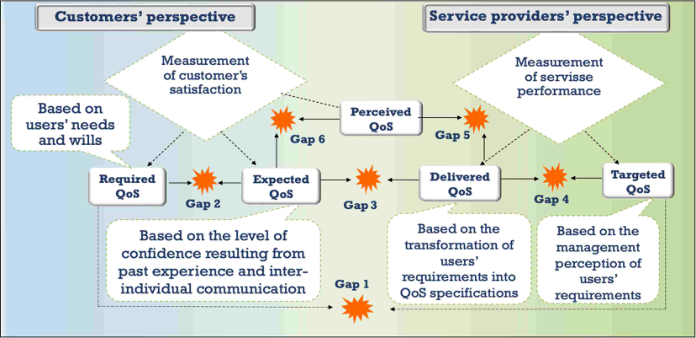
THE CONCEPT OF SERVICE QUALITY AND ITS ASSESSMENT The concept of the quality loop, as defined by Parasuraman et al. (2005), is the basis for the assessment of the provided services quality, in accordance with both customers’ and service providers’ points of view. On the user’s side, the criterion of satisfaction will be measured on the expected and perceived service quality; from the service provider’s side, the criteria of performance
474 Anabela and Ling
level will be based on the planned and delivered services, according to their economic viability. The usability of the available technology for planning, ticketing, and wayfinding from the access to and egress from the transport network should be assessed as well. Furthermore, support services at the destination should be previewed for mobility challenged users requiring help upon exiting the transport network.
The feedback loop represented in Figure 1 below is the basis for the asses- sment of the transport service quality, against a set of criteria embodying both customers’ and service providers’ points of view. Highlighting the identified gaps between the views of each player, the feedback loop acts as the link in this quality assessment of the provided service quality.
Bridging the identified gaps on the collected information forms the main tool for the Quality Assessment Model towards building a detailed evaluation platform for any system improvement towards the defined service targets.
Focusing on the system to be assessed in terms of transport mode and cove- red urban, suburban, or rural area, and considering the diversity of its users in terms of their special needs resulting from any permanent or temporary impairment or older age, a questionnaire should be designed for in person application as the main tool for collecting quantitative data from the users’ side. Thus, the users should be inquired about the obstacles they found in each step of a planned trip. The collected data should identify each incompa- tibility or gap between the user’s needs to overcome each step of the planned trip and the related level of difficulty. Thus, for each gap, the user should identify the level of the required effort in a previously defined scale for each step of the service provided. From the service provider’s side, the gaps betw- een both the planned and the actual services, could also be deduced. Such gaps could likely be caused by financial constraints at the corporate funding level, thus delaying the implementation of the planned improvements.
The collection of the users’ feedback regarding their travel experience will draw the service providers’ attention to finding solutions for inclusion. The
Figure 1: The concept of quality of service (qos) as the basis for its assessment (adapted from Parasuraman et al., 2005).
The Service Quality of Inclusive, Sustainable and Resilient Community Transport Systems 475
development of a holistic approach towards the provision of transport servi- ces, integrating sustainability and resilience as targeted qualities, is new and requires in-depth analysis and well-defined procedures. Thus, a simulated scenario using Immersive Virtual Environments (IVEs) could be developed to represent a journey along the entire chain of a transport system. Working as simulators, IVEs play a relevant role as training and research platforms in road and rail transport, aviation, and maritime navigation (Young et Lenné 2017). IVEs have also been used for studies of pedestrian safety (e.g., Feldstein et al. Dyszak 2020, Soares et al., 2021), environmental perception (e.g., Jiang et al. 2018) and as a tool in allowing people with disabilities to communicate their impressions on transport systems (Wallergård et al., 2008). Like road transport simulators, they allow simple and fast adaptation of visual and acoustic characteristics of the environments and thus, enable easy comparison of multiple design alternatives.
Considering the importance of periodic assessment of the services provi- ded, a model applied to transport services should be developed based on both the new EU Standard EN 13816 and the quality loop of the provided service. It is expected that a periodic quality assessment will help improve the overall service quality of the transport system.
FINAL REMARKS Considering the variability of public transport users, highlighting the spe- cial needs of disabled and older users, as well as temporary or occasional conditions impairing some users, there is much to investigate and test towards high-quality inclusive, safe, resilient, and sustainable transport services.
Furthermore, the walking areas in the urban built environment that are used to reach the required transport infrastructure and network, or the destination area upon leaving the vehicle and the transport infrastructure, should be inclusive and safe to every user. The transport infrastructure now- adays, being very complex, should provide clear information displayed in user-friendly technology in orientation and way-finding, in a multi-language setting at the crucial moment for appropriate reading.
Finally, the quality assessment model requires deep research towards its better definition, matching users’ needs and expectations towards its testing and validation. Applying a tested and validated quality assessment model onto existing transport services could lead to system improvements benefiting the travelling public.
The submitted poster, synthesizing this conceptual framework, highlights the research needs for the development of a holistic approach having sustai- nability and resilience as overarching concepts towards the provision of high-quality transport services. The clarification of the four targeted qualities in the provision of transport services, as well as its framework integrating the quality assessment model and its application, will form the main tar- gets of a new research project using IVE as an important tool for designing,
476 Anabela and Ling
assessing, testing, and demonstrating new solutions targeting inclusive, safe, sustainable, and resilient transport systems for everyone.
REFERENCES
Alexopoulos, A. and Wyrowski, L. (2015). Sustainable Urban Mobility and Public Transport in Unece Capitals. The United Nations Economic Commission for Europe, Geneva. European Commission (2020). How to Make Inclusive Mobility a Reality: 8 pri-
nciples and tools for a fair (er) transport system. Retrieved on 15-02-2023 from: https://civitas.eu/tool-inventory/how-to-make-inclusive-mobility-a-reality -8-principles-and-tools-for-a-fairer. Feldstein, Ilja T.; Dyszak, Georg N. (2020): Road crossing decisions in real and virtual environments: A comparative study on simulator validity. In: Accident Analysis & Prevention 137, page 105356. Jiang, L., Masullo, M., Maffei, L., Meng, F., & Vorländer, M. (2018). How do
shared-street design and traffic restriction improve urban soundscape and human experience? An online survey with virtual reality. Building and Environment, 143, 318–328. Parasuraman, A., Zeithaml, V. A., & Malhotra, A. (2005). E-S-QUAL - A multipleitem scale for assessing electronic service quality. Journal of Service Research, 7(3), 213–233. Pariès, J.; Wreathall, J.; Hollnagel, E. (2014). Resilience Engineering in Practice: A
Guidebook. ASHGATE, U. K. Pickett, S. T. A.; McGrath, B.; Cadenasso, M. L.; & Felson, A. J. (2014). Ecological resilience and resilient cities: Building Research & Information, 42:2, 143–157. Reggiani, A.; Nijkamp, N., Lanzi, D. (2015). Transport resilience and vulnerability:
The role of connectivity. Transportation Research Part A 81 (2015) 4–15. Rupprecht Consult Ed. (2019) Guidelines for Developing and Implementing a Sustainable Urban Mobility Plan, Second Edition. Soares, F., Silva, E., Pereira, F., Silva, C., Sousa, E., & Freitas, E. (2021). To cross or
not to cross: Impact of visual and auditory cues on pedestrians’ crossing decision- making. Transportation research part F: traffic psychology and behaviour, 82, 202–220. United Nations (1948). The Universal Declaration of Human Rights (UDHR) was proclaimed by the United Nations General Assembly in Paris on 10 December 1948 (General Assembly resolution 217 A) as a common standard of achievements for all people and all nations. United Nations (2019). Global Sustainable Development Report, 2019: The Future is
Now. Science for Achieving Sustainable Development. Written by an Independent Group of Scientists appointed by the Secretary-General. United Nations (2020). The SDG Partnership Guidebook: A practical guide to building high impact multi-stakeholder partnerships for the Sustainable Development Goals, Darian Stibbe and Dave Prescott, The Partnering Initiative and UNDESA 2020. United Nations (2021). Sustainable transport, sustainable development. Inte-
ragency report for the Second Global Sustainable Transport Conference. DOI: 10.1016/j.aap.2019.105356. DOI: 10.1080/09613218.2014.850600. Wallergård, M., Eriksson, J., & Johansson, G. (2008). A suggested virtual reality methodology allowing people with cognitive disabilities to communicate their knowledge and experiences of public transport systems. Technology and Disability, 20(1), 9–24.
The Service Quality of Inclusive, Sustainable and Resilient Community Transport Systems 477
Woods, D. (2015). Four concepts for resilience and the implications for the future of resilience engineering. Reliability Engineering and System Safety, https://dx.doi.o rg/10.1016/j.ress.2015.03.01. World Health Organisation a) (2007). The International Classification of Functio-
ning, Disability and Health. Geneva: WHO. World Health Organization (2013). How to use the ICF: A practical manual for using the International Classification of Functioning, Disability and Health (ICF). Geneva: WHO. World Health Organization b). How to use the ICF (2013). A practical manual for
using the International Classification of Functioning, Disability and Health (ICF). Geneva: WHO. Young, M. S., & Lenné, M. G. (Eds.). (2017). Simulators for transportation human factors: Research and practice. CRC Press.
LISTED IN THE AHFE DIGITAL BOOKSTORE CATALOGUE
Explore the complete digital volume
Human Factors in Transportation
Read this individual research paper free through the original publisher, or explore the full digital proceedings book.
ISBN 978-1-958651-71-1
Explore this ISBN in the AHFE Bookstore ↗Listed in the July 2026 bookstore catalogue; search by ISBN to confirm current availability · Digital book purchase optional