Jan Grippenkoven, Alexandra König (2022). Mobility for everyone - a matrix-based approach to ensure accessibility of public transport. In: Human Factors in Transportation. AHFE Open Access, vol. 60, pp. 272–278. https://doi.org/10.54941/ahfe1002457
The target group of public transport is the general public. Public transport vehicles are the tools that are supposed to meet the mobility needs of a multifaceted population. A central difficulty for transport companies is to ensure accessibility for users with physical or cognitive restrictions. Disabled people, senior citizens and children are examples of groups that face a variety of challenges when they intend to use public transport. In this work a method to identify mobility barriers in a structured and replicable way is described. This method is based on two-dimensional matrices that relate detailed steps and subtasks of a passenger within his or her travel chain to functional components of health, based on the International Classification of Functioning, Disability and Health (ICF) as described by the World Health Organization (WHO) (REHADAT, 2022). This matrix offers a systematic approach to understand and analyze the impact of various sets of restrictions on the accessibility and usability of defined modes of public transport.
A key aspect that is defining for the democratic beauty of public transport is that all people are equal in the face of subways, buses and trains. Ever- yone needs a ticket, has the same right to a seat as everyone else and must ensure to get off in time at their destination. However, the democratic self- understanding of public transport to provide mobility for all is put to a serious test when it comes to the mobility of persons with disabilities, senior citizens and children. This group of persons often faces a variety of barriers when using public transport. Some of the most frequent barriers for per- sons with disabilities are related to the entry and exit to the vehicles, long lead times for bookings of adapted vehicles or assistance services at stati- ons, broken ramps and elevators and the lack of accessible information in an appropriate format in vehicles and at stops and stations among others (Grewal, Joy, Lewis, Swales, & Woodfield, 2002; König, Seiler, Alˇciauskait˙e, & Hatzakis, 2021).
Mobility for Everyone – A Matrix-based Approach to Ensure Accessibility 273
In order to understand problems and reduce barriers in public transport, changing the own perspective and taking an attempt to empathize with per- sons with disabilities in the context of public mobility is a first step. The greater the variety of physical and cognitive limitations that are considered in the planning step of transportation systems, the more inclusive and user- centered it is possible to design them. Since emphasizing with persons with disabilities can be difficult for transportation planners, engineers, human factors experts and other professionals in the absence of an own firsthand experience, a variety of methods exist that attempt to systematize and forma- lize the change of perspective. These methods can be used to anticipate the needs of persons with disabilities and to identify design measures that meet special demands. However, these methods differ in terms of scientific quality criteria as well as in terms of their practical applicability, e.g. regarding time and cost.
The central dilemma in choosing suitable methods is often that they either suffer from a lack of objectivity and reliability, or are not adaptive enough to situational impressions and special circumstances. For example, interview studies that are conducted with persons with disabilities are probably the most commonly used method to gain deeper insights into the attitudes and beliefs of the interviewees (e.g. König et al., 2021). However, the validity of interview studies highly depends on the number and heterogeneity of the interviewed sample of a population. Furthermore, the content and way of questioning is sensitive to the experience and expectations of the intervie- wer who might influence the responses and results due to experimenter bias (Barber & Silver, 1968). Furthermore, the results are highly subjective since they depend on the interviewed subject and his or her specific impairments and experiences with it. Thus, the transferability of results is limited.
The same problem with objectivity applies to shadowing studies. In shado- wing studies users of public transport systems are observed during their trips with the goal to understand the challenges they face during their end-to-end journeys and explore the criteria affecting their transport-related decisions. While systematic observation is a good approach to obtain a basic impres- sion of potential problems and form hypotheses, the validity is limited to the insights derived from the subsample of persons observed. In addition, impres- sions of the observer may or may not correspond to the actual situational experiences of the observed individual.
In contrast to interviews and observations, the use of norms or surveys offers a more objective and reliable approach to assessing the accessibility of an object under consideration. The validity, however, depends heavily on the context and the fit of the used norm or survey to the object and subject of investigation. A norm for the accessibility of public transport infrastructure (e.g. DIN 18040-3) for example offers structural guidelines for stops and tracks in public transport, but does not serve to identify problems and specify interaction requirements from the perspective of the user, like e.g. DIN EN ISO 9241-110. This norm, however, offers an assessment framework that the professional user of the standard must adjust for each context and each specific user group. In the case of standards, the fit to the specific object of investigation may be limited as well the flexibility in application.
274 Grippenkoven and König
Surveys represent a cost-efficient way for collecting extensive amounts of data, especially when conducted online. However, inclusivity and repre- sentativeness of surveys are limited because of self-selection effects and the need for respondents to process written information. Thus, for exam- ple, in most accessibility-related surveys, people with intellectual disabilities are underrepresented because they are limited in answering for themselves (Hatzakis et al., 2021).
Motivated by the various limitations of existing methods, a new method is being developed with the goal to identify mobility barriers in an objective, reliable and efficient way. This matrix-based method, as presented in the following sections, takes a deep dive into specific types of functional impair- ments as well into distinct subtasks that an individual might face on his or her journeys with different means of public transport.
A MATRIX TO IDENTIFY MOBILITY BARRIERS In the following two sections the development of the two-dimensions of a matrix that relates detailed steps and subtasks of a passenger within his travel chain to functional components of health is described. This matrix- based method to identify problematic areas for people with disabilities along their journeys builds on a similar approach that was pursued in the Euro- pean TRIPS project to assess the accessibility of emerging transport systems (Brinkmann et al., 2020). Necessary skills and abilities that are required for performing specific steps of a trip are added as a central component. A com- prehensive classification of single steps and tasks during the trip, based on a hierarchic task analysis (HTA) add a detailed sequence that has not been systematically addressed in this context before.
Braking Down Sequences of Tasks on a Journey Using a HTA In order to get a detailed impression of the difficulties that persons with disabilities face on their journeys in public transport, a holistic view of all associated problem areas is recommended (e.g., Wilson, 2003). HTA is a sui- table methodological approach with which mobility in a certain transport system can be systematically broken down into sequential goals, sub-goals, operations and plans (Stanton et al., 2013). The resulting sequence of the microscopic plans and operations serves as the columns of the matrix to evaluate in which areas of their journey people with certain functional restri- ctions are confronted with challenges. In the following section, a HTA for the task of using a train is described as an example.
The scope of the HTA applied for using a train defined to cover each step in between the planning of the trip and the arrival at the target destination. The mobility demands resulting from the necessity to cover the first and last mile in between e.g. stations and home or final destination were included. The data collection was conducted by four Human Factors experts who structu- red the processes of using various mobility services from a user’s perspective, like the process of riding a commuter train. The overall goals of the task were determined first and identified as trip planning, conducting the journey itself and coping with complications. Next, the sub-goals belonging to higher-level
Mobility for Everyone – A Matrix-based Approach to Ensure Accessibility 275
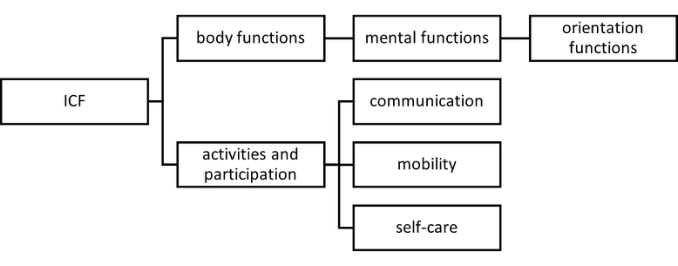
Figure 1: Structure of the dimension of skills and abilities according to the ICF (source: authors).
goals were determined. For the goal conducting the journey in the context of a ride in a commuter train these sequential sub-goals were identified to be entering the station, orientating oneself inside the station building, entering the platform, waiting, boarding the train, taking a seat, collecting informa- tion about the arrival time during the ride, using the train toilet, changing trains, leaving the platform, orientating oneself at the target station and lea- ving the station. Finally, these sub-goals were again decomposed into detailed operations and plans. The sub-goal of boarding the train, for example, was decomposed into the plans identify the correct train, identify the door, open the door, get your luggage onto the train and bridge the gap between platform and train.
On this level of detail of the journey, the second dimension of the matrix comes into play. The skills and abilities are related to the sequence of plans on the lowest level of the HTA for a journey within a particular mode of transport.
Braking Down Skills and Abilities Using the ICF The skills and abilities as the rows of the matrix were based on the Inter- national Classification of Functioning, Disability and Health (ICF), which was published first 2001 by the World Health Organization (REHADAT, 2022). Out of the 34 core sets of the ICF (Selb et al., 2015), the two main components body functions and activities and participation as well as five sub-components were chosen that appear to be most related to require- ments for travelling (Figure 1). The sub-components and their subsequent sub-components were enriched by further skills and abilities if needed. The skills and abilities were structured by up to four levels. For example, the ICF component communication was clustered into the clusters producing and receiving. Producing was in turn clustered to speaking, producing messages in formal sign language, writing messages and nonverbal messages. Writing messages contains three options. with a pen, with a touchscreen and with a keyboard.
276 Grippenkoven and König
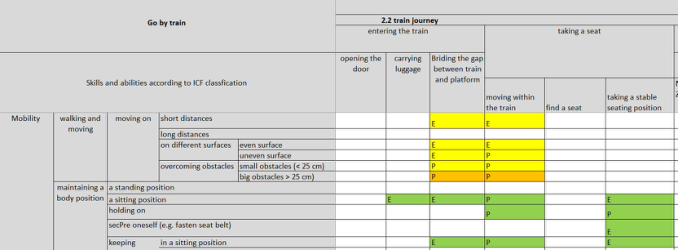
Integration of the Two Dimensions in a Matrix By relating detailed sub-steps of the travel chain from the user’s perspective as columns to the functions of the ICF classification as rows in a matrix, a template with a large number of crossing points results. These multitude of resulting fields serve as a basis for a detailed evaluation. Judgements in each field of the matrix have to be assessed regarding two questions: 1) whether the skills and abilities were essential for a task (E) or just pos- sibly required (P) for the specific step of the journey and 2) whether the person needs assistance in performing the task. The need for assistance was marked in color in the matrix: red for tasks that were not possible under any circumstances, e.g., a hearing-impaired person understanding verbal information, orange for tasks only possible with human support, yellow for tasks only possible with technical support and green for tasks possible without restrictions. For reasons of clarity, only those fields of the matrix were colored that comprised of essential or possibly required skills and abilities.
The resulting matrix provides an overview over the requirements that dif- ferent steps of a journey pose on the skills and abilities for persons with a specific kind of disability and whether assistance is needed. The matrix has a twofold character – on the one hand, it represents a tool for a retrospective assessment of the requirements a journey with a specific transport means poses on a person with a specific kind of disability. On the other hand, the matrix has a prospective character as it facilitates the derivation of design measures for increasing accessibility in future transport systems. For interpre- tation of the matrix, especially the red, orange and yellow fields (indicating that some kind of support is needed) marked with an E (for essential) are of interest, because they indicate the phases of the journey where people face barriers. Especially the red fields mark urgent action points and necessities for improving the accessibility because no technical or non-technical solution is provided so far to ensure accessibility. By pointing out specific barriers that occur when the requirements of a specific step of a trip are not fulfilled by the skills and abilities of a person, the matrix approach aims to uncover improve- ment potentials. In this context, the matrix facilitates prospective ergonomics by pointing out current weaknesses and accessibility barriers of a specific step of a trip that need further investigation.
To give one example, Figure 2 presents an excerpt from a matrix related to a train journey and the target group of persons paralyzed from lumbar vertebra downwards, meaning not being able to move the legs and thus being dependent on an electric wheelchair. The columns present the sequence of steps based on the HTA. Rows list the skills and abilities according to the ICF. The example refers to the phase of the train journey and the steps of entering the train and taking a seat. As shown here, various skills and abilities from the categories walking and moving and maintaining a body position are essential or at least possibly required for bridging the gap between train and platform. The orange fields mark that these tasks would require human assistance, e.g., by operating a ramp to overcome big obstacles.
Mobility for Everyone – A Matrix-based Approach to Ensure Accessibility 277
Figure 2: Exemplary excerpt from the matrix for the use case of a train journey and a person paralyzed from lumbar vertebra (source: authors). E = skills and abilities are essential, P = skills and abilities are possibly required, red color = tasks that are not possible under any circumstances, orange color = tasks only possible with human sup- port, yellow color = tasks only possible with technical support, green = tasks possible without restrictions.
CONCLUSION
The matrix-based approach described in the previous sections offers a possi- bility to identify the impact of each functional restriction on each individual step within a travel chain. The main strength of this matrix-based approach is that it is a highly standardized way to shed light on specific deficiencies within a mode of public transport that limit the usability for persons with certain impairments. In addition, the matrix-guided approach offers the pos- sibility of deriving sharp requirements for planning and tendering of vehicles as well as transport infrastructures, with the goal to ensure the accessibility for people with a variety of disabilities.
As a next step, the matrix approach will be applied to a broader variety of new and emerging means of transport, e.g., bike sharing or driverless bus- shuttles. Furthermore, the resulting matrices will be reviewed with persons with disabilities that are regularly affected by mobility barriers to validate the results.
As a future step, it is planned to link best practice examples of design mea- sures to cope with certain barriers to the matrices. The complement of the matrices by best practice examples will highlight changes in the fields of the matrices by showing how the best practice examples help to overcome spe- cific barriers. This way the matrix is planned to be developed into a toolbox consisting of an analytic component and a countermeasure component. Fur- thermore, the matrices facilitate the identification of voids that need further investigations and mark a starting point for future research and technological development.
Once a substantial amount of feedback is gathered for a variety of tran- sport systems, the system will be translated into a web-based service free for all. This application will enable filtering to select either all or a subset of functional impairments as well as means of transport. Target groups for this application are manifold with transport planners and authorities, vehicle
278 Grippenkoven and König
manufacturers, municipalities as well as researchers in the field of disability studies being the central ones.
REFERENCES
Barber, T. X., & Silver, M. J. (1968). Fact, fiction, and the experimenter bias effect.
Psychological Bulletin, 70(6, Pt. 2), pp. 1–29. Brinkmann, F., Repetto, C., Banes, D., Hoogerwerf, E., Barbosa, S., Hatzakis, T. (2020). Deliverable (No D11) D3.1 – Report on Mobi- lity Services Trends Impacts and Related Policies. Available online: https://trips-project.eu/wp-content/uploads/2020/10/TRIPS-D3.1-Report-o n-Mobility-Services-Trends-Impacts-and-Related-Policies.pdf DIN Standards Committee Building and Civil Engineering (2014). DIN 18040-3 Construction of accessible buildings - Design principles - Part 3: Public circulation areas and open spaces. DIN Standards Committee Ergonomics (2020). DIN EN ISO 9241-110 Ergo-
nomics of human-system interaction - Part 110: Interaction principles (ISO 9241-110:2020). Fassnacht, G. (1982). Theory and practice of observing behaviour. Behavioural Development: A Series of Monographs, 209. Grewal, I. Joy, S., Lewis, J., Swales, K. & Woodfield, K. (2002).
Disabled for Life: attitudes towards and experiences of, disability in Great Britain. Research Report 173. London: Department for Work and Pensions. Hatzakis, T., König, A., Goralzik, A. & Alˇciauskait˙e, L. (2021). Delive- rable (No 9) D2.3 Quantitative survey report. Deliverable. Online availa- ble: https://trips-project.eu/wp-content/uploads/2021/04/D2.3-Quantitative-sur vey-report-1st-version-TRIPS.pdf Keseru, I., Heyndels, E., Ton, T. D., & Macharis, C. (2020). Multitasking on the go: An observation study on local public transport in Brussels. Travel Behaviour and Society, 18, 106–116. König, A., Seiler, A., Alˇciauskait˙e, L., & Hatzakis, T. (2021). A participatory qua-
litative analysis of barriers of public transport by persons with disabilities from seven European cities. Journal of Accessibility and Design for All, 11(2), 295–321. https://doi.org/10.17411/jacces.v11i2.353 REHADAT (2022). International Classification of Functioning, Disability and Health (ICF). Available online: https://www.rehadat-icf.de/en/klassifikation/ Selb, M., Escorpizo, R., Kostanjsek, N., Stucki, G., ÜSTüN, B., & Cieza, A. (2015). A
guide on how to develop an International Classification of Functioning, Disability and Health Core Set. Eur J Phys Rehabil Med, 51(1), 105–17. Stanton, N. A., Salmon, P. M., Rafferty, L. A., Walker, G. H., Baber, C., & Jenkins, D. P. (2013). Human Factors Methods: A Practical Guide for Engineering and Design. Great Britain: Ashgate Publishing Limited. Wilson, L. M. (2003). An overview of the literature on disability and transport.
Disability Rights Commission, London.
LISTED IN THE AHFE DIGITAL BOOKSTORE CATALOGUE
Explore the complete digital volume
Human Factors in Transportation
Read this individual research paper free through the original publisher, or explore the full digital proceedings book.
ISBN 978-1-958651-36-0
Explore this ISBN in the AHFE Bookstore ↗Listed in the July 2026 bookstore catalogue; search by ISBN to confirm current availability · Digital book purchase optional