Nina Theobald, Philip Joisten, Felix Friedrich, Bettina Abendroth (2023). Investigating the Influence of Perceived Anthropomorphism of Vehicles on Pedestrians’ Crossing Decisions in a Test Track Study. In: Human Factors in Transportation. AHFE Open Access, vol. 95, pp. 1–11. https://doi.org/10.54941/ahfe1003786
People tend to anthropomorphize, i.e., perceive the fronts of vehicles in a face-like manner and attribute personality traits to them. This study investigates the influence of perceived vehicle appearance, in terms of perceived anthropomorphism of vehicles, on pedestrians’ crossing decisions. Therefore, a test track study with 20 participants and two vehicle types was conducted. No relationship between the perceived anthropomorphism of the vehicles and pedestrians’ decisions when crossing the road in front of the vehicles was found. However, the results show that the anthropomorphic description and the non-anthropomorphic description have opposite valences in case of both vehicles. A lack of influence of perceived anthropomorphism of vehicles on pedestrians’ crossing decisions in this study could be due to compensation mechanisms between anthropomorphic and non-anthropomorphic positive and negative attributions to the vehicles. The study concludes with a discussion of both approaches used for operationalizing vehicle appearance and implications for further research.
Due to an evolutionary “better than sorry” strategy and some given schema congruence (Aggarwal and McGill, 2007), people are prone to visual facial pareidolia, i.e., the illusory perception of non-existent faces in vehicle fronts (Windhager et al., 2010). Thereby, basic principles of emotional decoding of human faces are applied: Whereas an upturned grille corresponding to a smile is interpreted as a friendly behavioral disposition, a downturned grille and slanted headlights are interpreted as an aggressive behavioral disposi- tion (Purucker et al., 2014). In addition, features and proportions of vehicles are found to covary with the attribution of characteristics such as maturity, gender and attitudes (Windhager et al., 2008). Thus, people tend to anth- ropomorphize, i.e., interpret vehicles as non-human beings in human terms (Guthrie, 1993).
Vehicle appearance serves as an indication of the vehicle’s sociability and power (Windhager et al., 2008) and leads to stereotypes about the type of people who own it and about their driving behavior (Davies and Patel, 2005; Dey et al., 2019). Pedestrians are expected to use those assumptions about vehicle behavior based on vehicle characteristics in order to adapt and shape their interaction behavior in road traffic (Dey et al., 2019; Windhager et al., 2012). Pedestrian behavior in interaction with vehicles has long been the sub- ject of investigation in traffic research and road safety (Petzoldt, 2014) and is becoming even more relevant in view of the development of automated vehicles and increasing urbanization.
In the virtual reality study of Klatt et al. (2016), pedestrians chose a greater distance to cross the street in front of large high-power vehicles compared to large low-power vehicles indicating an effect of vehicle appearance on pedestrians’ crossing decisions. However, for small-sized vehicles, no effect of appearance was found (Klatt et al., 2016). Since automated vehicles are controlled by computer algorithms rather than humans and stereotypes may not apply to an automated driving system as they do to a human driver, the appearance of automated vehicles was not expected to influence pedestri- ans’ crossing willingness (Dey et al., 2019). Nevertheless, in a video-based experiment of Dey et al. (2019), a dependence of pedestrians’ willingness to cross on vehicle appearance in both manual and automated driving modes at close ranges was found. The results suggest that the novelty, unfamiliarity and uniqueness of the friendly-looking Renault Twizy led to more cautious pede- strian behavior than the ordinary and everyday familiar, albeit angry-looking BMW (Dey et al., 2019).
This study aims to improve the understanding for pedestrians’ perception of vehicle appearance and investigate the influence of perceived anthropo- morphism of vehicles on pedestrian behavior. Therefore, the following resea- rch questions were formulated: What factors play a role in the description of vehicle appearance? To what extent are vehicles anthropomorphized? How does perceived anthropomorphism of vehicles influence pedestrians’ crossing decisions?
METHODOLOGY
To address these research questions and to add to the aforementioned studies using virtual reality and videos, a test track study was conducted in which participants described two different vehicle types in terms of their appearance and interacted with them from the perspective of a pedestrian in a crossing scenario.
Experimental Design and Study Procedure In a preceding online questionnaire, sociodemographic data was collected and questions were asked about mobility socialization and behavior, in parti- cular about holding a driver’s license and occurrence of accident involvement as a pedestrian. In addition, there were questions about whether participants have a job or hobby related to technology and automobiles.
Investigating the Influence of Perceived Anthropomorphism of Vehicles 3
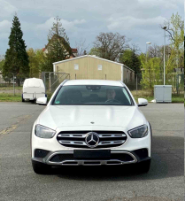
Figure 1: Station wagon: Mercedes-Benz model series 213 T-model (S213) (left). Subcompact car: VW Polo IV (9N3)) (middle). Participant indicating crossing behavior in front of an approaching vehicle (right).
Afterwards, a test track study with a within-subject variable in form of two different vehicle types was conducted. The two vehicles chosen (see Figure 1), a station wagon (Mercedes-Benz model series 213 T-model (S213)) and a subcompact car (VW Polo IV (9N3)), were of different sizes and designs, but white in color, in order to control the influence of vehicle color on road user behavior (Davies and Patel, 2005; Dey et al., 2019). The experimental procedure was identical for each vehicle type and the order of vehicle types was randomized: Five experimental trials with speeds between 10 and 30 km/h (10/15/20/25/30 km/h) were driven by a driver for each vehicle type. The vehicle was approaching the participant in the role of a pedestrian waiting at the roadside on a straight line starting at 50 m. To measure the dependent variable – the pedestrian’s crossing behavior – the participant was asked to step forward at the last moment when the road could still be comfortably crossed in front of the vehicle (see Figure 1) indicating the minimal accepted gap to cross (Faas et al., 2020). After the participant stepped forward, the vehicle was turned away.
To capture the independent variable – the perceived anthropomorphism of the vehicle – two different approaches were used: In the first approach of adjective naming applied before interacting with each vehicle type in the crossing scenario just explained, the participant was asked to describe the vehicle with up to six freely chosen adjectives (Kühn et al., 2014) serving as a basis for calculating the so-called “Open Anthropomorphism Degree” (OAD). After interacting with this vehicle type in the crossing scenario, the participant had the opportunity to add or change the adjectives originally named. Moreover, in the second approach of adjective ranking applied after interacting with each vehicle type in the crossing scenario, the participant was asked to rank order two given antonymous adjective lists, i.e., one list of given positive and one list of given negative adjectives, each consisting of four anthropomorphic (personality traits) and four non-anthropomorphic (mechanical attributes) adjectives (Chandler and Schwarz, 2010; Gössling, 2017; Windhager et al., 2012), according to how much the adjective applied to the vehicle (rank 1 (extremely applicable) to rank 8 (not applicable at all)) serving as a basis for calculating the so-called “Closed Anthropomorphism Degree” (CAD). Both lists were identical for both vehicles.
In addition, one ex-ante interview before the experimental trials provided information on the participant’s experiences with each vehicle type and one ex-post interview after the experimental trials provided information on vehi- cle aspects influencing the adjective naming for each vehicle type as well as on factors influencing the crossing decisions when interacting with each vehicle type.
After completing the procedure of five experimental trials as well as one ex-ante and one ex-post interview and description for each vehicle type, a brief survey was conducted. First, the participant filled in the IDAQ que- stionnaire as a measure of stable individual differences in the tendency to anthropomorphize (Waytz et al., 2010), was asked whether vehicles have a visually recognizable face in general and whether and why it has been easy or difficult to rate vehicles with adjectives. Second, to gain insights about the naturalness and generalizability of the experiment, the participant was asked to provide feedback to the experiment.
Experiment duration was approximately one hour per participant.
Participants Participants were recruited in the environment of Technical University of Darmstadt, gave written consent for study participation and received mone- tary compensation. The sample constituted of N = 20 participants (8 female, 12 male) aged 19 to 30 years (mean (M) = 24.55 years, standard deviation (SD) = 2.65 years, Median (Mdn) = 24.50 years). Each participant had a driver’s license and no participant has ever been involved in an accident as a pedestrian. Further data providing information on the participants’ affinity for technology and automobiles can be found in Table 1. Moreover, the IDAQ questionnaire (items rated on a 0 (not at all) to 10 (very much) scale) revea- led a dispositional anthropomorphic tendency of the collective of M = 4.42 (SD = 1.42, Min = 2.33, Max = 8.40). As an expression for anthropomor- phism in a vehicular context, three quarters of the participants stated that vehicles in general have a visually recognizable face.
Table 1. Descriptive data on study participants (N = 20).
Table available in the original PDF paper.
Characteristics of participants n % Profession related to technology yes 11 55.0 no 9 45.0 Profession related to automobiles yes 5 25.0 no 15 75.0 Hobby related to automobiles yes 4 20.0 no 16 80.0
Data Analysis In the first approach to operationalize perceived anthropomorphism of vehi- cles with adjective naming, three raters independently classified the adjectives named as either anthropomorphic (a = 1) or not anthropomorphic (a = 0)
Investigating the Influence of Perceived Anthropomorphism of Vehicles 5
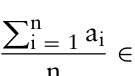
based on a common definition and understanding of anthropomorphism (Chandler and Schwarz, 2010; Kühn et al., 2014) and regarding their con- notation (negative, neutral, positive). The inter-rater reliabilities for the anthropomorphic coding (Fleiss Kappa: κ = 0.64) as well as for the con- notation coding (Fleiss Kappa: κ = 0.73) of the adjectives were substantial. In case of differences in coding, the adjective was discussed among the raters. Then, the OAD per vehicle type (V) per participant (P) was calculated by summing the anthropomorphic scores of the adjectives named by this parti- cipant for this vehicle type and dividing the sum by the number of adjectives named (n). Thus, the OAD has a value between 0 and 1, with higher value indicating higher perceived anthropomorphism:
Pn
Equation reproduced from the original PDF.
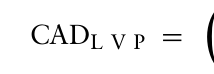
In the second approach to operationalize perceived anthropomorphism of vehicles with adjective ranking, the CAD was calculated separately for the list (L) of positive adjectives and the list of negative adjectives per vehicle type (V) per participant (P). Since both lists consisted of four anthropomorphic and four non-anthropomorphic adjectives respectively, a1, a2, a3, a4 correspond to the places of the four anthropomorphic adjectives per list. The normaliza- tion formula below was applied resulting in the CAD taking the value of 1, if all anthropomorphic adjectives were ranked in the first four of eight pla- ces and taking the value of 0, if all anthropomorphic adjectives were ranked in the last four of eight places. Thus, a higher CAD value indicates higher perceived anthropomorphism:
−5
× 1 −0
Equation reproduced from the original PDF.
1−a1 + a2 + a3 + a4 36
18
13 18−5 18 + 0 ∈[0; 1]
RESULTS
In the following, the results on the perceived vehicle appearance based on the two approaches of adjective ranking and naming and the results on the relationship between perceived anthropomorphism of vehicles and minimal gap of pedestrians are presented. The quantitative results are supplemented with qualitative data from the interviews.
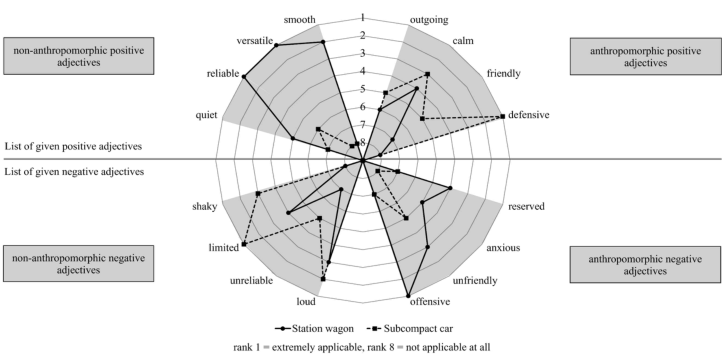
Vehicle Description Based on Adjective Ranking The modal values calculated for each adjective in the two given antony- mous adjective lists per vehicle type in the approach of adjective ranking for vehicle description are shown in Figure 2. The vehicle types were rated oppositely: The station wagon was assigned non-anthropomorphic positive as well as anthropomorphic negative adjectives while the subcompact car was assigned non-anthropomorphic negative as well as anthropomorphic positive adjectives.
Figure 2: Modal values based on the ranking of one list of given positive and one list of given negative adjectives each consisting of four non-anthropomorphic and four anthropomorphic adjectives (N = 20).
The statistical analysis confirmed the results based on the preceding descri- ptive analysis: For the station wagon, the CAD value based on the list with negative adjectives (Mdn = 0.75) was significantly higher than the CAD value based on the list with positive adjectives (Mdn = 0.16; Wilcoxon signed- rank test: z = −3.63, p < 0.001, r = 0.81, N = 20). Exactly opposite, for the subcompact car, the CAD value based on the list with positive adjectives (Mdn = 0.72) was significantly higher than the CAD value based on the list with negative adjectives (Mdn = 0.25; Wilcoxon signed-rank test: z = −3.91, p < 0.001, r = 0.87, N = 20).
In addition, the CAD value based on the list with positive adjectives was significantly higher for the subcompact car (Mdn = 0.72) than for the sta- tion wagon (Mdn = 0.16; Wilcoxon signed-rank test: z = −3.73, p < 0.001, r = 0.83, N = 20). On the contrary, the CAD value based on the list with nega- tive adjectives was significantly higher for the station wagon (Mdn = 0.75) than for the subcompact car (Mdn = 0.25; Wilcoxon signed-rank test: z = −3.81, p < 0.001, r = 0.85, N = 20).
Vehicle Description Based on Adjective Naming In the following, the results of the ex-post interviews on the vehicle aspe- cts influencing adjective naming are reported whereby the mention of each aspect by one participant per vehicle type was counted as one mention. The general vehicle appearance (in total: 17 times) was mentioned most often as well as the vehicle design, body, shape and proportions (in total: 12 times). In addition, the vehicle front including headlights and radiator grille (in total: 13 times) was named (Participant: “Mainly the front yes, I don’t know how to describe it but just this front … has a bit of this kind of mouth that is shaped downwards.”). In addition, the vehicle brand, model and type were named (in total: 11 times). Besides vehicle size (in total: 7 times), the vehicle age, condition and the presence or absence of scratches and damages (in total: 8
Investigating the Influence of Perceived Anthropomorphism of Vehicles 7
times) were mentioned. Some participants also referred to prior knowledge, experience and profession (in total: 4 times) as a source for vehicle descri- ption (Participant: “… because everyone who was 18 years old with us had a little VW Golf or something similar … and that is what people associate with it.”). Moreover, rims and tires (in total: 2 times) and details such as chrome components and plastic coverings (in total: 1 time) had an influence (Parti- cipant: “… for the adjective noble are details like chrome elements decisive and for the adjective robust e.g., the plastic trim on the wheel arches …”).
Table 2. Number of adjectives named by participants (N = 20) per vehicle type categorized as negative, neutral, positive as well as anthropomorphic (a), non-anthropomorphic (na).
As Table 2 shows, in the approach of adjective naming for vehicle descri- ption more adjectives were named for the station wagon (in total: 102 adjectives) than for the subcompact car (in total: 83 adjectives). Moreo- ver, the station wagon was predominantly described with positive adjectives, whereas the subcompact car was predominantly described with neutral adje- ctives and a nearly balanced number of positive and negative adjectives. For the station wagon over 71% of the negative adjectives named were coded as anthropomorphic and over 78% of the positive adjectives were coded as non-anthropomorphic. For the subcompact car almost 87% of the nega- tive adjectives named and almost 81% of the positive adjectives named were coded as non-anthropomorphic.
The descriptive data on OAD per vehicle type revealed that the station wagon (M = 0.23, SD = 0.17, Mdn = 0.25, Min = 0, Max = 0.50, N = 20) was described with more adjectives coded as anthropomorphic than the subcompact car (M = 0.09, SD = 0.20, Mdn = 0, Min = 0, Max = 0.75, N = 20). For the subcompact car, only five participants had an OAD value different from zero. Thus, in case of the subcompact car, the OAD value as a measure of perceived anthropomorphism of the vehicle was not further used to analyze its influence on pedestrians’ minimal gap when interacting with this vehicle type.
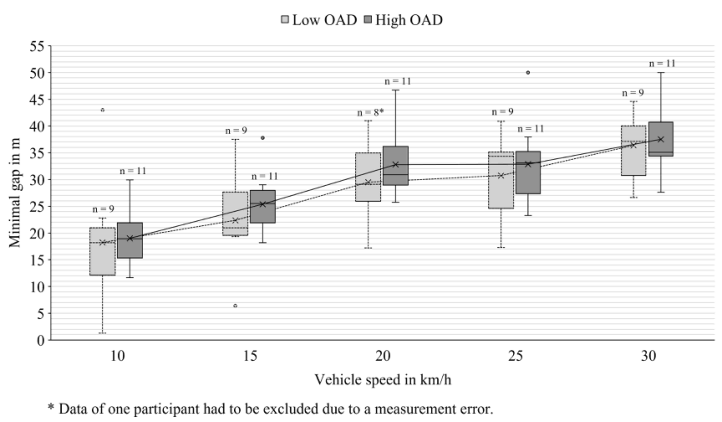
Relationship Between Vehicle Appearance and Minimal Gap To analyze the relationship between perceived appearance with respect to perceived anthropomorphism of the station wagon and minimal gap of pede- strians when crossing in front of it, a median-split of participants was made, assigning participants with an OAD value less than 0.25 to the low OAD
group (n = 9) and participants with an OAD value of 0.25 or greater to the high OAD group (n = 11) (see Figure 3). For none of the vehicle spe- eds driven, the Mann-Whitney-U-Test showed significant results indicating no difference in crossing decisions between low and high OAD groups when interacting with the station wagon (see Table 3).
Figure 3: Plot of descriptive data for the minimal gap in m of low and high OAD group at different vehicle speeds in km/h of the station wagon.Table 3. Minimal gap in m of low and high OAD group at different vehicle speeds in km/h of the station wagon and results of the Mann-Whitney-U-Test.
* Data of one participant had to be excluded due to a measurement error.
In the following, the results of the ex-post interviews on factors influencing the crossing decisions are reported whereby the mention of each factor by one participant per vehicle type was counted as one mention. The most frequently mentioned factors were vehicle speed (in total: 33 times), followed by vehicle distance and time to arrival (in total: 9 times). Moreover, engine noise as an indicator for vehicle speed (in total: 3 times) was named. In addition, the distance to the opposite street side and the estimated street crossing duration (in total: 3 times) as well as the emergence of discomfort and the instruction to
Investigating the Influence of Perceived Anthropomorphism of Vehicles 9
walk rather than run (in total: 4 times) determined the minimal gaps chosen, according to the participants. While one participant ruled out an influence, another participant saw a rather small, not further specified influence of the appearance of the subcompact car on the crossing decisions. In case of the station wagon, four participants mentioned its size and aggressive impression as determining factors.
DISCUSSION
This study adds to the current literature by analyzing the influence of perceived vehicle appearance, in particular perceived anthropomorphism of vehicles, on pedestrians’ crossing decisions in a test track study. Moreover, two different approaches for operationalizing perceived vehicle appearance were used. The detailed analysis of both approaches for vehicle description, the adjective naming and the adjective ranking, shows the station wagon to be primarily evaluated positively in terms of mechanical attributes, i.e., non- anthropomorphic adjectives, but primarily evaluated negatively in terms of personality traits, i.e., anthropomorphic adjectives. In contrast, the subcom- pact car is primarily negatively evaluated in terms of mechanical attributes, i.e., non-anthropomorphic adjectives, but primarily positively evaluated in terms of personality traits, i.e., anthropomorphic adjectives through the approach of adjective ranking. The results on the anthropomorphic connota- tions of both vehicle types in this study are in line with the study of Windhager et al. (2012), in which participants rated the station wagon as dominant, i.e., offensive and comparable subcompact cars as submissive, i.e., defensive on the scale of dominance.
However, the approach of adjective naming for operationalizing the degree of perceived anthropomorphism failed for the subcompact car, as three quar- ters of the participants did not name a single anthropomorphic adjective for it. According to the participants, few salient features made this vehicle diffi- cult to describe which illustrates the dependence of the ease and occurrence of anthropomorphization on the presence of specific observable human-like features (Epley et al., 2007).
In addition, all anthropomorphic negative adjectives used to describe the station wagon were added to the originally named adjectives after experie- ncing the vehicle in the crossing scenario indicating a change in the perception of vehicle appearance through interaction (Epley et al., 2007). Furthermore, although vehicle ratings were done sequentially, participants often drew com- parisons with the first vehicle when describing the second one. Therefore, a comparative vehicle description following the interaction might be worth pursuing in future studies.
Overall, the approach of adjective naming for vehicle description was found easy by seven, moderately difficult by five and difficult by six par- ticipants. In the latter two groups, three participants stated viewing vehicles in functional terms due to a low interest in vehicles in general and three par- ticipants stated being unfamiliar with describing vehicles with adjectives due to a lack of practice. Thus, the different evaluations of the subcompact car
between the approaches of adjective ranking and naming in terms of a stron- ger anthropomorphization of the vehicle in case of adjective ranking could also indicate participants being unable to verbalize their perception.
But, since not all people anthropomorphize objects in the same manner due to dispositional factors determining the tendency to anthropomorphize in everyday life (Waytz et al., 2010), the approach of ranking given adjectives bears the risk imputing a vehicle perception to the participants. Hence, the approach of adjective naming was chosen to operationalize perceived anth- ropomorphism of vehicles in order to analyze its influence on pedestrians’ crossing decisions (Kühn et al., 2014). In this study, no relationship betw- een the perceived anthropomorphism of the station wagon and pedestrians’ minimal gap when crossing the road in front of it was found.
In light of the expressed difficulties with adjective naming and given that some participants reported an influence of vehicle appearance on their inte- raction behavior, the lack of influence of perceived anthropomorphism of the station wagon on pedestrians’ crossing decisions in this study could be due to compensation mechanisms between anthropomorphic negative and non-anthropomorphic positive attributions to the vehicle which were fully evident in the adjective ranking. Matching these assumptions, in the study of Dey et al. (2019), the unfamiliarity and novelty of the Renault Twizy cancel- led out its perceived friendliness while the aggressive-looking BMW benefited from its familiarity in interaction with pedestrians. Highlighting the need to consider confounding factors, Klatt et al. (2016) only found an influence of the perceived power of large but not small vehicles on the crossing decision. It is possible that perceived power plays little or no role in case of small vehicles due to vehicle size.
Aspects that influenced the participants’ vehicle descriptions in this study were the vehicle size, front, brand, model, type, condition such as damages or scratches and the evaluator’s prior knowledge and experience. These factors determining anthropomorphic and non-anthropomorphic positive and nega- tive vehicle attributions should be controlled for and considered in future studies in order to analyze the influence of vehicle appearance on pedestrian behavior in detail.
ACKNOWLEDGMENT
This research was funded by research project “Campus FreeCity – real lab for the research of a networked fleet of modular robot vehicles”, carried out at the request of the Federal Ministry for Digital and Transport (BMDV), under research project No. 45KI15I091. The authors are solely responsible for the content and thank Louis Fay, Jana Haselberger, Benjamin Hettrich, Luca Kleibel and Jonathan Lang for their assistance in conducting the study.
REFERENCES
Aggarwal, Pankaj and McGill, Ann (2007). Is that car smiling at me? Schema congruity as a basis for evaluating anthropomorphized products, Journal of Consumer Research Volume 34 No. 4 pp. 468–479.
Investigating the Influence of Perceived Anthropomorphism of Vehicles 11
Chandler, Jesse and Schwarz, Norbert (2010). Use does not wear ragged the fabric of friendship: Thinking of objects as alive makes people less willing to replace them, Journal of Consumer Psychology Volume 20 No. 2 pp. 138–145. Davies, Graham and Patel, Darshana (2005). The influence of car and driver stere-
otypes on attributions of vehicle speed, position on the road and culpability in a road accident scenario, Legal and Criminological Psychology Volume 10 No. 1 pp. 45–62. Dey, Debargha, Martens, Marieke, Eggen, Berry and Terken, Jacques (2019).
Pedestrian road-crossing willingness as a function of vehicle automation, exter- nal appearance, and driving behaviour, Transportation Research Part F: Traffic Psychology and Behaviour Volume 65 pp. 191–205. Epley, Nicholas, Waytz, Adam and Cacioppo, John (2007). On seeing human: A three-factor theory of anthropomorphism, Psychological Review Volume 114 No. 4 pp. 864–886. Faas, Stefanie, Mattes, Stefan, Kao, Andrea and Baumann, Martin (2020). Effici-
ent paradigm to measure street-crossing onset time of pedestrians in video-based interactions with vehicles, Information Volume 11 No. 7 pp. 1–21. Gössling, Stefan (2017). The psychology of the car: Automobile admiration, attachment, and addiction, in: Gössling, Stefan (Ed.), Automobile personalities and (co) identities, Elsevier, pp. 47–65. Guthrie, Stewart (1993). Faces in the clouds: A new theory of religion. New York,
Oxford: Oxford University Press. Klatt, Wilhelm, Chesham, Alvin and Lobmaier, Janek (2016). Putting up a big front: Car design and size affect road-crossing behaviour, PLoS ONE Volume 11 No. 7 pp. 1–12. Kühn, Simone, Brick, Timothy, Müller, Barbara and Gallinat, Jürgen (2014). Is
this car looking at you? How anthropomorphism predicts fusiform face area activation when seeing cars, PLoS ONE Volume 9 No. 12 pp. 1–14. Petzoldt, Tibor (2014). On the relationship between pedestrian gap acceptance and time to arrival estimates, Accident Analysis and Prevention Volume 72 pp. 127–133. Purucker, Christian, Sprott, David and Herrmann, Andreas (2014). Consumer
response to car fronts: Eliciting biological preparedness with product design, Review of Managerial Science Volume 8 No. 4 pp. 523–540. Waytz, Adam, Cacioppo, John and Epley, Nicholas (2010). Who sees human?
The stability and importance of individual differences in anthropomorphism, Perspectives on Psychological Science Volume 5 No. 3 pp. 219–232. Windhager, Sonja, Bookstein, Fred, Grammer, Karl, Oberzaucher, Elisabeth, Said, Hasen, Slice, Dennis, Thorstensen, Truls and Schaefer, Katrin (2012). “Cars have their own faces”: Cross-cultural ratings of car shapes in biological (stereotypical) terms, Evolution and Human Behavior Volume 33 No. 2 pp. 109–120. Windhager, Sonja, Hutzler, Florian, Carbon, Claus-Christian, Oberzaucher, Elisa-
beth, Schaefer, Katrin, Thorstensen, Truls, Leder, Helmut and Grammer, Karl (2010). Laying eyes on headlights: Eye movements suggest facial features in cars, Collegium Antropologicum Volume 34 No. 3 pp. 1075–1080. Windhager, Sonja, Slice, Dennis, Schaefer, Katrin, Oberzaucher, Elisabeth, Thorstensen, Truls and Grammer, Karl (2008). Face to face: The perception of automotive designs, Human Nature Volume 19 No. 4 pp. 331–346.
LISTED IN THE AHFE DIGITAL BOOKSTORE CATALOGUE
Explore the complete digital volume
Human Factors in Transportation
Read this individual research paper free through the original publisher, or explore the full digital proceedings book.
ISBN 978-1-958651-71-1
Explore this ISBN in the AHFE Bookstore ↗Listed in the July 2026 bookstore catalogue; search by ISBN to confirm current availability · Digital book purchase optional