Benjamin Franz, Ilka Zöller, Michaela Kauer, Leander Schulz, Bettina Abendroth, Ralph Bruder (2021). Being “Always On” in Vehicles – The use of Apps While Driving Bears Risks. In: Advances in Human Aspects of Transportation: Part I. AHFE Open Access, vol. 15. https://doi.org/10.54941/ahfe100655
The availability of Smartphones leads to an increased demand for being “always on”. This demand does not only include being always on during everyday life but also demanding Smartphone usage while driving. Many previous studies have shown that using a mobile phone while driving does have an impact on driving safety, but little is known about Smartphone and infotainment usage. This paper presents an online survey with 215 participants, which was conducted at the Institute of Ergonomics of the Technische Universität Darmstadt. The aim of the survey was to identify needs, requirements, wishes and usage patterns of drivers to the issue of using mobile devices and infotainment systems during driving. Results show that current drivers use Smartphones and infotainment systems while driving, even though they are aware of the associated risks and have often experienced hazardous situations that can be traced back to that usage. Additionally, drivers perceived the usage of internet and applications as more distracting than the use of mobile phones. Still, participants were not willing to omit usage but rather demanded for better display and control concepts. The implications of the results are discussed within this paper.
In recent years a new automotive trend can be observed. While for many drivers making calls during driving is everyday life, the wish to use other media (e.g. internet, email) while driving increases. Also, with the rise of Smartphones (in Germany currently 62 % of all mobile phones are Smartphones; heise.de 2013) the trend to be “always on” is further strengthened. According to Toll Collect GmbH (2013), services and applications for being “always on” may become an important sales argument for passenger cars in the near future. Many car manufacturers recognized this trend and therefore are developing more and more modern infotainment systems, which additionally can often be coupled with Smartphones or have an integrated interface to establish an Internet connection. Volkswagen for example is working on an interface called Mirrorlink, which allows the user to mirror particular Smartphone apps onto in-car screens and controls (Gulde 2013). The author states, that hereby driver’s distractions should be reduced and advanced services could be available on inexpensive infotainment systems. Additionally, several in-car functions (e.g. heating, sidelights) will be controllable with special Smartphone remote-apps developed by Volkswagen (Gulde 2013). BMW is developing a system integrated into their Connected Drive strategy which creates a wifi hot spot in the car. According to Gökcek und Fischer (2013), up to 8 conventional wifi devices can be connected. Thus, services like video and music streaming or online gaming become available in the car. A similar system is under development by Daimler. The service called Command Online provides access to real time Human Aspects of Transportation I (2021) traffic information, personalized radio and social networks (cf. Gökcek und Fischer 2013). Also Audi (myAudi), Citroen (Etouch), Ford (MyFord), and Toyota (Entune) are developing similar systems which integrate the Smartphone into existing infotainment systems and enhance their capabilities through internet based services. In summary it can be said that automobiles are getting more and more linked to the internet and external services (e.g. Rees 2013). The market research company Juniper Research assumes that there will be around 92 million cars worldwide with access to the internet in 2016 (Cox und Anthony 2012). The consulting company McKinsey expects a billion networked automobiles in 2030 (cf. Gökcek und Fischer 2013). It can be assumed, that in near future the trend to be “always on” will increase further and more services will become available.
On one hand, the main benefit for the driver is a gain in comfort. For example information services (e.g. news, weather) can be used or text messages can be read aloud. On the other hand, the usage of advanced infotainment systems or Smartphones with widespread functions can distract the driver and cause dangerous situations. As the findings of the 100-Car-Naturalistic-Driving-Study show, the execution of a secondary task leads to inattention- related events (Dingus et al. 2006). Particularly, wireless devices were identified as the most distracting secondary task type for near crashes (Dingus et al. 2006). This effect can be explained with approaches like the multiple resource model by Wickens (1980), which describes the interplay of independent but limited attention resources (Wickens 2002). During the usage of non-driving related devices, parts of the driver’s mental resources are busy and therefore cannot be used for the driving task. While a phone call distracts the driver primarily in cognitive and auditive areas, the distraction during the usage of “always on” technology goes much further. Depending on the used applications, visual, cognitive, auditive and/or motoric distractions can result. In contrast to the well known and researched effects on making a phone call while driving (cf. meta-analyses by Caird et al. 2008; Horrey und Wickens 2006), the usage of Smartphones and modern infotainment systems is not yet sufficiently investigated. Therefore, this paper presents a survey on Smartphone and infotainment system usage while driving. First, the current state of the art is summarized. Afterwards the method of the survey will be presented. Subsequently, the results of the survey are shown and discussed. The paper closes with a conclusion section and an outlook on future research.
STATE OF THE ART In a survey performed by Allianz Technik Zentrum Austria (ATZ) it could be shown that 56 % of the younger participants (18 to 24 years) answer the phone while driving (ATZ Austria). Among the older participants (25 to 64 years) the phone is answered by 48 %. In contrast, 48 % of the younger participants and 32 % of the older drivers use the phone to actively call somebody while driving. In a similar study performed by Ford Germany, 47 % of the participants reported that they use the mobile phone while driving (Falk und Mundolf 2013). The results of the ATZ survey also show that 25 % of the younger and 22 % of the older drivers use the mobile phone to read and write emails and text messages (ATZ Austria). About 15 % of the younger and 3 % of the older drivers even admitted to use the mobile phone frequently for the aforementioned actions. A similar result was found by Ford Germany. In their study 21 % of the participants confirmed using a mobile device to write and read text messages while driving (Falk und Mundolf 2013). Also, a study by Valeo could show similar results (cf. Reilhac 2012).
The survey performed by ATZ also showed that 87 % of the younger drivers listen to music while driving and 90 % interact with their music device frequently (ATZ Austria). Similarly, 70 % of the older participants listen to music and 69 % operate their infotainment system while driving.
The above mentioned research results show that approximately every second driver makes phone calls while driving. In addition, about a fifth of all drivers reads and writes emails and text messages while driving. Also infotainment functions are used while driving. This is the case, even though the drivers are justifiably aware of the risk as will be shown below.
In the study by Valeo the participants stated that the usage of the mobile to make and answer phone calls, as well as writing and reading text messages or emails is clearly dangerous (Reilhac 2012). This perceived risk could be confirmed in several studies. The epidemiological studies performed by Violanti und Marshall (1996), Redelmeier und Tibshirani (1997), Young (2001), Lam (2002), Strayer und Drews (2003), and Laberge-Nadeau et al. (2003) Human Aspects of Transportation I (2021) consistently showed an increase in crashes associated with use of cell phones (cf. Caird et al. 2008; Horrey und Wickens 2006). Similar findings could be shown with several other types of additional tasks (cf. Stevens und Minton 2001; Stutts und Hunter 2003; Jamson und Merat 2005) like in-vehicle information systems (cf. Biever 2002) and voice-activated email systems (cf. Jamson et al. 2004; Lee et al. 2001). With respect to mobile phones and infotainment systems, research results indicate that cognitive distraction is the primary issue in driving impairments (cf. Hatfield und Chamberlain 2008).
In summary it can be stated that several non-driving related tasks are performed by the driver while driving and that those tasks increase the risk of accidents. It can be assumed that modern infotainment systems and Smartphones even increase that risk since they integrate more and more functions into the vehicle (cf. Grane und Bengtsson 2013; Bengtsson et al. 2003; Burnett und Mark Porter 2001). To the authors, no studies for the usage of modern infotainment systems and Smartphones are known. Therefore a survey was conducted at the Institute of Ergonomics of the Technische Universität Darmstadt. In the next section the method of the survey is described.
METHOD
A large online survey was conducted at the Institute of Ergonomics from the Technische Universität Darmstadt. The aim of the survey was to identify needs, requirements, wishes and usage patterns of drivers to the issue of using mobile devices and infotainment systems during driving. The survey involved n = 215 participants (158 male; 57 female) with ages range from 19 years to 70 years (mean = 34.3 years, sd = 12.9 years). Participants were confronted with 23 section blocks with a maximum of 12 questions per block. The format of the questions varied between the different sections and is explained for each question directly in the next chapter. The survey took about 10 minutes and was online between June and September 2013. Participants were recruited via Internet and notices.
RESULTS AND DISCUSSION
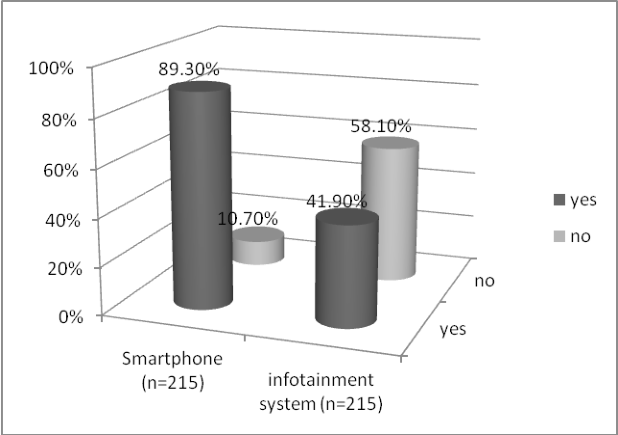
Results of the survey underline the wishes of today’s drivers to have access to the internet and to various applications under way. To answer the first questions concerning the usage/availability of Smartphone and infotainment the participants had to choose between the two nominal scale values “yes” or “no”. As shown in figure 1, nearly 90 % of the survey participants have a Smartphone. Even more surprising is the availability of infotainment systems among the interviewees. 41.90 % drive a car with integrated infotainment system, even though these solutions are expensive.
Human Aspects of Transportation I (2021)
Figure 1: Availability of Smartphone and infotainment system among the participants.
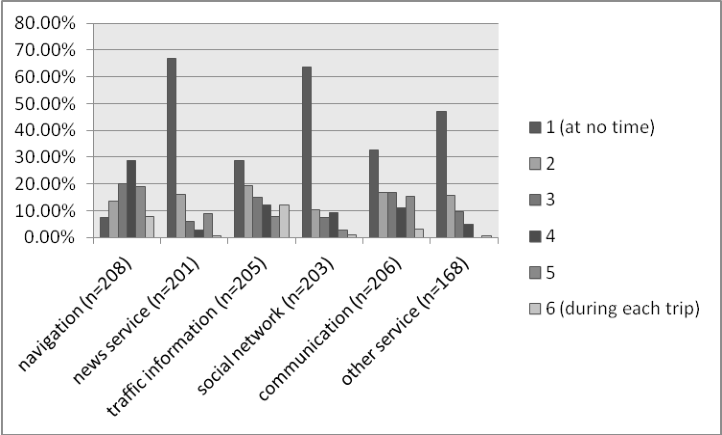
The results manifest the above written statement that customer demands are tending towards being “always on”. Automotive manufacturers have already recognized these wishes. First apps have been listed in the chapter “state of the art”. However, it is questionable if the offered applications and solutions match with the customer demands. Figure 2 presents the usage of different applications while driving (6 point likert scale from 1 “at no time” to 6 “during each trip”).
Figure 2: Use of applications while driving.
As can be seen in figure 2 about 30 % of the participants in the study admitted to use at least some times news services or social networks while driving. The results for using communication services are even worse. Over 60 % of the participants use communication while driving. This is almost three times the amount of younger people that admitted to use mobile phones under way for reading and writing mails (cf. ATZ Austria).
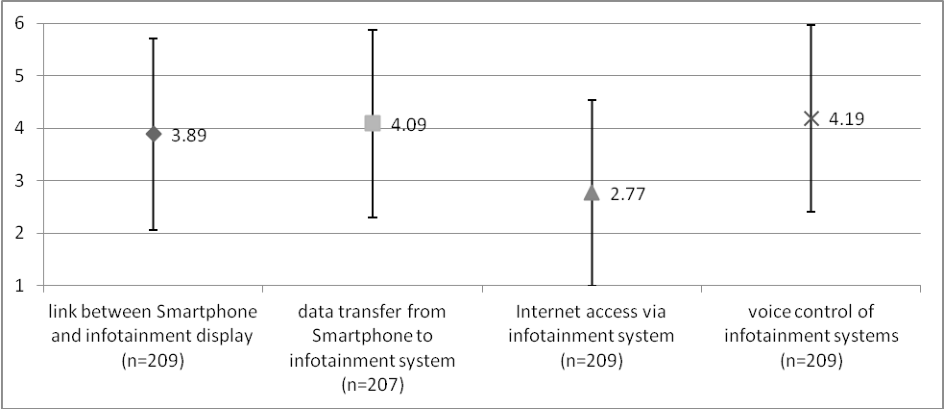
Another important point is the customer request regarding the interfaces and control options of infotainment systems. Do the offers currently available at market match the wishes and requirements? Figure 3 shows the average rating and standard deviation (on a 6 point likert scale from 1 “not interested” to 6 “very interested”) for various Human Aspects of Transportation I (2021) system functions.
Figure 3: Average rating and standard deviation for various infotainment system functions.
The results show a high demand for better control of current devices. Most participants did not want internet access via infotainment system but were interested in controlling their Smartphone via infotainment and viewing and using their contents on an infotainment system. Those findings lead to the conclusion that drivers are at least partially aware of the risks that they are accepting by using inappropriate devices during driving. This is further confirmed by the number of hazardous situations due to Smartphone handling (cf. figure 4). But results do also show that this awareness does not lead to a decreased usage of inappropriate devices, but to a demand of new forms of interaction (e.g. voice control).
Voice control functions could be a good solution in order to reduce distraction of the driver as the time during which a driver looks away from road is decreased.
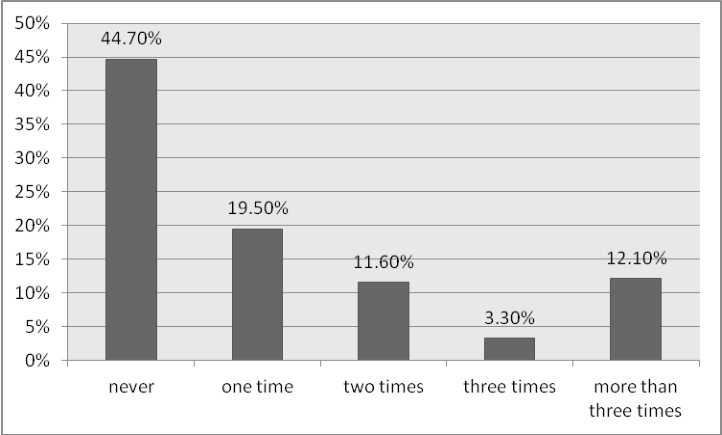
A substantial indication of the importance of such voice related developments is the frequency of hazardous situations triggered by handling applications by hand. The participants were asked to answer a previous question concerning the frequency of experienced hazardous situations. 6 options to answer the question were given from “never” to “more than three times” (see figure 4) and, in addition, the possibility of “no statement”. Results are shown in figure 4. Over 50 % of the participants that answered the question (n=196) confirm that they had been in a hazardous situation for one time or more because of using a Smartphone for applications or calling.
Human Aspects of Transportation I (2021)
Figure 4: Frequency of hazardous situations caused by handling a Smartphone (n=196).
It seems quite clear that drivers are aware of the risk of using Smartphones while driving but are not willing to omit usage. Additionally, drivers seem to accept the control of their Smartphone content via infotainment systems as an appropriate solution. This has to be regarded as critical, because former studies were able to show that the usage of infotainment systems does also increase the risk while driving (cf. Hatfield und Chamberlain 2008; Biever 2002).
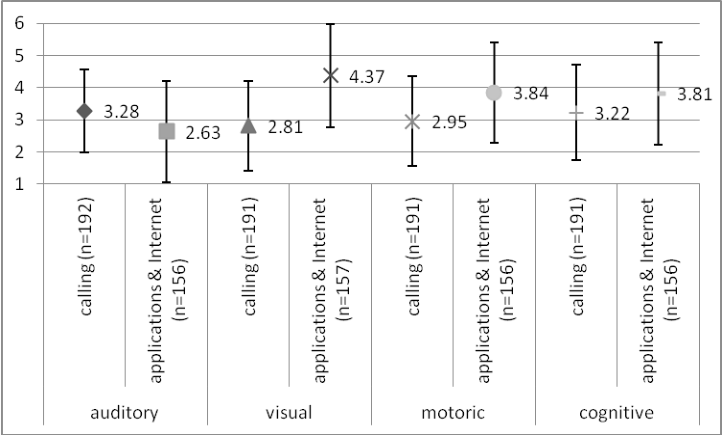
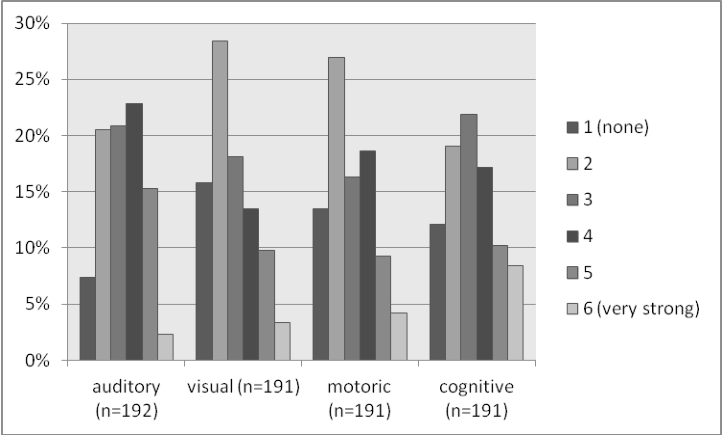
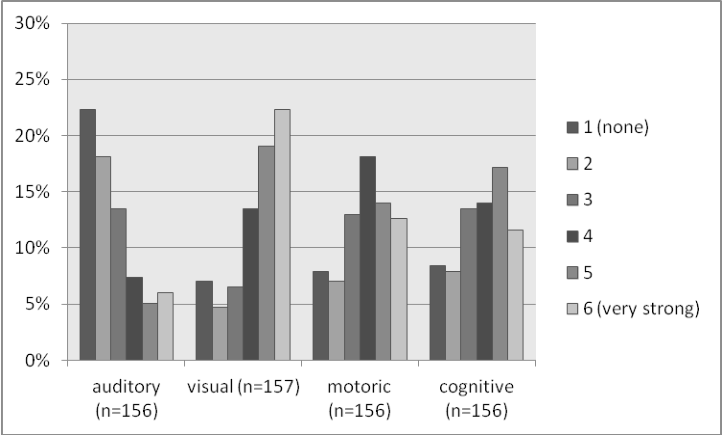
To get an impression about the personally perceived distraction, participants were asked how distractive the usage of applications and Internet is in contrast to making and receiving calls. The question was divided in the four distraction categories: auditory, visual, motoric and cognitive. The answers had to be given on a 6 point likert scale from 1 “none” to 6 “very strong”. Mean scale value and standard deviation are shown in figures 5. Corresponding bar graphs are pictured in figures 6 and 7.
Figure 5: Perceived distraction by making a phone call or using applications and Internet while driving (from 1 “none” to 6 “very strong”).
With the exception of auditory distraction the participants rated applications and Internet using as more distractive than calling. A t-test shows that the differences are significant for visual distraction (t = -9.631, df = 147, p = 0.000), Human Aspects of Transportation I (2021) motoric distraction (t = -7.250, df = 146, p = 0.000) and cognitive distraction (t = -5,784, df = 146, p = 0.000). One result that needs to be classified as very critical is the perceived visual distraction. As nearly 90 % of the important information for driving is perceived visually, a visual distraction leads to safety critical situations. The auditory distraction, however, is rated to be less distractive while using applications or Internet. This difference is also significant (t = 4.378, df = 146, p = 0.000). It can therefore be concluded that voice control functions would be a possible alternative for presenting app contents.
Figure 6: Perceived distraction by making or receiving calls while driving.Figure 7: Perceived distraction by using applications or Internet while driving.
The results of the study are summarized within the next section and conclusions are drawn for further development of display and control elements.
Human Aspects of Transportation I (2021)
CONCLUSIONS
The results of this study show that drivers use Smartphones and Smartphone applications while driving, even though they are aware of the associated risks and over 50% of them already experienced hazardous situations in this context. In combination with the demand for better access to Smartphone contents via infotainment system, this leads to the conclusion that current drivers do have a permanent demand for being “always on” and that they are not willing to omit this. Furthermore, this study was able to show that the perceived distraction by applications and internet is perceived to be significantly higher than that of calling and receiving calls, especially in the area of visual attention. This is critical, because visual attention is one of the main aspects for safe driving.
Those results show that the distraction of the driver is dependent on the display and control concept. In combination with former research, showing that the usage of infotainment systems does have a negative impact on driving (cf. Hatfield und Chamberlain 2008; Biever 2002), it becomes clear that an adaptation of current display and control concepts is necessary.
Possible ways to meet the distraction problem are new solutions that use the auditory or haptic modality to reduce driver workload and consequently increasing safety (cf. Bengtsson et al. 2003; Damiani et al. 2009). The feasibility of auditory or mixed visual-auditory solutions was already shown by Jamson und Merat (2005) and Liu (2001) who demonstrated a faster response to that information and a more accurate performance compared purely visual information. This goes along with findings of Treisman und Davies (1973, cited by Wickens 2002) that stated that dual task performance is weaker when two visual tasks must be performed and increases by mixed tasks. Those findings were replicated multiple times (cf. Wickens und Seppelt 2002). Additionally, new display concepts such as head-up displays, Google glasses or adaptable displays have to be investigated in terms of usability in the driving context. It is expected that the visual distraction of those new displays is significantly reduced in comparison to the usage of Smartphone or the display of Smartphone context via the infotainment system.
REFERENCES
Literaturverzeichnis ATZ Austria: Allianz Studie: Junge Autofahrer lassen sich leichter ablenken. Online verfügbar unter https://www.allianz.at/v_1351517993000/privatkunden/media-newsroom/news/aktuelle-news/pa-download/ 20121029_pa_ablenkung_strassenverkehr.pdf. Bengtsson, Peter; Grane, Camilla; Isaksson, Jessica (2003): Haptic/graphic interface for in-vehicle comfort
functions-a simulator study and an experimental. In: Proceedings of the 2nd IEEE International Workshop on Haptic, Audio and Visual Environments and Their Applications. Haptic, Audio and Visual Environments and Their Applications: IEEE, S. 25–29. Biever, Wayne J. (2002): Auditory-based supplemental information processing demand effects on driving performance. Master Thesis. Virginia Polytechnic, Virginia. Industrial and Systems Engineering. Burnett, Gary E.; Mark Porter, J. (2001): Ubiquitous computing within cars: designing controls for non-visual use.
In: International Journal of Human-Computer Studies 55 (4), S. 521–531. Caird, Jeff K.; Willness, Chelsea R.; Steel, Piers; Scialfa, Chip (2008): A meta-analysis of the effects of cell phones on driver performance. In: Accident Analysis & Prevention 40 (4), S. 1282–1293. Cox; Anthony (2012): Press Release: Internet Connected Cars to Exceed 90 Million by 2016 with Smartphones
Playing a Pivotal Role. Online verfügbar unter http://www.juniperresearch.com/viewpressrelease.php?pr=292, zuletzt geprüft am 24.02.2014. Damiani, Sergio; Deregibus, Enrica; Andreone, Luisa (2009): Driver-vehicle interfaces and interaction: where are they going? In: European transport research review 1 (2), S. 87–96. Dingus, T. A.; Klauer, S. G.; Neale, V. L.; Petersen, A.; Lee, S. E.; Sudweeks, J. et al. (2006): The 100-Car
Naturalistic Driving Study: Phase II – Results of the 100-Car Field Experiment. Hg. v. National Highway Traffic Safety Administration. Washington, D.C. Falk, Beate; Mundolf, Ute (2013): Studie: Das Auto als Schnittstelle sozialer Interaktionen. Ford. Online verfügbar unter http://www.presseportal.de/pm/6955/2564835/studie-das-auto-als-schnittstelle-sozialer-interaktionen,
Human Aspects of Transportation I (2021) zuletzt geprüft am 24.02.2014. Gökcek, Erol; Fischer, Edwin (2013): Mobilfunk-Infrastruktur auf die vernetzte Autowelt vorbereitet. In: ATZ agenda (11), S. 39–40. Grane, Camilla; Bengtsson, Peter (2013): Driving performance during visual and haptic menu selection with invehicle rotary device. In: Transportation research part F: traffic psychology and behaviour 18, S. 123–135. Gulde, Dirk (2013): Neue Online-Dienste. In: auto motor sport (19), S. 134–135. Hatfield, Julie; Chamberlain, Timothy (2008): The effect of audio materials from a rear-seat audiovisual entertainment system or from radio on simulated driving. In: Transportation research part F: traffic psychology and behaviour 11 (1), S. 52–60. heise.de (2013): Studie: Smartphones verdrängen Handys in Deutschland. Online verfügbar unter
http://www.heise.de/newsticker/meldung/Studie-Smartphones-verdraengen-Handys-in-Deutschland- 1929520.html. Horrey, William J.; Wickens, Christopher D. (2006): Examining the impact of cell phone conversations on driving using meta-analytic techniques. In: Human Factors: The Journal of the Human Factors and Ergonomics Society 48 (1), S. 196–205. Jamson, A. Hamish; Westerman, Stephen J.; Hockey, G Robert J; Carsten, Oliver M. J. (2004): Speech-based e-mail
and driver behavior: Effects of an in-vehicle message system interface. In: Human Factors: The Journal of the Human Factors and Ergonomics Society 46 (4), S. 625–639. Jamson, Hamish A.; Merat, Natasha (2005): Surrogate in-vehicle information systems and driver behaviour: Effects of visual and cognitive load in simulated rural driving. In: Transportation research part F: traffic psychology and behaviour 8 (2), S. 79–96. Laberge-Nadeau, Claire; Maag, Urs; Bellavance, François; Lapierre, Sophie D.; Desjardins, Denise; Messier,
Stéphane; Saı̈di, Abdelnasser (2003): Wireless telephones and the risk of road crashes. In: Accident Analysis & Prevention 35 (5), S. 649–660. Lam, Lawrence T. (2002): Distractions and the risk of car crash injury: The effect of drivers' age. In: Journal of Safety Research 33 (3), S. 411–419. Lee, John D.; Caven, Brent; Haake, Steven; Brown, Timothy L. (2001): Speech-based interaction with in-vehicle
computers: The effect of speech-based e-mail on drivers' attention to the roadway. In: Human Factors: The Journal of the Human Factors and Ergonomics Society 43 (4), S. 631–640. Liu, Yung-Ching (2001): Comparative study of the effects of auditory, visual and multimodality displays on drivers' performance in advanced traveller information systems. In: Ergonomics 44 (4), S. 425–442. Redelmeier, Donald A.; Tibshirani, Robert J. (1997): Is using a car phone like driving drunk? In: Chance 10 (2), S.
5–9. Rees, Jürgen (2013): Wer denkt sich denn so was aus? In: WirtschaftsWoche (10), S. 88–92. Reilhac, Patrice (2012): Valeo Intuitive Driving. Valeo Comfort & Driving Assistance Business Group. Brussels,
2012. Online verfügbar unter http://www.earpa.eu/ENGINE/FILES/EARPA/WEBSITE/UPLOAD/FILE/2013/earpa_conference_2_october_2 013___valeo___patrice_reilhac.pdf, zuletzt geprüft am 24.02.2014. Stevens, Alan; Minton, Roy (2001): In-vehicle distraction and fatal accidents in England and Wales. In: Accident Analysis & Prevention 33 (4), S. 539–545. Strayer, David L.; Drews, Frank A. (2003): Effects of cell phone conversations on younger and older drivers. In:
Proceedings of the Human Factors and Ergonomics Society Annual Meeting. Human Factors and Ergonomics Society Annual Meeting: SAGE Publications (16), S. 1860–1864. Stutts, Jane C.; Hunter, William W. (2003): Driver inattention, driver distraction and traffic crashes. In: ITE journal 73 (7), S. 34–45. Toll Collect GmbH (2013): LKW-Maut in Deutschland. Nutzerinformationen. Berlin. Treisman, A.; Davies, A. (1973): Divided attention between eye and ear. In: Attention and Perjormance IV, S.
KORNBLUM (Editor). Academic Press, New York. Violanti, John M.; Marshall, James R. (1996): Cellular phones and traffic accidents: an epidemiological approach.
In: Accident Analysis & Prevention 28 (2), S. 265–270. Wickens, Christopher D. (1980): The Structure of Attentional Resources. In: Raymond S. Nickerson (Hg.): Attention and Performance VIII. Hillsdale, New Jersey: Lawrence Erlbaum Associates, Inc., S. 239–258. Wickens, Christopher D. (2002): Multiple Resources and Performance Prediction. In: Theoretical issues in
ergonomics science 3 (2), S. 159–177. Wickens, Christopher D.; Seppelt, Bobbie (2002): Interference with driving or in-vehicle task information: The effects of auditory versus visual delivery. In: Savoy: IL: University of Illinois, Aviation human factors division. Young, Richard A. (2001): Association between embedded cellular phone calls and vehicle crashes involving airbag
Human Aspects of Transportation I (2021) deployment. In: Proceedings of the 1st International Driving Symposium on Human Factors in Driver Assessment, Training, and Vehicle Design. Human Factors in Driver Assessment, Training, and Vehicle Design. Aspen, S. 390–400.
Human Aspects of Transportation I (2021)
LISTED IN THE AHFE DIGITAL BOOKSTORE CATALOGUE
Explore the complete digital volume
Advances in Human Aspects of Transportation: Part I
Read this individual research paper free through the original publisher, or explore the full digital proceedings book.
ISBN 978-1-4951-2097-8
Explore this ISBN in the AHFE Bookstore ↗Listed in the July 2026 bookstore catalogue; search by ISBN to confirm current availability · Digital book purchase optional