Massimo Di Nicolantonio, Giuseppe Di Bucchianico e Sefania Camplone (2021). The Visual Pleasantness in Yacht Design: Natural Lighting, View and Interior Colors. In: Advances in Human Aspects of Transportation: Part I. AHFE Open Access, vol. 15. https://doi.org/10.54941/ahfe100615
The quality of the environment is closely related to the control and the availability of natural lighting and possible views. In the field of yachting, however, the design solution of the hulls and the environments often makes this relations especially critical the availability of natural light and views inside the boat. Anyway, the demands of representation and sociality required, needs the introduction of new systems of windows, terraces and new layouts, to relate the interior of the boats with the deck, attributing new meanings within the social idea of “going into the sea". This is how the small portholes, with the original function of air environments, aspire to become large openings for dialogue with the sky and sea. However, the unstable horizon of the boat, and the dynamic changing nature of views and natural lighting, generate very difficult conditions about the control of the factors which can help to determine the good size of the domestic interiors and their relationship with the environment. The paper presents the results of a research on the topic of visual pleasantness in yachting, conducted at the Department of Architecture, University "G. D'Annunzio "of Chieti-Pescara (Italy). The research has developed a system of guidelines for the aware-design of the openings to the outside in the nautical living spaces, taking into account the constraints imposed by the marine environment, activities and postures of users, as well as natural lighting and views, according with the knowledge that the control of these factors contribute to the overall quality of the project.
INTRODUCTION: NEW IDEAS OF “TRASPARENCY” IN YACHT DESIGN In recent years, the yachting industry has had an unprecedented expansion and evolution. Technological development has been complemented by experimental research of new layout solutions, new product concepts and new morphologies, where the methodologies, techniques and tools of the project have responded with unprecedented dynamism, research and verification solutions that guarantee the improvement of each performance, putting the end user at the center of the whole creative process, executive and productive. Leaving outside other sociological digressions, today it is known that the yachting boats are not only for transportation, for competition or for exploration, but increasingly assume the role of status symbols, places of representation with high social value. It is therefore inevitable that the spaces above and below the deck, need substantial technical and functional changes. Referring to the range of the sailing yachts of medium and large size, the attention of the yacht designers today take care both to the pleasure of sailing conditions that to the living conditions on board, in fact changing spatiality and Human Aspects of Transportation I (2021) shapes. To obtain the best organization of the interior living spaces, the designers tends to preserve the most typical layouts, with the living area placed mainly at the center of the boat, at the area volumetrically larger. New materials and advanced technologies, like composite materials, structural glazing, plumbing, home automation systems, contribute to improve the performance values of the boat, and make possible new ways of living the boat.
The new technological solutions improve the operating conditions of the crew, so it’s possible to reduce the number of crew members, to reduce the crew area. It’s now possible to create larger living external spaces, separated and organized better to increase the levels of comfort and hospitality. But the most significant innovations are related with the interior and the research about their "transparency": the interiors are no longer small, dark, cramped, protective.
The interiors tend to "open-up" to the surrounding environment, giving new social meaning to the idea of “going into the sea". The small portholes, originally designed to ventilate the interior, now becomes large openings, so the crew can really dialogue with the sea and the sky, from the interiors of the boat. Hulls and decks structures are cut from large windows. The walls can be more transparents, and the crew can live in dialogue with the sea and nature. New physical and visual relationships between interior and exterior of the boat are established, through the inclusion of unpublished terraces and openings.
In this context of technological innovation and space control experimentation, these new visual attractiveness represent strategic project proposal, both referring to the "views" and the possibility for the crew to relate visually from the surrounding natural environment, both reported to control the quantity and quality of natural light that invests on a daily basis the inside of the boats, which often must be shielded in order to obtain acceptable levels of visual comfort.
The paper reports the results of research about Visual Pleasantness in Yacht Design, conducted as part of a Master's Degree Thesis developed at the Department of Architecture, University "G. d'Annunzio "of Chieti-Pescara (Italy).
OBJECTIVES: VERIFY AND ASSESS THE VISUAL PLEASANTNESS ON BOARD The visual comfort in any indoor environment is the result of several factors:
The natural and artificial lighting, the colors, the views, the shape of the space (narrow and long, wide and high, etc..), which must be carefully related to each other in order to produce well-being and malaise. In particular, most of these aspects are derived directly from the sizing, the shape and positioning of any openings to the outside. Added to these are the aspects of "color". The use of color displays and in general the tone of natural light incoming from outside that can change during the passage through the openings transparent or translucent. Natural light that can be direct or indirect. The research was conducted with an initial investigation of the general nature on the visual comfort subject through the natural and artificial lighting and through the use of color and its effects on the man, and also investigating to those activities the user is going to do into these specific environments. This study was preliminary and extremely useful for defining the research objectives, and to obtain qualitative data on the attractiveness of the apertures towards outside and the colors in the living area of the yacht. Two the issues of the choice referred first to a sailing yacht, with defined dimensions, and second, of a specific environment. First, the choice of the size of the sailing yacht of 15 meters is due to the fact that the interior layout of this type of boat of this dimension can be considered a good compromise between a marine space and architectural civil space. Smallest sailing yachts have internal spaces similar to cockpits. On the contrary, the environment of this type of boat can be compared to those of the civil architecture, which lead to a different spatial perception from that of the interior of a boat.
Second, the choice to conduct the experiment on the living area, because it is the common and the most experienced space of the yacht. This particular environment, defined “square”, represents the social area of the yacht, generated by the union of the saloon (dining-living room) and the kitchen: so, you are preparing and consuming food, relax, it makes conversation, often also special spatial conditions (a boat tilted, in continuous movement, etc..).
METHOD: THE PBA (PLEASURE BASED APPROACH) The research is part of the most famous experiments in applied ergonomics that make reference to the so-called Pleasure-Based Approach. The designers use this methodologies to know the needs and desires of the target through tests with specific groups of individuals at any stage of design.
The SeQUAM as reference method In particular, the organization of the experimental phase has made reference to the SeQUAM 1 method, with some changes due to the specific contexts of use. The SeQUAM method provides an experimentation in three different stages.
First phase, defined as "investigation on the present". In this phase objects with particular interesting aspects of pleasantness are selected from those offered by the market, and investigated. The purpose is to find useful indications to guide the design of the necessary experimental maquettes to a subsequent systematic study of the individual components of pleasantness. This first phase has been investigated by a number of specific "observation matrix".
Second phase, called "Innovation Survey". This phase consists of objects/maquettes specially made for research, which should be enabled to investigate the parameters appeared more promising in the first phase. The "maquettes" are designed to be used by the sample in situations of "low noise", without preconceptions. In our case, the test results with the results of cross matrices have led to a significant design guidelines.
Third phase of SeQUAM. "Verification on the prototype". It requires to carry out research on working prototypes that have all the characteristics of the finished product and which are included in the correct environment, from the functional point of view, and from that formal point of view. Last, that can be used in real conditions by potential users.
In our case the third phase did not take place.
First phase: The M1 and M2 Matrixes To carry out the '"analysis on the current" in a structured way, the research developed two matrices or cards classification. The matrix M1 refers to the "analysis of the views" and it is a table that organizes: the "elements" and "criteria" to analyze the views to the outside ". In particular, among the "elements" are considered some aspects of identification of vessels analyzed, and especially the vertical and horizontal elements having the ability to control the stimuli coming from the outside, ie the four "directions" in which are inserted apertures (at the bow , aft to the bulwarks, on the ceiling). Among the "Criteria", however, have been shown: position of the openings/transparent surfaces, with which you can benefit from it the view posture (standing, sitting, half-lying, lying), and finally what kind of view of return openings (circumscribed, elongated, fragmented, overview). The use of the matrix M1 has allowed us to analyze a sample sufficiently significant of boats. The matrix M2 refers to the "analysis of the use of colors" and it is a table that organizes: the "elements" and "criteria" to analyze the use of color in the living spaces of the yachts. In particular, among the "elements" are considered some aspects of the yachts analyzed identifiers (name, images of the square) and especially the opaque surfaces of the living area like as the deck, the sides, the bulkheads and the Top. Among the "Criteria", however, have been shown, each part has its own color with high gloss levels, those characterized by colors that convey similar feelings, with those colors that convey different sensations. Also in this case the use of the matrix M2 has allowed to analyze and systematize the data referring to a significant sample of yachts.
1 The SEQUAM method (Method for Sensory Quality Evaluation) was developed by L. Bandini Buti and L. Bonapace, since 1992, as part of a project for FIAT Auto aimed at increasing the levels of pleasantness perceived by users during eye contact, touch and body parts and components of motor vehicles. Human Aspects of Transportation I (2021)
Table 1: Matrix M1 “analysis of the views”.
Table available in the original PDF paper.
Table 2: Matrix M2 “analysis of the use of colors”.
Table available in the original PDF paper.
Second phase: the maquettes/render scenes This phase of the research has the aim of obtaining qualitative data on the attractiveness of the views to the outside, the colors, related to the living area of a sailing boat. An evaluation test was designed to investigate the “new tendencies”. For the experimentation was used a questionnaire accompanied by some "maquettes" , in respect of which, was asked to give the judgment of pleasantness.
The variables evaluated (and on which were carried out maquette/render scenes) were considered with respect to: 1. placement of transparent surfaces; 2. posture of the individual for the views; 3. kind of fruition views; 4. dyes for coloring matt surfaces. The sample was composed of 26 members, divided in three age groups between 21 and 65 years, 13 of them with experience in sailing and 13 with no experience of sailing.
Table 3: Maquettes.
Table available in the original PDF paper.
In particular, users had to answer a questionnaire based on some cards containing render scenes describing an "environment type", to which we must make a judgment. The reproduced scenes on each card are different only for the feature that is intended to investigate. The ratings of pleasantness judgments were expressed using a simple rating scale (1: no pleasant; 10: very pleasant), with the possibility of indicate intermediate values. Each judgment of pleasantness expressed in numerical form (quantitative assessment), was also required to associate an explicit "motivation" (qualitative judgment). The scenes for which we asked to give the judgments of pleasantness were 61, divided into 8 tabs. Each tab on the back reported two questions to answer. Assuming an average rating for each scene of 15 seconds, a minute and a half to meet every couple of questions, and adding about five or six minutes to fill out the Getting Started tab and be informed on the tasks to be performed, it is previously calculated overall average length of proof in about 40-45 min., a time short enough to keep the attention and get answers instinctive enough, and at the same time sufficiently long to avoid a hasty compilation of the questionnaire. Even the conduct of the trial has been designed in detail, describing in detail the activities and roles of the researcher to obtain sufficiently objective. The test was carried out in the laboratory.
RESULTS
The results are organized in respect of two aspects. The first concerns the system of guidelines for the design aware of the apertures to the outside in the living nautical spaces and for the use of colors. The second consists in a further study reported the possible control systems of the quality and quantity of light through natural apertures which could be transparent or translucent.
Data Analysis and Guidelines The data collected were allowed to organize guidelines respect to placement of the apertures (and their respective openings that allow it); postures to enjoy the apertures, the type of use of the views. The data collected were allowed to organize in more general terms, the requirements relating to internal living spaces for sailing boats of similar size to those analyzed are attributable to the following concepts: highest availability of free surfaces on the sides; convertibility, mobility and flexibility use of equipment and furnishings to allow variability exhibition set up environments; maximum spaciousness and maximum usability views.
The same comparison was conducted with respect to the use of colors. In this case, the guidelines have been organized with respect to dyes to color the side surfaces of matt colors for opaque surfaces at the bottom (deck); colors for opaque surfaces at the top (Top). In more general terms, the requirements related to the use of the colors were: transformability (possibility to change the colors also instantly depending on the prevailing activities) and high gloss.
Daylight control systems Another interesting study of our research has focused on the identification of possible smart systems to control the quality and quantity of natural light that passes through the transparent or translucent into the yachts. Our attention was focused to the identification of a useful smart system for screening:
control the amount of natural light that penetrates inside at certain times of the day and to specific conditions and changing orientation of the yacht relative to the position of the sun (mostly because of the so-called "greenhouse effect"); the choice of the quality of natural light, even filtered through special screening systems that can help to determine new shades for specific environmental conditions and activities.
The research is focused on chromogenic devices that also allow you to greatly reduce the energy consumption for cooling and lighting in the indoor environment, in our case of a yacht. In marine applications, the control of the solar factor referred to the transparent or translucent parts o is very important for maintaining the thermal comfort of the microclimate, as well as to provide specific visual, high levels of security and privacy levels that can may differ if related with internal and external factors to the yacht. The control of "natural light" or "sunlight" depends on the type of yacht, the weather, the seasons, the different times of the day and on the characteristics of use. The use of chromogenic materials is more effective than the use of traditional solar shading systems such as: blinds, curtains, drapes and many others. The systems chromogenic materials are characterized by the ability to modify the optical properties with a reversible effect, following the application of an electrical stimulus, heat or light. According to their behavior identify four types of chromogenic materials: liquid crystals, electrochemical, photochromic, thermochromic. In our case the device chromogenic photochromic proved potentially more effective compared to the specific conditions of use. In particular, these devices are sensitive to environmental parameters and placed in special "smart windows", react with the gradual and reversible change of its color when exposed to light stimuli of varying intensity (UV exposure). With the same technology is also possible to control the tint of the light, turning the transparent surface in a real color filter.
CONCLUSIONS
The system of guidelines referred to the design of the apertures to the outside, have allowed a deepening next in terms of design possible responses. The starting point of view, related with the innovative way of relationship between interior and exterior spaces of the sailing yacht, through the combination of the data produced by research and the new concept referring to the relationship between the product and the marine environment, has had great influence on the proposal of the final concept . At last, we find the solution through two ways of action.
New interior concept: about the interiors we choose to reconfigure the living area , through the use of large apertures on both sides of the hull and on the deck of the yacht. This choice, obtained with the aid of intelligent control systems of the intensity of natural light, and with the aid off the control systems of the staining, allowed us to optimize the relationship with the natural environment.
New exterior concept: we have found new technological and formal solutions for the exterior design, that could highlight the innovation represented by large apertures. The first step was to redesign a structural framework that would guarantee the stability of the entire system under the effect of stress from which a yacht is constantly subject. Second one, we needed to rethink the yacht starting by the elements that characterize the morphological forms of the hull.
All the design choices implemented have allowed us to develop the project of a boat with extremely innovative solutions in terms of morphological, structural and distribution . All the solutions were allowed , especially in the middle of the square, to get a visual relationship with the external environment is extremely flexible, instantly reconfigurable spatial configurations really unusual for the industry sector of sailing ships.
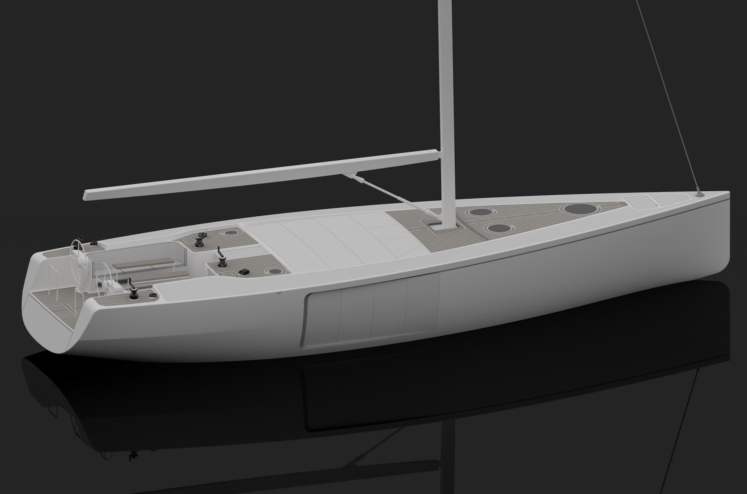
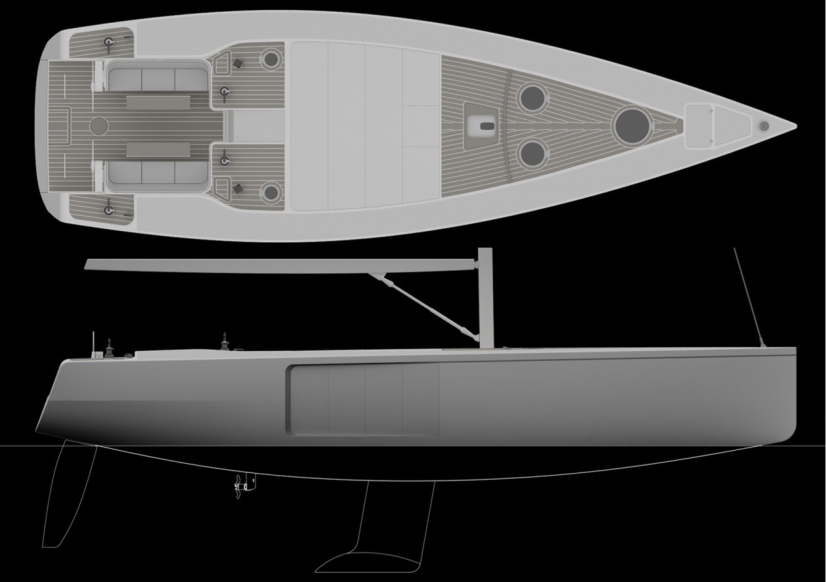
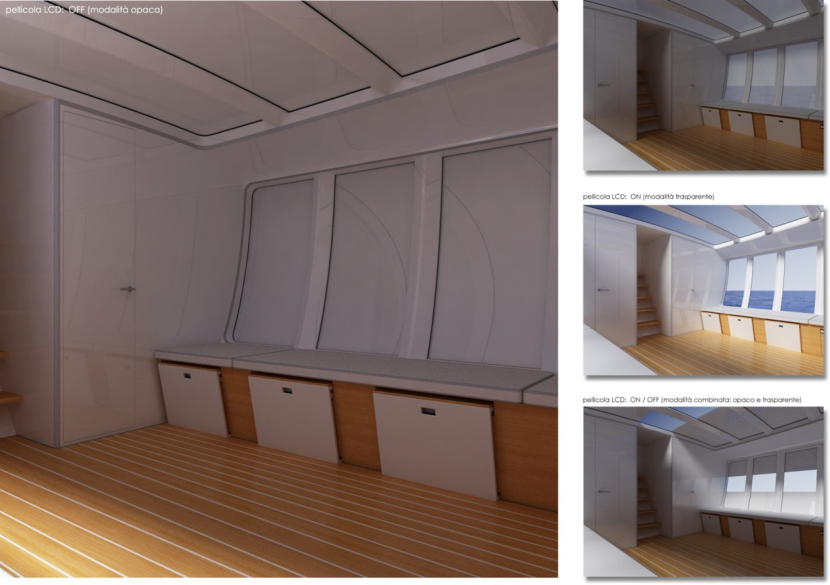
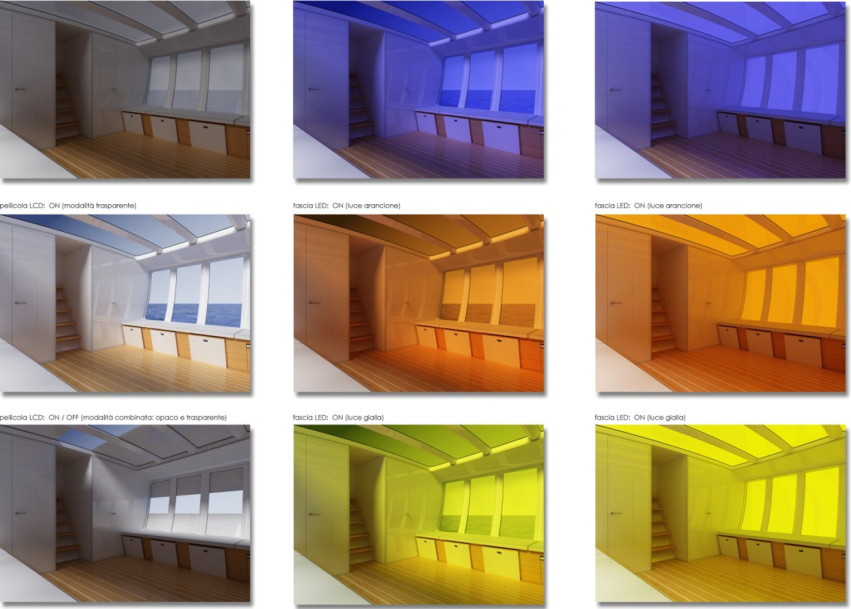
Design of apertures towards the outside In the first phase for our project we take care of designing a reconfiguration of an original deck layout and an original design of topsides (Fig.1) concerning the introduction of these great apertures (Fig. 2). At the same time we tried to find new solutions for a new internal layout, related with our choice of introduce great apertures on the top and on the sides, and introducing the new technology by using the chromogenic panels (Fig. 3), with the purpose of obtain these large apertures outside the yacht, and color variations of sensory character (Fig. 4). The rise of the filly has allowed the insertion of these large portholes in the hull, which acquire a great architectural value, due to their size, due the fact that the entire system is redesigned outer side, so unusual and original enhance the form and function through the use of views. The rise of the filly has allowed the insertion of these large portholes in the hull, which acquire a great architectural value, due to their size, due the fact that the entire system is redesigned outer side, so unusual and original enhance the form and function through the use of these views. The final result is a new and original design of the hull profile, strongly characterized by the system of architectural openings embedded in a dynamic way.
Figure 1: General views of the sailing yacht.Figure 2: Profile and Top views of the sailing boat.Figure 3: Apertures towards outside.Figure 4: Views of different lighting systems.
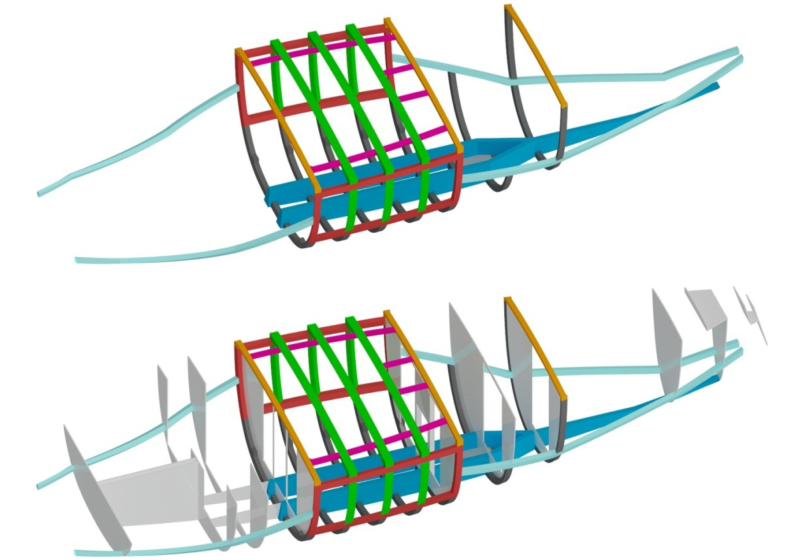
The new concept design of the hull structures The inclusion of a large number of apertures in deck and in the hull of the sailing yacht, led us to analyze the functioning of the structures of the entire boat (Fig. 5). As we know, the sailing boat is by nature subject to a number of high stress and effort that are absorbed by a complex system of structural stiffening of the body. In our case, the stress increase due to the inclusion of large apertures. It has therefore become necessary to optimize the structural system of the floor plates and transversal beams. The structural grid has been reinforced with the right number of beams that serve the dual function of supporting the chromogenic panels. The reinforcement system increases its mechanical performance with the use of the bulkheads in carbon single-skin laminated with vinyl ester resin , which can block the movement of the structural reference cage. The rigidity of the cage is also increased through the right dimensioning of the high-current, placed in the vicinity of the top side line of the hull, and the low current, which also absolve the dual function of support and base for the coupling of the chromogenic panels inside. The chosen material is carbon fiber, resin laminated and the structural omega and at the hull with vinylester resin, and subsequently worked with the system of the vacuum bag to clear possible delamination problem. The entire system of hull lamination is based on a sandwich with honeycomb core and an internal and external layers of carbon fiber material.
Figure 5: Hull structures.
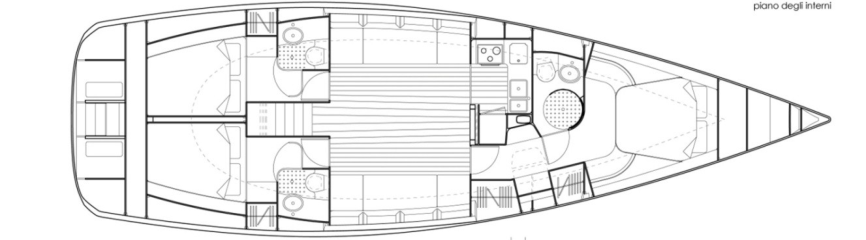
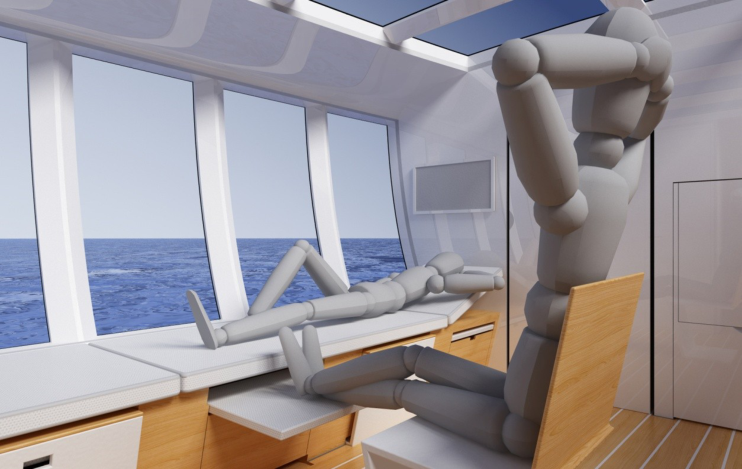
Design solutions “to live” the living area The two last insights involved the insertion of two sitting systems in the living area and the transformation system of the living area in dining area (Fig.6). In the first chase, the concept proposal of two symmetrical and linear components, equipped with low seats inside (fig. 7). This sitting system puts the user in a position to take advantage of the space, in different ways, depending on the different useful functions and criteria of the management system of the apertures outside, in the hull and on the deck. In the second chase, we can transform the living area into an hybrid space involving the function of dining through a mechanism that moves a folding table in the forward bulkhead (fig. 8). The table, with characteristics of modularity, can accommodate by a minimum of two guests to a maximum of six guests, according with the general layout organization.
Figure 6: general interior layout.Figure 7: View of the living area.Figure 8: View of the dining area.
Figure available in the original PDF paper.
CREDITS This paper refers to the results achieved within a Master’s degree Thesis “Yacht Design_PBA. Pleasure Based Approach”. (advisor: Prof. G. Di Bucchianico, Ph.D.; co-advisor: Prof. M. Di Nicolantonio; technical consultant: S. Camplone; candidate: F.P. Salvemini), edited in the “Interior Design of Sustainable Living” Degree Laboratory, at the Department of Architecture of the University of Chieti-Pescara (Italy). All the images reported in this paper are taken from the above mentioned M.Sc. Thesis. The development of the research referred to the visual pleasure was conducted directly from the M.Sc. candidate under the guide of Prof. Di Bucchianico. The various paragraphs of the present paper can be considered the consequence of a common discussion and a collective review among authors. In particular, the writing of the various paragraphs can be attributed to: Giuseppe Di Bucchianico (Paragraphs 1 and 2), Stefania Camplone (Paragraphs 3 and 4) and Massimo Di Nicolantonio (Abstract and Paragraph 5).
REFERENCES
Bandini Buti, L. & Bonapace, L. & Tarzia, A. 1997. Sensorial quality assessment: A method to incorporate perceived user sensations in product design. Applications in the field of automobiles. In IEA ’97 Proceedings, Finnish Institute of Occupational Health, Helsinki,186-9.
LISTED IN THE AHFE DIGITAL BOOKSTORE CATALOGUE
Explore the complete digital volume
Advances in Human Aspects of Transportation: Part I
Read this individual research paper free through the original publisher, or explore the full digital proceedings book.
ISBN 978-1-4951-2097-8
Explore this ISBN in the AHFE Bookstore ↗Listed in the July 2026 bookstore catalogue; search by ISBN to confirm current availability · Digital book purchase optional