Massimo Di Nicolantonio (2023). Suitability of Sustainable 3D-Printing in the field of Yacht Design: Houseboats for Student Communities and Tourism. In: Human Aspects of Advanced Manufacturing. AHFE Open Access, vol. 80, pp. 228–235. https://doi.org/10.54941/ahfe1003525
Issue relating the vertiginous growth of population, the effects caused by climate change fall-out, as ground consuption represents an important opportunity for the design research community. The adoption of sustainable strategies to solve the problem of high densification of the existing urban fabric with new public functions, housing or tourist accommodation, can introduce new experimentations, by the adoption of unused “ground”, through the application of solutions with low environmental impact and controlled consumption of energy and resources, different contexts such as water. Living on water qualifies as a long-established reality in the contemporary contexts, and many cultures, a global widespread heritage. At the same time, mobility on waterways is a formidable cultural and economic challenge: a developing model based exploring on the alliance between the experimentation of the nautical product and an environmental reflection conducted in terms of enhancing marine, river and lake environments. As the vision suggest, designers provide to develop innovative and futuristic housing models at various scales of intervention. Among the possible interventions, this design research explored the concept of sustainable 3D printed houseboats taking care of diversified target, like student communities or tourists, being careful to ergonomics, safety, enhancement of the natural heritage; the case study focused on using 3D printing production processes using natural fibers, and how the entire process can contribute to to define new interpretative models, new product morphologies, new languages. The result presented in the document provides evidence and validity on the use of sustainable 3D printing production processes for sustainable products, as a good opportunity and intelligent solution adaptable to the conditions imposed by a specific context, with the aim of opening new avenues of research for the design community.
Nowadays, design community must propose new housing solutions, stri- ctly related with the adoption of sustainable strategies, to densify the existing urban systems with new public functions, housing and tourist accommodation, due to forecasts about the vertiginous growth of the urba- nized population in the coming decades and the effects caused by climate change; water contexts plus low environmental impact solutions can repre- sent a possible solution, improved by controlled consumption of energy and resources.
Fluid element exerts interest and attraction on the human being; living on the water and in wetlands is a very ancient tradition, dating back to our prehistoric ancestors, driven by the assumption of systematically giving life to the foundation of settlements, as well as resorting to shelter from preda- tors on their floating rafts. Furthermore, aquatic contexts have always been ways of communication and suitable places to welcome new ways of living and travelling, since the end of the last century. This kind of development is more or less facilitated on the basis of the natural assets of the watercourses,
Suitability of Sustainable 3D-Printing in the Field of Yacht Design: Houseboats 229
their structure, and the potential expressed by the surrounding environmental context (Baldassarri, 2019).
Living on the water has been a long-established reality in the many contem- porary contexts; it manifests itself as a globally diffused heritage, expression of the culture of the populations concentrated in humid naturalistic contexts; places whose orographic characteristics are characterized by the presence of important waterways and ports.
NAUTICAL MOBILITY AND FLOATING HOUSES The floating house is the subject of many futuristic projects, and represent a possible sustainable solution to environmental problems, as well as from a tourist point of view, a refuge for a holiday away from the daily urban con- text; design research on this terrain is very prolific, characterized by different aesthetic-morphological, structural and technological solutions, each in close relationship for the different environmental contexts. Houseboats are produ- cts similar to real pleasure boats; in general they are solutions designed to encourage the idea of sustainable river tourism.
Tourism, among the thematic areas of the contemporary age, is certainly the one most charged with strategic attraction from a socio-cultural and economic point of view (Marano, 2019); tourism plays a strategic role of fundamental importance; today tourist demand towards the search for a new relationship between man and nature. This favors sustainable tourism and marine ecotourism; the rise of river tourism in the third millennium is largely linked to the idea that it falls within the category of slow tourism: a model of sustainable tourism that experiences a different temporality and involves immersion in the particularity of the place, evoking different ways of being and moving, transforming travel experiences into forms of knowledge (Fullagar, Markwell, Wilson, 2012).
“Slow tourism” is a new way of understanding the holiday, motivated by the need to discover beauties, cultures, authentic local traditions; its aimed at real knowledge of the area, through personalized experiences full of acti- vities that allow the user to fully enjoy the tourist destination and respect the environment and the host communities.
Nautical mobility represents a formidable cultural and economic chal- lenge, which consists in seeking a development model based on the alliance between the experimentation of the nautical product and an envi- ronmental reflection conducted in terms of ecotourism enhancement of marine, river and lake environments; nautical mobility for sustainable tou- rism requires new forms of interpretation of the relationship between sea and coast, as well as between waterways and the context of terrestrial landscapes.
The conscious use of water contexts is confronted with the management of tourist accommodation services made explicit through design soluti- ons on multiple scales of intervention. Simple housing units, mobile hou- sing units, similar to real boats or pleasure boats, widespread marina resorts.
230 Di Nicolantonio
DESIGN CONTRIBUTION Design contributes by proposing new usage scenarios and new relationships between product user and context.
The generation of ideas assumes a particular importance in the design dri- ven innovation process (Verganti, 2009); it represents the moment in which new opportunities that can be transformed into competitive advantages for the company; eliminate research and identification of the most suitable mate- rials to meet the project requirements (essential condition for innovating both from the point of view of the process and the product); technology and the wisdom in its involvement in the whole process. “Technology should bring more to daily life than ever-improving performance of various activities: it should add wealth and enjoyment. A good way to add fun and pleasure to life is to rely on the ability of artists. Luckily, there are quite a few.” (Potter, 2013); the ability to persuade the good’s purchase. Design can offer its con- tribution for the enhancement and regeneration of aquatic contexts, through the search of sustainable solutions at system and product level.
CHALLENGES FOR FLOATING DESIGN Our society needs to look carefully to valid alternatives to replace ancient technologies and production processes. Addressing the cultural root to this problem is the only solution to make in practice the slogan ‘producing less and better’ (Vezzoli and Manzini, 2008).
The development of sustainable 3D printed products can repre- sent a possible solution. Anyway this option needs a new approach (Rossi, Di Nicolantonio, Barcarolo, Lagatta, 2020). By combining new rese- arch models matching different levels for sustainable innovations, which are composed by primary and secondary levels of interaction, it is possible to develop a new scenario for Sustainable 3D Printing; this scenario defines a new set of design opportunities for Sustainable-oriented 3D Printing Systems (Rossi and Di Nicolantonio, 2020).
The paper introduce different design outcomes developed by the stu- dents graduates in Design - Interior design final laboratory - Bachelor in Design at the d’Annunzio University from Chieti-Pescara; the students explo- red new solutions through the principles, methods and tools of design; they verified the multiple design intentions, discovering interior design in an ever-changing cultural context and in physical contexts in contact with water; they explored the theme of “contemporary living”, in a scenario defined by three key factors: relationship between land and water; relati- onship between temporary and permanent; relationship between project and environment.
Many topics, such as sustainability, eco-efficiency, habitability, customiza- tion, technological equipment, communication, experimentation, flexibility, adaptability, sustainable 3D printing, etc., have been investigated with stu- dents of Design, and subsequently developed on the basis of common reflections (brain-storming activities, inspiring design, etc.).
Suitability of Sustainable 3D-Printing in the Field of Yacht Design: Houseboats 231
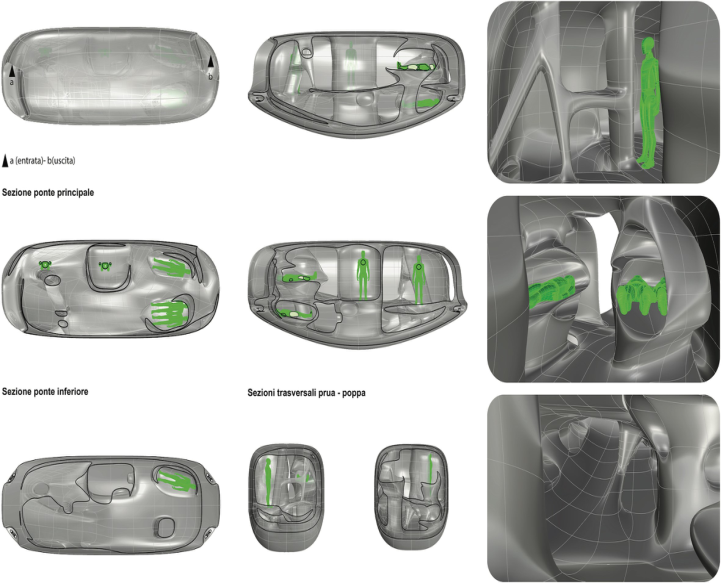
Covum Concept of an houseboat with autonomous propulsion and helm station, designed to host tourist in highly immersive naturalistic contexts; organic shapes of the shell refer to the idea of the “cavea”, understood as a refuge and place of well-being.
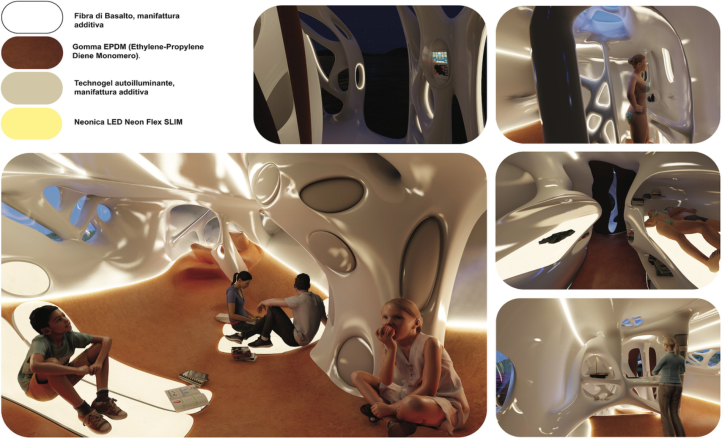
The main material is basalt fiber; Basalt fiber is a 3D printable material, brittle, characterized by high modulus of elasticity, excellent heat resistance, remarkable thermal and acoustic resistance capacity and exceptional vibra- tion insulators. This choice allows maximum flexibility in the management of the design and production process, and allows for the reproduction of an informal, unique, sculptural living space; form and function are integrated into the 3D printed monocoque (see Figure 1 and 2).
Figure 1: Covum general layout; sections and perspective views of informal and continuous space.
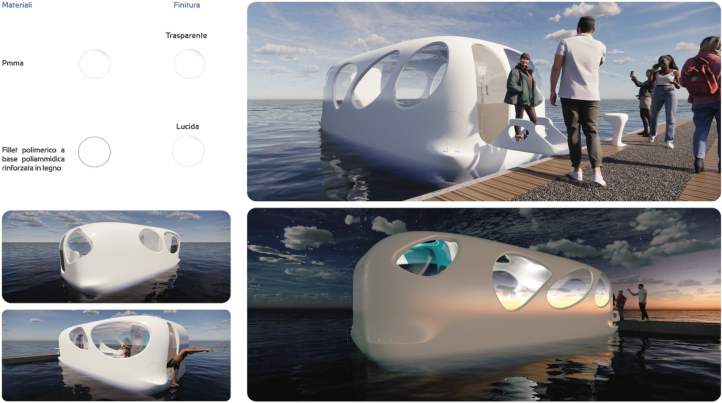
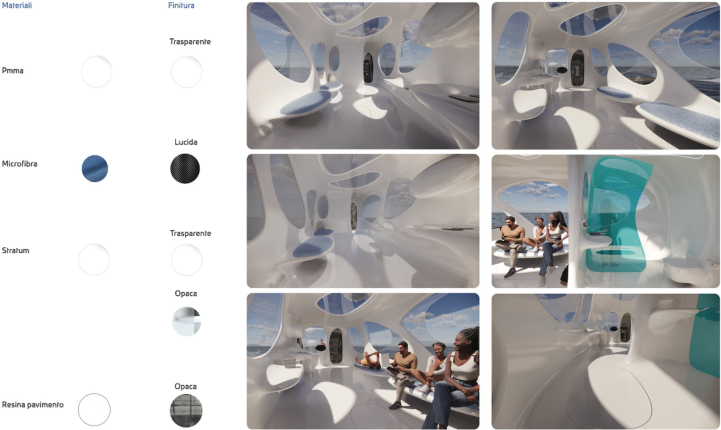
Flow Flow is a concept based on the interaction between the platform and the air-water fluids; the result is a liquid form, characterized by continuity of internal-external surface, conceived as a 3D printed “monocoque”.
Cellulose microfiber is the principal material; CNF is used in combina- tion with plastics or elastomers; it is light and resistant; this option reduces
232 Di Nicolantonio
Figure 2: Covum interior views; materials and perseptions.
the weight. A second aspect concerns recycling at the end of its life: the reprocessed material retains a good part of its mechanical properties (see figures 3 and 4).
Figure 3: Flow exterior shell.
Motunui Motunui is a floating housing system for student communities, developed starting from the centrality of water; water is an element characterizing
Suitability of Sustainable 3D-Printing in the Field of Yacht Design: Houseboats 233
Figure 4: Flow interior design.
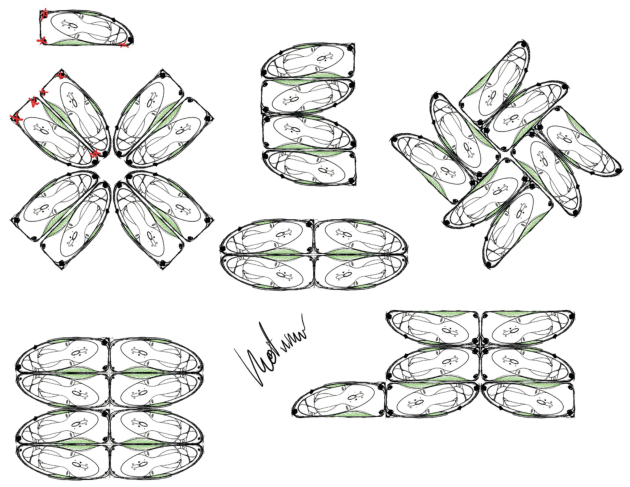
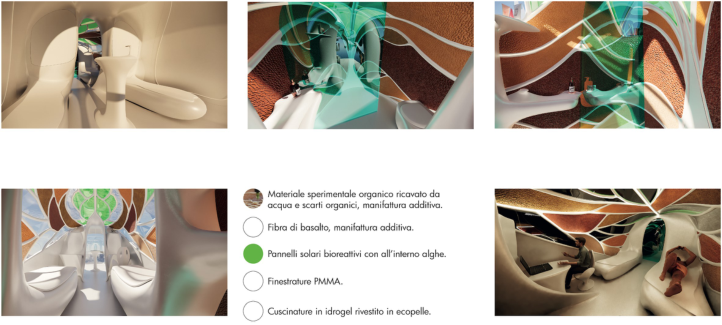
the reference context, through which to develop an idea of shared com- munity space. The structure is characterized by the combination of 3D printed basalt fiber mounted ribs, insulated panels and bioreactive solar panels featuring organic materials derived from water and organic waste (see Figures 5 and 6).
Figure 5: Motunui, floating student village: various conbinations.
234 Di Nicolantonio
Figure 6: Mutunui, interior space; materials and perseptions.
CONCLUSION
As the vision suggest, designers provide to develop innovative and futuri- stic housing models at various scales of intervention. Among the possible interventions, this design research explored the concept of sustainable 3D printed houseboats taking care of diversified target, like student communities or tourists, being careful to ergonomics, safety, enhancement of the natural heritage; the case study focused on using 3D printing production processes using natural fibers, and how the entire process can contribute to to define new interpretative models, new product morphologies, new languages. The result presented in the document provides evidence and validity on the use of sustainable 3D printing production processes for sustainable products, as a good opportunity and intelligent solution adaptable to the conditions impo- sed by a specific context, with the aim of opening new avenues of research for the design community. At the same time, results provides evidence and validity on the use of green technologies, alongside insights related produ- ction and management of sustainable products for water contexts. Ultimately, this work suggests good design practices and opportunities for intelligent solutions, opening up even new research avenues for design community.
ACKNOWLEDGMENT
This paper shows an extract of the research results of several disserta- tions in industrial design’s Bachelor, authored by Giampaolo Sanghez - Covum, Cristiano Zizzari - Flow, and Giovanni Simone - Motunui (Advi- sor: Massimo Di Nicolantonio), Department of Architecture at the “G. D’Annunzio” University of Chieti-Pescara, Italy. All the images reported in this paper are taken from the mentioned Thesis. The various paragraphs of the present paper can be considered the consequence of a common discussion and a review of the author. In particular, the writing of the various paragraphs can be Attributed to Massimo Di Nicolantonio.
Suitability of Sustainable 3D-Printing in the Field of Yacht Design: Houseboats 235
REFERENCES
Baldassarri, E. (2019), La slow mobility pluvio costiera, in Di Nicolantonio, M.
(a cura di, 2019) Design per la mobilità fluivo costiera, Sala editori, Pescara. Marano, A. (2019), I paesaggi della mobilità nautica per il turismo sostenibile, in Di Nicolantonio, M. (a cura di, 2019) Design per la mobilità fluivo costiera, Sala editori. Fullagar, S., Markwell, K., Wilson, E. (2012), Slow turism: experiences and mobilities, Channel View, Bristol. Potter, D. N. (2013), Emotional design, Apogeo Education, Milano. Rossi, E., Di Nicolantonio, M., Barcarolo, P., Lagatta, J.: Sustainable 3D printing:
design opportunities and research perspectives. In: Di Nicolantonio, M., Rossi, E., Alexander, T. (eds.) AHFE 2019. AISC, vol. 975, pp. 3–15. Springer, Cham (2020). Rossi, E., Di Nicolantonio, M.: Integrating human-centred design approach into sustainable- oriented 3D printing systems. Hum.-Intell. Syst. Integr. 2, 57–73 (2020). Verganti, R. (2009), Design-Driven Innovation, Rizzoli Etas, Milano. Vezzoli, C., Manzini, E.: DesignforEnvironmentalSustainability. Springer, London
(2008).
LISTED IN THE AHFE DIGITAL BOOKSTORE CATALOGUE
Explore the complete digital volume
Human Aspects of Advanced Manufacturing
Read this individual research paper free through the original publisher, or explore the full digital proceedings book.
ISBN 978-1-958651-56-8
Explore this ISBN in the AHFE Bookstore ↗Listed in the July 2026 bookstore catalogue; search by ISBN to confirm current availability · Digital book purchase optional