Sarah Jane Cipressi, Massimo Di Nicolantonio, Emilio Rossi (2023). Design of a Sustainable and Modular Shuttle Vessel for Inland Waterways. In: Human Factors in Transportation. AHFE Open Access, vol. 95, pp. 740–750. https://doi.org/10.54941/ahfe1003859
Issue of slow mobility in inland waterways represents an important opportunity for the design research community, as part of the objectives of the main research programs in EU (e.g., Horizon Europe); hence, complex problems related to mobility can be faced by the design community through sets of smart solutions, both tangible and intangible. Recent trends in the sector suggest that the Design discipline should employ conceptual, methodological and operational tools to produce meaningful visions for urban and territorial scenarios oriented towards sustainable mobility. This is important in the perspective of sustainable development, and the related development of sustainable solutions supporting local authorities in enhancing the environmental and socio-economic quality of living contexts. Among the possible interventions that can be proposed to deal with this scenario, this paper proposes a project of a sustainable water shuttle. The boat is a part of a more complex project – system design approach – comprising service design and communication. It considers different users and stakeholders, as well as ergonomics standards like accessibility, safety, sustainability, mobility on waterways, modular design, enhancement of the natural and cultural heritage, etc. Specifically, this project focuses on the use of modular and photovoltaic components for green ferries, and how the design process used for this work can contribute to define the structure for a system-oriented design for sustainable mobility on waterways cities and natural contexts. The result presented in the document provides evidence and validity on the use of green technologies, alongside insights related production and management of sustainable products for water cities (re: shuttle boat). Ultimately, this work suggests good design practices and opportunities for intelligent solutions, opening up even new research avenues for community design.
In lands with hight presence of waterways and especially in fluvial ones, the respect, protection and knowledge of natural resources’ value might be the start elements for the design of services and products linked both to river and lakes nautical activities and in those carried out in the surrounding territory. The fluvial mobility concept in Europe, understood as a knowledge-oriented activity for the use of territories and inland waterways, has been developed for several years (Di Nicolantonio, 2019a; 2019b).
Today, the wide range of fluvial mobility’s services and products defines a market demand which entails both the nautical and the land fields; activities performed in natural areas and in those nearby rivers stimulate the expansion of market niches toward systemic perspectives. Sustainability is not always the key factor considered for this sector and disastrous consequences for the
Design of a Sustainable and Modular Shuttle Vessel for Inland Waterways 741
environment and its ecosystem can be observed. Furthermore, lands cros- sed by inland waters are considered as disjoint from the eco-systemic lens. Sometimes, this condition generates a separation between the two parts of fluvial-territory system, which instead should be experienced and perceived as a single entity by users. To be able to get exhaustive information about flu- vial territories, activities performed along rivers should be included to provide scenario-led opportunities for the coexistence of two primary elements: ‘blue practices’ (i.e., nautical activities) and ‘green practices’ (i.e., green and grey elements) (Cerrutti, 2014).
Referring to this issue, the Design discipline can give a research con- tribution to the creation of sustainable systems of solutions – re System Design – understood as integrated and coherent sets of artefacts such as services, products, and comunicative solutions (i.e., PSSs) (Ceschin, 2013).
This study focuses on the potential design contribution offered to waterw- ays and intermodal river-land mobility seen through a system-oriented angle. A variety set of A variety set of criteria and meta–design tools belonging to both Design for Sustainability and Design-Driven Innovation methos (Ver- ganti, 2009) are considered. Specifically, the study follows a system-led design approach to define a system-product model to favour the use and the valorisa- tion of most coastal and lake areas. The research tackles different intervention levels by using arrays of methods employed in DDI.
The goal of this work was to develop system-based sustainable models for the informed use of territories, such as enabling services for river and marine navigation; a modular shuttle vessel for inland waterways was presented at the end as a ‘physical interface’ to implement the system-led scenario (Pauw- elyn and Turf, 2023). This was done at the product design level by proposing flexible plans for different ways of use, including transportation of passen- gers and the ones referred to work equipment. Accordingly, the idea behind this work is that the use of an informed research-led practice can significan- tly contribute to mobility issues, which require creative ways of thinking and design.
SUSTAINABLE MOBILITY: RESEARCH FRAMEWORK Throughout human history, rivers have always been seen as primary commu- nication routes to move passengers and goods. Models for sustainable travels were therefore promoted by and through waterways.
In the EU, 21 out of 28 Member States have inland waterways, 13 of which have an interconnected waterway network (European Commis- sion, 2019; Erceg, 2019). Europe’s waterway network consists of more than 40,000 kilometres of waterways. The core network with rivers and canals of international importance (Class IV and higher) is for- med by more than 12,000 kilometres of interconnected waterways, 444 locks, and hundreds of inland ports and transhipment sites. The remai- ning network is made up by smaller waterways (European Commission, 2006).
In the last years, design-related topics about river mobility in Europe got a higher value as a medium to get knowledge about territories and inland wate- rways. As a result, river mobility is spreading and the creation of a wide range of both nautical services and products (e.g., cruises, short excursions, house- boat leasing, etc.) and the ones for land exploration (e.g., activities performed in natural places or in the nearby of rivers such as: walking, cycling, hiking, horseback riding, etc.) can be documented. However, unexplored issues rela- ted to the sustainability of mobility sector resulted in dramatic consequences for fluvial environments, and in general for the whole ecosystems.
To create a higher awareness around these issues, the UNWTO (United Nation World Tourism Organization) in late 80’s introduced the concept of ‘Sustainable Tourism’ (Tourism Manifesto, 2022), defined as a travel moda- lity that respects and preserve the natural, social and artistic environments, which ultimately promotes the development of local economies of popu- lations living in those areas. The European Commission encouges the use of inland waterways, and the importance of inland navigation is emphasi- zed in white papers ‘European transport policy for 2010: time to decide’ (Commission of the European Communities, 2001) and ‘Roadmap to a sin- gle European transport area – Towards a competitive and resource efficient transport system’ (European Commission, 2011). Both works emphasize the need to eliminate the main infrastructure obstacles to the development of inland navigation in Europe. This vision was also echoed by the Horizon 2020 research programme (European Commission, 2013). Research into marine environments, inland waterways, bioeconomy, clean and efficient and safe energy, smart transportation, integrated ‘green’ mobility, are now part of the main EU’s social challenges.
The European Tourism Manifesto (Tourism Manifesto, 2022) defines tra- vels and tourism as one of the ecosystems most affected by COVID-19 pandemic, so 162 billion EUR were invested to return the sector to pre-crisis levels. The recovery and resilience framework (NexGenEU) (Eropean Com- mission, 2020) proposed by the EU to overcome the negative effects produced by the pandemic offers a unique opportunity to support the tourism reforms. For instance, digital and green transitions as well as strengthening of global- local economy in a perspective of societal resiliency are supported by key actions (Mobility, UE commission).
One of the most notable research projects in the EU is the ‘TrAM Transport Project: Advanced and Modular’. TrAM mainly focusses on the modular design approach and on the introduction of zero emissions fast vessel into markets. The design methodology behind the project follows three main steps, (a) Identification, where requirements for demonstration cases are esta- blished, (b) Innovation, which includes the development of design methods and modular productions, and their application into a pilot project run in Stavanger (Norway), (c) Replication, which ensures that the second phase’s results are applicable to widest cases. TrAM is bases on four main target aims: (i) Modularity; (ii) Zero emission; (iii) High-speed operations; and (iv) Re-use and re-configuration.
Because the transport sector is today considered as one of the main globally polluters, the challenge to create transport solutions that are eco-friendly is
Design of a Sustainable and Modular Shuttle Vessel for Inland Waterways 743
paramount in terms of public policies. Through the validation of concepts more aligned to innovation and sustainability of the waterway transport, the need to employ holistic design methos and production techniques – even the 4.0 ones – show intrinsic potentialities in promoting the introduction of fully electric vessels, to operate fast connections among river areas (TrAMproject, 2020).
GUIDELINES The analysis of contextual features, regulations, and best practices define the outline of a modular vessel for urban public transport proposed in this work. User needs and design requirements considered were divided in four main categories.
Technology, which has been divided into: (i) Navigation: all boats should have a remote navigation system made by sensors, radars, lidar DP cameras, automatic pilot, etc.; (ii) Propulsion: to comply with environmental safety standards. In this way, emissions are reduced using the latest energy system technologies. (iii) Solar energy: vessels should have solar panels and batteries to store the energy produced; (iv) Materials: materials employed should be waterproof and certificated for high weather resistance and flame resistance.
Safety, divided into the following subcategories: (i) Accessibility: all boar- ding stations should be equipped with gates to favour boarding/landing actions from ferries; (ii) Navigations and mooring: vessels should have safe navigation devices and mooring systems; (iii) Passenger transport: ergono- mics seats, shockproof materials, underlined paths, restraint system, rescue equipment, first aid kit, etc.
Ergonomics, divided into: (i) Thermal comfort: it is essentials for vessels to guarantee adequate thermal comfort both in summer and in winter seasons (all projects, except The Trusst project which have a total open system, are equipped with air conditioning and recirculation system); (ii) Visual com- fort: improved landscape visibility is a preferred option. A 360
view of the surrounding landscape is preferred. Interiors are well lit through both natural and artificial light, which is crucial for night use (e.g., artificial light is also used to indicate exits and pathways). (iii) Living comfort sits arrangement should be designed to allow users (both service customers and service providers) to have a good view of external landscapes. In some solu- tions considered, passengers are arranged in front of each other to create a visual contact. In almost all vessels analysed, seats have soft cushions and worktables.
Usability, divided into three subcategories: (i) Flexibility: common features to all exanimated models recommend the use of modular system, which are composed about one, two or three modules that can be assembled to meet navigation and market requirements. Flexibility can also be found in interior layouts; (ii) Comfort and accessibility: accesses should be arranged at the bow and stern of the boat – interior paths are smooth and easy to be used (re access to sitting); (iii) Services: bike racks near the access, in number appropriate to fulfil the capacity of boats, luggage and bags racks integrated with seats solution, toilets near the access or in the middle of the boat, etc.
PRODUCT DESIGN Results extracted from contextual design allow to affirm that the design of vessels are characterized by single interventions distributed along the hull layout. In general, each ship is developed from scratch to meet specific requi- rements. Overall, the final design is the result of an optimization process, cost-intensive in many cases, in which the best solution to employ is selected form a range of alternative solutions based on a variety of optimization cri- teria, such as stakeholders’ needs, speed and route length and international regulations. The resulting boat is therefore usually designed to fit exactly the respective purpose.
As a result, small requirement changes have a strong impact to the final project. A possible solution to this conceptualization problem lies in the adoption of modular design criteria for marine transportation, using specific procedures for the engineering and development of ship’s archite- cture, task-based and use-related conditions, analysis of system impact, etc. (i.e., Tramproject, 2020).
The product can therefore be adapted to individual needs or to contex- tual conditions. Meanwhile, the re-use of modules reduces developing and production time. However, these approaches, beyond the methods emplo- yed for the design of modules, are difficult to adapt to the shipbuilding industry.
One of the reasons for this, is the difficult to divide a ship into single parts – re units or modules – due to the large number of complex interactions between ship’s system elements. Because geometries, the boat design needs to find compromises between modularity, equipment shapes, and functio- nalities, reflecting in an increased complexity when relates to hull, decks, and bulkheads. Furthermore, boat geometry has a huge impact on hydrody- namic performance, on its weight, and the related capability of the various components. This is as much important as much the vessel navigate faster.
MODULAR DESIGN A “flexible” product can be customised when bespoke commissions arise. This provides cost-effective strategies to improve updates and modifica- tions along and during of its operative life. Then, flexible products can adapt to users’ evolving needs so they will benefit from technological developments.
A key-factor for product’s flexibility is modular design, that is the ability to create different products (re configurations) from standard components. A correspondence between product’s physical elements and functions can be provided by employing modularity. This then allows designing modular pro- ducts. Urlich and Eppinger (1995) state that each function is fully realised by a single physical module – a module can have multiple functions – interacti- ons between physical element are clearly defined and they are ran thought standard interfaces. Only when these two conditions are met, it will be possi- ble to modify the product performances by changing a module with another one – re interchangeability.
Design of a Sustainable and Modular Shuttle Vessel for Inland Waterways 745
Modular design’s benefits are multiple and very important. Product’s range is improved, as well as the customisation. Easier chances to operate develo- pments and interventions; productions and logistics are placed within scale economies; reduced time when designing and possibility to run simultane- ous productions. Finally, higher sells and revenues, better optimization, and management.
Three main approaches to introduce modular architecture into product family exist.
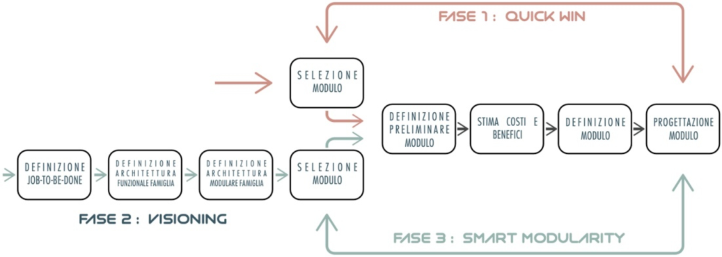
1. The first approach, which is also the most investigated and applied to businesses, entails top-down definitions of optimal products, though requires major investments. 2. The second one, less considered as modularity, aims at standardizing the physical elements by creating reusable modules and products. This is a bottom-up method that can gradually transform existing products, but it often leads to fragmented processes for expanding the products range, which is not suitable for system design. 3. Both approaches can be combined to achieve excellent results; this is the case of the third approach, which takes the best potentialities from previous ones. The main logic behind the selection is the achievement of goals against resources availability (Figure 1).
Figure 1: Stages for introducing the modular architecture (redesigned from Scabbia, 2019).
The Scabbia’s model (2019) was then applied to the design and definition of a platform to investigate possible configurations (Figure 2).
Brief The proposal project is an electric modular transport system for public and private navigation of rivers, lakes, and lagoons. There are two main scenarios set to define the potential use: (i) Private use, and in this case the project is a day cruiser for daily trips; (ii) Public use, for urban transport and for short/daily tourist itineraries.
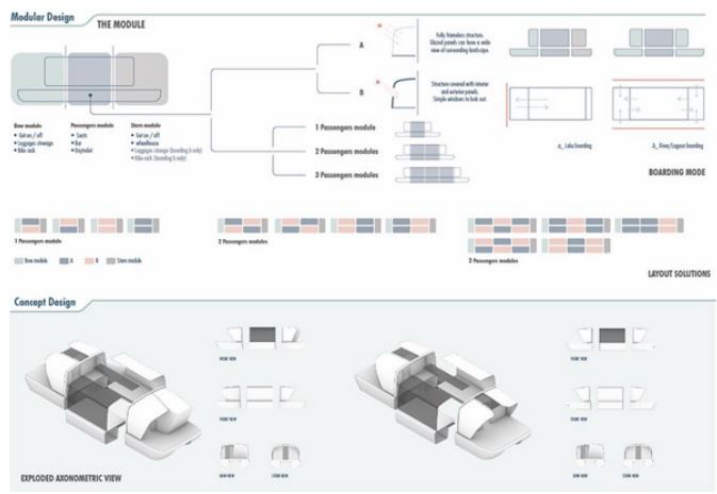
The design of the modular system was approached according to three lenses:
1. Modules A and B are combined. The area between the structural ele- ments is considered as the main modular element. The area is composed
Figure 2: Modular design and platform to explore multiple configurations (Cipressi, 2022).
of both internal and external boat coverings, and there are two main solutions: (A) a fully frameless structure, where glazed panels foster the enjoyment of external views, so that transparent surfaces simply become windows. 2. Combination of modules for passengers. The module can be replicated in series up to three times.
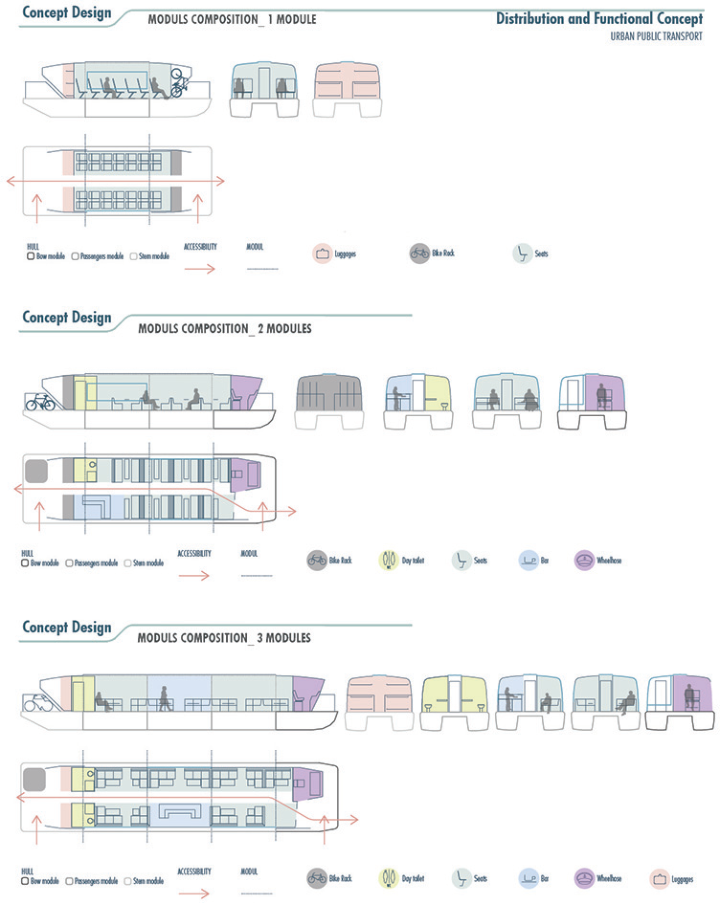
The boat’s size may change depending on the following conditions: (i) sin- gle module for passengers (11-12 meters); double (two) modules for pas- sengers (15-16 meters); triple (three) modules for passengers (19-20 meters). Inside the vessel, different interior layouts can be developed depending on the use of the vessel as well as the combination of sub-components (Figure 3).
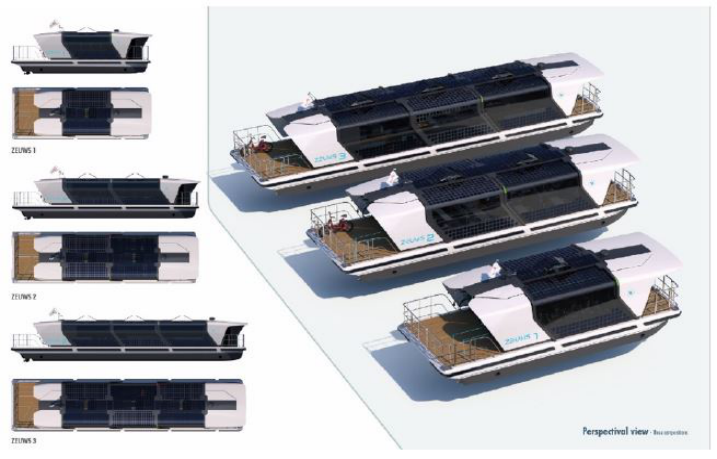
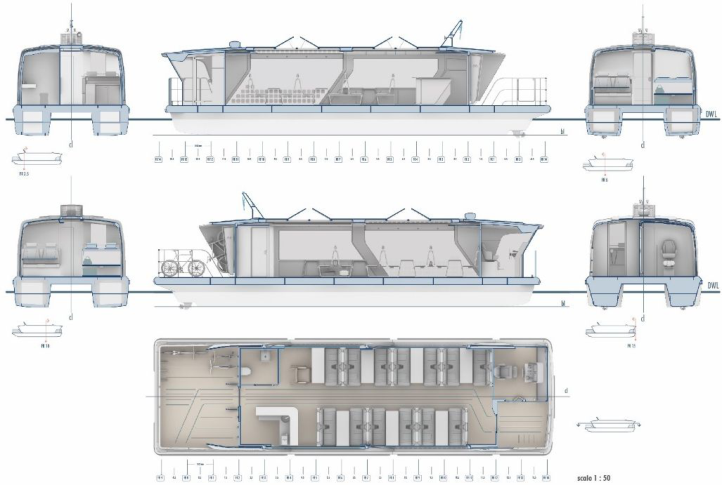
Concept Design Development ‘ZEUWS’ (Zero Emission Urban Water Shuttle) is a low environmental impact modular system for public and private transport for urban water con- text and is a first design attempt to answer the research framework discussed in this work. A multi-hull solution was adopted to guarantee the vessel stabi- lity, the best accessibility, and the usability to all users. This vessel has also a larger flat deck to make easier and rational the distribution of all functions.
Overall, modular design principles allowed the design of three main layouts. Each ZEWS combination (re ‘ZEUWS 1’, ‘ZEUWS 2’, ‘ZEUWS 3’) (Figures 4 and 5) has different interior and exterior layout were studied and proposed.
Design of a Sustainable and Modular Shuttle Vessel for Inland Waterways 747
Figure 3: Modular design, platforms, and possible configurations (Cipressi, 2022).
ZEUWS 1 is presented in its “bus layout” type. This design typology was imagined for public use and short trips, where both the open space module and the one containing partition are used to favour external view, mainly on one side.
ZEUWS 2 proposes two fully frameless configuration modules and two partially framed ones. These modules face each other to create a positive semantic friction between openness, which allow a 360
view of the outside, and closeness, containing services such as toilets, InfoPoint/bar, etc. Unlike ZEUWS 1, the interior layout seats are arranged to create intimate units for conviviality. Finally, ZEUWS 3 combines three modules to foster the mobility
on board. Specifically, the modules’ flexibility and the equipment propo- sed also create dynamism and organised distribution of seating areas so that islands of conviviality are created in different manners. For instance, the inte- rior layout could contain InfoPoint/bar (in the central area), toilets at the stern, and small living areas near windows.
Design of a Sustainable and Modular Shuttle Vessel for Inland Waterways 749
All ZEUWS’s solutions are also designed to accommodate people with various types of physical disability, alongside families, travellers, sportsmen, using specific devices when needed. Ergonomics and anthropometric stan- dards used comply with HCD criteria and to make the boat as much inclusive as possible.
Finally, materials were investigated to provide completeness to this pro- ject to comply with sustainability-related criteria. Thus, only eco-friendly and recyclable ones were used (e.g., aluminium for the hull, cork for the deck floor, composite materials with bioresins and natural fibers for super- structures). Furthermore, these materials are easier to be cleaned, fireproof, waterproof and anti-skid.
CONCLUSION
Among the possible interventions that can be proposed to deal with the sce- nario of sustainable mobility of inland waterways, this paper proposes an original project for a sustainable water shuttle, as a part of a more com- plex project based on the development of a tourism system (system design approach) comprising a service an artefact (ZEUWS) and a communication system.
Referring to the ZEUWS – the system of artefacts – it considers diffe- rent users and stakeholders, as well as ergonomic standards like accessibility, safety, sustainability, mobility along waterways, modular design, enhance- ment of the natural and cultural heritage, etc. Specifically, this project focuses on the use of modular and photovoltaic components for green ferries, and how the design process used for this work can contribute to define the stru- cture for a system-oriented design for sustainable mobility on waterways cities and natural contexts.
The result presented in the paper also provides evidence and validity on the use of green technologies, alongside insights related the production and management of sustainable products for water cities (re shuttle boat). Ultimately, this work suggests good design practices and opportunities for intelligent solutions, opening new research avenues for community design.
ACKNOWLEDGMENT
This paper contains an extract of the dissertation project in Industrial Design (MSc in Architecture) produced by Sarah Jane Cipressi (Advisor: Massimo Di Nicolantonio, Co-advisor: Emilio Rossi and Stefano Carugno) at the Department of Architecture at the “G. D’Annunzio” University of Chieti- Pescara in Italy. All authors have equally contributed to the study design and implementation. The writing of the various sections is attributed as fol- low: Cipressi wrote ‘Guidelines’, ‘Product Design’ (and related sections), Di Nicolantonio wrote ‘Introduction’ and ‘Sustainable Mobility: Research Framework’, Rossi wrote ‘Abstract’ and ‘Conclusions’.
REFERENCES
Ceschin, F. (2013). Sustainable Product-Service Systems: Between Strategic Design and Transition Studies. London: Springer. Cipressi, S. J. (2022). ZEUWS – Zero Emission Urban Water Shuttle. Sistema modu-
lare di trasporto pubblico e private a basso impatto ambientale per contesti urbani acquatici. M. Arch Thesis. “Gabriele D’Annunzio” University of Chieti-Pescara, Italy. Commission of the European Communities (2001). European transport policy for 2010: time to decide. COM (2001) 370 final. Bruxelles, European Commission. Di Nicolantonio, M. (2019a). Nautica Design & Innovazione: Linee di Ricerca ed
Esperienze Didattiche sul Progetto. Pescara: Sala Editore. Di Nicolantonio, M. (ed.). (2019b). Design per la Mobilità Fluvio Costiera: Riflessioni Tematiche e Ricerche Progettuali. Pescara: Sala Editore. Erceg, B. C. (2019). Inland waterways transport in the European Union – Flowing
or still standing? Proceedings of the International Scientific Conference “Social Changes in the Global World" 1 (6), 123–137. European Commission (2011). Roadmap to a single European transport area – Towards a competitive and resource efficient transport system. COM (2011) 144 final. Bruxelles, European Commission. European Commission (2019). Inland waterways, What do we want to achieve?
Redtrived, January 10, 2023 from: https://ec.europa.eu/transport/modes/inland_ en. European Commission (Commission Staff Working Document) (2006). Annex to the Communication from the Commission on the Promotion of Inland Waterway transport “NAIDES” – an Integrated European Action Programme for Inland Waterway Transport, Brussels from: (COM/2006/6/F). Bruxelles, European Com- mission. European Commission. (2013). Horizon 2020 - Work Programme. Retri- eved, January 10, 2023 from: http://ec.europa.eu/research/particip ants/data/ref/h2020/wp/2014_2015/main/h2020-wp1415-health_en.pd fhttp://ec.europa.eu/research/participants/data/ref/h2020/wp/2014_2015/ main/h2020-wp1415-health_en.pdf. European Commission. (2020). Europe’s moment: Repair and Prepare for the Next
Generation, COM (2020)456. Brussels: European Commission. Pauwelyn, AS and, Turf, S. (2023). Smart Shipping on Inland Waterways. In: Li, Y., Hu, Y., Rigo, P., Lefler, F. E., Zhao, G. (eds.). Proceedings of PIANC Smart Rivers 2022. PIANC 2022. Singapore: Springer. pp. 951–958. Scabbia, M. (2019) Flexible by design: il future è dei prodotti modulari. Redtri-
ved, January 10, 2023 from: https://it.linkedin.com/pulse/flexible-design-il-futur o-%C3%A8-dei-prodotti-modulari-maurizio-scabbia Tramproject. 202-. TrAM - Transport: Advanced and Modular, About. Retrieved, January 10, 2023 from: https://tramproject.eu/about/ Verganti, R. (2009). Design-driven innovation: changing the rules of competition by
radically innovating what things mean. Cambridge, MA: Harvard Business Press.
LISTED IN THE AHFE DIGITAL BOOKSTORE CATALOGUE
Explore the complete digital volume
Human Factors in Transportation
Read this individual research paper free through the original publisher, or explore the full digital proceedings book.
ISBN 978-1-958651-71-1
Explore this ISBN in the AHFE Bookstore ↗Listed in the July 2026 bookstore catalogue; search by ISBN to confirm current availability · Digital book purchase optional