Edmund Pawlowski (2023). Designing the organizational structure of enterprises operating in a highly turbulent environment. In: Human Aspects of Advanced Manufacturing. AHFE Open Access, vol. 80, pp. 111–119. https://doi.org/10.54941/ahfe1003513
The subject of this article is the methodology of designing the organizational structure of the enterprise. The aim of the research is to summarize many years of theoretical and empirical research on the organizational structures of enterprises and the methodology of their design, especially the design of organizational structures of enterprises operating in a turbulent environment. Theoretical research has led to the definition of a multidimensional organizational structure design space (Pawlowski E., 2009). In parallel, this multidimensional concept was used to develop an organizational structure design methodology for Agile Enterprises (Pawlowski E., Pawlowski K., 2008). The next step was to develop a methodology for designing an organizational structure in the context of the Knowledge Based Economy (Pawlowski E. , 2010). In 2015-2016, an empirical study was conducted on the flexibility of the organizational structure of Polish enterprises (Pawlowski E., 2016). In 2018-2020, a methodology for designing organizational structures was developed for the Management Systems of of Intelligent, Autonomous Environment (Pawlowski E. , Pawlowski K. 2020). This article focuses on the design of organizational structures of enterprises operating in a highly changeable, turbulent environment. The methodology is described in a five-dimensional design space: 1. Interpretation of organizational structure, 2. Methodology of organizational structure modeling, 3. Methodological approach to organizational design, 4. Procedures of organizational structure design, 5. Principles of organizational structure design
The subject of this article is the methodology of designing the organizational structure of the enterprise. The aim of the research is to summarize many years of theoretical and empirical research on the organizational structures of enterprises and the methodology of their design, especially the design of organizational structures of enterprises operating in a turbulent environment. This research has been carried out for more than two decades at the Faculty of Management Engineering of Poznan University of Technology. Theoretical research has led to the definition of a multidimensional organizational stru- cture design space (Pawlowski E., 2009). In parallel, this multidimensional concept was used to develop an organizational structure design methodo- logy for Agile Enterprises (Pawlowski E., Pawlowski K., 2008). The next step was to develop a methodology for designing an organizational structure in the context of the Knowledge Based Economy (Pawlowski E., 2010). In 2015-2016, an empirical study was conducted on the flexibility of the organi- zational structure of Polish enterprises (Pawlowski E., 2016). In 2018-2020, a methodology for designing organizational structures was developed for the Management Systems of Intelligent, Autonomous Environment (Pawlowski E., Pawlowski K. 2020). This article focuses on the design of organizational
structures of enterprises operating in a highly changeable, turbulent envi- ronment. The methodology is described in a five-dimensional design space: 1. Interpretation of organizational structure, 2. Methodology of organiza- tional structure modelling, 3. Methodological approach to organizational design, 4. Procedures of organizational structure design, 5. Principles of organizational structure design.
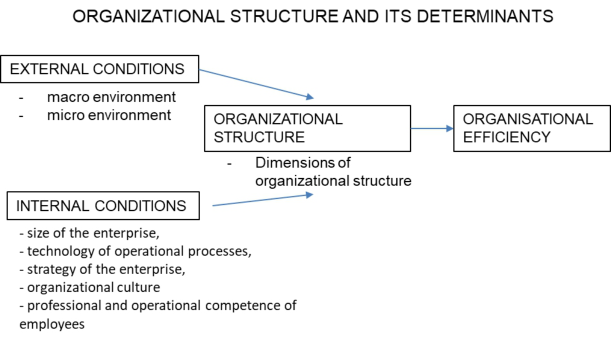
ORGANIZATIONAL STRUCTURE AND ITS INTERNAL AND EXTERNAL CONTEXT The issue of organizational structure is considered from three aspects: 1) What is organizational structure (interpretation), 2) What does organi- zational structure depend on. 3. what is the impact of structural solutions on organizational efficiency (see Figure 1). Organizational structure is interpre- ted differently both in science and in business practice. The modern scientific interpretation of organizational structure originates from sociological orga- nization theory - and mainly from the “Aston concept”, which describes organizational structure in five dimensions: Configuration, Centralization, Specialization, Standardization, Formalization (Pugh and Hinings, 1971, Hinings and Lee, 1976, Mrela and Pankow, 1980, Mrela 1983). Organi- zational practice is still dominated by a simplistic approach focusing on the first three dimensions: 1. structure chart (the equivalent of Configuration), 2. responsibilities (the equivalent of Specialization), and 3. the scopes of decision-making authority (the equivalent of Centralization). Internal con- ditions of the enterprise that affect the adopted structural solutions are: 1. the size of the enterprise, 2. the technology of operational processes, 3. the strategy of the enterprise, 4. the organizational culture and traditions, 5. the professional and operational competence of employees. The second inde- pendent variable for organizational structure is external conditions, which mainly include the variability of the environment in which the company operates.
Figure 1: Organizational structure and its determinants (own elaboration).
Designing the Organizational Structure of Enterprises Operating 113
International Conditions as the Main Factor of Environment Changeability in the Design of Organizational Structure The environment of a company is usually considered in two cross-sections: macro and micro. The macro environment includes four spheres common to many sectors of the economy: 1. economic, 2. political and legal, 3. social, 4. Technological. The micro environment focuses on the sector and identifies the competi- tive forces present in the sector: 1. Competitive rivalry in the sector, 2. The bargaining power of suppliers, 3. The bargaining power of customers in the sector, 4. The treat of new entrants, 5. The threat of substitute products or services. (Porter, 1980). Combining the macro and micro environment, we get a picture of external forces commonly called uncontrollable forces: (Ball and McCulloch, 1996):
1. Competitive (Competitors, Distributors & Clients, Suppliers) 2. Economic (GNP, unit labor cost, personal consumption expenditure) 3. Socioeconomic (characteristic and distribution of human population) 4. Financial (interest rates, inflation rates, taxation) 5. Legal (domestic and foreign laws by which firms must operate) 6. Physical (topography, climate, natural resources) 7. Political (political climates, government, international organizations)... 8. Sociocultural (attitudes, beliefs) 9. Labor (composition, skills, attitudes of labor) 10. Technological (technical skills and equipment In the strategic analysis of the enterprise, opportunities and threats from the environment are identified and sectors are sought in which to gain a com- petitive advantage. The adopted strategy will be the basis for adaptation of the organizational structure of the enterprise. It is relatively simple when a company operates mainly in the domestic market and, using an ethnocen- tric strategy, enters one foreign market similar to the domestic one. However, if the company applies polycentric, global and dual strategies, operating in dozens of markets, then the complexity and unpredictability of external situa- tions is radically greater. Although we are still operating with the same today’s five environment variables, the combination of their values and trends of change in individual markets multiplies the possible scenarios. It is necessary not only to adjust the organizational structures in each market individually, but also to ensure intra-organizational consistency and controllability of the entire corporation.
CONCEPT OF METHODOLOGY FOR DESIGNING ORGANIZATIONAL STRUCTURES UNDER CONDITIONS OF HIGH ENVIRONMENT VARIABILITY
1. The basis for the development of this methodology concept is the five-dimensional design space developed at the Department of Manage- ment Engineering, Poznan University of Technology (Pawlowski, 2009), presented below in 2 stages:
114 Edmund
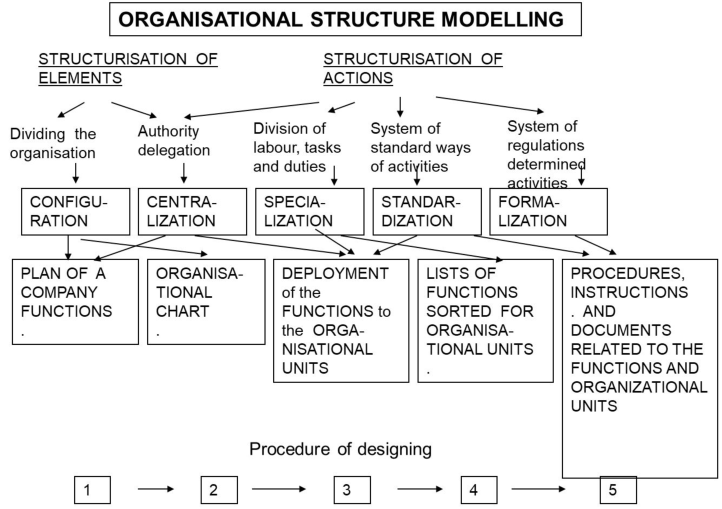
2. Defining the first two dimensions: a. Interpretation of the organizational structure - 5 dimensions were adopted in accordance with the Aston concept b. Modeling of the organizational structure - five modeling stages were adopted as in Figure 2.
3. Defining dimensions 3,4, and 5. a. Methodological approach to design (dimension 3)-it was assumed that both diagnostic and anticipation approaches could be used depen- ding on the previously chosen strategy (cost strategies, development strategies) b. Development of a detailed design procedure (dimension 4) and design principles (dimension 5) - is an extension and detailing of the stru- cture modeling procedure (adding preliminary stages - concerning the analysis of the company’s strategy, and final stages related to the implementation of the project).
Methodology for Modeling Organizational Structure The structure modeling methodology is shown in Figure 2.
The modeling of the organizational structure is carried out in five stages:
1. Designing an Enterprise Function Plan. A function plan is a set of enterprise business processes structured in a tree-type graph. The main function of the corporation (e.g., 0. Meeting the demand for automotive products) is divided into lower-level sub-functions representing functi- onal subsystems (e.g., 1. Marketing and sales, 2. Product and process
Figure 2: Diagram for modeling the organizational structure (own elaboration).
Designing the Organizational Structure of Enterprises Operating 115
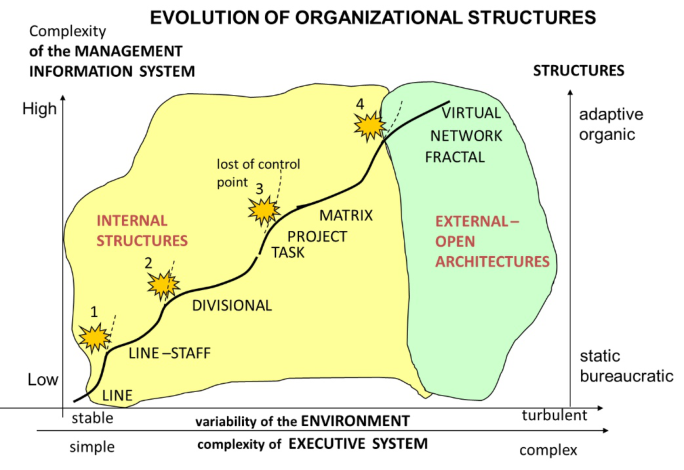
design, 3. Production and services) or business units (e.g., 1. Bus manu- facturing, 2. Passenger car manufacturing, 3. Truck manufacturing). At each level of the division into subsystems, control (management) functions are distinguished that maintain the consistency of the divi- ded subsystems (e.g. 0.#.01. Strategic management of the Corporation, 0.#.02. Tactical management of the Corporation 0.#.03. Organizational development). In practice, the function tree of a corporation contains from several hundred to a thousand functions. 2. Designing an organizational structure chart. The organizational stru- cture diagram is a graphical representation of the Configuration dimen- sion. The evolution of organizational structures in the context of the variability of internal and external conditions of the enterprise and their impact on the complexity of the management information system is shown in Figure 3. The effect of these relationships is the increase of the complexity of the information system to the level of loss of con- trollability. A change in the management system is required, including a change in structure, a change in information and computer systems. Subsequent forms of organizational structures have responded to such demands. The simplest linear structures, based on the quantitative divi- sion of management work, were replaced by line-staff structures, based on the qualitative division of work and specialization of managerial mem- bers. Divisional structures enabled the decentralization of management through the introduction of profit centers. Task, project and matrix structures enabled management control of the entire process (referenced to project, product, customer) across the traditional functional depar- tmentalization of the enterprise. Fractal, network and virtual structures
Figure 3: Evolution of organizational structures (own elaboration).
116 Edmund
Documents
Executor Supervisor Cooperation Connected
for result Main
costs - profit) S PE PE PZ ZF DF
(Current assets - current liabilities) T DEF DEF PE ZF DF
Table 1. Example of a function plan and a table of function deployment to organizational units.
Table available in the original PDF paper.
The Company Functions Plan
Number of Function Function L Responsible
00. External Function
00.#.03. FINANCE AND ACCOUNTING S T PE PE PZ ZE EF
00.#.03.01. INVESTMENT MANAGEMENT S PZ PZ RN ZW PE
00.#.03.01.01. Planning of capital investment S PZ PZ RN ZW PE
00.#.03.01.03. Estimating of investment decisions S PZ RN ZW ‘PE
00.#.03.01.04. Management of working capital net
00.#.03.01.04.01. Invetories management T PH PH PZ ZF
00.#.03.01.04.02. Receivables Management T DEF EF PE Sales Assistant
00.#.03.01.04.02.01. Receivables control O EF 1 EF1 DEF Sales Assistant
00.#.03.01.04.02.02. Reports concerning receivables control O DEF EF1 DEF PE EF3
1 2 3 4 5 6 7 8
Designing the Organizational Structure of Enterprises Operating 117
(Current assets - current liabilities) T DEF DEF PE ZF DF
finance credibilty T DEF DEF PE DF ZP
Table 2. Example of job duties.
Table available in the original PDF paper.
DEF FINANCE DEPARTMENT MANAGER
A - Responsible for the results of the following functions
Number of Function Function L Responsible for result Main Executor Supervisor Cooperation
1 2 3 4 5 6 7
00.#.03.01.04. Management of working capital netto
00.#.03.01.04.02. Receivables Management T DEF EF PE Sales Assistant
00.#.03.01.04.02.02. Reports concerning receivables control O DEF EF1 DEF PE EF3
00.#.03.01.04.02.03. Preparations of loans police assumptions T DEF DEF ZF PE PZ
00.#.03.01.04.02.04. Creating of systems of estimating clients
00.#.03.01.04.02.05. Policy of collecting receivables T DEF DEF PE DHT DHB
00.#.03.01.04.03. Cash management T DEF DEF PE
118 Edmund
by incorporating external business units into their own business enable both large and small companies to expand internationally and globally. Recommendations for companies operating in a turbulent environment are adaptive, organic solutions as various forms of virtual structures and their combination with divisional structures. 3. Deployment of functions to organizational units. This stage is a con- junction of the previous two parts of the configuration dimension. Allocation is based on indicating who participates in the performance of the function and to what extent. An example form of such an allocation is presented in Table 1. In column 3 - Level - the level of management is specified (S- Strategic, T-Tactical, O- Operational). In the allocation table, the symbols of organizational units and management positions included in the organizational structure diagram are entered. 4. Designing responsibilities for organizational units and management posi- tions. The responsibilities are created in four levels: Main Executor, Responsible for the Result, Supervision, Cooperation. The sorted functi- ons form a Job Duties Description Sheet as in Table 2. 5. Designing documents related to the performance of functions. Business processes have varying degrees of standardization and formalization. In column 8 in the Function Plan, links to documents related to the function are inserted. In this way, a continuity of business process description is created.
Documentation of the organizational structure should be placed on the intranet. This allows quick updating of the function plan, responsibilities and related documents, as well as quick, direct access for employees.
CONCLUSION
Designing organizational structures of enterprises operating in a highly chan- geable environment is among the most difficult design cases. The changeabi- lity and unpredictability of such an environment requires enterprise managers to have the ability to anticipate the future. On the other hand, designers of organizational structures are expected to be able to incorporate into the orga- nizational structure appropriate mechanisms of flexibility, speed of response to changes and mechanisms of organizational learning. These mechanisms should appear in the plan of business functions, in a properly adjusted confi- guration (chart) of the organizational structure, and allocation of functions ensuring hybrid centralization and decentralization of management.
REFERENCES
Hinings C. R., Lee G. L. (1976). Dimension of Organizational Structure and their Context: A Replication; in: Organizational Structure: Extensions and Replicati- ons. Pugh D. S., Hinings C. R. (ed.). Saxon House, Westmead. Mrela K. (1983). Struktury organizacyjne. Analiza wielowymiarowa. PWE, Warszawa 1983. Mrela K., Pankow M. (1980). Organizational Structure’s Effectiveness in Their
Context, PAN Warszawa.
Designing the Organizational Structure of Enterprises Operating 119
Pawłowski E. (2009). Designing the organizational structure of a company. A concept of multidimensional design space; [in]: Csath M., Trzcielinski S., (Eds). Manage- ment Systems. Methods and Structures. Monograph. Publishing House of Poznan University of Technology, Poznan, (pp. 107–121). Pawłowski E. (2010). Organizational Structure Designing and Knowledge Based
Economy. The Research Framework for the Polish Enterprises. [in]: Karwowski W., Salvendy G., (Eds.). Advances in Human Factors, Ergonomics, and Safety in Manufacturing and Service Industries. CRS Taylor & Francis Group. Boca Raton, (pp. 52–61). Pawlowski E. (2016). Flexibility of Organizational Structure in a Context of Organizational Innovations and Modern Concepts of Enterprise Management. Source: Portland International Conference on Management of Engineering and Techno- logy (PICMET 2016): Technology Management For Social Innovation Pages: 2331-2337 Published: 2016. Pawlowski E., Pawlowski K. (2020). Management system of intelligent, autonomous
environment (IAEMS). The methodological approach to designing and develo- ping the organizational structure of IAEMS. In: Advances in manufacturing, production management and process control: Proceedings of the AHFE 2019 International Conference on Human Aspects of Advanced Manufacturing and the AHFE International Conference on Advanced Production Management and Process Control, July 24-28, Washington D. C., USA / ed. Waldemar Karwowski, Stefan Trzcieli´nski (WIZ), Beata Mrugalska (WIZ) - Cham, Switzerland : Springer, 2020 - s. 92–99. Pawlowski E., Pawlowski K., (2008), A Framework of Organizational Structure Designing for Agile Enterprises; [in]: Proceedings of 2nd International Confere- nce on Applied Human Factors and Ergonomics. (Eds.) W. Karwowski and G. Salvendy. 2008, Las Vegas, (p. 1–8). Porter M. E. (1980). Competitive Strategy. Techniques for Analyzing Industries and
Competitors. Free Press, New York. Pugh, D. Hinings C. (1971). Dimensions of Organization Structure and their Context: A Replication. Sociology January 1971/ 5: 83–93 (1971). Thompson A., Strickland A. (1993). Strategic Management. Concepts and Cases.
IRWIN, Burr Ridge.
LISTED IN THE AHFE DIGITAL BOOKSTORE CATALOGUE
Explore the complete digital volume
Human Aspects of Advanced Manufacturing
Read this individual research paper free through the original publisher, or explore the full digital proceedings book.
ISBN 978-1-958651-56-8
Explore this ISBN in the AHFE Bookstore ↗Listed in the July 2026 bookstore catalogue; search by ISBN to confirm current availability · Digital book purchase optional