Edmund Pawlowski (2020). Size of an Enterprise and Organizational Innovations. In: Advances in The Ergonomics in Manufacturing: Managing the Enterprise of the Future. AHFE Open Access, vol. 12. https://doi.org/10.54941/ahfe100434
In the literature two opposite theoretical concepts on the innovation of enterprises can be found. The assets concept, known as the “Schumpeterian hypothesis”, assumes that large enterprises have more assets and greater ability to introduce innovations, not only in the technological but also in the organizational sphere. The other concept is the “Inertia theory”, which shows that the growth of the firm’s size causes the increase of standardization and formalization of its procedures and relations inside the organization. Structures seem to be stable, non-flexible and they resist organizational changes. Empirical examinations based on EUROSTAT statistics, as well as other, independent research confirm the assets concept. Author’s own research on the innovation of Polish enterprises has been conducted in the context of the development of the knowledge-based economy. The survey was conducted in 2012 on the group of 150 companies. Results of this study have also confirmed the assets concept. Large enterprises are more active in the area of innovation than medium or small firms. Presented dependency has been confirmed both in organizational and structural innovations.
This paper is a part of a larger research project called “Adjustment of enterprises’ management systems to knowledge-based economy”. The project, undertaken at the Faculty of Engineering Management of Poznan University of Technology, started in 2009 with the aim to define:
1. Model solutions (best practices) in regard to changes in enterprises regarding: strategy and organizational structure, human capital, innovations, ICT systems, relationships with institutional-legal environment, which enable them to realize the knowledge-based organization model. 2. Mechanisms of enterprises’ behavior, ignoring or blocking the influence of changes occurring in the environment, which results in keeping the organization unable to take advantage of the occurring opportunities and efficiently compete in the market. 3. Barriers existing outside and inside the enterprises, which neutralize or make negative the relationship between changes in the environment, reflecting the knowledge-based economy and changes in enterprises describing the knowledge-based organization.
The empirical research were conducted in 2012 and surveyed 150 of Polish enterprises. This paper focuses only on organizational innovation aspects in knowledge based enterprises with the aim of summarizing the actual research issue both: theoretical postulates and their empirical verification. In particular, the main question is: if implementation of organizational innovations depends on the size of an enterprise.
Ergonomics in Manufacturing (2020)
There are three parts of the paper:
1. Theoretical background 2. Own research 3. Conclusions
THEORETICAL BACKGROUND The concept and classification of organizational innovation
The concept of innovation is associated with the broadly understood introduction of novelties. The material, objective and functional scope of this concept has evolved over the years. Initially the concept of innovation was limited only to new products and technologies. Such approach was sufficient in times of domination of industry and local and international competition. Automation and robotics displace people from the real production processes into the area of services. In developed countries, most employees are hired in the service sector. Simultaneously increasing globalization has changed the importance of marketing and organizational strategies of enterprises in the competitive struggle. The result of these changes was gradual expansion of the concept of innovation, taking into account the impact of marketing and organizational changes on competitive position of companies. Systematic research on innovation in Europe have resulted in developing a series of books known as the Oslo Manual. The first manual was published in 1992 and developed the theories of innovation in products and processes, mainly in the production sectors. It became a foundation for a number of surveys on the innovation of economy, including studies conducted until today by the European Community Innovation Survey (CIS). Second Oslo Manual was published in 1997 and expanded the scope of research to include service sector, and the third, published in 2006, introduced two new areas: marketing and organizational innovation. In the last edition, Oslo Manual (2008, pp. 49-55) gives the current definitions of innovation and its different types. An innovation is the implementation of a new or significantly improved product (good or service), or process, a new marketing method, or a new organizational method in business practices, workplace organization or external relations. The minimum requirement for an innovation is that the product, process, marketing method or organizational method must be new (or significantly improved) to the firm. This includes products, processes and methods that a company was the first to develop, as well as those that have been learned from other companies or entities.
An organizational innovation is the implementation of a new organizational method in the firm’s business practices, workplace organization or external relations.
A characteristic feature of organizational innovation compared with other organizational changes in the company, is the use of such organizational method (in the principles of operation accepted by the company, in workplace organization or in its relations with the environment), which has not previously been used in the company and which is the result of strategic decisions made by its management. Organizational innovation in regard to company principles of operation consist in the implementation of new methods of organizing routine activities and procedures regulating company’s operation. Innovations in the field of workplace organization mean the implementation of new methods of distribution of tasks and decision making authority between employees, in order to divide work within divisions and between divisions (and organizational units). New organizational methods in regard to relations with the environment mean the implementation of new ways of organizing relations with other firms or public institutions, such as establishing new type of collaboration with research institutions or clients, new methods of integration with suppliers, as well as the first order to an outside company (outsourcing) or subcontracting such elements of activity as production, supply, distribution, recruitment or auxiliary services.
Systematic classification of organizational innovations can be found in the report "Patterns of Organizational Change in European Industry", developed by the Fraunhofer Institute Systems and Innovation Research (Armbruster et al, 2006, p 20-21).
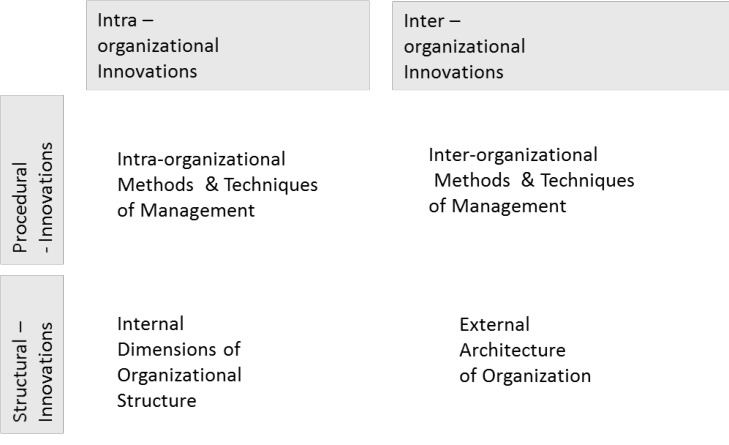
Organizational innovation can be divided into two types (Fig. 1): structural and procedural. Each of them can further be considered in the context of intra-organizational or inter-organizational innovation. Structural innovations relate to changes in the organizational structure (eg. reducing the number of hierarchical levels, the introduction of Ergonomics in Manufacturing (2020) divisionalization of activities, changes in the division of powers, responsibilities and decision-making authorities). Procedural innovations apply to routines of processes realization in an organization, change or introduce new organizational rules and procedures such as concurrent engineering, principles of zero inventory, continuous improvement of processes. While intra-organizational innovations show their effects within the organization, the inter-organizational innovation create new structures and procedures between the organization and its environment (eg, strategic alliances, outsourcing and partnership in supply chains).
Figure 1. Classification of organizational innovations. Own work based on: Ambruster., Kirner , Lay (2006)
Size of an Enterprise and Organizational Innovation in Literature The relationship between the size of the company and its innovation has been the subject of research interest since the beginning of the theory of innovation. „Schumpeterian hypothesis’’ argued, that the large firm operating in a concentrated market is the main engine of technological progress. (G. Symeonidis, 1996). For many years, empirical studies have focused on product and process innovation, aimed at, inter alia, verification of this hypothesis. D. Archibugi, R. Evangelista, R. Simonetti (1995) confirmed the existence of a positive association between firm-size and innovative intensity in sectors with high technological opportunities. D.A. Aranda, B.M. Rata, A.R. Duarte (2000), searching innovation in services sector in Spain indicated that firm size, is related positively with degree of innovation. A. Vaona and M. Pianta (2007), based on data from CIS 2, provided evidence on two dimensions of the innovation-firm size issue: the differences in the determinants of product and process innovation, and the pat- terns emerging across firm size in European manufacturing industries.
Attempts to explain the relationship between company size and organizational innovations are a part of two opposing theoretical concepts:
1. A resource-based view, deriving from "Schumpeterian hypothesis", implies that large companies, having more resources, have also a greater capacity for innovation, both technological and organizational (Kimberly and Evanisko, 1981; Damanpour, 1987) 2. Inertia theory, indicating that the increase in size of the company increases standardization and formalization of procedures and relationships inside the organization. The structures become stable, inflexible and create resistance against organizational change (Hannan and Freeman, 1984, Kelly and Amburgey, 1991, Downs, 1967, Carroll and Hannan, 2000).
Ergonomics in Manufacturing (2020)
Empirical studies of organizational innovation in the context of the size of companies have been conducted based on the Eurostat methodology and data, but there are also other studies, based on individual methodologies. A. Stabryła and his team (2009) conducted in 2007 their own comparative study of Polish knowledge-based businesses and companies operating in conventional form. One of the main features of knowledge-based enterprises is their organizational innovativeness. In the group of 275 surveyed companies, a high index of the level of knowledge (category A) was found in 21 companies. The percentage of large enterprises in category A was significantly higher than in other categories (B - average, and C - weak). It was also found that the leading business sector for companies of Category A was services (53%) and to a smaller extent production (32%). An important factor was the geographical coverage; 63% percent of enterprises of category A operated on international market.
Innovativeness of companies in category A was by far superior to other categories of enterprises in all analyzed criteria: organizational, product, process and marketing. Product innovations were introduced by 85% of companies, process innovations by 78% of companies, innovation in marketing strategy by 62% of companies, changes in organizational structures by 62% of companies, changes in the strategy of the enterprise management - 66%, implementation of advanced management techniques - 42%.
K. Sapprasert (2008) using a dataset based on the firm-level Norwegian CIS (1999 – 2001 and 2002 – 2004) and financial accounts, has examined the determinants and performance effects of organizational innovation within the firm. The research indicated, that organizational innovation is greatly constrained by many factors, particularly firm age and size. More than one third of firms in the sample are organizational innovators, having introduced at least one type of organizational innovation during 2002 – 2004, with a higher percentage of larger firms (13% of small firms, 17% of medium and 19% of large firms).
CIS 2008 reports show an increase of organizational innovation of enterprises in Europe. Just as in studies of K. Sapprasert, the share of innovative firms by size shows the dominant position of large companies (56%) and relatively less innovativeness of medium-sized (40%) and small (30%) companies. It is also worth noting that the percentage distributions of marketing, product and process innovation are similar (KNOWINNO 2012).
Small firms Medium firms Large firms Product innovations
1
0.5
Marketing innovations 0
Process innovations
Organizational innovations
Figure 2. Share of innovative firms by size and by type of innovation. Source: own work based on CIS 2008 and KNOWINO 2012
Figure available in the original PDF paper.
Ergonomics in Manufacturing (2020)
More detailed distribution of innovative activity by different types of organizational innovation is presented in Table. 1. The table was based on CIS 2008 - 2010 and applies to Ireland. The distribution is similar for all three sizes of companies. The highest innovative activity relates to the implementation of the first two types of innovation: 1/ new business practices and 2/ new methods of organizing work responsibilities and decision making. These two types of innovation were implemented by two times more companies than the third type: new methods of organizing external relations.
Table 1. Organizational innovations activity in Ireland by size of firm and type of innovation . Sorce: Own work based on CIS, Dublin 2012
New methods of organizing work, responsibilities and decision making New methods of organizing external relations 15,9 13,4 22,8 36,1
Any organizational innovations 36,4 31,9 49,3 72,9
Presented above results of empirical studies confirm the "Schumpeterian hypothesis" also in regard to organizational innovation. The size of company determines its physical, financial and human resources, and thus also affects the scope of implemented organizational innovation. On the other hand, studies confirm the presence of a symptom of petrification of organizational structures and inertial behavior (Stabryła and others 2009). Declared in CIS surveys changes introduced by companies illustrate the quantitative aspect of innovation. Number of changes does not imply however the qualitative growth, understood as modernity and organizational efficiency of the company. A study conducted in 2003 in the German industrial sector has shown that only a small group of companies fully applied certain organizational innovations. For example, more than 60% of companies declared implementation of teamwork, but only 10% reported that it took advantage of this innovation, and only 7% have used this innovation throughout the entire enterprise. (Armbruster, Kirner, Lay, 2006).
OWN RESEARCH The Genesis and methodological assumptions of the research
The research on innovation character of the structure of the enterprise is a part of a bigger project named “Adaptation of management systems in Polish companies to the knowledge based economy”. The project is realized in the Faculty of Engineering Management of the Poznań University of Technology since the year 2009. The material scope of examinations in the project includes: the strategy, organizational structure IT technology and human capital. The survey was made in 2012. The survey questionnaire included 107 questions and the demographics that characterized examined business entities. A method of direct interviews with owners of companies or the general management (chairmen, vice chairmen or directors) was applied. The study was conducted in 150 enterprises. Criteria for the selection of the sample were defined in the preliminary stage of the project.
The percentage of interviews in particular regions of Poland, sectors of the industry and service and sizes of Ergonomics in Manufacturing (2020) companies (30% of small business, 40% medium and 30% large enterprises) were determined. The principal classification of sizes of enterprises was referred to the size of employment (small: 10-49 employees, medium: 50- 249, large: more than 250 employees). In regard to the analysis of trends, two points in time were defined: year 2007 (as the beginning of implementation of the Lisbon Card in Poland, which meant the beginning of knowledge-based economy) and the year 2012 – in which the research has been conducted. The following hypotheses in the area of research on organizational innovation of enterprises were formulated:
1. The organizational innovation of enterprises increased in the period 2007 – 2011 both in the aspect of their structure and from the perspective of processes. 2. Structural innovation manifests itself with and increased flexibility of organizational structures. 3. The flexibility of the organizational structure is different in different functional areas of the company. 4. The process innovation manifests itself with a higher level of application of modern concepts and methods of management. 5. The innovative character of enterprises depends on the size of the company.
The preliminary analysis of research findings The presented analysis of research results has a strictly introductive character and it refers only to presented hypotheses; however, it mainly concerns the last hypothesis: whether and how the innovation depends on the size of a company. The table 2 illustrates the activity of enterprises in the process of implementing modern methods of management and changes in their organizational structures and processes. Respondents were determining the level of activity and the stage of advancement in the implementation of particular methods, using the scale from 0 to 5. „0” in this scale meant ignorance of the method and / or lack of its implementation, while „5” was for complete implementation of the determined method. The table presents values representing the average result for responses of a determined group of enterprises.
Table 2. The innovation activity of Polish enterprises in the year 2011. The evaluation representing the average within the scale: 0 – 5 (0 – lack of implementation, 5 – full implementation). Source: personal elaboration
Process Management 2,1 1,4 2,0 3,0 Work flow (IT systems) 2,3 1,5 2,0 3,5
Just in Time 1,6 1,6 1,5 2,6 Kaizen 2,2 1,2 1,6 3,1
Network organization 1,8 1,2 1,6 2,8 Assessment and changes in organizational structure 2,7 1,9 2,6 3,6
Assessment and changes in procedures 2,7 2,0 2,5 3,8
The level of innovative activity of examined enterprises is low and reaches values from 1.3 to 2.7 point in the five pointscale. There is an explicit differentiation of innovative activity depending on the size of the company. The highest innovative activity was reported in big companies (indicators from 1.9 to 3.8: however indicators higher than Ergonomics in Manufacturing (2020)
3.0 were dominant), next were medium enterprises (indicators from 1.2 to 2.5) and small companies (indicators from 1.2 to 2.0). The order on the list of activity of large, medium and small firms is the same in for all examined methods and processes of change. The lowest indicators of innovative activity were observed in reference to Lean Management and TQM. Such small activity and efficiency of implementation can be explained by the complexity of these methods consisting of many detailed techniques, as well as costs and time needed for the complete implementation.
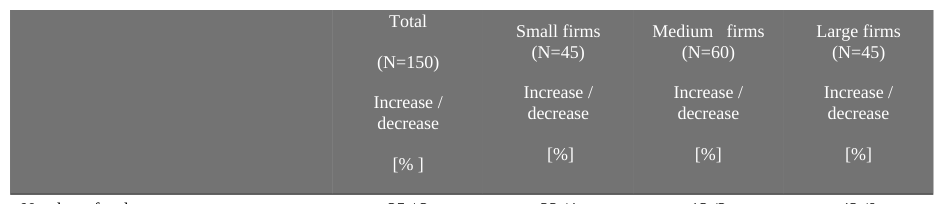
The table 3 shows results of research concerning changes of innovation in companies in the sphere of organizational structure in years 2007 -2012. Changes in the organizational structure were examined in five dimensions of the organizational structure: configuration, centralization, specialization, standardization and formalization. In view of the dimension of configuration, the question did not refer directly to the type of the applied organizational structure because pilot survey presented a poor knowledge of the management of enterprises on the modern taxonomy of organizational structures. This led to questions about the range of implementation of flexible structural forms, such as breakdown structures, project-based or matrix structures. The table included the percentage share of numbers of companies that observed an increase / or decrease of values of particular dimension of the organizational structure.
Table 3. Changes in organizational structures of Polish enterprises in the period 2007 – 2012
Number of task teams 25 / 2 22 /4 13 /2 42 /0 Number of Product / Project / Client Managers 17 /0 11 /0 8 /0 36 / 0
In regard the context of research on the adaptation of Polish enterprises to the knowledge-based economy, an increase of flexibility of the organizational structure was assumed. The growing flexibility was identified with the increase of the dimension of the configuration and decentralization, as well as with the diminution of the level of specialization, standardization and formalization. Research results do not present an unequivocal response. In view to the entire group of examined enterprises, 40% of them stated that the total flexibility of the structure increased, but 47% declared that it dropped. The evaluation of individual dimensions was also not explicit. The rise of the number of task teams, project managers and product managers (for projects or for clients) speaks only for the increasing flexibility of the configuration dimension. However, the number of levels in the hierarchy also grows. From the other hand, one can observe the loss of flexibility in the sphere of dimensions of the specialization, standardization and formalization. The size of the company has a significant impact on its changes in the structural Ergonomics in Manufacturing (2020) innovation. The total indicator of flexibility for large enterprises shows a positive trend (51% firms declare an increase of flexibility and 38% the reduction of flexibility). However, in sectors of medium and small enterprises the tendency is opposite: the majority of these companies assess that the structural flexibility has decreased. The high level of implementation of the breakdown projects and matrix structures, as well as growing level of decentralization, is characteristic for big enterprises. An increase of the level of specialization, standardization and formalization was observed in all sizes of enterprises.
CONCLUSIONS
Innovation of enterprises in the context of the size of a business unit was the point of scientific interest since the 40- ies and the 50-ties of the 20th century. “Schumpeterian hypothesis’’ argued, that the large firm operating in a concentrated market is the main engine of technological progress has been confirmed with empirical research made by D. Archibugi, R. Evangelista, R. Simonetti (1995), D.A. Aranda, B.M. Rata, A.R. Duarte (2000), A. Vaona and M based on the Eurostat Pianta (2007) study. A similar dependency was confirmed in reference to organizational innovations. The dependency between organizational innovation and the size of a company was confirmed by the research CIS (2002. 2004. 2008), Sapprasert (2008), and by independent studies of A. Stabryła and his team (2009). The authors research led on the subject of the organizational innovation in enterprise in the context of the knowledge-based economy also confirmed similar dependencies. The innovative activity of large firms is much stronger that the activity of medium and small enterprises in the scope of process and structural innovations. Changes of dimensions in the configuration and centralization increase the flexibility of organizational structures. However, the higher level of specialization, standardization and formalization reduces the flexibility of the organizational structure in examined enterprises and moves them away from the theoretical model of the knowledge- based enterprise. The reduction of flexibility of the structure confirms in a way the Inertia theory. Hence, it is important to notice that such trends of stiffening structures take place not only in large enterprises, but also in medium and small companies. The petrification of organizational structures is not related to the size of the business unit.
REFERENCES
Armbruster, E. Kirner, G. Lay, (2006), “Patterns of Organizational Change in European Industry (PORCH). Ways to Strengthen the Empirical Basis of Research and Policy”, Germany, Fraunhofer Institute Systems and Innovation Research. Arranda D., Minguela – Rota B., Rodrigez – Duarte A. (2000), “Innovation and firm size: An empirical study for Spanish
engineering consulting companies”. First World Conference on Production and Operations Management POM, Sevilla Archibugi D., Evangelista R., Simonetti R. (1995). “Concentration, firm size and innovation: evidence from innovation costs”.
Technovation, 15(3) (1995) 153-163 Carroll, G. R. and Hannan, M. T. (2000), “The Demography of Corporations and Industries”. New Jersey: Princeton University Press. Damanpour, F. (1987) “The Adoption of Technological, Administrative and Ancillary Innovations: Impact of Organizational
Factors.” Journal of Management, Vol. 13, No. 4, pp. 675 – 688. Downs, A. (1967) Inside Bureaucracy, Boston: Little, Brown. Hannan, M. T. and Freeman, J. H. (1984) “Structural Inertia and Organizational Change.” American Sociological Review, Vol.
49 No. 2, pp. 149 – 64. Kelly, D. and Amburgey, T. L. (1991) “Organizational Inertia and Momentum: A Dynamic Model of Strategic Change.”
Academy of Management Journal, Vol. 34, No. 3, pp. 591 – 612. Kimberly, J. R. and Evanisko, M. J. (1981) “Organizational Innovation: The influence of individual, Organizational, and Contextual Factors on Hospital Adoption of Technological and Administrative Innovation.” Academy of Management Journal, Vol. 24, No. 4, pp. 689 – 713. KNOWINNO (2012), “Making the most of knowledge Innovation in services: the role of R&D and R&D policy (INNOSERV)”.
Second expert meeting OECD, Paris 20-21 March 2012 Oslo Manual (2008). Podręcznik Oslo, OECD, Warszawa Sapprasert K. (2008). “On Factors explaining Organizational Innovations and its Effects”. TIK Working Papers on Innovation Studies No. 20080601, University of Oslo Symoenides G. (1996). “Innovation, firm size and market structure: Schumpeterian hypothesis and some new thems”. London
School of Economics, OECD, Economic Department, Working papers no 161, Paris Stabryła A. (red.), (2009), “Doskonalenie struktur organizacyjnych przedsiębiorstw w gospodarce opartej na wiedzy”.
Warszawa, Wydawnictwo C.H. Beck. Voana A., Pianta M. (2007). “Firm Size and Innovation in European Manufacturing”. Small Business Economics. Springer Ergonomics in Manufacturing (2020)
2007 DOI 10.1007/s11187-006-9043-9
Ergonomics in Manufacturing (2020)
LISTED IN THE AHFE DIGITAL BOOKSTORE CATALOGUE
Explore the complete digital volume
Advances in The Ergonomics in Manufacturing: Managing the Enterprise of the Future
Read this individual research paper free through the original publisher, or explore the full digital proceedings book.
ISBN 978-1-4951-2103-6
Explore this ISBN in the AHFE Bookstore ↗Listed in the July 2026 bookstore catalogue; search by ISBN to confirm current availability · Digital book purchase optional