Diego José Gómez Montoya (2020). Quantitative Techniques Integration For Allocation of Workers. In: Advances in The Ergonomics in Manufacturing: Managing the Enterprise of the Future. AHFE Open Access, vol. 12. https://doi.org/10.54941/ahfe100440
In this work are combined several techniques of quantitative type, to determine the number of people to use and the moments of the day in that should begin their work, in services of attention to the client via phone (that is to say to program the schedule of agents in a company of contact center), in such a way that the indicators of monetary utility and occupation (use of the resource) are increased. In the first phase, are used technical of optimization like the mixed integer programming - using GAMS software -, starting from the results of the first phase a second phase is generated in which implicit functions of non-lineal type are introduced in the system, the quantities of agents are conceived that they begin in each interval of half hour and the recommendations are analyzed for the strategic area of the organization.
In a campaign of telephone customer need to hire people who provide care (agents) in working full days (8 hours) due to the high fixed costs of the operation and the difficult context of housing location people (many agents live in remote and mobility in large cities is slow). According policies or guidelines that are managed in the organization, these days usually include periods for rest or eating. It is therefore intended that the time spent by agents to care, relevant and consistent with the demand of calls from customers. In other words try not to stop serving customers for lack of capacity, or that agents are idle in their work periods. For them develops a mathematical model using optimization at first phase and other functions at second, that ensure more favorable utility level for the organization.
REFERENCE MARK Determining the number of people required in a task, and the scheduling of shift work associates have been approached by interested organizations reduce costs, increase profits, or establish the best combination for the use of its resources, using Industrial Engineering mathematical techniques such as sequencing, optimization, testing and mistake.
Allocation Problems HSI Such problems arise in situations where you must perform a number of activities, existing logical limitations on the amount of resources or how they are used, preventing the activity of the most effective. In these situations you want to distribute the available resources between activities, so as to optimize the overall effectiveness. The number of possible ways to allocate activities resources may be finite or infinite. In problems with a finite number of possibilities could, in theory, list them all. Unfortunately this numbering is excessively long on practical problems. Therefore, for the analysis of situations in which the effectiveness and restrictions set out in terms of linear functions of fixations techniques have been developed called linear programming, these techniques can be divided into three main groups according to the methods used in the solution:
Allocation Issues Each source is associated to one and only one destination, and is intended to associations so as to minimize (or maximum) the total effect (the sum of the efficacies). The number of sources is equal to number of destinations.
Transportation Problems We wish to determine how to make associations between origins and destinations, subject to the limitations on the totals. The number of sources may be different than the number of destinations.
Problems Simplex Involves maximizing or minimizing a linear function of a set of non-negative variables subject to a set of linear inequalities that relate to variables (Sasieni and Yaspan, 1976).
In those cases where the variables should have a positive integer value, these variables are known as integer variables, one can take meantime when value of 0 or 1, are known from nature Boolean (or binary).
Contact Center Contact Center is a structure that provides the company with the necessary elements for a centralized telephone service establish mutually beneficial relationships with their customers, suppliers, etc., Which is why we very commonly see the Contact Centres are designed to handle large volumes of telephone calls, incoming and outgoing calls to and from customers in order to support the daily operations of the entity (Torres y Rosas, 2004).
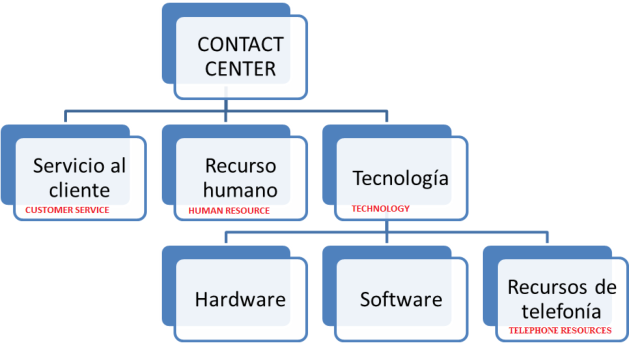
For the proper functioning of a contact center must achieve integrate three key features or components such as customer service, human resources and appropriate technology processes performed in the hardware, software and telephone resources needed these requirements are structured in Figure 1.
Figure 1. Contact center components
Background
Some studies related to this, which have been reported by technical articles, papers in different grade levels and scientific documents, then the summary of this work:
Garcia and Vazquez, develop a mathematical model of static general equilibrium, which determines the length of a working day and the starting times of the same, under different scenarios that take into account the preferences of human talent resulting model Flexible schedules can have a positive impact on the productivity of workers (García and Vázquez) Torres and Rosas, described in detail the operation of the ‘Credibanco visa’ contact center and perform a simulation of queuing time now, from these results give the number of workers required for each hour in two groups (working days and days holidays) (Torres y Rosas, 2004).
Hernandez and Miranda, evaluated using eight indicators, the improvement provided by the use of integer programming for class scheduling and room assignments at a university; able to demonstrate that the current methods used to schedule times are highly inefficient and ineffective regarding the proposed method (Hernandez and Miranda, 2008).
Restrepo, Amaya and Velazco (2008), using mathematical programming to design a planning model that was used to staff the areas of hospitalization, radiology, emergency and for the case of nurses and instrumentalists in the area of surgery (Restrepo et al., 2008). It is important to recognize that in some roles idle staff, while the number of nurses is insufficient.
Puente and Gómez, used Genetic Algorithms for planning shifts in the emergency department of a hospital, there was defined that the chromosomes in the model were determined by five possible working day and by the code of the individual (worker); main findings reveal that the model yields schedules that are feasible (Puente and Gómez).
Other authors have focused on improving the service delivery systems in the aviation industry, especially in scheduling shifts at an airport. Casado and Pacheco, seek to rationalize the cost of billing and security personnel serving restrictions on traffic flow of passengers, the results allow the decision maker to find appropriate solutions to the change in the priority objectives: cost or service (Casado and Pacheco, 2006). Meanwhile Gonzalez and Diego, using integer programming to set the quadrants of turns, taking into account different kinds of contract and the behavior of the weekdays. It also shows that the resolution of the problem in phases allows obtaining very good results in the overall problem (Gonzalez and Diego, 2008) Other studies agree be oriented to planning staff in user service centers (call centers) and solved using linear programming are aimed at solving problems that must determine the days off and the starting times of shifts (Baker, 1976), (Henderson and Berry, 1976), (Koutsopoulos and Wilson, 1987), and Bechtold (1991).
CHARACTERIZATION SYSTEM
Determining This system is made from the point of view of human resources for agents and advisers met for eight hours continuous days, with the right to take a break for lunch intake (half hour) and two minor breaks (each quarter of time) for the intake of other foods or to rest.
Agents are supported and monitored by supervisors at approximately 1:15, there is also a chief operating and others who are part of the Staff and Trainers meet or roles of quality auditors.
There is a cost associated with each answered call (telephone) and a variable cost to ensure each job.
The attention given to the customer in the campaign analyzed corresponds to Customer IN-BOUND a cell phone company, and starts at 7 am. The time to stop this hotline addressed is at 12 midnight.
AGENTS PROGRAMMING MODEL
It was decided to develop a model with Boolean variables (binary), indicating periods (half-hour) in which each agent should be active or attentive to receive a call, we evaluated multiple scenarios in which you set the number of hiring agents in the day with historical data as input a type of day that records high call traffic.
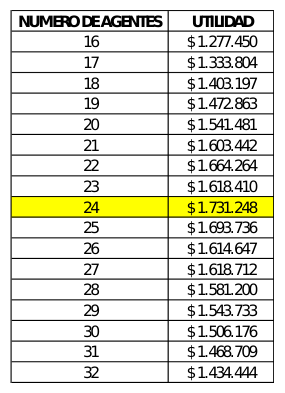
Table 1 summarizes the utility obtained by the business daily for each alternative hiring number of agents.
Table 1: Profits as model depending on the number of agents NUMERO DE AGENTES UTILIDAD 16 $ 1.277.450 17 $ 1.333.804 18 $ 1.403.197 19 $ 1.472.863 20 $ 1.541.481 21 $ 1.603.442 22 $ 1.664.264 23 $ 1.618.410 24 $ 1.731.248 25 $ 1.693.736 26 $ 1.614.647 27 $ 1.618.712 28 $ 1.581.200 29 $ 1.543.733 30 $ 1.506.176 31 $ 1.468.709 32 $ 1.434.444
Table 1 shows that when agents use 24, you get a profit in the day that is one million seven hundred thirty-one thousand two hundred forty-eight COP (equivalent to 964 US dollars).
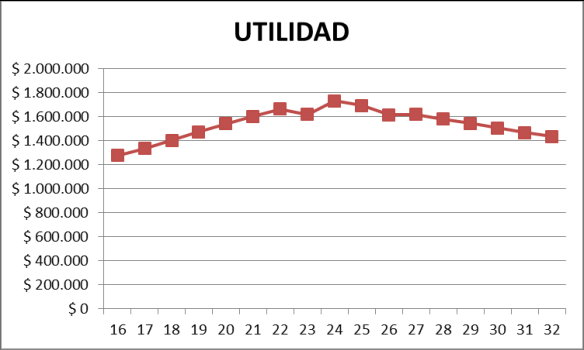
Figure 2. Behavior Profit (COP) vs. Number of agents
According to the results in Table 1, Figure 2 was constructed, which demonstrates the usefulness of increasing behavior as it increases the number of agents, such behavior can be explained with diminishing marginal returns labor resource.
Following the formulation of the model using the software language GAMS (General Algebraic Modeling System), for 24 agents:
$title MODELO ASIGNACION JORNADAS CAMPAÑA DE TELEFONÍA sets
i identifica cada agente /A1*A24/ * identifies each agent j identifica cada periodo de media hora /Q1*Q36/ * identifies each half hour period ;
parameters LLAM(j) Llamadas entrantes en periodo de media hora j * Incoming calls half hour period j
SCALAR TMO Tiempo promedio de duración de llamadas /170/ * Mean duration of calls
*Está dado en unidades de segundos/llamada (Is given in units of seconds / call) INGRUNIT Ingresos percibidos por cada llamada recibida /775/ * Income received by each call received
CAH Costo de agente en cada hora (incluyendo carga prestacional) /4689/ * Cost of agent in each hour (including fringe benefits load) ;
PARAMETERS CAPAGENT Capacidad de atención en llamadas de cada agente para cada periodo de media hora * Calls attention capacity of each agent for each half-hour period ;
Equation reproduced from the original PDF.
F funcion objetivo * objective function ; binary variable
AD(i,j) Agente disponible i en periodo de media hora j * Available agent i at half hour period j ; integer variable
C(j) LLAMADAS CONTESTADAS en periodo de media hora j * Answered calls in a half hour period j; equations
model TelefoniaBinario /ALL/; SOLVE TelefoniaBinario using mip MAXIMIZING F;
DISPLAY AD.l, C.l;
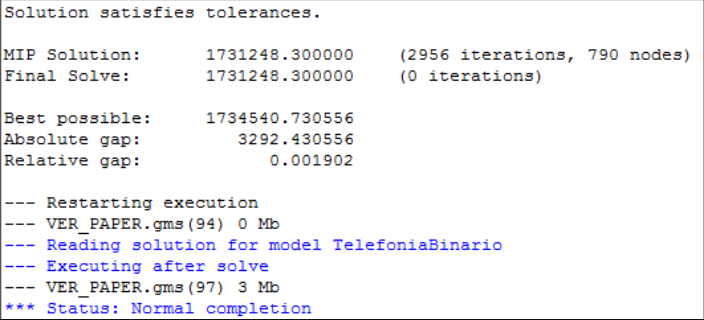
Figure 3. Results of optimization using mixed integer programming
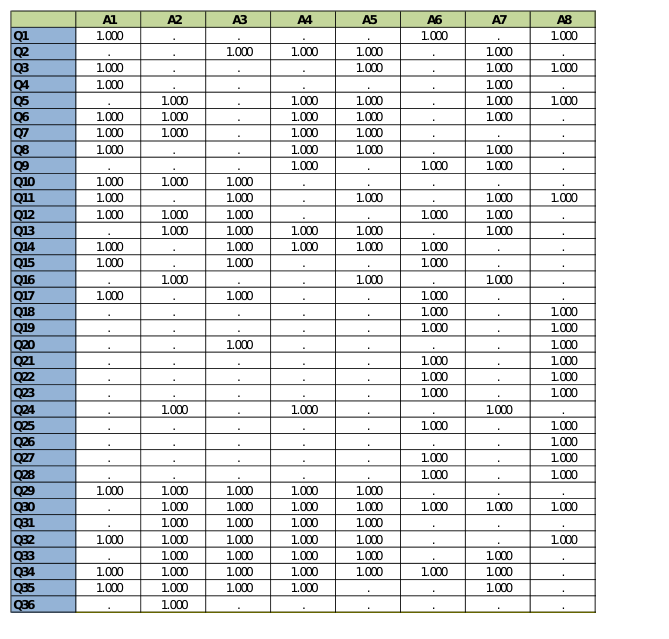
Figure 3 is recorded that 2956 iterations were necessary and the use of 790 nodes to reach the optimal solution for periods that should be available in each of the 24 players (the best option on the profit of the business). Table 2 presents the schedule for periods of half an hour for the first 8 agents according to the optimization results.
Although the results in Table 2 indicate how agents should work in periods 1 to 36, exist a continuity restriction periods (people may be available in consecutive periods, because many of them live in remote areas to contact center facilities or perform other academic activities), which failed to include in the optimization model because of the lack of software flexibility to integrate some functions.
Therefore we resorted to another phase in the development of this project, which take as input the results of the optimization and make decisions for the determination of the periods of continuous work start of each of the 24 agents.
DETERMINATION OF THE START OF WORK PERIODS
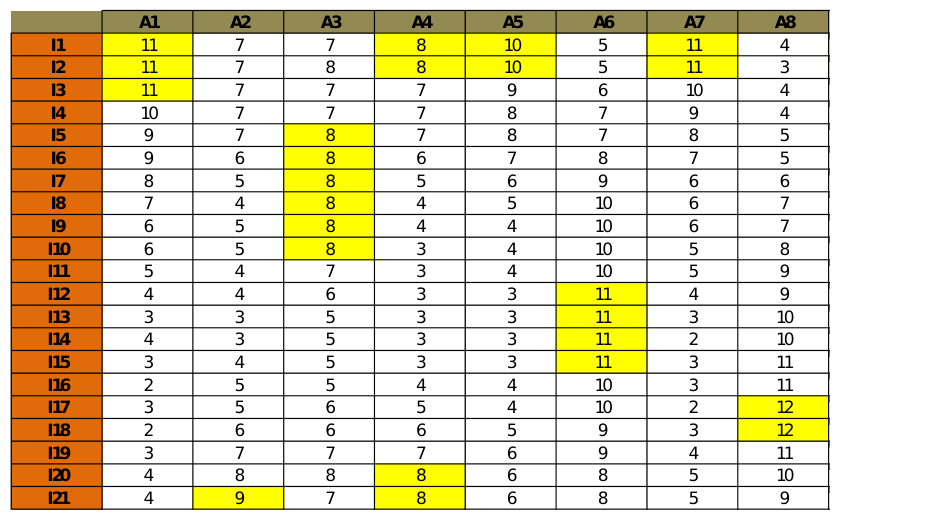
Based on each agent is hired by an 8 hour shift, equivalent to 16 half-hour periods, an evaluation of the number of periods in which the optimization would be active as if carrying a continuous day and if it started its work in each start periods I1 to I21, the results are seen in Table 3.
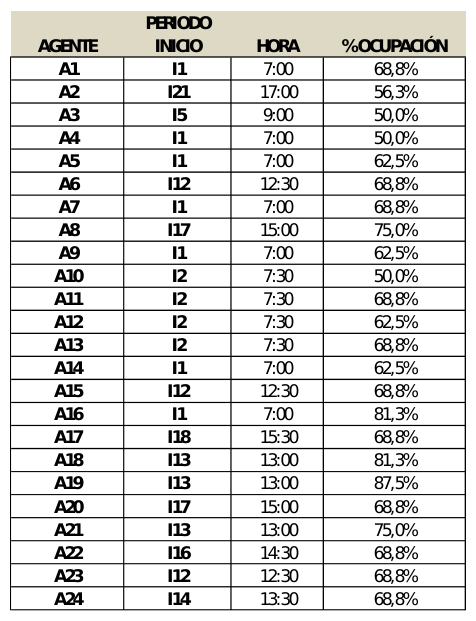
For each of the agents are shaded in yellow the maximum number of periods that would be active, to potential work periods start. As an example, agent 6 could be busy up to 11 of the 16 periods that lasts your day, this would happen if the start of their journey is presented in period 12, 13, 14 or 15, as a criterion for selection was decided to start the first period having a maximum number of busy periods (in the case of Agent 6, the start-up period will be 12), because the continuation of the journey includes subsequent periods. Finally Table 4 summarizes the starting period, the time associated with that period and the % occupancy (measured as the percentage of busy periods on the ideal of 16).
Table 4: Start time of each agent and % occupancy in final solution
The occupancy rate of the agents is between 50 and 87.5%, which shows that in any case will exist an inevitable idle fraction of working time.
CONCLUSIONS AND RECOMMENDATIONS It was recognized that other authors have been interested in scheduling shifts and working hours of persons in service processes, primarily in the aviation sector and call center activities.
The model accounted for agents scheduling in a contact center system, finding that in day rates expected high call traffic, 24 agents are available because it is the amount that provides the best combination of earned income and calls attention to the costs associated with the operation.
In the first phase of optimization were certain moments or periods of half hour in which each agent is required to be available or acceded to the answering system, in those periods where the working day is repeated a large number of agents are idle, it is suggested to schedule training or feedback to monitoring carried out by the quality Department.
Fixed the problem that the GAMS software was not possible to guarantee the continuity of the periods in which each agent should be active (consecutive 8-hour day), by proposing a second phase where they chose that moment to start offering for each agent the most busy periods of half hour or more occupancy rate throughout the day.
In a future modeling is recommended use periods of 15 minutes and include the times that take place every one of the breaks or recesses, also plans to conduct a validation of the results and then to implement an automated logging program.
REFERENCES
Baker, K.R., (1976), “Workforce allocation in cyclical scheduling problems: a survey”, Operations Research Quarterly Bechtold, S.E.; Brusco, M.J., y Showalter, M.J., (1991), “A comparative evaluation of labor tour scheduling methods”, Decision Science Casado, Silvia y Pacheco, Joaquín., (2006), “Diseño de un sistema para la resolución del problema de asignación de turnos en
un aeropuerto”, Estudios de Economía Aplicada. Diego, Francisco Javier y González, José Angel., (2008), “Optimización de cuadrantes de turnos para el personal de atención de vuelos en tierra”, XII Congreso de Ingeniería de Organización - 2nd International Conference on Industrial Engineering and Industrial Management. García, Antonio y Vázquez, María del Mar., “Modelo de determinación del horario de trabajo”, Departamento de Economía.
Universidad Politécnica de Cartagena Henderson,W.B., y Berry,W.L., (1976), “Heuristics methods for telephone operator shifting scheduling: an experimental analysis”, Management Science Hernández, Rodrigo y Miranda, Jaime., (2008), “Programación de Horarios de Clases y Asignación de Salas para la Facultad
de Ingeniería de la Universidad Diego Portales Mediante un Enfoque de Programación Entera”, Revista Ingeniería de Sistemas – Vol. XXII. Koutsopoulos, H., y Wilson, N., (1987), “Operator workforce planning in the transit industry”, Transportation Research Puente, Javier y Gómez, Alberto., “Planificación de turnos de trabajo en el servicio de urgencias de un hospital mediante algoritmos genéticos”, Área de Organización de Empresas - Universidad De Oviedo Restrepo, Amaya y Velazco, (2008), “Planeación de personal para las diversas áreas que componen un centro médico: Un caso
de aplicación”, Los cuadernos de PYLO – Universidad de los Andes. Sasieni, Maurice y Yaspan, Arthur., (1976), “Investigación de Operaciones. Métodos y Problemas” Editorial Limusa Torres, Fidel y Rosas J.C. (2004), “Optimización del call center de Credibanco – Visa”, III Congreso Colombiano y I Conferencia Andina Internacional de Investigación de Operaciones
LISTED IN THE AHFE DIGITAL BOOKSTORE CATALOGUE
Explore the complete digital volume
Advances in The Ergonomics in Manufacturing: Managing the Enterprise of the Future
Read this individual research paper free through the original publisher, or explore the full digital proceedings book.
ISBN 978-1-4951-2103-6
Explore this ISBN in the AHFE Bookstore ↗Listed in the July 2026 bookstore catalogue; search by ISBN to confirm current availability · Digital book purchase optional