Hanna Włodarkiewicz-Klimek (2020). The Changes of Human Capital Structure in Condition of Adaptation the Enterprises’ Management Systems to the Knowledge-Based Economy Requirements. In: Advances in The Ergonomics in Manufacturing: Managing the Enterprise of the Future. AHFE Open Access, vol. 12. https://doi.org/10.54941/ahfe100438
The purpose of the article is to present the research findings in the area of adapting the human capital of Polish enterprises in the context of changes tendencies of the status and structure of the human capital in the Polish social and economic reality. The Polish access to the European Union initiated activities leading to adjust our country to the directions of changes and of development of European countries in accordance to principles of the knowledge-based economy. The knowledge domination as a fundamental resource creating the social and economic reality determines the internal changes of organization basic resources in relation to the changes of the key areas of its environment. The article presents results of the study concerning the human capital in Polish enterprises, in which it has been examined from the point of view of changes of its statute and structure in the context of its turbulent environment. The research on the human capital presented in the paper is a fragment of a broaden research on the adaptation of enterprises’ management systems to the knowledge-based economy requirements, which were carried out at the Faculty of Engineering Management of the Poznan University of Technology in 2010.
The purpose of the article is to present the research results concerning changes of statute and structure of the human capital. The examination was made within the frames of the project “Adaptation of enterprise management systems to the knowledge-based economy requirements”(Trzcieliński,2010). Undertaking examinations in the area of the human capital was connected with two premises: the first referred to the role and meaning of the human capital in shaping the knowledge-based economy conditions. The second premise was connected with activities of organization aiming at using the opportunities created by the knowledge-based economy. The organization notices and uses opportunities, mainly by its appropriate state and structure of the human capital. The presented research try to answer to the questions which areas of the human capital are the most sensible to changes appearing in the knowledge-based economy and which changes of the human capital occurred in the examined period. The accepted time horizon of the study as well as the method for identifying dependencies between the environment and the organization allows determining the characteristic of an enterprise in the area of the human capital assumed to be the most representative from the view point of human capital behavior sensibility to the influence of the knowledge- based economy conditions.
THE CONTEXT OF THE CHANGES OF THE HUMAN CAPITAL IN THE KNOWLEDGE-BASED ECONOMY CONDITIONS
Knowledge in its wide interpretation became one of the crucial notions of the modern economy, theory and practice of enterprise management. The knowledge domination as a resource leads to the continuous evolution of the classic economy to the knowledge-based economy, in which the permanent creation and use of knowledge are the central point of the economic development processes (World Bank, 2006). The dynamic development of the knowledge- based economy in Europe started in the year 2000 starting with the implementation of the Lisbon Strategy within the frames of the Europe 2020 Strategy, has been based on the development of four basic potentials such as: human capital, innovation, IT technologies and political and legal environment forming the conditions for the knowledge- based economy development. These potentials constitute the integral entirety; although the human capital, i.e. knowledge society in its wide interpretation is the stimulating and motivating factor to initiate the activities. The human capital has the resources of information and knowledge. It also has predispositions, possibilities and abilities for acquiring the new knowledge, popularize it and use in economic processes (Kałkowska et all 2013).
The human capital influence development on the changes in the knowledge-based economy can be analyzed in two approaches:
Macroeconomic – social approach, in which the dynamics of changes of the human capital value is directly connected with possibilities of creating the national income. The changes in the state and the structure of the human capital in a determined country results from the shape of its society in the areas of education, labor market, tendencies for migration and the condition of the health care service.
Microeconomic – referred from the one hand personally and concentrating on characteristics of the individuals, his or her position on the labor market, on investing in self-development and own psychical and physical condition, which in consequence refers to the diversification of individual incomes. From the other hand, it is an approach referring to the enterprises, in which the human capital of the organization is a combination of intelligence, skills, specialist knowledge and condition of individual employees. It is the key element for building the position and competitive advantage of the organization (Włodarkiewicz-Klimek, 2013).
Two-dimensional view at behaviors of the human capital in the economy gives possibilities to make a full diagnosis of the mutual influence of changes within the society in the context of individuals behaviors. The observed dependencies constitute the basis for shaping and adjusting behaviors of enterprises in conditions of creating and developing the knowledge-based economy.
RESEARCH ON CHANGES IN THE HUMAN CAPITAL IN CONDITIONS OF ADAPTING THE ENTERPRISES’ MANAGEMENT SYSTEMS TO THE KNOWLEDGE-BASED ECONOMY Research Genesis The study of changes in the human capital of the knowledge-based economy enterprises have been made within the frames of a scientific project carried out at the Faculty of Engineering Management, Poznan University of Technology. It was focused on the topic of adapting the enterprises’ management systems to the knowledge-based economy requirements. The essence of these holistic examinations was statement whether is the relation between changes occurring in the enterprise’s environment according to the realization the process of building the knowledge-based economy (in accordance with the Lisbon Strategy) and changes occurring in the enterprises leading to the formation of knowledge-based organizations. (Włodarkiewicz-Klimek, Kałkowska 2011).
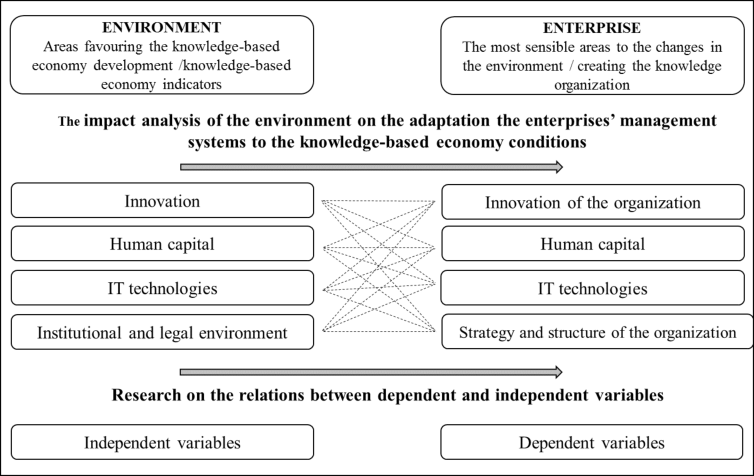
In examinations an assumption about homogeneous and sustainable conditions created by the environment for the enterprise development and about the diversified internal potentials of enterprises that condition (favour or hinder) the possibilities of the use of opportunities appearing in the environment has been undertaken. The accepted assumption has contributed to the formation of two data categories. The first category encloses independent variables referring to the environment and are determined by the decomposition of four domains of the knowledge- based economy: innovations, human capital, information technology and the institutional and legal environment. The second category is created by dependent variables which are identified within the organization. It results from the decomposition of factors operating on major determinants of the organization management system changes of knowledge-based organization. They enclose organization’s innovative character, human capital, information technology and organization’s strategy and organizational structure. The figure 1 shows the mechanism and the research concept.
Figure 1. The concept and the research mechanism of the adaptation of organizations’ management systems to the knowledgebased economy requirements (own study)
According to the accepted principle of the examination, the research and the analysis of results was made in areas of the environment and the enterprise. In case of the environment analysis, there has been applied the analysis method of the knowledge-based economy four pillars development level using the KAM methodology, including statistical evaluation of the macroeconomic trends development in the economy. The examination of enterprises in the knowledge based economy was made with use of the survey method. The questionnaire was created based on areas of the organization which were regarded as the most sensitive to the influence on the knowledge economy (see: figure 1). Next it was defined the representative enterprise features for the individual areas. The described operations constituted only a part of scientific works correlated with the project. They mainly served for obtaining basis results, which next became the base for the following analytic works and for the preparation of final results in accordance with the project objective.
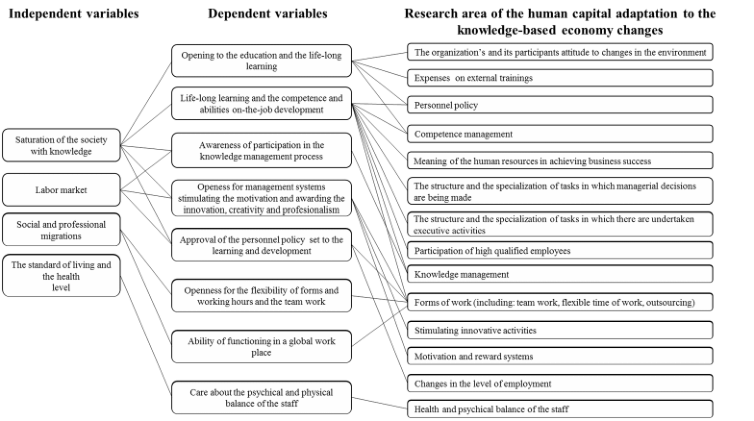
The examination of the human capital of enterprises within the frames of the project “Adaptation the enterprises’ management systems to the knowledge-based economy requirements” While initiating the research on the human capital changes of the organization in the knowledge-based economy conditions, there has been accepted a scientific assumption: the human capital changes on the society level resulting from the assumptions of the knowledge-based economy development influence on behaviors of organizations in the area of shaping the human capital. The dependencies between the environment and the organization are inducing enterprises for undertaking activities adapting the internal potential in the human capital area to more efficient functioning in the knowledge-based economy. Adjustment efforts are particularly taking the use of the human capital for finding the opportunities created by the development of the knowledge-based economy into account. According to such assumption there were established three research’s levels. The first level enclosed the key macroeconomic factors that identify the dynamics of the economy’s development in the scope of the human capital. Under the second research level there were defined enterprise features in the area of the human capital that have been accepted as the most representative from the view point of the human capital sensibility behavior in enterprises of the knowledge-based economy conditions influence. At the third level there were defined directed areas of analysis that enable the evaluation of the degree of adaptation of the enterprises’ human capital to the knowledge-
based economy dynamics. The analysis areas were determined as a result of enterprise developing characteristics presented in the second area, which can be a representative indicators of the realization of a determined enterprises feature in its operational dimension. The figure 2 presents factors that constitute particular research areas, their structure and relations between individual scientific areas.
Figure 2. Dependencies between research areas on the level of the macro-environment and the organization referring to the human capital (own study)
Characteristics and findings in changes of the human capital in the process of adapting the organization to conditions of the knowledge based economy The examinations presented in this publication were conducted in 150 randomly selected enterprises located in entire Poland. The time horizon of the examination included year from 2007 to 2012. The study was performed with the use of standardized survey interviews (PAPI), and a survey enclosing 107 questions was the accepted examination instrument. The examination survey was divided into four topic categories that allowed assessing changes in the following enterprise areas: strategy, human capital, IT infrastructure and organizational structure. Research results presented in the following part of the paper refer only to the area of the human capital. Results are presented in form of aggregated analysis areas (interpreting answers to groups of questions).The figure 2 shows the topic scope of research areas on the human capital adaptation to changes in the knowledge-based economy. The research results of the particular areas are as follows:
The organization’s and its participants attitude to changes in the environment The examination included the evaluation of the attitude of the organization and its participant towards changes occurring in the macro-environment which included: political-legal, economic, social-demographic and technological environment. The study enclosed the attitude towards changes within the period of five years, starting from the year 2007. Its results are as follows: [Equation or mathematical symbol available in the original paper PDF] in the area of the political and legal environment 20% of enterprises declared a growing positive attitude toward changes, the attitude of 70% of firms staid at the same level and in case of circa 9% - it decrease, [Equation or mathematical symbol available in the original paper PDF] in the area of the economic environment 17% of enterprises declared a better attitude toward changes, in 63% of enterprise the attitude staid the same and in 18% it decrease, 2% of firms did not give a response to this question, [Equation or mathematical symbol available in the original paper PDF] in the area of the social and demographic environment 21% of examined firms stated an increasing positive attitude toward changes, 73% of organizations declared that their attitude did not change, and in case of circa 4% - it decrease.
• in the technological area 27% of enterprises pointed at a growing positive attitude toward changes, 69% of firms declared the same level of attitude and in 3% it decreased, 1% of enterprise did not give a response to this question The most significant increase of the positive orientation on changes was noticeable in case of examinations related to the technology (27%). Worse results were founded on the economic ground (decrease of the positive attitude reached 18%).
Expenses on external trainings The medium level of expenses on external training of own staff in examined enterprises in the year 2011 reached circa 14.5 thousand PLN. The analysis of changes of the level of the budget for trainings, in relation to general costs/expenses until 2007 was as follows: 55% of firms participating the study did not change the level of expenses on external training for their staff in the period of examined 5 years, 13% of companies increased the level of expenses and 14% reduced these expenses. The medium growth of expenses for trainings between years 2007 and 2012 was 25%. However, the average decrease of the costs level was 46 %. One of the five examined enterprises was not able to show the changes direction for the level of costs spend on external trainings.
Personnel policy The study of the personnel policy realized in organizations enclosed the identification of enterprises’ methods in the process of recruiting employees and providing them development possibilities. Following models have been used as an input versions: model of employing people with basic competences and developing their skills within the enterprise, model of employing high qualified staff and minimizing the stage of learning, mixed model.
In 50% of examined enterprises the currently conducted personnel policy was based on the mixed model, 35% of examined enterprises chose the policy, in which they mostly focus on employing high qualified personnel and minimize costs of training for employees, 11% of examined firms decided to apply the personnel policy based on employing people with basic competences and developing their skills within the enterprise.
The examination of changes within the realization of the personnel policy in years 2007-2012 showed that 25% of firms increased their level of employment within the analyzed period of five years. Only 11% of companies that increased employment since the year 2007, employed people with basic competences. 73% of examined firms did not change their personnel policy in a view to the fact of employing both types of staff and in 11% of cases enterprises additionally reduced the number of employed staff with basic competences.
Competence management The evaluation of the competence management included the identification of the possession and using by the organization the system of the development of employed employees competence (the development of competence was interpreted as a development of all features that could support the development of the enterprise like: knowledge, skills, experience and styles of acting). The research showed that in the analyzed period the number of enterprises using the competence management grew from 39% in 2007 to 49% in 2012. In the same time, the share of firms without the competence management system became smaller: from 55% to 50%. The same was observed in case of enterprises that were not able to determine own behavior in this sphere: from 6% to 1%.
48% of enterprises declared that the analysis of own competencies in reference to the demand resulting from the development of the organization and from changes occurring in the environment was the most important instrument of competence management. Other useful tools were: examination of staff expectations in the scope of own professional development – 30%, projects and programs of cooperation with the institutions of professional development and education programs (trainings) related to specialization and diversification of activities – 29%.
In the analyzed period using such tools as: projects and programs concerning the cooperation with the education and professional development institutions, analysis of owned competences in relation to the demand resulting from the organization development and the study on employees’ expectations toward their professional development, increased in case of circa 16% of enterprises.
The examination of the competence management also included the assessment of the characteristics and competences of candidates that entrepreneurs determined as an important in the process of recruitment. In the process of recruitment employers stated that they value most following characteristics: the attitude and willingness to work and develop own competencies – 90%, professional experience – 89% and specialist knowledge from the domain – 80%. The second group of most often enumerated important competences includes characteristics like: type of major study graduation, general knowledge and communications and interpersonal skills – 70%.
Meaning of the human resources in achieving business success The analysis of the human resources importance in the process of achieving success in the business was evaluated in the context of the scale of impact of issues related to the human resource management on the way of running the business. The average result had the value 3.5 (near to a high grade) in a scale, where 5 meant a very strong impact and 1 – very small impact.
75% of examined units declared that in the year 2012 the importance of the human capital was the same as in 2007, 19% companies stated that the importance of this area grew; 2% declared that the importance of the human capital decreased.
The structure and the specialization of tasks in which managerial decisions are being made The analysis of tasks and departments of the organizations, in which decisions affecting the management of the entire firm are being made, showed that 59% of decisions is being made within highly specialized posts responsible for a narrow scope of organization’s tasks (directors, department managers, specialists), 27% of decisions was being made by other task teams (for example: a part of tasks is realized in the organization in form of projects), 17% of decisions depend from mobile task teams initiated for period of realization of the project, 3% of decisions was made within other occupations.
The share of tasks made by specialized posts in the enterprise in the period from 2007 to 2012 grew in the opinion of 14% of participants of the study – 79% declared that it stayed the same. In case of assessing changes on the level of permanent task teams: 10% enterprises pointed at the growing share of this form of making decisions, 79% declared no changes. Mobile teams increased their participation in the process of making managerial decisions in 11% of cases, 71% firms stated that the participation of this form did not change and 4% declared the decreasing share of the participation of this form.
The structure and the specialization of tasks in which there are undertaken executive activities Tasks are mainly made by specialists or by permanent employee teams. 54% of the work is made by highly specialized employees on managerial posts. 30% of realized work is being delegated to permanent task teams. Only 17% of executive tasks are being realized in mobile teams that after making it return to their formerly established post in the structure of the organization.
During the last 5 years examined enterprises did not introduce changes in the way they divide executive tasks between different types of posts. In circa 14% of firms, the share of tasks realized both by employees on specialist workstations and by mobile and permanent teams, grew. In the examined period, about 80% of companies did not change the share of tasks realized by individual groups of employees and circa 4% declared that the share of tasks realized by types of posts and teams mentioned before decreased.
Participation of high qualified employees The research has showed that the average share of high-qualified employees in the total amount of employed staff was 47%. In the course of the research period the share of both high-qualified employees and others, slightly changed. In 67% of examined firms the share of both types of employees in the total number of employees maintained at the same level. 29% of enterprises increased the participation of high-qualified employees, reducing at the same time the share the rest, less qualified staff. The medium increase of the share of high-qualified employees in enterprises reached 18%. Only 2% of firms in the examined period reduced the share of high-qualified employees in the total of the staff and the average difference was 25%.
Knowledge management The analysis of the state of knowledge management in organizations understood as an aware, affecting all areas of the organization, manner to operate in order to deliver the appropriate knowledge to the right persons in the right time, showed that 53% of examined organizations uses the knowledge management, 39% firms did not declare realizing processes of the knowledge management and 8% companies were not able to give an answer.
The research included also pointing and using tools of knowledge management in organizations, as well as changes and development in a view to the period of examination: years from 2007 to 2012.
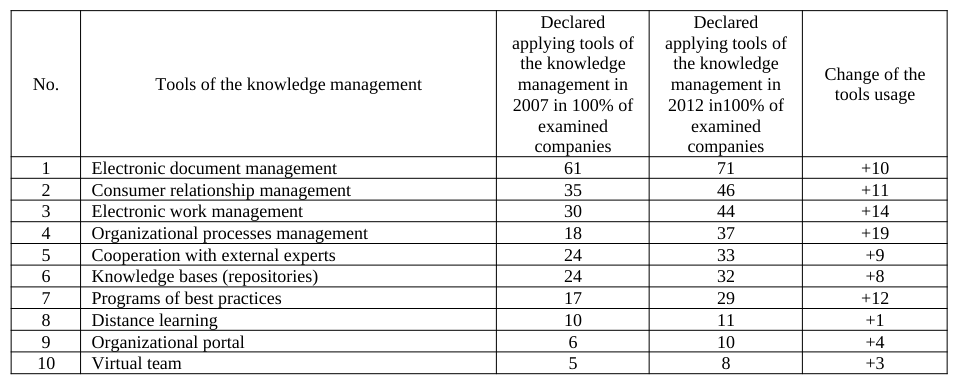
The table 1 shows types of applied tools of knowledge management and their changes in determined years.
Table 1. Types of applied tools of knowledge management and their changes in determined years (own study)
The analysis showed that one could observe the increasing use of all tools of knowledge management within the research period. The best dynamics of growth of the degree of use was noticed on the level of organization process management – 19%. Electronic document management, relations with customers’ management and electronic work management were pointed as most frequently applied tools of knowledge management in organizations.
The evaluation of the knowledge management in the organization included also the study of declarations of the tools development of the knowledge management used by enterprises. 25% of examined firms declared the development of currently used tools of the knowledge management, 46% stated that they do not implement any activities in the direction of developing their tools and about 20% declared to use owned tools at a very low level. Selected enterprises declaring the knowledge management tools development, at present focus all their efforts on upgrading the efficiency of the functioning of the electronic document management and relations with customers’ management. Moreover, they create databases and improve programs for best practice, already functioning in their organizations.
Stimulating innovative activities Examination of organizations within frames of motivating employees to undertake innovative activities showed that in the year 2012 only 45% of examined firms declared motivating activities in the scope of stimulating innovation, 48% did not declare any activities and 7% of enterprise were not able to define own statute in this area. The situation is hardly satisfying, although in comparison to the year 2007, when 39% of firms declared activities stimulating innovation, 55% of companies stated about lack of any activity in this area and 6% of enterprises could not define own statute in this sphere, some sort of improvement can be noticed. The table 2 illustrates the methods of employee motivation applied by examined enterprises according to the occurring changes in the examined period.
Table 2. The methods of employee motivation applied by examined enterprises according to the occurring changes in the examined period (own study)
Table available in the original PDF paper.
One can notice the positive tendency of the continuous and satisfying grow of number of realization of pro- innovative activities in organizations that declared some sort of activity in this area. All analyzed types of activities were characterized with a growth trend within the interval from 4% to 7%.
Motivation and reward systems The evaluation of the motivation system was mainly supposed to answer the question: what is the degree of application of motivation systems in examined enterprises support sharing the knowledge, integrate individual goals of the employee with organization’s objectives and individual development of employees. The examined organizations evaluated statements presented above in the scale from 1 to 5 (in which 1 means – definitively yeas and 5 – definitively no). The average result for the period from 2007 to 2013 reached the similar level 2.3 to 2.5. This means that the use of the potential of the motivation system was at a medium level. In case of evaluating the influence of the motivation system on the employees development – the result was 2.4 for the year 2007 and 2.3 for the year 2012; however, in case of the motivation system and it function of integrating individual goals of the employee with organization’s objectives and its function of knowledge exchange support, the result for the entire cycle of research reached 2.5.
The analysis of the reward structure made on the three hierarchy levels, i.e. on the level of senior managers, managers of the middle management level and execution employees. The study showed that independently from the place in the structure of the organization’s hierarchy, the participation of permanent components of the reward was circa 83%, variable components of the salary consisted 17% of the reward. The examination also enclosed the change of the share of the salary dependent from results of the company in the examined period from 2007 to 2012. Only 15% of responses were considerable in this area. According to the enterprises, which answered, over a half of firms did not conditioned the level of reward on the enterprise.
Forms of work (including: team work, flexible work time and outsourcing) The dominant form of employment in examined enterprises was: the employment contract – 87% cases, mandate contract – 7.7%, specific work contract – 2.8% and own business activity – 2.5%. In the analyzed period an essential change of the employment structure didn't take place. 82% of employment contracts were contracts for an indefinite time period, 16% were contracts for a definite time period, and 2% were manager contracts. It has been also stated that during the examined period, the realization of tasks in a form of a team and flexible work time were stabilized at the same level. It was worth noticing that enterprises did not use outsourcing very often, and when they did – they did it in a narrow scope of activity.
Changes in the employment level Changes of the employment level in examined organizations were as follows: 31% of examined companies declared the growth of employment in last 5 years, 22% stated that the employment level dropped and 45% of firm declared stagnation. In the opinion of examined units, the average employment growth was at a level of 31.9% in comparison to the year 2007; hence, the average decrease of employment was circa 20.4%.
Health and psychical balance of the staff
Examining the organizations’ behaviors in the area of taking organized activities in keeping the psychical and physical balance of employees shown that only 38% of companies initiates such actions, 58% does not present any systemized actions, and 4% is not able to determine own behavior in the area discussed. The group of operations for keeping the psychical and physical balance of the employee, initiated by enterprises, the most often mentioned were integration events, which constituted 72% of respondent’s choice. High ranks referred also to the cofinancing of holiday trips of the employee and his families - 60%, financing additional medical service for the employee - 58% and flexible time of work - 40%. Activities, like: financing medical service of the employee’s family – 26%, identification of individual needs – 23% or care of children in working hours – 2%, were significantly less important.
THE RESEARCH RESULT INTERPRETATION IN A CONTEXT OF ENTERPRISES’ HUMAN CAPITAL SENSIBILITY UNDER THE KNOWLEDGE ECONOMY CHANGES The presented research results are the basis for the enterprise features evaluation in the human capital area sensible for the knowledge economy changes. The list of the features including the dependencies shaping enterprises features were presented on the figure 2. The interpretation of the research results is the following:
Openness for lifelong learning Research areas characterizing the
Lifelong learning and both competences and ability development in a work place Research areas characterizing the
Awareness of participation in the process of knowledge management Research areas characterizing the
Openness to management systems stimulating motivation and rewarding innovation and creativity Research areas characterizing the
Acceptance of the personnel policy focused on learning and development Research areas characterizing the
Openness for the flexibility of the forms of work, work time and to the work in teams
Ability to function in the global workplace
Care of the psychophysical condition
SUMMARY
The research results presented in the paper lead to a statement that in the examined period of time there has been an efficient and positive change in the majority of analyzed areas. The positive trend was especially noticeable in the spheres related to competence management, knowledge management and stimulating innovation activities (in organizations that initiated the innovative activities). Presented results enabled making a preliminary confirmation of the scientific assumption on existing dependency between changes in the environment resulting from the realization of objectives of the knowledge-based economy and activities adapting the potential of the organization. It will be possible to fully verify the existing dependencies after conducting research on correlations between trends describing changes in the human capital in the knowledge-based economy and changes in examined enterprises (in accordance to the structure presented in the figure 1). The study on dependencies between elements of the macro- environment and potentials of business units is the goal of future scientific works.
REFERENCES
Kałkowska J., Pawłowski E., Włodarkiewicz-Klimek H., (2013), Zarządzanie organizacjami w gospodarce opartej na wiedzy, Wydawnictwo Politechniki Poznańskiej, Poznań, Trzcieliński S., Kałkowska J., Pawłowski E., Włodarkiewicz-Klimek H., (2010), Dostosowywanie systemów
zarządzania przedsiębiorstw do warunków gospodarki opartej na wiedzy – projekt finansowany przez Ministerstwo Nauki i Szkolnictwa Wyższego nr identyfikacyjny 75136 Włodarkiewicz-Klimek H. (2013), Kapitał ludzki w kształtowaniu zwinności organizacji opartych na wiedzy, Wydawnictwo Uniwersytetu Ekonomicznego we Wrocławiu, Wrocław Włodarkiewicz-Klimek H., Kałkowska J., (2011), Adaptation of enterprise management systems into knowledge
based economy conditions – research concept [w] Lewandowski J., Jałmużna I., Walaszczyk A. (eds.), Contemporary and future trends in management, Wydawnictwo Politechniki Łódzkiej World Bank (2006) Korea as Knowledge Economy. Evolutionary Process ad Lessons Learned. Overview, Washington
LISTED IN THE AHFE DIGITAL BOOKSTORE CATALOGUE
Explore the complete digital volume
Advances in The Ergonomics in Manufacturing: Managing the Enterprise of the Future
Read this individual research paper free through the original publisher, or explore the full digital proceedings book.
ISBN 978-1-4951-2103-6
Explore this ISBN in the AHFE Bookstore ↗Listed in the July 2026 bookstore catalogue; search by ISBN to confirm current availability · Digital book purchase optional