Nico Feller, Ulf Müller (2020). Development and Assessment of Work Systems for Elder Employees in Industrial Manufacturing. In: Advances in The Ergonomics in Manufacturing: Managing the Enterprise of the Future. AHFE Open Access, vol. 12. https://doi.org/10.54941/ahfe100442
The following article presents a software tool for the development and assessment of age-differentiated work systems for elder employees in industrial manufacturing. The main objectives of the introduced software system are the maintenance and support of elder employees’ health and abilities, the extension of working lifetime and the perpetuation of productivity with an aging workforce. The system structure, consisting of a generator for sufficient mapping of work systems, a simulator for discrete representation of manufacturing and an analyzer for detailed investigations, is delineated. The simulation of aging employees and calculation of overall stress of work systems are emphasized. Concluding, achieved results and intended development are discussed.
NEED FOR ACTION The population of industrial nations is in change; the part of employees is downsizing at the same time their age- average is rising. In Germany, for example, a reduction of employees from 50 to 34.5 million is expected by 2060 and more than 30% of the staff will be older than 50 years (cf. Statistisches Bundesamt, 2009, p. 44). Due to their different physical and psychological abilities elder people have different needs from younger adults with regards to their environment and their interaction with technical systems either in daily live or at work (cf. Boot et al., 2012, p. 1444).
As a reaction to the described situation work systems have to be redesigned for aging. Physical and psychological stress at work has to be reduced to create conditions of work, which keep and support elder employees’ wellbeing and health. For this a simulation-based software tool is designed to develop and assess work systems for elder employees in industrial manufacturing.
Inquiries of current research projects, industry programs and software solutions enable the identification of four fields of action: leadership and qualification, labor time and organization, health promotion, and work place design. Usually these are enterprise-specific solutions for special questions, which have to be dedicated to corrective respectively preventive work design. Current software solutions are either based on digital human models for ergonomic work place and product design focusing on short term intervals of use or based on human centered simulations for development of labor time and organization models dealing with middle term and long term periods (Zülch, 2010; Leupold et al., 2010; Wischniewski and Adolph, 2013).
Currently the middle and long term stress influence of work systems on the future ability and health of employees - as an aging process - is not sufficiently considered (cf. Zülch, 2013, p. 59). It needs to be integrated in the develop- ment and assessment of work systems for elder employees.
OBJECTIVE To respond to the described need for action an age- and stress-based simulation model (software tool) is designed. By holistically investigating individual and age-based stress of employees in industrial manufacturing and simulating aging of workforce, the simulation model enables the development and assessment of work systems in a prospective way of work design.
The main objectives of the age- and stress-based simulation model are:
the investigation of age-specific strain in industrial manufacturing to identify potential improvement of work systems and necessary needs for action,
the mapping of aging workforce to determine middle and long term influence of demographic change on productivity,
the verification of innovative work equipment and work processes in consideration of employees’ stress,
to maintain and support elder employees’ health and abilities,
to prolong working lifetime,
to sustain productivity with an aging workforce.
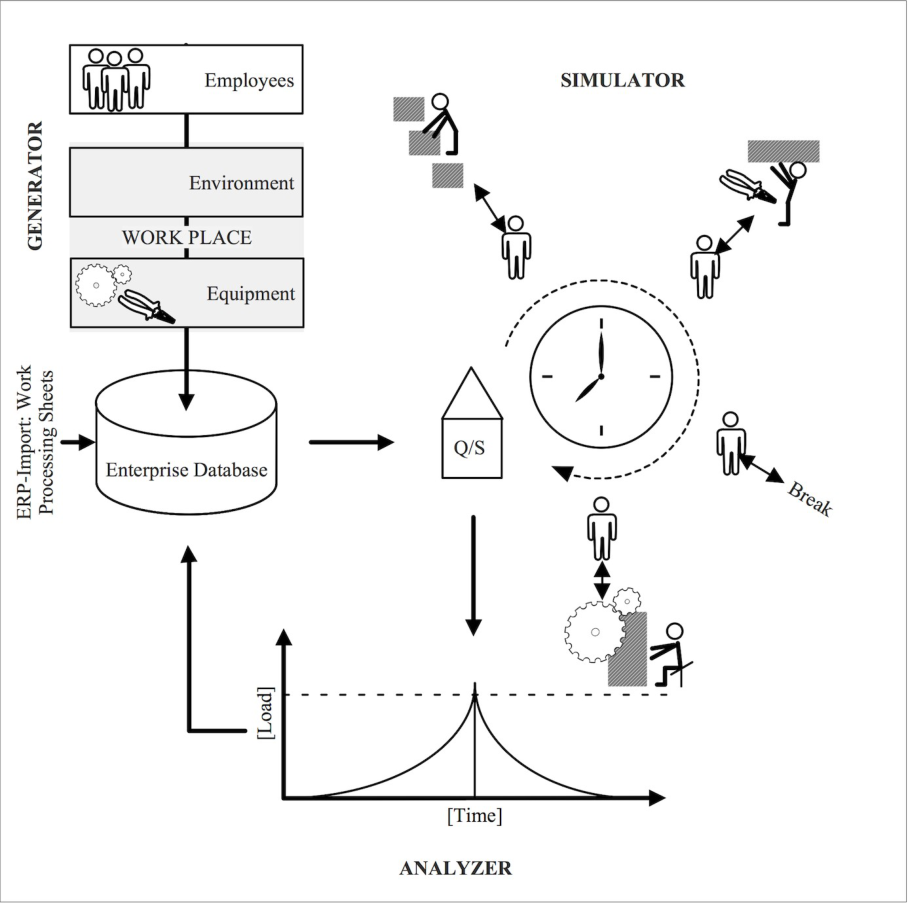
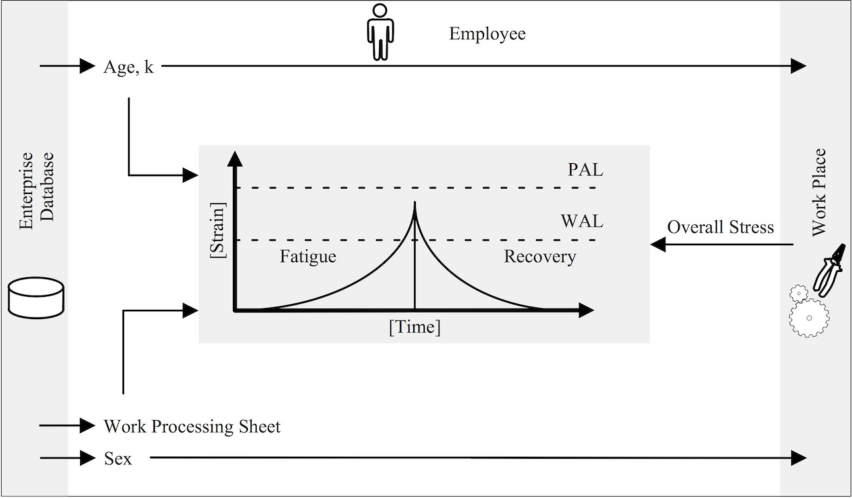
AGE- AND STRESS-BASED SIMULATION MODEL FOR THE DEVELOPMENT AND ASSESSMENT OF WORK SYSTEMS FOR ELDER EMPLOYEES According to the demands of enterprises of industrial manufacturing - e.g. high flexibility, easy usability - the age- and stress-based simulation model consists of three main parts: generator, simulator and analyzer (see Figure 1).
Generator: pre-converted, modular model elements enable the intuitive transfer of variable work systems and resources of industrial manufacturing into simulation models. Employees, work equipment and work environment are available as parameterizable input values for sufficient mapping. Work processing sheets can be imported from various ERP-systems in popular data types. All input vales are saved in an enterprise operating data base. The transfer of employees and work places is circumstantially explained in “Generating Work Systems”.
Simulator: discrete mapping of manufacturing. The stress of each work process is holistically investigated considering every employee’s individual age, sex and fitness as well as the duration of a particular work. Therefore an integral approach is taken. Based on a dominating impact of the main stress factor all other stress factors are summed up as a weighted average. For the duration of the simulation experiment, stresses of all work processes - including breaks - are summed up to calculate the individual employee’s strain trend over time (fatigue and recovery). By an age-based weighting of the stress-factors, aging of workforce is also considered. All necessary parameters and functions are described in detail in “Simulating Manufacturing Processes”.
Analyzer: the employees’ strain over time enables the development and assessment of age-differentiated work systems. In order to describe the analysis of simulation outcomes a small example is given in “Analyzing Work Systems Based on the Employee’s Individual Strain”.
Figure 1. System structure
Generating Work Systems The work system is specified as interaction of employees, work task, work equipment, work place and its environment by Bullinger (1994, p. 2) and Spath et al. (2012, p. 1651). Based on that definition employees, work place (environment and equipment) and work processing sheets are given as the main input values for sufficient mapping of various work systems in industrial manufacturing, as already mentioned (cf. Figure 1).
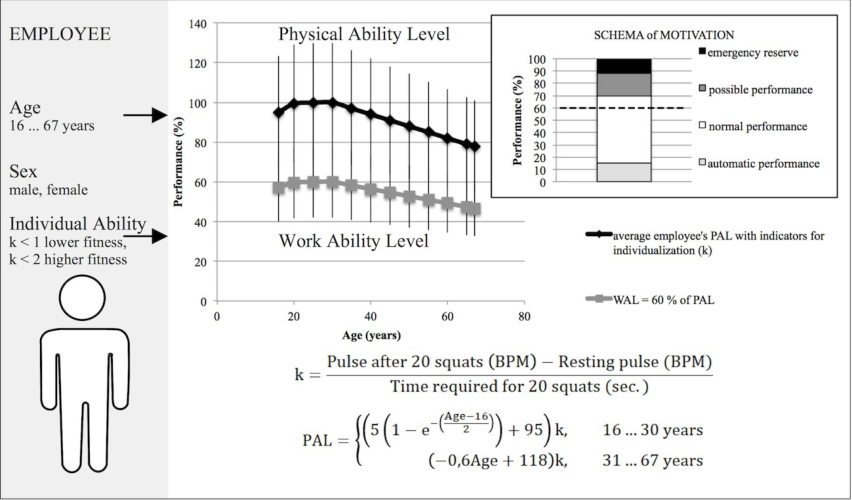
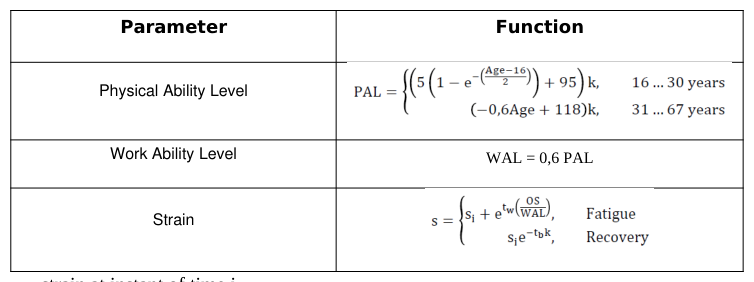
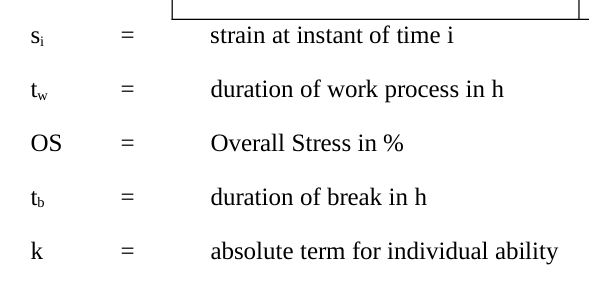
Employees Employees are the central input value. For an individual mapping of workforce, age, sex and an absolute term for individual ability (k), are available (see Figure 2). In the first step every employee’s physical ability level (PAL) is calculated. The declaration of the absolute term k is based on Börner et al. (2013, p. 264). The PAL is calculated by the introduced functions, developed in accordance with an age performance model from Schlick et al. (2010, p. 121). In the second step every employee’s corresponding work ability level (WAL) is determined. According to the also shown schema of motivation from Bullinger (1994, p. 46), employees’ average WAL is around sixty percent of his or her PAL for an eight hours work period. WAL is an important parameter to determine every employee’s strain. In “Simulating Manufacturing Processes” this aspect is described in detail. The integration of employees’ qualification is intended for future development of the software tool. For additional information the interested reader might spend a look at Zülch et al. (2013, pp. 65-87).
Figure 2. Employee setup
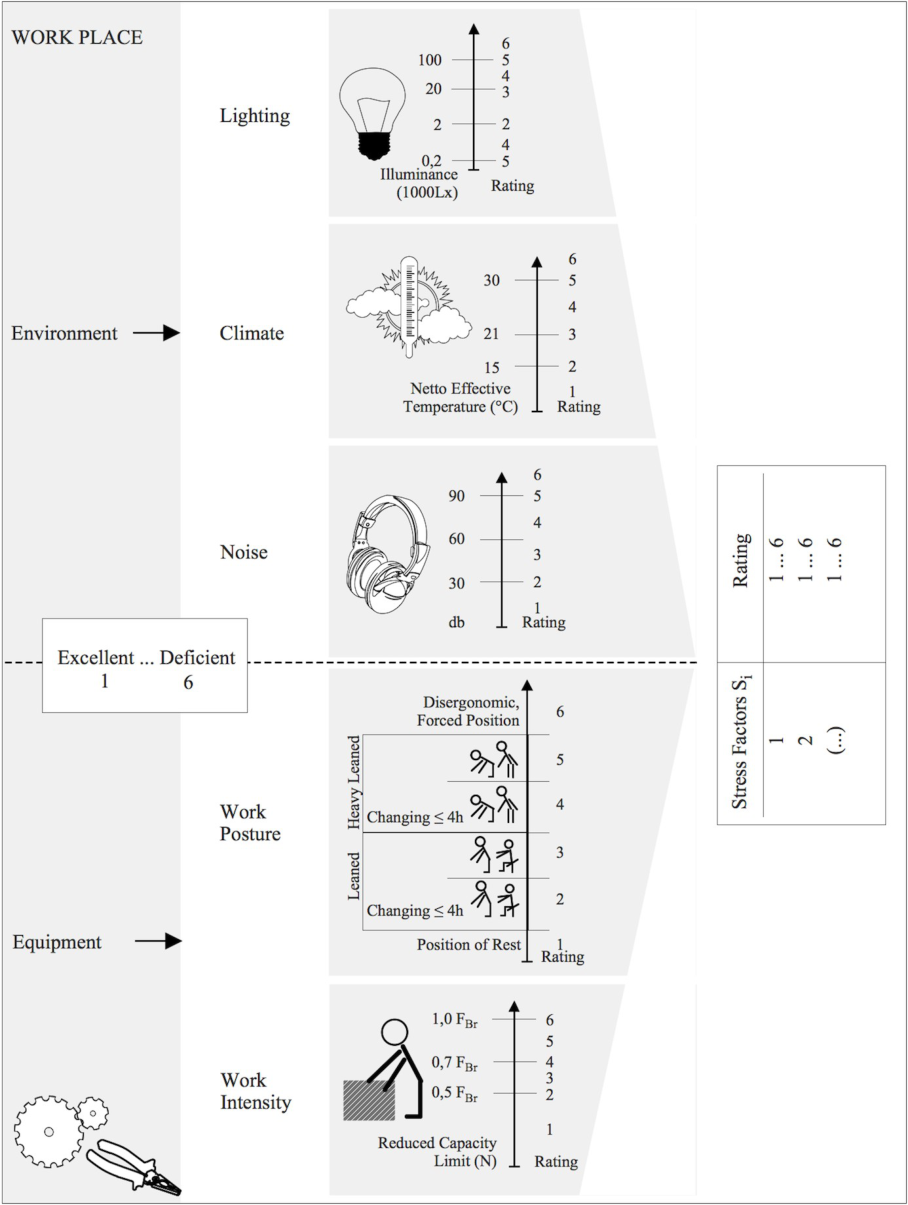
Work Place As it is already shown in figure 1 every work place consist of equipment and environment. For a sufficient work place mapping five parameterizable input values are given: lighting, climate, noise, work posture and work intensity. Spath et al. (2012) agree that “[t]he three environmental factors […] are most frequently identified as being problematic in manufacturing” (p. 1655). In addition, Bullinger (1994, p. 198) explains that the two ergonomic factors take center stage of ergonomic work design.
All those parameters can easily be measured or calculated, however, as far as this is not necessary for the paper the interested reader might have a look at the list of references. To translate every work place into a model element consisting of stress factors, all of the characteristic parameters are rated from “excellent (1)” to “deficient (6)” (see Figure 3).
Lighting: even though a few parameters (e.g. light intensity, illuminance, reflection) have to be taken into consideration, the illuminance has the biggest impact. Different investigations revealed and specified the direct relationship between illuminance and performance, fatigue, error rate and work safety (cf. Bullinger, 1994, p. 98; Spath et al., 2012, p. 1655). According to those findings, stress caused by lighting is categorized from beneath 200 Lux (linked to ‘deficient’, e.g. twilight), over approximately 3000 Lux (linked to ‘excellent’, e.g. good work illumination), up to 100.000 Lux and more (linked to ‘deficient’, e.g. a bright summer’s day, dazzling; cf. Bullinger, 1994, p. 93).
Climate: air temperature, humidity and air movement are summed up to one climate value – the netto effective temperature (NET). Based on NET different climate conditions can be compared and rated (cf. Bullinger, 1994, p. 179). Geared to the relationship of NET and stress intensity from Bullinger (1994, p. 187), stress by climate is rated between beneath 15 °C (‘excellent’) and higher 30 °C (‘deficient’).
Noise: the most significant environmental factor (cf. Spath et al., 2012, p. 1655). It has a very strong influence on human’s physical and psychological wellbeing and health (e.g. permanent injury of hearing, heart arrhythmia and dysfunction of gastric and intestinal peristalsis). Work places’ noises are regulated by law: the work places ordi- nance (Arbeitsstättenverordnung) and the accident prevention regulations (UVV Unfall-Verhütungs-Vorschriften).
According to those regulations stress caused by noise is rated from beneath 30 db (‘excellent’) to higher 90 db (‘deficient’).
Figure 3. Work Place setup
Work Posture: there are a lot of different solutions for the assessment and design of work postures. They are all based on statistical investigations of the human body dimensions, ranging from tables and data sheets to software solutions (e.g. digital human models). Because the introduced simulation system is not the investigation of single work places in a micro-perspective way but the development and assessment of holistic work systems in industrial manufacturing in a macro-perspective way, rating of work posture is reduced to a few significant postures focusing the stress on the back.
The postures, amongst others geared to EN 1005-2:2003+A1:2008 and EN 1005-4:2005+A1:2008, are:
position of rest (‘excellent’, laying and/or body and extremities are in axis of gravity),
leaned (‘good to satisfactory’, body and/or extremities are not in axis of gravity, work equipment is easy to reach in a circle of approximately fifteen inches),
heavy leaned (‘sufficient to insufficient’, body and/or extremities are not in axis of gravity, work equipment can only be reached uncomfortably outside a circle of fifteen inches or overhead work) and
disergonomic, forced position (‘deficient’, position can only be taken with heavy effort and cannot be kept without pain).
To avoid injuries of the back and to keep efficiency of the back, movement respectively change of work posture is required. Under consideration of this aspect, changing of work posture is considered too.
Work Intensity: the most significant stress factor. The work intensity is rated according to EN 1005- 3:2002+A1:2008. Based on the reduced capacity level (FBr) – which is the statistically investigated isometric maximum force weighted by factors for movement speed, frequency and duration – a classification of endurance is calculated. The work intensity ranges from below 0,5 FBr (‘excellent’) to 1,0 FBr and higher (‘deficient’).
Weighting Factors Based on age-related perceptual and physical changes all measured and objectively rated stress factors (cf. Figure 3) have to be weighted according to every employee’s individual age.
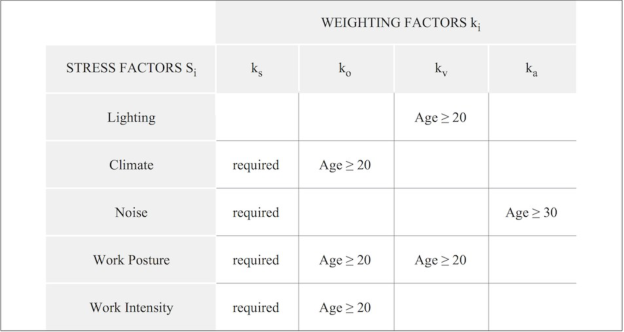
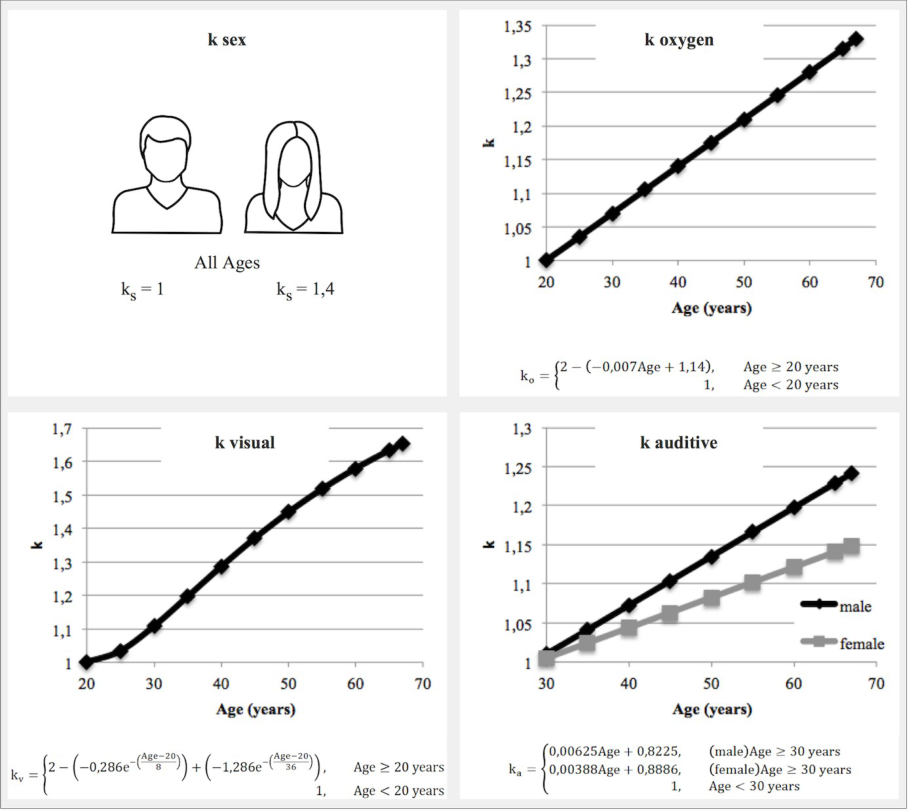
The uptake of oxygen has an immediate influence on the individual physical ability. It depends on sex and age and is accounted for by the weighting factors ks (sex) and Ko (oxygen; cf. Schlick et al., 2010, p. 119). Because of elder employees’ visual changes, amongst others, “[m]ore illumination is required to see adequately” (Boot et al., 2012, p. 1446) and their “useful visual field is reduced” (Boot et al., 2012, p. 1446). This is considered by weighting factor kv (visual). “The ability to perceive speech and complex sounds […]” (Boot et al. 2012, p. 1446), i.e. the ability to interact with surroundings, is decreasing especially in combination with noise. This is considered by weighting factor ka (auditive). As it is shown in figure 4 every stress factor is related to the particular relevant k factors.
Figure 4. Matrix of Weighting and Stress Factors
Figure 5 shows the relationship between age and the particular k factor. All factors are described by developed functions based on common ergonomic perceptions.
Figure 5. Declaration of k Factors k sex and k oxygen: directly linked to each other. As far as differences between men and women in industrial manufacturing can be reduced to muscular strength (and body height, what is already considered through ‘work intensity’ and ‘work posture’), the absolute terms for ks male and female as well as the linear function of decreasing of oxygen uptake with age, are based on frequently described differences and changes of:
oxygen uptake, e.g. from Schlick et al. (2010, p. 119), and
physical performance, e.g. from Bullinger (1994, p. 65).
According to the quoted literature the domain of ko is set between twenty and seventy years.
k visual: technically abstracted the eyes are a proportional controlled system with delay, which changes light pulses to visual information. The system dumping is rising with age amongst other because of the decreasing light transmission and the fading range of accommodation (cf. Bullinger, 1994, pp. 67, 96; Schlick et al., 2010, pp. 123- 125). According to TRILUX GmbH & Co. KG (2007, p. 21) age-related visual changes are summed up to the depicted transfer function of kv over age (i.e. need of illumination). The domain is set between twenty and seventy years.
k auditive: the description of age-related auditive change is based on EN ISO 7029:2000. For the area of speech (around 250 to 4000 Hz) the average decreasing of hear intensity was calculated for men as well as women between thirty to seventy years and translated to the shown functions (see Figure 5). As age-based reduction of auditive abilities has to be expected to start at the earliest at an age of thirty years – according to Schlick et al. (2010, p. 125) – the domain of ka is set between thirty and seventy years.
It is very important to mention that the physical ability level PAL respectively the work ability level WAL of elder employees is not decreasing in general. Psycho social and cognitive abilities normally stay at their level or even rise with age (cf. Schlick et al., 2010, pp. 120-122). Therefore the weighting factor kc (compensation) is intended for further development steps.
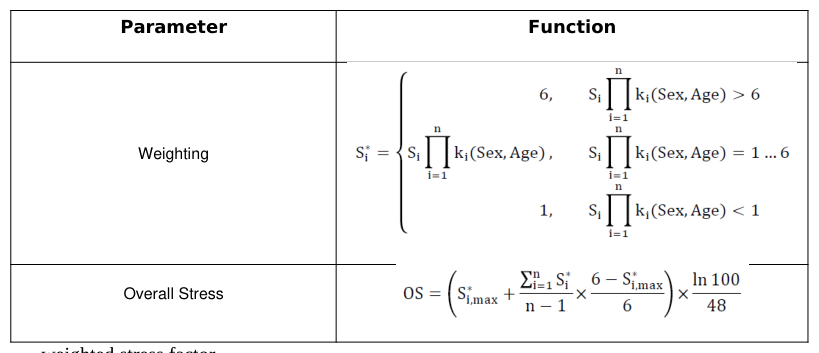
Simulating Manufacturing Processes The most significant part of simulating manufacturing processes is the interaction between the model elements employee and work place. Guided by his or her work processing sheet every employee interacts with different work places for different durations per shift (cf. Figure 1). It has been mentioned above that the model element employee consist of dynamic parameters: age, individual ability k, work processing sheet, sex, PAL,WAL and strain (cf. Figure 6). While interacting with a particular work place, the element employee sends age and sex to the model element work place. There, the individual age-based overall stress (OS) is calculated. With the reception of OS the employee’s strain is dynamically changing. All functions required to calculate the employee’s parameters are shown in table 1. Employees (i.e. parameters PAL, WAL, age) are aging with every shift: one shift equals one day, considering vacations, weekends etc. a year in lifetime consist of 227 days at work.
Figure 6. Employee as simulation elementTable 1: Functions to calculate the employee’s parameters (cf. Schlick et al. 2010, p. 202) Parameter FunctionEquation reproduced from the original PDF.
Figure 7 shows the work place as simulation element consisting of its particular specific stress and weighting factors (cf. Figure 3 and 4). In the first step the stress factors are individually weighted according to the received parameters sex and age (cf. Table 2). In the second step the overall stress (OS) is calculated and send to the model element employee. OS is newly calculated with every simulation step and every employee, which enables the simulation of an aging workforce.
The calculation of OS is based on two assumptions:
eight hours work at the worst work place (rated ‘deficient’) equals a hundred percent of the physical ability of a young and fit employee (100 % performance, cf. Figure 2),
the maximum stress factor Si
* max has a crucial impact on the employee’s strain (and all other stress factors are summed up as a weighted average related to Si
* max).
Figure 7. Work Place as simulation element
Figure available in the original PDF paper.
Table 2: Functions to calculate the employee’s overall stress Parameter Function
Si
* = weighted stress factor Si = Stress Factors
Equation reproduced from the original PDF.
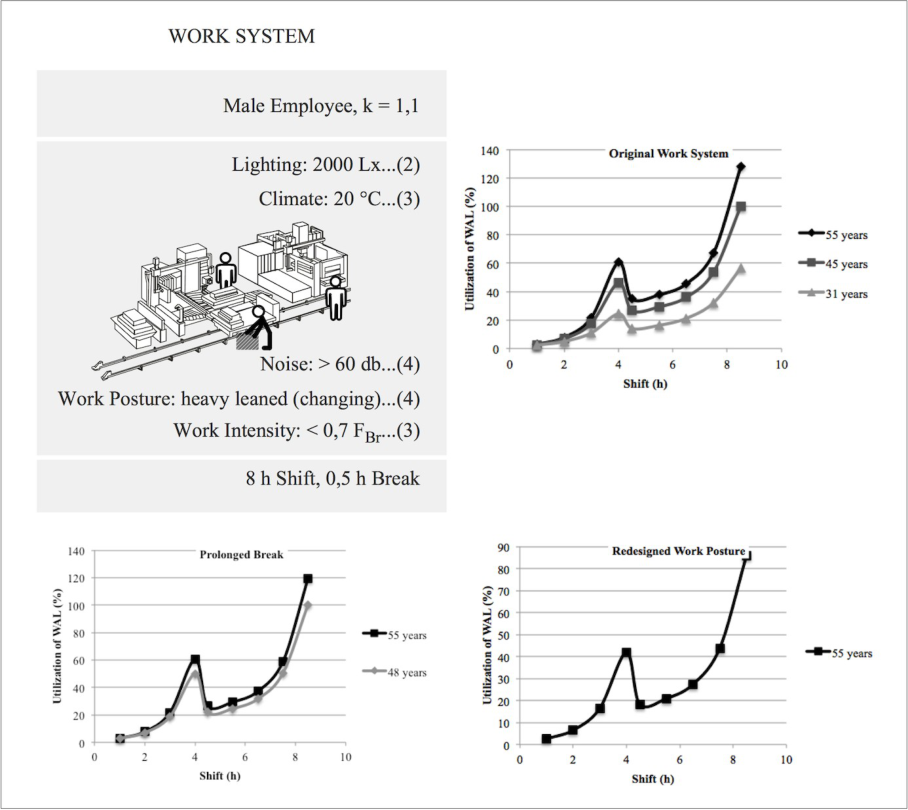
Figure 8 shows an example, which explains how work systems are analyzed by the employee’s individual strain. Therefore a typical machinery work place for industrial manufacturing is configured. The employee is a 31 years old man of average physical ability (k = 1,1) at the beginning of the simulation experiment. In the upper right corner the utilization of the employee’s work ability level is depicted for different ages for the duration of one shift. The significant insights are:
beneath 45 years the employee’s strain at work is comfortable respectively endurable. An increase of load factor is possible.
from an age of 45 years onwards changes of the work system are required to maintain the employee’s wellbeing and health. A simultaneous decrease of productivity and a rise of errors and accidents have to be expected.
at the age of 55 years changes of work system are necessary to avoid physical as well as psychological injuries.
The diagrams below show two possible solutions. By prolonging the break for 15 minutes the 55 years old employee’s strain is reduced for approximately 10 %. The critical point of 100 % of WAL is shifted for three years from 45 to 48 years. In combination with the redesign of work posture the strain can be reduced to beneath 90 %, which leads to a decreasing failure and accident ratio as well as the maintenance of wellbeing and health.
Concluding, the simulation outcomes enable the identification of the age of first overload, to quantify the individual employee’s overload, to name the significant stress factor(s) and to assess and compare different work systems with regard to wellbeing and health.
Figure 8. Example Work System
CONCLUSION
With the presented software system a simulation-based tool for the development and assessment of work systems for elder employees in industrial manufacturing is introduced. The explained rating and age-based weighting (i.e. ageing) of stress factors enable the calculation of every employee’s strain in various work systems and for different ages (middle and long term impact). This is the basis for a prospective design of work systems.
One very difficult aspect – which probably cannot be sufficiently solved – is the mapping of leisure between two shifts. Several factors like training/sports, insomnia, physical and psychological diseases, private stress and the misuse of alcohol and drugs have a crucial influence on the employees’ performance. A second weakness to be mentioned is the individual motivation of every employee. For example, short term contracts and temporary employment have an enormous impact on the employees’ motivation.
To verify the presented simulation-based development and assessment tool and to regard the named weaknesses, investigations of work systems from small and medium sized enterprises in combination with employees of at least ten years seniority are intended. Based on a proper anamneses and the common work history of test persons, the aim is to specify the confidence region of the presented simulation tool.
REFERENCES
Boot, W. R., Nichols, T. A., Rogers, W. A., & Fisk, A. D. (2012). DESIGN FOR AGING. In G. Salvendy (Ed.), Handbook of human factors and ergonomics (pp. 1442-1465). Hoboken, NJ: Wiley. Börner, K., Scherf, C., Leitner-Mai, B., & Spanner-Ulmer, B. (2013). Field Study of Age-Critical Assembly Processes in the
Automotive Industry. In C. M. Schlick, E. Frieling, & J. Wegge (Eds.), Age-Differentiated Work Systems (pp. 253-277). Berlin: Springer. Bullinger, H.-J. (1994). Ergonomie: Produkt- und Arbeitsplatzgestaltung. Stuttgart: Teubner. EN 1005-2:2003+A1:2008. (2009). Normenausschuss Ergonomie (NAErg) im DIN (Ed.), Safety of machinery – Human physical performance – Part 2: Manual handling of machinery and component parts of machinery (German version EN 1005- 2:2003+A1:2008). Berlin: Beuth. EN 1005-3:2002+A1:2008. (2009). Normenausschuss Ergonomie (NAErg) im DIN (Ed.), Safety of machinery – Human physical
performance – Part 3: Recommended force limits for machinery operation (German version EN 1005-3:2002+A1:2008). Berlin: Beuth. EN 1005-4:2005+A1:2008. (2009). Normenausschuss Ergonomie (NAErg) im DIN (Ed.), Safety of machinery – Human physical performance – Part : Evaluation of working postures and movements in relation to machinery (German version EN 1005- 4:2005+A1:2008). Berlin: Beuth. EN ISO 7029:2000. (2001). Deutsche Elektrotechnische Kommission im DIN und VDE (DKE), & Normenausschuss Akustik,
Lärmminderung und Schwingungstechnik (NALS) im DIN und VDI (Eds.), Acoustics – Statistical distribution of hearing thresholds as a function of age (ISO 7029:2000; German version EN ISO 7029:2000). Berlin: Beuth. Leupold, M., Stock, P., Schmidt, D., & Zülch, G. (2010). Simulationsbasierte Bewertung von Arbeitszeitmodellen bezüglich der Work-Life-Balance. In G. Zülch, & P. Stock (Eds.), Integrationsaspekte der Simulation: Technik, Organisation und Personal (pp. 365-372). Karlsruhe: KIT Scientific Publishing. Schlick, C., Bruder, R., Luczak, H. (2010). Arbeitswissenschaft. Berlin: Springer. Spath, D., Braun, M., & Meinken, K. (2012). HUMAN FACTORS IN MANUFACTURING. In G. Salvendy (Ed.), Handbook of
human factors and ergonomics (pp. 1643-1665). Hoboken, NJ: Wiley. Statistisches Bundesamt. (2009). BEVÖLKERUNG DEUTSCHLANDS BIS 2060: 12. koordinierte Bevölkerungsvorausberechnung. Wiesbaden: Statistisches Bundesamt. TRILUX GmbH & Co. KG. (2007). Beleuchtungspraxis: Innenbeleuchtung. Arnsberg: TRILUX GmbH & Co. KG. Wischniewski, S., & Adolph, L. (Chairs). (2013). Proceedings from the Symposium of Bundesanstalt für Arbeitsschutz und
Arbeitsmedizin at November 2012: Digitale Ergonomie: Trend und Strategien für den Einsatz digitaler Menschmodelle. Dortmund. Zülch, G. (2010). Stand und Entwicklungstendenzen der personalorientierten Simulation. In G. Zülch, & P. Stock (Eds), Integrationsaspekte der Simulation: Technik, Organisation und Personal (pp. 1-19). Karlsruhe: KIT Scientific Publishing. Zülch, G. (2013). Ergonomic representation of humans in the digital factory: The new guideline VDI 4499-4. In W. Dangelmaier,
C. Laroque, & A. Klaas (Eds.), Simulation in Produktion und Logistik: Entscheidungsunterstützung von der Planung bis zur Steuerung (pp. 53-60). Paderborn: HNI-Verlagsschriftenreihe. Zülch, G., Waldherr, M., & Becker, M. (2013). Effects of an Ageing Workforce on the Performance of Assembly Systems. In C.
M. Schlick, E. Frieling, & J. Wegge (Eds.), Age-Differentiated Work Systems (pp. 65-87). Berlin: Springer.
LISTED IN THE AHFE DIGITAL BOOKSTORE CATALOGUE
Explore the complete digital volume
Advances in The Ergonomics in Manufacturing: Managing the Enterprise of the Future
Read this individual research paper free through the original publisher, or explore the full digital proceedings book.
ISBN 978-1-4951-2103-6
Explore this ISBN in the AHFE Bookstore ↗Listed in the July 2026 bookstore catalogue; search by ISBN to confirm current availability · Digital book purchase optional