Sebastian Kamp, Tilmann Spitz, Ulf Müller, Nico Feller (2022). Ergonomic Engineering of a Mobile Walker. In: Advances in Ergonomics In Design, Usability & Special Populations: Part II. AHFE Open Access, vol. 19. https://doi.org/10.54941/ahfe1001266
Due to demographic development and rising problems in cost and resource management in health care and social systems, higher demands with respect to assistance for the elderly in everyday life are to be expected. Especially the need for mobile walker to assist people with developmental differences has risen throughout the years. Against this background, ergonomic product design is used in most parts of the construction of such walkers and their properties. On this basis, much care is taken in designing the man/technology interfaces (MTI) to increase the usability of medical products. Surveys of users have shown that an improvement of MTI of mobile walkers is necessary. This medical equipment allows deriving forces which need to be transmitted by the human hand. The ergonomic design of the walker handles needs to be adapted to the user requirements. In this paper, several problems with conventional handles and the problems such handles cause are discussed. To prove the benefits of adapting the handles to ensure better support, conclusions based on the results from experiments that were carried out are drawn. Increasing the usability by reconstructing the product with a user-oriented geometry and taking ergonomic aspects into consideration is achieved comparatively easily.
DEMOGRAPHICAL CHANGE AND ITS INCREASING MEANING IN TECHNICAL DESIGN Demographical change has been gaining more importance through the years. The main development is assumed to be that there will be many more old people living in the world than do today.
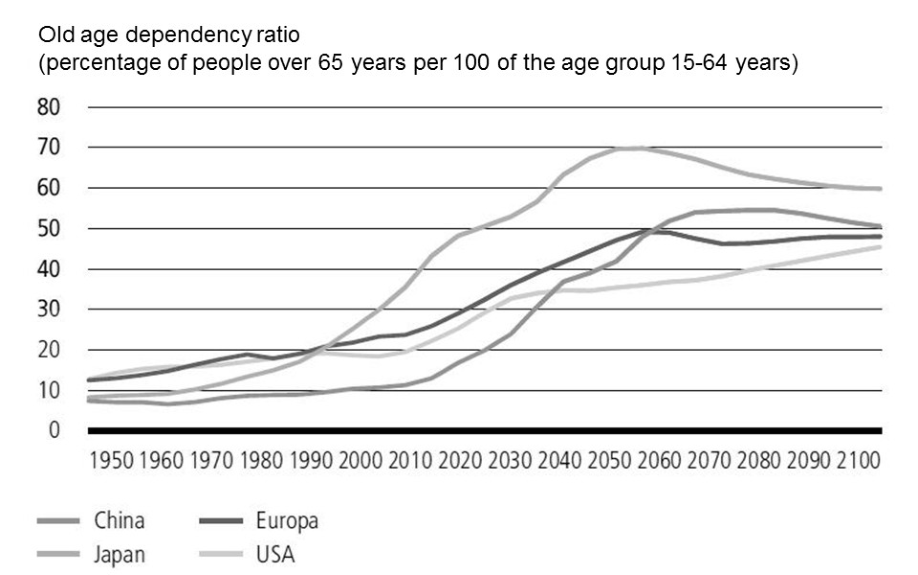
For the future, experts predict that the world population will double within the next 35 years, whereby the number of citizens older than 65 will rise drastically. In Germany for example, more than 21 % of the population is over 65 years now, which will increase to a third in the next few years (cf. Bundesministerium des Inneren, 2011). The progression of the world population is about to act in a similar way. The graphic below is an extrapolation created by the United Nations. It is based on data of population numbers taken over the last 50 years. This chart proves that not only Europe is affected. Besides the USA, mostly the eastern countries will suffer due to demographical change. The major part of their population will consist of people aged 65 or older (cf. United Nations, 2012).
Figure 1. Demographical development worldwide (cf. United Nations, 2011)
For this reason it is necessary to take a closer look at the needs of this kind of demographic group. The elderly have major problems within our society. They are less integrated in society because they often have distinct limitations in their mobility in everyday life. However mobility is the major coefficient for a healthy and satisfied life. To take part in social interactions, groups or activities, they have to gain access to technology and tools for increasing their daily support. However, technology is not only needed for helping to cope with social demands. With increasing ages, the population is fragile for symptoms of old age. Thus, active supporting technology is becoming an important function for older citizens.
There are a number of technical instruments and products for supporting people in their daily lives. For an evaluation of assistance, it is important to consider the man/technology interface (MTI). Further reflection displays major deficits in usability for users. In most cases, they are not designed to be used by different age groups. Not only are the elderly affected but they are most often unattended when it comes to designing a MTI. Closer looks shows that interfaces are constructed just for one purpose; to provide the functionality of the product, regardless of expense. Within the process of manufacturing a MTI, most engineers are often not interested in how the interface will be used nor how it affects the user.
Due to this, engineers and designer have to make sure their product is easy to use. It is important to take care about health restrictions and how the product can support the user in curing physical diseases or in which way it can cause problems.
For optimal implementation, a user centered design is essential. The users and their needs have to be the basis for every construction. Acquiring the needs of users has to be the first step in the construction design process. In further steps, the functions must be adapted to the users. Not using these steps leads to a product which does not have the optimal requirements for a well-working medical aid.
USER CENTERED DESIGN User-oriented products are specifically adapted in their design to the user's needs and fulfill this in general better than conventional products. The findings of ergonomics and anthropometry are now applied in various fields.
For ergonomic design, the developer has a wide variety of design aids available that are designed for consideration in product design. Ergonomics data specifically consider humans and their physical or mental (informative) capabilities and their influence on the design of work processes and products. In all relevant product design approaches, the human being is separately viewed by the system or the task. Often a combined view is not possible because of the high variance of tasks that people have to deal with.
In data processing, the informational interfaces are considered an important part of an overall system. The design of Human-Machine-Interfaces is a central component of software in terms of functionality and allows the user a simple and safe handling of the system.
Interfaces are defined as points of contact between different facts or objects. Mechanical coupling points are also to be considered as interfaces. These components can be understood as human-machine interfaces. Hence the importance of mechanically oriented interfaces and their importance for the user design of products derived from this.
In the product development process, the impact of interfaces to the user is very limited and considered over short periods. For products that require frequent use, such as walking aids, the effect of the interface on the people is of particular importance.
By focusing on interfaces in product design, usability can be increased and the damages minimized or ideally excluded. The product’s mechanical contact points must be adapted to humans, also with respect to its long-term use, not only taking into account the technical requirements but also, and even especially, ergonomically and by paying special attention to the long-term effects. This requirement is particularly important, especially for technical aids needed in daily living as well as work systems and similar areas.
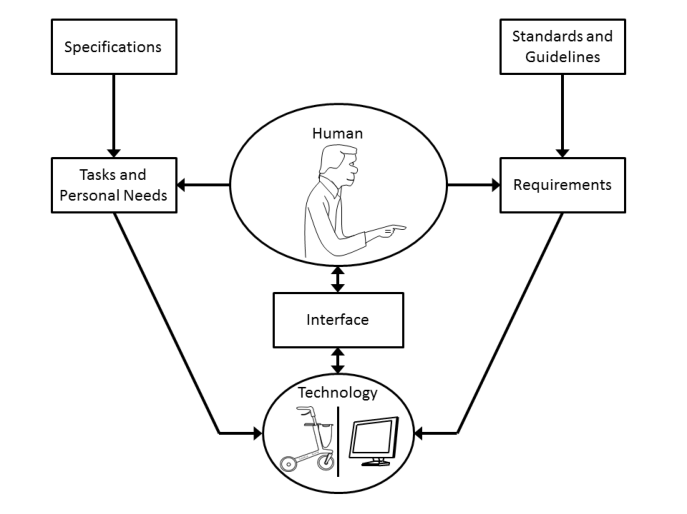
The following figure describes the relationships between systems and focuses on the user and the MTI as a central element. The interpretation of these areas is influenced by further specifications that must be considered in the product development cycle as mandatory policies or security aspects.
Figure 2. Relationship between human, technology and context parameters
The requirements must be based on the task the product has to fulfill and need to be defined by the user. A consider- ation of the overall system enables optimal performance of the task and thus leads to an optimized product that satisfies the needs of the user. Especially elderly, impaired or handicapped people with reduced physiological capabilities require ergonomically designed products that support their decreasing abilities best.
By evaluating and iterative improvement of a user interface, an optimum condition is developed. Frequently, the number of iterations can be considerably reduced if all interfaces that are used for interactions with technology are considered in detail during product development.
Information systems are usually designed so that the use is self-explanatory and the user can deal directly with the product. Consider, for example, advanced smart phones: it is possible to use these devices without tediously reading and studying an instruction manual. The high utility value to the product obtained in this way gives the user the value of a product directly. The acceptance to use such a product is significantly higher than for complex systems where a targeted training is necessary. Approval is a crucial factor for the success of a product (cf. Woywode et al., 2012, p. 8-10).
Mechanical interfaces have to be handled similar. They must be designed in a way that a more intuitive handling is quickly and easily possible. Especially with user groups with bodily weaknesses or limitations, the design is essential.
This design approach can be applied to both the development of new products as well as the improvement of existing products. The center of attention is not on the product, but on the humans and the task they want to achieve with the help of a product. Considering processes in this way can often identify potential improvements that can be remedied by simple design changes.
APPLICATION OF ERGONOMIC PARAMETERS IN CONSTRUCTION OF A MOBILE WALKER Walkers have prevailed in recent decades. Today they are of course part of everyday life of many people. Walking aids support the independent walking of users with physical limitations or weaknesses and provide the opportunity for self-determined mobility.
Sales of walkers have risen in recent years continuously. According to a German insurance company, the number of prescription has risen by almost 50% from 2009 to 2012. The increase is only partially justified by changes in demographic development. It is likely that the steadily increasing acceptance in society leads to a higher readiness to use. The use of a mobile walker is only useful if the patient's mobility otherwise cannot be guaranteed (DAK Gesundheit, 2013).
Current state of the market For the most part, all of the systems on the market support the user only passively and serve to maintain general mobility. The walker is the perfect aid for users who are somewhat mobile, but sometimes need support when walking. Being able to use walkers, especially rolling walkers, provides users with independence and mobility as long as possible.
In recent years, walkers have been increasingly viewed not only technically, but by their design. The creative variety of walking aids available on the market clearly shows the optical factors of the manufacturers were identified as selling features.
Walkers have also technically developed more and more in recent years. In addition to the standard models, there are now models available that stand out due to their reduced weight. Additionally, specialized walkers are available for individual user groups. An example of this can be called XXL walkers that are designed separately to the needs of obese users.
Meanwhile, there are various research approaches that deal with the electric drive for walkers. In these approaches, the user is supported by the drive and the force to push the walker is thus minimized. Currently, the “VELOPAD” is the only available product on the market. At MEDICA 2013, the “BEACTIVE+E” was presented as well and its market launch is scheduled in in the near future.
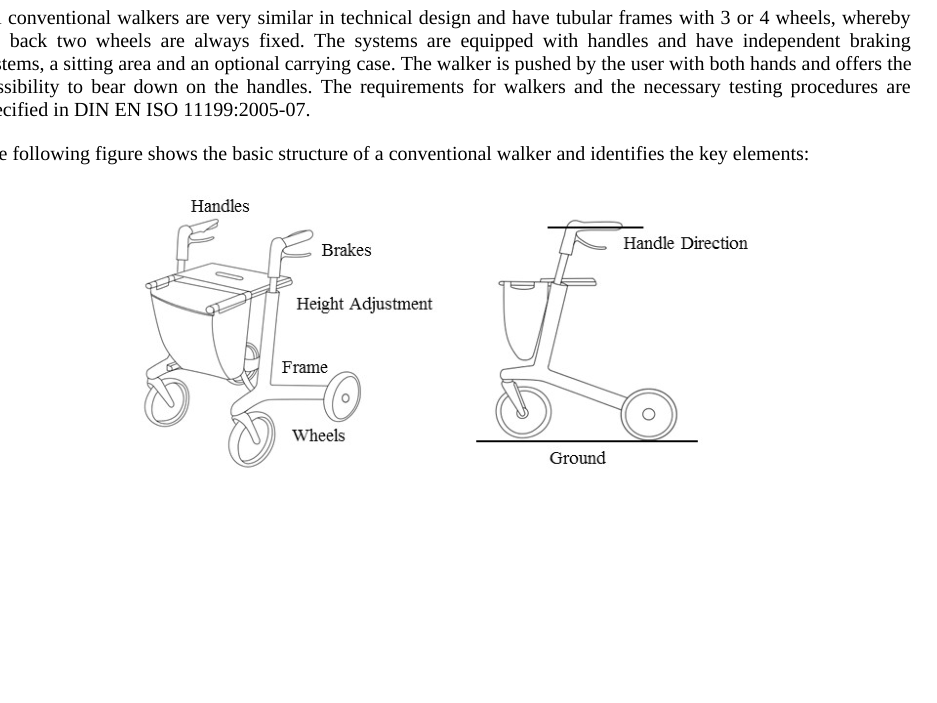
All conventional walkers are very similar in technical design and have tubular frames with 3 or 4 wheels, whereby the back two wheels are always fixed. The systems are equipped with handles and have independent braking systems, a sitting area and an optional carrying case. The walker is pushed by the user with both hands and offers the possibility to bear down on the handles. The requirements for walkers and the necessary testing procedures are specified in DIN EN ISO 11199:2005-07.
The following figure shows the basic structure of a conventional walker and identifies the key elements:
Figure 3. Left: Basic parts of a walker, Right: Handle direction in comparison with the ground
Problems in Interaction and use Currently, the technical structure of walkers, especially the design of their handles, is very similar with all manufacturers. There are some variations in design and in some cases also in orientation of the system in relation to the user. Walkers in the market are equipped with handles whose position is parallel or approximately parallel to the contact surface as shown in Figure 3 (right figure). The handle position is adjustable in height. The correct and consistent adjustment of the handle height is important for the load distribution between both arms. The setting influences the entire body position while walking and is significant for the usage.
The handle body is slightly different in its design. As a basic form for the gripping surface, a cylindrical body can be found in all models, which can be modified, for example by ball pads or finger grooves. Often there is also rejuvenation in the area between the index finger and thumb.
The orientation of the handle and its geometry are critical to the usability of the entire product. The handle of the walker is clearly seen here as a mechanical system interface to humans and therefor it should be specifically adapted to human needs as described in the previous section. When considering ergonomic principles it is clear that such handle constellations are not optimally adapted in their orientation and geometry to fit the needs of the human body.
The identified key points for the design of the handle assembly are compared with the ergonomic findings of the equipment design in the next section. The examination is divided into two main points; the form of the handle and the hand posture, i.e. the orientation of the handle. The differentiation is based on the factors influencing the design of work equipment.
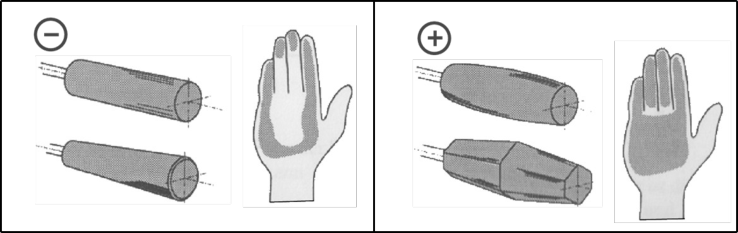
Handle Form The cylindrical design of the handle in most walkers is not identical to the natural form of the hand. Contrary to some representations, the hand is not flat but curved in its rest position. The curvature of the palm of the hand along the longitudinal axis and along the transverse axis of the hand does not allow reliable contact with a cylindrical body. The contact is reduced to a limited area of the hand. Investigations on different types of handles have identified a cycloid grip body as the best possible form. The different contact surfaces between a cylindrical body and a cycloid by hand are described in detail in the following figure.
Figure 4. Area of contact with the hand of different handles (cf. Bullinger & Ilg, 1994, p.326)
Modifying the design of the handle form of a rolling walker distributes the forces exerted by and acted upon the hand of the user more evenly and thus reduces the strain on the hand. The design effort to implement such a change is small in contrast to the generated added value. Other factors are also critical to the usability of the handle assembly.
Orientation of the Handle Considering the position of the handle compared to the body attitude it becomes obvious that many walkers take ergonomic aspects inadequately into account. For a proper design, the focus needs to be extended to the hand-arm system. The motion space of the hand towards the rest position is anatomically limited to 30 ° in ulnar and 15 ° in radial directions. At rest, the middle finger is the extension of the forearm. If the rest of the arm and the resulting angles are superimposed to this area, it is clear that the spatial orientation of the handle is critical to the use of a walker. Due to the fixed handle position of the walker, users are forced to adapt to this position.
By superposition of shape and orientation of the handle and the lack of ergonomic adjustment, the user is forced to adapt to the mobile walker. As an overlay effect, this creates excessive stress on the ulnar side of the hand that is detected by measurement in the course of verifying the results. Through the transfer of force application and the reduction to a small area, there is a dorsal flexion and thus to a change from the resting position of the hand. Figure 5 compares the deviations of the hand of the optimal position and clarifies how the handle design affects the user’s bearing and attitude.
Figure 5. Comparison of wrong and right wrist position
Figure available in the original PDF paper.
Consequences of wrong usage A closer look at mobile walker users often shows a completely wrong use of the walker. The bent-over posture of the user is responsible for this, caused by leaning over the handles to obtain support. This posture has the effect that the vertebral column loses its lumbar lordosis. It is the main reason for high pressure on the spinal discs. Back pain is the common consequence of this overuse, which often disembogues in disc prolapse. Furthermore, electromyographic tests show that another consequence is increase muscle stimulation in areas of nape and back (cf. Grandjean, 1991, p. 70-71). The wrong posture not only causes higher muscle strain and higher demands on energy, it is one big reason for increased pulse frequency and blood pressure (cf. Bullinger & Ilg, 1994, p. 211). This is a big problem especially for the elderly. Due to their higher age, they often have already high blood pressure (cf. Schuchert, 2011, p. 21). Therefore an additional increase of pulse frequency and blood pressure should be avoided.
Besides the wrong body position, there are further mistakes in using a walker. As described above, many users tend to set up their handles up too high. As a result, the user must correct the position of the hands by over flexing them in ulnarly.
A study with conventional and ergonomically formed tools showed that using conventional tools forced an unnatural hand position. Comparing this knowledge to the handle position of mobile walkers displays the need of adapting the angular position of the walker handles. Due to the heavily limited movement abilities of human hands in the ulnar direction, this posture causes high muscle strain, even without any load on it. This can lead to inflammations of the wrist or even to tendonitis (cf. Grandjean, 1991, p.25).
First and foremost mobile walkers and walkers in general are used as supporting devices. Therefore most of the bodyweight is led through the hand and the handles into the walker system. If the hands are positioned as shown in figure 5 (left column) the wrist experiences more load than usual. To lead the force into the system, the wrist must not only take the normal forces into account, there are also torque and shear forces to transfer as well. These additional forces cause higher risks for inflammations of the wrist and must be avoided absolutely.
As mentioned above, the overflexion in a dorsal way leads to bigger area to transfer forces into the handles of the mobile walker. This is a wrong hand position that the user uses to reduce wounds on the palms. In figure 5 (middle column) the problem with this position is clearly visible. The forces are similar to those resulting of the overflexion in the ulnar way. Besides possible inflammations to the wrist, a consequence could be a carpal tunnel syndrome (cf. Armshoff, 2010, p.439). To avoid these injuries, the design of the handle surfaces must be changed.
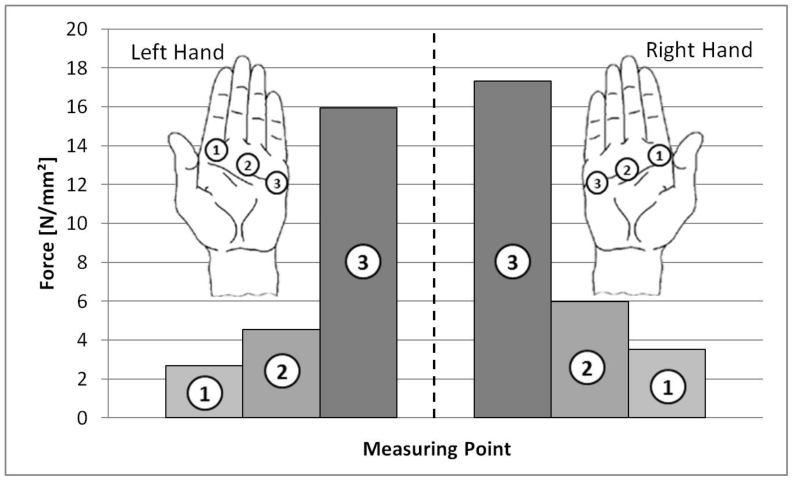
Ergonomic Focus As described above, the ergonomic handle design is elementarily influenced by the form and the orientation. For the determination of the force, distribution measurements were carried out using piezoresistive film sensors that were installed in three significant areas of the handle. A steady force distribution in the palm and a reduction of joint flexion is necessary to reduce user stress.
To measure the power transmission by ergonomic parameters, 3 areas defined in the handle were determined. The measurements revealed very high deviations between the different areas in all subjects. Figure 6 shows the average of all measurements and defines the high stress areas.
Based on the measurements, this shows that the introduction of force mainly by the edge of the hand (point 3). This effect is caused by the superposition of a false form and a wrong orientation of the handle assembly.
To reduce the hand edge load and to achieve a steady force application, it is necessary to adapt the handles. A redesign should be orientated to the human needs in order to ensure an optimal human-technology interaction The measurements confirm the results known from the literature and provide important information on the applicability to the walker. In order to determine a range for the grip angle, the relevant variables were included in a model.
Figure 6. Force distribution over 3 measuring points in the palm
The hand-arm system can be represented as a simplified rod kinematics that uses the lengths of the individual segments of the DIN 33402-2:2005-12. Due to ergonomic guidelines, the wrist should not be moved from the rest position; the system can be traced back to a simple trigonometric model. In addition, the manufacturer's instructions for adjusting the height of the handles were included as a reference. In addition, the main handle direction is assumed according to the design specifications for hand tools with a grip angle of 75 ° (cf. Bullinger & Ilg, 1994, p. 317). Figure 6 shows the simplified system that was used for the calculation.
Figure 7. Correct angles in the hand-arm-system
Figure available in the original PDF paper.
If the hand-arm system and the resulting angles are observed, it is clear that the orientation of the handles needs to be adjusted. The parallel alignment of the walker handles inevitably leads to ulnar flexion of the wrist. To avoid the displacement from the rest position, the walker handles are mounted approximately at a calculated angle of 11 ° to the horizontal axis. The calculated deviations from the different aspect ratios thereby amount to about + / - 1.5 °. Since a fixed setting cannot be optimally adapted to all users, it is necessary to provide the grip location with an adjusting device.
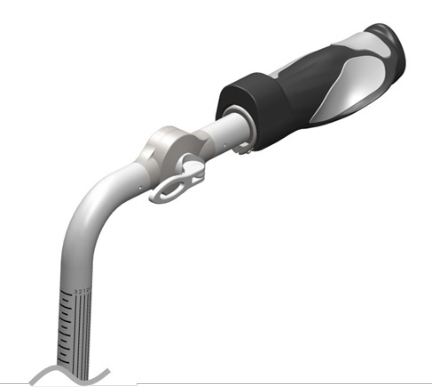
IMPROVED CUNSTRUCTION The heart of this new and innovative construction is the handle. It is the part that leads the forces from the hands into the walker system. To provide the best pressure distribution, the whole handle is formed ergonomically. The improved construction with a user centered design is shown in figure 8 below.
Figure 8. New handle design for walkers
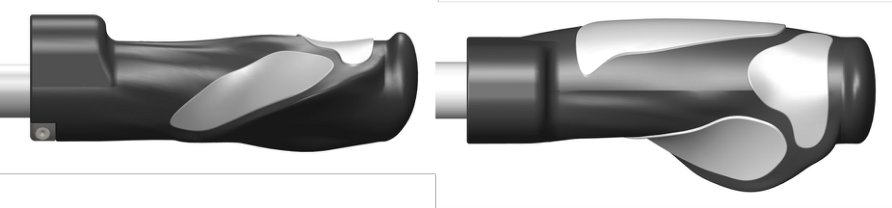
The basic form of the handle design is concave, whereby the top and bottom area of the handle have increased thicknesses. Their main function is to imitate the natural form of the human hand. A cylindrical basic shape would lead to a loss of contact in several areas in the palm, leading to higher pressure levels coming from the user. By using this new body shape, a full contact of the hand with the handle is achieved. The concave form supports the palm of the hand and provides constant pressure levels all over the hand.
Figure 9. New and ergonomic design of a walker handle, Left: side view, Right: top view
To increase an even pressure level, the handle shape is changed in another way. The right photo in figure 9 shows a shape similar to a wing on the side of the handle. This brings two new features. The first is that the surface becomes much bigger than a cylindrical one. The second is a protection for the user. With this shape, the user is not able to dorsally overflex the wrist. Injuries provoked by this misuse are thus excluded.
The handle must be useful for lots of different users. The problem is that each user has a unique and different hand shape. These differences arise not only due to the various possible physical dimensions, but can also arise from past injuries, which can cause sensitive areas in the palm.
Therefore the handle must be able to adapt to various different conditions. For this reason, the handles have three areas that are filled with an elastic material. This material compensates the different physical dimensions of each hand shape and allows the handle to fit different hand sizes, including differing proportions of palms and fingers. To provide a full contact for the hand, these areas can be compressed so that the palm has optimal contact with the handle. Furthermore, these areas spread out the pressure from the load. Thereby, the user obtains a more comfortable grip. Besides the handle shape itself, its position compared to the body attitude has to be adapted. Therefore a hinge was implemented in the improved construction. With it, the angle of the handle is adjustable independent of the walker that is used. All new functions combined with the already available ones create a higher level of comfort and adaption for the user.
CONCLUSIONS
In an aging society, the individual support, the preservation and the delivery of autonomous mobility is extremely important. Supporting devices such as mobile walkers enable self-determined movement in everyday life.
Via analyses of different popular systems und several observations of users, it is shown, that the design of MTIs of walkers have major deficits. Considerations of different scientific disciplines and ergonomic perceptions show huge potential for improvement. Current constructions of handles and their wrong setup cause major overloads in the hand-arm-systems. As a consequence, users sustain injuries and their mobility is severely limited.
This problem is already recognized in the sport and leisure sectors. In these branches, ergonomic product designs are state of the art. For example, the design of bicycle handlebars is adapted to the biker needs. Here ergonomic aspects have already been implemented.
In view of this, and especially if it is taken into consideration that the medical devices sector is such a large market, it is not understandable that such medical products have not been adapted as in the other sectors. On the contrary, the sales trends in this particular market predict rising demands for medical devices, especially for mobile walkers. The need for reconstructions of the handles and designing them with the help of ergonomic researches is enormous.
To achieve a much better support for users, only small changes in design for handles must be done. The result will be a product that not only supports the user in better way, it will also prevent injuries while using it. Only by protecting the user from misusing the mobile walker or using it the wrong way can mobility for the users be maintained. With this mobility a good quality of life for the elderly is guaranteed.
REFERENCES
Armshoff, T. (2010), „physiolexikon: Physiotherapie von A bis Z“. Stuttgart: Thieme. p 439 Bullinger, H.J., Ilg, R. (1994), “Ergonomie: Produkt- und Arbeistplatzgestaltung”. Stuttgart: Teubner. p 211 Bullinger, H.J., Solf, J.J. (1979), “Ergonomische Arbeitsmittelgestaltung 1 Systematik”, Bundesanstalt für Arbeitsschutz und Unfallforschung. Bremerhafen: Wirtschaftsverlag NW. pp. 663-698 Bundesministerium des Inneren (2011), “Demografiebericht: Bericht der Bundesregirung zur demografischen Lage und
künftigen Entwicklung des Landes”. Berlin: Referat G13. pp 32-36 DAK- Gesundheit (2013), “Generation Gehhilfe: Zahl der Rollatoren deutlich gestiegen”, DAK-Gesundheit Website: http://www.dak.de/dak/download/Pressemitteilung_Rollatoren-1330784.pdf DIN EN ISO 11199-2 : 2005-06, “Gehhilfen für beidarmige Handhabung: Anforderungen und Prüfverfahren“. Berlin: Beuth
Verlag Deutsche Wirtschafts Nachrichten (2012), “Zu wenig jugend: Anleger wollen nicht mehr in Europa investieren”, Deutsche Wirtschafts Nachrichten website: http://deutsche-wirtschafts-nachrichten.de/2012/10/30/demografie-problem-anleger-verlassen-europa/ Grandjean, E. (1991), “Physiologische Arbeitsgestaltung: Leitfaden der Ergonomie” (4th ed.). Landsberg: Ecomed. pp 25, 70–71 Schuchert, A. (2011), “Runter mit dem Blutdruck“. Pharmazeutische Zeitung, 39, pp. 20-27 United Nations (2012), “World Population Prospects: The 2012 Revision”. United Nations website:
esa.un.org/unpd/wpp/Excel-Data/EXCEL_FILES/1_Population/ WPP2012_POP_F01_1_TOTAL_POPULATION_BOTH_SEXES.XLS Woywode, M., Mädche, A., Wallach, D., Plach, D. (2012) “Gebrauchstauglichkeit von Anwendungssoftware als Wettbewerbsfaktor für kleine und mittlere Unternehmen (KMU)“. Institut für Mittelstandsforschung, Universität Mannheim, Usability in Germany website: www.usability-in-germany.de/kos/WNetz?art=File.download&id=267&name=UIG_Abschlussbericht.pdf
LISTED IN THE AHFE DIGITAL BOOKSTORE CATALOGUE
Explore the complete digital volume
Advances in Ergonomics In Design, Usability & Special Populations: Part II
Read this individual research paper free through the original publisher, or explore the full digital proceedings book.
ISBN 978-1-4951-2107-4
Explore this ISBN in the AHFE Bookstore ↗Listed in the July 2026 bookstore catalogue; search by ISBN to confirm current availability · Digital book purchase optional