Lucas Paletta, Julia Zuschnegg, Anna Schultz, Amadeus Linzer, Wolfgang Kratky, Ursula Berger, Martin Pszeida, Amir Dini, Sandra Draxler, Michael Schneeberger, Wolfgang Weiss, Jochen A Mosbacher, Thomas Orgel, Thomas Pfitzer, Silvia Russegger, Judith Goldgruber, Marisa Koini, Sandra Schuessler (2025). Virtual Experience and Interactive Training Environments With Bio-Signal-Based Indicators for Cognitive Decline: Results of the SmartAktiv Study. In: Cognitive Computing and Internet of Things. AHFE Open Access, vol. 165, pp. 37–48. https://doi.org/10.54941/ahfe1006088
Virtual Reality (VR) is among the top emerging technologies in healthcare for older adults. The SmartAktiv project developed an innovative VR-based training environment with the goal to support early detection and cognitive activation in individuals with mild cognitive impairment (MCI). The multimodal system combines immersive VR, hand and eye tracking, tablet-based exercises, and wearable biosignal sensors. Scenario development was informed by expert workshops and user focus groups. Usability testing and a pilot study evaluated system effectiveness. VR scenarios included leisure-based (I)ADLs (instrumental activities of daily living), such as, mushroom picking. Eye-tracking data and interaction performance revealed significant correlations. Participants without cognitive impairment completed tasks faster, had shorter fixations, and showed higher engagement. Findings support the potential of SmartAktiv as a motivating, sensor-driven intervention in a gamified environment with the potential for identifying digital biomarkers in early-stage MCI.The third and final phase tested the comprehensive system in a pilot study (n=30), including participants with various degrees of mild cognitive impairment. A control group (n=30) used only the Tablet training without VR. A subgroup of the recruited participants applied neurological assessment with various psychological tests led by a clinical expert in order to enable reference diagnostic information.The expert workshop identified four scenarios for further development: beach vacation, winter outing, summer hiking, and urban experience. The pilot study (n=30, female 80%, M=76.4/SD=8.2 years of age, with screening MoCAScore M=25.0/SD=3.3 ) applied these scenarios within the VR-based environment. The assessment of hand-based virtual events and eye movement features during specific sequences of the interactions resulted in significant advantages of persons without cognitive impairment (MoCA global score > 24) within IADLs, regarding the time to finalize a payment procedure, referring to faster scene understanding with lower fixation durations during natural scene observation, as well as presenting larger pupil dilation of higher engagement within entertaining scenarios. SmartAktiv emphasizes a comprehensive multimodal activation, integrating immersive and playful cognitive training within experiential scenarios. This training approach aims to strengthen all cognitive domains and offers training for various (I)ADLs within leisure scenarios. The assessment processes demonstrate statistically significant differences between cognitively impaired as well as healthy participants that. These results demonstrate the potential of the approach to provide digital sensor-based biomarkers that could be validated in future work.
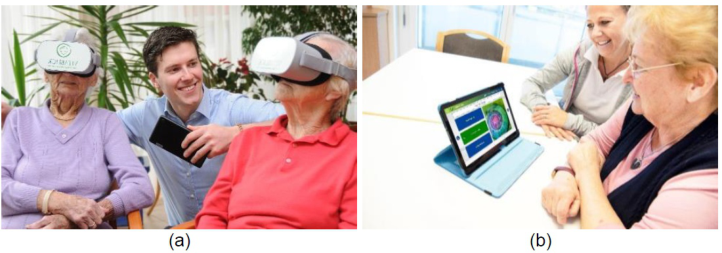
focusing on VR for individuals with cognitive decline remains scant, particularly in areas that merge cognitive training with leisure experiences. This goes beyond the conventional instrumental activities of daily living ((I)ADL) training, such as shopping and household chores. The Austrian project SmartAktiv aimed to prototype an innovative training environment, which combines immersive VR with hand tracking, VR- and tablet-based skill-oriented interactions, and wearables (Figure 1). This environment introduces a novel service for the intelligent multimodal activation and early detection of cognitive decline.
In the project’s initial phase, qualitative data from prior projects scrutinized to discern the most desired panoramic video-based VR scenarios. An expert workshop and a follow-up focus group consisting of individuals with and without cognitive decline provided further required details. Based on this feedback, the second phase oversaw the development and refinement of the VR service system including a usability study. This service system incorporated novel content about the leisure-based (I)ADL scenarios, including interactions with hand tracking. The eye tracking required an initial calibration procedure and provided raw data on eye movements, pupil dilation and gaze on pre-defined objects in the interaction scenes, such as, payment procedure, or mushroom picking.
A second component consisted of tablet-based exercises for cognitive activation, using thematic content in tune with the VR-based experiences. In addition, wearable activity trackers provided cardiovascular information (heart rate, heart rate variability).
Digital data from VR events and wearable bio-signal-based information was logged for time-synchronized post-processing. The third and final phase tested the comprehensive system in a pilot study, including healthy participants and with mild cognitive impairment (MCI). A subgroup of the recruited participants voluntarily applied neurological assessment with various psychological tests led by a clinical expert in order to enable reference diagnostic information.
The expert workshop identified four scenarios for further development: summer hiking, beach vacation, winter outing, and urban experience. The pilot study applied these scenarios within the VR-based environment. The assessment of hand-based virtual events and eye movement features during specific sequences of the interactions resulted in significant advantages of persons without cognitive impairment within (I)ADLs, regarding the time to finalize a payment procedure, with faster scene understanding with shorter fixation durations in natural scene observation, as well as presenting larger pupil dilation of higher engagement within entertaining scenarios.
SmartAktiv introduces a comprehensive multimodal activation, integrating immersive and playful cognitive training within experiential scenarios. This training approach aims to strengthen all cognitive domains and offers training for various (I)ADLs within leisure scenarios, exploring the potential of the approach to provide digital sensor-based biomarkers that could be validated in future work.
Virtual Experience and Interactive Training Environments 39
Figure 1: (a) Virtual excursions and activation in groups. (b) Tablet-based multimodal activation (Paletta et al., 2021a).
RELATED WORK
VR-supported services are among the most promising technologies for the care and support of older people in the healthcare sector (Kratky & Goldgruber, 2024; Abdi et al., 2021). In the neurodegenerative diseases, cognition and ADL are at the forefront of technological research with a focus on assessment, diagnosis and monitoring. Decrease of cognitive performance should be recognized at an early stage, emphasizing prevention but also existing diseases (e.g., MCI, dementia) to enable timely application of interventions. Technologies should also provide recommendations, motivation, instructions, and support (Abdi et al., 2021).
There is little VR research on the clinical picture of dementia (Choi, 2017, D’Cunha et al., 2019) that examined the potential benefits of VR interventions for people with MCI and dementia. The studies focused on cognitive interventions, movement exercises, communication, and hobbies/meaningful activities. The results showed that participants enjoyed the content, mood and apathy improved, and virtual interventions were more preferred than traditional interventions. Future research should include more social interactions, as well as psychophysiological outcomes. Two further systematic reviews with meta-analysis by Zhu et al. (2021) and Corregidor-Sánchez et al. (2020) also investigated the effect of VR exercise interventions. Positive effects were shown for function, balance, IADL, and ADL. Another study by Shin et al. (2022) examined IADL interventions in VR for people with MCI and dementia. These interventions were in the areas of household cleaning, shopping, cooking and ordering meals, and a hospital visit. The results showed significant improvements in IADL. The systematic review with meta-analysis by Zhu et al. (2021) investigated the effect of VR interventions (e.g. juicing, museum play, virtual city, movement exercises, childcare) on cognition. The results showed significant results for overall and global cognition, executive functions, memory and attention. Another study investigated the effect of VR training, which included four types of game-based content to improve attention, memory and processing speed. The intervention group showed a significant improvement in executive function and brain function at rest (Thapa et al., 2020). VR-based cognitive training should be an effective support for
people with MCI and dementia and their caregivers to improve quality of life (QoL). The disease should be stabilized and symptoms minimized. In addition, innovative multidisciplinary approaches must be integrated to promote knowledge for diagnosis, intervention and care in MCI and dementia (García-Betances et al., 2015). The SmartAktiv project aimed to reach beyond the state of the art in terms of comprehensive activation, which enables psychologically motivated multimodal exercises on the one hand and playful, immersive training of activities of daily living on the other. It also explores the expected precision of digital biomarkers, especially for dementia screening (e.g. the Montreal Cognitive Assessment, MoCA; Nasreddine et al., 2005) through VR-supported eye tracking and corresponding feature analysis. Digital biomarkers are defined as objective, quantifiable, physiological, and behavioral data that are recorded and measured with the help of digital devices - in SmartAktiv using digital sensors for eye tracking and wearables.
THE TRAINING PLATFORM The training platform includes several technologies: (i) firstly, the VR-based environment with hand-based interaction and eye-tracking enables to experience remote locations and assess the cognitive performance; (ii) secondly, the tablet-based training fosters gamified, ubiquitous access to multimodal activation, and (iii) thirdly, wearables with bio-signal sensors enable to monitor cognitive-emotional strain during training.
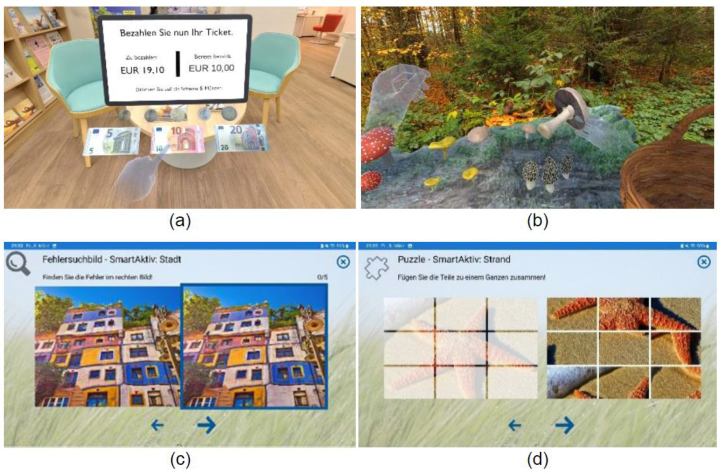
Virtual Reality With Hand-Based Interaction and Eye-Tracking Assessing cognitive impairment through VR offers a highly immersive and ecologically valid approach, especially when combined with hand-based interaction and eye-tracking technologies, such as those available in the Pico Neo 4 Eye headset. VR allows the simulation of real-life (I)ADLs, enabling the observation of behavior in controlled yet naturalistic environments. Hand tracking captures fine motor skills and task performance, reflecting executive function and procedural memory. Meanwhile, integrated eye- tracking provides objective measures of visual attention, gaze patterns, and cognitive load, offering insight into memory, scene understanding, and decision-making. Together, these modalities generate rich, multimodal data that can reveal subtle deficits in cognitive processing—often undetectable through traditional tests—supporting earlier and more precise detection of conditions like MCI. Figure 2a,b depict characteristic scenarios in the VR- based environment that represent IADLs, such as, (a) payment at the travel agency office and (b) collecting objects, such as, mushrooms in the forest during hiking.
Tablet-Based Exercises for Cognitive Activation and Assessment The tablet-based component (multimodal app; MMA) consists of a collection of playful exercises following the concept of multimodal training. It covers a diversity of exercise types for cognitive activation, including cognitive but also sensorimotor exercises. There are exercises for training attention (‘spot
Virtual Experience and Interactive Training Environments 41
the difference’), visuospatial executive (‘jigsaw puzzle’), naming (‘text quiz’), etc. These exercises were designed and selected by experts for health care and verified by clinical psychological experts. The MMA prepared in total 49 exercises out of 9 different types (pairs, mathematics quiz, text quiz, sequence, cloze text, jigsaw puzzle, spot the difference, hearing quiz, outsider quiz) for the 4 scenarios, with a single grade of difficulty and in German language. Figure 2c,d depicts characteristic scenarios in the tablet-based environment that represent exercises for cognitive activation, such as, (a) comparing visual content between pictures, and (b) puzzle, i.e., challenging short-term memory.
Figure 2: VR-based scenarios: (a) Payment at the travel agency. (b) Mushroom collection in the forest. Tablet-based scenarios: (c) Spot the difference, (d) jigsaw puzzle.
ASSESSMENT MODALITIES Assessment of Activities of Daily Living
ADL encompass basic activities (e.g., dressing, personal hygiene, mobility), while IADL refer to more complex activities (e.g., shopping, finances). Comprehensive concepts, (e.g., based on basic human needs) also include mental and psychosocial aspects such as cognition, social contacts, and communication. Impairments in (I)ADL may result in care dependency and in the most severe cases, in the loss of the ability to live independently at home (Dijkstra, 2017, Alzheimer Association, 2024).
Scientific evidence indicates that individuals with MCI often experience subtle deficits in IADLs—such as managing finances, medication, transportation, and meal preparation—despite generally maintaining independence in basic self-care tasks (Jekel et al., 2015; Aretouli & Brandt, 2010). This is of great importance, as MCI is a risk factor for the development
of dementia (Alzheimer Association, 2024) in which IADL are also primarily affected in the early stages. As dementia progresses, basic ADL become increasingly impaired, ultimately resulting in a high level of care dependency.
It is therefore necessary to regularly monitor limitations in IADL of people with MCI in order to recognize changing needs at an early stage and delevop appropriate support strategies. However, any intervention should take into account the stage of cognitive deficits and a person’s individual abilities. This prevents a premature increase in care dependency due to inadequate care (too much, wrong, too little support) and helps to identify risks for care problems (Schüssler, 2015).
Neuropsychological Assessment The diagnosis and differentiation of MCI and dementia requires a comprehensive neuropsychological battery that evaluates various cognitive domains, including memory, attention, executive function, visuospatial abilities, and language. The Montreal Cognitive Assessment (MoCA) is a brief screening tool designed to detect MCI. It evaluates executive function, memory, language, attention, abstraction, and orientation. Its sensitivity to early cognitive changes makes it preferable over the MMSE for identifying MCI (Nasreddine et al., 2005). The Comprehensive Trail Making Test (C-TMT) subtests 1 and 5 evaluate visual attention, psychomotor speed, sequencing, and cognitive flexibility. These components are essential for detecting executive dysfunction, which is often present in vascular dementia and later stages of Alzheimer’s disease (Reynolds, 2002). Altogether, this enables comprehensive profiling across critical domains affected in MCI and dementia. Combining performance across memory, visuospatial skills, executive function, and language allows for differential diagnosis and tracking disease progression.
Digital Biomarkers From Eye-Tracking Progressive neurological diseases such as Alzheimer’s disease are known to decrease eye movement behavior (Kuskowski, 1988). Alzheimer’s patients are characterized by a significant impairment of the inhibitory functionality of eye movements (Crawford et al., 2005; Wilcockson et al., 2019). Recently, numerous methods using laboratory-based eye-tracking technology have been developed (Oyama et al., 2019), but there is a lack of continuous mental state tracking capabilities in the home. Paletta et al. (2021a,b) validated tablet- and VR-based eye-tracking for Alzheimer’s disease detection and cognitive reserve estimation. Davies et al. (2021) applied virtual reality tests and eye tracking in older adults in a large-scale wayfinding task and found significant impairments in people with advanced Alzheimer’s disease. Imaoka et al. (2020) verified the feasibility of implementing the antisaccade task with VR goggles.
Wearable Biosignal Sensors Tracking stress in older adults during interactions with VR-based environments and tablet-based training is important for several key reasons.
Virtual Experience and Interactive Training Environments 43
Firstly, elevated stress levels can reduce engagement, learning efficiency, and willingness to continue using the technology. Monitoring stress helps ensure that the experience remains comfortable and motivating—especially crucial for older adults who may be unfamiliar with digital tools. Stress responses may further indicate that the interface is too complex, the tasks are too difficult, or that sensory or cognitive overload is occurring. By identifying these stress triggers, designers can adapt the system to be more user-friendly and cognitively appropriate for aging users. Another aspect is that in cognitively impaired individuals, stress can reflect an inability to cope with multitasking or unfamiliar scenarios. Continuous stress tracking (e.g., via heart rate variability or pupil dilation) provides insights into mental workload and helps fine-tune interventions. VR can occasionally cause discomfort, disorientation, or cyber-sickness in older adults. Monitoring physiological stress markers ensures that the technology does not negatively affect well-being during use. Real-time stress data enables systems to adapt difficulty levels or provide supportive prompts, creating a personalized, just-right challenge level that enhances cognitive activation without frustration. Finally, stress patterns can serve as indirect indicators of cognitive resilience or decline. Over time, stress reactivity data might also contribute to digital biomarkers for early detection of neurodegenerative changes.
EXPERIMENTAL RESULTS User-Centered Design and Pilot Study
The scenario development was informed by an expert workshops (n = 6) and a user focus groups (n = 8). The prototype (combined tablet and VR training: forest scenario) was tested for functionality and usability with healthcare service providers, i.e., employees of Geriatric Health Centres of the City of Graz from the fields of physiotherapy, occupational therapy, social care and clinical psychology, as well as in three further workshops with a total of 12 study participants. The resulting findings were directly incorporated into the further development and improvement of the system (combined training).
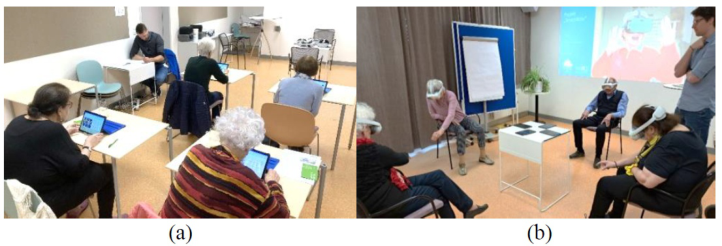
The improved technical solution was then tested in a pilot study on 30 study participants (female 80.00 %, M = 76.43, SD = 8.21 years of age, MoCA global score M = 25.00, SD = 3.29) over the course of a month in 4 training sessions. The training sessions took place weekly and a different scenario was used each week (4 different scenarios in total, Figure 3). Various measurements were taken during the training sessions, including questionnaire surveys (before and after the intervention), bio- sensory measurements - the study participants wore a wearable Garmin vivosmart 5 during the training sessions- and recording of eye tracking data using VR glasses.
Figure 3: Pilot study: (a) Tablet-based exercises. (b) VR-based experience.
Quantitative Results The participants were divided into two groups with MoCA global score cutoff of > 25 points (Nasreddine et al., 2005) resulting in a ‘healthy sample’ (n = 16; MoCA global score M = 27.62, SD = 1.36) and with ≥25 points forming the group of ‘MCI’ (n = 14; MoCA global score M = 22.00, SD = 1.96), respectively.
The symptoms of simulation disease were measured by the Simulator Sickness Questionnaire (SSQ; Kennedy et al., 1993). The standard severity levels of the SSQ (Bimberg et al., 2020; Stannev et al., 1997) are, as follows (total scores), ‘negligible’ (0–5), ‘minimal’ (5–10), ‘mild’ (10–15), … ‘significant’ (20–30). The SSQ in the individual scenarios were scored, as follows, ‘beach’ M = 4.24, SD = 5.62; ‘hiking’ M = 6.95, SD = 7.25; ‘winter’ M = 6.98, SD = 11.23; ‘city’ M = 8.64, SD = 13.89. In general the MCI group reacted more vulnerable than the healthy group but without statistically significant difference.
The recording of momentary affective states (‘emotions’) is of central importance for the collection of the affective component in connection with the performance data through the use of VR technology. The ‘Affective Slider’ (Betella & Verschure, 2016) was used for the survey in terms of self-assessment from a scientific perspective, and Wilcoxon Signed-Rank Test applied to compare groups. Across both groups, the change in arousal (p = .010*) as well as in valence was significant (p = .015*; Table 1), and both mean arousal and mean valence increased after the intervention. While there was a significant difference in the intra-individual mean values for arousal within the cognitively healthy subgroup (p = .030*), this difference was not significant in the MCI subgroup (p = .119). With regard to valence, cognitively healthy individuals reported on average significantly higher valence after the intervention (p = .036*). In contrast, the mean valence values of the MCI group did not differ significantly (p = .194).
The assessment of the ETAM (Erlangen Test of Activities of Daily Living in Persons with Mild Dementia or Mild Cognitive Impairment; Luttenberger et al., 2016) before and after the intervention showed a positive change in the healthy group (0.44 points) but a negative effect (–0.93
Virtual Experience and Interactive Training Environments 45
Equation reproduced from the original PDF.Table 1: Affective states before (pre) and after (post) the tablet- and VR-based intervention. Displayed values represent the average of intra-individual means within each group.
Exploring Digital Biomarkers From Eye-Tracking and Wearables Eye-Tracking. All n = 30 participants were included in the analysis of the eye tracking data. Within the specific interactive VR tasks, the time required to complete activities emerged as a clear indicator of cognitive impairment, showing a significant negative correlation with MoCA scores (Spearman’s ρ = –.473, p = .008**; beach scenario; interactive session ‘payment’). Participants in the healthy group completed this task considerably faster (M = 37.05 s, SD = 16.09) compared to those in the MCI group (M = 87.24 s, SD = 52.41).
Eye-tracking data also revealed several significant associations with cognitive status. Notably, in the winter scenario, MoCA total scores correlated with fixation duration (ρ = −.434, p = .017*; winter scenario, video session ‘ski lift ride’) and pupil dilation (ρ = .553, p = .002**; winter scenario, video session ‘car ride’), suggesting that both visual attention and physiological engagement may reflect underlying cognitive capacity.
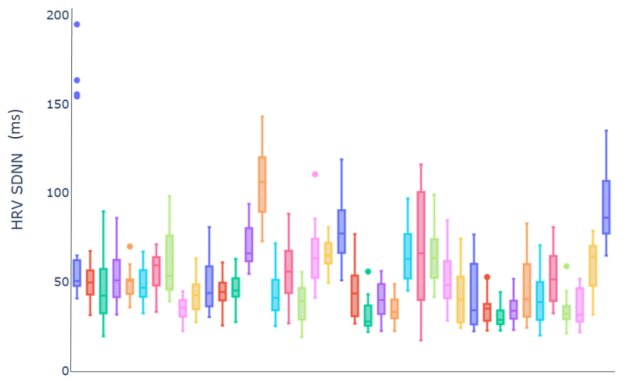
Figure 4: Wearable bio-signal sensor-based data (Garmin vivosmart 5) about HRV during the VR-based intervention. Encoded by ‘a.b’, with a=participant number, b= scenario (2=beach, 3=winter, 4=city); left to right: 3.3, 5.3, 6.3 7.2, 7.4, 8.3, 9.2, 9.4, 11.3, 12.2, 12.4, 13.2, 13.4, 14.3, 15.3, 16.2, 16.4, 18.3, 20.2, 20.4, 21.3.
Wearable bio-signal sensors. Stress signals were collected using heart rate (HR) and heart rate variability (HRV) data.
Figure 4 visualizes the boxplots of HRV signals of fifteen participants that were measured during the VR session. HRV tends to decrease with age, its normal range in older adults for Standard Deviation of Normal-to- Normal intervals (SDNN) is 30–50 ms (Voss et al., 2015). However, HRV is significantly lower in MCI than in age-matched cognitively healthy controls, it would be in the range of ∼20–35 ms according to Kim et al. (2018). The detailed results of these pilot study data will be analyzed in future work.
CONCLUSION AND FUTURE WORK This paper presented the concept and preliminary implementation of SmartAktiv, an intelligent multimodal assistive system for older adults with the risk for cognitive impairment, integrating a VR headset with eye-tracking, a tablet and a wearable bio-signal sensor. The system aims to promote playful exercise routines through the simulation of leisure-based ADL and multimodal feedback. Initial results indicate that the intervention increase valence and arousal of the users, and may increase the capacity for activities of daily living of healthy users. There is also a potential for non-invasive assessment of cognitive impairment through interaction and eye-tracking data. Long-term goals involve clinical validation of health outcomes and potential scaling for broader use in preventive healthcare.
ACKNOWLEDGMENT
This research was supported by the Austrian Research Promotion Agency (FFG) and the Austrian Federal Ministry for Climate Action, Environment, Energy, Mobility, Innovation and Technology (BMK) by project SmartAktiv (grant number FO999904045).
REFERENCES
Abdi S., Witte L., Hawley, M. (2021). Exploring the Potential of Emerging Technologies to Meet the Care and Support Needs of Older People: A Delphi Survey. Geriatrics (Basel). 2021 Feb 13;6(1):19. Alzheimer’s Association. Alzheimer’s Disease facts and figures. Alzheimers Dementia.
2024;20(5): 3708–821. Aretouli, E., & Brandt, J. (2010). Everyday functioning in mild cognitive impairment and its relationship with executive cognition. International Journal of Geriatric Psychiatry, 25(3), 224–233. https://doi.org/10.1002/gps.2325 Betella, A., Verschure, P. F. (2016). The Affective Slider: A Digital Self-Assessment
Scale for the Measurement of Human Emotions. PLoS One. 2016 Feb 5;11(2): e0148037. Bimberg, P., Weissker, T., and Kulik, A. (2020). On the Usage of the Simulator Sickness Questionnaire for Virtual Reality Research, 2020 IEEE Conference on Virtual Reality and 3D User Interfaces Abstracts and Workshops (VRW), Atlanta, GA, USA, 2020, pp. 464–467, doi: 10.1109/VRW50115.2020.00098. Choi, K. S. (2017). Virtual Reality in Nursing: Nasogastric Tube Placement Training
Simulator, Stud Health Technol Inform, vol. 245, p. 1298.
Virtual Experience and Interactive Training Environments 47
Corregidor-Sánchez, A.-I. et al. (2020). Effectiveness of Virtual Reality Systems to Improve the Activities of Daily Life in Older People. International Journal of Environmental Research and Public Health. 17(17):6283. Crawford, T. J., Higham, S., et al. (2005). Inhibitory control of saccadic eye
movements and cognitive impairment in Alzheimer’s disease. Biol Psychiatry, 57, pp. 1052–1060. Davis R. (2021). The Feasibility of Using Virtual Reality and Eye Tracking in Research With Older Adults With and Without Alzheimer’s Disease. Front Aging Neurosci. D’Cunha, N. M. et al. (2019). Mini-Review of Virtual Reality-Based Interventions
to Promote Well-Being for People Living with Dementia and Mild Cognitive Impairment. Gerontology. 2019;65(4): 430–440. Dijkstra, A. (2017). Care Dependency. In: Schüssler, S., Lohrmann, C. (eds) Dementia in Nursing Homes. Springer, Cham. Folstein, M. F., Folstein, S. E., & McHugh, P. R. (1975). “Mini-mental state”.
A practical method for grading the cognitive state of patients for the clinician. Journal of Psychiatric Research, 12(3), 189–198. https://doi.org/10.1016/0022- 3956(75)90026-6 García-Betances, R. I., Jiménez-Mixco, V., Arredondo, M. T., Cabrera-Umpiérrez, M. F. (2015). Using virtual reality for cognitive training of the elderly. Am J Alzheimers Dis other Demen. 2015 Feb;30(1): 49–54. Imaoka Y. et al. (2020). Assessing Saccadic Eye Movements With Head-Mounted Display Virtual Reality Technology. Front. Psychiatry 11:572938. Jekel, K., Damian, M., Wattmo, C., Hausner, L., Bullock, R., Connelly, P. J.,...
& Frölich, L. (2015). Mild cognitive impairment and deficits in instrumental activities of daily living: A systematic review. Alzheimer’s Research & Therapy, 7(1), 17. https://doi.org/10.1186/s13195-015-0099-0. Jessen, F. et al. (2014). A conceptual framework for research on subjective cognitive decline in preclinical Alzheimer’s disease. Alzheimer’s & Dementia, 10(6), 844–852. Kennedy et al., 1993) Simulator sickness questionnaire: An enhanced method for
quantifying simulator sickness. The Intl journal of Aviation Psychology, 3(3), 203–220. Kim, D. H., et al. (2018). Association between reduced heart rate variability and cognitive impairment in older adults. Journal of the American Geriatrics Society, 66(2), 385–391. Kratky, W., & Goldgruber, J. (2024). Virtual Reality in Therapie und Diagnostik von
Demenz. ProCare, 29(4), 44–47. https://doi.org/10.1007/s00735-024-1832-3 Kuskowski, M. A. (1988). Eye movements in progressive cerebral neurological disease, in: Neuropsychology of Eye Movements, Hillsdale, N. J., 1988, pp. 146–176. Luttenberger et al. (2016). Validation of the Erlangen Test of Activities of Daily
Living in Persons with Mild Dementia or Mild Cognitive Impairment (ETAM). BMC Geriatrics. Nasreddine, Z. S., Phillips, N. A., Bédirian, V., et al. (2005). The Montreal Cognitive Assessment (MoCA): A brief screening tool for mild cognitive impairment. Journal of the American Geriatrics Society, 53(4), 695–699. Nasreddine, Z. S. et al. (2005). The Montreal Cognitive Assessment, MoCA: A brief
screening tool for mild cognitive impairment. J Am Geriatr Soc. Apr;53(4): 695–9.
Oyama, A. et al. (2019). Novel Methods for Rapid Assessment of Cognitive Impairment Using High-Performance Eye-Tracking Technology. Nature Scient Rep, 9, 12932. Paletta, L. et al. (2021a). Towards Decision Support with Assessment of Neuropsychological Profiles in Alzheimer’s Dementia Using Playful Tablet-based Multimodal Activation, In: Ayaz H., Asgher, U., Paletta, L. (eds.) Advances in Neuroergon & Cognit Engin, Springer. Paletta, L., Pszeida, M., Schüssler, S., et al. (2021b). Virtual Reality-based Sensory
Triggers and Gaze-based Estimation for Mental Health Care. In: Ayaz H., Asgher, U., Paletta, L. (eds.) Advances in Neuroergon & Cognit Engin, Springer. Reynolds, C. R. (2002). Comprehensive Trail Making Test (CTMT). Austin, TX: Pro-Ed. Schüssler, S. (2015) Care Dependency and Nursing Care Problems in Nursing Home
Residents with and without Dementia, doctoral thesis, Medical University of Graz. Shin, H. T. et al. (2022). Fully-immersive virtual reality instrumental activities of daily living training for mild cognitive impairment: A feasibility study, Research Square. Stanney, K. M. et al. (1997). Cybersickness is not Simulator Sickness. Proceedings of
the Human Factors and Ergonomics Society Annual Meeting, 41(2), 1138–1142. Thapa, N. et al. (2020). The Effect of a Virtual Reality-Based Intervention Program on Cognition in Older Adults with Mild Cognitive Impairment: A Randomized Control Trial. J Clin Med. 2020 Apr 29;9(5):1283. doi: 10.3390/jcm9051283. Voss, A. et al. (2015). Short-Term Heart Rate Variability—Influence of Gender and
Age in Healthy Subjects. PLoS ONE 10(3): e0118308. Wilcockson, T. D. W. et al. (2019). Abnormalities of saccadic eye movements in dementia due to Azheimer’s disease and mild cognitive impairment, Aging, Vol. 11, No. 15. Zhu, S. et al. (2021). Effects of Virtual Reality Intervention on Cognition and
Motor Function in Older Adults with Mild Cognitive Impairment or Dementia: A Systematic Review and Meta-Analysis. Frontiers in Aging Neuroscience, 13.
LISTED IN THE AHFE DIGITAL BOOKSTORE CATALOGUE
Explore the complete digital volume
Cognitive Computing and Internet of Things
Read this individual research paper free through the original publisher, or explore the full digital proceedings book.
ISBN 978-1-964867-41-0
Explore this ISBN in the AHFE Bookstore ↗Listed in the July 2026 bookstore catalogue; search by ISBN to confirm current availability · Digital book purchase optional