Michael Schneeberger, Jochen A Mosbacher, Fredrik Gustaffson, Georg Lindner Turecka, Wolfgang Weiss, Martin Pszeida, Thomas Orgel, Silvia Russegger, Lucas Paletta, Gerhard Handler, Cindy Luisser Haller (2025). AI-driven Team Matching Using a Novel Personality Profile, Affinity Score and Fairness Measures. In: Cognitive Computing and Internet of Things. AHFE Open Access, vol. 165, pp. 158–168. https://doi.org/10.54941/ahfe1006099
Research into the matching of employees in teams is crucial, as the success of a team depends heavily on the right composition. Individual skills, personalities and working styles can have a significant impact on team dynamics, collaboration and productivity. Targeted matching strategies can reduce conflicts, strengthen synergies and increase employee satisfaction, which ultimately promotes a company's innovative strength and competitiveness. Our research aims at the development of an e-tool that systemically matches people into existing teams based on their personality structure, professional role, and an algorithm for affinity mapping processes. We developed a novel methodology and decision support for recruitment being based on AI-based matching of personality profiles. We firstly apply a novel psychometric profile of personality structure being inspired by Häusl (2019), focusing on limbic-aligned dimensions: security and socialization, dominance and autonomy, stimulant and curiosity, challenge and risk, empathy and team, discipline and control. Furthermore, a quantitative collaboration assessment integrates features of communication, operation, relationship, and emotion, from the analysis of the interaction of personalities, defining unconscious and controlling patterns of thought and behavior and their impact on collaboration. The core components of our self-learning evaluation model include an algorithm that records and processes the relationships between personality and role system in the form of individual data and, derived from this, creates recommendations in the form of affinity matrices for the successful composition of teams. We define AI-driven assessment functions to determine the entries of an affinity matrix to be based on personality matching between a recruited and a given team. In a first step we apply a machine learning with explainable decision making that scores a cooperation potential based on the pairing of two personality profiles between 1 and 10 (maximum). We then seek for an optimal pairing based on a given team, starting with dyadic relation with team leaders, given a space of possible recruited that is developed with real and synthetic data. Finally, the affinity matrix is determined based on the recruited and compared to the optimally sampled individual. We present first results of the novel profile- and AI-based methodology. We recruited more than 90 personality profiles as well as 60 pairings, determined the cooperation score and applied expectation-maximization method (Dempster et al., 1977) to generate synthetic data to find optimally recruited. Fairness-based measures were applied in order to monitor potential bias in the distribution in the context of gender, such as, sex, age, or ethnic origin. Applying an ensemble of bagged trees (Zoghni, 2020) to estimate collaboration performance achieved a mean absolute error of 0.93 score points, using cross-correlation for training and test set data separation. Entrepreneurs and managing directors are facing complex challenges in human resources (HR) management; the pandemic has changed working morale and working models. Recruitment is time-consuming and becoming increasingly complex. The future target group are self-employed people and small and medium-sized enterprises. The application would range from individual tests or packages for the self-employed and small companies to a white-label service for large companies.
Research into the matching of employees in teams is crucial, as the success of a team depends heavily on the right composition. Individual skills, personalities and working styles can have a significant impact on team dynamics, collaboration and productivity. Targeted matching strategies can reduce conflicts, strengthen synergies and increase employee satisfaction, which ultimately promotes a company’s innovative strength and competitiveness. Our research aims at the development of an e-tool that systemically matches people into existing teams based on their personality structure, professional role, and an algorithm for affinity mapping processes.
We developed a novel methodology and decision support for recruitment being based on AI-based matching of personality profiles. We firstly
apply a novel psychometric profile of personality structure being inspired by Häusl (2009), focusing on limbic-aligned dimensions: security and socialization, dominance and autonomy, stimulant and curiosity, challenge and risk, empathy and team, discipline and control. Furthermore, a quantitative collaboration assessment integrates features of communication, operation, relationship, and emotion, from the analysis of the interaction of personalities, defining unconscious and controlling patterns of thought and behavior and their impact on collaboration.
The core components of our self-learning evaluation model include an algorithm that records and processes the relationships between personality and role system in the form of individual data and, derived from this, creates recommendations in the form of affinity matrices for the successful composition of teams. We define AI-driven assessment functions to determine the entries of an affinity matrix to be based on personality matching between a recruited and a given superior. In a first step we apply a machine learning with explainable decision making that scores a cooperation potential based on the pairing of two personality profiles between 1 and 10 (maximum). We then seek for an optimal pairing based on a given team, starting with dyadic relation with team leaders, given a space of possible recruited that is developed with real and synthetic data. The affinity matrix is determined based on the recruited and compared to the optimally sampled individual.
We present first results of the novel profile- and AI-based methodology. We collected 110 personality profiles as well as 83 mutual collaboration ratings from superior-employee pairings, determined the cooperation score and applied expectation-maximization method (Dempster et al., 1977) to generate synthetic data to find optimally recruited. Fairness-based measures were applied in order to monitor potential bias in the distribution in the context of gender, such as, sex, or age. Applying an ensemble of bagged trees (Breimann, 1996) to estimate collaboration performance achieved a mean absolute error of 0.93 score points, using cross-correlation for training and test set data separation.
Entrepreneurs and managing directors are facing complex challenges in human resources (HR) management; the pandemic has changed working morale and working models. Recruitment is time-consuming and becoming increasingly complex. The future target group are self-employed people and small and medium-sized enterprises. The application would range from individual tests or packages for the self-employed and small companies to a white-label service for large companies.
RELATED WORK
Understanding human decision-making in real-world contexts, such as marketing and team formation, increasingly requires integrating findings from neuroscience and behavioral science. Affective neuroscience has revealed that emotions are not peripheral but central to cognition and behavior. Panksepp (1998) identified primary emotional systems, such as, related to seeking, fearing and caring, rooted in subcortical structures, which serve as evolutionary blueprints for motivation and affect. These
insights laid the groundwork for psychometric approaches that seek to capture the emotional-motivational basis of human interaction. Damasio (1994) further emphasized that emotion is fundamental to rational decision- making, challenging the traditional dichotomy between reason and feeling. His somatic marker hypothesis posits that bodily-based emotional signals are integral to evaluating complex options, especially under uncertainty. These perspectives are reflected in the Limbic® model developed by Häusl (2009), which structures personality and consumer behavior around limbic-aligned emotional dimensions such as dominance, curiosity, and social bonding. Kahneman’s (2011) dual-system theory complements this framework by distinguishing between fast, intuitive (System 1) and slow, deliberative (System 2) thinking. In most everyday decisions, especially those involving trust, preference, or interpersonal fit, System 1 prevails—driven largely by unconscious emotional cues.
Building on these interdisciplinary foundations, this paper presents an AI-assisted method for optimizing team composition and recruitment. It leverages a novel psychometric profile aligned with the limbic structure of motivation, and matches between individuals using explainable machine learning models. This approach aims to enhance collaboration by identifying affective compatibilities at the intersection of personality, role, and emotional dynamics.
PERSONALITY AND COOPERATION PROFILE The aim is to depict a personality structure based on motives, values and emotional systems. In the project, personality dimensions consist of two components:
(i) The SACRED code that is inspired from the limbic instructions according to Häusl (2009). Consequently, the dimensions of the SACRED code are, as follows:
security/socialization,
dominance/autonomy,
stimulation/curiosity,
challenge/risk,
empathy/team and
discipline/control.
(ii) The second part of the personality profile consists of meta programs taken from neurolinguistic programming (NLP).
The test subjects assess their collaboration independently of each other and in secret. This is the only way to learn which relationships work well. The assessment takes place in the areas of c_ommunication, o_peration, r_elationship, and e_motions – briefly: CORE - using several parameters on a scale of 1–10, such as, productivity (achieving goals), communication (understanding), efficiency (quality of success), personal development (encouraging personal growth), appreciation (valuing the contribution), trust (trusting openly), motivation (motivating to work and progress), enjoyment
AI-Driven Team Matching 161
(enjoying working together). The average value results in the CORE index. The tool finally learns which values are most promising in the cooperation.
When analyzing the interaction of people in a professional context, personality profiles and the role to be held or filled are considered in interaction in an existing system (team), which an algorithm records, extracts patterns of successful cooperation and uses them to create affinity matrices for new positions/roles to be filled. This complex analysis is unique on the market to the best of knowledge of the authors, and, thanks to the IT-supported implementation, ultimately requires appropriate technologies in its application.
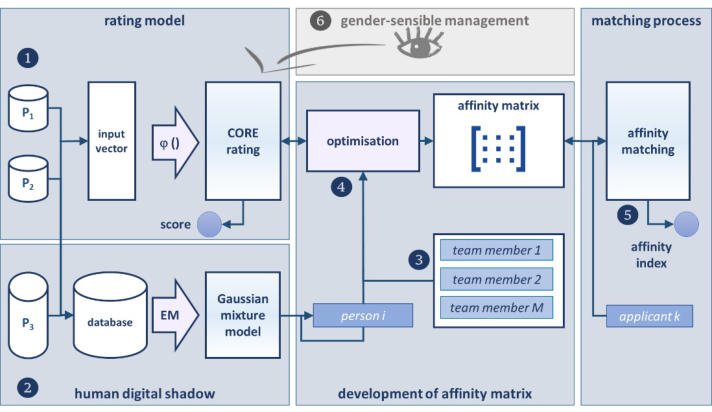
COOPERATION EVALUATION SYSTEM The key idea of applying a cooperation evaluation system was to implement the following use cases that have direct impact for human resources, in particular, for small and medium enterprises that would find an assisting tool very useful that empowers them to validate certain personality aspects in the job application process. The system sketch in Figure 1 is based on the requirement to enable to apply the following key use cases:
Figure 1: Schematic sketch of the cooperation evaluation system that includes typical use cases of human resources: evaluating potential cooperation using a learned function approximation ϕ() (1), understanding realistic human potential for application (2), considering an optimal complement (4) for a given team configuration (3). Finally, the differences between the profile of a real applicant and the optimal applicant’s profile are identified and weighed (5).
Evaluating the potential efficiency in the cooperation between two or more persons, potentially a team based on the archetypical experience of numerous previous co-operations. This would be implemented on a rating model Figure 1, “1”, top left box).
Receiving knowledge about the true potential of human resources. This uses a database of persons in application that was experienced
in known enterprises in the past. A human digital shadow model is developed from these experienced data samples that would determine a probability density function which itself weighs theoretically possible profile quantifications with a risk factor of how realistic it would be to find such a person in real life (Figure 1, “2”).
Searching for an optimal partner (Figure 1, “4”) for cooperation given the personality-based configuration of a given team (Figure 1,“3”). This optimal personality can me matched with the concretely applying persons. For a given team, the complementary partner would provide an optimal match in the resulting affinity matrix.
Identifying and weighing the differences between the profile of a real applicant and the optimal applicant’s profile.
COOPERATION RATING MODEL In this work we describe how the cooperation rating model is based on the evaluation of two profiles, i.e., a superior and its employee. This model maps two existing profiles to the output in terms of a “CORE” vector (see above) that describes the value of their cooperation. The CORE vector is determined from 4 aptitude characteristics. There exist two CORE vectors for each experienced cooperation, i.e., the estimation of the cooperation that was (i) defined by the opinion of the superior, as well as (ii) the opinion defined by the employee. The total score representing the resulting rating of the cooperation between the two persons was calculated in two alternative ways: (a) calculated using the mean of the two ratings of the 4 CORE features (“Mean”); (b) the results of a histogram cut of the 4 features were averaged from bilateral assessment (“HistDiff”).
The present dataset of profiles including aptitude represented a training data and test dataset for “supervised learning”; the evaluation was determined by cross-validation (Arlote & Celisse, 2010). For the development and the validation of the cooperation rating model, numerous machine learning models were applied (see Section “Experimental Results”).
MODELLING AND VALIDATION OF SYNTHETIC DATA For the modelling of the realistic human potential for application we developed a probability distribution with maximum likelihood on the limited dataset. Using this probability distribution, we will be able (i) to estimate the probability of any artificially generated data for being realistic, as well as (ii) to generate realistic synthetic data.
A simple and effective model to generate synthetic data from a limited set of data is the Gaussian Mixture Model (GMM; Reynolds, 2009). This model assumes that the data comes from a mixture of several Gaussian distributions and can be used to estimate the underlying distribution of the data. Once the model is fitted to existing data, one can sample new data points from the learned distribution. The Expectation-Maximization (EM; Dempster et al., 1977) algorithm was used to determine a Gaussian Mixture Model (GMM) as a probability distribution.
AI-Driven Team Matching 163
The Akaike information criterion (AIC; Akaike, 1974), which avoids overfitting, was used to evaluate the distribution quality.
OPTIMISATION AND AFFINITY MATRIX For the optimization of the evaluation based on an existing superior, the so-called “Warm Start Bayesian Optimization” was used, in which the optimization is initialized with existing data. The starting point was the CORE from the given superior and the highest rated real candidates.
The Sequential Model-Based Optimization (SMBO) method was then applied to stimulate the generation of “better” candidates. Single factor variation (One-at-a-Time, OAT) was then further applied so that individual characteristics were systematically changed.
EXPERIMENTAL RESULTS Database
The data of numerous collaborating teams in Vienna was collected via the web platform (QUAZR e-Tool). The Ethical Commission of the Medical University of Graz provided its vote for the data collection by EK Nr: 1035/2024. A total of 110 individual profiles (70 male, 40 female) were recorded: 29 superiors (20 male, 9 female) and 80 employees (46 male, 34 female), along with 83 evaluations by superiors and 83 evaluations by employees. Input for the evaluation function was derived from 26 “SACRED- CODE” items and 28 “PROGRAM” items. The resulting “CORE” output consisted of four major, distinct dimensions: “Communication,” “Execution,” “Relationship,” and “Empathy.”
Gender-Sensitive Data Management
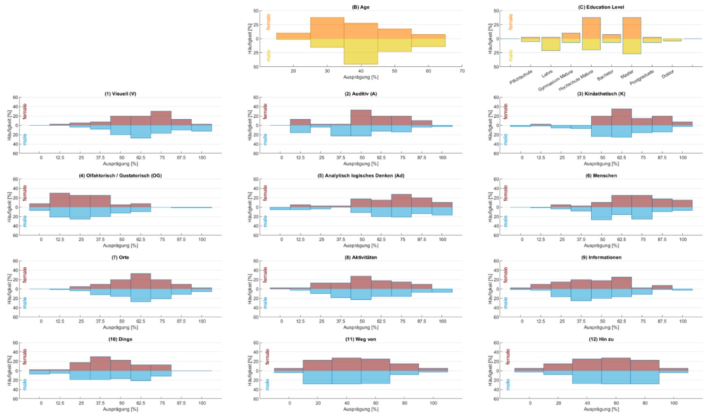
Figure 2 shows the data distribution with regard to “gender”. Women recruited for the survey (Figure 2; top side distributions) were younger than men (Figure 2; bottom side distributions), more educated, more visually and auditory oriented, women felt (Figure 2b) less cognitively oriented, less assertive, more disciplined, more sensitive, and less confident in making decisions. Other gender aspects could be investigated (e.g., “ethnicity”), but not enough data was available.
Fairness definitions have been linked to machine learning (Binns, 2018; Verma & Rubin, 2018): Equalized Odds (equal distribution of positive ratings), Statistical Parity (equal probabilities for positive ratings), Fairness Through Awareness (similar outcomes for similar individuals), etc. Test methods assess the degree of fairness; Aequitas (Saliero et al., 2018) tests models against fairness metrics for population groups.
Cooperation Rating Model The database of profiles that were associated with CORE outputs which themselves were integrated into CORE scores provided then the basis for the application of machine learning models.
Figure 2: Data distribution with regard to “gender” (sex).
A reduction of the input with originally 114 features (PROGRAM plus SACRED) to 42 features was carried out while maintaining 95% total variance by means of the principal component analysis.
Table 1 shows the results of the application of different machine learning- based cooperation rating models. The best method “ensemble of bagged trees” shows a mean absolute error of 1.14 points in the rating of the cooperation.
Table 1: Results of machine learning models for the cooperation rating function.
Table available in the original PDF paper.
Model Ranking RMSE MSE MAE Mean Std Mean Std Mean Std Mean Std
A bagged tree ensemble (Breiman, 1996) consists of several decision trees that have been trained independently of each other. Bagging reduces the variance; the aggregated decision is made by averaging (regression).
Due to its transparency, this method can be classified as eXplainable AI (Adadi & Berrada, 2018) and understood as a successful feasibility study.
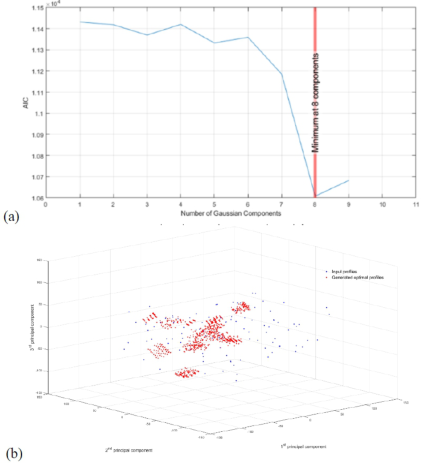
Learning the Probability Distribution The Expectation-Maximization (EM) algorithm was used to determine a Gaussian Mixture Model (GMM) as a probability distribution. The Akaike information criterion (AIC), which avoids overfitting, was used to evaluate the distribution quality. The convergence of the EM algorithm was achieved by mapping the profiles - using the PCA transformation on 10 dimensions - using the AIC criterion with k = 8 components (Figure 3a). A threshold (p2=1.0412e-21) was then developed based on the GMM to reject profile input data.
The function of the GMM distribution is now (i) to enable a threshold- based evaluation of “optimal” candidates and (ii) to generate synthetic data.
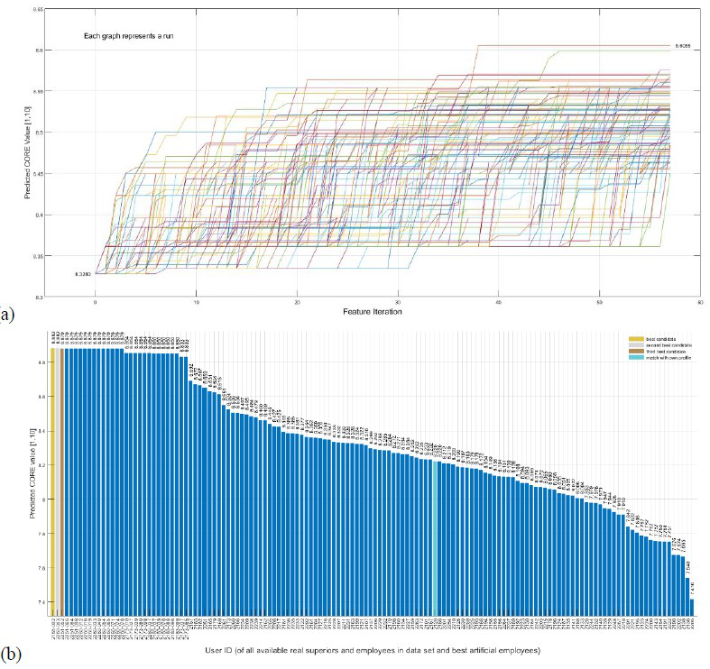
Optimization and Affinity Matrix Optimization was applied using the SBO procedure (see above). The starting point for the optimization process was the best-rated combination superior- employee from the database (rating ≈8.84). Value paths of numerous simulations from varied individual characteristics with the increased CORE values (rating) were then applied; the final optimized CORE score or rating value was in that case ≈9.18.
These in this manner simulated and therefore artificially generated data (Figure 5a) were further filtered to apply only those that could overcome a threshold value in the probability (pi> p2; Figure 5b).
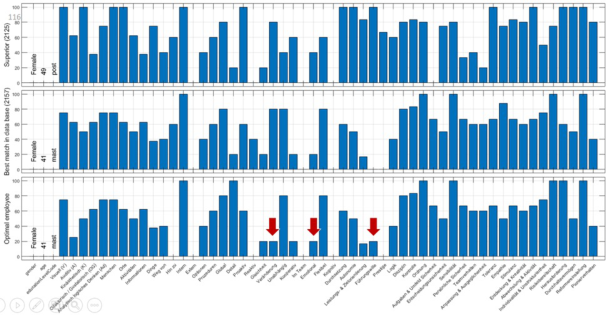
Figure 4 shows the case of a matching by comparing various profiles. Concretely, the personality profile in the individual characteristics of a female superior (top) is displayed with a comparison between (i) the best real
profile within the database (middle) and (ii) the optimized-simulated profile (bottom). Several features are marked (red arrows), i.e., the characteristics “change”, “emotional” and “will to lead” highlighting that a decrease in “change” together with an increase in the “will to lead” finally resulted in a higher rating score.
Figure 3: (a) Quality criterion AIC with minimum at k = 8 components. (b) Visualization of the feature space spanned by the 3 highest PCA-relevant features including the original input profile vectors (blue) as well as the generated optimized profiles (red).Figure 4: Comparison between the profiles of a female superior (top), a best guess of an existing person within the database (middle) and an optimized guess for highest possible cooperation rating (bottom) that surpassed the probability density threshold p2.
AI-Driven Team Matching 167
Figure 5: (a) The starting point for the optimization process was the best-rated combination superior-employee from the database. Value paths of numerous simulations from varied individual characteristics with the increased CORE values (rating) were then applied and resulted in a higher final CORE score. (b) Comparison between different predicted CORE values including those that could overcome a threshold value in the probability (bottom left; with pi> p2).
CONCLUSION AND FUTURE WORK This study introduced an AI-supported team-matching tool based on a novel personality profile, explainable machine learning, and fairness metrics. The approach achieved promising prediction accuracy using a bagged tree ensemble and synthetic data generation via Gaussian Mixture Models. Initial results support the system’s potential for improving collaboration and decision-making in HR processes.
Future work will focus on expanding the dataset, refining group-level matching beyond dyads, and integrating longitudinal feedback for adaptive optimization. Further validation in real-world organizational settings is planned to enhance the tool’s effectiveness and generalizability across diverse team structures.
ACKNOWLEDGMENT
This research was supported by the Austrian Research Promotion Agency (FFG) and the Austrian Federal Ministry for Climate Action, Environment, Energy, Mobility, Innovation and Technology (BMK) by project DigiPersTool (grant number FO999905836/50381995).
REFERENCES
Adadi, A., & Berrada, M. (2018). Peeking inside the black-box: A survey on explainable artificial intelligence (XAI). IEEE Access, 6, 52138–52160. Akaike, H. (1974). A new look at the statistical model identification. IEEE
Transactions on Automatic Control, 19(6), 716–723. https://doi.org/10.1109/ TAC.1974.1100705 Arlot, S., & Celisse, A. (2010). A survey of cross-validation procedures for model selection. Statistics Surveys, 4, 40–79. https://doi.org/10.1214/09-SS054 Binns, R. D. P. (2018). Fairness in machine learning: Lessons from political
philosophy. Journal of Machine Learning Research. Breiman, L. (1996). Bagging predictors. Machine Learning, 24(2), 123–140. doi: 10.1007/BF00058655 Damasio, A. R. (1994). Descartes’ Error: Emotion, Reason, and the Human Brain.
New York: G. P. Putnam. Daniel, C. (1973). One-at-a-Time Plans. Journal of the American Statistical Association, 68(342), 353–360. https://doi.org/10.1080/ 01621459.1973.10482433 Dempster, A. P., Laird, N. M., & Rubin, D. B. (1977). Maximum likelihood from incomplete data via the EM algorithm. Journal of the Royal Statistical Society: Series B (Methodological), 39(1), 1–38. https://doi.org/10.1111/j.2517– 6161.1977.tb01600.x Häusel, H.-G. (2009). Brain View – Warum Kunden kaufen. Freiburg: Haufe Verlag. Hutter, F., Hoos, H. H., & Leyton-Brown, K. (2011). Sequential Model-Based
Optimization for General Algorithm Configuration. In Proceedings of the 5th International Conference on Learning and Intelligent Optimization (LION 5) (pp. 507–523). Springer. https://doi.org/10.1007/978-3-642-25566-3_40 Kahneman, D. (2011). Thinking, Fast and Slow. New York: Farrar, Straus and Giroux. Matthias Poloczek, Jialei Wang, and Peter I. Frazier. 2016. Warm starting Bayesian
optimization. In Proceedings of the WSC ‘16. IEEE Press, 770–781. Panksepp, J. (1998). Affective Neuroscience: The Foundations of Human and Animal Emotions. Oxford University Press. Reynolds, D. A. (2009). Gaussian Mixture Models. Encyclopedia of Biometrics,
659–663. https://doi.org/10.1007/978-0-387-73003-5_196 Saleiro, P., Kuester, B., Stevens, A., Anisfeld, Ari., Hinkson, L., London, J., & Ghani, R. (2018). Aequitas: A Bias and Fairness Audit Toolkit. arXiv preprint arXiv:1811.05577. Verma, S., & Rubin, J. (2018). Fairness definitions explained. In 2018 IEEE/ACM
International Workshop on Software Fairness (FairWare). IEEE, 1–7.
LISTED IN THE AHFE DIGITAL BOOKSTORE CATALOGUE
Explore the complete digital volume
Cognitive Computing and Internet of Things
Read this individual research paper free through the original publisher, or explore the full digital proceedings book.
ISBN 978-1-964867-41-0
Explore this ISBN in the AHFE Bookstore ↗Listed in the July 2026 bookstore catalogue; search by ISBN to confirm current availability · Digital book purchase optional