Lucas Paletta, Sybille Reidl, Sarah Beranek, Robert Hartmann, Martin Sighart, Sebastian Mayer, Patricia Papic, Amir Dini, Martin Pszeida, Sandra Schuessler, Alfred Haeussl, Beatrix Koch, Hermine Fürli, Michael Schneeberger, Melanie Lenger, Silvia Russegger (2022). VR4care: Gender-sensitive Virtual Reality Technologies and Semantic Content Categories for Activation in Nursing Homes. In: Cognitive Computing and Internet of Things. AHFE Open Access, vol. 43, pp. 83–92. https://doi.org/10.54941/ahfe1001842
People living in long-term care facilities due to physical or mental impairments have few opportunities for self-determined activity. Virtual reality (VR) technologies offer a potential to expand individual experience through immersive presence in artificial environments, to activate mentally and to promote autonomy through the impact of self-efficacy. The overall goal of the Austrian project VR4Care was to research design basics for the development of a motivating, gender-sensitive, personalized and cost-effective VR technology to increase the activation and quality of life primarily of residents in inpatient long-term care. In the further development of VR for senior citizens, gender-specific differences were taken into account, such as gender-specific requirements for user interfaces, gender-specific preferences in interests with regard to content and different expectations of support when using the VR-based system.
Important factors for quality of life in old age include mental capacity, psych- ological and physiological health, mobility, housing and social participation (Boyle, 2015) . The move to a long-term care facility is a critical, often trau- matic life event for those affected, since in addition to the stresses already experienced, such as illness and loss events, the move to a new, unknown environment is accompanied by a great deal of emotional and physical stress. Due to the settlement to a nursing home, the elderly are forced to change their habits after an independent life at home and to adapt to the conditions of the facility. The reduction of one’s autonomy can have a greater impact on the mental health of residents than their physical limitations. Autonomy
is the strongest predictor of the absence of depression, and the perception of personal control correlates with long-term physical and emotional well- being. In order to maintain the quality of life of residents in long-term care facilities, it is relevant to move away from a deficit orientation in care tow- ards a focus on people’s positive resources. One way to support self-efficacy and apply positive reinforcement is to enable elderly to get activated through their own choice of video content.
Virtual reality (VR) represents a great potential for creating realistic, inte- ractive worlds of experience in which multisensory stimuli can be exploited for mental activation, for experiencing self-efficacy and for triggering positive emotions. VR supports the impression of physical presence (immersion), in a three-dimensional, potentially interactive environment (Benoit et al., 2015). The aim of the presented work that was developed within the Austrian natio- nal research project VR4Care was to research in the context of a motivating, gender-sensitive, personalized and cost-effective VR technology with the pur- pose to increase the activation and quality of life of residents in inpatient long-term care. With the help of VR glasses that are adapted to the needs of the elderly, people can visit places that would be very difficult or even impossible to access in reality. This experience can help to relieve stress and strengthen resilience, thereby also serving the caregivers and relatives.
We present results of an interactive VR prototype that can be controlled by a companion using an external control panel. The content of 360-degree videos provides excursions into the virtual environment to prevent loneliness and depression and giving residents of long-term care facilities the oppor- tunity to visit favorite places. We particularly investigated the acceptance of various semantic categories of VR content, such as, (i) highly persona- lized content, (ii) videos within a regional context, and (iii) content with interregional semantics. The results not only demonstrate indications for gender-specific differences within this target group concerning requirements and motivations, but also varying systematic preferences depending on the semantic content category. User-centered feedback was collected by qualita- tive interviews as well as by deriving descriptive and interference statistics about the user’s affective state before, within and after the VR session.
USER REQUIREMENT ANALYSIS To determine user requirements a qualitative study was performed in a rural Austrian nursing home to explore attitudes, knowledge, and expectations of its residents regarding the use of VR glasses for meaningful activities (Häussl et al., 2021). In this paper the results of female residents are presented as a first step. Results of all residents will be published in a future publication. In total 13 female nursing home residents participated in the study (five nurses, one dementia trainer and one occupational therapist). Focus groups (n = 3) and individual interviews (n = 5) were conducted. Characteristics of the sample were gathered by questionnaires. All interviews were audio-recorded, transcribed and organized with MAXQDA Pro Analytics software.
The results showed that most participants had no experiences with VR, but their attitudes were predominantly positive. In view of meaningful activities,
VR4care: Gender-Sensitive Virtual Reality Technologies and Semantic Content Categories 85
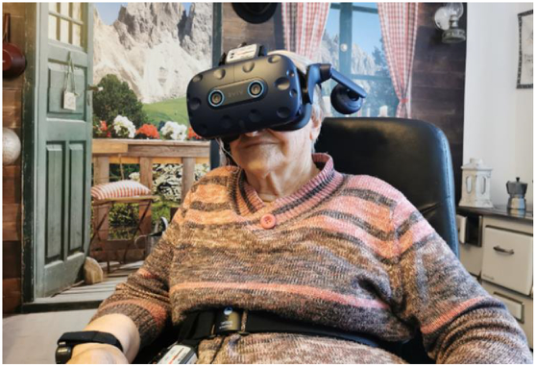
Figure 1: Resident of nursing home using the presented VR-based technology for activation.
participants described in the following nine categories their expectations for VR scenarios. In the category health and fitness they preferred swimming, cycling and running/jogging and in the category sports, skiing, tennis and bowling. Arts and crafts, singing, and drawing as well as painting were the most favoured activities in the category creativity. Household activities inclu- ded cooking and baking, making homemade beverages and gardening. Most popular activities that they would like to experience in VR outside the home area included walking and hiking, whereas reading, listening to music/radio and playing cards were among the most popular activities inside the home area. In the category social activities, nursing home residents were interested to have family visits and in the category education to read and watch docu- mentaries on TV. In the area of excursions, travel & entertainment, dancing, and travelling/holidays were described very frequently.
VIRTUAL REALITY-BASED ACTIVATION VR headset. After an analysis of the currently most popular VR headsets, the current devices of the company Facebook Technologies Ireland Limited (formerly Oculus VR Ireland Limited) were selected because they provide a mature developer platform and the headsets are characterized by their high user-friendliness. In order to have the greatest possible scope in terms of buil- ding the application, the VR headsets Oculus Rift S (desktop glasses, see Figure 1) and the Oculus Quest/Quest 2 were tested and compared.
VR content. 360° content was taken for single images with a digital camera on a panoramic head and then computed into a 360° x 180° panorama (orthographic projection). For 360° videos, recording was applied with 360° action cams (GoPro Fusion or Garmin Virb 360) as MP4 video. In the first prototype of the VR application for use in the care facility, both static 360° images and 360° videos were used. The used 360° images were integrated
into the application with a resolution of 8192 × 4096 pixels in order to ensure a VR-based experience that is as detailed as possible while at the same time offering good performance. The 360° videos used a resolution of 4096 × 2048 pixels in order to ensure smooth playback of the videos in the VR application. In each case, the optimal video codecs for the respective platform were used with regard to playback performance.
VR intervention prototype. In the first prototype, the images or videos were manually transferred into the application via a computer and then played back in the order of the file names. A preselection of videos/images was made available via a web platform and stored on a web server in the form of a configuration file. The application on the end device (mobile or PC-based VR headset) accesses this configuration file and plays the corresponding content in the configured order. The use of a VR application in a nursing or care facility requires a particularly simple operability by the care staff and at the same time the greatest possible comfort for the users (persons cared for), resulting in the requirements, as follows:
Simplest operability of the hardware.
Configuration and control by care personnel, as it is not guaranteed that the users themselves are able to do this.
Second screen to enable third parties to follow what the users are experi- encing at any time.
Use of a wireless VR headset to allow users the greatest possible freedom of movement without a cable becoming a hindrance/danger.
The strengths of a mobile VR headset (Oculus Quest, Gear VR) lie in the simplicity of the hardware (only the headset with the mobile app installed on it is needed) and the system-related absence of a connection cable to an external PC. However, these systems are designed for use by individual users (players). For this reason, the currently experienced VR experience cannot be viewed on an external screen and remote control of the application from outside is completely impossible.
This contrasts with a desktop application that simultaneously displays the image content on a VR headset connected by cable and on a conventional monitor and is controlled directly on the PC. The disadvantage of the external PC and the VR headset connected by cable is compensated by the possibility to follow the VR experience as an external observer and to control it from outside. For this reason, we decided to use this set-up for the tests of the product-related application as well.
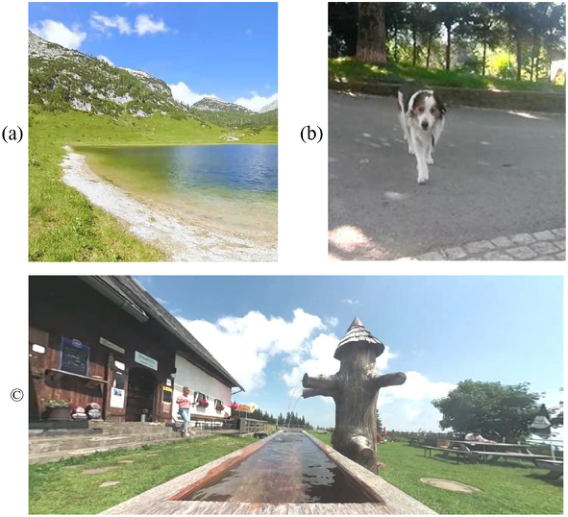
Semantic video content categories. The principal idea of clustering video content into semantic categories was motivated by the fact that the activation as well as the valence might be different for the users with respect to each par- ticular semantic reference. In order to test the affective impact of presenting different semantic categories of video content, we clustered the videos into three basic categories, i.e., of ‘regional’, ‘personalized’ and ‘global’ content (see Fehler! Verweisquelle konnte nicht gefunden werden.). We then evalua- ted the usability as well as the affective impact of the persons living at the nursing home within specifically targeted studies.
VR4care: Gender-Sensitive Virtual Reality Technologies and Semantic Content Categories 87
Figure 2: Typical samples of video content-based semantic categories (a) ‘global’ and (b) ‘personalized’ category. (c) ‘Regional’ category illustrated by a 360° video frame of the “Brendlalm”, a well-known alp-type hiking destination in the immediate vicinity.
Videos with regional content. Inhabitants of nursing homes sadly miss the typical environment of their daily activities. They are interested in watching their rural or urban landscape, their home, their working place, or typi- cal environments of leisure activities that they are not anymore capable to perform.
Videos with personalized content. In cooperation with the nursing home of Perisutti care centre, personalized videos were created for the participants. The videos reflect the interests of the participants and were created with a GoPro camera independently by the staff. For the video material, it was important to examine in advance which places and everyday situations are interesting for the respective persons. The videos should not have any nega- tive psychological effects on the participants. The finished videos were then edited by the company Netural. The videos were shortened to a maximum length of four minutes, which proved to be optimal for the target subjects in sub-studies of the project. In addition, the brightness and sharpness of the video material were adapted to the VR glasses. Since the videos were recorded with the GoPro camera, it was unavoidable that wind noise was very domi- nant in the audio. These disturbing noises were filtered so that they could be perceived as pleasant for the participants.
Videos with global content. Videos with content that does not have any obvious reference to regional or personalized aspects was classified as ‘global’ content category.
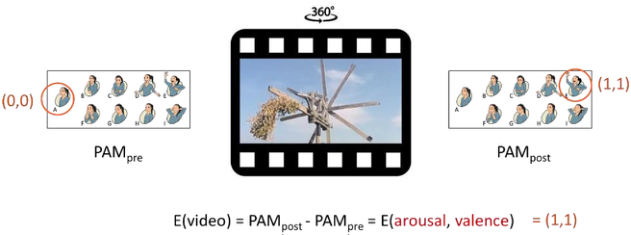
Figure 3: The mood state of a person was queried before and after each video presentation by means of Pick-A-Mood (PAM; Desmet et al., 2019) interaction.
MOOD ANALYTICS Measuring mood. Insight into mood is mandatory to understand how design can influence user behavior. People’s preferences are impacted by their momentary mood states (Maier et al., 2012). Well-being requires a positive mood balance (Morris, 1999), while a lasting disturbance of this balance is one of the main reasons for human ill-being (e.g., Peeters et al., 2006). The terms mood and emotion are often used interchangeably, however, they repre- sent different phenomena. Emotions are acute, and exist only for a relatively short period of time, usually seconds, minutes or hours at most. Contrary, moods are always present, they tend to have a relatively long-term nature, they can last for several hours or even for several days. This implies that our mood is the affective background state to what we do, whereas emo- tions are momentary ‘perturbations’ that are superimposed on this affective background. Furthermore, another substantial difference is that emotions are targeted while moods are global. Several mood questionnaires are available that obtain a reliable understanding of a respondent’s mood state. Question- naires are easy to administer and analyse, and can be used to measure subtle and nuanced mood patterns. Visual scales are promising because they are quick, easy, and (when properly validated) reliable. Several visual scales are available that measure basic dimensions of affect, the most famous of which is SAM (Lang, 1980), however, SAM is limited in that it requires considerable explanation before respondents can effectively report their feelings for each factor separately (Broekens and Brinkman, 2013).
Pick-A-Mood (PAM; Desmet et al., 2019) is a validated cartoon-based pictorial instrument for reporting and expressing moods. It measures eight distinct mood states in a quick and intuitive way, and can be used both for qualitative and quantitative research. Pick-A-Mood consists in principle of a female (Figure 3) and male cartoon character set, respectively. Each set of car- toon characters includes nine expressions that represent eight distinct mood states (and one neutral character). The sets are interchangeable; choice of character can be based on respondent demographics or on other pragmatic considerations. The PAM was applied in a specific research study in order to investigate the particular affective impact of the presentation of each video, and, in particular, in the context of the different semantic categories of the
VR4care: Gender-Sensitive Virtual Reality Technologies and Semantic Content Categories 89
video content. For this purpose, PAM queries were applied before and after each video presentation and the effect of the video E(·) was computed based on the differences in both arousal and valence (see Figure 3).
EXPERIMENTAL RESULTS Study design. The evaluation of the VR-based application was a two-stage process: In a first step (September/October 2020), the technically implemen- ted VR-based scenarios were tested at the Perisutti nursing home in Eibiswald with 20 test persons (50% male, 50% female). The aim of this test was to find out how the images and 360° video clips would be received by the residents and which content-related and technical improvements or further developments would become necessary. Residents were observed viewing VR scenarios and then a guided qualitative interview was conducted. By means of a simulation sickness questionnaire, it was tested whether the VR application had an effect on the physical condition of the test persons. After this initial evaluation, the technology remained in the nursing home and was made avai- lable to the test subjects for four weeks for further use. This use was supported and documented by the Perisutti staff. In a second step (June 2021), the tech- nically further developed prototype VR application was tested in the same nursing home with 5 caregivers and 5 relatives for its handling (usability).
The aim of this evaluation was to find out how well caregivers and rela- tives can handle the app and to what extent it should be adapted to their needs. For the usability test, each relative or carer applied the VR app toge- ther with a resident and completed various tasks. They were observed and then a qualitative interview was conducted with the relatives and caregivers. All qualitative observation and interview data were content-analysed using MAXQDA software. In the data analysis, emphasis was placed on gender- and diversity-relevant aspects in order to make the technology and its content suitable for all.
Results of the evaluation with residents. Although most of the test persons had no experience with virtual reality technology, they tended to be open- minded towards the technology and accepted it very positively. Through VR technology, they experienced variety in everyday life, distraction and curio- sity. Men, however, expressed a greater interest in the technology and also a willingness to use it again. Many test persons, especially women, were initi- ally hesitant to turn around with VR glasses and try out the 360° perspective, which suggests a slight uncertainty. Almost all of the test persons said they had the feeling of being in the place shown: ‘It’s like being in the middle of it. It’s a live experience.’ Especially those scenarios seemed ‘real’ where people in motion appeared in the scene. Familiar places also contributed to a stron- ger sense of presence and audio experiences evoked clear (partly emotional) reactions (e.g. laughing at cowbells, singing along, wind) and can thus be evaluated as a presence factor. In general, videos are preferred over photos, as they are more true to nature and thus also seem more impressive: ‘When it moves a bit and everything, it’s already something different’.
Dizziness or fears were rather the exception during the tests. If anxiety occurred, it was expressed in all test persons by the feeling of slipping or
falling down. Dizziness occurred when the camera moved too fast or shook or when turning around/looking down. This was especially true for wheelchair users. In addition to the image content, the cinematic realisation of the videos therefore turned out to be a central evaluation criterion, especially in order to reduce dizziness and insecurity.
From the interviews with the test persons, clear instructions for the cine- matic realisation could be gained regarding perspective (distance to objects, slopes, water and people), height of camera position, ground (stable ground should be visible) and speed of movement. The evaluation of the image con- tent shows that test persons are mainly interested in scenarios with reference to nature and home, as well as scenarios with moderate movement (such as a walk in the woods) and audio (such as dancing, singing). In general, the combination of scenarios that offered variety on the one hand, but on the other hand also showed familiar things and places, was very well received by both women and men. Scenarios on cooking and sports (running, cycling) were chosen least often by both sexes – presumably because the latter trigger dizziness and insecurity due to a lot of movement. Overall, it was found that subjects with higher education selected different scenarios more often than subjects with lower education. Most test persons would like to see an expan- sion of the range of scenarios: ‘It’s nice to have variety’. When asked what other content they would like to see, they mainly mentioned places and activi- ties nearby that evoke memories, activities in nature and holiday destinations. The gender differences were small – women mentioned personalised content such as family slightly more often, men named nature and foreign places sli- ghtly more often. However, it was noticeable that women – regardless of their educational background – displayed greater uncertainty, excessive demands or even a negative attitude when asked about their wishes.
Results of the usability tests with caregivers and relatives. In general, the handling was feasible for all test persons, however, some persons needed support through instructions and explanations. No one had any major diffi- culties in using the prototype VR application. The female test persons coped with the application similarly well as the male test persons, some even better. However, this could also be due to the fact that more male test persons were older relatives with less computer experience. In the usability study, older test subjects tended to need more help than younger test subjects and younger test subjects found a solution more quickly on their own. Computer use in general decreases with age and older test subjects tend to be less accustomed to using a computer. The usability test identified some areas for improvement in the VR app, especially with regard to the size of buttons, the designation of menu items, the recognisability of symbols and menu navigation when creating and saving playlists. Overall, relatives could be supported by a printed checklist or a manual with screenshots of the individual steps and explanations.
Results on mood-based measurements. In an additional research study, N = 7 inhabitants of the Perisutti nursing home (57.1 % female; with M = 83.0, S = 5.3 years of age; MoCA cognitive assessment M = 19.0, S = 7.3 score) were voluntarily participating in a VR-based session with 6 videos (with 2 personalized, 2 regional and 2 global category-type videos),
VR4care: Gender-Sensitive Virtual Reality Technologies and Semantic Content Categories 91
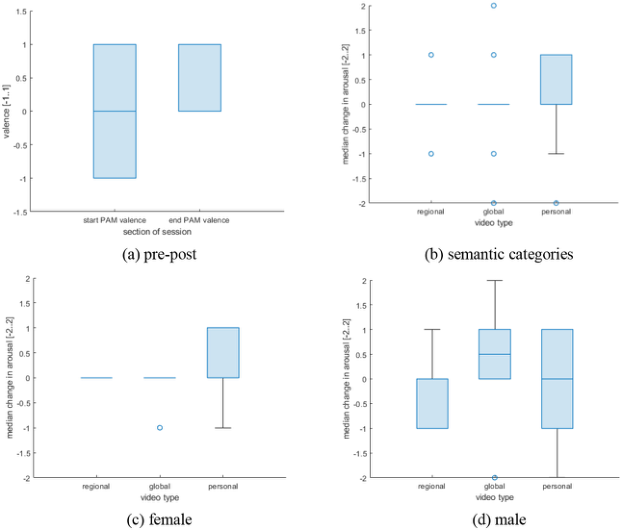
Figure 4: The impact in the mood state by presented video was investigated in detail. The results indicate (a) an overall intervention-based positive change in valence, (b) an activating effect by personalized videos, and gender differences in the semantic category-specific activation in (c) female and (d) male study participants.
each one was presented for 2 minutes. Before and after each video we pre- sented a PAM query (20 seconds duration) and a centered black cross (8 seconds duration). The impact in the mood state applied by the presentation of individual videos was investigated in detail (Figure 4). The results indicate (a) an overall intervention-based positive change in valence, (b) an activa- ting effect by personalized videos, and gender differences in the semantic category-specific activation in (c) female and (d) male study participants.
CONCLUSION
The VR4Care project investigated the acceptance of activating VR-based content, gender-sensitivity, and preference of semantic categories. The expe- rimental results confirm that these aspects are relevant for design and usability.
ACKNOWLEDGMENT
This work was partly funded from project VR4Care under grant No 873757 (FFG femtech programme) and from project AI-Refit under grant No FO999887487 (FFG ICT of the Future programme), both co-financed by the Austrian Federal Ministry for Climate Action, Environment, Energy, Mobility, Innovation and Technology (BMK).
REFERENCES
Benoit, M., Guerchouche, R., Petit, P.-D., Chapoulie, E., Manera, V., Chaurasia, G., Robert, P. (2015). “Is it possible to use highly realistic virtual reality in the elderly? A feasibility study with image-based rendering”, Neuropsychiatric Disease and Treatment, 11, 557–563. Boyle, G. (2015). “Autonomy in Long-term Care: A Need, a Right or a Luxury?”,
Disability & Society, 23, 4 (2008): pp. 299–310. Web. September 10, 2015. Broekens, J. and Brinkman, W.P. (2013). “Affect button: a method for reliable and valid affective self-report”, International Journal of Human-Computer Studies, Vol. 71, No. 6, 641–667. Desmet, P.M.A., Vastenburg, M.H., & Romero, N. (2016). “Mood measurement
with Pick-A-Mood: review of current methods and design of a pictorial self-report scale”, J. Design Research, Vol. 14, No. 3, 241–279. Desmet, P.M.A., Vastenburg, M.H., & Romero, N. (2019). “Pick-A-Mood user manual: Pictorial self-report scale for measuring mood states”, Delft, NL: Delft University of Technology, ISBN: 978-94-6384-061–3. Häussl, A., Schuessler, S., Paletta, L., Fuerli, H., Koch, B., Binder, T., Schneeber-
ger, M., Andreu, J.-P., Reidl, S., Beranek, S., Hartmann, R., Sighart, M. (2021). “Requirements Analysis on Emotional Preferences for Leisure Activities in Virtual Reality for Female Nursing Home Residents – A Mixed Method Approach”, in Ayaz H., Asgher, U., Paletta, L., eds., Advances in Neuroergonomics and Cognitive Engineering, Springer Nature. Maier, E., Wilken, R., Schneider, H. and Schneider, G.K. (2012). “In the mood to buy? Understanding the interplay of mood regulation and congruence in an international context”, Marketing Letters, Vol. 23, No. 4, 1005–1018. Morris, W.N. (1999). “The mood system”, in Kahneman, D. and Diener, E., eds.,
Well-Being: The Foundations of Hedonic Psychology, 169–189, Russell Sage Foundation, New York. Peeters, F., Berkhof, J., Delespaul, P., Rottenberg, J. and Nicolson, N.A. (2006).
“Diurnal mood variation in major depressive disorder”, Emotion, Vol. 6, No. 3, 383–391.
LISTED IN THE AHFE DIGITAL BOOKSTORE CATALOGUE
Explore the complete digital volume
Cognitive Computing and Internet of Things
Read this individual research paper free through the original publisher, or explore the full digital proceedings book.
ISBN 978-1-958651-19-3
Explore this ISBN in the AHFE Bookstore ↗Listed in the July 2026 bookstore catalogue; search by ISBN to confirm current availability · Digital book purchase optional