Julia Zuschnegg, Sandra Schuessler, Lucas Paletta, Silvia Russegger, Maria Fellner, Karin Ploder, Bernhard Strobl, Maja Sekulic, Marisa Koini, Maria M Hofmarcher Holzhacker, Regina Roller Wirnsberger (2022). Usability Evaluation after a 6-month Tablet-based Dementia Training Program by People with Alzheimer’s Disease, Relatives, and Dementia Trainers. In: Cognitive Computing and Internet of Things. AHFE Open Access, vol. 43, pp. 102–110. https://doi.org/10.54941/ahfe1001844
Non-pharmacological interventions, like tablet-based cognitive trainings, already present an important alternative treatment of dementia. For tablet-based cognitive trainings to be effective, regular practice seems to be required, highlighting the need for such trainings to be applicable not only in well-prepared laboratory settings, but also for continuous use at home. In order to raise the acceptance as well as the user-friendliness of such trainings to consequently increase training intensity, usability research is essential. Therefore, the aim of this study was to explore the experiences of people with Alzheimer’s disease (PwAD), relatives, and dementia trainers regarding the usability of a tablet-based dementia training practiced in the home setting.A qualitative study was performed within the ongoing randomized controlled trial of the project multimodAAL. In total 15 individual interviews (each 5 per target group) were conducted with people with mild AD, their relatives and dementia trainers, who were already assigned to the intervention group for at least 6 months, practicing a dementia training program, including physical and cognitive exercises on a tablet-PC at home. The interviews lasted 91.9 minutes on average. A qualitative content analysis was performed to analyze the data.Participants were predominantly female (73.3 %). PwAD and relatives stated that they had no previous experience with this type of computer-based cognitive training and had experienced the training as positive and enriching. Some relatives saw the joint performance as a meaningful activity with their loved ones. Participants confirmed that the different types of physical exercises (e.g., coordination, strength), presented in a video format were well feasible for PwAD. In this regard, some PwAD reported feeling a bit unchallenged. Relatives and dementia trainers recommended for the exercise videos to be more motivating and fun (e.g., direct motivational address by the gymnast in the video like in a tv show, colorful sportswear). Regarding cognitive exercises, participants appreciated the variety (e.g., quiz, puzzle, calculating) as well as the sequence of the different exercises within a training session. Dementia trainers and relatives perceived that exercises related to topics about past/biography (e.g., previous occupation, hobbies) and to religious/seasonal traditions (e.g., Christmas) were particularly appreciated among PwAD. In view of beneficial factors to complete a training session with its physical and cognitive exercises successfully, relatives and dementia trainers underlined that PwAD needed support in terms of (technical) guidance, motivation/feedback/praise, as well as hints/tips/thought-provoking impulses. Dementia trainers and relatives suggested that this could be achieved by a supporting person (e.g., dementia trainer) or an expansion of the program by written and verbal support (e.g., hint button, voice assistant). Furthermore, participants emphasized the need of a tablet pen for comfortable handling, as well as a high sensitivity of the tablet-PC's touch screen.The results show that the already applied tablet-based dementia training is well received and accepted by participants. However, there is still potential for enhancement regarding motivational and feedback strategies as well as user-friendliness by the addition of a comprehensive application for guiding through the physical and cognitive exercises to enable more independent practice sessions.
Non-pharmacological interventions, like tablet-based cognitive trainings, already present an important intervention for dementia (Holthe et al., 2018). For tablet-based cognitive trainings to be effective, regular practice seems mandatory (Bahar-Fuchs et al., 2019), highlighting the need for sustainable implementation of those trainings in community-dwelling settings. In order to raise the acceptance as well as the user-friendliness of such trainings
Usability Evaluation After a 6-Month Tablet-Based Dementia Training Program 103
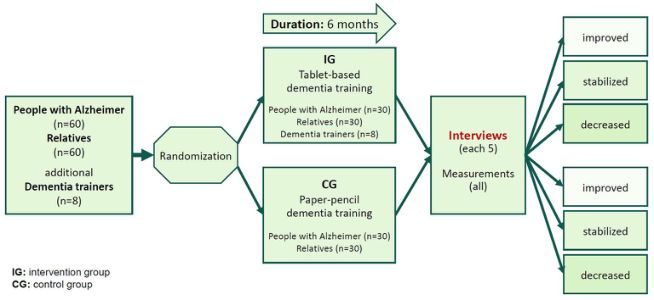
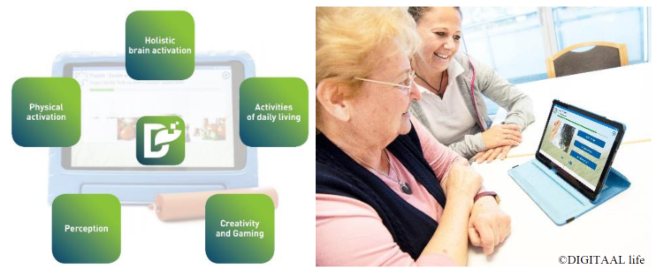
Figure 1: Design and study set-up of the RCT.Figure 2: Tablet-based dementia training program (DIGITAAL life app).
to consequently increase training intensity, usability research is essential (Contreras-Somoza et al., 2021).
It was the aim of this study to explore the experiences of people with Alzh- eimer’s disease (PwAD), relatives, and dementia trainers with tablet-based dementia training practiced in the home care setting.
METHODS
Study Desing and Recruitment of Participants This qualitative descriptive study was performed as integral part of an ongoing randomized controlled trial (RCT) (see Figure 1), with the ove- rall aim to investigate the effects of a tablet-based training program in community-dwelling PwAD (Project MultimodAAL; ClinicalTrials.gov Iden- tifier: NCT04628702).
Participants were offered a tablet-based dementia training at home (DIGI- TAAL life app, https://digitaal.life/en/our-offer/) with free schedules of trai- ning in the intervention group (Figure 2). Additionally, participants were visited by dementia trainers (hereafter called trainers) on a weekly basis for a joint, supervised training session. Each session with the app has a
specific theme (e.g., water) starting off with three video-based physical exe- rcises, followed by cognitive exercises. Each theme has 4 different levels of challenge. The methodology is based on a holistic training according to 5 pillars (cognition, movement, perception, activities of daily living, games and creativity.
Nested within this RCT, complementary qualitative research was condu- cted with the aim, to evaluate the usability and user-friendliness of the applied tablet-based dementia training program in users themselves, relatives as well as trainers involved in the intervention group of the trial (see Figure 1).
Recruitment of participants was performed during face-to-face contacts with PwAD and/or relatives during the supported trainings, or by telephone by a clinical psychologist. Prior purposive sampling of possible participants for the qualitative study part was performed upon expression of interest to participate as well as the cognitive capacity of PwAD to perform a 50–60-minute interview. For relatives and trainers, a 1-2-hour interview was foreseen. Ethical approval had been obtained from the Ethics Committee of the Medical University of Graz (31-566 ex 18/19). Written informed consent was collected from all study participants.
Development and Running of Interviews The qualitative study part was performed from December 2020 to December 2021. Therefore, the current ongoing pandemic of SARS-Cov-2 impacted the study design and study framework (see figure 1). Supportive study visits for the table-based training sessions could be continued under strict SARS-Cov-2 contingency measures, vaccination already available for study participants, relatives, and health care professionals during this period in Austria. Intervi- ews with the PwAD were held face to face at their home by the psychologist, who also had been supporting the tablet-based trainings. Relatives and trai- ners were interviewed by a nursing scientist via telephone or online meetings additionally to reduce contact during the pandemic.
Based upon literature (Hill et al., 2015; Moumane, Idri, and Abran, 2016; Nouri et al., 2018) and expert knowledge of the research team a semi- structured interview guide was developed. Following domains were included into the interview guide: general experiences with the tablet-based demen- tia training, motivation for practicing with the tablet-PC, physical exercises, cognitive exercises, facilitators and barriers for successful completion trai- ning sessions, technical considerations, and supportive needs. Interviews were audio-recorded with permission of participants and lasted 107.0 minutes on average (range of 70-170 minutes) for relatives and trainers and for PwAD 61.6 minutes on average (range of 40-95 minutes).
Data Analysis The audio-recorded interviews were transcribed, and a qualitative content analysis was performed according to Schreier (2012). A concept-driven coding frame with main and subcategories, based on the interview guide, was developed. Data-driven subcategories were then created based on the tran- scripts of interviews. To ensure internal reliability of the coding frame, for
Usability Evaluation After a 6-Month Tablet-Based Dementia Training Program 105
the analysis remaining stable over time, the first author categorized and che- cked the transcripts on two different time points (Schreier, 2012). Finally, the main and subcategories were summarized, interpreted, and discussed within the research team. The software MAXQDA 2020 Pro Analytics was used for data analysis.
RESULTS
Sample Characteristics In total, 15 individuals (each 5 PwAD, relatives and trainers) agreed to par- ticipate in a semi-structured interview. PwAD were predominantly women (n = 4), with an average age of 73.4±11.4 years and a Mini Mental State Examination (MMSE) mean score of 23.4±4.3 points. Three of the five rela- tives were female and the average age for the relatives was 66.2±10.7 years. In total four of five trainers were women, and their age was 43.1±10.4 years on average.
Results of the Interviews The results describe participants’ experiences on the usability of the tablet- based dementia training practiced by PwAD at home, according to six categories.
General Experiences with the Tablet-based Dementia Training. Results showed, that despite missing previous experience with tablet-based dementia trainings, interventions were collectively appreciated. Relatives experienced joint practicing as a “meaningful activity”, however pointed out the wealth of the weekly visits by trainers, as they provided a short-time relief of the care giving.
Participants themselves would recommend the tablet-based dementia trai- ning program to others affected, and some trainers stated that this trai- ning program should also be offered earlier in life even as a preventive intervention.
Motivation for practicing with the Tablet-PC. Some PwAD expressed their motivation for the training as doing “meaningful”, with the hope to benefit in terms of cognitive performance, aiming at an independent life as long as possible. In some cases, the relatives were the driving force for participa- tion in the tablet-based training. One relative stated that she hoped for a better quality of life for her loved one due to the tablet-based dementia trai- ning, aligned with answers collected from participants themselves. Trainers emphasized that such motivated relatives made a significant contribution to a regular performance of the training, as they were integrating the training more likely into the daily routine of the PwAD.
Furthermore, trainers as well as relatives high-lightened the impact of the social interaction and conversations during the joint training sessions with study participants. Another learning of interviews with trainers touched upon tailored timing necessary to keep up motivation of PWAD patients using the tablet trainings and taking into consideration day to day variations of indivi- dual capacities and motivation to actively participate in the training sessions.
This “social aspect” related to the motivation of PwAD practicing the trai- ning was also noticed by relatives. Clear recommendations to include the family (e.g., grandchildren) into private training sessions through a game competition by adding additional people in the program was recommended.
Physical Exercises. Participants confirmed that the different types of physi- cal exercises (e.g., coordination, strength), presented in a video format were well fit for PwAD. In this regard, some PwAD wished for more “action” for physical exercises. Relatives and trainers expressed their wish for more diverse exercise videos (e.g., other types of exercises, motivating and fun e.g., including direct motivational address by the gymnast in the video like in a tv show, colorful sportswear).
In contrast, relatives and trainers were hesitant that PwAD were able to follow written as well as the verbal instructions in the videos to practice on their own (i.e., assume correct position, prepare utensils, start video, and perform the exercise). Repetitively, the asset of direct social support, either by relatives and/or professional trainers was highlighted by both of these groups. Additionally, trainers argued for the positive impact of videos with verbal and pictorial instructions leading the PwAD step by step, at an appropriate pace through the physical exercise(s).
Cognitive Exercises. Participants appreciated the variety of the different cognitive exercise types (e.g., quiz, puzzle, calculating) as well as their sequ- ence within a training session. The variety of exercise themes (e.g., animals, vegetables, sports) was also positively highlighted. In this regard, trainers and relatives recognized that PwAD particularly enjoyed themes of their past/biography (e.g., hobbies, previous occupation) and to religious/seasonal traditions (e.g., Easter, Christmas).
Most participants expressed their issues about the unaffordable challenge related to use images in cognitive exercises such as puzzles, memory game, and spot-the-difference puzzle, due to vision impairments. Images for these exercises should be very colorful and with a high color contrast so that clea- rer/coarser structures are recognizable. Pictures with a lot of details, such as a spacious flower meadow, should be avoided.
The range of challenge levels from level 1 (easiest one) to level 4 (most difficult) was appreciated by the participants. Relatives and trainers agreed that the levels of challenge should not be pre-determined for training sessions rather than chosen individually for the specific cognitive excercises to be more responsive of PwAD’ individual day to day capacities.
Facilitators and Barriers for successful Completion Training Sessions. Adh- erence to exercises may be impacted positively introducing (technical) gui- dance/instruction, motivation/feedback/praise, as well as hints/tips/thought- provoking impulses, as otherwise PwAD tend to stop the training early out of frustration. Trainers and relatives suggested additional written and verbal support (e.g., hint buttons, voice assistant) to be included into training offers to overcome frustration during trainings.
One PwAD mentioned herself, that the weekly visits of trainers as a bene- ficial factor, in terms that the presence of the trainer leads to more ambition and perseverance to complete a training session, instead of practicing it alone.
Usability Evaluation After a 6-Month Tablet-Based Dementia Training Program 107
An incorrect training approach of relatives at joint training session may contribute to patients’ frustration and impatience of both parties involved in the joint training. Trainers recommended to develop a manual for relatives with tips/hints for supervising a tablet-based dementia training (e.g., avoiding right/false-principle) as well as providing information about an appropriate training environment (e.g., avoiding incidence of (sun)-light on the screen, recommended position of the tablet-PC, calm environment, clean glasses), and proper handling with the tablet-PC itself (e.g., changing screen brigh- tness). Information about the training environment should be programmed and shown as pop-ups at the beginning of the training.
Technical Considerations and Supportive Needs. Participants emphasized the need of a tablet pen, especially with soft touch, for comfortable handling, as well as a high sensitivity of the tablet-PC’s touch screen. The screen size of the applied tablet-PC was considered adequate by most participants, but some also stated that it should not be smaller and that if available a larger screen would be preferred.
It was recommended by all three target groups that the first training session should be held in a timely open timeframe, allowing a smooth introduction, especially of the technical features to patients as well as relatives. The need for continuous technical support available to users may be crucial to maintain adherence to any technically based intervention program.
DISCUSSION
The work presented in this conference paper provides fundamental insights in the usability of a tablet-based training program delivered during a RCT for patients suffering from manifest AD with an average MMSE score of 23.4±4.3 points and older than 70 years. The data we present are based upon a qualitative research approach, gathering feedback from study par- ticipants themselves, relatives involved in the training programs as well as trainers supporting the use and uptake of the technical solutions. This appro- ach adds crucial evidence to existing literature, as most data published have been based on quantitative data tracking activities during trainings, questi- onnaires, and others (Adcock et al., 2020; Contreras-Somoza et al., 2021; Parry et al., 2021). We deliver data including subjective criteria impacting the usability of an information technology (IT) based training system, allo- wing a better understanding, how devices and design of trainings have to be modified to increase acceptance of such IT based training interventions, also in people of advanced age.
There seem to be three pillars to consider when designing tablet-based trai- nings for patients suffering from mild AD and living at home. The technical set-up of the devices used, the design and level of challenge used for the trai- ning sessions and, finally, the “social interaction” to be considered for the training framework, already in mild stages of AD.
Our data highlight that the technical equipment needs to be adapted to user’s individual needs considering visual and hearing capacity as well as comfortable handling including the use of soft pens, and highly sensitive touch screens. Several groups have pointed out the need for a person-centered
technical design of devices, especially when it comes to people with cognitive deficits (Pappada et al., 2021; Zhang and Chignell, 2020), to facilitate the use of tablet devices. However, our qualitative research approach allowed a detailed and deeper understanding on technical modifications helping to overcome barriers to the use of IT devices by people with cognitive deficits. Furthermore, it was able to get an insight on the need of program design and audiovisual needs of our study participants (Adcock et al., 2020; Parry et al., 2021). It seems likely, that written and bespoken information builds barriers to many participants and that a clear and colorful design of graphically based information facilitates adherence of AD patients. This information strength- ens previous evidence suggesting a technical device must address a person’s “felt need” in order to be perceived as useful (McCreadie and Tinker, 2005).
The most powerful learning from the study is, for sure the 360° degrees feedback we were able to collect according to the study design and meth- odology used. We involved patients, relatives and professional trainers in our analysis, allowing a very comprehensive analysis of different views and opinions on the usability of an IT based training system. There seemed to be common sense from all parties involved, that independent from technical offers, social interaction is crucial to allow smooth usability of a system and to keep adherence for continuous trainings. It could be shown that personal relationship between patients and relatives is key facilitator and/or barrier for IT-systems as is the role of professional trainers. Several studies have high lightened the impact of social relations since, however, our study for the first time allows deeper insight on specific psychosocial domains affected in AD patients when using tablet- based trainings including support from people (Adcock et al., 2020; Parry et al., 2021) close to them as well as incoming professionals. The later ones may help to distract social barriers due to their professional capacities, thereby increasing the individual power of endurance to finish the training session and to overcome frustration. Interestingly, posi- tive attitude coming from relatives also had an overall positive impact on the usability of the trainings for patients. These findings sum up nicely with the fact, that un-anonymously all participants claimed for a personalized trai- ning approach for every patient per se, as well as every single training session due to the day-to-day individual condition and capacity of AD patients. This has been hypothesized in literature elsewhere (Adcock et al, 2020; Imbeault et al., 2018; Pappada et al.; 2021; Zhang and Chignell, 2020), however, our data for the first time allow insights from three different groups of study participants all equally in line with this information.
CONCLUSION
Our results demonstrate that a tablet-based dementia training is overall well received and accepted by PwAD and their relatives. We were able to pre- sent new insights into technical and design features enabling usability of such trainings for patients suffering from AD. A more detailed analysis of the psychosocial components influencing the uptake and acceptance of such IT based trainings was offered due to our work. Nevertheless, there are questi- ons open for future research such as the impact of generational histories and
Usability Evaluation After a 6-Month Tablet-Based Dementia Training Program 109
capacities towards new technologies as well as possible benefit of IT based interventions at very early stages of subjective cognitive decline. Future rese- arch is needed to open up also for study settings including evidence-based motivational and feedback strategies as well as clarifying the impact of gen- der and cultural background on the user-friendliness for IT based trainings targeting cognitive performance of older people.
ACKNOWLEDGEMENT
We wish to thank all the participants who took part in the interviews.
CONFLICT OF INTEREST No potential conflict of interest was reported by the authors.
FUNDING SOURCES This research was supported by the Austrian Research Promotion Agency [FFG] and the Austrian Ministry for Transport, Innovation and Technology [BMVIT] by project MultimodAAL [grant number 875345].
REFERENCES
Adcock, M., Sonder, F., Schättin, A., Gennaro, F. and de Bruin, E. D. (2020). A usability study of a multicomponent video game-based training for older adults. European Review of Aging and Physical Activity, 17(3), 1–15. Bahar-Fuchs, A., Martyr, A., Goh, A. M. Y., Sabates, J., and Clare, L. (2019). Cogni-
tive training for people with mild to moderate dementia. Cochrane Database of Systematic Reviews, 3, 1–448 (2019). Contreras-Somoza, C. L. M., Irazoki, E., Toribio-Guzmán, J. M., Torre-Díez, I., Diaz- Baquero, A. A., Parra-Vidales, E., Perea-Bartolomé, M. V. and Franco-Martín, M. A. (2021). Usability and User Experience of Cognitive Intervention Technolo- gies for Elderly People with MCI or Dementia: A Systematic Review. Frontiers in Psychology, 12. Hill, N.L., Mogle, J., Colancecco, E., Dick, R., Hannan, J. and Lin, F.V. (2015). Fea-
sibility Study of an Attention Training Application for Older Adults. International Journal of Older People Nursing, 10(3), 241–249. Holthe, T., Halvorsrud, L., Karterud, D., Hoel, K.A., and Lund, A. (2018). Usability and acceptability of technology for community-dwelling older adults with mild cognitive impairment and dementia: a systematic literature review. Clinical Interventions in Aging, 13, 863–886. Imbeault, H., Langlois, F., Bocti, C., Gagnon, L. and Bier, N (2018). Can people with
Alzheimer’s disease improve their day-to-day functioning with a tablet computer? Neuropsychological Rehabilitation, 28(5), 779–796. McCreadie, C. and Tinker, A. (2005). The Acceptability of Assistive Technology to Older People. Ageing & Society, 25(1), 91–110. Moumane, K., Idri, A. and Abran, A. (2016). Usability Evaluation of Mobil
Applications using ISO 9241 and ISO 25062 Standards. Springer Plus, 5(548). Nouri, R., Niakan Kalhori, S.R., Ghazisaeedi, M., Marchand, G. and Yasini, M.
(2018). Criteria for assessing the Quality of mHealth Apps: A Systematic Review. Journal of the American Medical Informatics Association, 25(8), 1089–1098.
Schreier, M. (2012). Qualitative Content Analysis in Practice. Sage Publications Ltd., London. Pappada, A., Chattat, R., Chirico, I., Valente, M. and Ottoboni, G. (2021). Assistive
Technologies in Dementia Care: An Updated Analysis of the Literature. Frontiers in Psychology, 12. Parry, D. A., Davidson, B. I., Sewall, C. J. R., Fisher, J. T., Mieczkowski, H. and Quintana, D. S (2021). A systematic review and meta-analysis of discrepancies between logged and self-reported digital media use. Nature Human Behaviour, 5, 1535–1547. Zhang, B. Y. and Chignell, M. (2020). A Person-Centered Design Framework for
Serious Games for Dementia. Proceedings of the Human Factors and Ergonomics Society Annual Meeting, 64, 18–22.
LISTED IN THE AHFE DIGITAL BOOKSTORE CATALOGUE
Explore the complete digital volume
Cognitive Computing and Internet of Things
Read this individual research paper free through the original publisher, or explore the full digital proceedings book.
ISBN 978-1-958651-19-3
Explore this ISBN in the AHFE Bookstore ↗Listed in the July 2026 bookstore catalogue; search by ISBN to confirm current availability · Digital book purchase optional