Verena Wagner-Hartl, Ramona Schmid, Katharina Gleichauf (2022). The influence of task complexity on acceptance and trust in human-robot interaction - gender and age differences. In: Cognitive Computing and Internet of Things. AHFE Open Access, vol. 43, pp. 118–126. https://doi.org/10.54941/ahfe1001846
An increase of human-robot collaboration is expected in the near future. Many people are already experiencing this in their working life, especially in the industrial context for example in production. As technology continues to improve, the number of scenarios and tasks in which humans and robots can interact with each other is also increasing. Therefore, it is important to focus on how humans and robots can work together in the future, while ensuring that negative emotions and mistrust towards this new form of work environment are avoided.The aim of the presented online study was therefore to get more insight in this important future field. Overall, 29 men and 42 women (N = 71) aged between 19 and 64 years (M = 31.44, SD = 13.30) participated in the study. All participants assessed four different scenarios were humans interact with robots in an industrial context. To assess the influence of task complexity on the subjectively assessed acceptance and trust, task complexity was increased with each scenario. The results show, significant assessment differences regarding the different levels of task complexity. Furthermore, women seem to assess the different interaction tasks as significantly more useful and satisfying than men. Regarding trust an interaction of age and gender can be shown.The results of the presented exploratory study can help to understand how the interaction of human and robots is seen today and shall help to get more insight in this important future field.
The World Health Organization (2021) expects the proportion of the world’s population over 60 years to nearly double between 2015 and 2050. As part of demographic change, ageing also increases the shortage of skilled wor- kers (Federal Ministry of Economic Affairs and Climate Action 2022). To counteract this shortage and remain profitable, many companies are trying to automate work processes that were previously performed by humans, e.g., by using robots. Hence, an increase of human-robot collaboration is expe- cted in the near future (Ajoudani et al. 2017). Nowadays, especially in the industrial context, for example in production, many people are already expe- riencing this in their working life (Vanderborght 2019). Former research of our research group showed that attitudes towards robots in the working envi- ronment in general were rather neutral to positive (Wagner-Hartl et al. 2020). A tendency towards an age effect was shown, whereas younger participants tend to assess them as more positively than elderly. Within this study, the most preferred tasks for human-robot collaboration at the workplace were loading and unloading tasks. Furthermore, focusing only on the use of col- laborative robots in different areas within the industrial context (assembly,
The Influence of Task Complexity on Acceptance and Trust in Human-Robot Interaction 119
logistics and cleaning) indicates rather positive attitudes towards an intera- ction with robots within these working environments (Wagner-Hartl et al. 2021). However, assembly and logistics tasks were assessed as significantly more conceivable for human-robot collaboration as cleaning tasks. Following Takayama et al. (2008), jobs that require skills like memorizing, perceptual skills and service orientation are preferred jobs for robots. Examples are jobs where very controlled movements are necessary. Furthermore, it seems to increase a positive attitude towards robots when robots do the job together with employees but not instead of them.
However, the increasing use of robots is also accompanied by concerns and fears of the employees (Pouliakas 2018). Research shows that 30% of the employees are afraid of being replaced in their workplace by robotics (Mori- kawa 2017). Hence, the acceptance of the interacting humans has a crucial role for a successful implementation of human-robot interaction (Görke et al. 2017). Another influencing factor that must be considered is task complexity (Stollnberg et al. 2013). It was shown that the perceived acceptance and sati- sfaction of an interaction between a human and a robot is assessed better when they must solve tasks with higher complexity. The authors assume, that people who succeed more challenging tasks, are more satisfied with themse- lves and with the system, when successfully achieving a goal. Another crucial dimension for effective interactions with robots is trust (Hancock et al. 2011). Characteristics of the robot, in particular its performance, were found to be the most important influences of trust. Therefore, it is important to consider robot-related factors as well as human-related factors when designing and training human-robot interaction.
As technology continues to improve, the number of scenarios and tasks in which humans and robots can interact with each other is also increasing. Thus, it is important to focus on how humans and robots can work together in the future, while ensuring that negative emotions and mistrust towards this new form of work environment are avoided. A lack of research concer- ning other occupational fields than health care or social care was reported by Savela et al. (2017; literature review). Therefore, the aim of the presented online study was to get more insight in this important future field, especially regarding the acceptance of and trust in human-robot interaction. The study focusses on different scenarios of possibilities to uses of a robot and interact with them in an industrial context. Of particular interest are (1) the general participants’ attitude towards robots as well as (2) how informed participants feel about human-robot collaboration in general. Furthermore, (3) the influ- ence of task complexity on acceptance and trust in human-robot interaction as well as gender and age differences will be examined within the exploratory online study.
METHOD
Participants Overall, 29 men and 42 women (N = 71) aged between 19 and 64 years (M = 31.44, SD = 13.30) participated in the online study. Participants were
Table 1. Description of the five different scenarios of human-robot interaction in an industrial context (adapted from El Zaatari et al. 2019).
Table available in the original PDF paper.
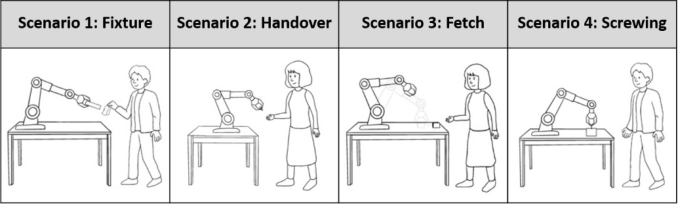
Scenario 1: Fixture
The human polishes the held object. The robot holds the object in a position according to a learnt human preference. Scenario 2: Handover
The human takes the object from the robot’s gripper, performs a short quality check, and places it aside. The robot hands the object to the human. Handover pace depends on the human’s readiness to take the object. Scenario 3: Fetch The human inserts the bolt into the hole of a plate. The robot tightens the bolt in the plate.
The human performs the assembly actions, places the object, and pushes it to the designated position. The robot fetches the object according to the human’s progress in the assembly task Scenario 4: Screwing
grouped into two age groups using a median split (younger, n = 36: 25 years and younger, elderly, n = 35: 26 years and older). Thus, 48% of the male par- ticipants were grouped into the younger age group and 52% in the elderly one. In addition, 52% of the female participants were grouped into the youn- ger age group and 48% in the elderly age group. The distribution regarding gender and age groups does not differ significantly, χ2(1, N = 71) = .01, p = .921. Overall, 69% of the participants were employed, with a self- reported average working time of 34.33 hours per week (SD = 14.18). All participants provided their informed consent at the beginning of the online study.
Study Design and Materials The exploratory study was designed as an online survey with a within-subject design. Overall, the participants needed about 15–20 minutes to complete the whole questionnaire. The first part focused on sociodemographic data as well as general attitudes and previous knowledge about human-robot interaction. Therefore, the participants had to assess their general attitude towards robots on a 5-point rating scale from negative (1) to positive (5). Afterwards they had to assess how well they are informed about the interaction between humans and robots in general from not at all (1) to very good (5).
In the second part, all participants assessed four different scenarios (fix- ture, handover, fetch and screwing) where humans interact with robots in an industrial context. The scenarios contents were adapted from El Zaatari et al. (2019) which provide an overview of collaborative industrial scenarios in research. For each scenario, the activity of the human and the activity of the robot were described textually (see Table 1). For a better visual imagina- tion, an additional sketch of the scenario was presented to the participants (see Figure 1). To assess the influence of task complexity on the subjecti- vely assessed acceptance and trust, task complexity was increased with each scenario (from 1 to 4).
After each scenario of human-robot interaction the participants rated their subjectively perceived acceptance and trust. To assess acceptance, the acce- ptance scale of Van der Laan et al. (1997) was used. Nine items (5-point
The Influence of Task Complexity on Acceptance and Trust in Human-Robot Interaction 121
Figure 1: Scenarios of human-robot interaction in an industrial context (Gleichauf et al. 2021).
semantic differentials) represent two subscales of acceptance: usefulness and satisfaction (both ranging from −2 to +2). A trust score was also determined for each human-robot interaction scenario. Therefore, separate items were developed, based on the questionnaires of Körber (2019) and Charalambous et al. (2016). The participants rated the following four statements: “I trust the robot”, “I trust the robot not to make mistakes”, “I trust the robot to perform its operating task as required”, “I trust that the robot will not hurt me”. The degree of agreement with these statements was assessed by the par- ticipants using a 5-point likert scale [strongly agree (5) to strongly disagree (1)]. The subjective trust score for the scenarios of human-robot interaction is determined as mean value of the four items. A reliability analysis for the trust score reached a Cronbach’s Alpha of .812, which shows a good internal consistency for the underlying items (Cronbach 1951; Taber 2017).
Statistical Analysis The software IBM SPSS Statistics was used for the statistical analysis. Uni- variate analyses of variance and analyses of variance with repeated measures were used as statistical procedure. The evaluation was based on a significance level of 5%.
RESULTS
General Attitudes Towards Robots Following the results of the study, the participants’ general attitudes towards robots were rather neutral to positive (M = 3.92, SD = .81). The results of an univariate analyses of variance, showed a significant effect of gender, F(1, 67) = 3.99, p = .050, η2part. = .056. Therefore, men’s general attitudes towards robots were significantly more positive (M = 4.14, SD = .83) then women’s (M = 3.76, SD = .76). The other effects did not reach the level of significance [age: F(1, 67) = 1.11, p = .297, η2part. = .016; interaction gender x age: F(1, 67) = .19, p = .664, η2part. = .003].
Being Informed About Human-Robot Collaboration Overall, the participants feeling about being informed about human-robot collaboration was rated as partly to well informed (M = 3.25, SD = .95).
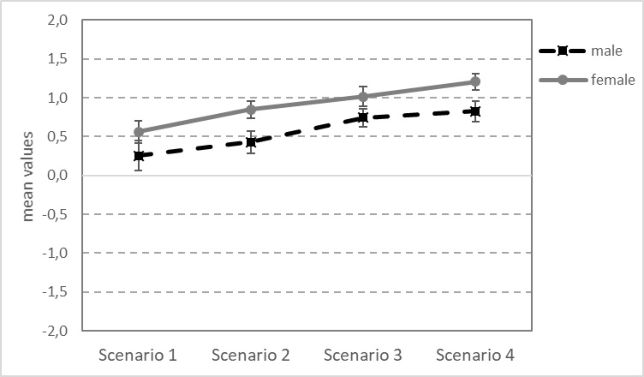
Figure 2: Scenarios: Perceived usefulness – gender differences. Note: I … standard error of mean.
Following the results of an ANOVA, a significant age effect is shown, F(1, 67) = 4.14, p = .046, η2part. = .058. Younger participants (M = 3.50, SD = 1.00) described themselves as significantly more informed about human-robot collaboration than elderly participants (M = 3.00, SD = .84). No significant effects of gender, F(1, 67) = .62, p = .435, η2part. = .009 or the interaction gender x age, F(1, 67) = 1.71, p = .195, η2part. = .025, can be shown.
Scenarios – Different Levels of Task Complexity Usefulness
Following the results of an analysis of variance with repeated measures, significant differences regarding the perceived usefulness of the four diffe- rent scenarios can be shown, F(3, 65) = 9.31, p < .001, η2part. = .300. Post-hoc analyses (Sidak) showed that both, Scenario 1 (p < .001) and Sce- nario 2 (p = .005) were assessed as significantly less useful than Scenario 4. Additionally, Scenario 1 was assessed as significantly less useful than Scena- rio 3 (p < .001). Furthermore, a significant effect of gender can be shown, F(1, 67) = 6.39, p = .014, η2part. = .087 (see Figure 2). Women assessed the usefulness of collaborative robots within the presented scenarios overall significant more positive than men. All other effects did not reach the level of significance.
Satisfaction Regarding the perceived satisfaction of the participants, the results of an analysis of variance with repeated measures, showed significant differences of the four different scenarios, F(3, 65) = 6.66, p < .001, η2part. = .235. The two scenarios Scenario 1 (p = .025; post-hoc test: Sidak) and Scenario 2 (p = .011)
The Influence of Task Complexity on Acceptance and Trust in Human-Robot Interaction 123
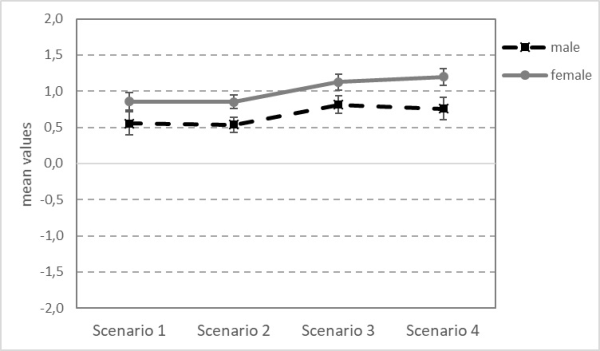
Figure 3: Scenarios: Perceived satisfaction – gender differences. Note: I … standard error of mean.
were assessed as significantly less positive than Scenario 3. In addition, Sce- nario 2 was assessed as significantly less positive than Scenario 4 (p = .037). Also, a significant effect of gender can be shown, F(1, 67) = 6.45, p = .013, η2part. = .088 (see Figure 3). Women were significantly more satisfied regar- ding the human-robot collaboration presented in the different scenarios than men. All other effects did not reach the level of significance.
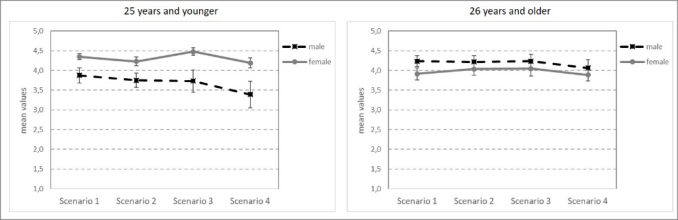
Trust The results of an analysis of variance with repeated measures, showed signifi- cant differences regarding trust in the different collaborative situations betw- een human and robot presented in the scenarios, FHF(2.86, 191.36) = 4.07, p = .009, η2part. = .057. Following the results of post-hoc analyses, par- ticipants trusted the robot significantly more within Scenario 3 than within Scenario 4 (p = .027; Sidak). Furthermore, a significant interaction of gender x age can be shown, F(1, 67) = 8.49, p = .005, η2part. = .112 (see Figure 4). Overall, elderly men trusted the robots in the presented scenarios significan- tly more than younger men (p = .028; Sidak). And in addition, regarding participants of the younger age group, younger women trusted them signifi- cantly more than younger men (p = .003). All other effects did not reach the level of significance.
DISCUSSION
Following the results of the study the participants’ general attitudes towards robots were rather neutral to positive. This is in line with former research (Wagner-Hartl et al. 2020). Furthermore, they described themselves as par- tly to well informed regarding human-robot collaboration. The results show that men’s general attitudes towards robots were significantly more positive than women’s. Interestingly no significant effect of gender can be shown concerning the participants feeling of being informed about human-robot
Figure 4: Scenarios: Trust – interaction gender x age. Note: I … standard error of mean.
interaction. Regarding this aspect a significant effect of age can be shown according to which younger participants perceive themselves as significantly more informed than elderly participants.
The third question in this research focusses on the influence of task complexity on acceptance (operationalized as the two dimensions perceived usefulness and perceived satisfaction of the acceptance scale of Van der Laan et al. 1997) and trust in human-robot interaction. The results show signifi- cant assessment differences of the different levels of task complexity. So, both scenarios representing a higher task complexity (fetch, screwing) were asses- sed as significantly more useful than the scenario representing the lowest task complexity (fixture). In addition, the scenario with the highest task comple- xity (screwing) was assessed as significantly more useful than the scenario with the second lowest task complexity (handover). Furthermore, this can be partly confirmed regarding the perceived satisfaction of the participants. Both scenarios representing a higher task complexity were assessed as signi- ficantly more satisfying than the scenario representing the second lowest task complexity, whereas only the scenario with the second highest task comple- xity was assessed as significantly more satisfying than the scenario with the lowest task complexity. The results are in line with Stollnberg et al. (2013).
Interestingly, regarding trust the results show only one significant differe- nce between the two scenarios with the highest task complexity. Participants trusted the robot within the third complex scenario (fetch) significantly more than in the scenario representing the highest task complexity (screwing). One interpretation for this result may be that within the screwing-scenario the robot tightens a bolt in a plate, which could be interpreted as potentially causing more injury by the participants than the interaction within the other scenario.
Gender and age effects were also shown. On the one hand, women asses- sed the usefulness of human-robot interaction within the presented scenarios as significantly more useful and satisfying than men. This seems particu- larly interesting with regard to the result that men’s general attitudes towards robots within the study sample was significantly more positive than women’s. This result supports the idea of the importance of including different scena- rios and tasks when studying human-robot interaction. On the other hand, regarding trust an interaction of age and gender can be shown. The results of post-tests indicate that younger women trusted them significantly more than
The Influence of Task Complexity on Acceptance and Trust in Human-Robot Interaction 125
younger men, which is in line with the results for perceived usefulness and satisfaction. Interestingly, elderly men trusted the robots in the presented sce- narios significantly more than younger men. Maybe younger men represent a group to which more attention should be paid in the future. Thinking about the development of trainings to accompany the introduction of robots in a company, trainings should possibly be developed specifically for this target group. Following the results of a review of Nomura (2020) gender effects are also related to “(…) the type of robots, and the situations and contexts under which robots are used.” (ibid., p. 751). Therefore, the next step would be to repeat the online study with a real industrial robot. This should help to proof if the effects can also be shown when the participants perform with a robot in a real working environment.
To sum it up, the results show that gender and age differences should be considered when focusing on how humans and robots can work together in the future. Also, task complexity can be seen as one influencing factor for the acceptance of human-robot interaction. Although, the presented tasks of human-robot interaction were assessed rather positive, more research is needed to ensure that negative emotions and mistrust towards this new form of work environment are avoided.
ACKNOWLEDGEMENT, AUTHORS’S STATEMENT The authors would like to thank all participants who participated in the study. The authors state no conflict of interest. Informed consent has been provided from all participants of the study. The study was examined and approved by the ethics committee of the Furtwangen University.
REFERENCES
Ajoudani, A., Zanchettin, A.M., Ivaldi, S., Albu-Schäffer, A., Kosuge, K., Khatib, O. (2017). Progress and prospects of the human–robot collaboration. AUTON. ROBOTS Volume 42 No. 5, pp. 957–975. Charalambous G., Fletcher S., Webb P. (2016). The Development of a Scale to Eva-
luate Trust in Industrial Human-robot Collaboration. INT J OF SOC ROBOTICS Volume 8, pp. 193–209. Cronbach L.J. (1951), Coefficient alpha and the internal structure of tests. PSYCH- OMETRIKA Volume 16 No. 3, pp. 297–334. El Zaatari, S. Marei, M. Li, W. & Usman, Z. (2019). Cobot programming for
collaborative industrial tasks: An overview. ROBOTICS AND AUTONOMOUS SYSTEMS Volume 116, pp. 162–180. Federal Ministry of Economic Affairs and Climate Action (2022). Skilled professionals for Germany. https://www.bmwi.de/Redaktion/EN/Dossier/skilled- professionals.html Accessed: March 18, 2022 Gleichauf K., Schmid R. (2021). Scenarios of human-robot interaction in an industrial context – Sketches. Furtwangen University. Görke M. Blankemeyer S. Pischke D. Oubari A. Raatz A. Nyhuis P. (2017). Sichere
und akzeptierte Kollaboration von Mensch und Maschine: Integrierte Betrach- tung technischer und nicht technischer Gestaltungsfaktoren für die Einführung nachhaltiger und effizienter kollaborativer Montagesysteme. ZEITSCHRIFT F, WIRTSCH. FABRIKBETRIEB Volume 112, pp. 41–45.
Hancock, P.A., Billings, D.R., Schaefer, K.E., Chen, J.Y., De Visser, E.J., Parasuraman, R. (2011). A meta-analysis of factors affecting trust in human-robot interaction. HUMAN FACTORS Volume 53 No. 5, pp. 517–527. Körber M. (2019). “Theoretical considerations and development of a questionnaire
to measure trust in automation”, in: Proceedings of the 20th Congress of the Inter- national Ergonomics Association (IEA 2018), Bagnara S, Tartaglia S, Albolino S, Alexander T, Fujita Y (Eds.). Springer, pp. 13–30. Morikawa M. (2017) Who Are Afraid of Losing Their Jobs to Artificial Intelligence and Robots? Evidence from a Survey No. 71 Nomura, T. (2020). A possibility of inappropriate use of gender studies in human-
robot interaction. AI & SOCIETY Volume 35, pp. 751–754. Pouliakas K. (2018). Determinants of Automation Risk in the EU Labour Market: A Skills-Needs Approach. SSRN JOURNAL No. 11829, 30pp. Savela, N., Turja, T., Oksanen, A. (2017). Social acceptance of robots in different
occupational fields: a systematic literature review. INT. J. SOC. ROBOT Volume 10 No. 4, pp. 493–502. Stollnberger, G. Weiss, A. Tscheligi, M. (2013). “The harder it gets” Exploring the interdependency of input modalities and task complexity in human-robot collaboration”, in: 2013 IEEE RO-MAN, pp. 264–269. Taber, K.S. (2017). The Use of Cronbach’s Alpha When Developing and Reporting
Research Instruments in Science Education. RES. SCI. EDUC. 24pp. Takayama, L., Ju, W., Nass, C. (2008) “Beyond dirty, dangerous and dull: what everyday people think robots should do” in: Proceedings 2008 3rd ACM/I- EEE International Conference on Human-Robot Interaction (HRI), Amsterdam, pp. 25–32. Van der Laan, J.D. Heino, A. De Waard, D. (1997). A simple procedure for the
assessment of acceptance of advanced transport telematics. TRANSPORTATION RESEARCH - Part C: Emerging Technologies Volume 5, pp. 1–10. Vanderborght, B. (2019). Unlocking the potential of industrial human–robot collaboration. A vision on industrial collaborative robots for economy and society. European Commission, Brussels. Wagner-Hartl V., Gleichauf K., Schmid R. (2020) “Are We Ready for Human-Robot
Collaboration at Work and in Our Everyday Lives? - An Exploratory Approach”, in: Human Systems Engineering and Design II. IHSED 2019. Advances in Intelli- gent Systems and Computing, Ahram T., Karwowski W., Pickl S., Taiar R. (Eds.) pp. 135–141, vol 1026. Springer, Cham. Wagner-Hartl V., Pohling K., Rössler M., Strobel S., Maag S. (2021) “Attitudes Towards Human-Robot Collaboration and the Impact of the COVID-19 Pandemic”, in: HCI International 2021 - Late Breaking Posters. HCII 2021. Communications in Computer and Information Science, Stephanidis C., Antona M., Ntoa S. (Eds.) pp. 294–299, vol 1498. Springer, Cham. World Health Organisation (2021). Ageing and health. https://www.who.int/news-r
oom/fact-sheets/detail/ageing-and-health Accessed: January 22, 2022.
LISTED IN THE AHFE DIGITAL BOOKSTORE CATALOGUE
Explore the complete digital volume
Cognitive Computing and Internet of Things
Read this individual research paper free through the original publisher, or explore the full digital proceedings book.
ISBN 978-1-958651-19-3
Explore this ISBN in the AHFE Bookstore ↗Listed in the July 2026 bookstore catalogue; search by ISBN to confirm current availability · Digital book purchase optional