Isabel Kreißig, Tina Morgenstern, Josef Krems (2023). Blinking, Beeping or Just Driving? Investigating Different Communication Concepts for an Autonomously Parking E-Cargo Bike from a User Perspective. In: Human Interaction and Emerging Technologies (IHIET-AI 2023): Artificial Intelligence and Future Applications. AHFE Open Access, vol. 70, pp. 57–67. https://doi.org/10.54941/ahfe1002930
While autonomously parking e-cargo bikes offer the potential to enhance users’ comfort and time efficiency at sharing-stations, it is important to ensure a safe and useable interaction. External human machine interfaces (eHMIs) provide a possible solution for highly automated systems to communicate relevant information and to ensure system transparency. We conducted a laboratory study investigating three different communication concepts for autonomously parking e-cargo bikes: (1) a visual eHMI, (2) an auditory eHMI, and (3) a baseline condition. Participants (N = 36) watched videos of an autonomously parking e-cargo prototype and assessed each concept regarding user experience, acceptance, perceived safety, and trust. Results revealed a clear ranking of communication concepts with the visual eHMI rated to be most suitable followed by the auditory eHMI, whereas ratings for the condition without eHMI revealed considerable concerns for all aspects. Our findings suggest important implications for designing user interfaces for self- parking e-cargo bikes.
Autonomously parking e-cargo bikes offer the potential to enhance users’ comfort and to save time during return at sharing stations and could there- fore contribute to higher attractiveness of this sustainable mode of transport. However, to interact safely, efficiently, and comfortably with such auto- nomous functions, a certain degree of system transparency is of particular importance. Besides, driving also comprises a social facet requiring interacti- ons and communication between all involved traffic participants to ensure a smooth and safe cooperation (Rasouli and Tsotsos, 2018). For this com- munication and the anticipation of the development of a traffic situation, interaction partners have been found to use implicit (e.g., vehicle trajectory, deceleration) as well as explicit cues (e.g., gestures, indicator; Schieben et al. 2018). Especially in case implicit cues are not sufficient, external human machine interfaces (eHMIs) are discussed as a possible solution for commu- nicating relevant information such as vehicle status when interacting with
highly automated systems (Schieben et al. 2018). In this context, shared spaces are of particular interest because of many potential encounters with various traffic participants, especially vulnerable road users, and only limited regulations, resulting in a high amount of ambiguous situations (Hammilton- Baillie, 2008). As (e-cargo) bike sharing stations and the surrounding area could be categorized as shared spaces, the investigation of users’ require- ments in terms of communication needs during highly automated parking is of high importance.
While to our knowledge there is no human factors research about auto- nomously parking (e-cargo) bikes, recent studies have been conducted in the field of automated passenger cars (e.g., Hensch et al. 2019). Results of these studies predominantly revealed promising effects and identified users requi- ring supplementary cues in addition to implicit signals from the automated vehicle’s movements for certain scenarios (Faas et al. 2020). In this regard, positive effects in terms of enhanced perceived safety (De Clercq et al. 2019) and trust (Faas et al. 2020) have been shown for eHMIs compared to a base- line condition without additional cues. Besides such directly safety-relevant issues, user acceptance of the signals and a satisfactory user experience (UX) constitute important facets when thinking about the introduction of eHMIs for automated systems. Research so far indicates the potential of eHMIs to increase both acceptance as well as UX in the interaction with highly automated vehicles (Avsar et al. 2021; Faas et al. 2020). The current study contributes to the field of research investigating the effect of different commu- nication concepts taking into account eHMIs as well as a baseline condition for the scenario of a self-parking e-cargo bike.
In the automobile context, plenty of studies investigated eHMIs for diffe- rent traffic situations and with a broad variety of design options regarding relevant characteristics such as signal modality or abstraction level (Dey et al. 2020). Although a standard aiming at a consistent design of eHMIs would be useful, consensus still has to be found based on results of research. In this regard, the question about the appropriate and most efficient modality for eHMIs has often been raised (Dey et al. 2020; Rasouli and Tsotsos, 2018). Studies investigating auditory eHMIs are rather scarce compared to a clear research focus on visual eHMIs (Dey et al. 2020). Apart from that, studies conducted so far showed mixed effects. For example, Merat et al. (2018) found no clear results when comparing safety measures for visual and audi- tory eHMIs in a cross-cultural study. In a survey study, Haimerl et al. (2022) observed better assessments for visual compared to auditory communication concepts with regard to UX. We included both modalities as eHMIs in the current study in order to gain further knowledge on the comparison of these concepts and to explore them in the context of self-driving bikes.
To summarize, we addressed two objectives in the scope of our study: (A) Investigation of the effects of explicit versus implicit communication cues for the interaction between users and highly automated e-cargo bikes regarding users’ UX, acceptance, perceived safety and trust.
Blinking, Beeping or Just Driving? Investigating Different Communication Concepts 59
(B) Exploration of effects of modality comparing assessments of an auditory and a visual eHMI for autonomous e-cargo bike parking in terms of users’ acceptance, UX, perceived safety, and trust.
As the user, who shared the e-cargo bike and wants to return it at the sharing station, is an important interaction partner involved, we decided to focus on this perspective for our evaluation in a first step of research.
METHOD
Research Design and Communication Concepts In order to investigate whether an eHMI is needed in addition to impli- cit information via the vehicles’ movements and to compare two different eHMI modalities, we conducted a laboratory study evaluating three different communication concepts for autonomously parking e-cargo bikes. Appl- ying a one-factorial within-subjects design, we comparatively examined the concepts described below (see Table 1 for detailed descriptions):
(1) a visual eHMI implemented via LED light band (fixed at the handlebar and the cargo box, Figure 1), (2) an auditory eHMI implemented via signal tones, and (3) a baseline condition without an eHMI but based on implicit cues.
According to Schieben et al. (2018), the investigated signals predominan- tly refer to information about vehicle driving mode (takeover from manual to autonomous mode) and next maneuvers (autonomous parking) as well as the perceptions of the environment (detection of obstacle). In the baseline condition, communication was solely based on implicit communication cues such as vehicle trajectory or deceleration without any additional eHMI. For the visual eHMI, the color turquoise as common color in automated driving was chosen, supplemented by a red- and green-colored signal indicating an error state or a successful completion of the task, respectively (confer Dey et al. 2020). When designing the auditory communication concept, the aim was to choose characteristics as similar as possible to the visual concept. However, some modality specific adaptations had to be made for reasons of interaction comfort as decided by the human factors team (e.g., a continuous beep tone without pause during autonomous parking would have been too aversive). For both concepts, we decided for a rather abstract design of the eHMIs, as we believe these are more independent from aspects like language understanding (compared to meaningful words) or symbol recognition and interpretation and therefore more compatible in terms of a Design for All approach.
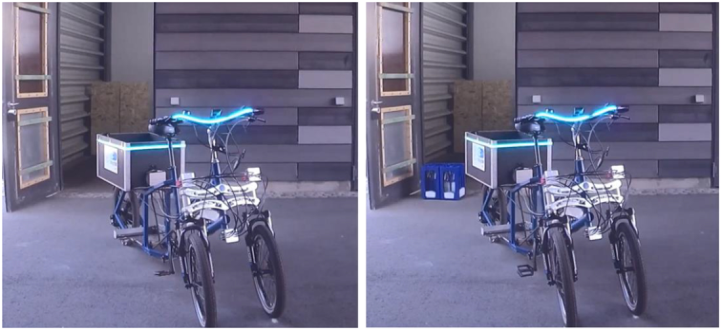
The video material used in the study showed two different autonomous parking scenarios of the e-cargo bike implemented via Wizard of Oz: (a) an unobstructed (parking process without obstacles) and (b) an obstructed (par- king process with a barrier in the parking trajectory) use case (Figure 1). The autonomous parking process was as follows: After the takeover from manual to autonomous mode, the e-cargo bike started the automated drive by an ini- tial steering and backwards movement at walking speed. While the e-cargo
Figure 1: Example screenshots of the presented video displaying the e-cargo bike at the beginning of the autonomous parking process for the unobstructed (left) and obstructed scenario (right) with the visual eHMI.
bike successfully completed the parking process at the charging point in the sharing station in the unobstructed condition, parking was interrupted by deceleration and standstill in front of a bottle crate in the obstructed scena- rio. The description of the e-cargo bike’s actions and the respective visual and auditory eHMI is depicted in Table 1. Both use cases were presented for each communication concept.
Instruction and Procedure When arriving at the laboratory, informed consent was obtained from the participants and they received some information about the SteigtUM pro- ject as well as the use case of autonomous parking of e-cargo bikes at sharing stations. Furthermore, the investigated communication concepts were explai- ned and presented in a balanced order. Participants were asked to watch the pre-recorded videos from the perspective of a user who wants to return the e-cargo bike after a shared ride and just initiated the autonomous par- king process via the user interface of a smartphone app. Subsequent to the introduction and the videos for the respective communication concept pre- sented on a TFT-display and via speakers, participants completed a set of questionnaires to assess each concept. In the end, a short questionnaire containing items about socio-demographic variables was applied and par- ticipants had the opportunity to clarify open questions. As compensation for taking part in study, which lasted about 90 minutes, participants could receive course credits in case they were students of Chemnitz University of Technology.
Questionnaires In order to assess the investigated communication concepts of the autono- mously parking e-cargo bike, participants were instructed to complete a questionnaire containing items regarding (UX), acceptance, subjective safety
Blinking, Beeping or Just Driving? Investigating Different Communication Concepts 61
Table 1. Overview about actions in the autonomous parking process with vehicle movements and description of the respective visual and auditory eHMI.
Table available in the original PDF paper.
Action Without eHMI (e-cargo bike movement)
Auditory eHMI (signal tones via speakers)
Visual eHMI (LED strip at handle-bar & cargo box)
Standstill in front of the sharing station
Takeover from manual to autonomous mode
5 flashes of the LED strip in turquoise (RGB: 1, 128, 181, 600 ms length each, 600 ms pause)
Steering movement and backwards driving at walking speed (further steering & de-/ acceleration if needed) Standstill in the sharing station Successful completion of the autonomous parking
3 flashes of the LED strip in green (RGB: 0, 255, 0; length: 1000 ms each, 300 ms pause)
Sound sequence (4 tones (frequency: 264, 330, 396, 528 Hz), length: 500 ms, 750 ms pause, volume: −20 dbFS) Detection of obstacle in trajectory
Continuously flashing LED strip in red (RGB: 255, 0, 0; length: 500 ms, 300 ms pause)
Deceleration until standstill in front of the obstacle (no movement until obstacle is removed)
and trust. As a tool to collect the subjective impression of users regarding the UX of products, the short version of the User Experience Questionnaire (UEQ-S; Schrepp et al. 2017) was used. The UEQ-S is a semantic differen- tial with eight items that have to be answered on a 7-point scale representing values ranging from -3 (full agreement with negative term) to +3 (full agree- ment with positive term; e.g., “clear” – “confusing”). The questionnaire was applied to the three communication concepts. Calculating a mean score, a total value reflecting the overall UX was derived (Schrepp et al. 2017) with good internal consistency (Cronbach’s α = .80 - .84).
In order to assess users’ acceptance regarding the investigated communi- cation concepts, users were asked to complete the Van der Laan Acceptance Scale (van der Laan et al. 1997). Participants’ ratings were collected for nine word pairs on a 5-point semantic differential. The scale consists of two sub- scales, a Usefulness- and a Satisfaction-score represented by the calculated means of the respective items of both scales with values ranging from −2 to +2. Four semantic differentials belong to the Satisfaction scale (e.g., “plea- sant”– “unpleasant”), the other five items belong to the Usefulness scale (e.g.,
“bad” – “good”). The internal consistency of both sub-scales was satisfa- ctory for all investigated communication concepts (Satisfaction: Cronbach’s α = .80 - .93; Usefulness: Cronbach’s α = .76 - .83).
For trust ratings, we applied the Scale for Trust in Automated Systems (Jian et al. 2000). The scale consists of 12 Items that have to be answered on a 7-point Likert scale ranging from 1 - “not at all” to 7 - “absolutely”. For analysis, all ratings per person were aggregated to a mean overall trust score (Cronbach’s α = .80 - .91).
Additionally, participants indicated their feeling of safety by a single item measurement (“I felt safe when interacting with the autonomously driving e- cargo bike”) on a 7-point Likert scale ranging from 1 - “completely disagree” to 7 - “completely agree”.
Participants A total of N = 36 participants, amongst them n = 17 women, n = 18 men and n = 1 diverse, took part in the study. The sample had a mean age of M = 26.5 years (SD = 6.4; Min = 18 years; Max = 48 years) and was predominantly highly educated (53% with university degree, 36% with abitur, 11% with secondary school certificate).
RESULTS
The effect of the different communication concepts on participants’ asses- sments was analysed calculating repeated measures ANOVAs. In case the assumption of sphericity was violated (Mauchly’s test), the Hynh-Feldt correction was applied.
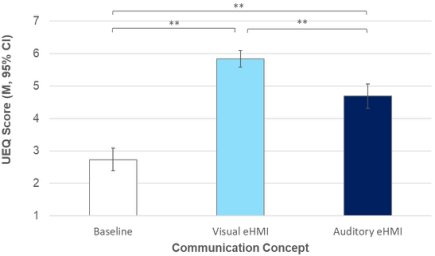
User Experience In order to get an impression about the UX of the tested eHMIs, we applied the UEQ-S. The repeated measures ANOVA resulted in a highly significant effect for the communication concept with a large effect size, F(1.45, 50.90) = 90.924, p < .001, ηp2 = .722. Bonferroni-corrected pairw- ise comparisons revealed differences for all conditions on a highly significant level (p < .001). As depicted in Figure 2, the visual eHMI received the highest UX ratings, which could be interpreted as good UX on a descriptive level. The auditory eHMI ranged in a medium to good UX-level, whereas the condition without eHMI received low values representing a rather poor UX assessment.
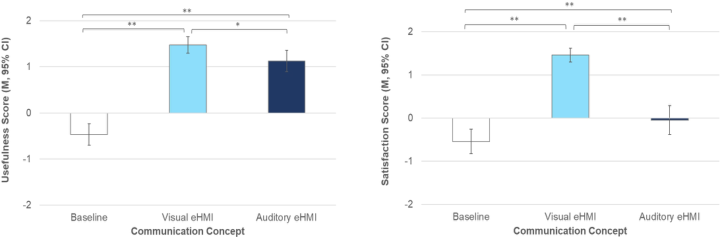
Acceptance Investigating the acceptance of the three communication concepts, we applied the van der Laan Acceptance Scale comprising a Satisfaction- and a Use- fulness-scale. Regarding Satisfaction, the repeated measures ANOVA resul- ted in a highly significant large effect for the communication concept, F(1.61, 56.42) = 56.411, p < .001, ηp2 = .617. All Bonferroni-corrected pai- rwise comparisons showed highly significant differences between all commu- nication concepts (p < .001) with best ratings for the visual eHMI, followed by the auditory eHMI and the baseline condition. On a descriptive level, the visual eHMI reached scores representing a satisfying communication concept
Blinking, Beeping or Just Driving? Investigating Different Communication Concepts 63
Figure 2: Comparison of UX-ratings for the three communication concepts. **p < .001.Figure 3: Comparison of acceptance assessments for the investigated communication concepts (left: scale Usefulness; right: scale Satisfaction). *p < .05; **p < .001.
(Figure 3). For the auditory eHMI, ratings were at a rather neutral level. For the baseline condition without any external communication cue, we observed rather poor Satisfaction scores represented by negative values.
Similarly, we observed a highly significant effect with a large effect size for the communication concept regarding Usefulness-ratings, F(2, 70) = 84.215, p < .001, ηp2 = .706. Bonferroni-corrected pairwise comparisons resulted in highly significant differences between the baseline condition and the visual eHMI (p < .001) as well as the auditory eHMI (p < .001) with higher Usefulness ratings for conditions with eHMI, respectively. Furthermore, we obtained higher Usefulness scores for the visual compared to the auditory eHMI (p = .043). While negative values for the baseline condition repre- sent rather poor Usefulness, the ratings for both eHMI conditions revealed a medium (auditory eHMI) to rather high Usefulness (visual eHMI; Figure 3).
Trust To compare users’ trust in the autonomously parking e-cargo bike, parti- cipants rated trust in the system according to Jian et al. (2000). Results of the repeated measures ANOVA revealed a highly significant effect for the communication concepts regarding trust with a large effect size,
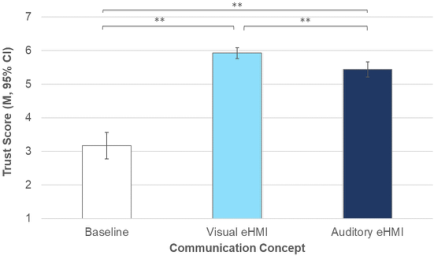
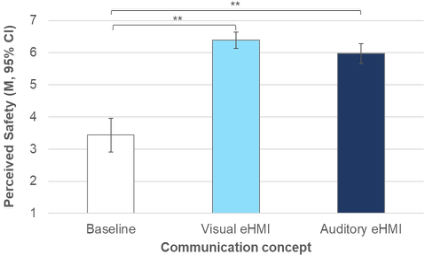
Figure 4: Comparison of trust ratings for the different communication concepts. **p < .001.Figure 5: Perceived safety compared for the investigated communication concepts. **p < .001.
F(1.39, 48.57) = 118.314, p < .001, ηp2 = .772. Bonferroni-corrected pairw- ise comparisons resulted in highly significant differences for all tests (p < .001) with highest trust scores for the visual eHMI followed by the auditory eHMI. As can be also seen in Figure 4, the trust scores for the baseline condition, where no eHMI was applied, were rather low.
Perceived Safety As another important facet in the evaluation of potential communica- tion concepts for autonomous e-cargo bike parking, we investigated users’ perceived safety during the autonomous parking process via single item measurement. Results of the repeated measures ANOVA, again, sho- wed a highly significant and large effect for communication concept, F(1.39, 48.57) = 77.515, p < .001, ηp2 = .689. Consistent with the results of the other measures, we observed highly significant differences between the condition without eHMI compared to the visual (p < .001) and auditory eHMI (p < .001) as revealed by Bonferroni-corrected pairwise comparisons. Participants indicated higher perceived safety ratings for both eHMI conditi- ons compared to the baseline condition (Figure 5). There was no significant difference for the comparison of both eHMIs.
Blinking, Beeping or Just Driving? Investigating Different Communication Concepts 65
DISCUSSION AND CONCLUSION In order to investigate the effects of different communication concepts for the communication of autonomously parking e-cargo bikes from a user per- spective, we conducted a study based on pre-recorded videos comparing a visual eHMI, an auditory eHMI and a baseline condition based on impli- cit cues. In sum, results consistently showed better assessments for eHMIs compared to the baseline condition without additional cues confirming fin- dings of research in the automotive context (e.g., Faas et al. 2020). Especially with regard to safety aspects in the interaction with the autonomously par- king vehicles, users’ perceived safety was significantly enhanced by an eHMI regardless of signal modality in contrast to solely implicit communication cues. While participants indicated rather high feelings of safety for situations with explicit communication signals, the baseline condition received rather low to medium safety ratings. For the other investigated constructs, we obse- rved differences between all communication concepts. More concretely, the visual eHMI received best assessments with consistently good or high scores on a descriptive level regarding UX, acceptance as well as trust in the auto- mated system. For these aspects, the visual was preferred over the auditory communication concept, which has been similarly found by research investi- gating automated cars (He et al. 2021). As we observed biggest differences for UX and Satisfaction ratings for the auditory eHMI, we interpret these results rather in terms of the need for increased interaction comfort than clai- ming a big safety or usefulness issue. The ratings for the baseline condition, however, resulted in rather low to medium scores indicating that solely impli- cit communication according to the vehicle’s movements is not as sufficient, safe, acceptable and trustworthy as needed. Comparable results have been shown in research for automated cars, implying a certain need for additional communication cues in specific situations (e.g., Merat et al. 2018).
Our study provides important insights into the field of interaction with autonomously parking e-cargo bikes. Some aspects of the study, however, have to be considered when interpreting the results or rather open the field for further in-depth research. The focus of the study was the perspective of the user who just shared the e-cargo bike and is now monitoring the highly automated return at the sharing station. As stated in the beginning, sharing stations might be located in shared spaces, where interaction with many diffe- rent traffic partners (e.g., passengers) could occur, whose perspective should be incorporated in future evaluations. Furthermore, also other interaction scenarios and signal information, for instance incorporating cues regarding yielding scenarios, might be investigated. Although we tried to design both the visual and auditory eHMI in a comparable way (similar length, amount and abstractness of signals), there were some differences due to certain design considerations and specifics of modality. For example, the visual eHMI was presented continuously during the parking process, while the auditory signal was interrupted by pauses in order to prevent it from appearing aversive. While we do not have any hints in this direction, this, however, may have led to unintentional effects that might have also been reflected in users’ assessments. Furthermore, as also raised by Dey et al. (2020), evaluations
in a next step should incorporate design solutions which take into account the inclusion of people with special needs such as a visual impairment. In this regard, one option in terms of an inclusive design might be the combination of visual and auditory cues in the communication concept. Apart from that, the study set-up could play an important role. For this first step, we chose a laboratory setting to investigate the effects of the different communication concepts in a controlled environment with a high safety standard. Future studies, however, should aim at gaining knowledge about the assessment in the field, facing real conditions such as different surrounding light and noise conditions, further enhancing the external validity of data.
Taken together, results revealed a clear ranking of communication conce- pts from a user perspective indicating the visual eHMI to be most suitable for the investigated scenarios followed by the auditory eHMI. Participants’ asses- sments imply that a communication concept implicitly interacting with users is not suitable for the investigated scenarios. Our findings suggest important implications for the design of the user interface for the automated parking process and offer a basis from which to start in-depth investigations regar- ding this emerging application in the field of highly automated (e-cargo) bike functions.
ACKNOWLEDGMENT
This study was part of the BMBF-funded project SteigtUM (grand number: 16SV8273). We would like to thank our project partner Technische Universi- tät Bergakademie Freiberg, especially Norman Seyffer for programming the Wizard of Oz autonomous parking function as well as Thomas Fürstner, Jim Gerschler and Florian Tischner for preparing the e-cargo bike. Special thanks to our student group: Dorothea Liehr (LED light band programming via Arduino), Susanne Creutz (implementing the sound eHMI via MatLab), Jakob Siegmund, and Hendrik Meißner for supporting the video shoot and data collection. We further acknowledge Leonie Wagner for her support in preparing and analyzing the data.
REFERENCES
Avsar, Hüseyin. Utesch, Fabian. Wilbrink, Marc. Oehl, Michael and Schießl, Caroline. (2021) “Efficient Communication of Automated Vehicles and Manually Dri- ven Vehicles Through an external Human-Machine Interface (eHMI): Evaluation at T-junctions”, proceedings of the Twenty-third HCI International Conference, Washington DC. De Clercq, Koen. Dietrich, Andre. Núñez Velasco, Juan Pablo. De Winter, Joost
and Happee, Riender. (2019). External Human-Machine Interfaces on Auto- mated Vehicles: Effects on Pedestrian Crossing Decisions, HUMAN FACTORS Volume 61 No. 8. Dey, Debargha. Habibovic, Azra. Löcken, Andreas. Wintersberger, Philipp. Pfleging, Bastian. Riener, Andreas. Martens, Marieke and Terken, Jaques. (2020). Taming the eHMI Jungle: A Classification Taxonomy to Guide, Compare, and Assess the Design Principles of Automated Vehicles’ External Human-Machine Interfa- ces, TRANSPORTATION RESEARCH INTERDISCIPLINARY PERSPECTIVES Volume 7.
Blinking, Beeping or Just Driving? Investigating Different Communication Concepts 67
Faas, Stefanie M. Mathis, Lesley-Ann and Baumann, Martin. (2020). External HMI for Self-Driving Vehicles: Which Information Shall Be Displayed? TRANSPOR- TATION RESEARCH PART F: TRAFFIC PSYCHOLOGY AND BEHAVIOUR Volume 68. Haimerl, Mathias. Colley, Mark and Riener, Andreas. (2022) “Evaluation of
Common External Communication Concepts of Automated Vehicles for People with Intellectual Disabilities”, proceedings of the ACM on Human-Computer Interaction, New York. Hamilton-Baillie, Ben. (2008). Towards Shared Space, URBAN DESIGN INTERNA- TIONAL Volume 13 No. 2. He, Z., Tan, Z., Zhang, R., Li, Y., Liu, B. (2021) “How Pedestrian-AV Interaction Is
Affected by the eHMI: A Virtual Reality Experiment”, in: Advances in Usability, User Experience, Wearable and Assistive Technology, Ahram, Tareq Z., Falcão, Christianne S. (Eds.). pp. 707–714 Hensch, Ann-Christin. Neumann, Isabel. Beggiato, Matthias. Halama, Josephine and Krems, Josef F. (2019). Effects of a Light-Based Communication Approach as an External HMI for Automated Vehicles - A Wizard-of-Oz Study, TRANSACTIONS ON TRANSPORT SCIENCES Volume 10 No. 2. Jian, Jiun-Yin. Bisantz, Ann M. and Drury, Colin G. (2000). Foundations for an
Empirically Determined Scale of Trust in Automated Systems, INTERNATIONAL JOURNAL OF COGNITIVE ERGONOMICS Volume 4 No. 1. Merat, Natasha. Louw, Tyron. Madigan, Ruth. Wilbrink, Marc and Schieben, Anna.
(2018). What Externally Presented Information do VRUs Require When Inte- racting with Fully Automated Road Transport Systems in Shared Space? ACCI- DENT ANALYSIS & PREVENTION Volume 118. Rasouli, Amir and Tsotsos, John K. (2018). Joint Attention in Driver-Pedestrian Interaction: From Theory to Practice, arXiv:1802.02522. Schieben, Anna. Wilbrink, Marc. Kettwich, Carmen. Madigan, Ruth. Louw, Tyron
and Merat, Natasha. (2018). Designing the Interaction of Automated Vehicles with Other Traffic Participants: Design Considerations Based on Human Needs and Expectations, COGNITION, TECHNOLOGY & WORK Volume 21. Schrepp, Martin. Hinderks, Andreas and Thomaschewski, Jörg. (2017). Design and Evaluation of a Short Version of the User Experience Questionnaire (UEQ- S), INTERNATIONAL JOURNAL OF INTERACTIVE MULTIMEDIA AND ARTIFICIAL INTELLIGENCE Volume 4 No. 6. Van der Laan, Jinke D. Heino, Adriaan and De Waard, Dick. (1997). A Simple
Procedure for the Assessment of Acceptance of Advanced Transport Telematics, TRANSPORTATION RESEARCH - PART C: EMERGING TECHNOLOGIES Volume 5 No. 1.
LISTED IN THE AHFE DIGITAL BOOKSTORE CATALOGUE
Explore the complete digital volume
Human Interaction and Emerging Technologies (IHIET-AI 2023): Artificial Intelligence and Future Applications
Read this individual research paper free through the original publisher, or explore the full digital proceedings book.
ISBN 978-1-958651-46-9
Explore this ISBN in the AHFE Bookstore ↗Listed in the July 2026 bookstore catalogue; search by ISBN to confirm current availability · Digital book purchase optional