Maria Carola Morozzo della Rocca (2021). Classic Yacht Redesign and Restoration:Ergonomic and Operational Aspects. In: Advances in Human Aspects of Transportation: Part I. AHFE Open Access, vol. 15. https://doi.org/10.54941/ahfe100617
The rebuilding and restoration of historical yachts have developed significantly over the past few years only, and there is ongoing discussion addressing issues in this respect. To understand the need for new scientific rigor in this field and turn largely self referential interventions into a discipline is a challenge relevant to academic research, organizational entities and regulatory agencies, both governmental and nongovernmental, in Italy and in Europe. There is a multiplicity of aspects that are central to the renovation of historical craft, including primarily ergonomics as key to the design of how to operate boats as ‘places to live and voyage in’, and technology and instrumentation as fundamental elements of navigation systems, additional to standards issued by classification societies. The restoration of classic yachts with a historical and cultural value must correctly consider all ergonomic, functional and technological aspects in reference to both conservational issues and the need to upgrade existing designs to ensure that comfort and navigational safety standards are met. A critical approach that helps find the right compromise under such constraints that are often antithetical and conflicting is central to this research.
MAIN TEXT To evaluate the ergonomics of classic designs in terms of operational technology and livability of interior spaces is no banal aspect. Classic yachts show profiles, dimensions, technology, interior décor and comfort of a very different standard level than today. These rétro features contribute to the cultural aura of classic designs. There are difficulties with the definition of whether insuperable limits exist to the upgrading of vintage craft according to ergonomics, technology and functionality.
The analysis and interpretation of case studies, interdisciplinary research geared towards building a body of knowledge applicable to the yachting industry and the law and regulations in force are also at the foundation of our research. Centered on the ergonomics of yacht design, this study integrates and deepens a larger project on ‘IL RESTAURO PER IL PRODOTTO NAUTICO, RIFLESSIONI METODOLOGICHE E DISCIPLINARI’/The restoration of classic yachts. Methodology and discipline.
As the Principal Investigator with this research, funded by the University of Genoa in 2012, I have supervised work with doctoral students as reported here, which significantly concurs to further integrate key aspects of the restoration of historical craft and contribute to the definition of a new academic discipline, young and yet maturing.
Responding to a new interest in this field, research on STRATEGIE PER LA VALORIZZAZIONE, LA TUTELA E IL RECUPERO DELLE IMBARCAZIONI STORICHE’/Strategies to revitalize, preserve and recover historical vessels continues, funded by the University of Genoa, through the years 2014 and 2015.
While to solve this problem univocally is beyond the scope of this paper, we look to a critical emphasis on aspects of design that are strictly connected to research on an improved ergonomics and functionality of yacht redesign and restoration.
Current trends in yacht design are a continued design evolution and a research for habitability to meet comfort and safety standards increasingly, independent of a vessel’s technical sea keeping state. Yachts are complex products, that are highly individualized and articulated. Design and manufacturing aspects that converge to make a yacht involve a variety of professional specializations. As the result of these different professional specializations a yacht follows their evolution in a transformation process that continues post manufacture, based on technical, technological and functional upgrades that characterize periodical maintenance under applicable regulations. We need a larger framework to analyze classic yacht renovation, because the innumerable possibilities of a contemporary yacht market must be evaluated in terms of their compliance under applicable legislation and in respect of preservation issues that characterize the recovery of historical artifacts.
Excluding a museological perspective as an extreme case for restoration, we have various degrees of operational freedom in the technological and ergonomic upgrade of historical yachts, for which many more years of service are expected post restoration, be it a conservational, philological or critical-creative intervention. The only constraint in this respect is that a yacht’s character is preserved, and as much as possible of the remains of its origins. It is also key to this that a restoration project that respects the yacht’s style language enables such upgrades as are required to ensure unlimited operational safety post restoration.
The big difference between the yachting industry and parallel sectors including the automotive industry is that no restrictions apply to the navigation of historical vessels, while there are restraints on classic cars under the law that only enable a sporadic, non routine utilization. Also, exceptions to the regulations disciplining the automotive sector do not apply to the yachting industry because classification societies require that periodic surveys are conducted to verify that vessels are maintained to class standards. Vessels are subsequently certified 1 (RINA) in conformity with laws and regulations. To maintain a yacht’s efficiency unaltered is key to its preservation. To do this, there is a need to both rescue and update at the same time.
JClass Shamrock V 2 epitomizes this, as the only J that was maintained to continued service since launching of all JClass yachts. Derelict Endeavour and Velsheda were both salvaged in the 1980s. In a history of ownership changes, Shamrock V underwent repeated restorations that preserved its efficiency, while purists of its original design may have considered them controversial at times.
That total conservation per se was eluded in this respect has enabled the continuity to this day of a historically significant exemplar, that is technically representative of a particular formal value. This reasoning is limited to a particular example and may not be generalized in absolute terms. Notwithstanding, reference to Shamrock V constitutes an ineludible matter to consider. Ergonomics and technology are an integral part of a restoration concept that utilizes design skills and tools to deliver an upgrade that is coherent with the original yacht design. Also, that vintage sailing yacht designs return to shine a light of their own is closely in association with their efficiency. Because a yacht generally represents capital expenditure that generates no return, this is accentuated if its operational perspective is extremely limited, due to difficult usability and livability. From a utilitarian, realistic standpoint, it is very difficult to find sponsors who have a disposition to the safeguard of exclusively cultural heritage unless it is perfectly efficient.
Classic yachts, those ocean ladies that fascinate habitués on the dock, can no longer afford large crews to maneuver them, at the same time that their wealthy owners may want to find all or almost all the comforts of contemporary living below deck.
Human factors and technology upgrades are aspects of a restoration project to achieve full usability of the recovered good. It is not by chance only that among the numerous J’s that were key players in the 1930s, Shamrock V only continued uninterrupted service while capitalizing on the possibilities of a technological upgrade as compliant under applicable regulations, which included the possibility to replace its original gaff versus Bermudan rig. Technology and passion for racing, seconded by the finance of owners also contributed to this result.
We look to the methodology of this upgrade and its impact on the yacht’s existing general plan to possibly unveil a correct philosophical interpretation of a restoration project.
Also, in reference to vintage designs, and to exemplify major criticalities of historical yachts largely, we may argue that operational upgrades address issues primarily in reference to a yacht’s upper deck plan in terms of new maneuverability and compliance with existing safety standards, and to the redesign of interior spaces to new habitability practices in respect of earlier tradition.
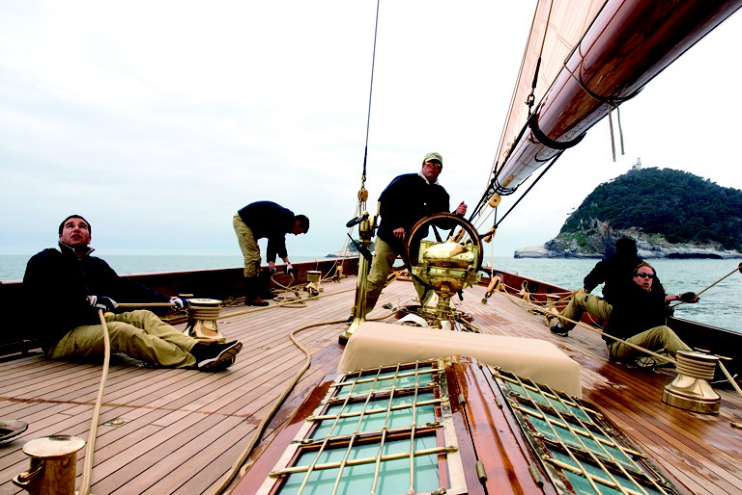
Upgraded sails plan, rigging and deck equipment enable facilitated maneuvers and reduce crews as required for operational purposes, also in compliance with regulations that were not in force and binding at the time that vintage yachts were launched. There is a need to introduce new technology to enhance sail plan control that affects the upper deck morphology while maintaining the solid and void architecture of deckhouse and cockpit to their original design. (Fig.1)
Figure 1. A design of Herbert W. White, launched in 1920, Lulworth is the world’s larger surviving gaff rigged cutter, the last of mythic British Big Class. Completed extensive restoration at Studio Faggioni Yacht Design of La Spezia, Italy, 2001-2006.
Image: Lulworth sailing after restoration, photographed by Francesco Rastrelli.
For vintage yachts older than 75 years, it is rare to find exemplars in their original designed state. Also, there may be uncertainty about a yacht’s original designed plan based on documentation as available. Designers would personally engineer post launch upgrades to their original JClass race plans to improve their performance. Among others, this is the case with JClass Astra, a 1927 design of Camper & Nicholson, who reconfigured it to a new sail plan and water ballast ratio twenty years later. Because of this, there are difficulties in establishing a philological order and identify whether Astra’s authentic configuration is its original built condition or the condition after it was upgraded to an optimized performance. Because this is in issue, we argue that there is consistency in utilizing design skills and tools to upgrade and enhance a yacht’s usability features to keep it alive, the same as the yacht’s original designers did. For purebreds designed to be raced and subsequently owned to serve new purposes as cruise or charter work, there is a need for domestication to enable a new usability with smaller crews and adjusted parameters of guest spaces below deck. Because navigational safety and comfort have found an organic definition in an ergonomic approach, it is also Human Aspects of Transportation I (2021) indispensable to comply with those norms that discipline the relation of human work and the goods that are instrumental to it. This includes all elements that are in a relation with the operations that are routinely performed as part of human work. Applied to yacht design, this discipline focuses on all aspects where an interface exists between instruments and users.
One particular field of application of ergonomics to the redesign of sailing craft is a yacht’s deck, where multiple activities take place in restricted spaces. For sailing yachts, propulsive functionality is a responsibility of crews who simultaneously interact with the yacht’s equipment integrally. Cockpit and deck on board racers and cruisers alike epitomize a testing ground for human factors and safety of operations in terms of spaces and sizes, posture and coordinated motion, load levels on muscular and skeletal systems in various maneuvering positions.
Modern design and engineering ensure safety margins on deck that are absolutely superior than in the past, both based on recently defined regulations and an in depth analysis of functions, operational dimensions, range, correct general logistics positions, reciprocal distances of various maneuvering positions in respect of winches, rails, gearings, halyards, sheets, cordage, et cetera. Winches, rails, and controls are located to optimize performances aligned to human factors considerations as earlier discussed. Because classic yachts came earlier than these concepts, to upgrade their sail plan and maneuverability can only be consequential to a larger operational rationalization. Safety in operations and onboard livability may not be secondary when design has a focus on a rationalization of the potentialities of an existing exemplar.
The restoration of historical craft affects both their operational efficiency and aspects in relation to better onboard livability, involving comfort levels of interior spaces and of all activities that are in association with routine organization below deck.
Preserving the original yacht layout and bulkhead partitions, interior décor upgrades are possible at a variety of levels to serve the purposes that generated them. In a comprehensive work logic, restoration enables limited changes that may not compromise the original yacht design in the name of better habilitability, to the extent necessary to adapt interiors to human factors considerations as contemplated under current legislative trends on marine safety and livability. Also, there is a need to consider an evolution of home habits and habitability requirements.
Specific style and form criteria condition improvements to classic designs, such that additions must be completely integrated in the general development of the original décor. Interventions typically focus on critical kitchen, restroom facilities, cabin comfort and operational facilities and equipment.
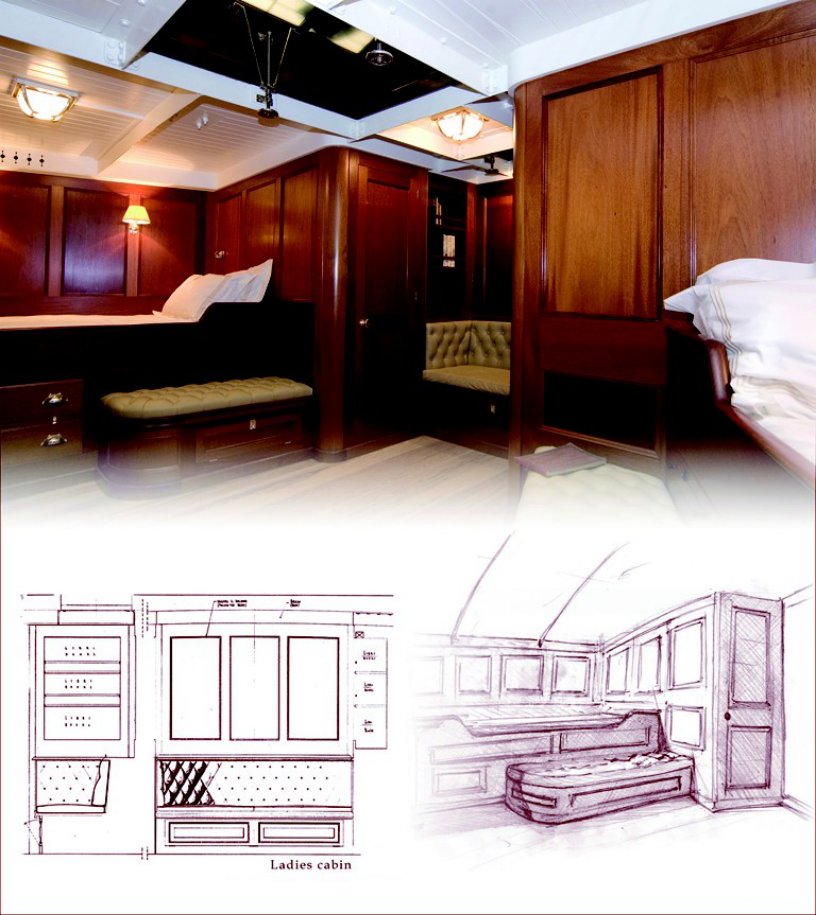
Adaptability and usability are key concepts applicable to the interior redesign of a historical yacht. To exemplify one aspect of this work, cabin décor elements were designed based on significantly different concepts than contemporary overall design practices. Owner quarters normally featured a double berth on the yacht’s side, sometimes at a greater elevation above floor level than is compliant with current applicable regulations.
There is consistency in updating these aspects and preserve the original interior décor character, utilizing simple steps at floor level to facilitate access to bed in comfort. (Fig.2-3)
Figure 2. Lulworth, master stateroom, restoration project details and image after restoration .Figure 3. Lulworth, captain’s room, restoration project details and image after restoration
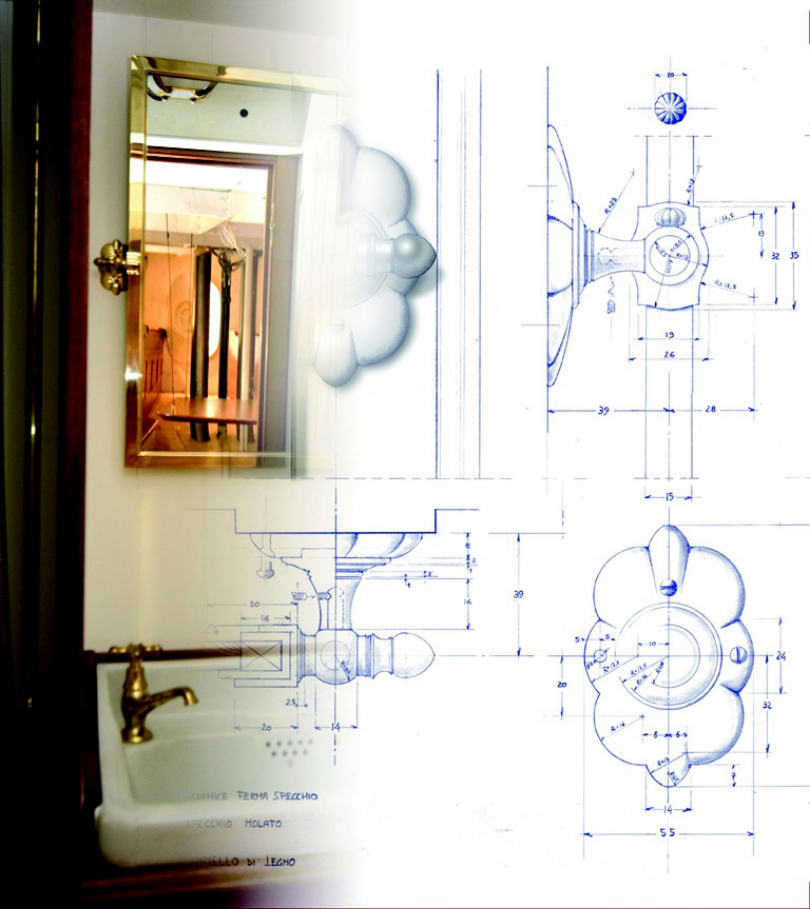
Interior spaces that are also noncompliant in respect of current standards are restroom facilities. Spartan, undersized spaces, peripheral to the overall yacht’s design, restroom facilities hardly accord with current standards and need substantial updating to meet the needs of a changed culture and lifestyle. (Fig.4)
Facilities are an important component for which update is indispensable. This include the redesign of kitchen technology.
Figure 4. Lulworth, restroom facilities, restoration project details and image after restoration
Contemporary kitchen technology is a must both at home or on board a classic yacht. To utilize kitchen appliances and equipment that guarantee efficiency in terms of the yacht’s energy balance justifies the replacement of obsolete elements that are both noncompliant with current safety legislation3 and with the standards of primary classification societies internationally4.
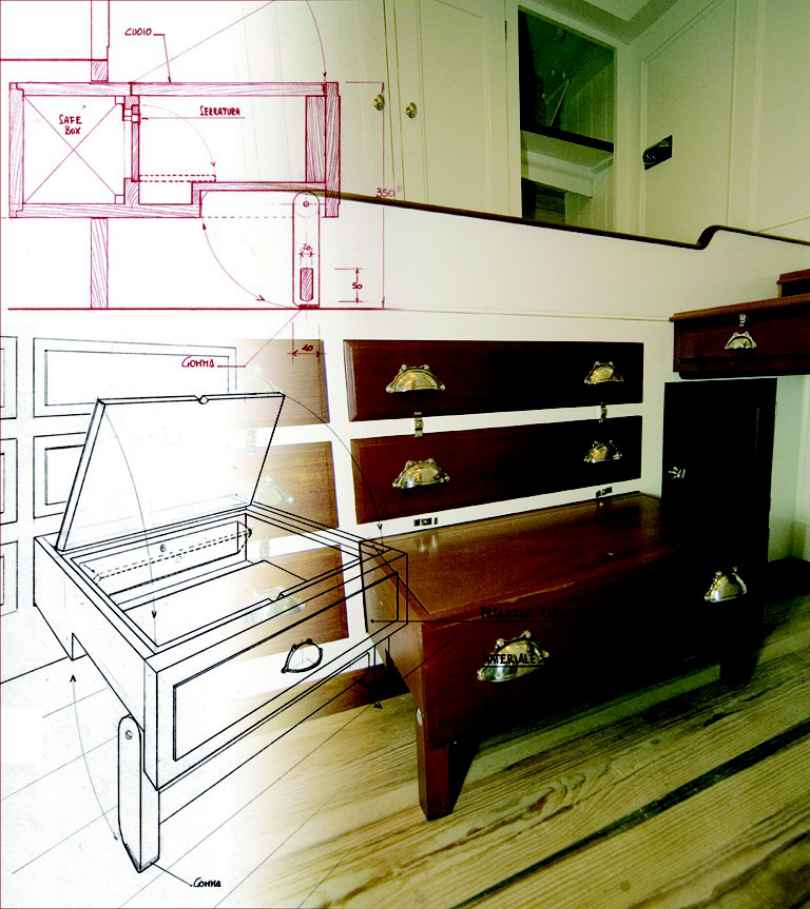
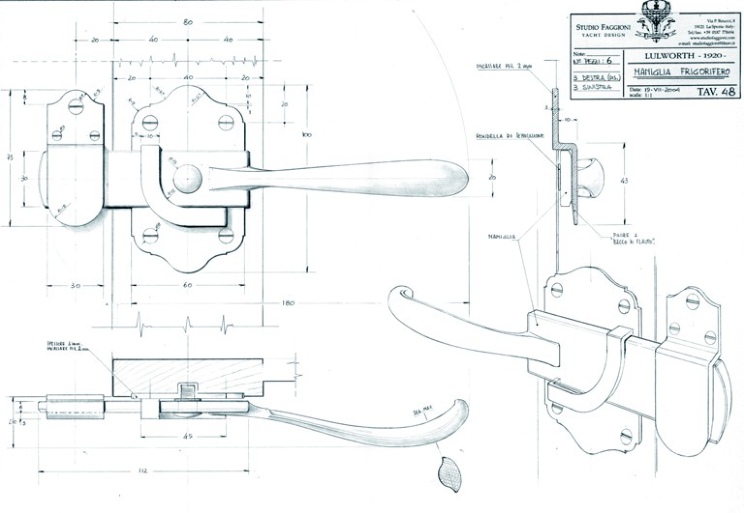
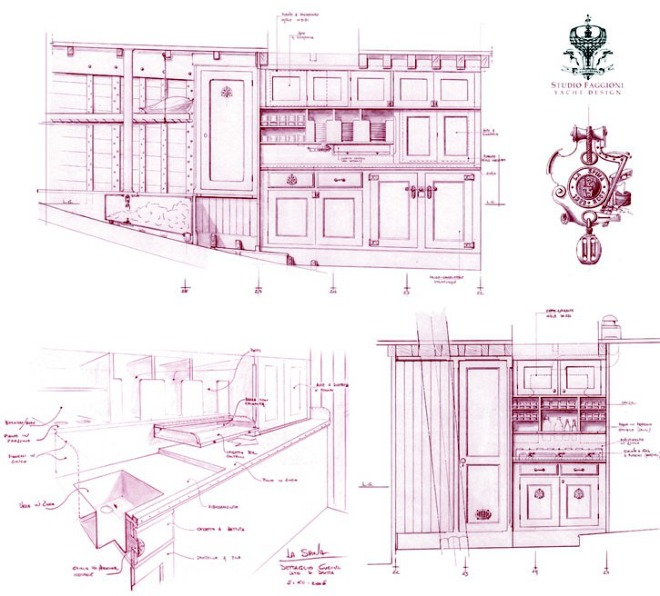
There is a need to replace or else integrate, in a careful mimesis, each single element, from dishwasher to refrigerator, to fit in the original vintage décor5 of these charming ‘ladies of the ocean’ yachts. (Fig.5-6-7-8)
Figure 5. Lulworth, detail of individualized icebox upgrade based on original galley styleFigure 6. Lulworth, detail of individualized restoration to integrate sink and original galley décor
Figure available in the original PDF paper.
Figure 7. A realization of Cantieri Baglietto of Varazze, Italy, launched in 1929, La Spina is Italy’s first built 12 meter SI sailing yacht. Completed extensive restoration at Studio Faggioni Yacht Design of La Spezia, Italy, 2005-2008. Drawings highlight design effort to upgrade galley appliances and equipment to enhance onboard livabilityFigure 8. La Spina, restoration project, plan of kitchen and restroom facilities. Drawings show design effort to optimize and upgrade both spaces to enhance onboard livability
Figure available in the original PDF paper.
Also at the same time that interiors are modified, aligned to current hygrothermal comfort standards, the possibility to modify existing interiors and install – rigorously integrated in the original interior design and hidden from sight – heating and air conditioning systems.
Contemporary habitability styles strongly characterize the offer of technology for basic utilities in fields that include the recreational marine industry. Home automation is increasingly a determinant of interior comfort levels as a key aspect of buying decisions in the yachting industry, in regard to both new and historical craft. Indispensable onboard equipment includes such utilities that enable the same livability standards as a residential setting. This involves control technology for environmental comfort, multimedia, information and entertainment, auxiliary instrumentation including bow thrusters, tension inverters in support of portable devices as are ordinarily indispensable.
Technological implementation interfaced with evolving customs affects a yacht’s habitability and its maneuverability and navigational instrumentation. Advanced multiple device panel instrumentation that controls onboard functionalities – engines, trim controls or stabilizers, lightning, environmental conditioning, hydraulic systems, geolocation systems, communication – necessitates to be integrated and aptly concealed on board classic yachts.
The organization of advanced navigational systems configured in accordance with current cognitive ergonomics is no ‘impossible thing’ for classic yachts. To upgrade a yacht design to current requirements is both a good design practice and obligatory under applicable legislation, particularly in such cases as, for example, when private yachts for charter are involved. There are safety issues in this respect that are a responsibility of owners towards yacht charterers, under normal circumstances.
Finally, under such legislation as, for example, SOLAS6 rules for yachts carrying more than 12 passengers, interior décor materials, finishes, coatings, wall coverings, paneling and tapestry, window drapery must be in conformity with fire prevention legislation7. It is the responsibility of owners to eliminate any nonconformity in respect of current legislation on the safety of human environments.
CONCLUSIONS
We argue that the talent, knowledge and cultural sensitivity of designers, through an ability to skillfully integrate ‘the old and the new’ will successfully enable better upgrades to classic yachts, that are both in accordance with the original yacht design and functional to avoid their anachronistic unsuitability and inevitable dereliction.
FOOTNOTES 1 Periodic surveys of newly built RINA classed yachts that are CE compliant are conducted no later than 8 years of RINA’s original classification for A and C categorized yachts, and no later than 10 years of RINA’s original classification for C and D categorized yachts. Subsequent inspections are on a five year basis. RINA’s surveys consist in a series of analysis that normally focus on hull, helm and shafting line, pump room, piping and safety valves, engine cooling and exhaust system, fuel system, bilge system, electrical system, fire safety systems, kitchen gas supply systems.
2 Shamrock V is a JClass sailing yacht. A design of Charles Ernest Nicholson for Sir Thomas Lipton’s fifth and last America’s Cup challenge, lost to US design Enterprise.
3 European Electromagnetic Compatibility EMC Directive 89/336/EEC
REFERENCES
Ciocchetti, D., Rosa, A. (2006), “I Relitti Galleggianti. Riccardo I. L’ultima Comacina di Comacchio. Storia di un recupero”, in: Il MiBAC ricerca e applicazioni a confronto, Atti del convegno, Venezia 1-3 dicembre 2006, X Salone dei Beni e delle Attività Culturali. Di Maggio, P. (2005), “La dichiarazione delle imbarcazioni storiche: Il recupero di Pianosa”, in: Yachting Library, Library
Editore srl, Milano. Faggioni, S. (2002), “Storia, Tecnologia e Committenza: restauro di una barca d'epoca”, in: DDD -Rivista trimestrale di Disegno Digitale e Design, anno 1 n°3, Edizioni Poli.Design, Milano, lug/set 2002. p. 47. Giacinti, R., Fani, A. (2009), “Proposta di legge sull’istituzione del Registro delle Imbarcazioni di Interesse Storico”, Convegno
Vele Storiche Viareggio. Giacinti, R., Marino, G. (2006), “Tutela e valorizzazione di imbarcazioni storiche”, in: Terzo Settore, Il Sole 24 Ore, n°12, Gruppo 24 Ore, Milano. Giacinti, R., Cambi, S. (2011), “Inquadramento fiscale dei servizi di rimessaggio di imbarcazioni svolti dai circoli nautici”, in:
Terzo Settore, Il Sole 24 Ore, n°10, Grupp 24 Ore, Milano. Giacinti, R. (2009), “DDL di regolamentazione delle imbarcazioni d’epoca”, in: Yacht Digest, n°155, Nautica Editrice, Roma. Giacinti, R., Fani, A. (2009), “Proposta di legge sull’istituzione del Registro delle Imbarcazioni di interesse Storico”, Convegno Associazione Vele Storiche di Viareggio. Giacinti, R., Fani, A. (2008), “Proposta di regolamentazione delle imbarcazioni d’epoca e di interesse storico”, Bozza disegno
di legge, IV Raduno Associazione Vele Storiche Viareggio. Giacinti, R. (2008), “Il bene culturale barca visto dalle associazioni”, in: Nautica, n°552, Nautica Editrice, Roma. Giacinti, R. (2012), “Il Redditometro della nautica”, in: BEC–Barche d'Epoca e Classiche, anno 2 n°4, gen/feb/mar. Giacinti, R. (2013), “Il Redditometro per le barche d'epoca”, in: BEC-Barche d’Epoca e Classiche, anno 3 n°11, ott/nov/dic. Giacinti, R. (2013), “Il Registro delle imbarcazioni storiche con la Legge di Stabilità 2012”, Convegno Associazione Vele Storiche di Viareggio. Giacinti, R. (2012), “Inquadramento fiscale dei servizi di ormeggio svolti da circoli nautici”, in: BEC-Barche d’Epoca e
Classiche, anno 2 n°6, lug/ago/set. Giacinti, R. (2007), “L’imbarcazione storica come bene culturale”, Seminario III° Raduno Vele Storiche Viareggio. Giacinti, R. (2008), “La barca storica come bene culturale”, in: Nautica, n°553, Nautica Editrice, Roma. Giacinti, R. (2008), “Norme per le imbarcazioni d’epoca e di interesse storico e collezionistico”, Convegno Associazione Vele Storiche di Viareggio. Moretti, M., Liberati, S. (1995), “Guida alla stima di un'auto d'epoca. Metodologia di analisi e valutazione”, Palombi Editori,
Roma. Morozzo della Rocca M. C. (2010), “Le radici del design nautico contemporaneo. Rapporti disciplinari e ambiti progettuali. The roots of contemporary naval design. Interdisciplinary elements and fields of design, in: Falcidieno M.L. (a cura di), Le scienze per l’architettura. Frammenti di sapere / Architectural sciences. Fragments of knowledge, Allinea, Firenze. pp. 340- 359. Morozzo della Rocca M. C. (2009), “Le tipologie contemporanee, definizione dei recenti modelli nautici”, in: Musio Sale M.,
Yacht design, dal concept alla rappresentazione, Tecniche Nuove editrice, Milano. pp.39-55. Morozzo della Rocca M. C. (2009), “Nuovi scenari per il design nautico, il design per il restauro occasioni di riflessione”, in: Musio Sale M., Yacht design, dal concept alla rappresentazione, Tecniche Nuove editrice, Milano. pp.39-55. Morozzo della Rocca M. C. (2006), “Un’esperienza assoluta, Lulworth raccontata da Stefano Faggioni”, in: GUD, Genova
Università Design, n°6, Alinea Editrice, Firenze. pp.82-93. Morozzo della Rocca M. C. (in press), “Imbarcazioni Storiche, problematiche e prospettive per la valorizzazione e il restauro”. Nardella D. (2004), “Uscita e ingresso nel territorio nazionale”, in: AA. VV., Il codice dei beni culturali e del paesaggio, il
Mulino, Bologna. Petragnani Ciancarelli A. (2005), “Il formale riconoscimento di interesse culturale per un'imbarcazione storica”, in: Nautica n°516, Nautica Editrice, Roma. p. 246. Prud Homme G. (in press), “Le label Bateau d’interet patrimonial”, in: Atti del Convegno “Censimento e tutela del naviglio
storico e tradizionale in Italia. Le imbarcazioni da lavoro”, Cesenatico 17 giugno 2009, Museo della Marineria di Cesenatico e di ISTIAEN. Riccardo A. (2006), “L’Ultima delle Comacina di Comacchio. Storia di un recupero” in: Archeologia e Territorio, Atti del Convegno Paestum 16-19 novembre 2006, IX Edizione Borsa Mediterranea del Turismo Archeologico. Robinson J. (in press), “Censimento della flotta storica: l’esperienza britannica”, in: Atti del Convegno “Censimento e tutela del
naviglio storico e tradizionale in Italia. Le imbarcazioni da lavoro”, Cesenatico 17 giugno 2009, Museo della Marineria di Cesenatico e di ISTIAEN. Rodrigo De Larrucea J. (2009), “La protection del patrimonio flottante: hacia un estatuto juridico del buque historico, Comunicazione per la “Jornada tècnica sabre la gestión de embarcaciones históricas”, in occasione del Salone Nautico Internazionale di Barcellona 2009, Museu Maritim de Barcelona. Rosa A. (2006), “Barche tradizionali dell’Adriatico. Tutela del Patrimonio Storico Artistico Etnoantropologico”, in: Atti del
Convegno Paestum 16-19 novembre 2006, IX Edizione Borsa Mediterranea del Turismo Archeologico. Rosato G. (2011), “La tutela e il restauro delle imbarcazioni storiche”, Ministero per i Beni e le Attività Culturali, Soprintendenza Beni Storici Artistici, Etnoantropologici della Liguria. Zaccagni E. (2006), “Vintage Yachts: il lavoro del project management”, in: Yachting Quarterly, n°10, Fabio Ratti Editoria,
Milano. Zignego M.I. (2012), “Yacht Refitting. Nuove frontiere dell’allestimento nautico”, Aracne Editrice, Roma.
Advances in Human Aspects of Transportation: Part I
Read this individual research paper free through the original publisher, or explore the full digital proceedings book.
ISBN 978-1-4951-2097-8
Explore this ISBN in the AHFE Bookstore ↗Listed in the July 2026 bookstore catalogue; search by ISBN to confirm current availability · Digital book purchase optional