Katherine L. Plant, Neville A. Stanton (2021). A Qualitative Exploration of Critical Incidents: Expanding Neisser’s Perceptual Cycle Model. In: Advances in Human Aspects of Transportation: Part I. AHFE Open Access, vol. 15. https://doi.org/10.54941/ahfe100604
The Perceptual Cycle Model (PCM) presents a process-orientated approach to understanding decision making by exploring the interaction between a person’s cognitive schema, the actions they undertake and information available in the world. This paper presents the work undertaken to refine and subcategorize the three elements of the PCM; schema, action and world, to gain a more detailed understanding of the aeronautical decision making process. Critical decision Method interviews were conducted with twenty rotary wing pilots to generate a set of critical incidents. These incidents were qualitatively analyzed using a coding scheme generated from the PCM and then the constant comparison technique was employed to generate the refined PCM coding scheme. The final PCM coding scheme contained 7 ‘schema types’, 14 ‘action types’ and 12 ‘world types’. Three critical incident case studies are presented to demonstrate the insights gained from using the refined coding scheme. Potential applications and plans for future research are discussed.
Aeronautical decision making is a form of Naturalistic Decision Making (NDM: Klein, Calderwood, and Macgregor, 1989) in which decision makers have domain expertise and make decisions in contexts that are usually characterized by limited time, goal conflicts and dynamic conditions. The most popular model in the NDM domain is Klein’s (1998) Recognition Primed Decision (RPD) model. In summary, this captures how experts make decisions based on recognition of past experiences that are similar to the current situation. These experiences are used to generate one workable option before considering other options, a process known as satisficing (Klein, 1998). In complex cases evaluation of the option reveals flaws that require modification or the option is rejected in favor of the next most typical reaction. Klein (1998) highlighted dynamic conditions, i.e. the changing situation, as one of the key features of NDM. As new information is received or old information becomes invalid the situation and goals can be radically transformed. This cyclical nature of decision making is referenced in the RPD model in terms of mental simulation but this is only internal to the decision maker. The cyclical nature of a changing external environment is not fully captured in the RPD model. Similarly, the implementation of the model does not connect the internal process of the decision maker to the external environment in which decisions are made. The explanation provided by the RPD model is primarily one of the decision making processes occurring in the head of the decision maker. However, decision making of any kind, especially in the dynamic conditions that characterize the NDM environment, is a product of the interaction of the processes going on in the head of the decision maker and the conditions in the external environment. As Dekker (2006) argued, in order to truly understand decision making it is essential to account for why the actions and assessments undertaken by an operator made sense to them at the time.
What makes sense for a decision maker will be based on internal information in the head and external information in the environment. As such, we propose that Neisser’s (1976) Perceptual Cycle Model (PCM) is a more suitable framework to model decision making processes because it accounts for the cyclical interaction that occurs between an operator and their environment in a way that is not captured by the RPD model.
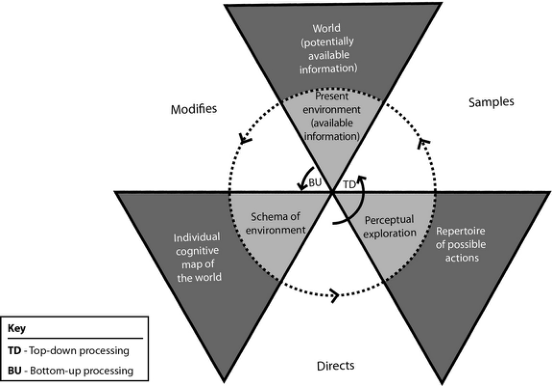
Figure 1. The Perceptual Cycle Model (adapted from Neisser, 1976) As illustrated in Figure 1, Neisser presented the view that human thought is closely coupled with a person’s interaction in the world, both informing each other in a reciprocal, cyclical relationship. World knowledge (schemata) leads to the anticipation of certain types of information (top-down processing, TD in Fig.1); this then directs behavior (action) to seek out certain types of information and provides a way of interpreting that information (bottom-up processing, BU in Fig.1). The environmental experience (world) results in the modification and updating of cognitive schemata and this in turn influences further interaction with the environment. The role of past experience is emphasized in the PCM, as Neisser proposed that schemata are the medium in which the past affects the future, i.e. information previously acquired will determine what will be sampled next. The PCM has seen widespread application across a variety of domains (e.g. Stanton and Walker, 2011; Salmon et al., 2013). In the aviation domain the model has been applied to account for the actions of the pilots involved in the Kegworth plane crash (Plant and Stanton, 2012) and to explain aeronautical decision making when dealing with critical incidents (Plant and Stanton, 2013). It should be noted that the research presented in this paper is in the context of decision making by rotary wing pilots. The difference in accident rates between fixed and rotary wing pilots is a driving force of this research. The Civil Aviation Authority’s Aviation Safety Review (2008) reported that the accident rate for public transport helicopters was 19.1 per million hours and the fatal accident rate was 3.1 per million hours, this can be compared with 4.8 per million hours for public transport aeroplanes over the same timeframe (with a corresponding fatal accident rate of 0.2 per million hours). Therefore it is seems relevant to explore decision making processes of rotary wing pilots in an attempt to increase safety levels in this area. Whilst the PCM offers an explanatory framework for aeronautical decision making, the account of the decision making process is at a relatively high level. Neisser (1976) described the three elements of the PCM as being: schema, action and world, but did not further subcategorize these elements. The intention of this paper is to showcase a refined PCM classification scheme in order to gain a fuller understanding of the perceptual cycle that pilots engage during critical incident decision making.
METHOD
Critical Decision Method The Critical Decision Method (CDM; Klein et al., 1989) is a knowledge elicitation tool devised to extract the content knowledge of experts from a naturalistic setting. This is achieved through the use of cognitive probes as a tool for reflecting on strategies and reasons for decisions during non-routine situations. Since its development the CDM has been extensively used in a variety of domains including emergency dispatch management (Wong et al., 1997), critical care nursing (Crandall and Gretchell-Reiter, 1993) and aviation (O’Hare et al., 1998; Plant and
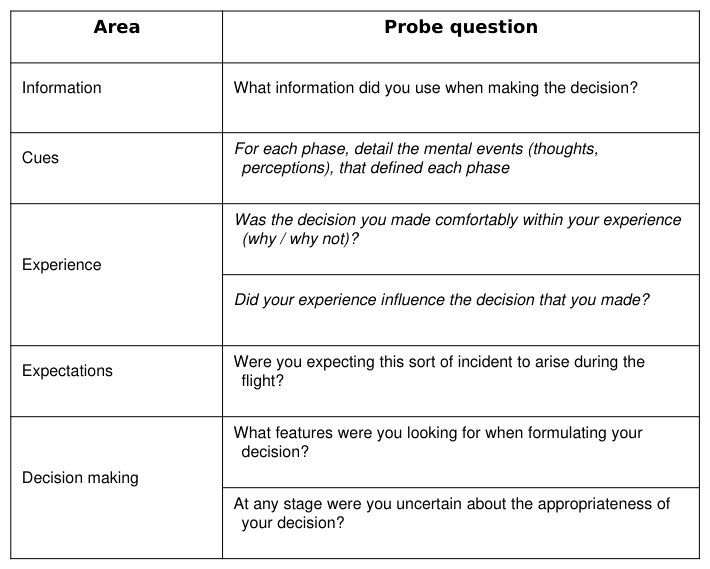
Stanton, 2013). The CDM elicits expert knowledge by asking people to discuss previous incidents they were involved with. The process of eliciting information is via cognitive probes in a retrospective semi-structured interview. Crandall et al. (2006) described the four phases for conducting a CDM interview: (1) Incident identification, (2) Timeline construction, (3) Deepening probes and (4) “what if” queries. Interested readers are directed to additional texts for the full CDM procedure (for example: Crandall et al., 2006; Klein and Armstrong, 2005; Stanton et al., 2005). A shorter version of the method is permitted when time with experts is limited. For this, Crandall, Klein, and Hoffman (2006) have suggested that the probes are asked in relation to the whole incident as opposed to each phase of the incident. It is acknowledged that the probes have been modified over the years and researchers are encouraged to modify the list as necessary for their individual research projects (Klein and Armstrong 2005; Crandall, Klein, and Hoffman 2006). In the light of this research project, five additional probes were added that expanded certain areas of the original CDM probes to increase their relevance to the elicitation of schemata (i.e. drawing out the role of experience and expectations). A selection of probes, including the additional ones is included in Table 1.
Table 1: Examples of CDM knowledge elicitation probes (additional probes in italics) Area Probe question
Procedure The CDM interview was conducted with twenty rotary wing pilots each with varying levels of experience and employed in a variety of aviation occupations including Search and Rescue, personal passenger transfer and military. Ethical permission for the study was granted by the University of Southampton’s Research Ethics committee. Each pilot was asked to recall a critical incident in which they had been the primary decision maker. A critical incident was defined as being ‘a non-routine or unexpected event that was highly challenging and involved a high workload’. Each interview last between 30 and 60 minutes.
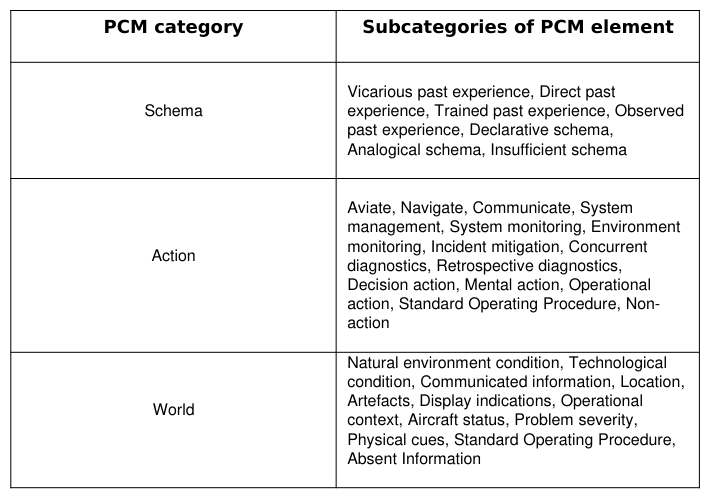
Qualitative data analysis The interviews were audio recorded and transcribed. In accordance with guidelines on qualitative data analysis the transcribed interviews were chunked into meaningful segments of approximately one sentence or less in length (Strauss and Corbin, 1990). Deductive thematic analysis was used to analyze the text segments. This involves classifying the data into meaningful themes generated from existing theory (Boyatzis, 1998). The coding scheme was based on the three categories of the PCM (schema, action and world) and text segments were coded for instances of the themes identified. This method has been previously applied before for accident reports (Plant and Stanton, 2012) and decision making data (Plant and Stanton, 2013), in which the coding scheme has demonstrated high levels of inter-and intra-rater reliability (Plant and Stanton, 2013). Once the interview data had been coded into the three elements of the PCM, further thematic analysis was undertaken using constant comparison technique to generate a more detailed coding scheme, whereby each text segment was compared with previous items as to whether the same or different phenomenon was described. This resulted in a perceptual cycle coding scheme that contained 7 schema types, 14 action types and 12 world types (see Table 2). The CDM interviews were then coded using this detailed classification scheme.
Table 2: Schema subcategories PCM category Subcategories of PCM element
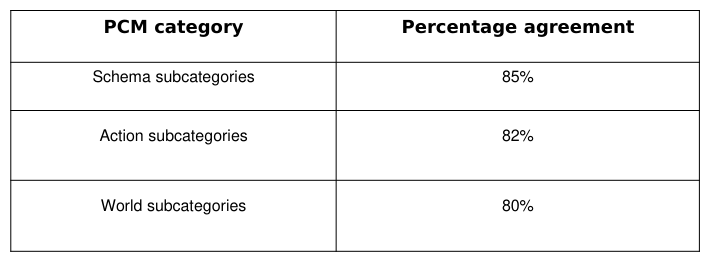
As with all data analysis, but particularly qualitative data analysis, reliability is of paramount importance. It has previously been demonstrated that the original PCM coding scheme based on the three primary elements of schema, action and world generated high levels of inter-rater (86%) and intra-rater (83%) reliability over a four week period (Plant and Stanton, 2013). The new classification scheme described here has been subjected to preliminary tests of inter-rater reliability with three coders coding 216 text segments. Their code assignments were compared to the criterion coder’s assignments (lead author) and percentage agreement was calculated. Literature suggests that agreement over 80% indicates an acceptable level of reliability (Jentsch and Bowers, 2005). The results are presented in Table 3.
Table 3: Preliminary inter-rater reliability results (average percent agreement) for the classification scheme
CASE STUDIES The critical incident interviews were coded using the refined coding scheme. All incidents were structured into six key phases, which was generated from an amalgamation of the phases identified by each pilot during their interview. The six phases were: (1) pre-incident, (2) onset of incident, (3) Immediate actions, (4) Decision making, (5) subsequent actions, and (6) incident containment. Case studies are presented here to demonstrate the application of this coding scheme to understanding different types of decision making during critical incidents.
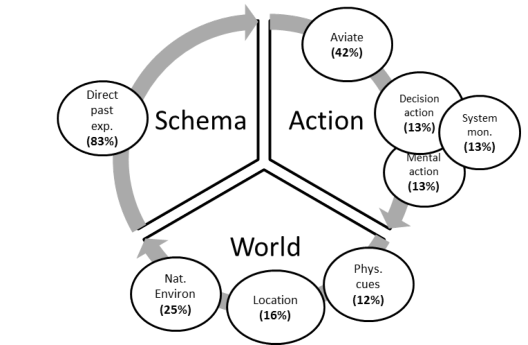
Case study 1: Landing in marginal weather The first case study was a critical incident that occurred when the pilot was conducting a passenger transfer flight from London to Exmoor in the UK. The pilot was relatively experienced with 1900 hours of flying. The incident occurred when flying an AW109, in which he had 500 hours on type. The weather was marginal and the passengers were nervous and kept pressing the intercom to talk to the pilot about whether they would be able to land. This resulted in a lot of distraction for the pilot and the weather continued to worsen. At the descent point the pilot lost all visual references and had to perform scud running (lowering the altitude to avoid clouds in order to maintain any visual references) whilst continually being distracted by the passengers. The pilot defined the critical incident as the moment that the descent was made from altitude, when the decision height was reached and the pilot was committed to landing in weather conditions that were not appropriate. This incident was broken down into 62 text segments. Of these, 52% related to world information, 38% related to action and 10% to schema. Figure 2 depicts the main subcategories represented in the data for each PCM element (percentages relate to the category data, i.e. 83% of the schema text segments were coded as direct past experience). The majority of data related to world information which suggests that the pilot was mainly using a bottom-up approach for processing information, i.e. using data in the environment. Within this, 25% of the data was related to the natural environment. This is unsurprising given the nature of the incident in which the pilot was concerned about the marginal weather where statements included: “visually I had about 1000m forward” and “it was poor visibility, darkness”. Location (16%) and physical cues (12%) also featured highly as data in the world category which again corresponds with the nature of the incident. Of the action text segments, 42% related to aviate which is defined as ‘statements relating to the direct manipulation (handling) of flight controls’, i.e. flying the aircraft. This suggests that the incident was associated with a high piloting demand, which is to be expected when trying to control an aircraft in marginal weather conditions. The schema data only accounted for 10% of all the data, of this, 83% was related to direct past experience (e.g. “…it is a site I have been to before…I knew where certain features [of the landing site] were…”). Direct past experience was only represented in the data from the decision making phase of the incident onwards. This suggests that top-down information processing (i.e. using knowledge and expectations to guide processing) was mainly utilized in the decision making and subsequent action phases of the incident, rather than in the earlier stages of the incident.
Figure 2. Percentages of most represented subcategories in each PCM element for the incident of landing in marginal weather
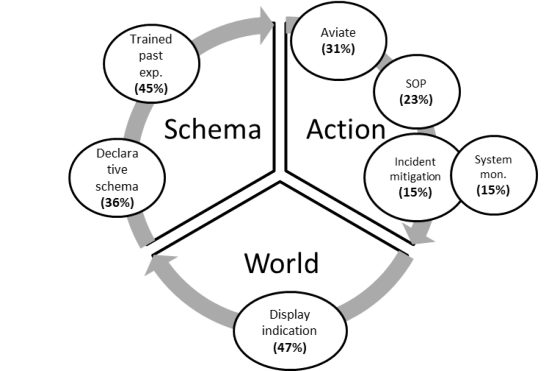
Case study 2: Engine fire warning The second case study came from an experienced military pilot with 9500 flying hours. The incident occurred when he was flying a Twin Squirrel as part of a military training exercise, at the time of the incident the pilot had 200 hours on type. Whilst in flight the central warning light came on and the pilot was alerted via an audio message to an ‘engine fire in number 1 engine’. The pilot followed the procedures and fired the fire bottle into the engine bay, this resulted in the warning lights going out but then the warning lights and audio tone came back on again, so the pilot fired the second fire bottle and the warnings went out again but then came back on again and so the pilot had to land the aircraft by returning to base which was the nearest airport. The engineers determined that the incident was the result of an electrical fault with the warning system rather than an engine fire. The incident was broken down into 39 text segments and there was a more even spread of data between the three elements of the PCM, compared to the previous case study: world (38%), action (33%), and schema (28%). Figure 3 depicts the main subcategories represented in the data for each PCM element. Within the world data, 47% was coded as display indication, and the rest of the world data was evenly spread (7%) over 8 different world categories (technological conditions, location, artefacts, operational context, aircraft status, severity of problem, physical cues and absent information). The high proportion of world data attributed to display indications fits the nature of the incident; the repeated activation of the warning lights meant that much of the pilots attention in the environment was focused on the display indications in the aircraft, statements relating to this included “the light on the instrument panel went out”, “the light came on again” and “the fire light was on, there was no other indications”. The subcategories of the action data included, aviate (31%), Standard Operating Procedure (23%), system monitoring (15%) and incident mitigation (15%). Within the schema subcategories, trained past experience (45%) and declarative schema (36%) were most represented. Information processing for this incident was more evenly spread between top-down and bottom-up processing and was spread throughout all the phases of the incident. The top-down processing (use of schemata) appears to be appropriate for the nature of the incident; trained past experience (defined as the statements relating to knowledge developed by experiencing a specific task, event or situation within the confines of a training scenario) and declarative schema (defined as statements relating to a schema that manifests as a descriptive knowledge of facts, usually as a product of the world information available) were the most represented categories. For certain incidents, such as an engine fire, there would be no other way to react apart from following the facts as they are presented and training guidelines. Similarly, the most represented actions of flying the aircraft, following standard operating procedures, monitoring the systems (displays) and incident mitigation (acts to reduce the potential severity of the incident) are in line with the bottom-up and top-down processing that occurred when dealing with the incident.
Figure 3. Percentages of most represented subcategories in each PCM element for the incident of engine fire warning
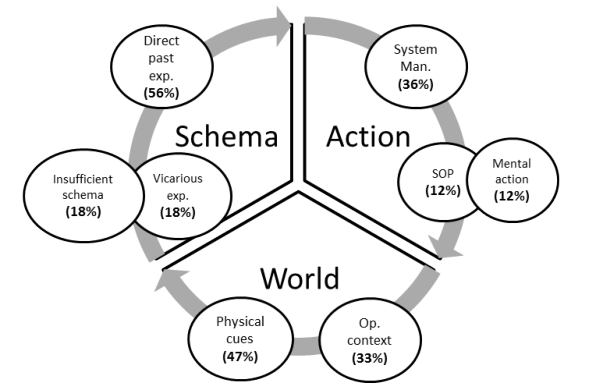
Case study 3: Engine surge The final critical incident occurred during a training exercise when flying a Gazelle with a pilot who had 1500 type hours (and total hours) of experience at the time. The incident happened on the ground before take-off. The pilot was in the process of carrying out the pre-start checks and instead of checking the engine switches were off, he proceeded to start the engine, without realizing, and then continued with the pre-engine start checks. One of the checks was for the throttle and the action of checking the throttle, with the engine on, resulted in an engine surge which caused a loud explosion. The pilot cancelled the training sortie as he felt the crew was being too rushed which resulted in the incident. This incident was broken down into 59 text segments and is a very action-heavy incident, with 59% of the data being coded as action, 25% as world and 19% as schema. Figure 4 depicts the main subcategories represented in the data for each PCM element. Within the data coded as action, system management (statements relating to the processes of making inputs into technological systems of the aircraft) was the most represented subcategory (36%), followed mental action (12%) and standard operating procedure (12%). The world data was mostly coded as physical cues (47%) and operational context (33%). Within the schema category, direct past experience accounted for 56% of the data, followed by vicarious experience (18%) and insufficient schema (18%). As with the previous case study, there was a relatively even spread between top-down and bottom-up information processing and this occurred throughout all phases of the incident. The subcategories of the PCM elements that were represented in this case study align with the nature of the incident. For example, the main action type was system management as the pilot interacted with the technological systems before the incident in the pre- start checks and afterwards to mitigate the effects of surging the engine, where he reverted to following standard operating procedures. Physical cues were the most represented world-type and this included the noises and vibrations from the surged engine. There was a range of schema-types; the pilot stated he had never surged an engine before but knew what it was because he had heard sound clips (vicarious past experience) and the direct past experience codes were assigned to statements relating to his knowledge that something was wrong because he knew what to normally expect and this situation was very different.
Figure 4. Percentages of most represented subcategories in each PCM element for the incident of surging the engine
DISCUSSION
This paper has presented the work that has been undertaken so far to refine the categories of the PCM in order that a more detailed description of decision making can be provided. As highlighted in the introduction, the PCM has been used for a variety of applications, specifically related to aviation, these include analyzing the Kegworth plane crash (Plant and Stanton, 2012) and exploring aeronautical decision making (Plant and Stanton, 2013) however this has been at a high level of description with focus on the three categories of the PCM: schema, action and world. To our knowledge, the model has not previously been refined, thus we anticipate this research will be a valuable contribution to the Human Factors literature. Twenty critical decision method interviews were thematically analyzed to develop the coding scheme. Three case studies were presented to exemplify the application of the classification scheme when exploring critical incident decision making from the perspective of the perceptual cycle.
Applications The intention of refining the PCM is to provide a more detailed and explanatory descriptions so that that specific relationships and patterns can be explored to better understand the aeronautical decision making process. Rather than just stating that ‘world information’ was used, by employing the more refined classification scheme an analyst is able to identify what type of information a person is using at what stage of a critical incident. For example, in case study two the pilot made most reference to world information in relation to display indications. This was not surprising given the nature of the critical incident (engine fire warning). Similarly, rather than just attributing something to the broad category of schema, it is useful to know what type of schema is being used and when. For example, in case study one the majority of schema data related to direct past experience. This suggests that the pilot was using his previous experience of flying to the site to inform his decision on whether to land, rather than utilizing any other sort of schema, such as training.
Gaining an understanding of the subcategories of the PCM is useful for a variety of reasons. A detailed classification scheme allows for insights about where information is coming from and whether this is appropriate for the task in hand. For example, if an operator was shown to be relying on vicarious past experience (defined as statements relating to experiencing something in the imagination via description by another person or documentation) rather than utilizing direct or trained past experience, this could imply that training ought to be redesigned to reflect this gap in their knowledge base. It is also interesting to establish what is not included in the subcategory analysis. For example, in the schema data for case study one, the pilot made five references to direct past experience (and one reference to analogical schema), but no reference was made to trained past experience. The incident involved landing in marginal weather and it is possible that the pilot somewhat contravened his training by landing in the conditions that he did, but this decision was made based on his previous past experience. Conversely, in case study two, trained past experience was the most represented schema subcategory. This incident involved an engine fire warning. The pilot stated that he had an inkling the indication was spurious, but there are clearly some instances in which training and the standard operating procedures outweigh any previous personal experience, such as when dealing with a potential engine fire. By analyzing the incidents by specific subcategories of the PCM more insights can be gained about the nature of decision making.
The analysis also provides an understanding about the type of information processing that occurs when dealing with critical incidents. This understanding can be provided without the subcategories, i.e. just the high-level overview of the three PCM elements but the addition of the subcategories provides an explanation of whether the information is coming from. For example, the data presented in case study 1 demonstrated that information processing was predominantly bottom-up driven (52% of data related to world information) and within this, most of this came from the natural environment. However, in the other case studies there was a more even spread of data between world data and schema data, suggesting that in these instances, both bottom-up and top-down information processing are utilized when dealing with critical incidents. Within the twenty CDM interviews there was no instance of predominantly top-down (schema-driven) information processing. This may highlight a potential flaw with the CDM of data elicitation. The CDM interview technique relies on recall to capture data about a critical incident and even though the probes are designed to elicit information about prior knowledge and information in the environment (Klein et al., 1989), it is potentially easier to recall physical elements of the world rather than mental thoughts and processes that occurred. Stanton et al. (2013) have questioned how far a verbal report accurately represents the cognitive processes of decision makers. Pilots will also be utilizing schema to some degree, whether it is through their training or direct past experience, but without explicitly asking about this, the role of schema is so implicit that it is assumed and therefore underrepresented in the data. It is only when analyzing the data by distinct subcategories that gaps in the data appear. For example, in case study one, the majority of data in the action category was attributed to aviate (42%). Only 8% of the data was coded as environment monitoring. However, the majority of the world data was coded as natural environmental conditions (28%). One would expect environmental monitoring to be more highly represented in the action category to align with the natural environmental conditions in the world category. The pilot must have obviously been monitoring the environment to get an appreciation of the environmental conditions, but this interaction does not present itself in the data. Ideally, it would be useful to use the subcategories as a behavior classification tool during observational studies and complement this with the CDM. However, the CDM offers a valuable data collection method for use in domains where access to observing critical incidents would be unlikely.
Avenues of future work This paper presented three case studies to exemplify different insights that could be gained from using a refined perceptual cycle coding scheme to explore aeronautical decision making. Future endeavours intend to analyse the relationships between the different subcategories in more detail and efforts have begun by collating the data into a frequency table in order to capture the ‘from-to’ links between the different categories as they appear in the coded transcripts. For example, a text segment coded as ‘action_decision action’ (from), followed by segment coded as ‘world_standard operating procedure’ (to) was recorded in a frequency count matrix table. Scores in the frequency count matrix table depict how many times the from/to links occurred between each subcategory of the PCM. The overall goal of the research is to investigate the patterns in the links to determine what type of information processing is occurring when pilots are engaged in the perceptual cycle during critical incidents. Network data analysis methods to analyze the frequency data are currently being explored.
Furthermore, as touched upon in the method section, the reliability and validity of such an approach needs to be considered. Future work will produce a more detailed assessment of the reliability of the classification scheme and automated processes for network creation can be utilised to help address the validity of a manual coding approach. Another endeavor of future research is to explore the unit of analysis. Thus far, this research has presented an individual level of analysis (i.e. the perspective of one pilot dealing with a critical incident). In reality, decision making, especially in complex sociotechnical systems such as aviation, is rarely the result of one person. At minimum, decisions will be made by two crew members in the cockpit and often this will involve input from other operators in the system (e.g. air traffic services). Therefore it will be important to consider the perceptual cycle representation of decision making in a multi-crew, distributed environment.
By gaining a more detailed understanding of what is happening when people engage in the perceptual cycle it is anticipated that insights will be gained that have practical implications to enhance the decision making process. The research presented here has been in the context of aeronautical decision making when dealing with critical incidents, specifically for helicopter pilots. However there are no constraints on the use of the classification scheme and we envisage it having a variety of applications. For example, it could be used as a tool to assist with simulator observations during training exercises or to aid video analysis. The coding scheme can also be used to explore differences between groups of people, for example experts and novices. This then has the potential to serve as a training aid. There is no reason why the classification scheme could not be used in other domains. For example, the PCM has been successfully applied in the railway domain as the theoretical underpinning for accident analysis (Stanton and Walker, 2011; Salmon et al., 2013). It would be interesting to see how this subcategorized PCM would have shaped the analysis
CONCLUSIONS
The impetus behind this work was to create a classification scheme that allowed for qualitative data to be understood in more detail than the original PCM coding scheme allows. The PCM analysis structures the analysis of qualitative data in such a way that the integrating elements of the PCM: schemata, actions and world information, are accounted for and attributed to decisions, but gaining a more detailed understanding of the specifics of this process will enhance our understanding of aeronautical decision making. The motivation for such research is to develop more process- driven decision-making research in order to establish causal accounts of why pilots make decisions which will increase understanding about the potential consequences of those decisions
ACKNOWLEDGEMENTS
We would like to thank the pilots who gave their time to participate in the interviews and the colleagues who assisted with the reliability assessment.
Thousand Oaks, CA: Sage. Civil Aviation Authority, 2008. Aviation Safety Review 2008. Access online at: http://www.caa.co.uk/docs/33/cap780.pdf Crandall, B., & Gretchell-Reiter, K. 1993. “Critical Decision Method: A Technique for Eliciting Concrete Assessment Indicators From the Intuition of NICU Nurses.” Advances in Nursing Science 16: 42–51. Crandall, B., Klein, G.A. & Hoffman, R.R. 2006. Working minds: A practitioner’s guide to cognitive task analysis. MIT Press:
Cambridge, MA. Dekker, S. 2006. The field guide to understanding human error. Ashgate: Aldershot Jentsch, F. & Bowers, C. 2005. Team communication analysis. In Handbook of Human Factors and Ergonomics Methods, edited by N. A. Stanton, A. Hedge, K. Brookhuis, E. Salas, and H. Hendrick, 50.1–50.5. CRC Press: Boca Raton, FL. Klein, G. A. & Armstrong, A. 2005. “Critical Decision Method.” In Handbook of Human Factors and
Ergonomics Methods, edited by N. A. Stanton, A. Hedge, K. Brookhuis, E. Salas, and H. Hendrick, 35.1–35.8. Boca Raton, FL: CRC Press Klein, G. A., Calderwood, R. & Macgregor, D. 1989. Critical Decision Method for eliciting knowledge. IEEE Transactions on Systems, Man and Cybernetics, 19(3), 462-472. Klein, G. A. 1998. Sources of power. How people make decisions. MIT Press: Cambridge, MA. Neisser, U. 1976. Cognition and Reality, W.H.Freemand and Co: San Francisco. O’Hare, D., Wiggins, M., Williams, A. & Wong, W. 1998. “Cognitive Task Analyses for Decision Centred
Design and Training.” Ergonomics 41 (11): 1698–1718. Plant, K. L. & Stanton, N. A. 2012. Why did the pilots shut down the wrong engine? Explaining errors in context using Schema Theory and the Perceptual Cycle Model. Safety Science, 50, 300-315. Plant, K. L. & Stanton, N. A. 2013. What’s on your mind? Using the Perceptual Cycle Model and Critical Decision Method to
understand the decision making process in the cockpit. Ergonomics, 56(8), 1232-1250. Salmon, P.M., Read, G.J.M., Stanton, N.A. & Lenne, M.G. 2013. The crash at Kerang: Investigation systemic and psychological factors leading to unintentional non-compliance at rail level crossings. Accident Analysis and Prevention, 50, 1278- 1288. Stanton, N. A., & Walker, G.H. 2011. “Exploring the Psychological Factors Involved in the Ladbroke
Grove Rail Accident.” Accident Analysis and Prevention 43: 1117–1127. Stanton, N. A., Salmon, P.M., Rafferty, L.A., G. H. Walker, C. Baber, and D. Jenkins. 2013. Human Factor Methods. A Practical Guide for Engineering and Design. Second Edition. Aldershot: Ashgate. Wong, W., Sallis, P. & O’Hare, D. 1997. “Eliciting Information Portrayal Requirements: Experiences with
the Critical Decision
Method.” The Information Science Discussion Paper Series 97.
LISTED IN THE AHFE DIGITAL BOOKSTORE CATALOGUE
Explore the complete digital volume
Advances in Human Aspects of Transportation: Part I
Read this individual research paper free through the original publisher, or explore the full digital proceedings book.
ISBN 978-1-4951-2097-8
Explore this ISBN in the AHFE Bookstore ↗Listed in the July 2026 bookstore catalogue; search by ISBN to confirm current availability · Digital book purchase optional