Victoria A. Banks, Neville A. Stanton (2021). Hands and Feet Free Driving: Ready or Not?. In: Advances in Human Aspects of Transportation: Part II. AHFE Open Access, vol. 16. https://doi.org/10.54941/ahfe100668
“Almost-driverless” cars are coming with an aim to improve the safety of our roads. Full automation of longitudinal and lateral control will enable the driver to become “hands and feet free” but without active control, one question remains. What is the driver actually doing? This paper looks at how multi-system automation that enables the driver to become “hands and feet free” may affect the driving system and the role of the driver within it. Using Operator Sequence Diagrams to explore Distributed Cognition in the driving system, the authors explore the interaction that may occur between the driver and vehicle subsystems in a “hands and feet free” driving system and how this may change the drivers position within the control-feedback driving loops. Acknowledging the role of the driver in this way highlights the need for ongoing Human Factors research into the implications of highly automated vehicles on driver behavior.
Safety research suggests that driver inattentiveness and a lack of timely response to unpredictable or incomplete information are the most common driver errors that result in vehicular accidents (Amiditis et al. 2010; Cantin et al. 2009; Donmez, Boyle & Lee, 2007; Khan, Bacchus, Erwin, 2012). These external factors are typically random events that evolve to form complex interactions between driver and vehicle (Khan, Bacchus, Erwin, 2012). Without automated assistance, the driver may be underprepared or lack the training needed to respond to the situation accordingly. The vision is that highly automated vehicles will lead to accident-free driving in the future. This means that 100% of the active driving task will need to be completed by a combination of automated subsystems with the driver becoming a passive monitor of system operation (Flemisch et al. 2008). With both General Motors and Nissan reporting that driverless cars will be ready to market from 2020, it is clear that highly automated vehicles that combine multiple automated subsystems are coming whether we are ready for them or not. Whilst it is technically feasible to achieve full vehicle automation (Brookhuis et al. 2008), there is growing concern within the Ergonomics and Human Factors community that the role of the driver is not being fully recognized. Even if the vehicle is capable of controlling all of the physical and cognitive tasks associated with driving, it is unlikely that drivers will willingly and ever truly become disengaged completely from the task. Just like a pilot in a cockpit, the driver will assume a new supervisory role that will become more important as they must remain aware of multiple vehicle subsystems statuses simultaneously and respond accordingly in situations of malfunction or failure (Cuevas et al. 2012; Dehais et al. 2012; Walker et al. 2009). However, consideration of the drivers ability to actually undertake this new supervisory role is becoming increasingly important as the average motorist becomes less actively involved in traditional vehicle handling.
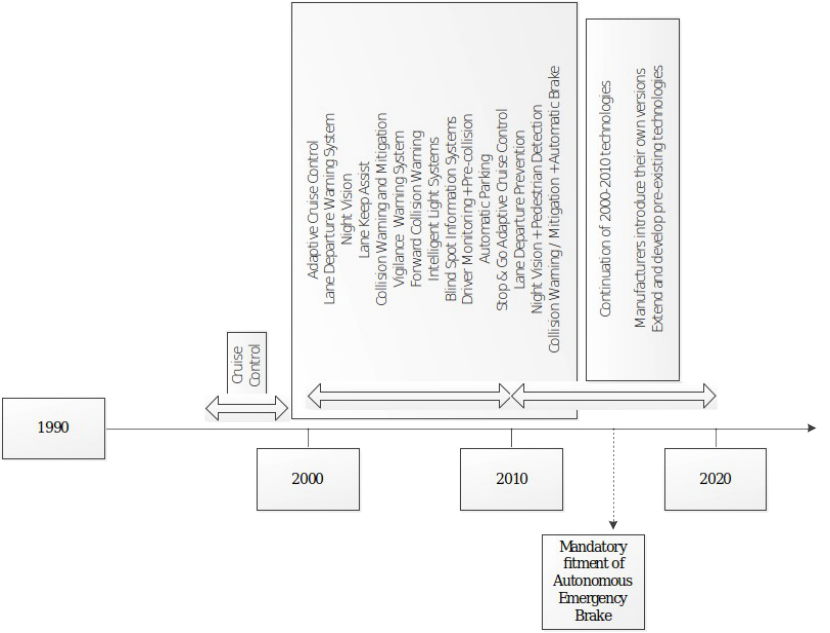
“Hands and feet free” driving has been on the horizon for a while with each facet of technology being a stepping stone to an increased level of autonomy. Since the 1990s, autonomous driving has been viable (for a comprehensive review see Dickmanns (2002). Key milestones are shown in Figure 1. First, there was Adaptive Cruise Control
(ACC) capable of controlling the speed and longitudinal headway between vehicles (de Waard et al. 1999). Then there was Autonomous Emergency Braking (AEB) built upon the existing architecture of ACC. AEB is capable of detecting and identifying imminent collision threats and applying the brakes if needed. Next came Lane Keep Assist (LKA) capable of maintaining lateral road position by applying gentle steering inputs to avoid lane deviation. It is clear to see how the combination of ACC (Stop and Go), an extension of LKA and automated braking, activated simultaneously may lead to a hands and feet free driving environment similar to that of autonomous vehicles.
This paper looks at how multi-system automation that enables the driver to become “hands and feet free” may affect the driving system and the role of the driver within it using the representational method of Operator Sequence Diagrams (OSD) (Kurke, 1961) and a discussion on control-feedback loops within the driving task. With “almost- driverless” vehicles on the horizon, it is imperative that more is known about the Human Factors implications of this shift in driver role by focussing upon the interaction that may take place in a fully automated driving system. This form of task analysis provides an insight into “who” owns “what” information and how this is communicated across the system as a whole (Kaber & Endsley, 2004; Hoc, Young & Blosseville, 2009).
Figure 1. Milestones of vehicle automation since 1990
A "HANDS AND FEET FREE" DRIVING SYSTEM With Systems Engineering integrating both technical and human-centered approaches, this theoretical approach enables us to understand the functioning and performance of joint cognitive systems such as driving (Salmon et al. 2008) and can be used in the design of adaptive automation (Hollnagel & Woods, 1983). An interdisciplinary approach such as this is extremely complex because the ‘behavior’ or interaction that occurs between system
components is not always well defined or understood. The aim of Systems Engineering is to better define and characterize subsystem behavior and the interaction that occurs between system agents. Distributed Cognition (Hutchins, 1995), unlike traditional theories, incorporates the idea that interactions can occur between humans, resources and materials over space and time (Hollan, Hutchins & Kirsh 2000; Hutchins, 1995; Walker, Stanton & Chowdhury, 2013). It recognizes that system agents can be both human and non-human (Stanton et al. 2006; Salmon et al. 2008) with Griffin, Young & Stanton (2010) suggesting that all system agents are vital to the flow of information in the control-feedback loops. With vast amounts of information being exchanged between multiple system agents, the ability to make sense of changes in the environment and respond accordingly implicates Situation Awareness (Endsley, 1995) and describes the essence of Distributed Cognition (Walker et al., 2010). However, many argue there is a need to move away from traditional notions of Situation Awareness to one that focuses on entire systems (Gorman, Cooke & Winner 2006; Salmon et al., 2008; Sorensen & Stanton, 2011; Walker et al., 2010). Distributed Situation Awareness (DSA; Stanton et al., 2006) assumes that Situation Awareness is a system level phenomenon (Salmon et al., 2008) and loosely holds systems together because one agent has the ability to compensate for degraded Situation Awareness in another (Stanton et al., 2006).
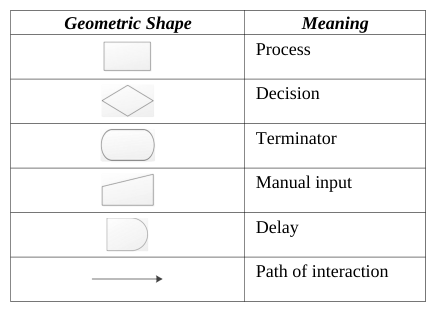
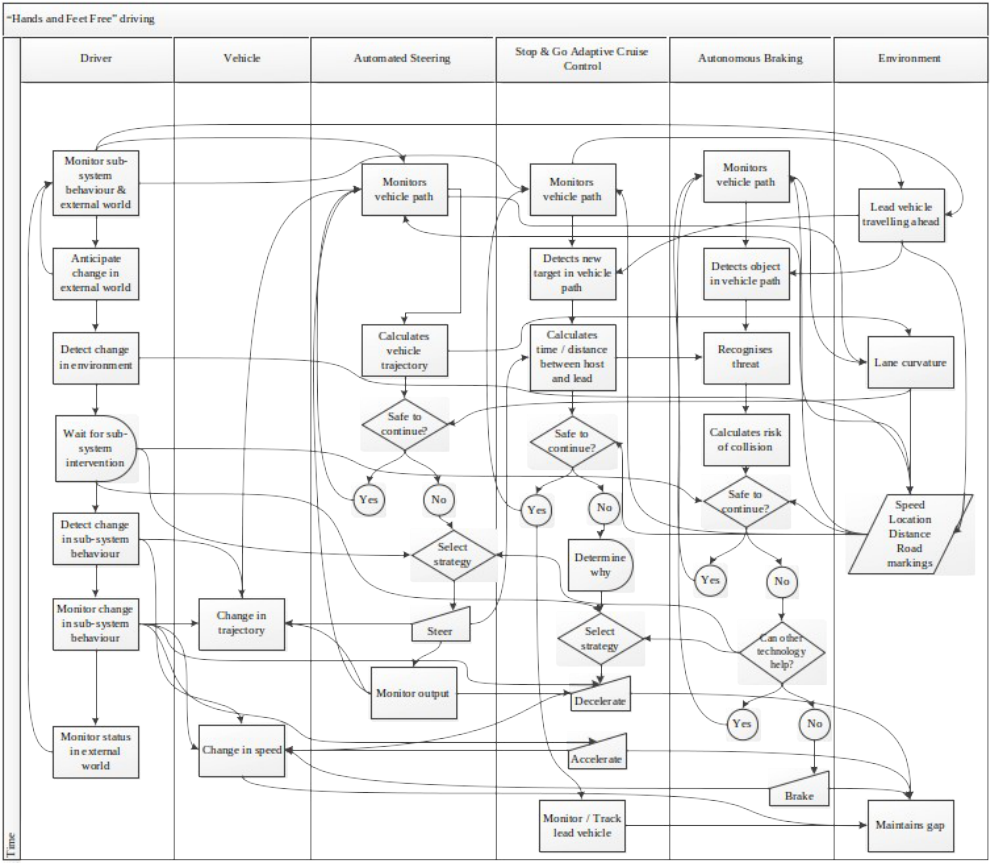
For driving automation, OSD’s offer a means to explore distributed cognition within the driving system with an aim to provide a clearer understanding of how tasks can be shared between system agents and offers a unique opportunity to visualise how system agents may communicate (e.g. Banks, Stanton & Harvey, 2014). OSD’s have previously been used to model interactions between system agents in a cockpit environment (Sorensen & Stanton, 2011) and driving emergencies at different levels of automation (Banks, Stanton & Harvey, 2014) as well as a number of other domains. Figure 2 offers a visual representation of Distributed Cognition in an “almost-driverless” system using standardised geometric features (see Table 1; Kurke, 1961) and the subsystems described earlier that allow for a near autonomous driving environment. Where Endsley & Kaber (1999) suggested that at higher levels of automation, human operators are completely removed from the control-feedback loops as intelligent subsystems become capable of completing all of the physical and cognitive responsibilities associated with a task, the authors argue here that far from being removed from the loop, drivers still remain passively involved via their monitoring of the wider environment and subsystem behaviour. Thus, although the driver is no longer required to perform any of the physical tasks associated with driving and in theory, can be relieved of any cognitive workload, it is clear that driver monitoring remains to some extent. Just like a pilot in a cockpit, the driver will assume a new supervisory role when automation is engaged and far from being removed from the control-feedback loop, drivers will find themselves to be an important link between these multiple subsystems. This is because they still accept ultimate responsibility for safe vehicle operation and have an innate desire to be in control (Parasuraman & Wickens, 2008).
It is also clear that the multi-subsystem approach on the road to full vehicle automation will bring with it a greater need for effective communication between system agents to ensure that safe driving practice is maintained. All system agents will need to have an awareness of how each subsystem works and have some level of intelligence relating to specific functional limitations of each subsystem. In essence, automated subsystems will need to monitor the behaviour of each intelligent counterpart as well as monitoring the wider environment and adapt accordingly signalling the development of Distributed Situation Awareness amongst automated subsystems (Stanton et al. 2006).
Table 1: OSD Key Geometric Shape Meaning Process
Proceedings of the 5th International Conference on Applied Human Factors and Ergonomics AHFE 2014, Kraków, Poland 19-23 July 2014
Figure 2. Division of labor in a “hands and feet free” driving system.
https://openaccess.cms-conferences.org/#/publications/book/978-1-4951-2098-5 Human Aspects of Transportation II (2021)
Proceedings of the 5th International Conference on Applied Human Factors and Ergonomics AHFE 2014, Kraków, Poland 19-23 July 2014
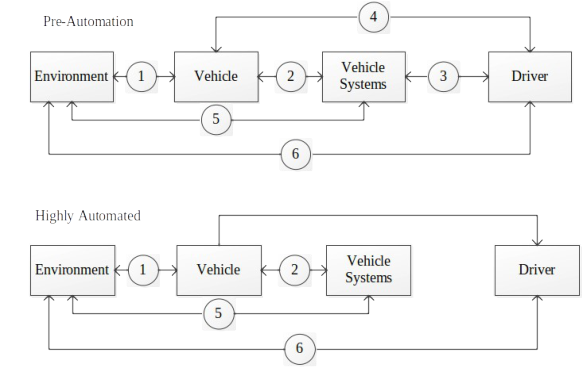
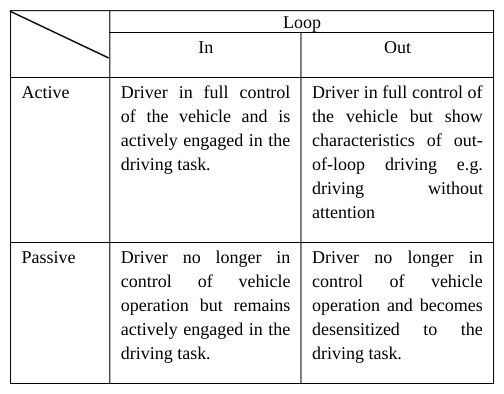
THE CHANGING DRIVER ROLE At first glance, a “hands and feet free” driving system could lead to the traditional role of the driver becoming redundant. An “almost driverless” system such as this would see 100% of the active driving task being completed by automated subsystems (Flemisch et al. 2008) with the driver becoming a passive monitor of system operation. However, Figure 2 clearly indicates that driver monitoring will remain an important aspect of the task regardless of their ‘location’ within the driving control-feedback loops. Whether the driver wants to or not, they will continue to receive feedback from both the vehicle and environment in a highly automated driving system (Figure 3). They will also continue to have the ability to anticipate changes in the environment using feedforward information. The key difference between manual and highly automated driving is that the latter may see a disintegration or possible removal of links between the driver and vehicle subsystems (Stanton, Young & McCaulder, 1997; Stanton et al. 2007). This disintegration or removal of links could negatively impact upon the level of driver engagement (Table 2). Although it seems reasonable to suggest the driver will remain in-the-loop once automation is engaged for some time, prolonged durations of automated driving could lead to the driver becoming out-of-the-loop (e.g. Cuevas et al. 2007; Beckier, Molesworth & Williamson, 2012). A review of the literature indicates that automation can have both positive and negative impacts upon driver behavior. For example, Brookhuis et al. 2008 suggest that an individual’s ability to monitor the visual scene efficiently may actually decrease under automated driving conditions since automation leads to changes in levels of vigilance and complacency. Although this is not necessarily a cause for concern if the level of automation within the driving system is failsafe, capable of sound judgement, analysis, decision making and learning, questions still remain over how we reengage the driver and ensure their levels of situation awareness would enable swift manual takeover if required. Worryingly, de Waard et al. (1999) reported that 50% of drivers failed to regain control following system malfunction on an automated highway system due to the belief that the system would intervene despite the system being compromised (signaling an active driver being out-of-loop). Although the reality of system failure is small in most cases due to an extensive testing phase, operational failings may leave drivers vulnerable to the need of intervention whether it is prompted by the system or not (Larsson, 2012) and to sudden increases to their workload (Parasuraman & Hancock, 2001). This suggests that automated subsystems may not be uniformly beneficial (Brookhuis et al. 2001; Lee & See, 2004).
Figure 3. Changes to the Control-Feedback Loops in Driving.
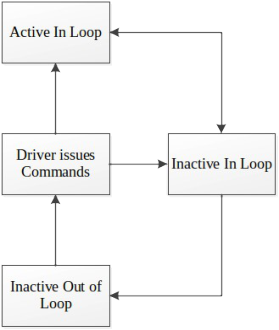
Driver desensitization may mean that manual override in unanticipated and unexpected events will be difficult to manage, increase workload and stress as well as create surprise or startle effects (Sarter, Woods & Billings, 1997). However, if an element of command and control remains within the drivers grasp, these performance decrements could be reduced (Figure 4). One way of achieving this is to allow drivers to issue commands to the automation and in this way, act as an active supervisor rather than a passive monitor of the system. This would allow the driver to be
Proceedings of the 5th International Conference on Applied Human Factors and Ergonomics AHFE 2014, Kraków, Poland 19-23 July 2014
maintained in the control-feedback loop and satisfy their ‘need’ or desire to remain in control of the vehicle. This
Table 2: Driver States of Engagement Loop In OutFigure 4. Keeping the driver engaged.
would go some way in addressing out-of-the-loop performance problems commonly reported in the literature (e.g., Kaber & Endsley, 2004; de Waard et al. 1999; Stanton & Young, 2000; Endsley & Kiris, 1995). In this way, the authors argue that the role of the driver could become analogous with the role of co-pilot within aviation. Although the status of the driver within the control-feedback loop has changed, an element of command and control could prevent the disintegration of driver-vehicle interaction and instead enable the driving system to become flexible and ‘accommodate’ for change. Furthermore, it is still important to note that the limitations of technology mean that at some point within the system of command and control, a human operator will be needed so having a mechanism to keep drivers engaged to some extent is important. In addition, it seems that until issues surrounding practicability, liability and individual preferences of the driver are addressed, control transitions will continue to be made between the driver and automated subsystems (SMART European Commission Study Report, 2010). This means that drivers remain a vital link within the system network and still accept ultimate responsibility for safe vehicle operation (Parasuraman & Wickens, 2008). Despite out-of-the-loop performance concerns, it is encouraging to see recent studies finding that although highly automated driving can lead to the driver becoming more involved with secondary driving tasks, drivers remain receptive to changing demands such as an increase in traffic density in the
Proceedings of the 5th International Conference on Applied Human Factors and Ergonomics AHFE 2014, Kraków, Poland 19-23 July 2014
wider environment. For example Jamson et al. (2013) found that drivers were more focused on the roadway when traffic was heavy when driving a highly automated vehicle. This goes some way in supporting the representation shown in Figure 2 and highlights that even when automated subsystems are capable of controlling the vehicle without any human input, the driver continues to engage in the control-feedback loops to some extent.
CONCLUSIONS
The complex web of interaction that an “almost-driverless” system is likely to introduce into the driving system is not something vehicle manufacturers should ignore. Although early research into automation seemed to focus most heavily upon autonomy, current research now focusses upon satisfying the requirements of joint activity, including human-machine teamwork (Klein et al. 2004). This is because questions still remain over appropriate levels of automation and whether or not fully automated driving enables the driver to become completely “mind free” as well as “hands and feet free”. Although Ursom et al. (2008) suggest that perhaps we view the subject of autonomous vehicles too inflexibly and that drivers should instead learn to adapt to intelligent vehicles rather than the other way round, driving remains a social activity – one that incorporates subtle behaviours. For example, behavioural indicators displayed by other drivers such as varying the speed and gap between vehicles can indicate a willingness to allow other vehicles to join the flow of traffic. Additionally, eye contact and hand gestures demonstrated by other drivers can assist in driver decision-making. Groom and Nass (2007) argue that intelligent vehicles lack these human-like tendencies necessary to be fully integrated or accepted on our roads. Whatever the stance, highly automated vehicles are coming apace.
If as we suspect the future of vehicle automation points to “near driverless” cars, more research is needed to ensure that the driver is capable of manual takeover after prolonged exposure to a fully reliable system. It is important that that the principle of complementarity is adopted, with the allocation of tasks serving to maintain control whilst retaining human skill (Grote et al., 1995). As with Free Flight (Langan-Fox et al., 2009), driving automation poses many challenges with regards to the interaction between humans and automation including operational functionality and system management. There may be confusion over “who” (the driver or automated subsystem) has authority over ‘which’ vehicular controls as the level of automation increases. Presently, technologies such as Adaptive Cruise Control can be controlled by the driver. This means that the driver is able to manually switch the system on or off. This on the one hand supports driver preferences but prevents the technology reaching its full potential. Controlling technologies that enable the driver to become “hands and feet free” may actually desensitize the driver because the manual and cognitive skill that is required to drive a vehicle is not being used. This desensitization may mean that manual override in unanticipated and unexpected emergency events will be difficult for the driver to manage (Sarter, Woods & Billings, 1997). Future research should focus upon driver-vehicle interactions in catastrophic failure events. Although these failure events are likely to be rare occurrences, we need to ensure that the driver remains capable of manual takeover. In other words, we need to find out ways to keep drivers actively engaged in the driving task whilst automation is engaged. This is because manual override may continue to be an important aspect of emergency intervention. Only once these concerns are acknowledged and resolved can we say we are ready for “almost-driverless” vehicles.
ACKNOWLEDGEMENTS
This research was funded by the Engineering and Physical Sciences Research Council (EPSRC) and Jaguar Land Rover.
REFERENCES
Amditis, A., Pagle, K., Joshi, S., & Bekiaris, E. (2010), Driver-Vehicle-Environment monitoring for on-board driver support systems: lessons learned from design and implementation. Applied Ergonomics, 41(2), 225-235. Banks, V. A., Stanton, N. A., & Harvey, C. (2014). Sub-systems on the road to vehicle automation: Hands and feet free but not
‘mind’free driving. Safety science, 62, 505-514.
Proceedings of the 5th International Conference on Applied Human Factors and Ergonomics AHFE 2014, Kraków, Poland 19-23 July 2014
Bekier, M., Molesworth, B. R., & Williamson, A. (2012). Tipping point: The narrow path between automation acceptance and rejection in air traffic management. Safety science, 50(2), 259-265. Brookhuis, K. A., De Waard, D., & Janssen, W. H. (2001). Behavioural impacts of advanced driver assistance systems–an
overview. European Journal of Transport and Infrastructure Research, 1(3), 245-253. Brookhuis, K. A., van Driel, C. J., Hof, T., van Arem, B., & Hoedemaeker, M. (2009). Driving with a congestion assistant; mental workload and acceptance. Applied ergonomics, 40(6), 1019-1025. Cantin, V., Lavallière, M., Simoneau, M., & Teasdale, N. (2009). Mental workload when driving in a simulator: Effects of age
and driving complexity. Accident Analysis & Prevention, 41(4), 763-771. Cuevas, H. M., Fiore, S. M., Caldwell, B. S., & Strater, L. (2007). Augmenting team cognition in human-automation teams performing in complex operational environments. Aviation, space, and environmental medicine, 78(Supplement 1), B63- B70. Dehais, F., Causse, M., Vachon, F., & Tremblay, S. (2012). Cognitive conflict in human–automation interactions: a
psychophysiological study. Applied Ergonomics, 43(3), 588-595. de Waard, D., van der Hulst, M., Hoedemaeker, M., & Brookhuis, K. A. (1999). Driver behavior in an emergency situation in the Automated Highway System. Transportation Human Factors, 1(1), 67-82. Dickmanns, E. D. (2002, June). The development of machine vision for road vehicles in the last decade. In Intelligent Vehicle
Symposium, 2002. IEEE (Vol. 1, pp. 268-281). IEEE. Donmez, B., Boyle, L. N., & Lee, J. D. (2007). Safety implications of providing real-time feedback to distracted drivers. Accident Analysis & Prevention, 39(3), 581-590. Endsley, M. R. (1995). Measurement of situation awareness in dynamic systems. Human Factors: The Journal of the Human
Factors and Ergonomics Society, 37(1), 65-84. Endsley, M. R. (2006). Situation Awareness. In G. Salvendy (Ed.), Handbook of Human Factors and Ergonomics (3rd ed., pp.
528–542). New York: Wiley. Endsley, M. R. & Kaber, D. B. (1999). Level of automation effects on performance, situation awareness and workload in a dynamic control task. Ergonomics, 42(3), 462-492. Endsley, M. R., & Kiris, E. O. (1995). The out-of-the-loop performance problem and level of control in automation. Human
Factors: The Journal of the Human Factors and Ergonomics Society, 37(2), 381-394. European Commission Study Report. (2010). SMART 2010/0064: Definition of necessary vehicle and infrastructure systems for Automated Driving, 1-111. Version 1.2. Flemisch, F., Kelsch, J., Löper, C., Schieben, A., & Schindler, J. (2008). Automation spectrum, inner/outer compatibility and
other potentially useful human factors concepts for assistance and automation. 2008), Human Factors for assistance and automation, 1-16. Gorman, J. C., Cooke, N. J., & Winner, J. L. (2006). Measuring team situation awareness in decentralized command and control environments. Ergonomics, 49(12-13), 1312-1325. Griffin, T. G., Young, M. S., & Stanton, N. A. (2010). Investigating accident causation through information network modelling.
Ergonomics, 53(2), 198-210. Groom, V., & Nass, C. (2007). Can robots be teammates?: Benchmarks in human–robot teams. Interaction Studies, 8(3). 326–
382. Grote, G., Weik, S., Wäfler, T., & Zölch, M. (1995). Criteria for the complementary allocation of functions in automated work systems and their use in simultaneous engineering projects. International Journal of Industrial Ergonomics, 16(4), 367- 382. Hoc, J. M., Young, M. S., & Blosseville, J. M. (2009). Cooperation between drivers and automation: implications for safety.
Theoretical Issues in Ergonomics Science, 10(2), 135-160. Hollan, J., Hutchins, E., & Kirsh, D. (2000). Distributed cognition: toward a new foundation for human-computer interaction research. ACM Transactions on Computer-Human Interaction (TOCHI), 7(2), 174-196. Hollnagel, E., & Woods, D. D. (1983). Cognitive systems engineering: New wine in new bottles. International Journal of Man-
Machine Studies, 18(6), 583-600. Hutchins, E. (1995). How a cockpit remembers its speeds. Cognitive science, 19(3), 265-288. Jamson, A. H., Merat, N., Carsten, O. M., & Lai, F. C. (2013). Behavioural changes in drivers experiencing highly-automated vehicle control in varying traffic conditions. Transportation Research Part C: Emerging Technologies, 30, 116-125. Kaber, D. B., & Endsley, M. R. (2004). The effects of level of automation and adaptive automation on human performance,
situation awareness and workload in a dynamic control task. Theoretical Issues in Ergonomics Science, 5(2), 113-153. Khan, A. M., Bacchus, A., & Erwin, S. (2012). Policy challenges of increasing automation in driving. IATSS research, 35(2), 79-
89. Klein, G., Hoffman, R. R., Feltovich, P. J., Woods, D. D., & Bradshaw, J. M. (2004). Ten challenges for making automation a" team player" in joint human-agent activity. IEEE Intelligent Systems, 19(6), 91-95. Kurke, M. I. (1961). Operational sequence diagrams in system design. Human Factors: The Journal of the Human Factors and
Ergonomics Society, 3(1), 66-73. Langan-Fox, J., Canty, J. M., & Sankey, M. J. (2009). Human–automation teams and adaptable control for future air traffic management. International Journal of Industrial Ergonomics, 39(5), 894-903. Larsson, A. F. (2012). Driver usage and understanding of adaptive cruise control. Applied Ergonomics, 43(3), 501-506. Lee, J. D., & See, K. A. (2004). Trust in automation: Designing for appropriate reliance. Human Factors: The Journal of the
Human Factors and Ergonomics Society, 46(1), 50-80. Parasuraman, R., & Hancock, P. A. (2001). Adaptive control of workload. In P. A. Hancock & P. E. Desmond (Eds.), Stress, workload, and fatigue, pp. 305–320. . Mahwah, NJ: Erlbaum.
Proceedings of the 5th International Conference on Applied Human Factors and Ergonomics AHFE 2014, Kraków, Poland 19-23 July 2014
Parasuraman, R., & Wickens, C. D. (2008). Humans: Still vital after all these years of automation. Human Factors: The Journal of the Human Factors and Ergonomics Society, 50(3), 511-520. Salmon, P. M., Stanton, N. A., Walker, G. H., Baber, C., Jenkins, D. P., McMaster, R., & Young, M. S. (2008). What really is
going on? Review of situation awareness models for individuals and teams. Theoretical Issues in Ergonomics Science, 9(4), 297-323. Sarter, N. B., Woods, D. D., & Billings, C. E. (1997). Automation surprises. Handbook of human factors and ergonomics, 2, 1926-1943. Sorensen, L. J., Stanton, N. A., & Banks, A. P. (2011). Back to SA school: contrasting three approaches to situation awareness in
the cockpit. Theoretical Issues in Ergonomics Science, 12(6), 451-471. Stanton, N. A., Stewart, R., Harris, D., Houghton, R. J., Baber, C., McMaster, R., ... & Green, D. (2006). Distributed situation awareness in dynamic systems: theoretical development and application of an ergonomics methodology. Ergonomics, 49(12-13), 1288-1311. Stanton, N. A., Walker, G. H., Young, M. S., Kazi, T., & Salmon, P. M. (2007). Changing drivers' minds: the evaluation of an
advanced driver coaching system. Ergonomics, 50(8), 1209-1234. Stanton, N. A., & Young, M. S. (2000). A proposed psychological model of driving automation. Theoretical Issues in Ergonomics Science, 1(4), 315-331. Stanton, N. A., Young, M. S., & McCaulder, B. (1997). Drive-by-wire: the case of mental workload and the ability of the driver
to reclaim control. Safety Science, 27(2-3), 149-159. Urmson, C., Anhalt, J., Bagnell, D., Baker, C., Bittner, R., Clark, M. N., ... & Ferguson, D. (2008). Autonomous driving in urban environments: Boss and the urban challenge. Journal of Field Robotics, 25(8), 425-466. Walker, G. H., Stanton, N. A., Baber, C., Wells, L., Gibson, H., Salmon, P., & Jenkins, D. (2010). From ethnography to the
EAST method: A tractable approach for representing distributed cognition in Air Traffic Control. Ergonomics, 53(2), 184- 197. Walker, G. H., Stanton, N. A., & Chowdhury, I. (2013). Self-Explaining Roads and situation awareness. Safety Science, 56, 18-
28. Walker, G. H., Stanton, N. A., Kazi, T. A., Salmon, P. M., & Jenkins, D. P. (2009). Does advanced driver training improve situational awareness?.Applied Ergonomics, 40(4), 678-687.
LISTED IN THE AHFE DIGITAL BOOKSTORE CATALOGUE
Explore the complete digital volume
Advances in Human Aspects of Transportation: Part II
Read this individual research paper free through the original publisher, or explore the full digital proceedings book.
ISBN 978-1-4951-2098-5
Explore this ISBN in the AHFE Bookstore ↗Listed in the July 2026 bookstore catalogue; search by ISBN to confirm current availability · Digital book purchase optional