Muhammad Izzat Nor Ma’arof, Helmi Rashid, Abdul Rahman Omar, Sukarnur Che Abdullah, Ismail Nasiruddin Ahmad, Roseleena Jaafar, Shamsury Abd Karim (2021). Motorcycling: Awkward Posture Is the Best Posture!. In: Advances in Human Aspects of Transportation: Part II. AHFE Open Access, vol. 16. https://doi.org/10.54941/ahfe100664
1 Motorcycle Engineering Test Lab (METAL) Faculty of Mechanical Engineering, Universiti Teknologi MARA 40450 Shah Alam, Selangor Darul Ehsan, Malaysia ↗
2 MASMED, Universiti Teknologi MARA 40450 Shah Alam, Selangor Darul Ehsan, Malaysia ↗
A study has documented that there are only four possible working postures for motorcycling, yet, all of these postures are argued by another study to be generally “unfitting” for human and hence a negative option as a mode of daily transportation. Even so, contradictory to this statement, motorcycle as a mode of transportation is becoming even more popular in Asia. The objective of this study is to show that the aforementioned “unfitting” value of the motorcycling working posture is a must in motorcycling. The significance of this study is to share a new perspective in ergonomics. Three studies were conducted: First, a descriptive within-subject design research of real world motorcycling experience using participant observation method. Second, an ethnographic controlled observation to support the findings. Third, an intrinsic case study on motorcyclists who experienced comfort related issues. Results showed that motorcyclists are relatively satisfied with the riding posture since it makes it possible for them to perform the motorcycling work tasks efficiently, thus, ensuring their safety. A too comfortable riding posture actually results in the deficit of the motorcyclist’s riding performance. In short, motorcycling requires a certain level of “discomfort” in order to ensure safely.
Ergonomics has been defined by numerous authors from various perspectives since its inception. Even so, the fundamental aim of ergonomics has always been idealistic – to ensure the human operator is working in a safe physical and psychological manner by ‘fitting’ the job to the human (Kromer et al., 2000b). This goal is also achieved by encouraging the human operator to work as close as possible to their neutral joint posture (Ergonomics Guideline for Manual Handling, 2010).
To achieve this fundamental aim, Kromer et al., (2000a) noted that there are three goals of ergonomics which need to be accomplished according to their hierarchy. First is to ensure the human operator is safe – both in term of mortality and health, by providing “tolerable” working conditions. The second goal to be fulfilled is to provide “acceptable” working conditions for the human operator to perform the work. Finally, after the fulfillment of the first two goals, generating “optimal” working conditions for the human operator is warranted.
In short, the outcome of ergonomics knowledge aims for the human operator to work within a safe environment while performing the work at their “natural” state – “natural” from the perspective of human biomechanics, physical and psychological characteristics and traits (Health and Safety Executive, 2013; Bosch Rexroth AG, 2012; Travail Sècuritaire, 2011; Berry et al., 2009; Openshaw and Taylor, 2006; Handbook of Human Factors and Ergonomics
Methods, 2005; Kroemer et al., 2000). The hierarchical goals noted by Kromer et al., (2000) will be the main guideline for this study. This study would discuss the result on an exploratory research which could be contradictory to the fundamentals or laws of ergonomics. This study aims to prove that though the motorcycle riding posture is awkward, it is still the best working posture for motorcycling.
GLOBAL STATISTICS OF MOTORCYCLE ROAD ACCIDENTS Various literatures such as Ma’arof and Ahmad (2012a), Ministry of Transport Malaysia (2011), Chen and Chen (2011), Velagapudi (2010), Karmegam et al., (2009 and 2012) have all noted that motorcycle is a universally popular human mode of transportation. In various Asian major cities, motorcycles strive beyond other fuel-powered vehicles due to being efficient (example: maneuverability through congested areas, amount of parking space required), yet, economical (example: fuel expenditure, maintenance cost) (Chen and Chen, 2011). The demand of this vehicle has shown escalating growth (Shell.com, 2013) and predicted to annually increase in the near future by this study – although experiencing the ever soaring global fuel price (Young, 2013) and the Honda Annual Report (2012) which reported the increment of 9.7% in global motorcycles sales of the brand from the previous fiscal year. As of the year 2011, 9,985,308 motorcycles were officially registered in Malaysia alone (Ministry of Transport Malaysia, 2011).
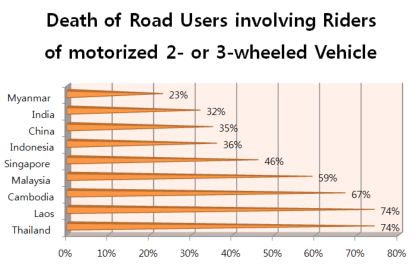
Nevertheless, corresponding to the global increasing demand for motorcycles, the number of road accidents involving this vehicle also increased nationwide. Figure 1 summarizes the percentage of road users’ deaths involving rider of motorized 2- or 3-wheeled vehicle in the South East Asian region. Global Status Report on Road Safety (2013) reported that Thailand and Laos recorded the highest percentage at 74%, followed by Cambodia (67%), Malaysia (59%), Singapore (46%), Indonesia (36%), China (35%), India (32%) and Myanmar (23%). (Note: The data for Brunei, East Timor, Philippines and Vietnam are not available in the report). Various literatures had noted poor behavior, the non-usage of helmets, alcohol abuse, age factor, lack of motorcycling education, night-to- day riding and riding without license as among the contributing factors towards motorcycle road accidents (Keall and Newstead, 2012; Manan and Várhelyi, 2012; and Jou et al., 2012). Besides that, fatigue experienced by motorcyclist during riding was also found to be a contributing factor towards motorcycle fatalities (Horberry et al., 2008; Velagapudi et al., 2010; Marina et al., 2011 and Williamson et al., 2011).
This study agrees with the findings by these literatures. Nevertheless, this study would like to share the following quote: “…horsepower wasn't the cause before, and was unlikely to be the cause now, of crashing motorcycles. Rather it is rider errors in applying core technical skills that cause them to go down. That was my story, and now I have proof, so I'm sticking to it” (Code, 2010). (Note: Keith Code is a former motorcycle racer, distinguished motoring writer and the founding father of the California Superbike School). This quote clearly highlights the strong connection between road accidents and the motorcyclist – the human factor.
Figure 1. Percentage of Road Users’ Deaths involving Riders of Motorized 2- or 3-Wheeled Vehicle in The South East Asian
Region (source: Adapted from Global Status Report on Road Safety, 2013)
The “core technical skills” mentioned by Code (2010) is closely related to the “work task of motorcyclist” noted by Ma’arof and Ahmad (2012a). During real world motorcycling, the motorcyclist is required to use the whole body and each body part has a specific and unique work task. For instance, only the right hand would control the throttle while the left hand would manage the clutch lever (for manual transmission motorcycle). Thus, the questions here are: How could a motorcyclist be capable of “applying the core technical skills” without error? How could a motorcyclist maintain from making any error? How could the motorcyclist make any necessary corrective actions if error does occur? There are several answers for these questions; nevertheless, all of the answers could be traced back to the very root of motorcycling – the riding posture. (Note: the term “error” here is referring to “error based on skills” as noted by Cañas et al., n.d)
The riding posture could also be treated as a sitting posture, only that it is performed on a motorcycle. Ma’arof and Ahmad (2012b) has outlined the “riding posture establishment conditions” in describing how a riding posture is assumed. The following section would give more in depth discussion on motorcycling riding posture.
MOTORCYCLE RIDING POSTURE VS IDEAL SITTING POSTURE From the “riding posture establishment conditions”, Ma’arof and Ahmad (2012b) has classified and simultaneously identified all possible working postures for motorcycling via the “Riding Posture Classification System” or the “RIPOC” System. The riding postures are: the “RIPOC Type 1: Forward lean riding posture”, “RIPOC Type 2: Upright riding posture”, “RIPOC Type 3: Seatback-leg-forward riding posture” and “RIPOC Type 4: Double forward riding posture” (Ma’arof and Ahmad, 2012b). In this study, these riding postures would be acknowledged as one, that is, from a general perspective of a working posture for motorcycling without specifying on a specific type of riding posture – unless noted. Now, how does the motorcycling riding posture stand before the definition of an “ideal” or “neutral working posture”?
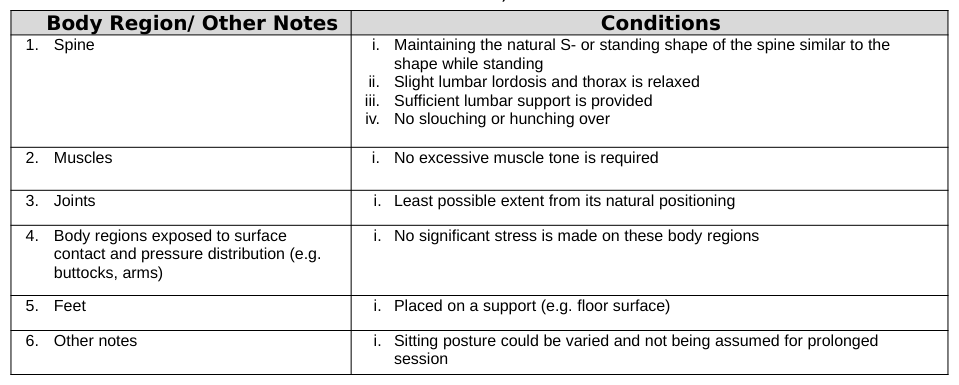
There are various definitions in describing an “ideal” or “neutral working posture” and in this case, the focus is for an optimal “sitting” posture. The debates on determining optimal sitting posture still continue as noted by O’Sullivan et al., (2012 and 2010) and Openshaw and Taylor (2006). Several literature noted that an optimal sitting posture is when it is comfortable and this is achieved when the following conditions are satisfied as shown in Table 1.
Table 1: Comfortable sitting posture establishment conditions (O’Sullivan et al., (2012) and 2010; Berry, 2009; Openshaw and Taylor, 2006; Dul and Weerdmesster, 2003; Cal/OSHA, 1999) Body Region/ Other Notes Conditions 1. Spine i. Maintaining the natural S- or standing shape of the spine similar to the shape while standing ii. Slight lumbar lordosis and thorax is relaxed iii. Sufficient lumbar support is provided iv. No slouching or hunching over
From the outline given for comfortable sitting posture, could the noted “riding postures” (Ma’arof and Ahmad, 2012b) be categorized as ideal working postures? Ma’arof et al., (2012) has concluded “the riding posture (sitting position) demonstrated by a motorcyclist on any given motorcycle is both an awkward and poor posture”. The study argued that the riding postures are “constrained”, “static”, “cramped” and “poor”. Henceforth, if all the motorcycling riding postures are deemed to be awkward, uncomfortable and physically and physiologically compromising, is it still relevant for motorcycling? Could it be replaced? Could we mimic the sitting characteristics of driving (four wheeled vehicle) to motorcycling? So, these are the research questions that would be answered by this study.
RESEARCH METHODOLOGY To answer the research questions, the following qualitative research methodologies were formulated.
Field Research The field research was divided into the following research method:
i. Non-structured observation A descriptive within subject research design (participant as observer type of observation) on motorcycling was performed by the authors. The data was recorded via data collection sheet. ii. Ethnographic controlled observation Minor ethnographic controlled observation was also conducted to support the findings. The authors spent time close to two years with motorcyclists from various background and motorcycling experiences.
Intrinsic Case Study Case studies were also conducted to further comprehend the effects of comfort during motorcycling. Semi-structured interview was selected as the data collection method. Interview sessions were conducted with three motorcyclists who were experiencing issues regarding comfort.
RESULTS
Field Research The following results were obtained via the field research:
i. Comfort in motorcycling is very subjective and highly dependent on the motorcyclist. Factors such as riding styles, for instances, leisure riding or speed riding would commonly determine the motorcyclist’s personal definition of “comfort” with respect to motorcycling. Both extremes of interests (high regard and disregard) exist in term of describing comfort. Senior motorcyclists usually prefer high emphasis on comfort. ii. Significant difference in the motorcyclist capability in controlling and maneuvering the motorcycle was apparent upon assuming different riding postures. iii. Duration of time in assuming, controlling and holding the riding posture were critical in determining the types of physical and physiological discomfort and fatigue experienced by the motorcyclist. iv. Trends or patterns of physical and physiological discomforts differ with different riding postures being assumed, maintained and controlled. v. Motorcyclists are relatively satisfied with the riding posture of their respective motorcycles.
Intrinsic Case Study Case Study 1
A motorcyclist was hospitalized for 3 days following an accident due to falling asleep while on a solo riding journey from Skudai, Johor Darul Takzim to Shah Alam, Selangor Darul Ehsan (total of 327 km). The accident took place in Batu Pahat, Johor Darul Takzim (108 km from Skudai) at about 10 o’clock in the morning after travelling for approximately 1 hour. The motorcyclist clearly noted that he had prepared for the journey. He had sufficient sleep and taken light meal prior to the journey. The motorcyclist was riding a Suzuki X7 250 motorcycle and cruising at velocities within the range of 80 -100 km/h. The subject was in his early twenties and healthy. The following details were given by the subject in describing the accident: i. He was too relaxed and comfortable. He was under very minimal time constraint since he was scheduled to reach Shah Alam at 2pm in the afternoon. ii. The comfortable riding condition was further elevated upon a mist of rain that occurred a few minutes prior to the accident. The subject seriously emphasized that the accident occurred was not due to the rain. iii. The comfortable and soothing motorcycling condition results in him getting drowsy, hence, slowly drifting to the side of the road and crashed. The subject only realized that he was involved in an accident when he woke-up on a hospital bed. iv. The subject survived the accident with almost no external and internal injuries except experiencing minor amnesia on the event. The motorcycle was also hardly damaged. At the end of the interview session, the subject further added that he agreed that certain degree of discomfort is a necessity for safe motorcycling. It is interesting to note that an awkward riding posture such as the “RIPOC Type 1: forward lean riding posture” (Ma’arof and Ahmad, 2012b) was noted by the subject to be better suited for motorcycling, although discomforting in prolonged session.
Case Study 2 A motorcyclist almost involved in an accident upon experiencing micro sleeps while on a solo riding journey from Penang to Shah Alam, Selangor Darul Ehsan (total distance of 372 km). From experiencing the micro sleeps, the motorcyclist stopped and took breaks (twice) with approximately 15 minutes per session. The motorcyclist noted that he had prepared for the journey by having sufficient sleep and meal prior to the journey. Nevertheless, the subject also highlighted that he was feeling rather excited the night before the journey. The subject was in his early twenties, healthy and riding a Honda EX5 and cruising below 100 km/h. The following details were given by the subject in describing the event:
i. The micro sleeps were the result from riding fatigue. The subject emphasized that muscular and mental fatigue were the main types of fatigue experienced. ii. The motorcyclist varies his riding posture throughout the journey. He chose to assume a pseudo-“RIPOC Type 1: forward lean riding posture” (Ma’arof and Ahmad, 2012b) to improve his riding experience. At the end of the interview session, the subject strongly emphasized that assuming an awkward riding posture actually leads to comfort in motorcycling and agrees with the notion that certain degree of discomfort is required for overall safety in motorcycling.
Case Study 3 A motorcyclist frequently experienced micro sleeps during his routine daily commute to work that requires him to travel from Kajang to Shah Alam covering a distance of approximately 50 km on a one way route. The micro sleeps mostly occurs during the morning on the way to work and sometimes during the way back. The motorcyclist was in his early twenties, healthy and rode a Yamaha 110ss. At the peak of the micro sleeps the motorcyclist was almost involved in a motorcycle crash. This nearly happened when the motorcyclist fell into the micro sleeps for a few seconds without noticing that the motorcycle had steered to left side of the road. Upon regaining consciousness from the micro sleeps, the motorcyclist found himself on the other side of the road and fortunately missed the middle road barrier. The following details were given by the subject in describing the event:
i. Muscle fatigue was the main cause of the micro sleeps as claimed by the motorcyclist due to maintaining a static riding posture throughout the route to work. ii. “RIPOC Type 2: Upright riding posture” (Ma’arof and Ahmad, 2012b) was maintained by the motorcyclist in a 50 km non-stop commute to work. iii. Wind gust generated from the speed of the motorcycle approximately 80-90 km/h pushed the motorcyclist’s body back and requires the motorcyclist to grip the throttles much harder and exhausted the body that leads to muscle fatigue. The motorcyclist stresses that maintaining a certain riding posture on a motorcycle and constraining the body to the motorcycle for better control may lead to fatigue. When the body is in a fatigue and exhausted condition, micro sleeps and lost of control at the bends took over. Subsequently, this resulted in inappropriate decision making.
DISCUSSION
Motorcycling is a very unique vehicle operating experience. It resembles bicycling especially for the small displacement model (less than 250cc). Nevertheless, motorcycling in general requires a higher degree of motor- control than bicycling. However, it is significantly different from operating a four-wheeled vehicle. The most prominent criteria that separates driving a four-wheeled automobile and riding a motorcycle is the “Uno Body Motion” or “UBM” (Ma’arof et al., 2012) – that is the “condition where the whole body of the motorcyclist has to act as one, that is, synchronized” (Ma’arof et al., 2012) to effectively and safely steer the motorcycle during motion. The term “UBM” (Ma’arof et al., 2012) summarizes the “core technical skills” and “work task of motorcyclist” mentioned by Code (2010) and Ma’arof and Ahmad (2012a).
Failure to perform the “UBM” (Ma’arof et al., 2012) at any time during real world motorcycling could results in “errors based on skills” (Cañas et al., n.d). Hence, this could potentially lead to road accident. From the results given by the field research and reviewing the motorcycling bible, Code (1993), the one thing that could assure “UBM” (Ma’arof et al., 2012) could be performed to the highest efficiency is the riding posture. For the hands-on real world riding experience assessment, the author had the opportunity to vary the riding postures while riding on the same motorcycle. The experimental riding was performed for the duration of 10 hours (with several rests taken) through variable types of roads. The results showed significant differences in term of the effort required to be exerted by the motorcyclist in maneuvering and controlling the motorcycle. This is because of the following reasons: i. In general, the riding posture provides the motorcyclist with the ease (muscular effort) of covering various range of motions of certain body joints and limbs, for instances, the arms and legs. ii. Different riding posture provides variable degree of the ease for the motorcyclist in covering the aforementioned range of motions. iii. The riding posture also enables the motorcyclist to utilize the leverage provided by the design of the motorcycle in performing the “core technical skills” (Code, 2010).
In short, the riding posture in general makes it easier and possible for the motorcyclist to efficiently perform the “UBM” (Ma’arof et al., 2012). Nevertheless, the results here are viewed and discussed only from the perspective of the human operator. The same issue on maneuvering and controlling the motorcycle, viewed from the perspective of the motorcycle would be discussed in another study. The assessment showed that the higher the degree of discomfort in assuming, controlling and holding the riding posture, the better it is for the motorcyclist to perform the motorcycling work task. “Discomfort” in this context is very subjective, yet, closely associated with the study by Ma’arof et al., (2012) in acknowledging the riding posture as “cramped”, “constrained” and “poor”. Certain range of motions for instances the wrist extension could be varied to neutral once the desired throttle control is achieved. While others such as spinal flexion and shoulder abduction are usually assumed for longer duration – this is what was meant by Ma’arof et al., (2012) in acknowledging the riding posture as “static”.
From the ethnographic observation, the author gathered the following results: i. Each motorcyclist has a unique riding preference. Hence, their riding styles are different too. This result in variable definitions and perceptions made on comfort in motorcycling. ii. Motorcyclists would usually purchase motorcycles that suit their personal style of riding. Hence, they are relatively satisfied with the riding posture for their respective motorcycles. Nevertheless, they are still interested in increasing the level of comfort during real world motorcycling in order to improve the experience. The authors were notified with various aftermarket products for various types of motorcycle (hence, various types of riding postures) that improve the ergonomics of the motorcycle. Commonly the aftermarket products are associated with the following trinity: handlebar, seat and foot-pegs. iii. Senior motorcyclists (age) usually prefer a relatively more comfortable riding posture since this type of riding posture places less stress on their physical and physiological system – especially at the joints such as the wrists and ankles.
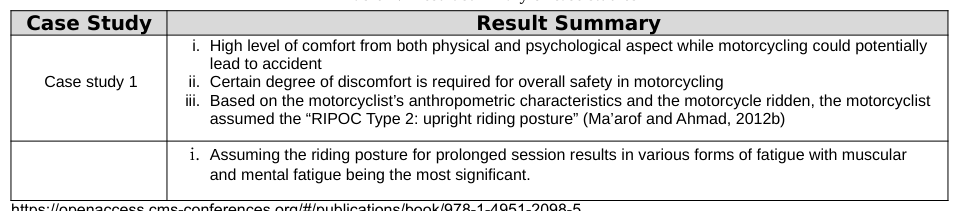
For experimental studies on investigating the motorcycling riding posture, the best reference frame is the duration of time spent in assuming, controlling and holding the riding posture. Distance traveled by the motorcyclist is not the best reference frame. For instance, a more powerful motorcycle could travel at a further distance in comparison with a less powerful motorcycle within the same time frame. Thus, exposure time to the risk factor (the riding posture) is the best reference time for motorcycling. The case studies give a perspective on the importance of assuming in the overall safety aspect of motorcycling. The summary is as follows in Table 2.
Table 2: Result summary of case studies Case Study Result Summary i. High level of comfort from both physical and psychological aspect while motorcycling could potentially
All the results from the field research and the case studies prove that awkward riding posture is a necessity for overall safety in motorcycling. A too comfortable riding posture would make it difficult to be physically mobile during real world motorcycling. This study strongly emphasizes that comfort is inversely proportional to the overall safety in motorcycling.
Indeed motorcycling experience could be improved with additional comfort, but, the concern here is to control the level of comfort in motorcycling. How much comfort is sufficient enough for motorcycling would be studied in another study. For this study, the authors anonymously agreed that based on the results and literature – comfort could be continuously supplemented in the motorcycling experience (e.g. using thicker seat-pan, additional lumbar support) for as long as the motorcyclist is capable in performing the “core technical skills” at optimal level (Code, 2010). Once the motorcyclist is incapable of performing the necessary task at the optimal safe level the amount of comfort should be decreased.
CONCLUSION
Conclusively, this study is not radically contradictory to the fundamental laws of ergonomics. It only advocates a different opinion on the niche area. This study strongly highlights that the notion of “the ideal human operator working posture” is limited to the human operator’s safety performance. This is specifically critical when the work performed is mortally hazardous – such as real world motorcycling where the human operator is constantly at high risk.
The most crucial aspect of real world motorcycling is for the motorcyclist to be constantly capable of performing the fundamental motorcycling work tasks at the highest level of efficiency – and at times even demanding the motorcyclist to contradict with the natural survival instincts (Code, 1993). Any failure to perform the work task efficiently could drastically place the motorcyclist at mortality risk. Hence, this would violate the law of ergonomics: to ensure the human operator’s safety while performing their work tasks (Health and Safety Executive, 2013; Bosch Rexroth AG, 2012). Based on the results, it is proven that the motorcyclist requires certain degree of “discomfort” in term of the working posture (the riding postures) to ride safely. Each of the riding posture represents varying degree of discomfort to the motorcyclist, hence, varying degree in the motorcyclist’s capability in performing the motorcycling work task. Nevertheless, all the riding postures generally facilitate the motorcyclist in efficiently performing the work tasks. This finding is supported by literature such as Karmegam et al., (2012 and 2009), Velagapudi et al., (2010) and Code (1993).
The findings also prove that the current motorcycling riding postures are still the best working postures for motorcycling. Removing or eliminating the riding postures could seriously jeopardize the motorcyclist’s safety. The riding postures could only be improved to promote its ergonomics qualities, yet, under a very close bound of safety. The study by Karmegam et al., (2012) is one of the best examples for such innovative study. The study managed to improve the riding posture – evidently the “RIPOC Type 2 Upright Riding Posture” (Ma’arof and Ahmad, 2012a) without significantly compromising on the motorcyclist’s capability in performing the work tasks.
Indeed, assuming awkward riding postures could leads to the development of various physical, physiological and psychological discomforts. Independent or co-dependently, these discomforts would leads to fatigue. Thus, there is a need to address this issue for only then countermeasures and necessary preventive actions could be taken to minimize the unwanted physiological effects. However, how riders fatigue are defined has yet to be outlined because there is a significant paucity of motorcyclist fatigue research and those available are mostly self-reported data without proper design studies and methodologies (Horberry et al., 2008). Finally, the development of the noted physiological disorders is controlled by the duration of time being spent by motorcyclist in assuming, controlling and holding the riding posture. If the duration of time in which the motorcyclist could safely and healthily assume, hold and control the riding posture could be identified and the development of unwanted physical, physiological and psychological effects could also be controlled.
ACKNOWLEDGEMENT
The authors would like to express their utmost gratitude to Rohani Haron, Muhammad Fauzi Mohd Talib, Muhammad Firdaus Azhar, Muhammad Hafizudin Kamal, Wan Muhammad Syahmi Wan Fauzi, Mohd Afham Azmi, Muhammad Adzri Adzman, the staffs of the Faculty of Mechanical Engineering and the Institute of Graduate Studies in Universiti Teknologi MARA and Human Factors and Ergonomics Society Malaysia who have, directly or indirectly, contributed to this research. The authors would also like to acknowledge the Ministry of Education (MOE) Malaysia for providing the research fund for this research study through the Fundamental Research Grant Scheme (FRGS/1/2014/TK01/UITM/02/3).
REFERENCES
Berry, C., McNeely, A., Beauregard, K., Dickens, H., Geddie, J. E. (2009), “A Guide To Ergonomics”, Occupational Safety and Health Division, NC Department of Labor, pp. 1-26. Bosch Rexroth AG, (2012), “Ergonomics Guidebook for Manual Production Systems”, Bosch Rexroth AG 2012, pp. 1-16. Cal/OSHA, (1999), “Easy Ergonomics”, Department of Industrial Relation, 1999, pp. 2. Cañas, J.J, Velichkovsky, B. B. and Velichkovsky, B.M., (n.d.), “Human Factors and Ergonomics”, pp. 6-7. Chen, C. F. and Chen, C. W. (2011), “Speeding for fun? Exploring the speeding behavior of riders of heavy motorcycles using
the theory of planned behavior and psychological flow theory”, Accident Analysis and Prevention 43, pp. 983-990. Chen, H-C., Chen, W-C., Liu, Y-P., Chen, C-Y., and Pan, Y-T. (2009), “Whole-body vibration exposure experienced by motorcycle riders – an evaluation according to ISO 2631-1 and ISO 2631-5 standards”, International Journal of Industrial Ergonomics 39, pp. 708-718. Code, K. “Code Break – Electronic Rider Aids. How A Chip Can Save Your Bacon”. Motorcyclist July 2010, Retrieved August
22, 2013, from Sport Rider official website: http://goo.gl/hviXs8 Dul, J. and Weerdmesster B., (2003), “Ergonomics for Beginners A Quick Reference Guide”, Second Edition, Taylor and Francis e-Library, pp.5-41. Health and Safety Executive. (2013), “Ergonomics and Human Factor At Work”, HSE, pp. 1-3. Horberry, T., Hutchins, R. and Tong, R. (2008), “Motorcycle Rider Fatigue: A Review”, Department for Transport, London 78,
2008. Kroemer, K., Kroemer, H., and K. Kroemer-Elbert, K. (2000a), “Ergonomics how to design for ease and efficiency (second edition)”, Prentice Hall International Series in Industrial & System Engineering, 2000a, pp. 1. Kroemer, K., Kroemer, H., and K. Kroemer-Elbert, K. (2000b), “Ergonomics how to design for ease and efficiency (second
edition)”, Prentice Hall International Series in Industrial & System Engineering, pp. 398. Keall, M. D., and Newstead, S. (2012), "Analysis of factors that increase motorcycle rider risk compared to car driver risk", Accident Analysis and Prevention, vol. 49, pp. 23-29. Ma’arof, M. I. N., Ahmad, I. N., Abdullah, N. R., Karim, S. A. (2012), “Motorcycling Riding Issues: Understanding the
Phenomenon and Development of Ergonomics Intervention in Improving Perceived Comfort for Prolonged Riding”, iDECON. Ma’arof, M. I. N., and Ahmad I. N. (2012), “Proposed Standardized Method for Motorcycle Nomenclature System”. Southeast Asian Network of Ergonomics Societies Conference (SEANES), Road User Ergonomics, Paper 60. Manan M. M. A., and Várhelyi, A. (2012), “Motorcycle fatalities in Malaysia”, IATSS Research 36, pp. 30–39, 2012 Marina, M., Porta, J., Vallejo, L. and Angulo, R., (2011), “Monitoring hand flexor fatigue in a 24-h motorcycle endurance race”,
Journal of Electromyography and Kinesiology, vol. 21, pp. 255-61, Ministry of Transport Malaysia, Transport Statistic, 2011, pp. 28. O’Sullivan, K., O’Dea, P., Dankaerts, W., O’Sullivan, P., Clifford A., and O’Sullivan, L. (2010), “Neutral lumbar spine sitting posture in pain-free subjects”, Manual Therapy 15, pp. 557-561. O’Sullivan, K., O’Sullivan, P., O’Sullivan, L., and Dankaerts, W., (2012), “What do physiotherapists consider to be the best
sitting spinal posture?”, Manual Therapy, 2012, pp. 1-6. Openshaw, C., Taylor, E. (2006), “Ergonomics and Design A Reference Guide”, Allsteel Inc., pp.15.
OSHA, (2000), “Ergonomics: The Study of Work”, U.S. Department of Labor Occupational Safety and Health Administration, 2000, pp. 1-10. Jou, R. C., Yeh, T. H., and Chen, R. S. (2012), "Risk factors in motorcyclist fatalities in Taiwan", Traffic Inj Prev, vol. 13, pp.
155-62. Sècuritaire, T. (2011), “Ergonomics Guidelines for Manual Material Handling 2nd Edition”, WorkSafeNB pp. 1-18. Shell. (2013), “Shell Responds To Boom In Asian Motorcycle Market”. Retrieved on 22nd August 22, 2013 from Shell Global official website: http://goo.gl/bXADNe Velagapudi, S.P., Balasubramanian, V., Adalarasu, K., Babu, R. and Mangaraju, V. (2010), “Muscle fatigue due to motorcycle
riding”, SAE Technical Papers, 2010. W. H. t. Schneider, P. T. Savolainen, D. Van Boxel, and R. Beverley, (2012), “Examination of factors determining fault in twovehicle motorcycle crashes”, Accident Analysis and Prevention, vol. 45, pp. 669-76. Williamson, A., Lombardi, D.A., Folkard, S., Stutts, J., Courtney, T.K. and Connor, J.L., (2011), “The link between fatigue and
safety”, Accident Analysis Prevention, vol. 43, pp. 498-515. Young, E. (2013), “Petrol Price: Why are they rising?” Retrieved on 22nd August 22, 2013 from BBC News Official Website: http://www.bbc.co.uk/news/business-21547684.
LISTED IN THE AHFE DIGITAL BOOKSTORE CATALOGUE
Explore the complete digital volume
Advances in Human Aspects of Transportation: Part II
Read this individual research paper free through the original publisher, or explore the full digital proceedings book.
ISBN 978-1-4951-2098-5
Explore this ISBN in the AHFE Bookstore ↗Listed in the July 2026 bookstore catalogue; search by ISBN to confirm current availability · Digital book purchase optional