Josue Franca (2024). Critical analysis of the interviews in the investigation of accidents in the O&G area – case study of 19 accidents in Brazil. In: Human Error, Reliability, Resilience, and Performance. AHFE Open Access, vol. 132, pp. 89–97. https://doi.org/10.54941/ahfe1004884
Since the beginnings of the O&G Industry, with the first onshore wells in Pennsylvania, in 1859, and the first offshore wells in California, in 1897, the occurrence of accidents has been frequent and caused injuries and losses. Dealing with something that is unknown, partially or completely - an oil reservoir - is something dangerous in itself, and this is associated with the handling of heavy tools, the risk of explosiveness, the collapse of the well and many other accidental scenarios. It is clear, therefore, that understanding the dynamics of an accident is more than important, it is necessary and, as already stated by several Government Regulators around the world, mandatory for the entire O&G chain. But despite all this history since the 19th century, as well as the obligation imposed by Regulators, there is still no methodological and institutional tradition for analyzing and investigating accidents in the O&G Industry, as there is internationally for Civil Aviation and Nuclear Energy. Particularly in the interviewing of workers, whether injured or not, different forms, approaches and treatments are observed, which makes it difficult to implement the best ways of obtaining information to understand the facts. In this research, based on 19 non-fatal accidents that occurred between 2012 and 2022 in Brazil, a critical analysis of the interview process was developed, studying the documents and reports, as well as re-interviewing the interviewees, but not in relation to the accident , but in relation to how they were treated and conducted during the interview. The perceptions and findings of the research demonstrated that there is significant room for improvement, as there are inconsistencies, mistakes and flaws in the accident investigation interview process.
An accident can be defined as an unfortunate incident that happens unex- pectedly and unintentionally, typically resulting in damage or injury, as well as an event that happens by chance or that is without apparent or deliberate cause. From these definitions, it is possible to see that an accident, and its con- sequences, is something not desired and unplanned, even though it happens. An important mark from these definitions are the sentences “deliberate” and “unintentionally”, because it characterizes the aspects of unexpected out- comes from an accident. In fact, for many years, and persisting in some
90 E. Maia França domains, as the O&G Industry, the accident is perceived as a choice of error from the workers, whom deliberately do something wrong. If it were possible to go back in time and, in the 1930s, notice the migration from the countryside and artisanal activities to the operation of industrial machines in the cities, without the necessary training and experience, a fail- ure would be perceived precisely in the human element of the system – the workers. But this is not happening now, in the 21st century. With the natural evolution of Society, driven by Industrial Revolutions, not only work envi- ronments has changed, but also people, creating high-tech work systems in an integrated way with very skilled workers – true complex sociotechnical systems (Thurner, Hanel & Klimek, 2018). This complexity is a result of the combination of equally complex elements – different equipment technolo- gies, company’s organizational culture, diverse work environments, human individuality, among others. It brought something that directly feeds the possibility of an accident: the unpredictability of almost infinite combina- tions between these elements, which interact continuously and dynamically throughout the work routine. Properly investigating an accident, therefore, will bring solutions and controls capable of reducing future accidents, making it essential for a company’s management system to learn from the unex- pected events. It is necessary to understand how interactions between all these elements occur, considering the context – temporal, organizational and sit- uational – of how, where and when an accident happened, and not simply looking for who made the error that caused the accident. Of the various stages that comprise an accident investigation process, one of the most important is the interview of the injured person and others involved. The analysis of this stage is the research object of this study.
THE ACCIDENT INVESTIGATION PROCESS IN THE O&G INDUSTRY Ever since the inception of the Oil and Gas (O&G) Industry, marked by the establishment of the first onshore wells in Pennsylvania in 1859, followed by the pioneering offshore installations in California in 1897, the occurrence of accidents has been frequent and resulted in both human casualties and financial liabilities. Dealing with something that is undisclosed, whether par- tially or wholly - an oil reservoir - is something dangerous in itself, and this is associated with the handling of heavy tools, the risk of explosiveness, the collapse of the well and many other accidental scenarios. With the world- wide development of this industry, on all continents of the planet, different cultures, companies, and ways of thinking have dealt with the characteristics, problems and local demands of their producing areas, reservoirs, and Gov- ernments (Yergin, 2018). Nowadays, accidents in this industry represents a persistent challenge, manifesting in various forms such as well blowouts, equipment failures, fires, and explosions, among others. These incidents not only pose significant risks to human and the environment, but also result in substantial financial losses for stakeholders. In special, the 2022–2023
Critical Analysis of the Interviews in the Investigation of Accidents 91
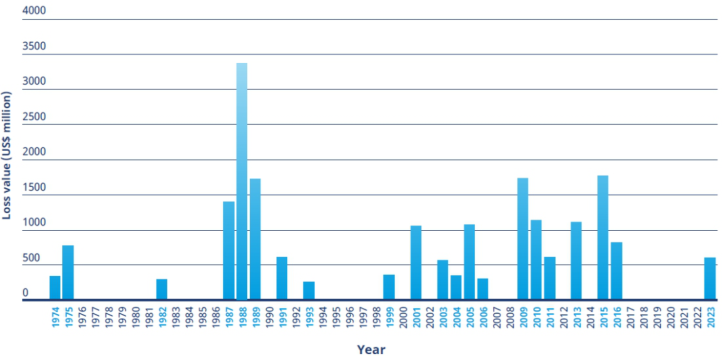
period was defined by several factors that challenged the O&G industry as well as the global economy: recovery from the Covid-19 pandemic was fur- ther complicated as the spotlight on energy security intensified as a result of the Russia-Ukraine war, soaring energy and commodity prices contributed to inflationary pressures and tightening of fiscal policies, and supply chain constraints impacted most industries (Marsh, 2023). Analysing the loss data only from the upstream area of the March report, which comprises the petroleum research, exploration, and production activities onshore and off- shore, superlative numbers are expressive, as can be seen in the graph in Figure 1.
In this dataset, the upstream sector accounts for the highest cumula- tive losses of US$20.25 billion. Various factors contribute to the cost of upstream losses, including the remoteness of offshore facilities which presents challenges for emergency response and recovery measures (Marsh, 2024). Furthermore, the crisis from the Russia-Ukraine war and the very recent con- flicts in in the Gaza Strip, arising from the historical conflict between Israel and Palestine (Yergin, 2021), also contributes for the upstream operations instability. Given these data, and considering the entire sociotechnological evolution of the O&G industry, it is possible to perceive that this entire industry was built in a sui generis way, as it needs the same commercial busi- ness agility as the civil aviation industry; is internationally regulated like the nuclear industry (they are part of the energy sector, without a doubt, but they have very different characteristics); has process plants such as the food and chemical industries; presents technological development and innovative scientific research such as the aerospace industry; and, finally, the entire production chain relays on a product, a commodity, that they don’t even “know”, as not even the smartest energy experts can’t foresee with precision the price of a barrel of oil for the next day. It is, undoubtedly, a sui generis and complex industry, where predict what could happen in an offshore oil
92 E. Maia França
platform, such an FPSO (Floating, Production, Storage and Offloading), is humanly impossible (França, Hollnagel & Praetorius, 2022). Thus, a com- prehensive understanding of the frequency, nature, and underlying causes of these accidents is crucial for the development and implementation of effective risk management strategies within the industry.
THE DESIGN OF THE RESEARCH – SCOPE, PAREMETERS AND LIMITATIONS Assembling a Multidisciplinary Team
In order to adequately conduct the research and provide a broad but also specific view of the interview process, a multidisciplinary work team was assembled, with three characteristics as its basic criteria: everyone has expe- rience in accident investigation, everyone effectively works in the O&G industry, and everyone could contribute with accident cases to the research, whether or not it happened in their companies, but they had participated in the investigation committee. This team was made up of five profession- als, namely: a psychologist, a nursing technician, a safety engineer, a safety technician, and an expert in Human Factors, each one of them from dif- ferent companies, contributing with different backgrounds, experiences, and perspectives. This team was designated as Multidisciplinary Working Group (MWG).
The Scope, Parameters and Limitations of the Research The initial proposal of the analysis of the interviews in the investigation of accidents was designed to cover all production chain of the O&G indus- try – from the shipyard that builds platform and equipment till the decom- missioning of offshore oil platforms, to interview around sixty interviewees and consolidate the data for the development of a manual for conducting interviews with injured in the O&G area. However, in the initial meetings of the MWG, it was already outlined that, within the socioeconomic real- ity of Brazil, this would not be possible. In addition to the natural resource limitations of a recovering economy, exogenous factors such as government bureaucracy, different protocols between companies and geographic dis- tances were decisive in reducing the scope of research. In face of that, the number was adjusted for twenty-five, with each of the MWG members con- tributing with five cases each. The selection criteria adopted considered three different parameters:
1. It was an accident with injury, that is, it caused some type of consequence to the worker, regardless of the degree, apart from fatality. 2. Full availability of the Accident Investigation Report, public or not, with sufficient details and data to be analysed. 3. That the Accident Investigation Report concluded that the main cause, or one of the causes of the accident, was human error.
For the development of this research, five distinct steps, including the assembling of the MWG, were assumed, considering the description of the scope and limitations, as well as the analysis and discussions.
Critical Analysis of the Interviews in the Investigation of Accidents 93
Step 1 – Assembling of the Multidisciplinary Working Group (MWG).
Step 2 – Definition of the scope of the research, which includes the definition of the selection criteria of the accidents.
Step 3 – Preliminary analysis of the accident’s report, by the MWG, selecting the ones who attends the criteria.
Step 4 – Scheduling, conducting, and collecting interview data from interviewees.
Step 5 – Analysis and discussions on the data from interviewees.
The Definition of the Accidents to be Analysed Each of the group members brought five different Accident Investigation Reports, meeting the criteria pre-established by the research. Of the twenty- five analysed in this preliminary stage, six were discarded for the following reasons: three did not have sufficient data from the interview, the main object of this research, therefore, fundamental; two presented inconsistencies in relation to the accident data itself; and one of them, the company no longer operated in Brazil, so the worker is out of reach. The study was therefore based on nineteen Accident Investigation Reports.
ANALYSIS OF THE INTERVIEWS IN THE INVESTIGATION OF ACCIDENTS To have a technical background supporting the interviews of the intervie- wee, the Report 621 (Demystifying Human Factors: Building confidence in human factors investigation) and Report 453 (Safety Leadership in Practice: A Guide for Managers), both from IOPG (International Association of Oil & Gas Producers), were adopted. Both Reports contain extremely important guidelines for conducting interviews and treating the interviewee. In partic- ular, Report 621 states how the relationship with the interviewee should be conducted: “Set the interviewee at ease. Greet the interviewee. Remember they may be nervous, or even have witnessed upsetting scenes. A calm, at ease interviewee is more likely to be able to remember helpful detail”. This may sound relatively obvious, just remember how parents and children have relationships and establish bonds of trust (Ribeiro, 2020). And a disclaimer is needed: this statement is not intended to infantilize the worker, but rather to determine that empathy is something inherent to the human being, in all aspects of life, and is essential in the process of interviewing an injured person (Sturm & Oakley, 2022). With this in mind, each of the injured of each of the nineteen accidents were contacted and invited to participate in a survey consisting of two stages, both on the same selected morning or afternoon: the answer to a set of four questions, prepared by the MWG, and based on IOGP Reports 435 and 621, followed by a free interview, where the intervie- wee would speak, if they so desired, about their experience in the accident investigation process. The questions are:
94 E. Maia França
1. How long was the interview conducted after the accident? Consider 0 for the same day, and 1 for the next day, and so on. 2. Was there a professional of human sciences (e.g. psychologist, social worker etc) present at the interview? If so, was he/she the one who conducted the interview? 3. On a scale of 0 to 10, where 10 is a terrible experience and zero is an excellent experience, how can you rate your interview experience during the investigation process in which you were involved? 4. After the end of the entire investigation process, was any type of sanction or obligation applied to you? If so, what was it: training, advertence, days off, firing or other? If other, please specify.
All the interviews performed by the MWG was conducted by the psychol- ogist, having a presence of only one of the other members. Twelve of these interviews were online, through Microsoft Teams® software, five in person (three in the Cabo Frio Airport, in Rio de Janeiro and two in a cafe near inter- viewee’s home) and two were not entirely performed, as the injured, despite having preliminarily confirmed, withdrew from the interview in person, send- ing their answers by email. The consolidation of these answers is presented in Table 1.
Table 1. Consolidation of the interviewee’s answers.
Table available in the original PDF paper.
Local
3rd
1st
4th Question (Obligation)
2nd Question (Professional) Question (Experience) Question (Days) 1 2 No - 10 Yes Advertence Online 2 1 No - 9 Yes Training In person 3 7 No - 10 Yes Firing Online 4 0 Yes No 10 Yes Training Online 5 6 No - 10 Yes Firing Online 6 2 No - 10 Yes Firing In person 7 3 No - 10 Yes Advertence Online 8 5 No - 10 Yes Firing In person 9 2 Yes Yes 7 Yes Training Online 10 11 No - 10 Yes Firing Online 11 3 No - 10 Yes Firing Mail 12 9 Yes No 10 Yes Training Online 13 6 No - 10 Yes Firing Mail 14 0 No - 9 Yes Training Online 15 2 Yes No 10 Yes Training Online 16 1 Yes No 10 Yes Training Online 17 13 No - 9 Yes Days off In person 18 2 No - 10 Yes Firing In person 19 8 No - 9 Yes Training Online
In the second part of this stage, the free interview, only seven of the inter- viewees participated (one in person and six online). This content is presented and discussed in the following chapter.
Critical Analysis of the Interviews in the Investigation of Accidents 95
DISCUSSION OF THE ANALYSIS AND RESULTS In view of the guidelines contained in Reports 621 and 453 of the IOGP, when examining the results of the 1st question, a misalignment with the recommen- dations of conducting the interview as soon as possible, if the injury permits, is noted. The average number of days obtained in this research was 4, 4 days. Except for injured 17, who had to recover from significant burns, having the need for more days due to medical hospitalization (13 days). In general, it is recommended that the interview should be conducted the day after the event, once the period of direct trauma has passed (Sturm & Oakley, 2022). In addition, the sooner an interview is conducted after an accident, the less bias will influence the construction of the narrative of facts (Thallapureddy et al., 2023).
Analysing the 2nd question, solely five interviews had a professional of human sciences present at the moment of the interview, and only one of them had the interview conducted by this professional. Crossing the answers of the 2nd and 3rd questions, it is noted that the best interview experience was precisely in this case, pointing out empirical data that this stage of the investi- gation process is more productive when is leaded by this specific professional. When multidisciplinary teams are involved in accident investigation, differ- ent perspectives are brought to discussion, which enhances understanding of the event, deepens corporate learning and promotes appropriate treatment of those involved (Heraghty, Dekker & Rae, 2021). Workers are involved in all stages before, during and after an accident and, therefore, their contribution is essential throughout the investigation process.
The answers to the 3rd question point to a known and troublesome prelimi- nary diagnosis: interviews in the accident investigation process have negative impacts on the interviewees. Indeed, in the free interview, after answering the 4th question, all interviewees stated that the interview was an uncom- fortable stage, with some of them stating that they felt like they were in a court, and not in a learning process or narration of what happened. It was not a friendly environment, and the blame and fear were the result from these inquisitions. When companies imply a blaming culture on its organization, taking the interview of an accident investigation as a biased moment to con- vict the injured, consequently arises an organizational silence, where workers are afraid to talk (Llory, 1999). This fear of speaking out is precisely what turns small safety deviations into latent causes of major industrial accidents. A fear-based organizational culture is an inherently destructive, inhibiting innovation, creativity, learning and trust. No 21st century organization can afford a culture of fear (Edmondson, 2018).
The person who knows most about the conditions and unique characteris- tics of an accident is the injured worked, who, in most cases, is fired, as can be seen from the answers to the 4th question, where 8 of the 19 interviewees were fired. The organization’s learning process is seriously compromised when these layoffs occur, weakening its resilience to deal with identical or simi- lar scenarios to what happened. It is important to notice here that blame-free systems are quite different of not accountability-free systems. Blaming people may in fact make them less accountable, once they feel less compelled to have
96 E. Maia França
their voice heard (Dekker, 2023). In another hand, accountability relays on responsibility and psychological safety, where people are willing to talk and listen actively.
CONCLUSION
Firing, advertence and counting employees for their individual failures is completely acceptable in business. However, one important reflection must be considered here: the error of the individual choice to do something irre- sponsible is being adequately separated from the error resulting from a complex combination of elements of a sociotechnical complex system? When the error is a consequence of all this complexity, it makes no sense to blame the employee and impose a culture of fear in companies, but rather listen to the employee and understand the details of the chain of events that led to the failure, producing organizational learning, enhancing the company to be more resilient to future demands. Safety is an emerging property of complex sociotechnical systems that is only possible through people, who make use of their variability to meet the conflicting, dynamic and complex demands of these systems. Therefore, considering the analysis and results of this research, the accident investigation process in the O&G Industry needs to review and improve its interview stage, transforming it from a court to a learning envi- ronment. Today, in the 21st century, considering people, and people alone, as the “cause” of accidents, it is inappropriate. In fact, people, and their knowl- edge about the accidents, are not a problem of the workplaces, but a solution, bringing learning and solutions for the entire organization.
ACKNOWLEDGMENT
The authors would like to acknowledge to all the workers and professionals that contribute to this research.
REFERENCES
Busch, C. (2021) Preventing Industrial Accidents: Reappraising H. W. Heinrich – More than Triangles and Dominoes. 1st Ed. London: Routledge - Taylor & Francis Group. Dekker, S. (2023) Stop Blaming – Create a Restorative Just Culture. 1st Ed. Brisbane:
Independently published. Edmondson, A. C. (2018) The Fearless Organization: Creating Psychological Safety in the Workplace for Learning, Innovation, and Growth. 1st Ed. London: Wiley. França, J. E. M., Hollnagel, E., & Praetorius, G. (2022) Analysing the interactions
and complexities of the operations in the production area of an FPSO platform using the functional resonance analysis method (FRAM). Arabian Journal of Geosciences, 15 (7). https://doi.org/10.1007/s12517-022-09801-0 Heraghty, D., Dekker, S. & Rae, A. (2021) Modifying an accident process and its justice system–From single narratives and retribution to multiple stories and restoration. Safety Science, vol. 139, pp. 105–248. https://doi.org/10.1016/j.ssci .2021.105248
Critical Analysis of the Interviews in the Investigation of Accidents 97
IOGP (2018) Report 621 – Demystifying Human Factors: Building confidence in human factors investigation. The International Association of Oil & Gas Producers (IOGP). IOGP (2019) Report 453 – Safety Leadership in Practice: A Guide for Managers.
The International Association of Oil & Gas Producers (IOGP). Llory, M. (1999) Acidentes Industriais – O custo do silêncio [in Portuguese] 1st Ed.
Rio de Janeiro: Editora Multimais. Marsh (2024) 100 Largest Losses in The Hydrocarbon Industry, 28th Edition, Marsh Specialty. Available at: www.marsh.com. Ribeiro, J. (2020) Empatia – Por que as pessoas empáticas serão os líderes do futuro?
[in Portuguese] 1st Ed. São Paulo: Editora Letramais. Sturm, P. & Oakley, J. S. (2022) Accident Investigation Techniques: Best Practices for Examining Workplace Incidents. 3rd Ed. California: American Society of Safety Professionals. Thallapureddy, S., Sherratt, F., Bhandari, S., Hallowell, M. & Hansen, H. (2023)
Exploring bias in incident investigations: An empirical examination using con- struction case studies. Journal of Safety Research, vol. 86, pp. 336–345. https: //doi.org/10.1016/j.jsr.2023.07.012 Thurner, S., Hanel, R. & Klimek, P. (2018) Introduction to the Theory of Complex Systems. Oxford: Oxford University Press. Yergin, D. (2008) The Prize: The Epic Quest for Oil, Money & Power. Free Press. Yergin, D. (2021) The New Map: Energy, Climate, and the Clash of Nations. Penguin
Books.
LISTED IN THE AHFE DIGITAL BOOKSTORE CATALOGUE
Explore the complete digital volume
Human Error, Reliability, Resilience, and Performance
Read this individual research paper free through the original publisher, or explore the full digital proceedings book.
ISBN 978-1-964867-08-3
Explore this ISBN in the AHFE Bookstore ↗Listed in the July 2026 bookstore catalogue; search by ISBN to confirm current availability · Digital book purchase optional