Josue Franca, Erik Hollnagel (2023). From unsafe acts to system resilience - how emerging technologies in the O&G industry reach new safety frontiers. In: Human Interaction & Emerging Technologies (IHIET 2023): Artificial Intelligence & Future Applications. AHFE Open Access, vol. 111, pp. 735–742. https://doi.org/10.54941/ahfe1004080
This study explores an historical evolution of the O&G industry, which has heavily relied on technological innovation to meet the operational challenges of its production chain. However, safety developments have sometimes failed to keep up with the technological evolution of this industry. In the beginning, its operations were marked by wild exploitation and numerous accidents, maintaining this scenario where there was the perpetuation of linear safety concepts, for increasingly complex workplaces. Traditional views of safety, such Safety-I, fails to capture the complexity and variability of real-world operations of the entire O&G production chain. To deal with complexity, evolved approaches of safety, such as Safety-II, recognizes that variability and trade-offs are inherent in complex sociotechnical systems and that people are an essential part of creating safety. Furthermore, Resilience Engineering is discussed, shifting the safety management from human error and accidents to system resilience and its own ability to cope with and adapt to disturbances. Embrace the complex reality of the work, grounded by evolved approaches of safety, provides a more comprehensive and effective way to assess, manage, and provide solutions in today's workplaces, ensuring an integration between productivity and safety.
Technology can be defined as the practical application of scientific knowledge through the handling of instruments and materials, resulting in the creation of products or processes that are beneficial for the advancement of society. According to Kay (2020), time serves as the defining factor in technology, with everything invented after an individual’s birth considered as techno- logical innovation. This highlights the relationship between technology and time, which is closely intertwined with a historical and social context. In the context of the Oil and Gas industry (O&G), technology encompasses every- thing that is conceptualized, constructed, manipulated, and transformed, while continuously interacting and evolving with humans. The O&G indus- try obtains hydrocarbons that were produced by the Earth thousands of years ago and stored for the same period. These resources can be extracted from depths of up to 8,000 meters on offshore platforms, transformed into
derivatives in refineries, and then transferred through various storage and transportation methods to gas stations, where they fuel approximately 90% of private vehicles. This complex and extensive process represents the last stage of a large and intricate chain (Morais, 2013). Besides fuel, the O&G industry also produces essential products for daily life such as polymers, plastics, pharmaceuticals, preservatives, and paraffins. These products have fostered a techno-scientific evolution by replacing metals and chemicals and adding value to digital services and solutions. At the forefront of technology, cutting-edge polymers are present in the structural components of probes, landers, and rovers, both active and inactive, that have already reached Mars (Gontijo, 2018). Additionally, smartphones, which are ubiquitous in the daily lives of over half of the world’s population, also incorporate these advanced polymers. Thus, the technological challenges posed by the pre-salt layer, with regards to depth, reserves, and flow (Machado, 2018), present a new context for the development of technology. This context highlights that the O&G industry will continue to drive new technological and experimental frontiers in equipment, processes, and sociotechnical interactions.
THE EVOLUTION OF THE O&G INDUSTRY On August 27th, 1859, Colonel Drake and Uncle Billy Smith drilled the first oil well in the history of mankind, in Titusville, Pennsylvania, marking the beginning of the Oil Age (Yergin, 2008). At the time, they could not have foreseen the immense impact their actions would have on society’s culture, habits, and evolution. The well, which reached a depth of 21 meters after several days of percussion drilling, was a remarkable achievement, given the limited resources, knowledge, and labour available in 1859. Fast forward to 2021, and the exploratory well in the Monai area, located in the pre-salt region of the Espírito Santo Basin, 145 kilometers off the coast of Brazil, has reached an unprecedented depth of 7,700 meters, making it the deep- est exploratory well ever drilled in Brazilian territory (VALOR, 2021). The well had significant technical challenges, requiring the use of state-of-the-art technology and specialized technical expertise to overcome them. The O&G industry has always employed intensive technology to meet the technical and operational challenges of its production chain, which spans from exploratory services to the final consumption of the derivatives by society, with drilling and production being the most complex stages (França, & Hollnagel, 2020). However, in 1859, the idea of adapting the drilling process and equipment from salt mines to achieve oil in the subsurface was an innovative and seem- ingly impossible feat. Uncle Billy Smith had to use his ingenuity to adapt the tools from salt mines, which were made of wood, rope, and leather, to create an oil percussion drilling system, a technique that had never been tried before. The challenges they faced were immense, and the inhabitants of Titusville even nicknamed Colonel Drake “the foolish” due to the seemingly disrup- tive nature of his venture (AOGHS, 2017). The O&G industry, since its early days, has been pushing the boundaries of technology, overcoming numer- ous technical and operational challenges along the way. The exploration and production of oil and gas in the pre-salt region of the Espírito Santo
From Unsafe Acts to System Resilience - How Emerging Technologies 737
Basin exemplify this ongoing drive towards innovation, and the industry’s unyielding commitment to technological advancement.
THE SAFETY HISTORY IN O&G INDUSTRY OPERATIONS In this full and undoubted evolution of the O&G industry, marked by tech- nological innovations, record breaking and fantastic discoveries, a very high price related to safety has been paid. At the origin of this industry, its activi- ties were more like a wild adventure than an industrial segment (Giddens, 1938). The predatory production of the reserves, the adaptation of bev- erage stills for refining and the precarious transport of oil and derivatives (notably kerosene) were the causes of several accidents (Yergin, 2008). As time went by, and the need for derivatives increased, wild exploitation gave way to the established industry, decreasing the individual occurrences of inci- dents, such as injuries handling shovels and wooden artifacts from percussion drilling (França, 2022). However, the scale of more serious accidents, such as fire and explosions, increased, causing the fires in the refineries on the banks of Oil Creek, in Pennsylvania, to evolve into the explosion of the BP Texas City Refinery (2005) and the Platform Deepwater Horizon (2010). One of the greatest milestones of technological evolution, which simultaneously impacted operational efficiencies and improved safety, was the transition from percussion drilling to rotary drilling at the beginning of oil activities in Texas, in 1901 (Clark & Halbouty, 2000). But also, with that, the intensity of the process parameters was increased, potentially escalating the consequences of rotary drilling accidents. It is important, therefore, that the entire techno- scientific evolution of the operations of the O&G production chain, from the exploratory geological studies, till the dispatch of derivatives to consumers, follow aligned with the evolution of safety. But it was only in the 1930s that the industry was able to effectively improve its safety results, with William Heinrich’s pioneering work.
THE BEGINNING OF SAFETY BASED ON UNSAFE ACTS In 1931, William Heinrich published the book “Industrial Accident Preven- tion: A Scientific Approach”, a pioneering work in the field of industrial safety. This scientific approach to accident prevention was based on extensive research and data analysis of accidents from insurance companies’ databases (Heinrich, 1931). It had presented, by that time, a new perspective for acci- dent analysis, hazard identification and prevention, emphasizing the role of human behaviour and psychology in safety management (Busch, 2016). With this behavioural bias and, having the production lines of the factory system as the epistemological basis of the work, a linear cause-and-effect relationship, dependent on human action, was established (Woods et al., 2010). In this way, for the social and temporal context of the study, people’s non-desired behaviour, that is, human error, seemed to be the main cause of the malfunc- tioning of the systems. To correct this malfunction and, consequently, avoid accidents, it was therefore necessary to eliminate human error, the mater
738 França and Hollnagel
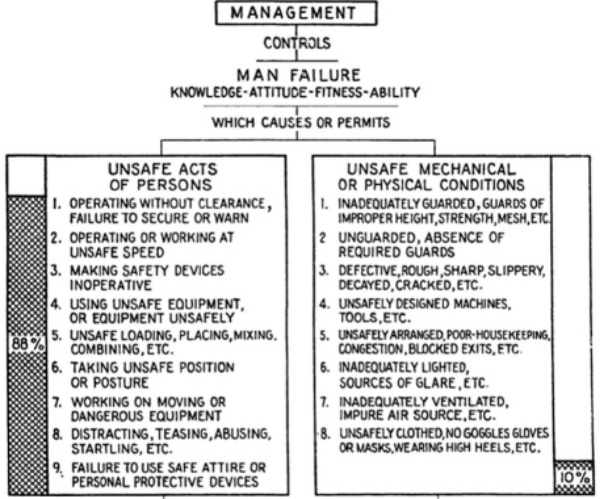
cause of the problems. In his chapter II, Basic Philosophy of Accident Pre- vention, Heinrich establishes and illustrates this relationship, through the quantitative data from the databases, in a management chart of probabilities of cause, presented in Figure 1.
Figure 1: Management for man failures (Heinrich, 1931).
Having this table in Figure 1 as a reference, as well as the Theory of Domi- noes also presented in Heinrich work, decades of safety study were based on the premise that about 80% of accidents happen due to human failure, whether it be knowledge, attitude, fitness, or ability (Busch, 2016). Human error was established as the main cause of accidents, also having decades of development of systems, barriers, and prevention standards to incessantly seek to reduce or eliminate human error (Wallace & Ross, 2016). While these 80% went through various works and safety documents over time, the Domino Theory underwent a semi-evolution, because despite changing the constituent elements of the domino, the linear relationship of cause- and-effect remained perennial. One of these is the “Swiss cheese” model of accident causation, develop by James Reason on his book “Human Error”, published in 1990. This model implies that safety barriers, such as proce- dures, training, and equipment, are slices of cheese with holes that can align, allowing an error to penetrate the barriers and cause an accident. Despite the (mistaken) linearity of the 1930s still being maintained as the representation of increasingly complex workplaces, already in this work from 1990, and consolidation in his other work from 1997, “Managing the risks of organi- zational accidents”, Reason examines that the human error in accidents are not the main cause, arguing that the traditional approach of blaming individ- uals for their mistakes is inadequate and that understanding of the context
From Unsafe Acts to System Resilience - How Emerging Technologies 739
in which errors occur is essential. Then, in 2000, in his work “Human Error: Models and Management”, Reason contextualizes the understanding that accidents in complex workplaces, such as aviation and the nuclear indus- try, are the combination of several factors, especially organizational ones, but stills very attached of the human error idea in a linear cause-and-effect model. With the continuous technological evolution of O&G work envi- ronments, and with historical accidents such as Piper Alpha (1988), Exxon Valdez (1989) and P-36 (2001) it was necessary to also evolve. If the out- dated human errors and linear cause-and-effect concepts remained, in work environments that are truly complex sociotechnical systems, there would be a limited, if not mistaken, understanding of what is happening. It was necessary to change, to do something different.
FROM UNSAFE ACTS TO SYSTEM RESILIENCE The combination of state-of-the-art technology, highly qualified workers, wide connectivity, and organizational culture has made the current work environments, of industries, that need and create technology, such as O&G, aerospace, civil aviation and chemical processes, true sociotechnical com- plex systems. Such systems are characterized by multiple interconnected subsystems that includes technological, social, individual, and environmental elements mutually coupled, working interconnected (Rasmussen, Pejtersen & Goodstein, 1994). Analysing workplaces that have these characteristics in a linear way, understanding the worker’s performance as just an individual and behavioural action, regardless of the system interactions, in addition to feed- ing a culture of guilt, will jeopardize the understanding of its operation. In this sense, Resilience Engineering emerged as a response to the realization that traditional linear approaches focused too narrowly on individual and techni- cal factors, failing to capture the complexity and variability of real-world operations (Hollnagel, Woods & Leveson, 2006). The resilience concepts focus on understand and improve the functioning of complex sociotechni- cal systems, developing dynamic and adaptative responses for the system’s demands (Hollnagel et al., 2013). That is, the complexity of the system will be understood by itself, examining emergent properties, interactions between the elements and adaptability. It also brings a paradigm for safety engineering because shifts focus from failures and accidents to system resilience and its own ability to cope with and adapt to disturbances. It is from this change that Safety-I & Safety-II emerges, allowing, in the same way as in linear systems, to apply methodologies, tools, approaches and practices to assess and manage the flaws, as well as what is doing right, in complex sociotechnical systems. Safety-I, the traditional view of safety, concerns prevent failures and reducing risks through the identification and removal of hazards, assuming that safety is achieved when everything goes according to plan and that the absence of negative outcomes indicates success (Hollnagel, 2014). In another hand, Safety-II emphasizes the positive aspects of work and the adaptive capacity of systems, seeking to ensure that things go right rather than wrong, recognizing that variability and trade-offs are inherent in complex sociotechnical systems and that people are an essential part of creating safety (Hollnagel, 2014). In
740 França and Hollnagel
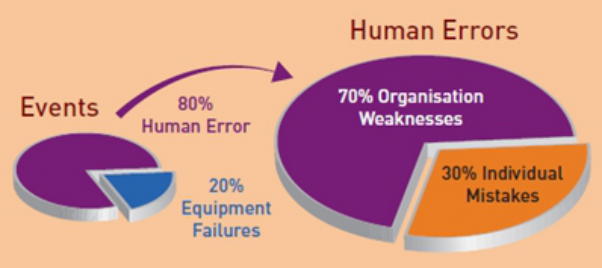
this context, it is perceived that human error is just one of several elements of a system, a trade-off result, not being a failure itself, but an indicator that the system has failed. As can be seen in Figure 2, from Report 453 of IOGP, the “Safety Leadership in Practice: A Guide for managers”, there is more to be studied, in terms of failure, in the organization, in the system, than in the individual.
Figure 2: Human error graphics from IOGP report 453 (IOGP, 2019).
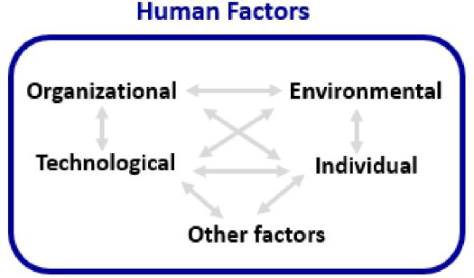
When the 80 percent human error is broken down further, it reveals that most errors associated with events come from latent organisational weak- nesses, the system functioning, whereas about 30 percent are caused by the individual worker who last touched the equipment or process (IOGP, 2019). A notable evolution of safety is then perceived, reaching new frontiers, albeit late, as the already evolved workplaces needed such concepts and practices to be properly managed. Indeed, Safety-II aims to enhance the ability of systems and people to adapt to changing conditions and recover from unexpected events, building on existing strengths and resources to create a more resilient system (Dekker, 2019). This approach, therefore, focus on how work is done rather than how it is intended to be done, seeing the human element com- petences as the source of the system’s resilience. Similar approach is also the core of the Ergonomics, a scientific discipline that focuses on understand- ing the interactions between humans and their environment, including the design of equipment, workplaces, and systems to optimize safety, comfort, and performance (Meister, 2018). The Human Factors approach, presented in Figure 3, is also applied in these new frontiers of safety, once it compre- hends the work done from the workers perspective of the system, not focusing on their behaviour or errors.
Human Factors are all factors that can influence human performance in their work activities; these factors act together and may be technological, environmental, organizational, and individual, among others (França et al., 2020). By embracing the complex reality of the work, the evolved approach of safety provides a more comprehensive and effective way to assess, man- age and provide solutions in nowadays workplaces, ensuring an integration between productivity and safety. Daily, workers deal with problematic tasks, unclear procedures, workload, difficult equipment, giving being necessary to
From Unsafe Acts to System Resilience - How Emerging Technologies 741
manage trade-offs to get the work done. Understanding that human error is normal in this sociotechnical context is very different from ignoring or min- imizing. It is important, therefore, to not confuse error awareness with error complacency. This is the first step towards reaching the new safety frontiers.
Figure 3: Human factors graphical representation (França et al. 2020).
CONCLUSION
People make mistakes, that’s an unquestionable fact. It is also unquestion- able that the current workplaces of industries such as O&G, maritime and aerospace, have long ceased to be mere linear production lines and have become truly complex sociotechnical systems. Knowing the dynamics of these facts, in an increasingly technological and complex work reality, especially in the O&G industry, is necessary not only to guarantee safety, but also business continuity. Taking advantage of, and applying evolved safety approaches, such as Safety-II and Human Factors, immersed in the Resilience Engineer- ing concepts, enables an expanded (and evolved), way to assess, manage and solve problems in increasingly complex workplaces. In this context, under- standing that the error will happen, and this is a sign of systemic failure, and not just an individual one, will allow an enhanced performance, searching deeply in the organizational structures its origins, as well as its solutions. Therefore, it is noticed that people, the workers, are not the problem, but the solution in complex sociotechnical systems.
REFERENCES
AOGHS. (2017). Modern petroleum exploration and production technologies evolved from 1890s platforms on lakes and California oil piers. American O&G Historical Society. https://aoghs.org/offshore-history/offshore-oil-history/ Busch, C. (2016). Preventing industrial accidents: Reappraising H. W. Heinrich -
more than triangles and dominoes. Routledge. Clark, J. A. & Halbouty, M. T. (2000). Spindletop (Special Centennial Edition). Gulf Publishing Company. Dekker, S. (2019). Foundations of Safety Science: A Century of Understanding
Accidents and Disasters. CRC Press.
742 França and Hollnagel
França, J. (2022). Do poço ao pixel: como a indústria de O&G impulsionou, e é impulsionada, pela evolução tecnológica. In Proceedings of the Rio Oil & Gas Expo and Conference, Rio de Janeiro, RJ, Brazil; 26–29 September 2022 (pp. 1–12). IBP. França, J., & Hollnagel, E. (2020). Safety-II Approach in the O&G Industry: Human
Factors and Non-Technical Skills Building Safety. In Proceedings of the Rio Oil & Gas Expo and Conference, Rio de Janeiro, RJ, Brazil; 21–24 September 2020. IBP. França, J. E. M., Hollnagel, E., Luquetti dos Santos, I. J. A., & Haddad, A. N. (2020).
Analysing human factors and non-technical skills in offshore drilling operations using FRAM (functional resonance analysis method). Cognition, Technology & Work, 21(1), 97–112. Giddens, P. (1938). The Birth of the Oil Industry (1st ed.). MacMillan. Gontijo, I. (2018). A caminho de Marte: A incrível jornada de um cientista brasileiro até a NASA (1st ed.). Editora Sextante. Heinrich, W. (1931). Industrial Accident Prevention: A Scientific Approach. McGraw-Hill. Hollnagel, E., Woods, D. D., & Leveson, N. (2006). Resilience Engineering: Concepts
and Precepts. Ashgate Publishing. Hollnagel, E., Pariès, J., Woods, D. D., & Wreathall, J. (2013). Resilience Engineering in Practice: A Guidebook. Ashgate Publishing. Hollnagel, E. (2014). Safety-I and Safety-II: The Past and Future of Safety Manage-
ment. CRC Press. IOGP. (2019). Report 453 - Safety Leadership in Practice: A Guide for managers.
IOGP - International Association of Oil & Gas Producers. Kay, A. (2020). The shock of the invisible. In J. Schroeter (Ed.), After Shock: The World’s Foremost Futurists Reflect on 50 Years of Future Shock - and Look Ahead to the Next 50 (9th ed., pp. 48–67). John August Media, LLC. Machado, M. (2018). Pré-sal, a saga: a história de uma das maiores descobertas
mundiais de petróleo (1st ed.). L&PM. Meister, D. (2018). The History of Human Factors and Ergonomics. CRC Press. Morais, J. M. (2013). Petróleo em águas profundas: uma história tecnológica da Petrobras na exploração e produção offshore. (1st ed.). Ipea, Petrobras. Rasmussen, J., Pejtersen, A. M. & Goodstein, L. P. (1994). Cognitive Systems
Engineering. Wiley Series in Systems Engineering. John Wiley & Sons, Inc. Reason, J. (1990). Human error. Cambridge University Press. Reason, J. (1997). Managing the risks of organizational accidents. Ashgate. Reason, J. (2000). Human error: models and management. BMJ Books. VALOR. (2021, December 10th). Petrobras atinge profundidade recorde em perfuração de poço no pré-sal. Valor Econômico, 45. Agência Brasil- Brasília. https://valor.globo.com/brasil/noticia/2021/12/10/petrobras-atinge-pro fundidade-recorde-em-perfuracao-de-poco-no-pre-sal.ghtml Woods, D. D., Dekker, S., Cook, R., Johannesen, L. & Sarter, N. (2010). Behind
human error: Human factors that shape our world. CRC Press. Wallace, B., & Ross, A. (2016). Beyond Human Error: Taxonomies and Safety Science. CRC Press. Yergin, D. (2008). The Prize: The Epic Quest for Oil, Money & Power (1st ed.). Free
Read this individual research paper free through the original publisher, or explore the full digital proceedings book.
ISBN 978-1-958651-87-2
Explore this ISBN in the AHFE Bookstore ↗Listed in the July 2026 bookstore catalogue; search by ISBN to confirm current availability · Digital book purchase optional