Josue Franca, Mônica Neves, Jeniffer Paula, Maria Luiza Castro (2026). FRAM analysis of a berthing accident in a high-throughput Brazilian port - failing safely in a complex and non-linear workplace. In: Human Factors and Systems Interaction. AHFE Open Access, vol. 230, pp. 88–96. https://doi.org/10.54941/ahfe1007980
This paper presents an accident reanalysis using the FRAM (Functional Resonance Analysis Method) methodology to understand a vessel grounding that occurred during a night-time approach for berthing at a large-scale deep-water, multi-terminal industrial port complex on the Brazilian coast, designed for high-throughput cargo handling and continuous operations, with segregated access channels, breakwater-protected waters, and intensive vessel traffic management. Although this accident resulted in no injuries, environmental impact, or intense structural damage, it exposed latent vulnerabilities in maneuvering, port operations and coordination routines. The official investigation relied on a linear accident analysis combining the 5 Whys and a Fault Tree Analysis (FTA), noticing discrete basic causes and recommendations focused solely on procedure revisions and training. While useful for identifying missing barriers, this linear approach can under-represent the coupled, adaptive, and time-compressed character of port entry and berthing operations in high-complexity and high-traffic cargo facilities. The FRAM reanalysis, though, revealed tight coupled interactions involving passage planning, bridge operations, port communication, coastline visual navigation and support resources, unveiling a hidden complexity blurred by linear methodologies. Indeed, moving beyond linear cause-effect methodologies, this FRAM reanalysis provided a more coherent understanding of how organizational, technological, environmental, and individual factors interact to shape maneuvering performance in complex workplaces of a VUCA and BANI world. Therefore, to properly recognize the real work conditions and constraints that took place in the accident of this study, the FRAM was applied to comprehend its complex nature, especially during nighttime operations.
Maritime support vessels are essential to the operations of the oil and gas industry, providing logistical support with the transport of drilling products, materials, people, and consumables, specialized underwater inspection and
FRAM Analysis of a Berthing Accident in a High-Throughput Brazilian Port – Failing 89 repair services, the laying of submarine pipelines, towing operations, anchor handling and positioning, as well as assistance in rescue and firefighting operations. This requires many vessels dedicated to offshore activities, of various sizes and designs, depending on the operational task. The vessels handle a high daily operational flow and access to ports, where they are prepared to meet the demands of oil and gas platforms located many miles offshore. The operational interactions between these agents – vessels, port facilities, and oil and gas platforms – combined with variable meteorological and oceanographic conditions, increase the complexity of this tightly coupled operational ecosystem. This leads to frequent operational and environmental safety incidents, creating a latent need to understand the elements that can cause undesirable outcomes and how they interact within the work system, so that these interactions can be steered toward a desired outcome. However, most risk analysis methodologies are based on the premise that systems function in a linear and non-complex manner, which limits, if not renders ambiguous, the entire analysis process (De Vries, 2017). In the search for tools capable of providing a more adequate analysis for complex socio-technical systems, the FRAM methodology was applied in this work to analyse an accident involving an offshore vessel, using a Human Factors approach, demonstrating how organizational elements and the complexity of the system could have contributed to the grounding of the vessel in question.
THE BERTHING ACCIDENT IN HIGH-THROUGHPUT BRAZILIAN PORT In the early morning hours of August 2025, an offshore and port maritime support vessel, a Line Handling (LH) tugboat, was involved in a grounding incident during the approach maneuver for berthing at the port where it was operating. The port is a high-throughput port complex located on the northern coast of the state of Rio de Janeiro, Brazil. Although classified as a navigational incident, the event did not result in fatalities, crew injuries, environmental pollution, or structural damage to the vessel. These outcomes can be attributed both to the characteristics of the local seabed and to the prompt response of the teams involved. The vessel’s owning company initiated an investigation to determine the sequence of events and the contributing factors that led to the occurrence. The incident originated when the vessel, which was awaiting instructions at the outer anchorage of the port, was called by the Vessel Traffic Service (VTS) at 01:40 local time to begin the berthing procedure at the port terminal. The crew carried out the standard preparations and initiated navigation toward the main access channel. The initial transit, from the anchorage area to the passage through the port’s protective breakwaters, occurred under nominal operational conditions, with all navigation and propulsion systems operating within expected parameters. The critical point in the sequence of events occurred after the vessel passed the breakwater entrance. At this moment, the 1st officer conducting the vessel was expected to execute a turn to align the vessel with the axis of the
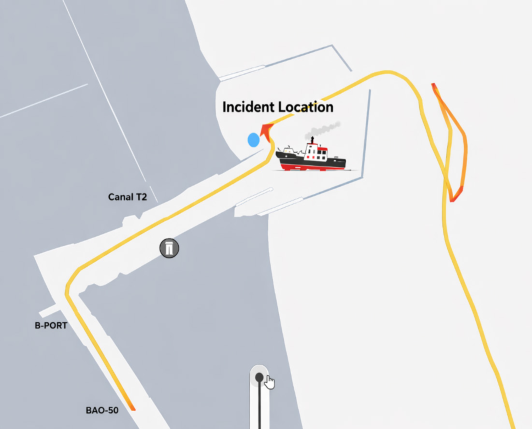
navigation channel. However, for reasons that the subsequent investigation would identify as a combination of non-linear factors, the maneuver was not performed. The vessel maintained its heading, deviating from the planned route and proceeding toward a shallow-water area. At 03:10, the bow of the vessel hit sandbank, resulting in grounding and the complete immobilization of the vessel. Figure 1 presents a simplified schematic of the vessel’s trajectory, indicating the incident location in relation to the access channel, highlighting the route that culminated in the grounding.
Figure 1: Simplified schematic of the vessel’s trajectory.
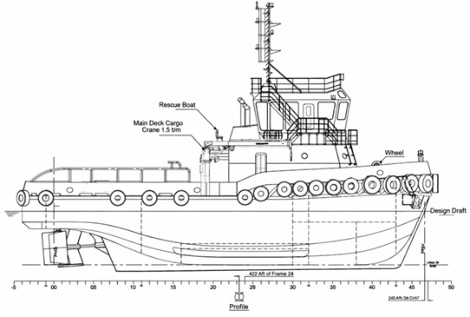
The response to the grounding was immediate. The 1st Officer reported the situation to the port’s Vessel Traffic Service (VTS) and activated the emergency procedures. An analysis of the nautical chart and local conditions revealed that the vessel was outside the navigation channel, which eliminated the risk of obstruction to port traffic. The support vessel assigned to the recovery arrived at the site at 05:05 and, following a technical assessment, determined that the friction forces, combined with low tide conditions, made refloating unfeasible at that moment. The adopted strategy was to wait for high tide, forecast for 13:00, to maximize the under-keel water depth and facilitate the refloating operation. During this period, the vessel’s stability was continuously monitored. At 14:07, with the tide at its maximum level, the recovery operation was successfully carried out using the combined pulling force of the port support tugboat. After being refloated, the grounded vessel underwent a series of machinery and steering system tests, which confirmed its full operational capability. The vessel then proceeded under its own power to a safe berth for a detailed underwater inspection, which identified no damage. Figure 2 presents the vessel’ technical blueprint.
Figure 2: The technical blueprint of the tugboat involved in the accident.
The official investigation report presented multiple causal factors of organizational, human, and technical nature, identified through the application of the FTA methodology (Fault Tree Analysis), supported by the experience of the investigative team. Among the highlighted factors were the absence of formal instructions requiring the communication of critical maneuvers (organizational factor); deficiencies in the crew familiarization and mentoring process regarding the specific area of operation (human and organizational factor); and the use of an outdated electronic nautical chart for the locality (technical and organizational factor). Despite the relevant contributions of this investigation, the application of FTA, due to its linear nature and emphasis on cause-and-effect relationships, constrained the understanding of the true complexities of the event, particularly concerning the influence of organizational elements within the chain of events. This perspective aligns with the human factors approach, which postulates that accidents in complex systems rarely result from a single error, but rather from an intricate and dynamic chain of events influenced by situational and organizational context (França et al., 2019). The proposed reanalysis, using methodologies such as the Functional Resonance Analysis Method, seeks to broaden and deepen this understanding, providing a more comprehensive view of the system and enhancing organizational learning derived from the event. Table 1 presets the characteristics and specifications of the vessel, whose specifications are relevant to understanding its maneuvering capability and size.
Table 1: Characteristics and specifications of the vessel.
Table available in the original PDF paper.
Registration and Identification Vessel Type Tugboat / LH (Line Handling)
Classification 1st Class – Maritime Support – Tugboat / Pusher Dimensions and Capacity
Overall Length 30.83 m Beam (Width) 11.00 m
Depth 5.20 m Maximum Draft 4.00 m
(Continued)
Table 1: Continued.
Table available in the original PDF paper.
Registration and Identification Gross Tonnage (GT) 416.00 t
Deadweight Tonnage (DWT) 509.98 t Construction
Hull Material Steel Year Built 2012 Propulsion and Power
Total Installed Power 3,290.00 HP Engine 1 (Mitsubishi) S12R Y1 MPTK – 1,260.00 HP
Engine 2 (Mitsubishi) S6R2 MPTK3 – 1,015.00 HP Engine 3 (Mitsubishi) S6R2 MPTK3 – 1,015.00 HP
Fuel Diesel oil
THE FRAM (FUNCTIONAL RESONANCE ANALYSIS METHOD) The Functional Resonance Analysis Method (FRAM) is a systemic method for modelling and analyzing how performance variability emerges from interactions in complex sociotechnical systems. It was developed in response to the limitations of deterministic and probabilistic approaches that tend to assume linear cause–effect pathways and component-level failure logic (Patriarca et al., 2020). In contrast, FRAM is grounded on resilience engineering concepts, treating both successful and unsuccessful outcomes as products of the same adaptive mechanisms: everyday adjustments made under finite time, information, and resources. Consistent with this view, FRAM analyses a system through its functions rather than its components and represents work as a network of interdependent functions whose couplings can create emergent outcomes (Hollnagel, 2012). A major review of FRAM applications reinforces this positioning by showing how FRAM has been used across safety management, accident/incident investigation, hazard identification/risk management, and complexity management in a broad range of domains (Salehi et al., 2021). In a FRAM model, each function is described by six aspects – Input, Output, Time, Control, Precondition, and Resource – which together define how functions can couple and how variability can propagate across the network (Hollnagel, 2012). In practical terms, FRAM is commonly implemented by (1) identifying and describing essential functions, (2) characterizing function variability, (3) examining how variability may aggregate through couplings (functional resonance), and (4) proposing measures to keep performance within acceptable conditions (Hollnagel, 2012). This functional lens helps reveal how relatively small, normal variations in multiple functions can combine and amplify, producing outcomes that cannot be reduced to a single root cause (Patriarca et al., 2020). Although FRAM was initially applied mainly to accident analysis, it has matured into a versatile framework used in sectors such as aviation, healthcare, maritime operations, and oil and gas (França et al., 2019). Retrospective applications have clarified systemic vulnerabilities in events such as a mid-air collision, highlighting how resilience can be eroded through
FRAM Analysis of a Berthing Accident in a High-Throughput Brazilian Port – Failing 93 interacting functional gaps (de Carvalho, 2011). Prospective applications have supported the design of safer and more efficient maritime operations by mapping ship–shore functional dependencies and identifying leverage points for intervention (Praetorius & Hollnagel, 2015). In parallel, FRAM has also been extended beyond a sole focus on dampening unwanted variability: it can be used to examine how functions positively resonate to create systems that excel, enabling analyses of how sociotechnical systems can flourish or stall depending on how functions are configured and coupled (Furniss et al., 2016). Contextualized in the maritime industry, the focus of the reanalysis of this research, FRAM has also been applied to analyse other high-risk and complex workplaces at sea, both for normal work in onboard operations (França et al., 2022), and accidents (França & Hollnagel, 2022) in vessels of the offshore O&G industry.
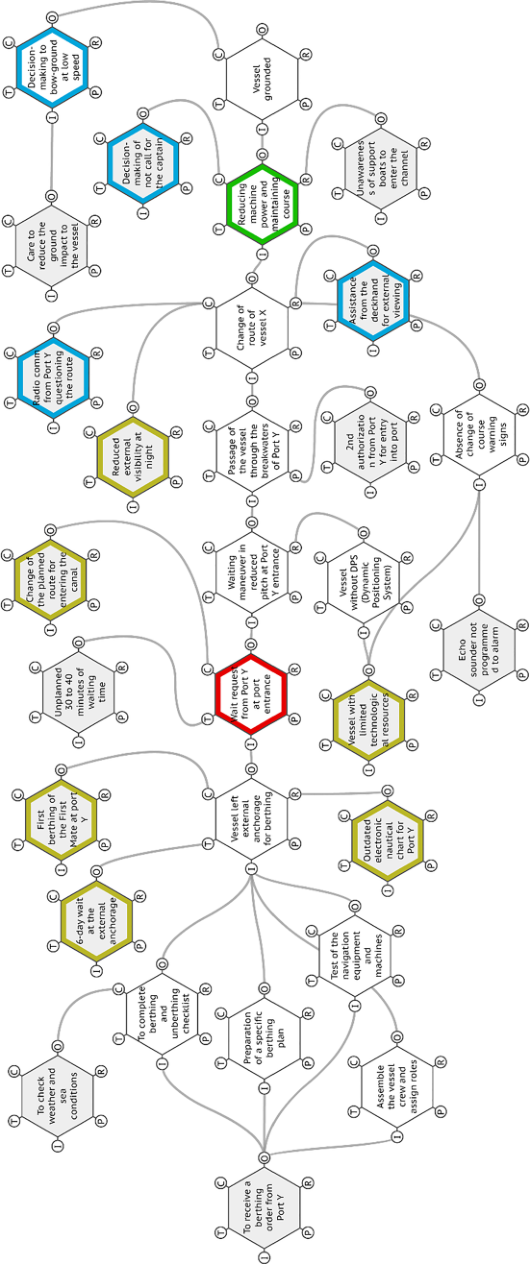
THE ACCIDENT ANALYSIS WITH FRAM The FRAM model develop by this analysis demonstrates how normal work in complex sociotechnical system is a constant performance adaptation to achieve goals safely. The berthing operations begins in a relatively normal conditions and progressively shifts from work-as-imagined (a planned berthing sequence) to work-as-done (a sequence of adaptations under accumulating constraints). The first functions of the modelling, represented by “To receive a berthing order from Port Y”, “To check weather and sea conditions”, “Assemble the vessel crew and assign roles”, “Preparation of a specific berthing plan”, “To complete berthing and unberthing checklist”, and “Test of the navigation equipment and machines”, constitute a coordinated attempt to stabilize the operation through procedural controls and role allocation. However, the model then introduces yellow functions that represent systemic conditions influencing performance variability rather than errors in isolation. It is how complex sociotechnical system – as this berthing operation – normally works, managing conflicting goals, providing dynamic adaptations, and giving effective responses to the non-linear demands of the system itself. In particular, “6-day wait at the external anchorage” acts as a strong modifier of timing, workload, and coordination demands, while also disrupting the temporal coupling between planning assumptions and the actual operational window. Similarly, “First berthing of the first Mate at port Y” and “Unplanned 30 to 40 minutes of waiting time” indicate that the entry/berthing process is no longer governed by a single coherent plan, but by iterative replanning as the vessel’s intentions must remain compatible with port-side constraints and emergent conditions. The red function “Wait request from Port Y at port entrance” emerged as the breaking point because it concentrates and amplifies the variability already introduced by the prolonged anchorage wait and subsequent unplanned delays. In fact, this function becomes a critical junction where multiple upstream variabilities resonate: time pressure grows, attention is reallocated, and the system’s capacity to maintain stable situational awareness is challenged precisely at a phase where margins are narrow (approach, canal entry, proximity to breakwaters). Figure 3 presents this FRAM analysis with all functions and its non-linear couplings.
Figure 3: The FRAM analysis of the berthing accident.
FRAM Analysis of a Berthing Accident in a High-Throughput Brazilian Port – Failing 95 The couplings around “Change of the planned route for entering the canal” and “Change of route of vessel X” show that adaptation is not a single decision but a cascade of non-linear adjustments through the system itself. Those dependencies are weakened by the technology-related yellow function “Vessel with limited technological resources”, and especially by its tightly coupled functions “Vessel without DPS (Dynamic Positioning System)” and “Absence of change of course warning signs”. Together with “Outdated electronic nautical chart for Port Y” and “Echo sounder not programmed to alarm”, the model indicates a degraded feedback environment: course deviations and proximity-to-ground risks are not escalated through reliable automated cues, pushing the system toward compensatory strategies such as external visual confirmation (“Assistance from the deckhand for external viewing”) under “Reduced external visibility at night”, while also managing the “Unawareness of support boats to enter the channel”. Just before the grounding of the vessel, it is possible to notice how decision-making becomes a controlled form of failure rather than an uncontrolled collapse. To fail safe, is, in fact, to adapt and respond under degradation/unplanned conditions, and it is not a problem of the system, but a solution responder under these circumstances. The function “Care to reduce the ground impact to the vessel” act as a prompt that reframe goals from maintain planned trajectory to minimize harm under constrained manoeuvrability. The blue functions “Decision-making of not call for the captain” and, crucially, “Decision-making to bow-ground at low speed” are not an error or problem; they are the needed performance variability from the preceding couplings: prolonged waiting, repeated replanning, reduced visibility, limited technological support, and weak warning/alerting capacity. It is very important to notice that analysis unveils the grounding not as a simple failure of compliance, but as a safe failure strategy, because “Reducing machine power and maintaining course” and “Decision-making to bow-ground at low speed” indicate deliberate teamwork and management to reduce impact consequences, converting a potentially high-consequence loss of control into a lower-energy contact with the seabed. Thus, the terminal function “Vessel grounded” emerges not as a sudden endpoint, but as the stabilized result of adaptive decision processes that, fed by earlier variability, and bounded by technological and operational constraints, prioritized the preservation of safety under rapidly narrowing operational margins.
CONCLUSION
This study reanalysed a night-time berthing approach grounding using FRAM to show how planning, bridge teamwork, port interface, and navigation support, combined in a non-linear way, interact dynamically in a complex sociotechnical system. In such environment, safety depends on continuous adaptation rather than strict adherence to an initial plan. Through the analysis, it was observed that the extended waiting and successive replanning demands (notably the prolonged external anchorage and further delays) compressed time margins and increased performance variability, while degraded feedback from limited/dated technological support reduced the system’s ability to
anticipate course-change risks early. In this context, the grounding arises not as an uncontrolled failure, but as a fail-safe outcome that evidences system’ resilience. Once that constraints accumulated and the operational picture degraded, decision-making shifted from achieve the planned manoeuvre to minimise consequences, leading to deliberate reduce vessel power, while maintaining a controllable course. The decision-making to bow grounding at a low speed converted a potentially high-consequence loss of control into a controlled, low-energy contact with the seabed, preserving life, preventing pollution, and limiting damage. It demonstrates, unequivocally, that the crew was not the problem, but a solution that reshaped system functioning to generate positive outcomes.
ACKNOWLEDGMENT
The authors would like to acknowledge all the professionals and experts involved in this work.
REFERENCES
de Carvalho, P. V. R. (2011). The use of functional resonance analysis method (FRAM) in aviation safety: A case study. Reliability Engineering & System Safety, 96 (2), 1482–1498. https://doi.org/10.1016/j.ress.2011.05.009 De Vries, L. (2017) ‘Work as Done? Understanding the Practice of Sociotechnical
Work in the Maritime Domain’, Journal of Cognitive Engineering and Decision Making, 11(3), pp. 270–295. https://doi.org/10.1177/1555343417707664 França, J., Hollnagel, E., Luquetti dos Santos, I. & Haddad, A. (2019) FRAM AHP approach to analyse offshore oil well drilling and construction focused on human factors, Cog Tech Work. https://doi.org/10.1007/s10111-019-00594-z França, J. E. M., Hollnagel, E., & Praetorius, G. (2022). Analysing the interactions
and complexities of the operations in the production area of an FPSO platform using the functional resonance analysis method (FRAM). Arabian Journal of Geosciences, 15, 573. https://doi.org/10.1007/s12517-022-09801-0 França, J. & Hollnagel, E. (2022). Reanalyzing the FPSO CSM accident (2015) with a Human Factors approach to understand the contribution of organizational elements and complexities. AHFE Open Access, vol 64. http://doi.org/10.54941/ ahfe1002628 Furniss, D., Curzon, P., & Blandford, A. (2016). Using FRAM beyond safety: A case
study to explore how sociotechnical systems can flourish or stall. Theoretical Issues in Ergonomics Science, 17(5–6), 507–532. https://doi.org/10.1080/14639 22X.2016.1155238 Hollnagel, E. (2012). FRAM: The functional resonance analysis method: Modelling complex socio-technical systems. Ashgate. Patriarca, R., Di Gravio, G., Woltjer, R., Costantino, F., Praetorius, G. & Ferreira,
P. (2020). Framing the FRAM: A literature review on the functional resonance analysis method. Safety Science. https://doi.org/10.1016/j.ssci.2020.104827 Praetorius, G. & Hollnagel, E. (2015). Control and resilience within the maritime traffic management domain. Journal of Cognitive Engineering and Decision Making, 9(3), 306–326. https://doi.org/10.1177/1555343414560022 Salehi, V., Veitch, B., & Smith, D. (2021). Modeling complex socio-technical
systems using the FRAM: A literature review. Human Factors and Ergonomics in Manufacturing & Service Industries, 31(1), 118–142. https://doi.org/10.1002/ hfm.20874
LISTED IN THE AHFE DIGITAL BOOKSTORE CATALOGUE
Explore the complete digital volume
Human Factors and Systems Interaction
Read this individual research paper free through the original publisher, or explore the full digital proceedings book.
ISBN 979-8-950676-06-2
Explore this ISBN in the AHFE Bookstore ↗Listed in the July 2026 bookstore catalogue; search by ISBN to confirm current availability · Digital book purchase optional