Josue Franca, Erik Hollnagel (2022). Reanalyzing the FPSO CSM accident (2015) with a Human Factors approach to understand the contribution of organizational elements and complexities. In: Safety Management and Human Factors. AHFE Open Access, vol. 64, pp. 57–62. https://doi.org/10.54941/ahfe1002628
This study presents a reanalysis of FPSO (Floating Production Storage & Offloading) CSM (Cidade de São Mateus) accident, occurred in February 2015, in the post-salt of the Camarupim fields, in the Espírito Santo offshore area, using the FRAM (Functional Resonance Analysis Method) methodology, and based on technical-scientific materials such as books, articles and reports prepared by the companies involved in the accident and the Brazilian regulatory agency ANP (Agência Nacional do Petróleo, Gás Natural e Biocombustíveis). The purpose of this reanalysis is to seek elements, factors, characteristics and interactions that could not be well analysed or evidenced using traditional risk assessment and accident investigation techniques, primarily designed to analyse simple and linear systems. In order to have a coherent analysis between the accident and the complex sociotechnical systems involved, the FRAM methodology was chosen, as it comprehensively manages to analyse from simple to more complex systems. And in fact, with this reanalysis using the FRAM, it was possible to perceive the influence of organizational elements, such as culture, in the entire accidental chain of the event. In addition, contractual pressures related to business, fear of hierarchical consequences and failures in decision making, at all levels, were also evidenced. The findings of this study highlighted the need of a broader approach for accidents involving high-tech industries, such as O&G and aerospace. In this sense, the FRAM enabled a more comprehensive and coherent analysis of the complexities of offshore oil production systems, notably in emergency situations, as was this accident. Comparisons between the traditional analysis methodologies, with the results obtained with the application of the FRAM, showed that there are elements contributing to the accidents that need to be considered, but that techniques limited to linear and simple systems still cannot cover this recognition. It was noticed that the greater the complexity of work systems, the greater the interaction and variability between personnel, equipment and systems, requiring, both for normal operation and for emergencies, analysis techniques and methodologies capable of recognizing the real complexities that take place in these sociotechnical systems, especially aboard offshore oil platforms at sea.
Since the first oil activities onshore, in 1859, in Titusville, PA, the O&G indu- stry has faced various accidents related to its labor activities. When these activities migrated from onshore to offshore, with the first offshore oil wells drilled from piers in 1896, in Summerland, CA, the additional risks of wor- king at sea were added for an already known dangerous activity (Wilder, 1998). From these initial activities of this industry, until the present day, the complexity of the work environments has been dramatically increased, enhancing, consequently, all the risks associated with the stages of explo- ration, drilling, commissioning, production and decommissioning of an oil well, whether onshore or offshore. Particularly, offshore activities enable risks related to sea conditions, weather conditions, confinement work regime, harmful effects of seawater mist on equipment and exhaustive work sche- dules. Accidents in these workplaces, besides causing fatalities, which is the most important to be avoided, have caused significant environmental impacts and losses, which exceed billions of dollars, as recently observed in Deepwa- ter Horizon (2010), Abkatun Alpha (2015) and FPSO CSM (2015) offshore accidents (Marsh & McLennan, 2018). With the constant and growing com- plexities of offshore workplaces in the O&G industry (França et al., 2020), in the face of these accidents, there is a clear need to properly understand how all interactions within work systems happens, identifying the elements that can cause undesired results. However, most risk analysis methodologies are based on the premise that systems work in a linear and not in a complex way, which limits, if not equivocal, the entire analysis process (De Vries, 2017). Seeking to provide an adequate analysis for complex sociotechnical system, what characterizes the current workplaces in the offshore oil platforms, the FRAM methodology was adopted, once it enables a comprehensive analysis of how a system works, from the simple to the most complex. For this, the FPSO CSM accident (2015) was analyzed under a human factors approach, demonstrating how organizational elements and the system’s complexity can contribute for an event as such.
THE ACCIDENT OF THE FPSO CSM (2015) In the morning of on 11th February 2015, after a loss of containment, a mas- sive explosion occurred in the pump room of the FPSO CSM, causing nine fatalities and seven injured over a 74 POB (People On Board). Petrobras was the operator of the field, whereas the FPSO was operated by the Norwegian company BW Offshore (Vinnem, 2018). Based on the ANP official investi- gation report (ANP, 2015), a condensate leak occurred in the pump room at approximately 11:30h, while the stripping pump was being used to drain liquid waste from central cargo tank number 6. The leak occurred in a flange in the piping system inside the pump room, due to failure of a blind flange in the piping connection. Among the first actions to recognize this leakage, until the explosion itself, several actions and events contributed to this accident, with its roots in much more complex organizational structures. According to Vinnem (2018), causal factors of organizational, human and technical nature fueled this accident, namely: inadequate storage of the condensed material
Reanalyzing the FPSO CSM Accident (2015) With a Human Factors Approach 59
(organizational), operational degradation of cargo system (organizational), degradation of marine staff (organizational), operating the stripping pump with the offload sealed (human and organizational), loss of primary conden- sed material (technical), exposure of personnel (human and organizational), ignition of the explosive environment (organizational). This understanding is weightily aligned with the human factors approach, which states that in a labor context, human factors are the set of factors that influence workers in their labor activities, which can be individual, organizational, technologi- cal, environmental, among others (França et al., 2020). That is, an accident, such as the one studied here, is not only the result of worker’s mistakes, but a complex, intricate and dynamic event that must be analyzed considering the temporal, situational and organizational context of the event. In this way, an approach such as that of human factors enables an analysis capable of understanding the complexity of workplaces as it happens, dynamically and sensitive to how the worker’s interactions occur intrinsically within work systems (IOGP, 2018). The ANP official investigation report (ANP, 2015) presented seven causal factors and 28 root causes for this accident, identified through a FTA (Fault Tree Analysis) methodology, supported by their own personnel experience and the practices of the Guidelines for Investigating Chemical Process Incidents (CCPS, 2003). Despite the undoubted contribu- tions provided by this investigation, the application of the FTA hindered the recognition of the real complexities of this event, identifying how the organi- zational elements contributed to the chain of events that caused the accident. The proposed reanalysis, using FRAM, is justly to bring this understanding, further increasing the learning from this event.
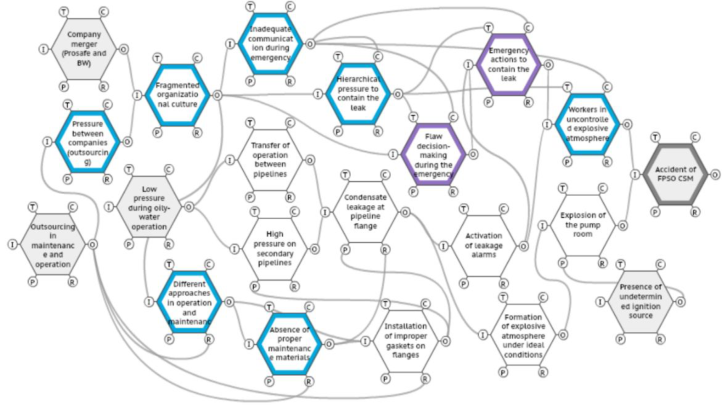
REANALIZING THE ACCIDENT USING FRAM FRAM methodology enables the understanding of how work activities are done, presenting this in a graphical qualitative model using hexagons. To build this, it is necessary to follow four steps, beginning with the identifica- tion of the functions, which can be human, technological, or organizational, depending on its natures in the system (França et al., 2019). The second step is the recognition of the output variability of each function, whereas the third step is the examination of how the functions couple and resonates with each other, modelling the complexities of the work activities itself (Patriarca et al., 2020). The last step is the analysis and management of the performance vari- ability of the entire model, which allows a broad understanding of how things really happen, which can result in positive or negative outcomes (Hollnagel, 2012). Based on previous analysis of the accident, a reanalysis was developed using FRAM, which is shown in Figure 1.
Considering the human factors approach (França et al., 2020) and its dimension of analysis – individual, organizational, environmental and tech- nological, the seven FRAM functions in blue are the organizational factors, while the two in purple are the individual contribution. The functions in white are related to technological or environmental factors, once FRAM do not classify this last one, all will be considered technological. The four functi- ons with a grey body are background function, which upon the methodology,
60 França and Hollnagel
Figure 1: FRAM model of the FPSO CSM accident.
cannot be categorized as the others, but has a fundamental importance for the foreground functions that are coupled. The function “Fragmented orga- nizational culture” resonates through several parts of the system, influencing all chain of the events that leads to the accident. Two background functions, “Company merger (Prosafe and BW)”and “Outsourcing in maintenance and operation”, are the roots of the decision-making process during the emerge- ncy actions, resonating over the entire model. Indeed, the business model and company policies influences the entire company, since the headquarters till the operational sharp end, contributing to accidents in aerospace (Vaughan, 2016) and maritime (Alexander, 2012) domains, two other sociotechnical complex workplaces.
THE CONTRIBUTION OF THE ORGANIZATIONAL ELEMENTS IN THE ACCIDENT Industrial accidents, such FPSO CSM (2015), are characterized as an event of large consequences, caused by a dynamic chain of events. Initially, between the 30s and 40s, this chain of events was idealized as linear and determini- stic, with human error being responsible for more than 80% of these events (Heinrich, 1931). With the evolution of work environments, the applied technologies, processes and procedures have developed diverse and complex workspaces, with sociotechnical interactions at various levels of scalability. Elements such as culture (Hopkins, 2019), non-technical skills (Flin, O’ Con- nor and Crichton, 2016), outsourcing (Le Coze, 2021), resilience (Hollnagel et al., 2011) are integrating parts these sociotechnical interactions, being necessary, therefore, to understand how it occurs within processes, equipment and environments, both in normal routines and in emergencies or accidents. Reanalyzing this accident through FRAM revealed that maintenance and ope- ration areas were formed by a fragmented organizational culture. The process
Reanalyzing the FPSO CSM Accident (2015) With a Human Factors Approach 61
of merging and acquiring companies must be balanced and cautious, oth- erwise will forge teams with different perceptions, postures and priorities (Hopkins, 2019). These differences disturbed the decision-making process at the time of the emergency, which, inserted in an already fragmented culture, feedback the chain of events of the accident. This relation of feedback of inte- ractions is not possible to be perceived in linear analysis tools, such as FTA, but it is with FRAM, through the resonance of its couplings. The outsourcing process, a key business issue for the O&G industry, despite of promoting service agility and price reduction, it has been systematically observed as an organizational element present in the chain of events of other accidents in this industry, such as the Deepwater Horizon (2010), Abkatun Alpha (2015) and FPSO Trinity Spirit (2022). Together with the financialization and digitali- zation, the outsourcing builds a continuous and unstable cycle of conflicting goals in the O&G industry (Le Coze, 2021). On the business side, stock mar- ket and investments rules, while on the safety side, observes regulations and procedures are mandatory. The speeds, objectives and results of both sides are mostly different, requiring a daily and conflicting balance between effi- ciency and thoroughness (Hollnagel, 2009). And the element that promotes and makes the balance of these conflicting opposites is precisely the worker, who with his variability, meets the demands, in front of the existing resources and constrains, building the resilience of the entire system.
CONCLUSION
The evolution of work environments, through new technologies and proces- ses provided services, equipment and innovations that are part of the present of Society, allowing significant achievements. However, behind this evolution, some aspects remained the same, generating an unbalance in work relationsh- ips. The analysis of accidents is one of these, because since the 30s, much has evolved, forming the current complex sociotechnical workplaces, but there is still a misconception that work happens in a linear way. In the O&G industry, particularly, the complexity is present in practically all stages of the produ- ction chain, from the design of projects to the decommissioning of massive industrial plants, also present in accidents. Therefore, the analysis of this event must be as its complexity occurs, understanding and discovering how different elements dynamically contribute to the happening. Reanalyzing the accident of the FPSO CSM (2015) with FRAM enabled perceive how much the organizational factors contributed to this accident, in the business stra- tegy, in the hierarchical structures and in the organizational culture itself. In this way, the conception that accidents are mostly caused by individual failures is also mistaken, as they start from an equally wrong premise. The FRAM model of this accident demonstrated a greater number of organiza- tional factors contributing to the accident, followed by environmental and technological, then the individual, the smallest one. There will always be individual contributions, but only with an adequate methodology, it will be possible to find the real proportions, as well as identify how organizational factors form, and are formed, by all the complexities of workplaces.
62 França and Hollnagel
ACKNOWLEDGMENT
The authors would like to acknowledge all workers who contributed to this study.
REFERENCES
Alexander, D. E. (2012) ‘The “Titanic Syndrome”: Risk and Crisis Management on the Costa Concordia’, Journal of Homeland Security and Emergency Manage- ment, 9(1). doi: 10.1515/1547-7355.1998. ANP (2015) Investigation Report of the FPSO Cidade de São Mateus - ANP
Superintendence of Operational Safety and the Environment. Rio de Janeiro. CCPS (2003) Guidelines for Investigating Chemical Process Incidents. 3rd edn. New York, NY: CCPS, AIChE. Le Coze, J.-C. (2021) Post Normal Accident - Revisiting Perrow’s Classic. 1 st.
London, UK: Taylor & Francis Group, CRC Press. Flin, R., O’ Connor, P. and Crichton, M. (2016) Safety at the Sharp End: A Guide to Non-Technical Skills. London, UK: Taylor & Francis Group, CRC Press. França, J. et al. (2019) ‘FRAM AHP approach to analyse offshore oil well drilling
and construction focused on human factors’, Cognition, Technology and Work. doi: 10.1007/s10111-019-00594-z. França, J. et al. (2020) ‘Analysing human factors and non-technical skills in offshore drilling operations using FRAM (functional resonance analysis method)’, Cognition, Technology and Work. doi: 10.1007/s10111-020-00638-9. Heinrich, H. (1931) Industrial Accident Prevention: A Scientific Approach. New
York: McGraw-Hill Book Company, Inc. Hollnagel, E. (2009) The ETTO principle: efficiency-thoroughness trade-off. 1st Ed.
Farnham, UK: Ashgate Publishing Ltd. Hollnagel, E. et al. (2011) Resilience Engineering in Practice: A Guidebok. 1st edn.
Farnham, UK: Ashgate Publishing Ltd. Hollnagel, E. (2012) FRAM: The Functional Resonance Analysis Method: Modelling Complex Socio-technical Systems. 1st Editio. New York: Ashgate. Hopkins, A. (2019) Organising for Safety: How structure creates culture. Camberra
- AU: CCH Australia Limited. IOGP (2018) Demystifying Human Factors : Building confidence in human factors investigation understand facilitate. Marsh & McLennan (2018) ‘The 100 Largest Losses 1978-2017’, (25th edition),
pp. 1–42. Patriarca, R. et al. (2020) ‘Framing the FRAM: A literature review on the functional resonance analysis method’, Safety Science, 129(May), p. 104827. doi: 10.1016/j.ssci.2020.104827. Vaughan, D. (2016) The Challenger Launch Decision: Risky Technology, Culture,
and Deviance at NASA. Enlarged E. New York: University of Chicago Press. Vinnem, J. E. (2018) ‘FPSO Cidade de São Mateus gas explosion – Lessons learned’, Safety Science, 101(May 2017), pp. 295–304. doi: 10.1016/j.ssci.2017.09.021. De Vries, L. (2017) ‘Work as Done? Understanding the Practice of Sociotechnical
Work in the Maritime Domain’, Journal of Cognitive Engineering and Decision Making, 11(3), pp. 270–295. doi: 10.1177/1555343417707664. Wilder, R. J. (1998) Listening to the sea: the politics of improving environmental protection. Pittsburgh, Pennsylvania: University of Pittsburgh Press.
LISTED IN THE AHFE DIGITAL BOOKSTORE CATALOGUE
Explore the complete digital volume
Safety Management and Human Factors
Read this individual research paper free through the original publisher, or explore the full digital proceedings book.
ISBN 978-1-958651-40-7
Explore this ISBN in the AHFE Bookstore ↗Listed in the July 2026 bookstore catalogue; search by ISBN to confirm current availability · Digital book purchase optional