Gülay Canbaloğlu, Laila Van Ments, Jan Treur, Jan Klein, Peter Roelofsma (2022). Adaptive shared mental models for medical teams. In: Safety Management and Human Factors. AHFE Open Access, vol. 64, pp. 103–108. https://doi.org/10.54941/ahfe1002634
This paper describes how second-order adaptive network models for mental processes can be used to model and support (shared) mental models for team performance and organizational learning. The paper illustrates on the one hand the value of adequate shared mental models for safe and efficient team and organizational performance. On the other hand it illustrates cases of imperfections of such shared team models in practice and how this complicates the team and organisational performance. To this end, the controlled adaptive network models can cover use, adaptation and control of a shared mental model and its learning. It is illustrated for an application context of a medical team and organization performance. Simulations illustrate how such adaptive network models are able to address the type of complications that can occur in realistic scenarios and also how better shared mental models can be learnt by organisational learning through aggregation of the best individual mental models. The paper discusses implications for healthcare safety and future research.
The concept of a shared mental model has recently received increased atten- tion in medical team performance literature as well as in other domains. Shared mental models are often brought in relation to the quality of team per- formance and safety (Burtscher, Kolbe, Wacker, 2011; Burtscher, M., Manser, T., 2012; Higgs, A., et al, 2018; Seo et al, 2021; Todd, 2018; Wilsom 2019). A team has a shared mental model when relevant knowledge structures concer- ning how reality works or should work are held by all team members and when there is sufficient alignment in the internal representations of these kno- wledge structures (Fisschoff & Johnson, 1997; Jones & Roelofsma, 2000; Mathieu, Hefner, Goodwin, Salas, Cannon-Bowers, 2000). The extent to which a team and organization have adequate shared mental models has important consequences among others for safety.
Safety, both in work and daily life has evolved more and more from being the responsibility of individuals to a shared responsibility of organisations.
Terminology has evolved from a focus on errors (Leape, 1994) to ‘patient safety’ (Donaldson, 2002; Institute of Medicine, 1999; to ‘psychological safety’ and adopting a ‘safety culture’ with adequate ‘shared mental models’ (Lee, et al., 2019;Sammer et al., 2010; Halligan, 2011; Van Ments et al, 2021). Scholars advocate to share incidents, analyse them across teams, and create an organisational culture that is amenable to sharing and learning from mistakes together (Khatri et al, 2009; Dekker, 2018; Groeneweg et al, 2018; Harvey, Sotardi, 2017). This evolution has required a delicate balance of removing blame while holding people and organisations to account when necessary. Scholars have advocated moving from a so-called ‘blame culture’ to a ‘psychologically safe’ and ‘just culture’. This means that organisations confidently share incidents and analyse them across teams. An example of such an organisational domain is the hospital.
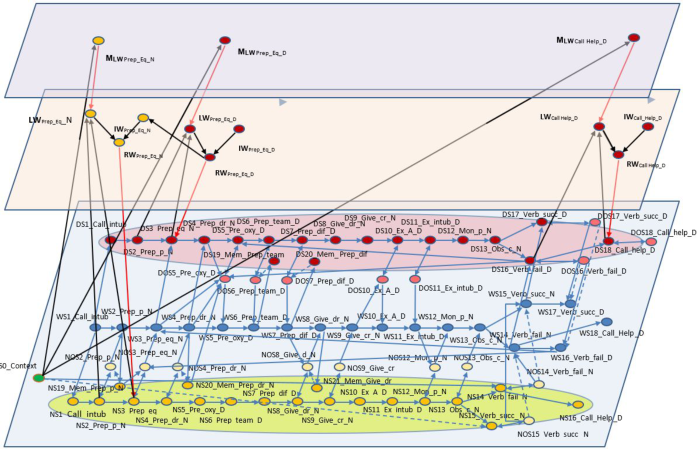
USING A SHARED MENTAL MODEL Like mental models in general, shared mental models are used in mental pro- cesses for internal mental simulation and decision making based on their outcomes; e.g., (Craik, 1943). Moreover, they often are adaptive in the sense that they can be learnt or forgotten, and for such adaptation usually a form of control is applied. These aspects of shared mental models are all addres- sed in the current paper. More specifically it makes use of the modeling work of Treur (2020) who has shown how an adaptive network-oriented modeling approach and a three-level cognitive architecture for mental models described in detail in (Treur and van Ments, 2022) can be used to model second-order adaptive mental processes involving individual and shared mental models. Van Ments, et al (2021a,b,c) demonstrate how in particular for the men- tal processes of members of a medical team, second-order adaptive network models can accurately describe and predict optimal and suboptimal deci- sion making in medical teams, see Figure 1. More specifically, the successful simulations in Van Ments et al (2021, a,b,c) cover both the errors and other imperfections that are daily practice in medical teams and they illustrate the way in which such teams can handle these.
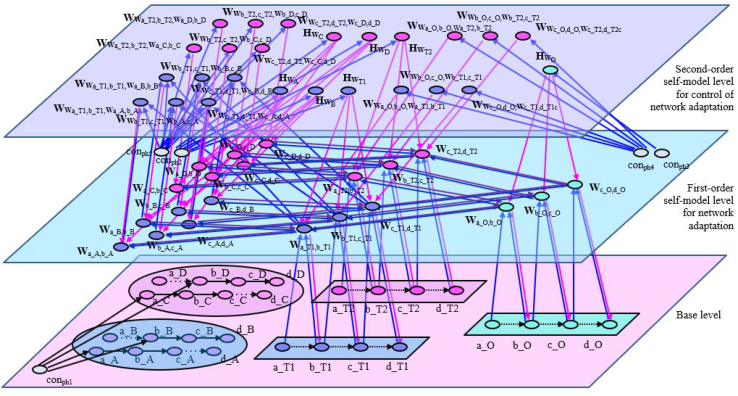
ORGANISATIONAL LEARNING TO OBTAIN A SHARED MENTAL MODEL Building on the work described above, Canbalo˘glu et al (2021a,b) have successfully addressed organizational learning to form a shared mental model (feed forward learning) for medical teams and to learn from it by indivi- duals (feedback learning). This was also done by applying and adaptive second-order adaptive network modeling approach; see Figure 2. Simulations illustrate how such adaptive network models are able to address the type of complications that can occur in realistic scenarios and also how better shared mental models can be learnt by organizational learning through aggregation of the best individual mental models.
Adaptive Shared Mental Mental Models for Medical Teams 105
Figure 1: Connectivity of the designed adaptive network model for the use of a shared mental model. It includes the two mental models of the nurse (long yellow oval) and of the doctor (long red oval). The adaptation is modeled by the self-model for the first- order (the pink plane) and the control of it by the second-order self-model (the purple plane). Dashed connections indicate connections with negative weights.Figure 2: Modeling multilevel organisational learning: the connectivity of the second- order adaptive network model for formation and learning from shared mental models within an organisation.
DISCUSSION
The work of Van Ments et al (2021, a, b, c) and Canbalo˘glu et al (2021a,b) has several important implications. One is the that it opens the way for propo- sing an Artificially Intelligent (AI) coach for medical teams and organisations.
106 Canbalo ˘glu et al.
Such an AI coach can collect and combine situational, behavioural and ver- bal information, e.g through sensors and microphones and/or an interactive dashboard, and process this, thereby using the modelling algorithms descri- bed above. The AI-coach can ask relevant questions to verify that all members have a shared mental model and intervene if necessary, e.g. using media- ted communication through the interactive dashboard and artificial speech. Such a system would have superior capabilities and no concerns e.g. about speaking up behavior in case problems arise.
The overarching aim of such an implication can then be to explore: How can this AI coach contribute in the hospital in improving patient safety by creating an adaptive shared mental model for team based on organisational learning? The underlying models and algorithms of an AI-coach can be fur- ther developed to enable this. The vision can be further elaborated in that the AI coach will interact with users (patients and clinical and non-clinical hospi- tal staff) in a personalised and motivating way and guide the organisation towards improvement of patient safety. This aims to optimise the utilisation of all available knowledge and the professional, personal and social skills of all team members facilitated by the AI-coach. The AI coach can stimu- late hospital staff by giving suggestions for initiatives and opportunities to improve patient safety. This will be done by stimulating and implementing, e.g., behavioural change within the organisation, elements of safety, and a shared mental model.
Such an AI coach can provide a new approaches for safety and quality of care, e.g. through introducing a concept of co-designed clinical pathways sup- ported by the AI coach. The AI coach can be an intervention for both impro- ving hospital-wide safety and two exemplary clinical pathways in exceptional vulnerable patients. It can empower users by supporting and facilitating the development of a shared mental model for team and organisational learning. The AI coach can function as an information, communication, cooperation and decision support system.
Several hospitals across Europe are willing to participate in forming such an AI coach in a co-creation process, e.g., by a connected Living Labs, which forms a ‘learners’ community’ in which hospitals learn and develop shared mental models for organisational and team learning. The AI coach can be developed, validated and disseminated in such a way. This AI coach can then be applicable in all hospitals where comparable patients are treated.
Such an AI coach implication is urgent since the available knowledge and current recommendations exceed the cognitive bandwidth of the ave- rage healthcare provider, especially in pathways where multidisciplinary care is provided. AI provides important solutions for challenges such as contra- dictory recommendations and innovations in this area. The impact of the implication can be such that within several years after the start of the pro- ject, hospitals using the AI coach will have better adherence to appropriate medical guideline and protocols, improved psychology safety in teams of healthcare providers and a higher level of patient safety.
In sum, the core implications are that the adaptive second order network modeling approach described in this paper will lead to:
Adaptive Shared Mental Mental Models for Medical Teams 107
a new framework for patient safety
inclusive and user-centered design of clinical pathways and total hospital quality
an AI platform with an interactive AI coach who reaches out and empo- wers its users with policy recommendations
improvements in team and organisational learning and training.
REFERENCES
Burtscher, M., Manser, T. (2012) Team mental models and their potential to improve teamwork and safety: a review and implications for future research in healthcare. Saf. Sci. 50(5), 1344–1354. Burtscher, M.J., Kolbe, M., Wacker, J. (2011) Interaction of Team mental models and
monitoring behaviors predict team performance in simulated anesthesia inducti- ons. J. Exp. Psychol. Appl. 17(3), 257–269 Booher, Harold, ed. (2003). Handbook of human systems integration. New Jersey: Wiley. Canbalo˘glu, G., Treur, J., Roelofsma, P.H.M.P. (2021): Computational Modeling of Organisational Learning by Self-Modeling Networks. Cognitive Systems Research, 73, 51–64. https://doi.org/10.1016/j.cogsys.2021.12.003. Canbalo˘glu,G., Treur, J. Roelofsma, P. H.M.P. (2022). An Adaptive Self-Modeling
Network Model for the Roles of Individual and Team Learning in Organisational Learning. Proc. of the 7th International Congress on Information and Communi- cation Technology, ICICT’22. Lecture Notes in Networks and Systems, Springer Nature. Craik, K.J.W (1943). The nature of explanation. Cambridge, MA: University Press (1943). Dekker, S. (2018). Just Culture: Balancing Safety and Accountability. Ashgate
Publishing. Donaldson, L. (2002). An organisation with a memory. Clinical medicine, 2(5), 452. Groeneweg, J., Ter Mors, E., van Leeuwen, E., Komen, S. (2018). The long and winding road to a just culture. In: SPE International Conference and Exhibition on Health, Safety, Security, Environment, and Social Responsibility. Society of Petroleum Engineers. Halligan, M., & Zecevic, A. (2011). Safety culture in healthcare: a review of concepts,
dimensions, measures and progress. BMJ quality & safety, 20(4), 338–343. Harvey, H. B., Sotardi, S.T. (2017). The just culture framework. Journal of the American College of Radiology: JACR, 14(9), 1239–1241. Higgs, A., et al (2018). Guidelines for the management of tracheal intubation of
critically ill adults. Br. J. Anaesth. 120(2), 323–352. Institute of Medicine. (1999). To err is human: Building a safer health system.
Washington, DC: National Academies Press. Khatri, N., Brown, G. D., & Hicks, L. L. (2009). From a blame culture to a just culture in health care. Health care management review, 34(4), 312-322. Leape, L. L. (1994). Error in medicine. Jama, 272(23), 1851–1857. Lee, S. E., Scott, L. D., Dahinten, V. S., Vincent, C., Lopez, K. D., & Park, C.G.
(2019). Safety culture, patient safety, and quality of care outcomes: A literature review. Western journal of nursing research, 41(2), 279–304. Sammer, C.E., Lykens, K., Singh, K.P., Mains, D.A., & Lackan, N.A. (2010). What is patient safety culture? A review of the literature. J. of Nursing Scholarship, 42(2), 156–165.
(2021) Towards an AI Coach to Infer Team Mental Model Alignment in Heal- thcare. Department of Computer Science, Rice University, Houston, TX, USA (2021). Todd, J. (2018) Audit of compliance with WHO surgical safety checklist and building a shared mental model in the operating theatre. BJM Leader 2(1), 32–135 (2018). Treur, J., Van Ments, L. (eds.) (2022). Mental Models and their Dynamics, Adapta-
tion, and Control: a Self-Modeling Network Modeling Approach. Cham, Springer Nature. Van Ments, L., Treur, J., Klein, J., Roelofsma, P.H.M.P (2021a). A Computational Network Model for Shared Mental Models in Hospital Operation Rooms. In: Proceedings of the 14th International Conference on Brain Informatics, BI’21. Lecture Notes in Computer Science, vol. 12960, pp. 67–78. Springer Nature. Van Ments, L., Treur, J., Klein, J., Roelofsma, P.H.M.P. (2021b) A Second-Order
Adaptive Network Model for Shared Mental Models in Hospital Teamwork. In: Nguyen, N.T., et al. (eds.), Proc. of the 13th International Conference on Computational Collective Intelligence, ICCCI’21. Lecture Notes in Artificial Intelligence, Springer Nature. Van Ments, L., Treur, J., Klein, J. & Roelofsma, P.H.M.P. (2021c): Are We On the Same Page: A Controlled Adaptive Network Model for Shared Mental Models in Hospital Teamwork. In: Treur, J., van Ments, L. (eds.). Mental Models and their Dynamics, Adaptation, and Control: a Self-Modeling Network Modeling Approach, Chapter 14, pp. 371–406. Berlin, Springer Nature. Wilson, A. (2019) Creating and applying shared mental models in the operating
room. J. Perioper. Nurs. 32(3), 33–36.
LISTED IN THE AHFE DIGITAL BOOKSTORE CATALOGUE
Explore the complete digital volume
Safety Management and Human Factors
Read this individual research paper free through the original publisher, or explore the full digital proceedings book.
ISBN 978-1-958651-40-7
Explore this ISBN in the AHFE Bookstore ↗Listed in the July 2026 bookstore catalogue; search by ISBN to confirm current availability · Digital book purchase optional