Frank Guldenmund, Jop Groeneweg, Irene Grossmann, Peter Roelofsma, Dimmy Van Dongen, Nienke Luijcks (2022). What is the Meaning of Safety in the Context of Health Care?. In: Safety Management and Human Factors. AHFE Open Access, vol. 64, pp. 109–116. https://doi.org/10.54941/ahfe1002635
In this paper we explore the meaning of safety in health care using the concepts of safety, barrier and risk and the Hazard-Barrier-Target model. Safety at the sharp end of health care very much relies on the decisions and actions of professionals providing care. To create safety at the sharp end we therefore need to focus on safety management processes that deliver measures (barriers) and support conditions in which health care professionals can create and sustain safety while tending to patients.
To this date, patient safety remains a serious concern, which means there are still too many medical mishaps impacting patients that could or even must have been avoided. But what does ‘safety’ mean in the context of health care? And how does such safety compare to other domains where safety is crucial? In this paper we will explore the concepts of hazard, safety and risk as well as the Hazard-Barrier-Target model and apply these to the concept of patient safety. We start with unpacking the concepts of safety and risk first. We then combine these concepts in the Hazard-Barrier-Target model, which we then apply to patient safety. Finally, we discuss risk and safety management in the context of patient and health care safety.
THE CONCEPTS OF SAFETY AND RISK Safety and risk are words used frequently in daily discourse, which means that both concepts will be invoked in many contexts and for many purpo- ses. The use of these concepts in everyday communication, however, is often inconsistent. Therefore, we need to elaborate these concepts further to make clear by what we actually mean by safety and risk.
Safety is often defined as the absence of accidents or the absence of unne- cessary risk (Aven 2022). Appealing as both definitions might be, we think they do not capture the actual nature of safety. That is, when safety is defi- ned as either the occurrence or absence of accidents, this basically means that safety is expressed in events, or non-events, that happened or did not happen
in the past. Furthermore, when risk is taken as an expression of safety, it actu- ally implies that safety is defined in terms of events that might happen in the future, but have not happened yet. We think, however, that safety is a state or condition of the present and to stay safe requires a constant effort of those involved in ‘creating’ safety. To explain our position, we need to unpack the concept of safety, which is what we will do first.
Safety To start with, a hazard poses a potential threat to safety. Manuele defines a hazard as ‘the potential for harm or damage to people, property, or the environment. Hazards include the characteristics of things (e.g., equipment, technology, processes, dusts, fibers, materials, and chemicals) and the actions or inactions of people’ (Manuele 2013, italics added).
Safety always implies a threat (a hazard), otherwise the use of the word safety is irrelevant. Furthermore, the hazard is perceived to be a threat to someone, or something. That is, for safety to be pertinent, someone or some- thing should be vulnerable to the hazard, whatever the hazard might be. Regarding the hazard’s perception, two perspectives are possible. One, the perspective by someone who perceives the hazard as a threat and could be target of the hazard. The second perspective involves someone who observes a hazard, perceives it to be a threat to someone, or something, but does not have to be a target themselves. Both views do not have to coincide, but they can, of course. That is, people’s perceptions of hazards differ, whether they are the hazard’s target, or not.
So, for safety to be relevant we need the threat of a hazard to begin with. This hazard also needs to be perceived as a threat. However, for safety to exist, we also need some sort of control or a containment because otherwise the concept of safety, again, is not pertinent. That is, if we perceive a hazard to be a threat to ourselves or others and we think it is not controlled, we cannot apply the concept of safety. Most of the times, this also means that safety is localized, because a hazard is always somewhere as well as that what can be harmed by the hazard, the target, that is.
Finally, regarding the control of the hazard, we must believe in its effecti- veness. If we perceive a particular hazard to be a threat but do not believe that it is controlled or contained effectively, we will not feel safe, despite what others might state. So, when we discuss safety, much seems to revolve around what we or others perceive; i.e., the perception of a hazard, the perception of its control. However, hazards can pose a genuine threat, no matter what people perceive or declare. The same goes for controls, which can be shown to ensure safety to a certain extent in most situations. With regard to hazards, absolute safety does not exist, because it would render the concept of safety irrelevant.
With the discussion of a hazard, its control and the possible target in rela- tion to the hazard, we have basically summed up the Hazard-Barrier-Target model (U.S. Department of Energy 1996), to which we will return later in this chapter.
What is the Meaning of Safety in the Context of Health Care? 111
We can distinguish different domains of safety based on the threats invo- lved. Traditionally, safety covers five distinct domains, based on five distinct types of threats: (1) Occupational safety; (2) Process or external safety; (3) Traffic safety; (4) Patient safety or health care safety; (5) Social safety. Oftentimes, when people use the word safety, they refer to the last type of safety, social safety. That is, people are either explicitly threatening other people for any kind of reason, or people feel threatened by other people for any kind of reason. In this paper we will solely focus on patient safety or, more broadly, health care safety.
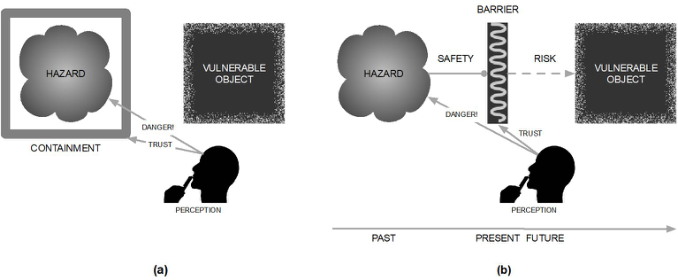
The Hazard-Barrier-Target Model We have already mentioned the Hazard-Barrier-Target model above. The HBT-model describes a safe situation, which is perceived also as safe. The hazard has the potential to harm people, property and the environment (Manuele 2013). The latter three concepts together comprise the overall ‘tar- gets’ of most, if not all, hazards. To prevent the hazard from reaching the target(s), we need another concept, a safety ‘barrier’. Simply put, a safety bar- rier fulfills a particular protective function with regard to a certain hazard. We use the word function here, because a barrier can be something material, but it can also be an act or some sort of symbol. The act is often related to something material, like putting a material barrier in place or activating a material barrier. A symbolic barrier might, for instance, indicate that some- thing risky is taking place and people should keep distance or keep out. The list of possible barriers is endless, yet the essence of a barrier is that it prevents or obstructs a hazard in reaching a certain target.
In choosing barriers, we use the so-called hierarchy of controls. This hie- rarchy describes several ways of containing hazards, ordered from most effective, and therefore preferable, to least effective and, therefore, least prefe- rable. Only when a barrier solution higher up in the hierarchy is not feasible, we descend one step down the hierarchy. We begin with looking for options to eliminate the hazard. If that is not possible, we search for possibilities to substitute the hazard for something less hazardous. A further step down the hierarchy, we put engineering controls in place to control the hazard. When such barriers are either not possible, or not sufficient, additional warning systems will need to be installed. Finally, we can resort to administrative con- trols, but only if barriers higher up in the hierarchy are not possible or not sufficient.
Together these three concepts – hazard, barrier and target – make up the Hazard-Barrier-Target Model. The HBT-model basically underlies all safety thinking as well the principles of safety and risk management (Figure 1b, 2a, 2b). The HBT-model is deceptively simple. Please note, however, that the model does not make any allusions to the nature of the hazard, the barrier or the target. It also does not describe how the hazard can reach the target. The HBT-model is central to, for instance, the bowtie model or the much more intricate Management Oversight and Risk Tree (MORT). Looking at this extensive tree makes the point above more than clear (see e.g., Johnson 1973).
Figure 1: (a) Safety consists of a perceived or real threat (hazard), perceived to be effectively controlled; (b) The Hazard-Barrier-Target model with the concepts of safety and risk.
Figure 1b also shows the timeline on which we can project the concepts of hazard, safety and risk. If the PRESENT is safe, it must mean that the threat or hazard is controlled and is therefore a matter of the PAST. However, things might change rapidly, to the extent that the hazard indeed might reach the target through a series of events in the FUTURE, which is called risk. We will discuss this concept next. In potential, safety and risk are close in time, because a situation can be safe at one minute and disastrous the next.
Risk While the concept of hazard has been popular with safety professionals for many years, risk is now gradually replacing this term. In the context of safety, we talk about a safety risk, which is usually referring to an unwanted situ- ation or outcome. However, risk can refer to both unwanted and wanted outcomes.
(si, pi, ci) (1) Risk is a composite concept (1), consisting of a scenario si (a possible sequ- ence in which a threat or hazard develops into something consequential, or unwanted), the probability pi of the threat materializing into something con- sequential and the consequences(s) ci the threat can lead to (Kaplan and Garrick 1981). The risk triplet does not refer to a hazard or threat because a hazard in itself is rather meaningless. We need to know the particular sequ- ence or scenario that describes how the hazard has particular consequences with a certain probability. The consequences can be expressed in different ways: money, deaths, injured (more difficult to ascertain), material damage, psychological damage (more difficult to ascertain), or any other numbered consequence someone is interested in.
For many, risk is also an expression of safety (Aven 2022). That is, a certain risk provides an indication of how safe a situation is. Perceptions do play a role here also, for instance in the estimation of the probability of an unwanted event to happen. People are notoriously bad at estimating probabilities as well
What is the Meaning of Safety in the Context of Health Care? 113
as unwanted outcomes. Regarding the latter, issues like imaginability (can we imagine what the unwanted consequences are) and dread (how dreadful are the consequences) determine how we estimate probabilities of risk (Slovic et al. 1981).
SAFETY IN THE CONTEXT OF HEALTH CARE Now that we have unpacked the generic concepts of safety, hazard, risk and barrier, and combined them in the HBT-model, we can now apply these concepts in the context of health care.
In terms of the HBT-model described above, the ‘target’ in patient safety is the patient, in health care safety the patient as well as the health care wor- ker(s). If we want to extent the target to material things, it could also be, for instance, the operating room, or the hospital, or any other living or material target.
Identifying hazards and barriers is more complicated, as hazards in pati- ent safety are often not hazards per se, but can be hazardous in a particular situation, or in a particular amount. In order to identify pertinent hazards in patient safety we use the taxonomy of medical errors developed by Elder and Dovey (2002), based on a systematic review of the literature. Elder and Dovey distinguish four groups of issues that can arise in health care pro- cesses and could result in adverse events for patients: (1) Clinician factors, (2) Communication factors, (3) Administration factors and (4) Blunt end factors. The first two factors have an immediate impact on patient safety, whereas the latter two are more distant from the sharp end, the place where patients and clinicians interact directly. Clinician factors pertain to judge- ment errors, e.g., in diagnosis, in treatment or in preventive services, and to procedural skills errors. The latter errors encompass errors made during medical procedures. Judgement errors can occur in various phases of patient care; that is, in the diagnosis phase, the treatment phase and the preventive services phase (Table 1). According to this latter classification, the hazards involved in patient safety are twofold: (1) Decision-based, in particular rela- ted to diagnosis and the ensuing treatment, meaning that a wrong diagnosis can lead to a patient’s exposure to the hazardous characteristics of things (e.g., equipment, processes, materials, chemicals, and so on; see definition of hazard above) (2) Action-based; these hazards encompass all actions or inactions of health care professionals in medical procedures.
Comparable to other safety domains, safety at the sharp end of health care means that we have arrived at the lower regions of the hierarchy of hazard control. This means health care professionals have to rely prima- rily on engineering controls, warning systems and administrative controls. Physical barriers will often consist of PPEs (Personal Protective Equipment) that health care professionals (or patients) have to don, while they carry out their work. In many ways, health care professionals resemble operators at the sharp end of work. However, while operators can and usually have to bring the installation they have to work on into a ‘safe state’ before they can continue, health care professionals do not have this possibility (some would say ‘luxury’). However, like operators, they do have to rely on work carried
Table 1. Classification of clinician factors (Elder and Dovey, 2002).
Table available in the original PDF paper.
Category Descriptor Adverse event Diagnosis Related to symptoms Misdiagnosis Missed diagnosis Delayed diagnosis Related to prevention Misdiagnosis Missed diagnosis Delayed diagnosis Treatment Drug Incorrect drug Incorrect dose Delayed administration Omitted administration Non-drug Inappropriate Delayed Omitted Procedural complication Preventive services Inappropriate Delayed Omitted Procedural complication
out by others, or perhaps themselves, to ensure that when they take over, working conditions are optimal. In the case of operators, an installation has to be shut down, a pipeline has to be isolated and emptied and so on. In the case of, for instance, surgeons, the operating room needs to be staffed with competent people, including themselves, instruments should be sterile and available, information about the patient is at hand, complete and unambi- guous, and so on. Put in other words, safety in health care at the sharp end is about creating optimal conditions in which competent health care profes- sionals can carry out their work on patients safely. Such conditions are, of course, optimal relative to the patient’s condition as well.
Creating such optimal conditions are indeed the primary purpose of safety management systems (SMSs). SMSs describe the processes for barrier delivery (development, monitoring and maintenance) and learning from both mishaps and the many things that go well to improve both the SMS-processes as well as the professional’s ability to cope with surprises during any stage of a pati- ent’s care pathway (Li and Guldenmund 2018). We therefore propose that SMSs in health care will contribute significantly to the very conditions in which patient safety and health care safety can be created and sustained.
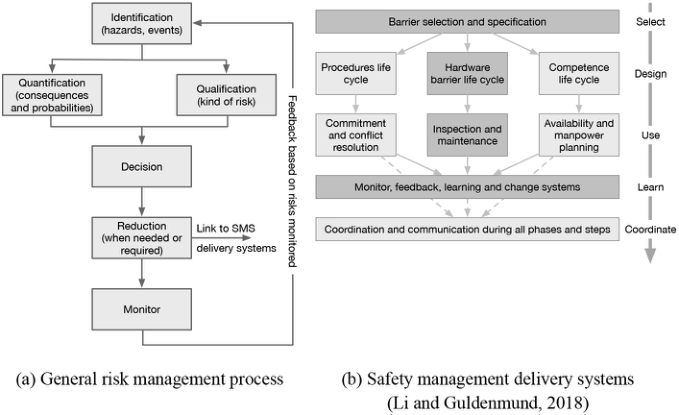
Applying Risk and Safety Management in Health Care Like the concepts of risk and safety, risk and safety management are closely related. We apply the concept of risk to decide about the risks we need to mitigate and to prioritize these. However, firstly we need to identify those risks and experience combined with lessons learned from incidents usually serve as inputs. When we have selected and prioritized the risks that need further treatment, safety management processes are activated. Overall, safety management is concerned with delivering, monitoring and maintaining safety
What is the Meaning of Safety in the Context of Health Care? 115
Figure 2: Risk and safety management processes.
measures (i.e., barriers) (Figure 2b) to reduce those risks we have identified for treatment in the risk management process (Figure 2a).
To create and sustain patient safety at the sharp end, we will need to rely on the delivery of procedures (i.e., protocols) and the commitment to apply these in a conscientious and thoughtful manner, on competent personnel to be available at the right time and the right place as well as on complete, up- to-date and unambiguous information about the patient. Moreover, working conditions should be such, that all health care workers involved at any time can raise concerns whenever they feel the need to and that expertise, and not hierarchy alone, is leading when the condition of a patient might suddenly change for the worse.
CONCLUSION
In this chapter we have discussed the concepts of hazard, safety and risk and the Hazard-Barrier-Target model in relation to patient safety and health care safety. Safety at the sharp end of health care resembles such safety in various other domains in that people at the sharp end always have to cope with the circumstances in which they find themselves. Circumstances shaped by management systems that deliver, monitor, and maintain safety barriers and that learn from the experiences that people have working within these systems.
REFERENCES
Aven, Terje. 2022. ‘A risk science perspective on the discussion concerning Safety I, Safety II and Safety III’, Reliability Engineering & System Safety, 217: 108077. Elder, Nancy C., and Susan M Dovey. 2002. ‘Classification of medical errors and pre-
ventable adverse events in primary care: a synthesis of the literature’, The Journal of family practice, 51 11: 927–32.
Johnson, W.G. 1973. “MORT. The Management Oversight and Risk Tree.” (U.S.
Government Printing Office). Kaplan, S., and B. J. Garrick. 1981. ‘On The Quantitative Definition of Risk’, Risk Analysis, 1: 11–27. Li, Yuling, and Frank W. Guldenmund. 2018. ‘Safety management systems: A broad
overview of the literature’, Safety Science, 103: 94–123. Manuele, Fred A. 2013. On the practice of safety (John Wiley & Sons, Inc.: Hoboken (NJ)). Slovic, Paul, Baruch Fischhoff, Sarah Lichtenstein, and F. Roe. 1981. ‘Perceived Risk:
Psychological Factors and Social Implications’, Proceedings of The Royal Society A: Mathematical, Physical and Engineering Sciences, 376: 34–34. U.S. Department of Energy. 1996. “Hazard and Barrier Analysis Guidance Document.” (Office of Operating Experience Analysis and Feedback).
LISTED IN THE AHFE DIGITAL BOOKSTORE CATALOGUE
Explore the complete digital volume
Safety Management and Human Factors
Read this individual research paper free through the original publisher, or explore the full digital proceedings book.
ISBN 978-1-958651-40-7
Explore this ISBN in the AHFE Bookstore ↗Listed in the July 2026 bookstore catalogue; search by ISBN to confirm current availability · Digital book purchase optional