Barry Kirwan (2022). Towards an action-oriented safety culture maturity scale. In: Safety Management and Human Factors. AHFE Open Access, vol. 64, pp. 80–86. https://doi.org/10.54941/ahfe1002631
Whilst safety culture is seen by many as an essential ingredient for safety, it is often vaguely described. This can make it harder to lead safety culture in an organization, particularly for those at senior management level, as it is not always clear what to do in concrete terms. Since senior managers are accustomed to benchmarking systems, the approach undertaken in this study was to adapt an existing benchmarking system to safety culture, and to populate it with safety culture activities and actions. This development built on work in the Maritime sector, which focused on safety learning, and resulted in the elaboration of a dozen safety learning approaches. These approaches, together with safety culture elements taken from existing maturity scales in the air traffic management domain, have resulted in a safety culture maturity scale that is more ‘action-oriented’. This paper gives an overview of the journey towards the development of this scale, outlines the twelve safety learning approaches, and then presents the proposed safety culture maturity scale itself.
Safety Culture: Understood in Words, But Not Actions Safety culture has been around for decades, the term coined shortly after the Chernobyl nuclear power accident in 1986. Despite its longevity, safety cul- ture has often remained an esoteric subject, where it is hard to state what constitutes ‘good’ safety culture, once even likened to “a state of grace…stri- ven for but rarely attained.” (Reason, 1997). Nevertheless, poor safety culture is seen as a major contributor to a plethora of high profile accidents across numerous domains including the energy sector (Chernobyl, Fukushima, Piper Alpha, Deepwater Horizon) and transport (Herald of Free Enterprise, Kings Cross and Ladbroke Grove rail crashes, AF 447 and B737 Max air crashes). But while safety culture is seen as important, to the extent that having a Safety Management System (SMS) is seen as inadequate without a positive safety culture to energize it, and while there are questionnaire-based safety culture measurement tools in existence (some of which are validated), the answer to the question of ‘what does good safety culture look like?’ often evades us. Whilst it is easy to recognize poor safety culture, it seems harder to envision what leading edge safety culture organizations might actually be doing.
Towards an Action-Oriented Safety Culture Maturity Scale 81
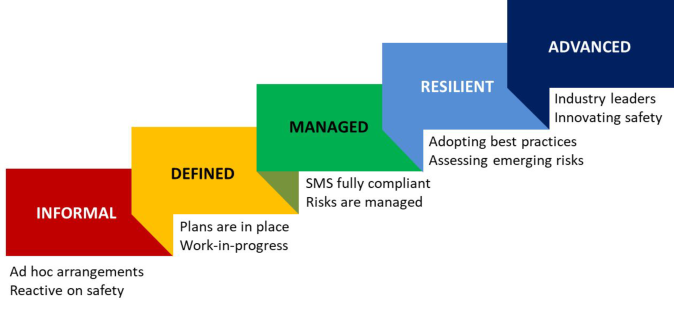
Figure 1: Safety benchmarking scale.
This endemic vagueness is problematic, as safety culture needs support from the top and middle management, and CEOs and other senior managers are usually rather focused people who believe in concrete goals, actions and processes, even if these are seen as instruments to achieve cultural change. How then, can they lead something so intangible?
Benchmarking Organisations’ Safety Culture Levels When something resists absolute definition, a pragmatic solution is to use a comparative approach such as benchmarking. Senior management often use benchmarking systems to gauge where their organization sits with respect to competitors or correlates, such benchmarking systems often being in the form of 5-stage maturity scales. One of the most influential of these in the domain of safety culture was proposed by Hudson (2001), who ascribed organizati- ons as either being pathological, reactive, calculative, proactive or generative with respect to safety. The European Air Traffic industry later developed a more palatable scale ranging from ‘Informal Arrangements’, through ‘Defi- ned’, ‘Managed’, ‘Assured’ and (the fifth and ultimate level) ‘Optimized’. But populating each of these levels with activities, processes or properties that appear equitable and realizable (scalable) across a broad range of organiza- tions has proven a challenge. It is important to develop a scale that is both representative and reflective of safety culture levels in a meaningful way, so that the leadership of an organization who wish to improve their standing can see clearly what they need to do to get there. The first step is to find a scale where the different levels are clearly distinguishable, and understanda- ble whether by safety people or a CEO. One such new version of the scale, being developed in Air Traffic Management (ATM) as part of the ‘Safety Management System Standard of Excellence’ (SMS SoE: EUROCONTROL, 2020), is shown in Figure 1. Whilst this scale originates from the ATM industry, it was found useful to look outside to another industry which had no ‘legacy’ safety culture system, to gain fresh ideas on how to ‘populate’ the scale with action-oriented
82 Kirwan
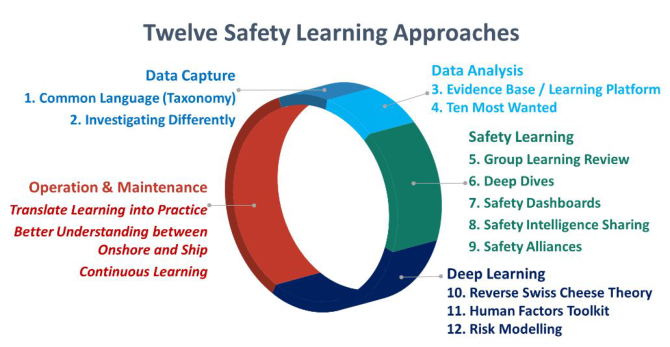
Figure 2: Twelve safety learning approaches.
guidance on what was required at each level. The domain selected was Maritime, in particular focusing on commercial shipping.
Looking Out to Sea: The Maritime Perspective As with many problems that seem difficult to resolve, it is often useful to look outside one’s own community. The Horizon Europe EU-funded SAFEMODE project has enabled such reflection, as it has the fundamental aim of maritime and aviation transport domains learning from each other or, by combining ideas, deriving a better way forward for both industry sectors. In 2020–21, an investigation into maritime Just Culture led to the conclusion that the shipping industry would benefit from a Safety Learning Culture. Learning from safety-related events (positive as well as negative), and deriving ways to improve safety is a cornerstone of safety culture in any industry. Accordingly, ten associated safety learning activities were established that would ‘fit’ the maritime domain, with several of these already evidenced by use cases from leading shipping organizations (Kirwan, Bettignies-Thiebaux and Cocchioni, 2022). The ten approaches are shown in Figure 2 within the framework of a safety learning cycle, from Data Capture (recording events or safety issue- s/practices) to Deep Learning. Two additional safety learning activities have been added here, namely the use of Safety Dashboards, and Risk Modelling, as these are used in other industry sectors (e.g. Air Traffic management). In total, these dozen practices represent concrete means of enhancing safety culture.
The twelve approaches are briefly described below:
1. Common language (taxonomy) – an agreed set of terms must be used to describe events and their contributory factors, as otherwise a ‘Tower of Babel’ effect will occur, where learning is impossible because the same event can be described in many different ways. The SAFEMODE pro- ject has developed a new taxonomy for Maritime based on the HFACS taxonomy (Wiegmann and Shappell, 2003).
Towards an Action-Oriented Safety Culture Maturity Scale 83
2. Investigating Differently - carrying out Investigations in a non-pejorative way, so that people will not be afraid to report exactly what happened. (e.g. see Dekker, 2006). 3. Evidence Base / Learning Platform – safety learning, especially concer- ning organizational factors more closely associated with safety culture, works best when looking across a number of events with similar circum- stances. This requires a database of events. SAFEMODE is developing one such database, called SHIELD, though many others exist. 4. Ten Most Wanted - at a national, international or industry sector level, it can be useful to identify the top ten (or five, or dozen) threats to safety. For example, European air traffic has a Top 5, and in the US, the NTSB has its ‘Ten most wanted’. 5. Group learning review - this is where an entire crew or crew segment are interviewed together following an event, rather than individually inte- rviewing each crew member involved as in most accident investigation practices. The aim here is allowing the group to identify how work pra- ctices need to change to make things safer. The collective review may follow after individual interviews have taken place. 6. Deep Dives - this is where a ‘vertical slice’ of the organization, with representatives from Executive Board level and safety management to front-line operators, tackle a recurrent or difficult-to-resolve safety issue. Deep Dives require thinking out of the box, and perhaps re-imagining work and changing business practices. 7. Safety Dashboards - these are high-level summaries of a range of safety indicators for the Executive Board, so that they are aware of their orga- nization’s overall safety performance, as well as any hotspots, upcoming ’pinch-points’, new safety trends or emerging risks. E.g. see: https://safe org.eu/safety-dashboard/ 8. Safety Intelligence Sharing - this means sharing safety data, ideas, concerns, trends, solutions, etc., with other stakeholders in the indu- stry, even with competitors, in order to keep the industry safe. Often the sharing of detailed operational data will be limited for commercial reasons. 9. Safety Alliances - this is where a group of organizations form an alli- ance to coordinate safety efforts at an industry or industry-segment level. Safety alliances have a natural synergy with other safety learning approaches such as safety intelligence sharing, and ten most wanted. 10. Reverse Swiss Cheese - this is a new approach under development (Kirwan, 2022), entailing a focus by senior management on how deci- sions and policies made at the ‘blunt end’ of the organization may be affecting operational safety, e.g. via financial constraints limiting adequate safety resources or encouraging unsafe practices. 11. Human Factors Toolkit - this refers to whether the organization applies Human Factors approaches to optimize its people-centered safety cri- tical operations. The organization may have its own Human Factors capability, or may outsource such work (see also Kirwan et al. 2021).
84 Kirwan
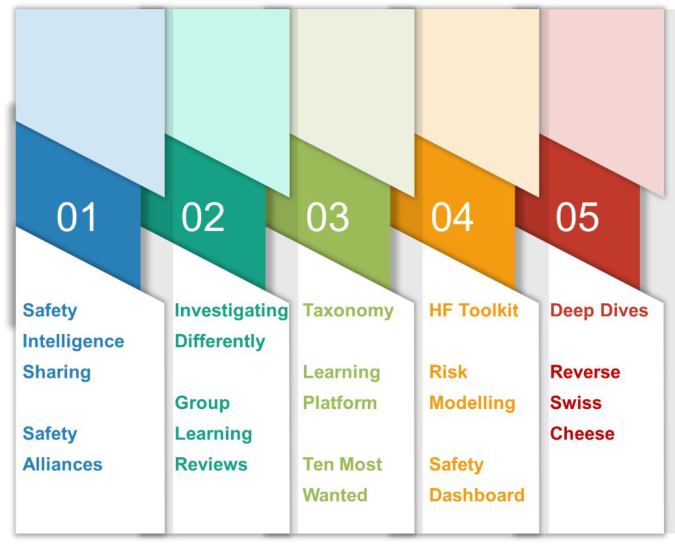
Figure 3: Logical stepwise workflow of safety learning approaches.
12. Risk Modelling - this is the use of quantified risk models (e.g. fault and event trees) to elaborate all system risks and their contributions, inclu- ding human error and recovery. Risk models support the prioritization of safety investment activities, and can serve as a platform for de-risking future business developments.
Whilst safety culture can be thought of as a state of mind, as soon as safety learning is discussed it is clear that there must be some safety effort to main- tain and improve safety, and to stay ahead of emerging risks. For the twelve action areas in Figure 2, there are varying levels of effort required in terms of commitment and/or expertise. Accordingly, Figure 3 plots these 12 activities according to a logical stepwise workflow of safety learning. Thus, for exam- ple, it is relatively straightforward to form alliances (or adapt existing ones to focus on safety) and to begin sharing safety intelligence at some level. How- ever, the next step really requires adoption of a common taxonomy and an investigative approach that will encourage, rather than hinder, honest repor- ting. At this point, learning platforms become useful, and ’top ten’ lists can be developed. Beyond Level 3 however, a step change in expertise may be requi- red, leading to deeper and more thorough analysis and learning, as well as more refined communication to the top of the organization via safety dashbo- ards. The final level involves senior management themselves in safety solution development.
Towards an Action-Oriented Safety Culture Maturity Scale 85
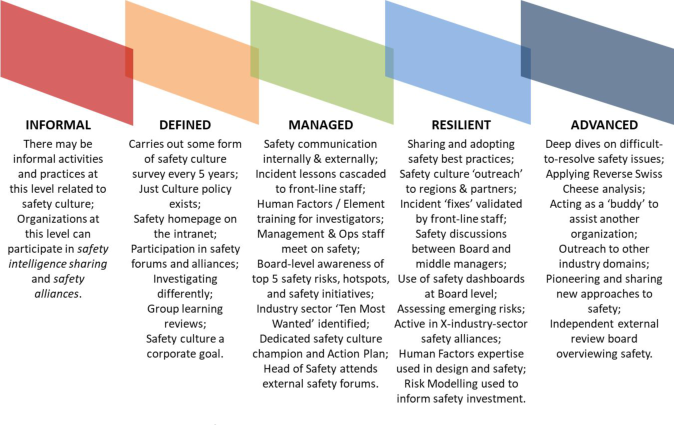
BRINGING IT ALL TOGETHER: AN ACTION-ORIENTED SAFETY CULTURE MATURITY SCALE Since safety culture is larger in scope than safety learning, a number of the more concrete elements from the original ATM SMS SoE for the area of Safety Culture have been integrated into Figure 4 above. These elements concern the following four safety culture ‘threads’:
Whether the organization has carried out a safety culture survey, to deter- mine its safety culture strengths and vulnerabilities, and has developed an associated safety culture action plan;
The organization’s commitment to Just Culture;
The prominence and visibility of safety in the organization, whether in corporate media or in activities involving front-line and support personnel;
The degree of interaction between senior management, middle mana- gement and front-line operators on current and future safety issues, concerns, and solutions.
Figure 4 merges these threads with the safety learning activities, resulting in 30 concrete safety culture activities.
CONCLUSION
This paper has highlighted that whilst safety culture is seen by many as an essential ingredient for safety, it is often vaguely described. This can make it harder to lead safety culture in an organization, particularly at senior mana- gement level, as it is not always clear what to do in concrete terms. Since senior managers are accustomed to benchmarking systems, the approach undertaken has been to adapt an existing benchmarking system to safety cul- ture, and to populate it with safety culture activities and actions. This work has benefitted from a parallel work-stream in the Maritime sector, which has
86 Kirwan
a focus on safety learning approaches for the shipping industry. These appro- aches, together with safety culture elements taken from existing work in the air traffic domain, have resulted in a proposed safety culture maturity scale that is action-oriented. Although this scale has been derived from a mixture of air traffic and maritime contexts, it can probably be adopted or adapted for use in other domains.
ACKNOWLEDGMENT
The author would like to acknowledge certain colleagues in air traffic wor- king on the air traffic SMS SoE, namely Radu Cioponea, Eve Grace-Kelly and Roger Dillon. The Maritime work has benefitted from the SAFEMODE project, which received funding from the European Union’s Horizon 2020 research and innovation programme under grant agreement No. 814961. Any dissemination reflects the author’s view only, and neither the European Commission nor other stakeholders involved in the study are responsible for any use that may be made of information it contains.
REFERENCES
Dekker, S. (2006) The field guide to understanding human error. Aldershot, UK: Ashgate. EUROCONTROL (2020) EUROCONTROL/CANSO Standard of Excellence in
Safety Management Systems Measurement Questionnaire. CANSO Civil Air Navigation Services Organisations: https://canso.org/event/regional-focus-euroc ontrol-canso-standard-of-excellence-in-safety-management-systems-measureme nt-questionnaire/ Hudson, P. (2001) Safety culture: Theory and Practice. Defense Technical Information Center, Compilation Part Notice ADPO10445. https://apps.dtic.mil/sti/pdfs /ADP010445.pdf Kirwan, B., Cichomska, K., Kilner, A., and Bettignies-Thiebaux, B. (2021) Is Our
Human Factors Capability in Aviation and Maritime Domains Up to the Task? Applied Human Factors & Ergonomics Conference (AHFE), in Advances in Safety Management & Human Performance, Arezes, P. and Boring, R. (Eds) July 25–29, pp. 89–96. https://doi.org/10.1007/978-3-030-80288-2_11 Kirwan, B. (2022: in press) Reverse Swiss Cheese Theory – Driving Safety Culture from the Blunt End. IEHF Conference, Birmingham, UK. Kirwan, B., Bettignies-Thiebaux, B., and Cocchioni, M. (2022: in press) Towards a
Safety Learning Culture for the Shipping Industry: A White Paper. http://safemo deproject.eu/ Reason, J.T. (1997) Managing the risks of organizational accidents. Aldershot, UK, Ashgate, p. 220. Wiegmann, D.A., and Shappell, S.A. (2003) A Human Error Approach to Aviation
Accident Analysis. Aldershot, UK: Ashgate.
LISTED IN THE AHFE DIGITAL BOOKSTORE CATALOGUE
Explore the complete digital volume
Safety Management and Human Factors
Read this individual research paper free through the original publisher, or explore the full digital proceedings book.
ISBN 978-1-958651-40-7
Explore this ISBN in the AHFE Bookstore ↗Listed in the July 2026 bookstore catalogue; search by ISBN to confirm current availability · Digital book purchase optional