Kenneth Nemire (2026). Failure of roller coaster safety management at amusement parks. In: Safety Management and Human Factors. AHFE Open Access, vol. 227, pp. 47–56. https://doi.org/10.54941/ahfe1007916
Background. Amusement park guests and employees have been killed by walking underneath inverted roller coasters. Best safety management practices require investigation and mitigation of hazardous conditions that have resulted in fatal incidents. While some amusement parks have taken actions to prevent such incidents, their efforts have been inadequate. This presentation describes the human factors (HF) method used to analyze these fatal incidents and the results of those analyses. Methods. We used online databases to identify fatal incidents in amusement parks that resulted from persons entering the space below inverted coasters, and obtained detailed records from government agencies, news accounts and legal proceedings describing these incidents. We used the Human Factors Analysis and Classification System (HFACS) to analyze these incidents. Results. We identified 41 different incidents world-wide. From descriptions of the behavior of people killed while underneath an inverted roller coaster, it was apparent that they had not understood the hazards of walking underneath the coaster. Results of the HFACS revealed multiple causal factors of the fatal incidents. Discussion. Adopting a systematic HF analytic approach to investigate fatal incidents is needed to lead park management and investigators away from focusing only on unsafe behavior of guests and employees, and instead lead them to evaluating systemic causal factors such as failures of safety policies and procedures, warning systems, and training. HFACS also can benefit HF and safety professionals not only in conducting incident investigations, but also in proactively improving design of amusement parks and other complex systems to support safe and effective use.
An inverted roller coaster is a type of coaster in which the train hangs underneath the track instead of riding on top of the track. Many amusement park guests and employees around the world have been killed by walking underneath inverted roller coasters to retrieve items that had fallen from themselves or other guests that had ridden the coaster. Park employees also have been killed while performing maintenance tasks in the area. While such fatal incidents are relatively few, given the millions of people who ride roller coasters each year (Woodcock, 2014b; Woodcock, 2019), best safety management practices require investigation and mitigation of hazardous conditions that have resulted in fatal incidents (Hagan et al., 2009; National Received January 24, 2026; Revised April 8, 2026; Accepted April 25, 2026; Available online July 20, 2026
48 Nemire Safety Council, 2025). These fatal incidents have been occurring since at least 1985, typically are widely publicized in the media, and have resulted in lawsuits against the amusement parks that have resulted in substantial documentation about their causal factors. This documentation therefore should provide critical data to help all amusement parks, not just those in which the fatal incidents have occurred, to evaluate their own safety management processes, identify the causal factors that have led to fatal incidents and implement means to mitigate them (Hagan et al., 2009; National Safety Council, 2025). While some amusement parks have taken some actions to prevent these fatal incidents, their mitigation efforts have been inadequate.
Injury incident investigations at amusement parks, if conducted, typically involve government agencies and amusement park staff. These investigations usually concentrate on the behavior of the rider, ride attendant, or ride operator to the exclusion of contributions from more systemic factors (Nemire, 2008, 2025; Woodcock & Diyaljee, 2010). This focus typically fails to consider other potential causal factors of rider injuries, such as inadequate equipment design, warning systems, employee training, and safety policies and procedures.
This article provides a description of these fatal incidents under inverted roller coasters, a description of the HF method used to analyze some of these fatal incidents, and the results and discussion of these analyses.
METHODS
We used several online databases to identify fatal incidents in amusement parks around the world that resulted from persons entering the space below an inverted roller coaster (Coasterpedia, n.d.; Coasterforce, n.d.; Saferparks archive, n.d.). We also obtained detailed inspection reports by government agencies and news accounts describing these fatal incidents, as well as documents that resulted from legal action taken against amusement parks by families of those killed in the parks.
I used the Human Factors Analysis and Classification System (HFACS; Shappell & Wiegmann, 2001; Wiegmann & Shappell, 2016) to analyze the fatal incidents for which we had sufficient data. HFACS was developed from other research in incident investigation and error classification (Rasmussen, 1982; Reason, 1990), and has been used to analyze injury incidents in many different complex systems such as in aviation (Wiegmann & Shappell, 2016), mining (Patterson & Shappell, 2010), maritime (Schr¨oder-Hinrichs et al., 2011), healthcare (Diller et al., 2016), railroad (Madigan et al., 2016; Reinach & Viale, 2006), amusement park {Nemire, 2025), and construction (Oliveira et al., 2023) environments.
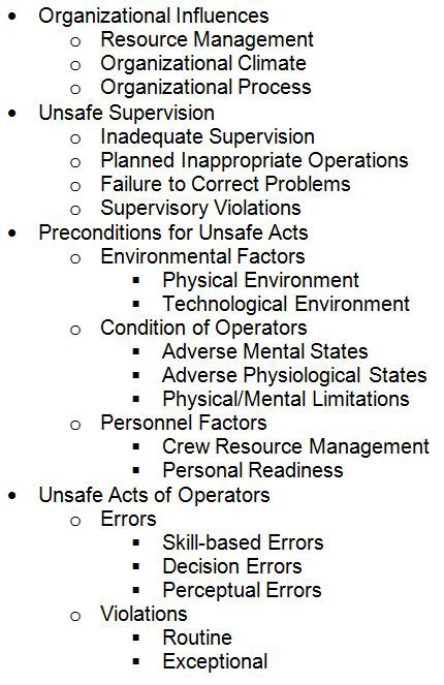
HFACS analyses are organized by four levels of system failure: 1) Unsafe Acts, 2) Preconditions for Unsafe Acts, 3) Unsafe Supervision, and 4) Organizational Influences (Wiegmann & Shappell, 2016). Each of these levels is composed of multiple potential failure categories (See Figure 1). HFACS analyses begins with the injury incident and proceeds with a series of questions about the causal factors for the unsafe act, and about the sources for those causal factors throughout the organizational system.
RESULTS AND DISCUSSION
Descriptions of Fatal Incidents We identified 41 different fatal incidents involving people walking under an inverted roller coaster to retrieve lost items and/or to do maintenance. These incidents occurred during the past 40 years, which is the approximate time period that inverted roller coasters have been available in amusement parks. Of these fatal incidents, most occurred in the USA (49%), followed by England (10%), France (7%), and Canada (7%), with the rest in Austria, Japan, Kurdistan, Poland, Spain, Puerto Rico, and Germany. Some of these amusement parks were the scene of multiple fatal incidents over a span of a number of years, indicating a failure to mitigate hazards even after knowing about a previous fatal incident in their own park. Also, most of these fatal incidents involved staff of the amusement park (78%), many of whom were performing maintenance or retrieving items lost by guests, indicating not only a failure of employees to recognize the hazard of walking under inverted coaster tracks, but also a failure of lock-out/tag-out policies and procedures at the amusement park.
Figure 1: Human factors analysis and classification system (adapted from wiegmann & Shappell, 2016).
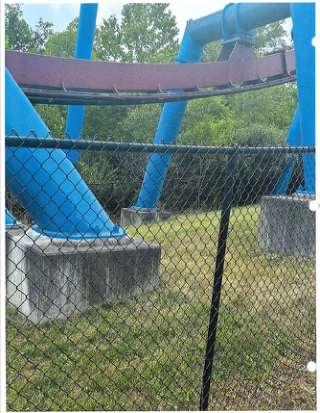
50 Nemire From the reported descriptions of the behavior of the people killed while standing or walking underneath an inverted roller coaster, it was apparent that neither of them understood the hazards of walking under the track of an inverted coaster (See Figure 2). Our analyses showed that the lowest height of inverted coaster tracks above the ground is typically about 3.4m (11 ft). If one were to conceive of the roller coaster as riding on top of the track, the track appears far enough above the ground that it would be safe to walk under. However, the train hangs from the track so its bottom is about 1.8m (5.8 ft) above the ground. The shortest adult riders’ legs hang an additional 0.4m (1.2 ft) below the bottom of the train, leaving only 1.2m (4.0 ft) of space between the feet of the shortest adult rider and the ground (See Figure 2). Most adults are taller that this; for example, the 5th percentile adult female height in the United States is 1.5m (4.9 ft) (Pheasant, 1996).
Research has shown that even after people have just ridden an inverted roller coaster, 76% of them conceived of a roller coaster with its train sitting on top of the track rather than suspended below the track (Nemire, 2007). Such conceptions are consistent with the behavior of people who walked under the tracks of an operational inverted roller coaster and apparently thought they could safely do so.
Figure 2: View of inverted roller coaster track from outside the 1.8 m (6 ft) chain link fence surrounding a portion of the track. Note that if one were to conceive of the roller coaster as riding on top of the track, the track appears far enough above the ground that it would be safe to walk under. (Photo from Investigative Summary, 2024).
HFACS of Recent Fatal Incident In June of 2024, about 8:00 pm, a man rode an inverted roller coaster with his two children in an amusement park in Ohio, USA. During the ride, his cell phone had fallen out of his pocket to the ground below. After the ride, he asked the ride attendant how he could retrieve his phone. He was told that the attendant will look for the phone at the end of the night. The man
Failure of Roller Coaster Safety Management at Amusement Parks 51 apparently determined that he could not wait that long for his cell phone. The man then found an unlocked gate near the ride entrance with a sign that read: “AUTHORIZED PERSONNEL ONLY” and walked through the gate. From there he would have seen an area underneath the roller coaster that was surrounded by a chain link fence that was 1.8m (6 ft) in height. There was a sign on the chain-link gate that read “DANGER. Entry into this area requires a LOCK-OUT” and multiple signs on the fence that read “DANGER. DO NOT ENTER”. However, it is not known whether the man noticed any of these signs. The man apparently climbed the chain-link fence, and while looking for his cell phone, his head was struck by the moving train that was still in operation. Other guests had alerted park personnel to the presence of the man under the roller coaster, but it took some time before park staff found his body. The man was transported by ambulance to a local hospital, where he died of his injuries. Later, the man’s cell phone and sunglasses were found under the ride (Investigative Summary, 2024).
Preconditions for Unsafe Act. The man committed an unsafe act by walking under an operational inverted roller coaster. Given the height of the track above the ground, it is not likely that he understood the risks in walking under it (Nemire, 2007). Consequently, the preconditions for his unsafe act consisted of a number of environmental causal factors of this fatal incident: 1) Park failure to provide effective procedures for securing loose articles such as cell phones, 2) Park failure to lock entrance gates to the hazardous area, 3) Park failure to monitor the hazardous area under the track, and 4) Park failure to effectively warn guests of the hazard of walking under the inverted roller coaster.
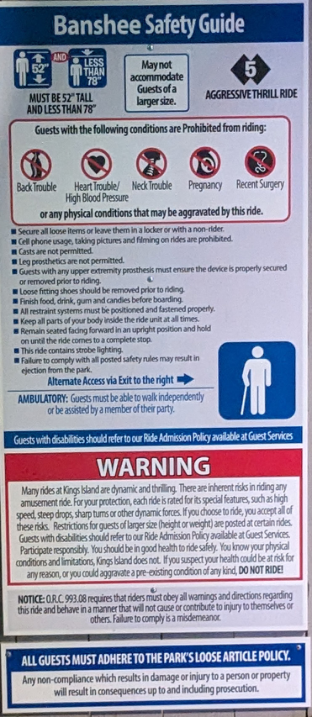
1] Park failure to provide effective procedures for securing loose articles. The only instruction about securing loose articles was near the top of an entrance sign that read: “Secure all loose items or leave them in a locker or with a non-rider.” This instruction was presented in a long list of bulleted items that would not likely be noticed or read (See Figure 3). Also, this instruction failed to include information that would make it more likely that riders would effectively secure their loose items. People are more likely to comply with instructions and warnings if an explicit description of the hazard is provided (e.g., “You may lose your items”), if they are presented with the consequences of failing to comply (e.g., “You will not be able to retrieve your lost items until tomorrow”), and if they are presented with easy options for securing the items (e.g., “Place the item inside your clothing or a zippered pocket”). Such instructions could have been provided as verbal instructions played while patrons waited in line or as signage visible to patrons as they waited in line to ride the coaster. Explicit diagrammatic instructions for guests about how to effectively secure their belongings so they would not be lost on a roller coaster with speeds of up to 109 kph (68 mph), along with explicit diagrams of the roller coaster forces involved, most likely would have helped educate riders about how to secure their belongings as well as help them understand the forces involved in riding an inverted roller coaster (Gilbert, 1999; Hegarty & Just, 1991; Kahler et al., 2000). The park failures made the existing instruction statement ineffective in properly instructing guests about how to secure loose items (Godfrey et al., 1991; Laughery, Vaubel, et al., 1993; Laughery, Young, et al., 1993; Rogers et al., 2000; Wogalter et al., 2002).
52 Nemire 2] Park failure to lock entrance gates. The amusement park failed to provide an effective barrier for the hazardous area. The man first entered an unlocked gate in a vertical board fence. This gate was near the entrance to the ride and therefore easy for riders to notice. The gate and fence would not have been easy to climb because of the absence of finger and toe holds. Had this gate been locked, per park policies, it is likely that this fatal incident would not have occurred.
While the chain link fence around the hazardous area under the ride was locked, it was only 1.8 m (6 ft) tall and would have been easily climbed by the man, who also was 1.8 m (6 ft) tall. Slats installed in the fencing would have made it more difficult to climb, but the existing fence did not include slats. Guarding strategies such as locked gates and taller chain link fencing with slats would have been more effective in providing physical and psychological deterrents to prevent unauthorized entry to the hazardous area.
Figure 3: The roller coaster entrance sign. Note the information about securing loose items is at the top and bottom of the sign amid visual clutter of much other text. There is no information about how to secure loose items or the consequences of failing to do so. If one’s attention were drawn to anything on the sign, it most likely would have been the icons and the red background for WARNING (Rogers et al., 2000; Wogalter et al., 2002). Therefore, this sign was useless in helping the man secure his cell phone. (Photo from Investigative Summary, 2024).
Failure of Roller Coaster Safety Management at Amusement Parks 53 3] Park failure to monitor the hazardous areas under the coaster track. In addition to the fatal incidents that should have informed park management of the need for safer policies and procedures, park management also knew that riders frequently lost their belongings while on these rides. There were reported estimates of riders losing a dozen items under roller coasters each day, providing incentives for patrons to attempt to retrieve those items. There also were reports that patrons and employees often entered the hazardous area, presumably to retrieve lost items. Given that people had died while attempting to retrieve lost items, active video monitoring and an alarm system would have more effectively guarded against persons entering the hazardous areas (Wang et al., 2025). No hazardous area under a roller coaster was monitored by surveillance cameras or alarms at this park.
4] Park failure to effectively warn guests of the hazard of walking under the inverted roller coaster. The signs warning about the hazardous area under the roller coaster failed to provide explicit hazard and consequence statements, which are required for effective warnings (Rogers et al., 2000; Wogalter et al., 2002). The sign on the unlocked gate read: “AUTHORIZED PERSONNEL ONLY”. This sign failed to provide an explicit description of the hazard or the consequences of not complying with the implied instruction. The sign on the chain-link gate read “DANGER. Entry into this area requires a LOCK- OUT”. The signal word DANGER is useful to indicate the presence of some hazard, but this sign also fails to provide an explicit description of the hazard. In addition, indication of a required lock-out is most likely only useful to those who have been trained on lock-out procedures and understand what it is, but not to the untrained person (Bullock et al., 2019; Shulman et al., 2020). The signs on the fence read “DANGER. DO NOT ENTER”. Again, this sign failed to provide an explicit description of the hazard or the consequences of not complying with the instruction. None of these signs indicated the source of the danger (riders’ legs dangling from the suspended roller coaster train and their proximity to the ground) and did not describe the consequences of failing to comply with the warning (severe injury or death). As shown earlier, observation of the scene most likely would have failed to indicate the nature of the hazard, and thus constituted a hidden hazard (Cohen & Cohen, 2009; Martin, 2000; Nemire, 2014), which requires the presence of an effective warning (Rogers et al., 2000; Wogalter et al., 2002).
Unsafe Supervision. The amusement park failed to adequately train ride greeters and attendants to monitor guests for loose items before they were seated on the ride. Such monitoring, such as is done for minimal height to board a ride, most likely would have increased the probability of guests securing loose articles before they entered the ride and most likely would have better impressed upon guests the importance of properly securing items. This “unsafe supervision” was another causal factor of this fatal incident.
Organizational Influences. Despite 40 years of guests and employees entering hazardous areas under inverted roller coasters to retrieve lost items and despite 40 years of fatal incidents, amusement parks have done little to improve safety management at their parks, such as implementing the suggestions detailed above.
This failure of organizational climate and processes extends beyond amusement park management to the agencies responsible for enforcing safety at the parks. For example, the safety inspection checklist for the government
54 Nemire agency responsible for enforcing safety at the subject amusement park only provided a checkbox “Safety signage exists?”, but no checkboxes as to the effectiveness of the formatting, content, symbology or location of those “safety signs”, all of which are critical for the design and implementation of effective warnings (Rogers et al., 2000; Wogalter et al., 2002). In addition, there were no checkboxes pertaining to the presence or adequacy of the safety policies and procedures at the park (Investigative Summary, 2024). The lack of effective safety oversight is common at amusement parks (Karimi, 2018; Song et al., 2023; Urbina, 2014; Woodcock, 2014a), and was another causal factor of this fatal incident.
CONCLUSION
The results of the HFACS revealed multiple causal factors of the fatal incidents, including failure to: 1) provide adequate barriers to prevent guests and employees from entering the hazardous area under the lower parts of the track, 2) provide adequate lockout/tagout training to employees, 3) adequately inform guests and employees about the hazardous conditions under the track, and 4) adequately inform riders about how to store or secure their belongings so they would not be lost. If the amusement parks had conducted such investigations early in their design, and chosen to implement effective mitigation efforts, it is most likely that such fatal incidents would not have occurred.
Adopting a systematic HF analytical tool, such as HFACS, to investigate fatal incidents and to design a safe system (Hendrick, 1997, Wiegmann & Shappell, 2016) is needed to move park management and government investigators away from their sole concentration on the unsafe behavior of guests and staff members and instead evaluate other systemic causal factors such as needed improvements in safety policies and procedures, warning systems, and training. In addition, the incident investigation method described in this presentation can benefit HF and safety professionals not only in conducting incident investigations, but also in proactively improving the design of amusement parks and other complex systems to support safe and effective use.
ACKNOWLEDGMENTS
The author thanks Daniel Nemire and TB Sojka for assistance with data collection. Address correspondence to Kenneth Nemire, knemire@ HFEconsulting.com.
REFERENCES
Bullock, O. M., Amill, D. C., Shulman, H. C. & Dixon, G. N. (2019). Jargon as a barrier to effective science communication: Evidence from metacognition. Public Understanding of Science, pp. 1–9. Coasterforce (n.d.). Roller Coaster Incidents. Available at: https://coasterforce.com/
category/accidents/ (Accessed: 15 November 2025). Coasterpedia (n.d.). List of deadly roller coaster accidents. Available at: https:// coasterpedia.net/wiki/List_of_deadly_roller_coaster_accidents (Accessed 13 January 2026).
Failure of Roller Coaster Safety Management at Amusement Parks 55 Cohen, J. & Cohen, H. H. (2009). “Spontaneous combustion’’ of oil-based wood
finishing products: Hidden or obvious hazard? Proceedings of the Human Factors and Ergonomics Society 50th Annual Meeting, pp. 860–864, Diller, D., Helmrich, G., Dunning, S., Cox, S. Buchanan, A. & Shappell, S. (2014).
The Human Factors Analysis Classification System (HFACS) applied to health care. American Journal of Medical Quality, 29(3), pp. 181–190. Gilbert, D. K. (1999). Using mental models as training tools: The effect of stringent acquisition criterion on utilization and retention. Human Factors and Ergonomics Society Annual Meeting Proceedings, 43, pp. 1384. Godfrey, S. S., Laughery, K. R., Young, S. L. Vaubel, K. P., Brelsford, J. W., Laughery,
K. A., & Horn, E. (1991). The new alcohol warning labels: How noticeable are they? Proceedings of the Human Factors and Ergonomics Society 35th Annual Meeting (pp. 446–450). Hagan, P. E., Montgomery, J. F. & O’Reilly, J. T. (2009). Accident Prevention Manual for Business & Industry: Administration & Programs (13th Ed.). Ithaca, IL: National Safety Council. Hegarty, M. and Just, M. A. (1993). Constructing mental models of machines from
text and diagrams. Journal of Memory and Language, 32, pp. 717–742. Hendrick, H. W. (1997). Organizational design and macroergonomics. In G. Salvendy (Ed.), Handbook of human factors and ergonomics (2nd Ed., pp. 594–636). John Wiley & Sons. Investigative Summary (2024). Ohio Department of Agriculture Enforcement
Division, Amusement Ride Safety Division. Reynoldsburg, Ohio. Kahler, S. E., Converse, S. A., Lester, J., Cheatham, D. & Stelling, G. (2000). Effect of intelligent instruction on students’ mental models and performance. Human Factors and Ergonomics Society Annual Meeting Proceedings, 44(1), pp. 101–104. Karimi, F. (2018). Before you go to an amusement park, read this. Available at
https://edition.cnn.com/2018/03/29/health/amusement-park-incidents (Retrieved January 14, 2025). Laughery, K. R., Sr, Vaubel, K. P., Young, S. L., Brelsford, J. W., & Rowe, A. L. (1993).
Explicitness of consequence information in warnings. Safety Science, 16(5–6), pp. 597–613. Laughery, K. R., Young, S. L., Vaubel, K. P. & Brelsford, J. W. (1993). The noticeability of warnings on alcoholic beverage containers. Journal of Public Policy & Marketing, 12(1), 38–56. Madigan, R., Golightly, D., & Madders, R. (2016). Application of Human Factors
Analysis and Classification System (HFACS) to UK rail safety of the line incidents. Accident Analysis & Prevention, 97, pp. 122–131. Martin, B. J. (2000). The value of explicit hazard and consequence warnings for products with hidden hazards. Proceedings of the IEA 2000/HFES 2000 Congress, 44(1), pp. 302–305. National Safety Council (2025). Serious Incident and Fatality (SIF) Prevention
Model and Guidebook. Ithaca, IL: National Safety Council. Nemire, K. (2007). Case study: The wrong mental model can kill you. Proceedings of the Human Factors and Ergonomics Society 51st Annual Meeting (pp. 554–558). Nemire, K. (2008). Roller Coasters, Mental Models, and Product Safety: A Case
Study. Ergonomics in Design, 16(4), pp. 7–10. Nemire, K. (2014). The hidden hazard of an invisible flame. Proceedings of the Human Factors and Ergonomics Society 58th Annual Meeting (pp. 1869–1873). Nemire, K. (2025). Human factors investigation of ejection from a roller coaster.
Ergonomics in Design, 33(1), pp. 52–57. Oliveira, S. S., Soares, W. A., Vasconcelos, B. M. (2023). Fatal fall-from-height accidents: Statistical treatment using the Human Factors Analysis and Classification System– HFACS. Journal of Safety Research, 86, 118–126.
Analysis of 508 mining incidents and accidents from Queensland, Australia using HFACS. Accident Analysis & Prevention, 42(4), pp. 1379–1385. Pheasant, S. (1996). Bodyspace: Anthropometry, ergonomics and the design of work (2nd ed.). Boca Raton, FL: CRC Press. Rasmussen, J. (1982). Human errors: A taxonomy for describing human malfunction
in industrial installations. Journal of Occupational Accidents, 4(2–4), pp. 311–333. Reason, J. (1990). Human error. Cambridge University Press. Reinach, S. & Viale, A. (2006). Application of a human error framework to conduct train accident/incident investigations. Accident Analysis and Prevention, 38, 396–406. Rogers, W. A., Lamson, N., & Rousseau, G. K. (2000). Warning research: An
integrative perspective. Human Factors, 42(1), pp. 102–139. Saferparks archive (n.d.). Roller Coaster Incidents. Available at: https://web.
archive.org/web/20140805135258/http://www.rideaccidents.com/ (Accessed: 15 November 2025). Schr¨oder-Hinrichs, J. U., Baldauf, M., & Ghirxi, K. T. (2011). Accident investigation reporting deficiencies related to organizational factors in machinery space fires and explosions. Accident Analysis & Prevention, 43(3), pp. 1187–1196. Shappell, S. A., & Wiegmann, D. A. (2001). Applying reason: The Human Factors
Analysis and Classification System (HFACS). Human Factors and Aerospace Safety, 1(1), 59–86. Shulman, H. C., Dixon, G. N., Bullock, O. M. & Amill, D. C. (2020). The Effects of Jargon on Processing Fluency, Self-Perceptions, and Scientific Engagement. J. Language and Social Psychology, pp. 1–19. Song, W., Zhao, Z., Zhang, K., Wang, H., & Sun, Y. (2023). Development of
Multifunctional Detection Robot for Roller Coaster Track. Sensors 23, 8346. Urbina, I. (2014, July 26). When thrill rides are real risks. New York Times. Available from http://www.nytimes.com/2014/07/27/sunday-review/ when-thrill-rides-are- real-risks.html?_r=0. Retrieved January 14, 2025. Wang, H., Zhao, Z., Sun, Y. & Song, W. (2025). LiDAR-based safety envelope
detection with accelerometer and DTW for intrusion localization in roller coasters. Micromachines, 16, 1062. Wiegmann, D. A. & Shappell, S. A. (2016). A human error approach to aviation accident analysis. Routledge. Wogalter, M. S., Conzola, V. C., & Smith-Jackson, T. L. (2002). Research-based
guidelines for warning design and evaluation. Applied Ergonomics, 33(3), pp. 219–230. Woodcock, K. & Diyaljee, Z. (2010). Human-factors Antecedents in California Amusement Ride Accident Investigations. In Proceedings of the Human Factors and Ergonomics Society 54th Annual Meeting (pp. 1875–1879). Woodcock, K. (2014a). Model of safety inspection. Safety Science, 62, 145–156. Woodcock, K. (2014b). Amusement ride injury data in the United States. Safety
Science, 62, 466–474. Woodcock, K. (2019). Global incidence of theme park and amusement ride accidents.
Safety Science, 113, 171–179.
LISTED IN THE AHFE DIGITAL BOOKSTORE CATALOGUE
Explore the complete digital volume
Safety Management and Human Factors
Read this individual research paper free through the original publisher, or explore the full digital proceedings book.
ISBN 979-8-950676-03-1
Explore this ISBN in the AHFE Bookstore ↗Listed in the July 2026 bookstore catalogue; search by ISBN to confirm current availability · Digital book purchase optional