Sébastien Tremblay, Cindy Chamberland, Isabelle Turcotte, François Vachon (2026). Training and Assessing Hazard Perception in High-Risk Occupations: Toward an AI-Driven Adaptive and Immersive Simulation. In: Safety Management and Human Factors. AHFE Open Access, vol. 227, pp. 102–109. https://doi.org/10.54941/ahfe1007921
Work-related accidents in high-risk occupations remain a recurring and costly challenge. Emergency vehicle driving (EVD) is ranked among the most hazardous occupations, with a large proportion of accidents attributed to poor risk perception and inadequate situation awareness (SA). The capacity to identify hazards is a multidimensional cognitive process that may benefit from training and cannot be assumed to develop through experience alone. Yet most occupational safety programs focus on technical skills. The objective of this research is to present the conceptual framework behind a simulation-based cognitive training approach and to discuss the ongoing development and validation of a proof-of-concept: an AI-powered adaptive simulation for hazard perception (HP) training in which eye-tracking is the enabling technology for real-time performance assessment and feedback. The conceptual framework is grounded in the NSEEV model (Noticing, Salience, Effort, Expectancy, Value) and the concept of SA. In the case of EVD, the platform presents drivers with short video clips recorded from the perspective of an emergency vehicle, with hazardous events time-stamped by experienced field instructors. Eye-tracking provides an objective measure of attentional allocation and can reveal which hazards drivers fail to detect and whether specific scan patterns are associated with anticipated hazard detection. These oculometric and behavioural data feed a Bayesian knowledge-tracing algorithm that adjusts training content. Preliminary results from early versions of the platform provide support for the feasibility of the approach and for its potential as a low-cost, portable complement to high-fidelity simulation training.
Emergency vehicle driving (EVD) is consistently identified as one of the most hazardous occupations. Ambulance drivers, firefighters, and police officers face a significantly elevated risk of work-related collisions compared to the general population and other professional drivers (Delavary et al.,
Training and Assessing Hazard Perception in High-Risk Occupations 103 2023). Emergency vehicle drivers are confronted with considerable cognitive demands: driving under time pressure, managing fatigue from extended shifts, navigating unfamiliar areas, and operating in adverse weather conditions; all of which reduce reaction time and impair visual efficiency (NIOSH, 2024). One of the most frequently cited causes of emergency vehicle incidents is sudden braking, which often results from inattentive driving associated with engagement in secondary tasks such as dispatcher communications, momentary drowsiness, or brief glances away from the road (Hsiao et al., 2018). Despite sustained efforts to improve safety, a substantial number of injuries and fatalities linked to EVD continue to be reported and the associated socioeconomic costs are considerable (Mazzolini, 2020).
A central yet underaddressed determinant of safe emergency driving is hazard perception (HP): the ability to detect, interpret, and anticipate potentially dangerous situations in a dynamic environment. HP involves a set of cognitive processes that include visual search, prediction and hazard processing (Pradhan and Crundall, 2016). Most safety errors and at-risk behaviours stem either from an inability to identify hazards or from a misperception of the associated risks (Tixier et al., 2014). HP is closely connected to situational awareness (SA), defined as the ability to perceive and comprehend a constantly evolving environment (Banbury and Tremblay, 2004; Endsley, 1995). Maintaining SA is critical for safe performance in dynamic, high-risk settings (Hasanzadeh et al., 2017), and one of the most important risk factors for EVD incidents is the drivers’ capacity to perceive hazards in time (Pandit et al., 2019). Yet most occupational safety programs are focused on procedural and technical skills while neglecting the cognitive processes that underlie safe behaviour.
Research on HP training in general driving has shown that even brief, targeted interventions meaningfully improve hazard detection accuracy and reaction time, with benefits extending to experienced drivers (Horswill et al., 2013; Prabhakharan et al., 2024). A recent study by Tutenuit et al. (2026) further confirms that experienced emergency vehicle drivers employ adaptive visual search strategies that vary in proportion to driving demands, underscoring the relevance of training these skills in a targeted and context- specific manner. The emergence of digital technologies has generated growing interest in immersive simulation tools that provide ecologically valid and engaging learning experiences (Ernst et al., 2023).
THEORETICAL FRAMEWORK The framework draws on two complementary bodies of theory. First, Endsley’s (1995) three-level model of SA posits that safe performance in dynamic environments depends on perceiving relevant cues (Level 1), comprehending their meaning (Level 2), and projecting their future state (Level 3). Failures at any level can lead to unsafe decisions or missed hazards. Second, the NSEEV model (Noticing, Salience, Effort, Expectancy, Value; Wickens, 2021) provides a theoretically grounded account of how visual attention is allocated across a dynamic workspace. By integrating basic visual perception with task demands and environmental characteristics, NSEEV enables the
modelling of attentional distribution and the prediction of which elements are likely to be noticed, overlooked, or prioritized.
Evidence from cognitive ergonomics and driving research shows that eye movement data can be linked to SA: fixation patterns and visual search strategies reflect how drivers perceive and process hazards, and oculometric patterns can identify at-risk individuals with reduced SA (Zhang et al., 2023). In the case of EVD, Tutenuit et al. (2026) documented that experienced paramedics adapt their visual search strategies in proportion to driving demands, showing longer fixation times, more frequent scanning, and greater variety in search patterns as driving complexity increases. As these strategies are trainable, simulation-based training with oculometric feedback is a promising avenue for improving HP in EVDs.
PLATFORM DESIGN AND PROOF OF CONCEPT We developed an initial proof-of-concept platform. The platform is a web- based application accessible on standard devices, designed to be low-cost and portable, addressing a key limitation of high-fidelity driving simulators whose cost and infrastructure requirements restrict their accessibility (Prohn and Herbig, 2020).
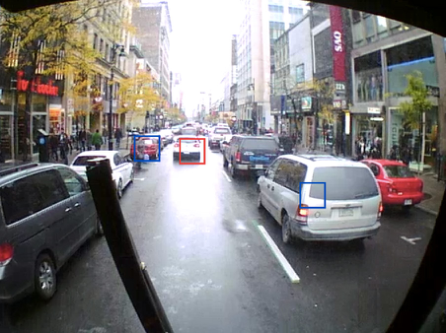
Stimuli Short video clips were recorded by expert fire truck drivers in real operational conditions, providing ecologically valid content rooted in the actual perceptual environment of emergency driving (see Figure 1). Hazardous events were identified and time-stamped by experienced field instructors, with each hazard specified by its spatial location and the earliest moment at which it could be perceived. This annotation method allows the system to distinguish correct and timely detections from late detections, misses, and false alarms, and enables the precise computation of anticipation time.
Figure 1: Example frame from the EVD footage used as stimulus material. Videos are recorded from the driver’s perspective in real operational conditions.
Training and Assessing Hazard Perception in High-Risk Occupations 105 Task and Procedure
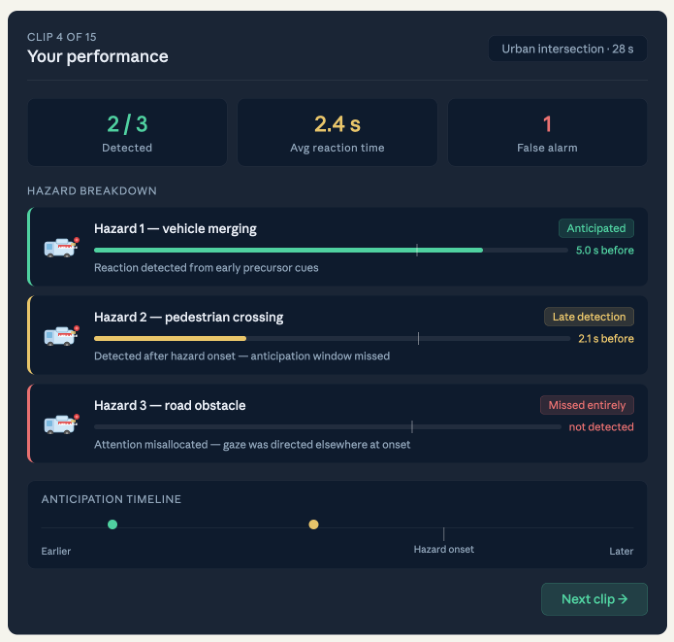
Participants watch video clips on a tablet and are instructed to detect and spatially localize hazardous events as quickly and accurately as possible by tapping the screen at the location of the perceived hazard. The task captures detection accuracy, reaction time, and anticipation (i.e., the time between the earliest possible detection and the participant’s response). After each clip, outcome feedback indicates the number of correct detections, false alarms, and average reaction time. Cognitive feedback specifies the nature of errors, including whether the driver missed a hazard entirely, detected it late, failed to anticipate it from early precursor cues, or misallocated attention (as detected through the analysis of eye movement) in the moments preceding it (Figure 2).
Figure 2: Example of the user-centred feedback screen, showing the spatial location of a correctly detected hazard and an incorrect response on a driving scene frame.
Eye-Tracking Integration The platform integrates eye-tracking as the enabling technology for performance assessment and feedback. Fixation patterns and visual search strategies reveal which hazards drivers fail to detect or perceive as less
threatening than they are, whether specific scan patterns are associated with anticipated and correct hazard detection, and whether detection failures reflect inattentional blindness (where a hazard is fixated but remains unnoticed). These oculometric and behavioural signals feed a Bayesian knowledge- tracing algorithm that continuously updates a learner profile and adjusts training content in real time to maintain optimal cognitive engagement and learning.
PRELIMINARY RESULTS Although the full adaptive system is still under development, our program of research has provided support for the technical and psychometric feasibility of the platform across four lines of evidence. First, initial testing of the platform established that the video-based target detection paradigm is functional and yields sensitive performance data. In the context of team sport target (but not hazards) detection, Croteau et al. (2025) demonstrated that the platform reliably captures detection responses across a large set of video clips, with reaction times showing variability across participants. Such a sensitivity to individual differences in detection speed and accuracy is a prerequisite for any adaptive training system.
Second, the feasibility of identifying individual visual scanning strategies from eye-tracking data collected during dynamic detection tasks has been established by Hodgetts et al. (2018), who showed that oculometric profiles reliably differentiate operators by scanning behaviour and link those profiles to detection performance (see also Chen et al., 2024).
Third, the technical integration of eye-tracking into a real-time gaze-aware feedback system has been validated in a high-fidelity surveillance simulation (with heavy reliance on target detection) by Marois et al. (2026). These authors successfully embedded eye-tracking within an augmented reality platform to deliver live gaze-based feedback to operators, demonstrating that oculometric data can be captured, processed, and fed back to users in real time within a dynamic task environment.
Fourth, the EVD-specific content pipeline has been successfully implemented: real emergency vehicle footage has been uploaded to the platform, hazard targets configured in collaboration with field instructors, and the annotated content converted into a time-sensitive anticipation task. The full workflow from expert knowledge to user-facing training interface is operational. These four lines of evidence provide a promising proof of concept on which the full adaptive system will be built.
DISCUSSION AND FUTURE DIRECTIONS The proposed framework addresses a gap in occupational safety training by targeting the cognitive and perceptual processes that underlie HP, rather than procedural knowledge alone. By combining real operational footage, user- centred feedback, eye-tracking, and adaptive AI, it aims to provide evidence- based training that is accessible to frontline emergency workers. Also, demonstrating both educational value and user acceptability is essential for
Training and Assessing Hazard Perception in High-Risk Occupations 107 organizational adoption. Future evaluation of the platform will therefore include measures of learner reactions, behavioural transfer to real driving, and user acceptance.
Ongoing work is extending the platform in several directions. Longitudinal data collected across expert and non-expert populations will characterize how HP and SA develop with adaptive practice, and whether oculometric profiles can reliably identify at-risk drivers. The full adaptive version, incorporating Bayesian knowledge tracing and real-time eye-tracking feedback, is currently under development and will be validated in a controlled experiment with emergency vehicle drivers. A parallel stream of work is adapting the framework for construction site safety, with scenarios developed in collaboration with industry experts, broadening the reach beyond the EVD domain. Future iterations will incorporate portable eye-tracking hardware compatible with tablet-based delivery.
CONCLUSION
This paper presented the conceptual framework and preliminary results related to the development of a simulation-based cognitive training approach for hazard perception. Based on the NSEEV model and the concept of SA, and enabled by eye-tracking and adaptive AI, the platform offers a scalable, low-cost alternative to high-fidelity simulation for training non-technical cognitive safety skills. Preliminary findings provide support for the validity and sensitivity of the approach. Our training system is anticipated to improve hazard detection performance, reduce unsafe attention patterns, and foster metacognition.
ACKNOWLEDGMENT
This work was supported by grants from the National Sciences and Engineering Research Council of Canada (NSERC), the Ministère de l’Économie et de l’Innovation du Québec (MEI), and Prompt Québec awarded to Sébastien Tremblay. Special thanks to Steven Thomas (lead developer), Serge Pelletier (UX design), and the staff of Dessercom. We are also grateful to all the students involved in data collection.
REFERENCES
Banbury, S. and Tremblay, S. (2004). A cognitive approach to situation awareness: Theory and application. Routledge. https://doi.org/10.4324/9781315263977 Chen, W., Song, C.-G., Luo, J., Xu, Z., Li, H., Ma, S., Wang, Q. and Yang, Z. (2024).
Priority design in multi-target AR-HUD warning: Evidence from eye movement and behavior of the novice driver. International Journal of Human-Computer Interaction, 41(17), pp. 10923–10939. https://doi.org/10.1080/10447318.2024. 2439572 Croteau, C., Chamberland, C., Hodgetts, H. M. and Tremblay, S. (2025). Initial validation of SENIC: A cognitive test for assessing concussion in team sports. Journal of Clinical and Experimental Neuropsychology, 47(6), pp. 580–593. https//doi.org/10.1080/13803395.2025.2547726
Delavary, M., Ghayeninezhad, Z. and Lavallière, M. (2023). Prevalence and characteristics of ambulance collisions, a systematic literature review. Safety, 9(2), p. 24. https://doi.org/10.3390/safety9020024 Endsley, M. R. (1995). Toward a theory of situation awareness in dynamic systems.
Human Factors, 37(1), pp. 32–64. https://doi.org/10.1518/001872095779049543 Ernst, K., Winner, J., Goldberg, B., Cheng, T., Plaza-Verdiun, M., Borders, J. and Militello, L. (2023). Training for high-stakes domains. Proceedings of the Human Factors and Ergonomics Society Annual Meeting, 67(1), pp. 1356–1360. https:// doi.org/10.1177/21695067231192413 Hasanzadeh, S., Esmaeili, B. and Dodd, M. (2017). Measuring impacts of safety
knowledge on construction workers’ attentional allocation and hazard detection using remote eye-tracking technology. Journal of Management in Engineering, 33(5), 04017024. https://doi.org/10.1061/(ASCE)ME.1943-5479.0000526 Hodgetts, H. M., Chamberland, C., Latulippe-Thériault, J.-D., Vachon, F. and Tremblay, S. (2018). Priority or parity? Scanning strategies and detection performance of novice operators in urban surveillance. Proceedings of the Human Factors and Ergonomics Society Annual Meeting, 62(1), pp. 1113–1117. https:// doi.org/10.1177/1541931218621255 Horswill, M.S., Taylor, K., Newnam, S., Wetton, M. and Hill, A. (2013). Even highly
experienced drivers benefit from a brief hazard perception training intervention. Accident Analysis and Prevention, 52, pp. 100–110. https://doi.org/10.1016/j. aap.2012.12.014 Hsiao, H., Chang, J. and Simeonov, P. (2018). Preventing emergency vehicle crashes: Status and challenges of human factors issues. Human Factors, 60(7), pp. 1048– 1072. https://doi.org/10.1177/0018720818786132 Malone, D. F., Sims, A., Irwin, C., Wishart, D., MacQuarrie, A., Bell, A. and Stainer,
M. J. (2024). Lights, sirens, and load: Anticipatory emergency medical treatment planning causes cognitive load during emergency response driving. Accident Analysis and Prevention, 204, 107646. https://doi.org/10.1016/j.aap.2024.107646 Marois, A., Lafond, D. and Tremblay, S. (2026). Gaze-aware support for security surveillance: A user-centered field study. Behaviour and Information Technology. Advance online publication. https://doi.org/10.1080/0144929X.2026.2651124 Mazzolini, G. (2020). The economic consequences of accidents at work. Oxford
Bulletin of Economics and Statistics, 82(5), pp. 1068–1093. https://doi. org/10.1111/obes.12358 National Institute for Occupational Safety and Health. (2024). EMS clinician safety.
U. S. Centers for Disease Control and Prevention. https://www.cdc.gov/niosh/ems Pandit, B., Albert, A., Patil, Y. and Al-Bayati, A. J. (2019). Impact of safety climate on hazard recognition and safety risk perception. Safety Science, 113, pp. 44–53. https://doi.org/10.1016/j.ssci.2018.11.020 Prabhakharan, P., Bennett, J. M., Hurden, A. and Crundall, D. (2024). The efficacy of
hazard perception training and education: A systematic review and meta-analysis. Accident Analysis and Prevention, 202, 107554. https://doi.org/10.1016/j. aap.2024.107554 Pradhan, A. K. and Crundall, D. (2016). Hazard avoidance in young novice drivers: Definitions and a framework. In D. L. Fisher, J. Caird and L. Trick (Eds.), Handbook of teen and novice drivers (pp. 439–450). CRC Press. Prohn, M. J. and Herbig, B. (2020). Evaluating the effects of a simulator-based
training on knowledge, attitudes and driving profiles of German ambulance drivers. Accident Analysis and Prevention, 138, 105466. https://doi.org/10.1016/j. aap.2020.105466
Training and Assessing Hazard Perception in High-Risk Occupations 109 Tixier, A. J. P., Hallowell, M. R., Albert, A., Van Boven, L. and Kleiner, B. M. (2014).
Psychological antecedents of risk-taking behaviour in construction. Journal of Construction Engineering and Management, 140(11), 04014052. https://doi. org/10.1061/(ASCE)CO.1943-7862.0000894 Tutenuit, V., Tremblay, M., Range, J. and Lavallière, M. (2026). Visual search while ambulance driving: Effects of driving contexts. International Journal of Paramedicine, 13, pp. 47–62. https://doi.org/10.56068/ZUDP9682 Wickens, C. (2021). Attention: Theory principles models and applications.
International Journal of Human-Computer Interaction, 37(5), pp. 403–417. https://doi.org/10.1080/10447318.2021.1874741 Zhang, Z., Guo, B. H., Chang-Richards, A., Feng, Z., Jin, R., Zou, Y. and Goh, Y. M.
(2023). Digital technology enhanced situation awareness for construction safety: Systematic review and future research directions. Safety Science, 167, 106280. https://doi.org/10.1016/j.ssci.2023.106280
LISTED IN THE AHFE DIGITAL BOOKSTORE CATALOGUE
Explore the complete digital volume
Safety Management and Human Factors
Read this individual research paper free through the original publisher, or explore the full digital proceedings book.
ISBN 979-8-950676-03-1
Explore this ISBN in the AHFE Bookstore ↗Listed in the July 2026 bookstore catalogue; search by ISBN to confirm current availability · Digital book purchase optional