Mohammed Alamoudi (2026). Development of a Comparative Framework for identifying the Optimal Process Safety Management (PSM) System using a Hybrid AHP-PROMETHEE Model. In: Safety Management and Human Factors. AHFE Open Access, vol. 227, pp. 110–119. https://doi.org/10.54941/ahfe1007922
Process safety (PS) is a disciplined framework for managing hazards in high-stakes industrial sectors, such as oil and gas, chemicals, and manufacturing, where it serves to prevent catastrophic fires, explosions, and toxic releases. While a robust Process Safety Management (PSM) system is essential for protecting human life, the environment, and corporate assets, the modern landscape offers multiple frameworks with varying components and scopes. This study addresses the challenge of system selection by developing a comparative framework grounded in Multiple Criteria Decision Making (MCDM) models. A hybrid approach integrating the Analytic Hierarchy Process (AHP) and the Preference Ranking Organization Method for Enrichment Evaluations (PROMETHEE-II) was developed to facilitate these comparisons. In this model, AHP is employed to quantify the relative importance of safety criteria, while PROMETHEE-II provides a rigorous outranking of the PSM systems. To ensure practical validity, five process safety experts were recruited to determine the weighting factors and perform the evaluations across four contemporary PSM systems. The results indicate that the Integrated Process Safety Management System (IPSMS) is the most reliable framework among those studied, as it offers the most comprehensive coverage of critical safety elements. This hybrid model provides a structured, data-driven decision tool for industries seeking to optimize their safety protocols.
Process safety is a branch of safety that focuses on preventing major accidents like fires, explosions, and toxic releases in facilities that handle hazardous materials, such as chemical plants, refineries, and gas processing units (Khan et al., 2016). These sectors are inherently complex socio-technical systems where the potential for catastrophic failure necessitates rigorous process safety management frameworks. A process safety management (PSM) system is a structured management framework used in industries that handle hazardous chemicals or high-energy processes to identify, understand, and control process hazards so that major accidents are prevented or mitigated
Development of a Comparative Framework 111 (Muhammad et al., 2024). It integrates technical, organizational, and procedural elements into one coherent system that covers the full lifecycle of a process. The genesis of modern Process Safety Management (PSM) can be traced to a series of devastating industrial disasters in the late 20th century, including the Flixborough explosion (1974), the Bhopal gas tragedy (1984), and the Piper Alpha platform fire (1988). These events fundamentally shifted the industry’s paradigm from a purely technical focus on hardware and engineering controls to a holistic management approach that integrates technology, procedures, and organizational culture. Today, PSM is recognized not merely as a regulatory requirement but as a critical strategic capability for ensuring operational integrity and preventing low-frequency, high- consequence events.
In response to these challenges, numerous PSM frameworks have been developed by regulatory bodies, industry associations, and academic researchers. Prominent examples include the mandatory OSHA PSM standard (29 CFR 1910.119) in the United States (OSHA, 2012), the voluntary Risk-Based Process Safety (RBPS) framework established by the Center for Chemical Process Safety (CCPS) (AIChE, 2015), and the performance- oriented API Recommended Practice 754 (Swuste et al., 2016). More recently, integrated models such as the Integrated Process Safety Management System (IPSMS) have emerged, attempting to synthesize best practices from existing standards into more comprehensive frameworks (Theophilus et al., 2017). While the proliferation of these systems provides organizations with multiple options, it also creates significant decision-making complexity. Decision- makers face the challenge of selecting or adapting frameworks that best address critical safety drivers such as safety culture, human factors, and continuous improvement capability. While the MCDM literature in safety is extensive, its application to the comparative evaluation of overarching PSM frameworks remains underdeveloped. Existing studies have largely been qualitative, focusing on element mapping or conceptual grouping (Nwankwo et al., 2020), which lacks the mathematical rigor to resolve conflicting criteria in system selection. This study introduces a novel hybrid AHP-PROMETHEE framework designed specifically to navigate the trade-offs between regulatory compliance and operational flexibility. Unlike standard MCDM applications, the proposed approach integrates the Analytic Hierarchy Process (AHP) to capture the nuanced, qualitative priorities of safety experts with the Preference Ranking Organization Method for Enrichment of Evaluations II (PROMETHEE-II) method to mitigate the ‘rank reversal’ and subjectivity issues common in safety benchmarking. This integration provides more than a simple ranking; it offers a multi- dimensional sensitivity analysis that identifies exactly which pillars (e.g., Risk Management vs. Human Factors) drive the superiority of one system over another. For practitioners, this framework serves as a diagnostic tool, allowing organizations to pinpoint specific structural weaknesses in their current PSM adoption and providing a data-driven roadmap for transitioning toward more resilient, high-performance safety architectures.
METHODOLOGY
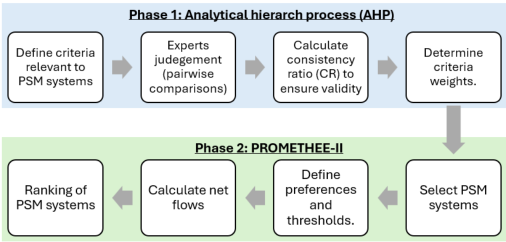
The current study’s methodology includes a systematic approach to developing a comparative framework for identifying relevant PSM systems within the process industry. First, the study employs AHP on determining the relative importance of the six safety criteria through expert pairwise comparison. Then, PROMETHEE-II applies the derived weights to rank the four PSM systems. Figure 1, summarizes the methodology of the current research.
Figure 1: The present study’s conceptual framework.
Key Criteria of PSM Systems
Table 1 summarizes the 6 criteria selected as the “Core Pillars” of the comparative framework in the current study, with the appropriate scales, and the preference for each criteria (i.e. either to maximize or minimize it in the PSM systems). Since all the criteria are considered important in PSM system, the preferences of all criteria in the AHP methodology will be maximizing the benefits of those criteria.
Table 1: The criterion and corresponding definitions, and scales.
Table available in the original PDF paper.
Criterion & Code Definition Scale C1: Design Specifications Measures the presence of the essential technical elements (e.g., Process Hazard Analysis, Asset Integrity).
0 – 26 elements (count of essential PSM factors) (Theophilus et al., 2017)
Yes, no (explicit safety culture elements presence)
C3: Human Factors
The integration of workers in the PSM systems.
0 – 19 components (aligned with Human Factors Analysis and Classification System framework) (Theophilus et al., 2017)
C4: Complex Systems
The applicability of the PSM in complex industry
Yes, no (tier 1 & 2 event accommodation) (AIChE, 2011)
Presence of feedback mechanism Yes, no
C5: Continuous Improvement C6: Scope of Application Evaluates whether the system bridges the gap between the management and the frontline.
1 – 5 (hierarchical level coverage) (Theophilus et al., 2016)
Development of a Comparative Framework 113 Process Safety Management (PSM) Systems
The PSM systems selected in the current study are illustrated in Table 2.
Table 2: The PSM systems selected in the AHP-PROMTHEE-II model.
Table available in the original PDF paper.
Scope & Applicability
PSM System & code A1: OSHA PSM (29 CFR 1910.119)
Requirements that must be met in order to prevent or lessen the effects of catastrophic discharges of substances that are hazardous, reactive, combustible, or explosive.
A2: CCPS Risk- Based Process Safety (RBPS)
Established by the Center for Chemical Process Safety (CCPS) to focus efforts on greater hazards and risks, rather than applying uniform high-intensity practices to every hazard.
Applies to all operations involving manufacture, storage, or handling of hazardous substances across the entire process life cycle.
A3: API RP 754 (3rd Edition)
Identifies proactive and reactive process safety performance indicators for measuring, tracking, and driving continuous improvement in safety performance.
Designed for the petrochemical and refining industries, but it can be used in other sectors where a loss of containment may occur.
A4: Integrated Process Safety Management System (IPSMS) Model
Designed in 2017 by integrating elements from existing PSM systems into one comprehensive system.
Mostly intended for the oil and gas sector. applicable at every level of the organizational hierarchy, including line managers, senior management, safety regulators, employees, and staff.
Experts Selections Experts were selected based on a rigorous set of inclusion criteria requiring a minimum of 5 years of professional experience in process safety management from diverse sectors, such as oil and gas, chemical, petrochemical, and manufacturing sectors. Selected experts demonstrated direct involvement in PSM system development, implementation, or auditing activities. The expert panel comprised three primary occupational categories: process safety engineers and managers, technical specialists, and academic researchers specializing in occupational safety and health.
Determining the Weights by AHP The relative weights of the criteria were determined using the AHP approach as follows:
Step 1: Construct the hierarchy of structures.. Step 2: Develop the matrix of pairwise comparison. The scale used in the pairwise comparison was according to Saaty’s matrix (Saaty, 1990) as shown in Table 3.
Table 3: The pairwise comparison scale’s definitions.
Table available in the original PDF paper.
1 3 5 7 9
Equally important
Moderately more important
Strongly more important
Very strongly more important
Extremely more important Step 3: Create a decision matrix that is normalized using the following
a c
(1)
ij ij n
Equations and mathematical formulas are available in the original paper PDF.
(2)
w w W . . w n
Equations and mathematical formulas are available in the original paper PDF.
j 1 Step 5: find the value of eigenvector and row matrix using the following
E (5) Step 7: Find the consistency index (CI) and consistency ratio (CR).
λ (6)
max n CI n 1
Development of a Comparative Framework 115 Ranking Alternatives Using PROMETHEE-II
The following are the steps in order to implement PROMETHEE-II: Step 1: Determine the comparison weights derived by the AHP tool. Step 2: Construct the decision matrix by constructing a matrix M where each element ij M represents the performance of alternative ia on criterion jc . Step 3: Normalize the decision matrix M, for each criterion jc : if the criterion is beneficial (i.e. maximize), normalize using equation:
M min M M
(8)
ij ij ij − max M min M ij ij
( ) ( ) ( ) Step 4: Determine preference functions ( ) jP d for each criterion jc by finding
the difference between the normalized performance of two alternatives k a and lc using the following equation: D = ik il M M − (9)
Step 5: Find the preference index. For each pair of alternatives ( k a , lc ), calculate the aggregated preference index using equation:
Where j w is the weight of criterion jc .
Step 6: Calculate the positive, negative, and net outranking flow using the following equations: ≠ = Π −∑ (11) ( ) ( ) 1 , 1 k k l l k a a c m φ +
Step 7: Rank the alternatives based on their net outranking flows ( ) ka φ .
RESULTS
Experts’ evaluations of the pairwise comparisons were averaged as shown in Table 4. Moreover, the final weights of each criterion obtained using AHP method are illustrated in Table 5. It is worth noting that consistency ratio (CR) for the derived weights was 0.036 which is less than 0.1, indicating sufficient level of consistency (Saaty, 1990). Moreover, Table 6 shows the decisions matrix which indicates the performance of each PSM system using PROMETHEE-II technique. Finally, Table 7 summarizes the ranking of each PMS through the calculations of the leaving, entering, and net flows.
Table 4: Pairwise comparisons matrix. The scores shown below were averaged to obtain a single value for each comparison.
This study’s integration of the Analytic Hierarchy Process (AHP) and PROMETHEE-II techniques offers a methodical and quantitative framework for assessing Process Safety Management (PSM) systems according to a variety of criteria. The results reveal significant insights into the relative strengths and weaknesses of contemporary PSM frameworks, with implications for both regulatory compliance and operational excellence in process industries. The AHP analysis yielded criteria weights that reflect
Development of a Comparative Framework 117 contemporary understanding of process safety priorities based on experts’ judgement. Safety Culture emerged as the most critical criterion with a weight of 36.9% significantly exceeding all other factors. Previous studies have demonstrated that safety culture has a direct impact on safety performance by lowering psychosocial risks and increasing worker participation in safety- critical tasks (Kabiesz & Tutak, 2024). The dominant weight assigned to this criterion suggests that stakeholders recognize process safety cannot be achieved through technical measures alone; rather, it requires a collective organizational mindset that prioritizes safety at all levels. Human Factors received the second-highest weight at 25.7% underscoring the critical role of human reliability in hazardous operations (Gan, 2019). This weighting reflects industry acknowledgment that human error contributes to 70-100% of process incidents, not as isolated failures of individuals, but as outcomes of systemic deficiencies in organizational design, work processes, and human-machine interfaces (La Fata et al., 2023). The substantial weight allocated to Human Factors validates the industry’s shift from a blame- oriented approach to a systems-thinking perspective that addresses latent organizational conditions influencing human performance.
The Integrated Process Safety Management (IPSM) system emerged as the superior framework. This dominance reflects IPSMS’s comprehensive design philosophy, which systematically integrates 26 essential elements identified across existing PSM frameworks while explicitly incorporating the Human Factors Analysis and Classification System (HFACS) (Theophilus, 2017). The IPSMS model’s structure addresses 19 distinct human factor components— significantly more than any other evaluated system—while maintaining explicit focus on safety culture through its PLAN-DO-CHECK-ACT implementation framework. The value of high leaving flow indicates that IPSMS consistently outranks other systems across multiple evaluation criteria, while the low entering flow demonstrates few comparative weaknesses. The CCPS (Risk- Based Process Safety) RBPS framework secured second place among the PSM systems. The system’s 20 elements, organized within four foundational pillars (Understand Hazards and Risk, Manage Risk, Commit to Process Safety, and Learn from Experience), represent a more comprehensive approach than mandatory regulatory standards (AIChE, 2014). Critically, RBPS explicitly includes Process Safety Culture as a standalone element and addresses human factors across six distinct elements, though less comprehensively than IPSMS. The risk-based philosophy underlying RBPS—which advocates proportionate resource allocation based on hazard magnitude and risk level—represents an evolution beyond one-size-fits-all approaches (CCPS, 2021). This strategic framework appeals to organizations seeking to optimize safety investments while achieving performance beyond regulatory minimums.
The remaining alternatives, OSHA PSM (Rank 3) and API RP 754 (Rank 4), both exhibited negative net flows, illustrating their distinct but limited roles compared to the holistic frameworks. OSHA PSM’s negative net flow reflects its nature as a regulatory baseline; while it established the legal foundation for process safety, its compliance-oriented design lacks explicit elements for safety culture and comprehensive human factors (Long, 2009). API RP 754
118 Alamoudi followed with the lowest ranking, a result that highlights a fundamental mismatch between its specific purpose as a performance monitoring tool and the broad criteria of a complete management system. API RP 754 is consistently outranked because it is designed to measure safety performance via leading and lagging indicators rather than manage it holistically (Mendeloff et al., 2013). Consequently, these two systems should be viewed not as failed frameworks, but as specialized components—one setting the minimum standard and the other providing the metric.
CONCLUSION
This study demonstrates that PSM system effectiveness depends critically on comprehensive integration of safety culture and human factors. The IPSMS model’s superior performance validates the integration strategy of pooling best practices from multiple frameworks to address gaps present in individual systems. In conclusion, the findings support a tiered approach where OSHA PSM provides the regulatory foundation, CCPS RBPS guides aspirational excellence, API RP 754 enables performance monitoring, and integrated models like IPSMS offer blueprints for comprehensive safety management architectures. Organizations should select and adapt PSM frameworks based on their specific operational contexts, risk profiles, regulatory obligations, and strategic safety objectives, recognizing that no single system provides a universal solution to the complex challenges of process safety management. Several limitations warrant acknowledgment. The study evaluated PSM systems as designed rather than as implemented, which means actual performance in practice may vary based on organizational factors such as resource availability, management commitment, and safety culture maturity. Therefore, future studies might conduct comparative analysis across different industrial sectors (petrochemical, pharmaceutical, food processing) to reveal sector-specific requirements that influence PSM system effectiveness. Another limitation is that the comparative framework focused on six criteria derived from literature review; alternative or additional criteria might yield different insights.
REFERENCES
AIChE, 2011. Process Safety Leading and Lagging Metrics: You don’t Improve What You Don’t Measure. AIChE, 2014. Guidelines for Risk-Based Process Safety. Centre for Chemical Process
Safety, 120 Wall Street, New York, NY. CCPS (2021). Overview of Risk Based Process Safety (RBPS). pp. 37–52. doi: https:// doi.org/10.1002/9781119620068.ch3. Gan, S.L. (2019). Importance of Hazard Identification in Risk Management. Industrial
Health, 57(3), pp. 281–282. doi:https://doi.org/10.2486/indhealth.57_300. Kabiesz, P. and Tutak, M. (2024). Developing a Culture of Safety for Sustainable Development and Public Health in Manufacturing Companies—A Case Study. Sustainability, 16(17), pp. 7557–7557. doi: https://doi.org/10.3390/ su16177557.
Development of a Comparative Framework 119 Khan, F., Hashemi, S.J., Paltrinieri, N., Amyotte, P., Cozzani, V. and Reniers, G.
(2016). Dynamic risk management: A contemporary approach to process safety management. Current Opinion in Chemical Engineering, 14, pp. 9–17. doi: https://doi.org/10.1016/j.coche.2016.07.006. La Fata, C.M., Adelfio, L., Micale, R. and La Scalia, G. (2023). Human error contribution to accidents in the manufacturing sector: A structured approach to evaluate the interdependence among performance shaping factors. Safety Science, 161, p. 106067. doi: https://doi.org/10.1016/j.ssci.2023.106067. Long, L.A. (2009). History of process safety at OSHA. Process Safety Progress,
[online] 28(2), pp. 128–130. doi: https://doi.org/10.1002/prs.10317. Mendeloff, J., Han, B., Fleishman-Mayer, L.A. and Vesely, J.V. (2013). Evaluation of process safety indicators collected in conformance with ANSI/API Recommended Practice 754. Journal of Loss Prevention in the Process Industries, 26(6), pp. 1008–1014. doi: https://doi.org/10.1016/j.jlp.2013.03.001. Muhammad, Genserik Reniers, Yang, M. and Bajpai, S. (2024). Risk assessment
methods for process safety, process security and resilience in the chemical process industry: A thorough literature review. Journal of loss prevention in the process industries, 88, pp. 105274–105274. doi: https://doi.org/10.1016/j. jlp.2024.105274. Nwankwo, C.D., Theophilus, S.C. and Arewa, A.O. (2020). A comparative analysis of process safety management (PSM) systems in the process industry. Journal of Loss Prevention in the Process Industries, 66, p. 104171. doi: https://doi. org/10.1016/j.jlp.2020.104171. OSHA (2012). 1910.119 - Process safety management of highly hazardous chemicals.
| Occupational Safety and Health Administration. [online] Osha.gov. Available at: https://www.osha.gov/laws-regs/regulations/standardnumber/1910/1910.119. Saaty, T.L. (1990). How to make a decision: The analytic hierarchy process. European Journal of Operational Research, 48(1), pp. 9–26. doi: https://doi.org/10.1016/0377- 2217(90)90057-i. Swuste, P., Theunissen, J., Schmitz, P., Reniers, G. and Blokland, P. (2016). Process
safety indicators, a review of literature. Journal of Loss Prevention in the Process Industries, 40, pp. 162–173. doi: https://doi.org/10.1016/j.jlp.2015.12.020. Theophilus, S.C., Abikoye, O.G., Arewa, A.O., Ifelebuegu, A.O. and Esenowo, V.
(2016). Application of Analytic Hierarchy Process to Identify the Most Influencing Human Factors (HFs) and Performance Influencing Factors (PIFs) in Process Safety Accidents. SPE/AAPG Africa Energy and Technology Conference. doi: https://doi.org/10.2118/afrc-2571952-ms. Theophilus, S.C., Esenowo, V.N., Arewa, A.O., Ifelebuegu, A.O., Nnadi, E.O. and Mbanaso, F.U. (2017). Human factors analysis and classification system for the oil and gas industry (HFACS-OGI). Reliability Engineering & System Safety, 167, pp. 168–176. doi: https://doi.org/10.1016/j.ress.2017.05.036. Theophilus, S.C., Nwankwo, C.D., Acquah-Andoh, E., Bassey, E. and Umoren, U.
(2017). Integrating Human Factors (HF) into a Process Safety Management System (PSMS). Process Safety Progress, 37(1), pp. 67–85. doi: https://doi.org/10.1002/ prs.11909.
LISTED IN THE AHFE DIGITAL BOOKSTORE CATALOGUE
Explore the complete digital volume
Safety Management and Human Factors
Read this individual research paper free through the original publisher, or explore the full digital proceedings book.
ISBN 979-8-950676-03-1
Explore this ISBN in the AHFE Bookstore ↗Listed in the July 2026 bookstore catalogue; search by ISBN to confirm current availability · Digital book purchase optional