Jiefeng Lu, Jie Jiang, Mengying Tang, Li Zhang (2023). The Evaluation Method of Cruise Ship Exterior Styling Imagery Based on Kansei Engineering and Analytic Hierarchy Process. In: Kansei Engineering. AHFE Open Access, vol. 101, pp. 95–106. https://doi.org/10.54941/ahfe1002997
In order to solve the matching problem between the acquisition of modeling features during the cruise ship design process and the cognition of the cruise ship exterior styling imagery after the design is completed, and to assist the designer in making a reasonable selection of the design scheme through styling imagery evaluation, the research group of this paper proposes a cruise ship exterior styling imagery evaluation method based on Kansei Engineering (KE) and analytic hierarchy process (AHP). The semantic vocabulary of the cruise ship exterior imagery is quantified and analyzed by using the methods of semantic difference (SD) and AHP, and the index system that affects the evaluation of the styling imagery is established. The weight of each evaluation index is calculated by constructing the judgment matrix, and the comprehensive ranking is carried out. Combined with the weights of the evaluation indexes of each level in the judgment matrix, the image fuzzy comprehensive evaluation matrix of cruise ship exterior styling is established to evaluate the four cruise ship exterior styling imagery design schemes designed by the members of the research group, and finally, the best image design scheme of cruise ship exterior styling is obtained. This method reduces the subjective factors in the evaluation process as much as possible and can provide an effective reference for the evaluation of the cruise ship exterior styling imagery design scheme.
The global cruise market has developed rapidly in the past 30 years and the number of passengers has increased steadily (Smirnov et al., 2022). Alth- ough the cruise industry has been greatly affected by COVID-19 since the end of 2019, with the gradual decline of the global epidemic, it is expected that by the end of 2026, the passenger volume of cruise ships will recover to more than 12% above the level of 2019 (CLIA, 2022). As a result, the cruise industry has great development potential.
The appearance of the cruise ship is an important carrier for tourists to get the cruise experience first before boarding, and also the primary carrier
for tourists to recognize the cruise ship and generate emotional associations. In terms of cruise ship design, western countries have more mature design technologies and more complete design systems, which are not only derived from the aesthetic culture of the transoceanic liner era and the accumulation of engineering design experience (Quartermaine et al., 2006), but also com- bined with the innovation of engineering technology and the upgrading of tourist entertainment needs.
For example, Sheridan (2013) analyzed the cruise ships based on the color, geometric proportion, and other elements of industrial aesthetics and discus- sed the method of integrating aesthetic design into ship engineering design; Musio-Sale and Zignego (2020) looked forward to the future development of cruise ship design in terms of interior decoration, overall appearance and environmental coordination; Jo and Jonas (2016) used fuzzy models to quan- tify the appearance impact that should be considered in cruise ship design by establishing the structure tree of appearance size parameters.
Scholars from other countries are also doing research on cruise ship appe- arance design. Cui et al. (2022), from Marine Design and Research Institute of China, built a frame boundary for the cruise ship appearance design based on the regional deconstruction and parameter tree sorting of the factors affe- cting the luxury cruise ship appearance design; Zhang et al. (2020) integrated Chinese elements and provided functional space and appearance design cases of large cruise ships with cultural characteristics.
In general, scholars at home and abroad have conducted extensive research in the field of cruise ship appearance design, but there are still deficiencies in the study of cruise ship appearance modeling image, especially the evaluation of modeling image.
The transformation of qualitative evaluation into quantitative evaluation can reduce the influence of subjective factors on the programme evaluation process and evaluation results, and improve the efficiency of designers’ decisi- ons on design solutions (Cheng et al., 2020). Image evaluation methods based on KE and AHP can better solve the problem that user-perceived images are difficult to quantify. KE is mainly based on qualitative and quantita- tive analysis (Nagamachi and Lokman, 2016). Between “human perception” and “characteristics of things,” the fuzzy and difficult to capture perceptual intention is converted into quantitative data and into design elements (Meng et al., 2011). The Analytical Hierarchy Process (AHP) is a method to assist in decision-making (Saaty, 1980). The advantage of this method is that it organizes tangible and intangible factors in a systematic way and provi- des a structured but relatively simple solution for decision-making problems (Skibniewski et al., 1992).
Therefore, this paper will explore the evaluation method of cruise ship appearance modeling images by combining the appropriate theoretical meth- ods of KE and AHP. First, by using the A-type graphical method (KJ) and the semantic difference method (SD), the cruise ship samples and semantic words studied were screened to determine the important words that can reflect the image of the cruise ship appearance; Secondly, AHP is used to construct an orderly hierarchical structure chart, establish an index system that affects the evaluation of modeling image, and calculate the weight of each evaluation
The Evaluation Method of Cruise Ship Exterior Styling Imagery 97
index by using the judgment matrix through the image evaluation experi- ment and carry out the consistency test; After the consistency test of the judgment matrix, the image fuzzy comprehensive evaluation model of cruise ship appearance modeling is constructed by combining the weight of evalua- tion indicators at all levels in the judgment matrix; Finally, based on the fuzzy comprehensive evaluation model, the four cruise ship exterior modeling sch- emes designed by the research team members were evaluated to determine the optimal design scheme.
STUDY ON THE SEMANTIC FEATURES OF THE IMAGE OF CRUISE SHIP EXTERIOR STYLING Sample Selection for Cruise Ship Appearance Study
The research team collected information on 42 cruise brands with 272 cruise ships from domestic and international cruise booking platforms and cruise lines’ official websites. Due to the large number of cruise ship brands, the research team selected cruise ship brands with eight (including eight) or more cruise ships currently on board as the initial screening target. In order to increase the variability of the cruise ship sample, the research team finally selected 39 cruise ships among the 13 cruise ship brands that met the criteria as the initial research sample.
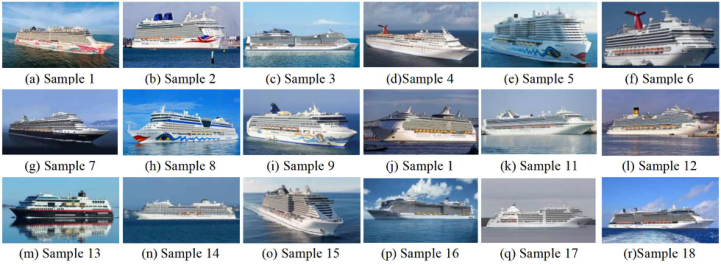
Based on the initial screening of the research sample, the research team invited 10 selectors to further screen the sample. The selectors used the expert scoring method to screen the 39 cruise ship samples collected, combined and categorized the screened samples, deleted similar samples, and finally obtai- ned 18 typical cruise ship samples and named them with samples 1∼18 (see Figure 1).
Analysis of the Semantic Features of Perceptual Imagery of Cruise Ship Appearance The specific evaluation of objective things through the connection between objectivity and perception is actually the result of people’s subjective expres- sions acting on the object things (Ju et al., 2021). Therefore, the study of perceptual imagery of cruise ship appearance can start from the analysis of
Figure 1: Sample of a typical cruise ship.
people’s semantic characteristics of it. Through consulting relevant literature, user interviews, and enterprise research, we obtained the semantic features of cruise ships and collected more than 90 perceptual words that can reflect the style, aesthetics, and form of cruise ship appearance.
Through discussion, evaluation, and integration, the research team classi- fied the collected perceptual vocabulary according to style imagery vocabu- lary, aesthetic imagery vocabulary, and morphological imagery vocabulary, and then applied the requirements of the secondary sex principle of the SD which pointed out by Cheng et al. (2019), finally obtaining 32 groups of ima- gery perceptual vocabulary and constructing a semantic feature set for cruise ship shape and form.
Combined with the 18 cruise samples determined in the above study, a Likert scale questionnaire was created to rate 32 groups of imagery perce- ptual vocabulary through 5 levels of evaluation criteria, i.e., very important, important, generally important, unimportant, and very unimportant, with scores of 2, 1, 0, −1 and −2, respectively. Then 30 respondents were invited to evaluate the cruise ship exterior modeling imagery vocabulary. The resea- rch team entered the obtained research data into the SPSS software, counted the perceptual vocabulary of the sample, and calculated the mean value of the score of each perceptual vocabulary. At the same time, the research team applied principal component analysis to obtain the component matrix and the specific number of components and finally identified 14 groups of sense words as important sense words (see Table 1).
CRUISE SHIP APPEARANCE MODELING IMAGERY DESIGN EVALUATION MODEL ESTABLISHMENT Establishment of the Imagery Evaluation Index System of Cruise Ship Exterior Modeling
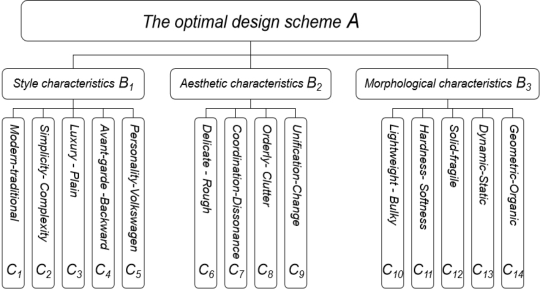
According to the principle of AHP, an orderly hierarchical structure chart is constructed, which contains the target layer, criterion layer, and indica- tor layer. The optimal cruise ship appearance design scheme is the target layer, the style characteristics, aesthetic characteristics, and morphological characteristics in the perception of cruise ship appearance imagery are the criterion layer, and the characteristic vocabulary that can reflect the cruise ship appearance imagery is the sub-criteria layer (see Figure 2).
The Evaluation Method of Cruise Ship Exterior Styling Imagery 99
Figure 2: Cruise ship appearance modeling imagery evaluation index system.
Imagery Evaluation Experiment of Cruise Ship Exterior Modeling After establishing the cruise ship appearance modeling imagery evaluation index system, the index weights in each layer need to be analyzed, using the judgment matrix (Saaty et al., 2000) to calculate the importance of each index in each layer relative to the previous layer, and derive the weight value of each index.
[Equation or mathematical symbol available in the original paper PDF]
[Equation or mathematical symbol available in the original paper PDF]
Equations and mathematical formulas are available in the original paper PDF.
In order to quantify the importance of two indicators, the nine-level scale method is used, i.e., the scale values are expressed by the numbers 1 to 9 and their reciprocals. In this paper, the weight vector is solved by the geometric mean method, and the obtained results are normalized to obtain the weights of each index, and the specific calculation process is as follows.
1) Find the product Mi of each row of indexes in the judgment matrix M:
Where Cij is the judgment matrix in the first i row and j column indicators. n is the number of indicators.
2) Find the geometric mean of the indicators of the judgment matrix αi:
3) Normalize the results to obtain the relative weight:
In order to ensure the accuracy of the study, a total of 20 expert judges were formed. This includes 4 cruise shipyard design researchers, 2 design faculty
members, 10 doctoral and master’s degree students engage in cruise design research, and 4 tourists with previous cruise travel experience. Based on the above judgment rules, members of the expert judging panel were invited to score the evaluation indexes in a two-by-two comparison, and the weight values of each index in the judgment matrix were calculated. Since the num- ber of experts is large and the scores given by each expert are different, the geometric mean method is used to process the scores of experts before calcu- lating the weight values of each index in the judgment matrix (see Tables 2∼5). In order to ensure the consistency of the experts’ thinking logic in the sco- ring process, it is necessary to conduct a consistency test on the judgment matrix after the results are obtained. The steps of the consistency test are as follows.
Table 2. Criterion-level judgment matrix and weights.
The Evaluation Method of Cruise Ship Exterior Styling Imagery 101
1) Find the judgment matrix consistency index CI: (CW)i n X
n−1 (6) In the formula: λmax is the maximum eigenvalue of the judgment matrix; (CW)i is the eigenvector CW of the i component.
2) Query the average random consistency index RI (see Table 6). 3) Calculate the consistency ratio CR.
RI (7) The consistency test is performed on the target layer and the criterion layer according to the above calculation steps. The results of the consistency test in this judgment matrix CR are less than 0.1, indicating that the judgment matrix passes the consistency test and the experiment results are valid (see Table 7).
After passing the judgment matrix consistency test, the research team nor- malized the evaluation index weights in the sub-criteria layer and calculated the comprehensive ranking of each evaluation index weight. This evaluation index ranking can be used as a reference standard for the design of cruise ship exterior modeling imagery (see Table 8).
Imagery Fuzzy Comprehensive Evaluation Matrix Construction for Cruise Ship Exterior Modeling Combined with the weights of the evaluation indexes of each level in the jud- gment matrix, the imagery fuzzy comprehensive evaluation matrix of cruise ship appearance modeling is constructed. The specific steps are as follows.
Table 6. Table of random consistency indicators (Saaty T L et al. 1992).
Table available in the original PDF paper.
Matrix Order 1 2 3 4 5 6 7 8 9 ...
RI 0 0 0.52 0.89 1.12 1.26 1.36 1.41 1.46 ...
Table 7. Consistency calculation results of the judgment matrix.
Table available in the original PDF paper.
Consistency indicators A B1 B2 B3 λmax 3.087 5.168 4.242 5.052 CI 0.044 0.042 0.081 0.013 RI 0.520 1.120 0.890 1.120 CR 0.084 0.037 0.091 0.012
Table 8. Combined ranking of the weights of the evaluation indicators in the subcriteria layer.
1) The calculation results from Table 4 to Table 7 show that the evaluation index weights of each layer are:
Equations and mathematical formulas are available in the original paper PDF.
2) Invite experts to evaluate the design plan according to the evaluation index. Evaluation criteria in accordance with the “very satisfactory,” “sati- sfactory,” “general,” “unsatisfactory” and “very unsatisfactory” 5 levels of evaluation. “very unsatisfactory” 5 levels of judgment. The scores are calcu- lated by the number of evaluations received for each index. For example C1 For example, if an indicator receives a “satisfied” rating 3 times, the score is 0.3. The sub-criteria level fuzzy evaluation relationship matrix R can be established.
[Equation or mathematical symbol available in the original paper PDF]
Equations and mathematical formulas are available in the original paper PDF.
Where r11-r1n are the scores of the same indicator evaluated by different experts. r11 -rm1 is the score of different indicators evaluated by the same expert in the sub-criteria layer.
Establish a secondary evaluation matrix P.
[Equation or mathematical symbol available in the original paper PDF]
The Evaluation Method of Cruise Ship Exterior Styling Imagery 103
(4) According to the secondary evaluation matrix, the indicators are eva- luated comprehensively. The comprehensive evaluation weight vector W is: W = wA×P (11)
(5) Assign values to the comprehensive evaluation weight vector accor- ding to the evaluation level and criteria, and the assignment vector β = (90, 80, 70, 60, 50)T (see Table 9). The percentage score of the solution is calculated S.
Comprehensive Evaluation of Cruise Ship Exterior Modeling Design Solutions Two design researchers from cruise shipyards, six teachers and students from universities specializing in design, and two tourists with cruise expe- rience were invited to form a review panel to evaluate the four cruise ship exterior styling proposals designed by the research team members (see Figure 3).
For this expert evaluation, 10 questionnaires were distributed by the research team, and 10 valid questionnaires were finally returned. Through SPSS reliability analysis, the Cronbach reliability coefficient (Cron- bach α coefficient value) was obtained as 0.953, indicating that the reliability of this test and scale is very good and can be calculated in the next step. Take design scheme 1 as an example, and the specific calculation process is as follows.
First, the expert scoring results were collated to obtain 3 sets of score data, namely R1, R2 and R3. R1 is the evaluation results of each index under the hierarchy of the evaluation index of the style characteristics B1, R2 is the eva- luation results of each index under the hierarchy of the evaluation index of the aesthetic characteristics B2, R3 is the evaluation results of each index under the hierarchy of the evaluation index of the morphological characteristics B3.
Table 9. Rating levels and criteria.
Table available in the original PDF paper.
Evaluation Level Very satisfied Satisfaction General Dissatisfaction Very dissatisfied Grade Criteria 90 80 70 60 50
Figure 3: Design schemes of cruise ship appearance.
The statistical results are as follows.
[Equation or mathematical symbol available in the original paper PDF]
Equations and mathematical formulas are available in the original paper PDF.
[Equation or mathematical symbol available in the original paper PDF]
Equations and mathematical formulas are available in the original paper PDF.
Second, using SPSSAU software, based on the fuzzy comprehensive evaluation matrix, the evaluation weight vector of the criterion level for design scheme 1 is calculated pi, and the results of the second-level evaluation matrix P.
Equations and mathematical formulas are available in the original paper PDF.
[Equation or mathematical symbol available in the original paper PDF]
[Equation or mathematical symbol available in the original paper PDF]
[Equation or mathematical symbol available in the original paper PDF]
[Equation or mathematical symbol available in the original paper PDF]
[Equation or mathematical symbol available in the original paper PDF]
[Equation or mathematical symbol available in the original paper PDF]
Again, according to the secondary evaluation matrix, the indicators are evaluated comprehensively, and the comprehensive evaluation weight vector is calculated W: 0.377 0.347 0.169 0.094 0.012 W=wA×P =
This is finally converted to a percentage score to calculate the final Score for design scheme 1.
Equations and mathematical formulas are available in the original paper PDF.
90 80 70 60 50T = 79.76 Based on this method, the final scores for design scheme 2, design scheme 3 and design scheme 4 were calculated. Score of Design scheme 2.
Equations and mathematical formulas are available in the original paper PDF.
The Evaluation Method of Cruise Ship Exterior Styling Imagery 105
Score of Design scheme 3.
Equations and mathematical formulas are available in the original paper PDF.
Score of Design scheme 4.
Equations and mathematical formulas are available in the original paper PDF.
90 80 70 60 50T = 71.60 In the end, the final scores of the four programs were ranked as follows S1 > S3 > S2 > S4. Therefore, it can be judged that design scheme 1 is the best cruise ship appearance modeling imagery design scheme.
CONCLUSION
Combining perceptual engineering with hierarchical analysis can better solve the problem that tourists’ perceptual cognition is difficult to be expressed in the design and can reduce the influence of subjective factors on the design process and design evaluation process. In this paper, researchers use the relevant theories and methods of KE and AHP to build the semantic fea- ture set of cruise ship exterior styling and the evaluation index system of cruise ship exterior styling imagery. Based on the above results, the resea- rchers also constructed the image fuzzy comprehensive evaluation matrix of cruise ship exterior styling and evaluated the design scheme through fuzzy comprehensive evaluation, which verified the feasibility and accessibility of the evaluation model. The research results of this paper can provide some reference for subsequent researchers in this kind of decision making problem.
ACKNOWLEDGMENT
The authors would like to extend their greatest appreciation to the Depar- tment of Science and Technology of Hainan Province and the Sanya Science and Education Innovation Park of Wuhan University of Technology. This research was supported by the Science and Technology special fund of Hai- nan Province (No. ZDYF2021GXJS214) and the Open Fund of Sanya Science and Education Innovation Park of Wuhan University of Technology (No. 2022KF0023) and the PhD Scientific Research and Innovation Foundation of Sanya Yazhou Bay Science and Technology City (No. HSPHDSRF-2022- 03-013).
REFERENCES
Cheng, Y. S., Xu, X. Q., & Bu, J. (2020). Evaluation method of automobile modeling image based on KE and AHP. Modern Manufacturing Engineering, 7, 102–109. CLIA. (2022). 2022 State of the cruise industry outlook. Cruise Lines International
Association Website: https://cruising.org/-/media/clia-media/research/2022/clia-s tate-of-the-cruise-industry-2022_updated.ashx Cui, M., Si, N., & Sun, L. (2022). Constraints of general arrangement on appearance design of luxury cruise ships. Chinese Journal of Ship Research, 17(2), 17–27.
Jo, J. H., & Jonas, W. (2016). Quantifying aesthetic preferences incruise ship exterior design. Cruise Business Development: Safety, Product Design and Human Capital, 127–138. Ju, Q. H., Huang, J., Ruan, J. K. (2021). Fuzzy Evaluation of Electric Concept Veh-
icle Based on KE-AHP (in Chinese), Journal of Hubei University of Automotive Technology, Volume 35 No. 3. Meng, R., Wang, X. P., & Wang, W. W. (2011). Evaluation method of tanker design based on kansei engineering. Modern Manufacturing Engineering, 9, 28–32. Musio-Sale, M., & Zignego, M. I. (2020). New visions for future cruise ship ves-
sels. International Journal on Interactive Design and Manufacturing (IJIDeM), 14, 19–33. Nagamachi, M. (1995). Kansei engineering: a new ergonomic consumer-oriented technology for product development. International Journal of industrial ergono- mics, 15(1), 3–11. Nagamachi, M., & Lokman, A. M. (2016). Innovations of Kansei engineering. CRC
press. Quartermaine, P., & Peter, B. (2006). Cruise: identity, design and culture. Laurence King Publishing. Saaty, T. L. (1980). The analytic hierarchy process. New York: McGrawHill. Saaty, T. L., & Vargas, L. G. (2012). Models, methods. Concepts & Applications of
the Analytic Hierarchy Process, 14, 346. Sheridan, J. A. (2013). Synthesis of aesthetics for ship design (Doctoral dissertation, University of Southampton). Skibniewski, M. J., & Chao, L. C. (1992). Evaluation of advanced construction tech-
nology with AHP method. Journal of Construction Engineering and Management, 118(3), 577–593. Smirnov, A., Smolokurov, E., Timofeeva, E., & Krovsh, S. (2022). Features of Development of Sea Cruise Tourism. Transportation Research Procedia, 61, 147–154. Zhang, Y. M., Wu, Q. R., Huang, S., Huang, J. X., & Lai, G. (2020). Integrating
characteristically Chinese cruise ship functional space and appearance with design and practice. Chinese Journal of Ship Research, 15(5), 49–56.
LISTED IN THE AHFE DIGITAL BOOKSTORE CATALOGUE
Explore the complete digital volume
Kansei Engineering
Read this individual research paper free through the original publisher, or explore the full digital proceedings book.
ISBN 978-1-958651-77-3
Explore this ISBN in the AHFE Bookstore ↗Listed in the July 2026 bookstore catalogue; search by ISBN to confirm current availability · Digital book purchase optional