Woojin Choi, Siyoung Choi, Ka Sanghoon, Kim Sunwoong, Sohn Moonjun (2023). A Study on the Spatial Location of HCP and Spinopelvic Alignment when Sitting on an Automotive Seat. In: Kansei Engineering. AHFE Open Access, vol. 101, pp. 34–41. https://doi.org/10.54941/ahfe1002989
The design of automotive seats is an important design factor that affects the biomechanical alignment of the driver's spinopelvic alignment when in a seated state. However, there is a lack of biomechanical studies evaluating body changes in a driver's seated state in a driving environment. Therefore, urgent research is needed on driver-specific basic data that can be used as basic data to be considered in the development and design of automotive seats.Purpose: The purpose of this study is to measure the difference in the alignment of the spine and pelvis according to the driver's sitting posture when voluntarily participating drivers sit at their preferred car seat back angle and to use this data as basic biomechanical data for car seat design.Method: A total of 15 participants were seated in their preferred posture, and the lateral view of their spine and pelvis was evaluated using X-rays. The sagittal seatback angle at the time of sitting and the distance from the HCP (hip center point) to the VBC (vertebral body center) were measured. The HCP was determined as being the center of the femoral head, which is the point where the horizontal line and the vertical line bisecting the horizontal line meet after drawing a circle enclosing the femoral head on the lateral X-ray. VBC was defined as being the point at which the lines connecting the four ends of the vertebral body with intersections met in the side view of the X-ray. Then, based on the HCP, the distance of the VBC from the 5th lumbar vertebra to the 10th thoracic vertebra was measured with the x-coordinate for the horizontal line and the y-coordinate for the vertical line.Result: When the angle of the seatback was optimized when sitting, the angle was 10.9.4°±2.997°. And the distance of all vertebral bodies (L5, L4, L3, L2, L1, T12, T11, T10) from the HCP was 128±15.96, 147.3±19.44, 167.6±22.39, 187.5±24.87, 202.9±26.93, 216.2±29.89, 226.4±32.42, and 234±33.46, respectively, and the y (mm) values were 64.67±21.93, 106.1±22.91, 143.8±24.78, 181.6±23.30, 218.1±24.32, 253.6±27.80, 283.8±30.6.57, 331.6.57, respectively. Thus, as the change in distance from the HCP from the 5th lumbar vertebra to the 10th thoracic vertebra increases, x-axis increases by 15%, 13.78%, 11.87%, 8.2%, 6.55%, 4.72%, and 3.4%, respectively, and y-axis increases by 64.67%, 35.53%, 26.29%, 20.1%, 16.28%, 11.9%, and 10.6%, respectively, were observed.Conclusion: The results of this study will be used as basic data that can be reflected in an optimal ergonomic seat design by providing the vertebral body coordinate shift in the thoracic and lumbar region from the HCP through actual X-ray imaging, not virtual simulation, for optimal car seat design.
A Study on the Spatial Location of HCP and Spinopelvic Alignment 35
BACKGROUND
According to a 2012 paper, women were found to generally be twice as likely to suffer a whiplash injury than men in similar crash conditions during a traf- fic accident (Carlsson et al., 2021). This is because the drivers’ height, weight, and body shape are different, so even if a seat is designed based on a standard body shape, there may be various differences in safety and comfort when the test subjects sit. Therefore, it is necessary to evaluate the body changes in a more realistic environment for spinal alignment while actually seated. In the past, in order to understand the movement of the vertebrae and the effect on the disc space during a low-speed rear-end collision, a study using X-rays of the arrangement and movement of the lumbar vertebrae in a driving posture was conducted (Robert et al., 2000).
In order to acquire accurate data on the impact applied to the spine, muscles, and nerves during a collision, it is necessary to accurately understand the alignment of the vertebrae and to check their movement and changes in the disc space.
However, to do this, it was not easy to conduct research in general because it was necessary to conduct an experiment that involved exposure to radi- ation, such as X-rays, and the use of invasive equipment that measures the disc pressure in the intervertebral disc.
Recently, in 2020, at Yamaguchi University Hospital in Japan, Mazda conducted a study using X-rays to identify overall changes in the global spine alignment when sitting in an automotive seat (Nishida et al., 2020). In addition, Hyundai Transys and Ilsan Paik Hospital in Korea condu- cted a study on changes in the spine when sitting on an automotive seat (Choi et al., 2022).
Automotive seats have played an important role since the early days of automobile development, and seat design, which provides the safest and most ideal comfort for the driver, has made great progress as ergonomic design and safety regulations in case of collision have been strengthened.
So far most of the research papers on the relationship between automotive seats and the spine have been related to cervical spine damage at the moment of a car crash because there is a high possibility of whiplash injury in a crash. In addition, by measuring the change in the shape of the intervertebral disk at each segment of the spine when sitting on an automotive seat, the stress applied to the cervical spine as well as the thoracic and lumbar spine was studied to evaluate comfort and pelvic movement while sitting (Sato et al., 2019; Baumgartner et al., 2012). The seat design of a car is not only related to safety but also highly related to comfort. Through ergonomic design, not only the function but also the design is developing in the direction of providing maximum comfort when sitting.
The driver or passenger relies on the automotive seat for a various duration of time from getting into to getting out of the car, and this process can cause
various medical problems related to lower back pain (Gowtham et al., 2020; Iftekhar et al., 2020; Lecocq et al., 2020).
Sitting posture and its effect on lower back pain and degenerative changes of the spine have been mentioned in several papers already. As a result, technology for automotive seats advances and interest in the clinical field of the spine and pelvis while seated in a car inevitably increases.
As a result of this trend, digital health is expected to be reflected in the interior space of automobiles. And the core of digital health is not the digitalization of diagnosis and treatment methods but the prevention and management of diseases. To do this, an anatomical understanding of the arrangement of the spine and pelvis is essentially required when sitting in an automotive seat.
Therefore, in this study, the design of the automotive seat is refle- cted to improve the comfort performance of the automotive seat and as basic data for the preventive study of spine-related diseases rather than the evaluation of the global spine posture when sitting on an automotive seat. By measuring the spatial coordinates where each vertebral body is located from HCP (the hip center point) of the thoracolumbar spine, we tried to find out the actual seating conditions of drivers when designing seats.
METHOD
This study was conducted with the cooperation of Hyundai Transys, and there was no conflict of interest other than the provision of seats.
X-ray data were measured when 15 voluntary participants were sitting in their preferred posture on the automotive seats. The 2022 Grandeur (GN7) driver’s seat wa used in the test, and the seat was installed on a large jig with fixed wheels in a flattened X-ray room.
After this, the participants sat down with both feet placed on the accelera- tor and footrests set in the same position as in an actual vehicle. In addition, the participants were made to take their actual driving posture, and the angle of the seatback was set to the preferred position. The position of the lumbar support was also adjusted to an optimal state by using a pneumatic system in the lumbar region.
When viewed from the side, the test was conducted while maintaining the hip flexion and knee flexion angle to the extent that the knee and thigh did not cover the iliac crest in the X-ray images. Afterwards, a neurosurgeon with more than 10 years of experience took a side-view full-spine X-ray of the seated participants.
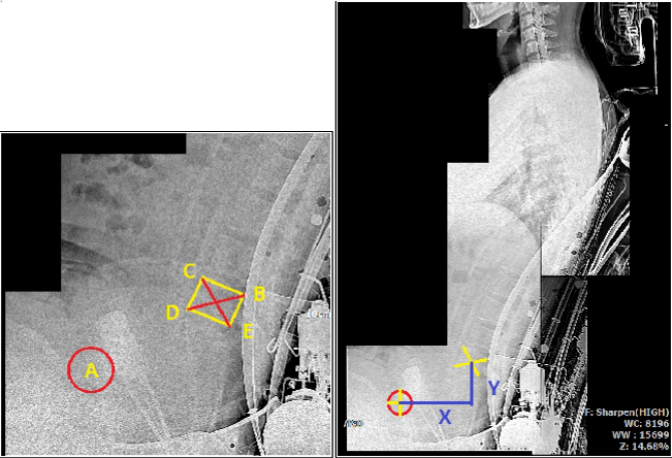
In the acquired X-ray image, the HCP was determined as the center of the femoral head, and after drawing a circle covering the head of the femur, the point where the horizontal line and the vertical line bisecting the horizontal line met was determined and marked as the HCP. The VBC (vertebral body
A Study on the Spatial Location of HCP and Spinopelvic Alignment 37
Table 1. Participants’ characteristics.
Table available in the original PDF paper.
Parameter Male Female Total n 9 6 15 Age (years) 38.22 ± 6.78 36.98 ± 7.97 38.27 ± 4.06 Height (cm) 175.6 ± 7.318 162.3 ± 5.20 170.4 ± 9.27 Weight (kg) 79 ± 6.91 62 ± 7.85 72.87 ± 11.77 Body mass index (kg/m2) 26.42 ± 2.95 23.48 ± 3.40 25.45 ± 3.55
center) is the point where the line connecting B and D and the line connecting C and E intersect.
Of the 15 participants in this study, 9 were male and 6 were female. The average age was 38.27 ± 4.06 years and the average height was 170.4 ± 9.27 cm. The average body weight was 72.87 ± 11.77 kg and the average BMI was 25.45 ± 3.55.
RESULT
All participants adjusted the angle of the seatback to their optimized angle when sitting, and at this time, the angle of the backrest was 109.4
±2.997
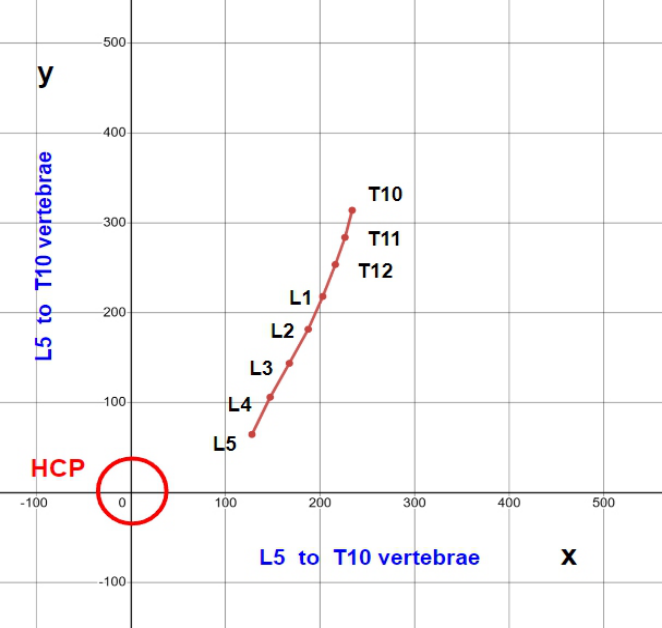
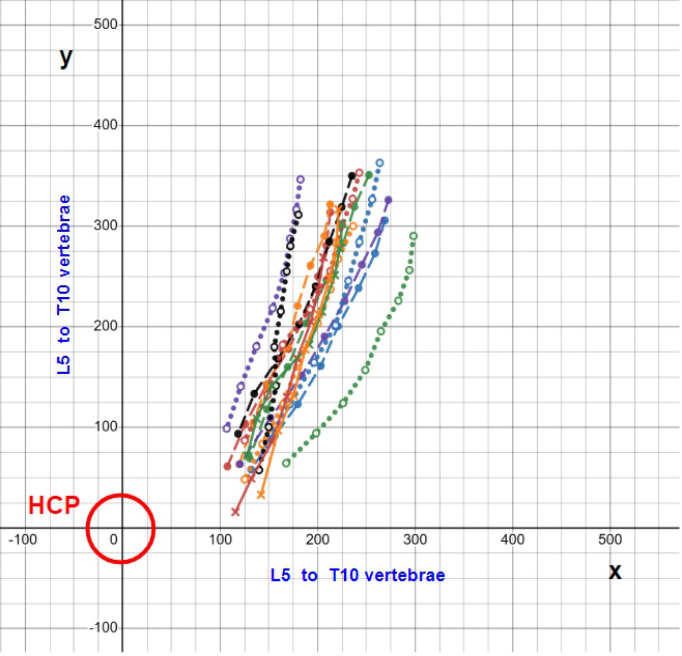
. Additionally, the coordinates of each vertebra position were measured based on the HCP and are shown in Table 2. The distance difference mostly decre- ases from the coordinates of the L5 vertebra to the coordinates of the T10 vertebra. Figure 1 shows the location of the average value of the coordinate values of each vertebra of the 15 participants, and Figure 2 and 3 show the coordinates from the L5 to the T10 vertebrae of all 15 participants. And as the change in distance from the HCP from the 5th lumbar vertebra to the 10th thoracic vertebra goes up, x-axis increases by 15%, 13.78%, 11.87%, 8.2%, 6.55%, 4.72%, and 3.4%, respectively, and y-axis increases by 64.67%, 35.53%, 26.29%, 20.1%, 16.28%, 11.9%, and 10.6%, respesctively, were observed.
Figure 1: Depiction of the method used to show HCP and the VBC.Figure 2: X, Y coordinates (mm) from HCP using means of vertebrae (from L5 to T10).
A Study on the Spatial Location of HCP and Spinopelvic Alignment 39
Figure 3: Total 15 volunteers’ coordinates (mm) from HCP of all vertebrae from L5 to T10.
DISCUSSION
From the study on the preferred driving posture in the technical report publi- shed by the Lear seating corporation in 1995, a study was conducted to recommend a lumbar support design that could be applied to automotive electric seats (Reed and Schneider, 1995). Here, a joint center curve conne- cting the center of the intervertebral space, not the vertebral body center, was drawn in the lumbar spine, and the relationship between the curve and the seat was studied (Reed and Schneider, 1995). When the coordinates of the vertebrae were arranged around the HCP, the torso angles were the same. Therefore, when designing a car seat, HCP is important, and it is necessary to identify the location of each element around the HCP.
The mean location of the point of maximum lordosis in the lumbar back contour is about 144mm above the sitter’s hip joint centers (Reed and Sch- neider, 1995). The mean preferred lumbar support apex location is about 152mm above the sitter’s hip joint centers (Reed and Schneider, 1995). This coordinate coincides with the height between the L3 and L4 vertebrae when looking at Table 2 of this study. Also, on average, the maximum prominence of the most preferred back contour is 150 to 160mm vertically from the HCP
(Reed and Schneider, 1995). This location coincides with the height between the L2 and L3 vertebrae in this study. Compared to standing, the movement of the lumbar spine when sitting is greater than the angle change of the cervical and thoracic vertebrae, and the change is greatest at the 2nd and 3rd lumbar levels (Carvalho and Jack, 2012). This is presumed to be because the size of the L5 vertebra is clinically large and the size of the vertebrae decreases when going up to the T10 vertebra, and the lumbar lordosis angle decreases when sitting.
A study on the coordinates of the vertebral body was conducted at the Uni- versity of Michigan in 2005(Liu, 2005). In the case of ERL, LLC, a spin-off from the University of Michigan, a virtual driver using a mathematical model was used to create an optimized model for the driver when seated. (Reynolds and James, 2012). Not only the pelvis and spine but also the curvature of the spine while seated can be optimized for automotive seat design, and the seat design undergoes optimization through physical iteration or mathematical calculations to realize an optimal seating posture (Flannagan et al., 1998).
Compared to a standing posture, a sitting posture mainly affects the thora- columbar spine from T10-11 to L5-S1 (Tsagkaris et al., 2022; Baumgartner et al., 2012). In addition, when holding the steering wheel with both hands when seated, the position where the weight is actually placed on the seat is below the T10 vertebra level.
That is, when the driver sits on the automotive seat, the driver’s wei- ght is placed on the spine from T10 to S1. Therefore, the arrangement and movement of this part of the spine can greatly affect the sitting posture and comfort. In addition, the part on which the driver’s weight is repeatedly pla- ced reduces comfort and can cause discomfort and pain (Lecocq et al., 2020). This is important when designing the maximum prominence level of support.
CONCLUSION
When sitting on an automotive seat, the position of the vertebral body in the thoracic and lumbar region changes which affects comfort and the driver’s safety in the event of an accident. Therefore, it is necessary to check the spatial position and arrangement of each vertebral body arranged in various forms upon sitting through X-rays. And by measuring the coordinates of each tho- racic and lumbar vertebra from the HCP, this data is expected to be reflected in a more personalized ergonomic seat design.
REFERENCES
Baumgartner, D. Zemp, R. List, R. Stoop, M. Naxera, J. Elsig, J. P. and Lorenzetti, S.
(2012). The spinal curvature of three different sitting positions analysed in an open MRI scanner, Scient World J Volume 2012 No. 184016. Carlsson, A. Davidsson, J. Linder, A. and Svensson, M. Y. (2021). Design and Evaluation of the Initial 50th Percentile Female Prototype Rear Impact Dummy, BioRID P50F - Indications for the Need of an Additional Dummy Size, Front Bioeng Biotechnol. Volume 9 No. 687058.
A Study on the Spatial Location of HCP and Spinopelvic Alignment 41
Carvalho, Diana E. and Jack, P. Callaghan. (2012). Influence of automobile seat lumbar support prominence on spine and pelvic postures: a radiological investigation, Applied ergonomics Volume 43 No. 5. Choi, W. J. Yeo, S. Y. Kang, G. C. Kim, S. H. and Sohn, M. J. (2022). A Study on
the Effect of Improving the Balance of the Spine and Pelvis Using an Air Bladder That Can Automatically Control the Left and Right Hips on the Automotive Seats, Transaction of the Korean Society of Automotive Engineers, Volume 30 No. 12. Flannagan, C. Manary, M. Schneider, L. and Reed, M. (1998). An Improved Seating Accommodation Model with Application to Different User Populations, SAE Technical Paper 980651. Gowtham, S. Ramnath, M. Sudharsan, S. Lalith Kumar, B. V. Praneeth, V. Dinesh,
S and Subramaniyam M. (2020). Seating comfort analysis: avirtual ergonomics study of bus drivers in private transportation, IOP Conference Series: Materials Science and Engineering Volume 912. No. 2. Iftekhar, H. Khan, R. M. W. U. Asghar, M. A. Qadeer, A. Umair, M. Nawab, Y and Hamdani, S. T. A. (2020). Study of comfort performance of novel car seat design for long drive, Proceedings of the Institution of Mechanical Engineers, Part D: Journal of Automobile Engineering Volume 234 No. 2–3. Lecocq, M. Lantoine, P. Bougard, C. Allègre, J. M. Bauvineau, L. Bourdin,C. Marqueste, T. Dousset, E. (2020). Neuromuscular fatigue profiles depends on seat feature during long duration driving on astatic simulator, Applied Ergonomics Volume 87 No. 103118. Liu, Zhenyu. (2005). Measurement and analysis of human posterior back and thigh
contours for automotive seat design, Michigan State University. Nishida, N. Izumiyama, T. Asahi, R. Iwanaga, H. Yamagata, H. Mihara, A. Nakashima, D. Imajo, Y. Suzuki, H. Funaba, M. Sugimoto, S. Fukushima, M. Sakai, T. (2020). Changes in the global spine alignment in the sitting position in an automobile, Spine J Volume 20 No. 4. Reed, Matthew P. and Schneider, Lawrence W. (1995). Design criteria for automobile seatbacks based on preferred driver postures, Technical Report, University of Michigan. Reynolds, Herbert M. and James, Wehrle. (2012). Validation of virtual driver model
for design of automotive seating packages, SAE Technical Paper, No. 2012-01- 0450. Robert, Banks. John, Martini. Harry, Smith. Alfred, Bowles. Thomas, McNish and Richard, Howard. (2000). Alignment of the Lumbar Vertebrae in a Driving Posture, Journal of Crash Prevention and Injury Control, Volume 2 No. 2. Sato, F. Miyazaki, Y. Morikawa, S. Perez, A. F. Schick, S. Yamazaki, K. Brolin, K.
and Svensson, M. Y. (2019). Relationship Between Cervical, Thoracic, and Lum- bar Spinal Alignments in Automotive Seated Posture, J Biomech Eng Volume 141 No. 12. Tsagkaris, C. Widmer, J. Wanivenhaus, F. Redaelli, A. Lamartina, C. Farshad, M.
(2022). The sitting vs standing spine, N Am Spine Soc J Volume 9 No. 100108.
LISTED IN THE AHFE DIGITAL BOOKSTORE CATALOGUE
Explore the complete digital volume
Kansei Engineering
Read this individual research paper free through the original publisher, or explore the full digital proceedings book.
ISBN 978-1-958651-77-3
Explore this ISBN in the AHFE Bookstore ↗Listed in the July 2026 bookstore catalogue; search by ISBN to confirm current availability · Digital book purchase optional