Woojin Choi, Siyoung Choi, Ka Sanghoon, Kim Sunwoong, Sohn Moonjun (2023). Considerations when Applying the BioRID II Dummy Used in Crashworthiness tests to 50 Percentile of Korean, Chinese, and Japanese Height. In: Digital Human Modeling and Applied Optimization. AHFE Open Access, vol. 76, pp. 51–56. https://doi.org/10.54941/ahfe1003353
The Insurance Institute for Highway Safety (IIHS) uses BioRid II dummies to evaluate seat safety. However, it is necessary to verify whether this dummy actually represents the body well when seated. In the case of women, the incidence of whiplash injury is two to three times higher than that of men, so a new dummy was created for this purpose. In addition, since there is a difference in the driver's median height by country, it is necessary to verify whether the dummy used in the actual vehicle crash test adequately represents the difference in the standard body size of the driver in that country.Purpose: A decision was made to compare the specifications of the BioRid II dummy used in the crash test and the numerical values of the evaluation items when the actual participants sat in the test condition. The height of the participants was classified into the height of the 50th percentile for the males and females of each country, and the difference was analyzed through a comparison with the parameter data of BioRID II.Method: A total of 15 participants were seated in a crashworthiness situation including the seatback angle, and side-view X-rays were taken and data were acquired. On the X-ray, the angle of the occipital interface plate relative to horizontal, the angle of the T2 vertebra relative to horizontal, the H-point indicator to occipital condyle pin (horizontal), and the H-point to indicator to occipital condyle (vertical) were measured. Then, after classifying according to the median height of Korea, China, and Japan, each data was compared with the parameters of BioRID II.Result: In the angle of the occipital interface plate relative to horizontal, which is a parameter used for testing in IIHS, BioRID II was measured as 29.5 ± 0.5°. When the average height was 175.6cm, the angle of the occipital interface plate relative to horizontal was 18.3 ± 5.89°, 170.4cm was 18.60 ± 5.36, and 162.3cm was 19.05 ± 4.93°. The angle of the T2 vertebra relative to horizontal was 37 ± 0.5° for BioRID II, 11.7 ± 8.38° for the average height of 175.6cm, 10.21 ± 7.55° for 170.4cm, and 7.60 ± 5.9° for 162.3cm. The H-point indicator to occipital condyle pin (horizontal) was 156 ± 3mm for BioRID II, 272.3 ± 60.57mm for the average height of 175.6cm, 251.1 ± 63.97mm for 170.4cm, and 219.2 ± 59.62mm for 162.3cm. The H-point indicator to occipital condyle (vertical) was 609 ± 3mm for BioRID II, 734.5 ± 39.18mm for the average height of 175.6cm, 708.2 ± 46.90mm for 170.4cm, and 668.6 ± 23.91mm for 162.3cm. As such, there was a difference in the values of the parameters presented in BioRID II and the values according to the height corresponding to each country's actual height.
In 1995, a consortium of Chalmers Univ. (Sweden), Saab, and Autolive Volvo began developing BioRIF to replace the existing Hybrid lll to evaluate human injuries including neck condition in rear-end collisions (Kim et al., 2009). According to the final report was part of the Swedish vehicle research pro- gram. The purpose of this study was to develop a dummy prototype for use in 50 percentile crash tests. BioRID was first designed in 1999 based on cada- veric experiments and was developed by R.A. Denton in the US. Since then, as head restraint global technical regulation (GTR) No. 7 enacted in March 2008, Hybrid lll and BioRID ll have undergone a revised head restraint test to prevent neck injuries in low-speed rear-end collisions worldwide (Kim et al., 2009). The widely used and familiar Hybrid III dummy lacks biofidelity in the special situation of a low-speed rear-end collision. Accordingly, the com- pletely new dummies BioRID and BioRID ll were developed (Arthur and Mathieu, 2007).
BioRID ll is used in safety regulations and seat design to reduce impact and injury to the body accompanying trauma such as a whiplash injury and to prevent fatal injury. In particular, since the BioRID ll dummy is used in the IIHS crash test that affects vehicle sales, car manufacturers have no choice but to refer to the specifications of BioRID ll when designing automobile seats.
When developing the dummy for the initial collision experiment, the stan- dard at the time was to reflect the male height and mass of the 50th percentile. Considering that BioRID was first designed in 1999, according to CDC Growth Charts for the United States: Methods and Development in 2000, the 50th percentile of male height was 176.70cm, so BioRID was designed based on that height. Afterwards, according to the CDC’s 2015–16 NHA- NES survey, 50% of American males were 175.69cm tall and females were 161.49cm tall. In other words, in the case of the US, the difference in median height between 2000 and 2015 did not significantly change. However, the median female height was approximately 14cm (175.69cm vs. 161.49cm) shorter than the median male height. For this reason, BioRID P50F has recently been developed and used to reflect the height and mass of the 50th percentile women (Hua, 1994).
But there is also a problem with BioRID P50F in that the T1 vertebra position is too far forward compared to the average female. Also it is a model that reduces the stiffness and damping characteristics of the neck and spine to 70% of the original value based on the male 50th percentile, but a proposal is being made due to the need to develop a new 50th percentile dummy to fit the female height and mass (Carlsson et al., 2021).
As such, the difference in mass related to height may change the risk of injury or the area of injury when performing a crash test with a dummy. In addition, according to the latest data, the average height of men worldwide was 171cm while the average height of women was 159cm (Lu et al., 2022; Hua, 1994).
In addition, Korea, China, and Japan are representative countries that have automobile manufacturers in Asia, produce and sell automobiles, and have large automobile markets, all of which are located in Northeast Asia.
Considerations When Applying the BioRID II Dummy Used in Crashworthiness Tests 53
Table 1. Participants’ characteristics.
Table available in the original PDF paper.
Parameter Male Female Total n 9 6 15 Age (years) 38.22 ± 6.78 36.98 ± 7.97 38.27 ± 4.06 Height (cm) 175.6 ± 7.318 162.3 ± 5.20 170.4 ± 9.27 Weight (kg) 79 ± 6.91 62 ± 7.85 72.87 ± 11.77 Body mass index (kg/m2) 26.42 ± 2.95 23.48 ± 3.40 25.45 ± 3.55
Among Northeast Asian countries, in the case of South Korea, the height of the 50th percentile male, confirmed through the 8th SizeKorea in 2020, was 175.2cm, and the median height for females was 161.8cm. In the case of China, according to statistics from Statista in 2022, the 50th percentile in 2020 was 169.7cm for males and 158cm for females. In Japan, according to the National Health and Nutrition Survey in 2016, the median was 171.2cm for males and 158.8cm for females.
In the case of Korea and Japan, they are close to a single ethnicity, but in the case of China, many ethnicities are mixed and the regional median difference is large, so a difference in the median height by region is expected. In the case of Korea, the median male height was not significantly different from that of the US, but it was relatively small in Japan and China.
Therefore, we tried to find out what the difference is when the specifica- tions of BioRID ll, a dummy used for automobile crash tests, are applied to actual participants who can represent the median of each country.
METHOD
This study was conducted with the cooperation of Hyundai Transys, and there was no conflict of interest other than the provision of seats.
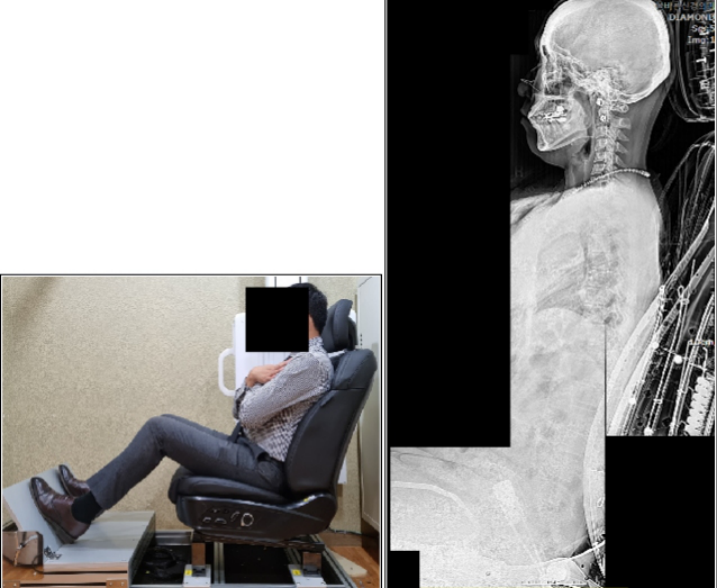
X-ray data for 15 volunteer participants was measured and analyzed when seated in the optimal posture on an automotive seat. The 2022 Grandeur (GN7) driver’s seat was used in the test, and it was installed on a large jig with fixed wheels in a flattened X-ray room.
The participants sat down and had both feet placed on the accelerator and footrests set in the same position as in an actual vehicle. In addition, the participants were made to take their actual driving posture, and the angle of the backrest was put in the optimal position. The position of the lumbar support was also adjusted to an optimal state using a pneumatic system in the lumbar region.
When viewed from the side, the test was conducted while maintaining the hip flexion and knee flexion angle to the extent that the knee and thigh did not cover the iliac crest in the X-ray image. Afterwards, a neurosurgeon took a side-view full-body X-ray of the participants while seated.
In the X-ray image acquired through the above process, the angle of the occipital interface plate relative to horizontal, the angle of the T2 verte- bra relative to horizontal, the H-point indicator to occipital condyle pin (horizontal), and the H-point indicator to occipital condyle (vertical) were measured.
Figure 1: Driving posture and radiographic image when sitting with preferred position.
RESULT
The following is a comparison of the results of this study and the measure- ment parameters of the BioRID ll dummy used in testing at the IIIHS.
In this study, the angle of the occipital interface plate relative to horizon- tal was 18.3 ± 5.89
for the average height of males, 19.05 ± 4.93
for the average height of females, and 18.60 ± 5.36
for the average height of all par- ticipants (vs. 29.5 ± 0.5
) for BioRID ll). The angle of the T2 vertebra relative to horizontal was 11.7 ± 8.38
for the average height of males, 7.60 ± 5.9
for the average height of females, and 10.21 ± 7.55
for the average height of all participants (vs. 37 ± 0.5
for BioRID ll). The H-point indicator to occipi- tal condyle pin (horizontal) was 272.3 ± 60.57mm for the average height of males, 219.2 ± 59.62mm for females, and 251.1 ± 63.97mm for all partici- pants (vs. 156 ± 3mm for BioRID ll). And the H-point indicator to occipital condyle (vertical) was 734.5 ± 39.18mm for the average height of males, 668.6 ± 23.91mm for females, and 708.2 ± 46.90mm for all participants (vs. 609 ± 3mm for BioRID ll).
As such, there was a large difference between the numerical results of each parameter measured based on the height of the actual subjects and the data of the evaluation parameters of BioRid II.
In particular, the BioRID ll specification used by the IIHS was based on the height of 50th percentile males, which is the median height of adult males
Considerations When Applying the BioRID II Dummy Used in Crashworthiness Tests 55
Table 2. Comparisons of parameters with BioRID II dummy.
Table available in the original PDF paper.
Equation reproduced from the original PDF.
29.5 ± 0.5
18.3 ± 5.89
19.05 ± 4.93
18.60 ± 5.36
Angle of occipital interface plate relative to horizontal
37 ± 0.5
11.7 ± 8.38
7.60 ± 5.9
10.21 ± 7.55
Angle of T2 vertebra relative to horizontal
156 ± 3 272.3 ± 60.57 219.2 ± 59.62 251.1 ± 63.97
H-point indicator to occipital condyle pin (horizontal) (mm)
609 ± 3 734.5 ± 39.18 668.6 ± 23.91 708.2 ± 46.90
H-point indicator to occipital condyle (vertical) (mm)
in the US in 2000 and 2015. Considering that the average height of the 9 males participating in this study was 175.6 ± 7.310, there was no significant difference. However, there is a difference between the BioRID ll specification and actually-measured parameters.
The average height of all 15 participants in this study was 170.4 ± 9.270cm, and considering that the height of the 50th percentile males is 171.2cm in Japan and 169.7cm in China, the research results of each parameter were found to be different from the BioRID ll specifications.
Also, in the case of the angle of the occipital interface plate relative to hori- zontal and the angle of the T2 vertebra relative to horizontal, it is lower than the IIHS standard regardless of height which is presumed to be because the participants’ either have straight or turtle necks. This is a form in which the upper cervical part flexes as the angle of the occipital interface plate relative to horizontal decreases, and as the angle of the T2 vertebra relative to hori- zontal decreases, the upper thorax part flattens from the lower cervical part. Thus, it suggests the shape of a turtle’s neck. These changes mean that it is necessary to reflect the changing body shape as the use of cellular phones, notebooks, pads, and PCs have recently increased.
In the case of a straight neck and a turtle neck, the absorption of shock in the event of an accident is less than that of a normal neck curve, and the amount of impact can be greater in the case of a whiplash injury.
In the case of the H-point indicator to occipital condyle pin (horizontal), the results of all participants were higher than those of the IIHS standard. This suggests that, compared to the IIHS test criteria, subjects are more likely to lean back than expected or have a flat back when correlated with the angle of the T2 vertebra relative to horizontal.
The H-point indicator to occipital condyle (vertical) also showed a higher value than the IIHS standard. This value can affect parameters such as MAX T 1 acceleration, max neck shear force, and max neck tension during a crash test by making the neck movement larger during a rear-end collision, such as a whiplash injury, and these parameters affect the prediction of the amount of impact on the neck when whiplash injury occurs (Sakayachi, 2017). In
fact, in the case of whiplash injury in a traffic accident, women were found to be three times more likely to have whiplash injuries than men (Christoph et al., 2007). Furthermore, the difference in the H-point indicator to occipi- tal condyle (vertical) can affect the result values of these parameters when performing an actual sled test.
CONCLUSION
The specifications of BioRID ll, which is currently widely used in crash expe- riments at IIHS, were confirmed to be based on the height of a 50th percentile male, which is different from an actual crash situation. For females, BioRID P50F was created to compensate for the difference with males, but additional supplementation is still required.
In addition, in Northeast Asia, the 50th percentile height for males is simi- lar to that of the US, but there is a difference for Japan and China, so it is necessary to correct the results of the collision test using the BioRID ll dummy. Also, when the parameters according to the 50th percentile height difference for each country were compared with the specifications of BioRID ll, each parameter data showed a difference.
In the case of an actual accident, additional research may be necessary because the impact may be greater than the degree of damage predicted based on the results of the crash test conducted through BioRID II.
REFERENCES
Arthur, C. Croft and Mathieu, M. G. M. Philippens. (2007). The RID2 biofidelic rear impact dummy: A pilot study using human subjects in low speed rear impact full scale crash tests, Accident Analysis & Prevention Volume 39 No. 2. Carlsson, A. Davidsson, J. Linder A and Svensson, M. Y. (2021). Design and Evalua-
tion of the Initial 50th Percentile Female Prototype Rear Impact Dummy, BioRID P50F - Indications for the Need of an Additional Dummy Size, Front Bioeng Biotechnol Volume 9 No. 687058. Christoph, Dehner. Martin, Elbel. Sylvia, Schick. Felix, Walz and Wolfram, Hell.
(2007). Michael Kramer. Risk of injury of the cervical spine in sled tests in female volunteers, Clinical Biomechanics Volume 22 No. 6. Hua Chi. (1994) Height and weight of Chinese college students 60 years ago, Sports Lit Hist Volume 5. Kim, T. H. Lee, M. K. Kim, Y. E. and Kim, D. T. (2009). Comparison of BioRID II
and Hybrid III for Dynamic Behaviors In Low Speed Rear End Impacts, KSAE 2022 Annual Autumn Conference & Exhibition. Lu, G. Hu, Yi. Yang, Z. Zhang, Y. Lu, S. Gong, S. Li, T. Shen, Y. Zhang, S. and Zhuang, H. (2022). Geographic latitude and human height - Statistical analysis and case studies from China, Arab J Geosci Volume 15 No. 335. Sakayachi, Fusako. (2017). Female and Male Whole Spinal Alignment and Cervical
Kinematic Responses in Rear Impacts. Department of Mechanics and Maritime Sciences, Chalmers University of Technology.
LISTED IN THE AHFE DIGITAL BOOKSTORE CATALOGUE
Explore the complete digital volume
Digital Human Modeling and Applied Optimization
Read this individual research paper free through the original publisher, or explore the full digital proceedings book.
ISBN 978-1-958651-52-0
Explore this ISBN in the AHFE Bookstore ↗Listed in the July 2026 bookstore catalogue; search by ISBN to confirm current availability · Digital book purchase optional