Peng Li, Hyegjoo Choi-Rokas, Blake Mitchell, Asbed Tashjian, Matthew Hurley (2023). An iterative and anthropometrically driven approach to body armor plate design for females. In: Digital Human Modeling and Applied Optimization. AHFE Open Access, vol. 76, pp. 11–19. https://doi.org/10.54941/ahfe1003349
The opening of combat arms positions to females, combined with innovative manufacturing processes allowing for increased curvature in rigid ballistic plates, allows the opportunity to design a body armor plate designed specifically for the female body. The current US body armor plates were developed from male torso shapes. This paper presents an iterative design and development process of female specific armor plates, based on the US Army anthropometric survey data (Gordon 2014) and rapid evaluation of prototyping designs.To understand the variation of female torso shapes, a female torso shape classification scheme was developed (Li, 2023), identifying nine torso groups for the US Army female population. For each shape group, a mean shape was generated from all torso surfaces within that group. Those nine torso shape groups were further categorized into three ‘curvature’ groups, based on angular measurement of the front profiles of each mean shape, as this will define the vertical curvature of a plate. Then two mean torso surfaces, a medium and a large bust shape were selected to target the prototype plate design for. Test plates were 3D printed but did not have equivalent weight as an ESAPI. Once the first plate shape was 3D printed, a design-fit evaluation-redesign cycle was initiated. A fit evaluation was performed to identify the design flaws. Then, those findings were documented and applied to the next round design, repeating this cycle four times. During each evaluation cycle, the current prototype, previous prototype versions, if applicable, and a 3D printed currently fielded plate were tested together. During the fit evaluation, the test participants’ (TPs) bra size was recorded but no measurements were taken. Based on TP’s bra size and prototype preferences, a fit table was created to correlate body size and bust shape to plate shape.The first round of fit evaluations involved the medium curvature plate and TPs (mostly with medium bust shapes). It was found that the TPs felt the top edge of the plate created pressure on the body, causing discomfort. We reduced the peak height of the prototyping plate by 20 mm to create the second iteration of the prototype. The second prototype was an improvement, however some could still feel the top edge of the plate. For the third iteration, the top and bottom plate edges were curved out to alleviate the pressure from the top edge, however, the fit test from this round indicated the curvature of the plate seems too flat. Hence the fourth prototype was developed by reducing the peak height only 10 mm from the first design with curved out edges on the top and bottom; it showed the best acceptability by all medium bust sized TPs. For future development, the accommodation envelope of the fourth iteration prototype will be evaluated so that we can delineate the anthropometric range of the central size in the target population, based on their breast size. Then, the large curvature plate will be evaluated to accommodate large breasted females (approximately 24% population according to the angular analysis of the front torso profile). Author contributions: P.L., H. C-R. and B. M. designed research plan and wrote the abstract. P.L. and H. C-R performed data analysis and fit evaluation, A.T and M.H did detail design and prototyping.References:Gordon, C. C., Blackwell, C. L., Bradtmiller, B., Parham, J. L., Barrientos, P., Paquette, S. P., Corner, B. D., Carson, J. M., Venezia, J. C., Rockwell, Belva M., Mucher, M., and Krietensen, S., (2014), “2012 Anthropometric Survey of U.S. Army Personnel: Methods and Sum-mary Statistics”, Technical Report NATICK/TR-15/007, US Army Soldier Systems Com-mand, Natick Research, Development and Engineering Center.Li, P., Mitchell, B., (2023), A shape classification scheme for female torso, Applied Ergonomics, Volume 106, 2023, 103904, ISSN 0003-6870,https://doi.org/10.1016/j.apergo.2022.103904
The opening of combat arms positions to females, combined with innovative manufacturing processes allowing for increased curvature in rigid ballistic plates, offers the opportunity and need to develop a body armor plate desi- gned specifically for the female body. The current US body armor plates were developed based on male torso shapes. While some earlier efforts have focu- sed on increased curvature for female torso shape, manufacturability was always a concern. Additionally, it’s unclear how best to define the plates’ shape to fit the complex curvature of the female torso. Two questions are frequently asked: how many different plate shapes are required to cover the spectrum of female torso shapes and how to correlate female torso shapes to plate shapes.
A few studies have been dedicated to investigating female body armor fit and products focused on fit improvement. Assessment of existing body armor fit was reported in An (2011), Choi et al., (2017), and Coltman et al. (2020, 2022a); they suggested that the existing body amor sizing system is inadequ- ate for female soldiers. Coltman et al. (2022b) further studied the impact of
female torso/breast’s anthropometric characteristics to body armor fit. Their study suggested, for large breasted female soldiers, a different curvature of armor plate may be necessary to accommodate their larger breast volume than the standard issue. Abtew et al. (2018) and Yang (2011) discussed female breast shape based on soft armor design and material selection respectively. West (2019) designed a hard plate shape to accommodate breast volume, but only for one test participant. In all, it is evident that both the size and shape of existing body armor systems cause fit problems for females.
This paper presents an iterative design approach to developing a female specific plate shape(s) based on the 2012 US Army anthropometric survey data (ANSUR II, Gordon et al., 2014) and following iterative refinement of the design based on rapid prototyping and fit evaluations. The fit evaluations are focused on user feedback, gross mobility, and comfort. It also provides insight into how the original plate shape was selected and defined, as well as how it evolved from a rigid dramatic curved body shape to more realistic, subtle curvature allowing for deformation of the breast and an improved level of comfort from the pressure. Overall resulting in an acceptable plate curvature for females with a medium size bust.
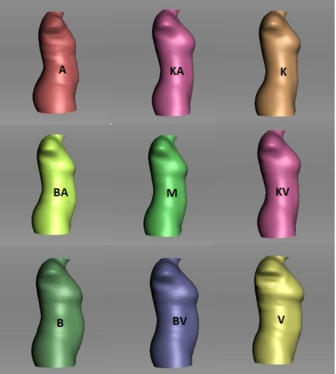
Li and Mitchell (2023) identified nine torso shape groups among 1646 female subjects (age 17 ∼58, BMI 16.4 ∼40.8) based on the ANSUR II 3D scan database (Gordon et al., 2014). The definition of those shape groups and their distribution is shown in Figure 1 and Table 1.
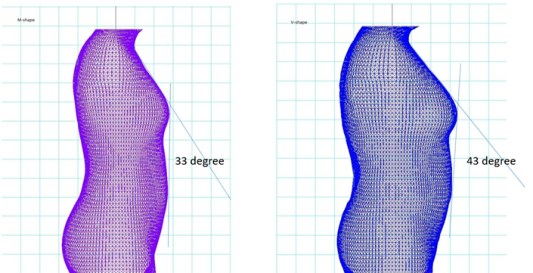
Based on the torso shape classification, we used a single angle value to quantify the breast curvature (Figure 2). This angle is formed by two lines, one line follows the surface slope from the Suprasternale toward the apex, and the other line connects the apex and the abdominal protrusion. The angles of the nine torso shapes are measured and displayed in Table 2. Then, we grouped breast curvatures into three groups: large, medium and small curvatures. The groupings are roughly based on the large angle gap between shapes. It is found that the shape A could be accommodated by the currently issued armor plate, which has a 21 degree angle at its sagittal plane. Howe- ver, the medium and large curvature groups are assumed to require additional curvature in the plate to accommodate these larger breast shapes. From each curvature group, the shapes with the largest angle (M for medium & V for large) were selected to represent its group (Figure 2 and Table 2).
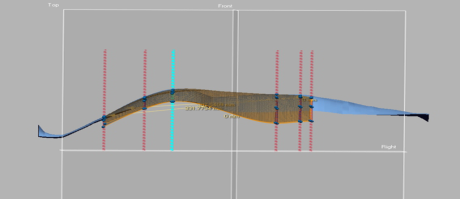
Initial Plate Shape Design The initial design of the medium and large curvature plates was based on torso shapes M and V which have curvature angles of 33 and 44 degrees, respectively (Figure 2 & Table 2). First, we obtain the front surface regions of the M and V torsos (Figure 2). Using Geomagic Design X (Rock Hill, SC USA), six torso cross-sections were selected for surface lofting as shown in Figure 3.
An Iterative and Anthropometrically Driven Approach to Body Armor Plate Design 13
Figure 1: Side view of nine female torso shape groups (courtesy of Li & Mitchell, 2023).Table 1. The definition of nine torso shape groups based on Chest-Waist (CW) drop and Waist-Buttock (WB) drop (courtesy of Li & Mitchell, 2023).
Table available in the original PDF paper.
Equation reproduced from the original PDF.
51.5
M shape A shape of both drops within one standard deviation from their means
0.7
K shape Curvy shape with both large drops 4.8 V shape Invert triangle shape with large Chest-Waist Drop and small Waist-Buttock Drop
0.5
A shape Triangle shape with small Chest-Waist Drop and large Waist-Buttock Drop B shape Straight (barrel) shape with small drops 6.1 KA shape Shape between A and K 9.3 KV shape Shape between V and K 9.7 BV shape Shape between B and K 8.4 BA shape Shape between A and B 8.7
While the number of cross-sections defines the conforming degree in each vertical torso shape, the number of control points of each cross-section will define the shape at the horizontal section. The more slices and more control points that are adopted, the more details the 3D torso shape will preserve. For the cross-sectional shape of the plate, it is not desirable preserve too much details, for example the concave geometry between breasts (Figure 4). There- fore, to make a convex cross-section at the bust level, while also preserving the horizontal shape for the other parts of the torso cross-sections, six control points were deemed sufficient.
Similarly, the placement of the cross-sections is critical to the development of the plate’s vertical shape. It is not desirable for the plate to have a concave crease at the under-bust. This is because the lowest part of the concave por- tion was anticipated to cause discomfort, depending on the breast location.
Figure 2: Angular measurement of breast curvature from frontal torso profile for the M shaped torso (purple, left) and the V shaped torso (blue, right).Table 2. Angles of front torso profile among nine torso shapes.
Table available in the original PDF paper.
Torso Shape Angle (degree) Shape distribution (%) Subtotal (%) Large Curvature V* 44 0.7 23.6 KV 43 9.7 BV 41 8.4 K 39 4.8
Medium Curvature M* 33 51.5 75.6 KA 32 9.3 B 32 6.1 BA 29 8.7 Small Curvature A 25 0.5 0.5
*indicates that torso shape was selected as the representative torso shape for the curvature group.
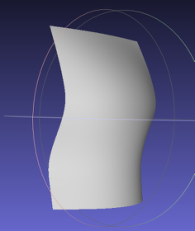
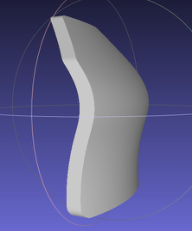
Hence, the six cross-sections located as shown in Figure 3 will maintain a smooth, nearly convex vertical profile for the plate. Two plates, one corre- sponding to the M torso and one to the V torso shape, were created and 3D solid models were developed (Figure 5). Between those two plates, the medium curvature plate was 3D printed for the fit evaluation.
Figure 3: The selection of torso surface cross sections (vertical dash lines) for genera- ting a lofted surface.
An Iterative and Anthropometrically Driven Approach to Body Armor Plate Design 15
Figure 4: Surface shape of medium plate, six control points (left) and seven control points (right) on the M shape.Figure 5: 3D solid models of high curvature (V shape, left) and medium curvature (M shape, right) plates.
The decision was made for these prototypes to focus on the form factor and therefore were not weighted to match either the current plate or anticipated weight and weight distribution of the prototype plates. This was done for cost savings and scheduling; and focusing on the form factor (i.e., curvature) and fit. The baseline plate (currently fielded armor plate) was also 3D printed without additional weight added, for a fair comparison point.
FIT EVALUATION–REDESIGN CYCLE The fit evaluation data collection was simplified to record subjective respon- ses and comments from test participants (TPs) on three questions, 1) does the plate fit, 2) is the contact pressure even, and 3) are there any spots of discomfort when the TP positions the prototype plate on her chest. This simplification of the data collection was utilized to allow for a very quick, ite- rative, focused assessments. Total testing duration was less than five minutes per prototype plate. No anthropometric dimensions were taken, but self- reported brassiere size was collected to quantify TP’s breast size and volume. Once all prototype plates were assessed, TPs were asked to rank them, based on their preference and comfort level. Some TPs participated in multiple ite- rations. Following the design-fit-redesign cycle, additional prototype plate(s) were made for each test round. The fit evaluation was continued with all
prototype plates made, in other words the former round of prototype plates were included in the subsequent fit tests.
First Iteration Prototype Fit Evaluation and Redesign In the evaluation of the first iteration prototype, a total of four female TPs volunteered and tested the medium curvature plate along with a 3D printed, prototype version of the currently issued armor plate, the Enhanced Small Arms Plate Insert (ESAPI). Their brassiere sizes were 34C, 34D, 36C, and 38C. Given the most populated brassiere size from the ANSUR II database is size 34D (Choi-Rokas, 2022), and the breast volume between 34D and 36C are equivalent (with different band sizes) (Choi-Rokas et al., 2022), the team felt it was appropriate to classify all four TPs as having a medium sized breast and therefore they tested the medium curvature plate.
TP feedback determined that the medium curvature plate was too curvy for all the medium breasted TPs. When TPs positioned the plate against their breast, they pressed it firmly against their front torso, the top edge of the plate caused pain and discomfort to their sternum while the apex of their breast only touched the inner surface of the plate lightly. Because the breast is composed of soft tissue, compared to the sternum, it allows the flatter plate shape to create a more even pressure on the breast and sternum. Therefore, for the second iteration of design, the new plate’s curvature will be reduced.
To understand better how much curvature reduction may be acceptable from a user perspective, the findings from Choi-Rokas et al. (2022) were revisited. In that study, females were measured in a series of different comme- rcial sports brassiere’s, the authors calculated a difference of approximately 20mm of Chest Depth, when measured at the breast apex, while still main- taining a comfortable level of compression. Thus, it was considered that a 20mm reduction at the highest peak point of the prototype plate may reduce the pressure on the top edge of the plate (Figure 6). The original (first round) plate has an apex of 45mm (thereafter the 45mm plate); therefore, the new plate’s apex was reduced by 20mm, giving it an apex of 25mm (thereafter the 25mm plate). Figure 6 illustrates the plate apex heights and overall shapes.
Second Iteration of Prototype Fit Evaluation and Redesign For the second iteration of fit testing TPs wore the 25mm, the 45mm, and the 3D printed ESAPI plates. A total of seven TPs volunteered in the second round of testing. The TPs’ brassiere sizes were 34C (n = 2), 36C (n = 2), 38C,
Figure 6: Modification of plate shape from peak height of the cross section at the middle (sagittal) plane. Yellow is the 25mm plate (2nd iteration), Red is the 45mm plate (1st iteration), Green is the 35mm plate (4th iteration).
An Iterative and Anthropometrically Driven Approach to Body Armor Plate Design 17
36DD and 40DD. Of the three prototype plates (ESAPI, 25mm and 45mm), the 25mm plate was ranked the highest by TPs with medium sized breasts, and the 45mm plate was ranked highest by the large breasted TP.
Although the 25mm plate seems to provide adequate height and space for the TP’s breasts, the TPs reported that the top edge of the plate caused discom- fort and high contact pressure against the sternum. Therefore, it was decided for the third iteration prototype to curve or flare out the top and bottom edge of the 25mm plate, as shown in Figure 7 in yellow (thereafter the curved edge 25mm plate).
Figure 7: Modification of plate shape from peak height of the cross section at the middle (sagittal) plane and curved out edges for the 25mm (yellow) and 35mm (green) plates, the 45mm (red) plate profile is used as a reference.
Third Iteration of Prototype Fit Evaluation and Redesign The curved edge 25mm plate was not tested on multiple TPs, but one whose brassiere size is 34C. When the curved out 25mm plate was positioned on her chest, it was immediately apparent that the apex of the new plate had been reduced. It effectively provided less volume to accommodate the medium sized breast than the original 25mm version, although the curvatures betw- een the two plates are identical. As a results, the curved edge 25mm plate felt very similar to the ESAPI in that it had a smaller curvature in vertical profile. Based on this result, the prototype was revised to increase its volume accom- modation by increasing the plate’s peak height to 35mm, while keeping the same curved out edges as the third iteration plate (thereafter the curved edge 35mm plate) (green line in Figure 7).
Fourth Iteration of Protype Fit Evaluation and Redesign For the fourth iteration of fit evaluation, the 45mm plate was also modified to have a curved out top and bottom edges. Then, the three plates with curved edges (25mm, 35mm, 45mm) were tested together with ESAPI plates.
A total of 6 TPs volunteered. Their brassiere sizes were 34B, 34C, 36A, 36B, 38A, and 38B. Each participant was asked to rank order the plates. The curved edge 35mm was the first choice for five TPs. The other TP (36A) selected the 25mm plate as her first choice. The TPs’ second choices were split between the prototypes. Three TPs (34B, 34C, 38A) selected the 25mm plate, two TPs (36B, 38B) selected the 45mm plate, and one (36A) selected the ESAPI plate. None of the TPs reported feeling any discomfort at the top edge of the curved edge 35mm plate.
CONCLUSION AND DISCUSSION This paper outlines a methodology for the development of an anthropome- trically driven rigid plate shape and ways to quickly and iteratively assess and improve upon that design through the incorporation of fit testing and user feedback. When designing an armor plate from 3D scan images, it is still necessary to get feedback from users to account for the soft tissue deforma- tion and to simulate realistic wearing of the plates, rather than relying on the rigid shape created by the body scan. During this study, a total of four design-fit-redesign iterations were performed. The critical outcomes through this process are two-folds: 1. when tracing the curvature from the scan sur- face to construct the curvature on the front plate, the apex of the plate at the breast area should be flatten (i.e., 35mm plate is created by reducing peak height 10mm from original curvature) to mimic the effect of the deformed breast under the plate; 2. the curved-out edges on the top and bottom of the plate reduced the pressure substantially at the sternum, while also decreasing concerns of potential injury due to pressure at different postures (e.g., prone). Based on the iterative design and testing, the 35mm curved edge plate was selected as the recommended shape for the medium breasted females. Figure 8 shows the 25mm and 35mm plates aligned to M torso shape in the vertical cross-sectional view and 3D view, respectively. The curvature of those two plates, in terms of the angular measurement, are approximately 25 degrees for 25mm plate and 30 degrees for 35mm plate.
Future work will focus on defining the accommodation envelope of fit for the fourth iteration prototype through testing with a much larger sample of participants. A detailed analysis of the torso profile angle distribution and breast size may be necessary to correlate the plate shapes to torso shapes. This will allow us to delineate the anthropometric range of each plate in the target population, based on a user’s breast size. While this current work touched on the plate shapes required for medium breasted women, additional fit testing and design work needs to be done to ensure that the large curvature plate will be accommodate large breasted females, who account for 24% of the Army’s user population. Furthermore, the current design process does not take the body armor carrier and soft armor into account, which may have significant impacts on the acceptability of plate shapes and curvatures.
Figure 8: The curved edge 25mm plate (left) and the curved edge 35mm plate (right) aligned to M torso shape in 3D view (red torso) and vertical cross-sectional view (clear torso).
Figure available in the original PDF paper.
An Iterative and Anthropometrically Driven Approach to Body Armor Plate Design 19
Once this work has been completed and a family of plate shapes has been developed, a full fit evaluation of the complete body armor system should be undertaken.
REFERENCES
An, S. K. (2011). Laboratory Assessment of Range of Motion and Pressure Associated with Female Soldiers Wearing a Ballistic Vest. Ph. D. Thesis, Oklahoma State University. Abtew, M. A., Bruniaux, P., Boussu, F., Loghin, C., Cristian, I. N., & Chen, Y. (2018).
Development of comfortable and well-fitted bra pattern for customized female soft body armor through 3D design process of adaptive bust on virtual mannequin. Comput. Ind., 100, 7–20. Choi, HyegJoo, Garlie, Todd, & Paquette, Steve (Dec. 2017) Phase1. Evaluation of existing ballistic hard armor plates (ESBI, ESAPI, and prototype plates). Anth- ropology team, Natick, MA: U. S. Army Natick Research, Development and Engineering Center. Choi-Rokas, H. E., Hennessy, E. R., Brown, S. A. T & DeSimone, L. L. (2022),
Assessment of Commercial Off the Shelf (COTS) Sports Brassiere for the U. S. Army Tactical Brassiere (ATB) Program. AHFE 2022. Digital Human Modeling and Applied Optimization, Vol. 46, 2022, 141–149. https://doi.org/10.54941/ah fe1001910 Choi-Rokas, H. E. (April, 2022). Army Tactical Brassiere (ATB) project. Study 2: Development of a sizing system for the US Army tactical brassiere (MFR). Natick, MA: U. S. Army DEVCOM Soldier Center. Coltman CE, Steele JR, Spratford WA, Molloy RH. (2020) Are female soldiers sati-
sfied with the fit and function of body armour? Appl Ergon. 2020; 89: 103197. doi: 10.1016/j.apergo.2020.103197 Coltman CE, Brisbine BR, Molloy RH, Steele JR. (2022a) Can smaller body armour improve thoracolumbar range of motion and reduce interference when female soldiers perform dynamic tasks?. Appl Ergon. 2022; 98: 103602. doi: 10.1016/j.apergo.2021.103602 Coltman CE, Brisbine BR, Molloy RH, Steele JR. (2022b) Effect of Torso and Breast
Characteristics on the Perceived Fit of Body Armour Systems Among Female Sol- diers: Implications for Body Armour Sizing and Design. Front Sports Act Living. 2022; 4: 821210. Published 2022 Mar 9. doi:10.3389/fspor.2022.821210 Gordon, C. C., Blackwell, C. L., Bradtmiller B., Parham, J. L., Barrientos, P. Paquette, S. P., Corner, B. D., Carson, J. M., Venezia, J. C. Rockwell, B. M., Mucher, M, and Kristensen, S. (2014). 2010–2012 Anthropometric Survey of U. S. Army Per- sonnel: Methods and Summary Statistics. Technical Report (Natick/TR-15/007). U. S. Army Natick Research, Development and Engineering Center, Natick, MA 01760–2646. Li, P., Mitchell, B., (2023), A shape classification scheme for female torso, Applied
Ergonomics, Volume 106, 2023, 103904, ISSN 0003-6870, https://doi.org/10. 1016/j.apergo.2022.103904 West, S., (2019), Designing a Human-Centric Rigid Body Armor for Female Police Officers: The Implications of Fit on Performance and Gender Inclusivity, MSc Thesis, University of Arkansas, Fayetteville. Yang, D., (2011), Design, Performance and Fit of Fabrics for Female Body Armour,
Ph. D. Thesis, University of Manchester.
LISTED IN THE AHFE DIGITAL BOOKSTORE CATALOGUE
Explore the complete digital volume
Digital Human Modeling and Applied Optimization
Read this individual research paper free through the original publisher, or explore the full digital proceedings book.
ISBN 978-1-958651-52-0
Explore this ISBN in the AHFE Bookstore ↗Listed in the July 2026 bookstore catalogue; search by ISBN to confirm current availability · Digital book purchase optional