Xuguang Wang, Junfeng Peng (2023). A simplified human body model for assisting electric bicycle design. In: Digital Human Modeling and Applied Optimization. AHFE Open Access, vol. 76, pp. 57–62. https://doi.org/10.54941/ahfe1003354
Compared to non-electric bicycles, power-assistance ones could be designed for more postural comfort with less consideration of power production when pedalling. The present work aimed to develop a simplified human body model to assist in the design of power-assisted bicycles to better accommodate a target user population. To characterize body posture in bicycle use, the inter-segmental angles corresponding to a reference posture were measured from a sample of 63 males and females testing 4 existing bicycle models for comfort and long distance use. As a first approximation, only upper body was modelled as a 2D linkage composed of trunk (hip to shoulder) and arm (shoulder to grip) segments. To better account for postural effect, functional segment lengths were measured in the reference posture, and used to build the regression equations with body height. For a given bicycle characterized by saddle and handlebar position, the hip and shoulder angles could be fully determined for a rider using the proposed model. To validate the model, we compared the measured and predicted inter-segmental angles and showed that the proposed human model could account for the effects of both body height and bicycle’s geometry. To show the usefulness of the proposed model, a comfortable range of hip and shoulder angles was defined from the experimental data and was used to predict the fit area of handlebar and saddle position for both short and tall persons. Simulation results show that a more reclined seat tube could better accommodate both short and tall users.
Bicycling is not only a popular recreational activity, but also becoming an alternative means of transport for many people. For ecological, economical and health reasons, there is an increasing demand on electric bicycles. Com- pared to non-electric bicycles, power-assistance ones could be designed for more postural comfort with less consideration of power production when pedalling. Saddle height, saddle tube angle and handlebar position are the design parameters, which affect cycling posture the most. To optimize pedal power, it is generally recommended that the saddle should be positioned so that the knee is directly above the pedal spindle with the cranks at 3 o’clock position (Burt, 2014), thus limiting the choice of saddle tube angle. Price and Donne (1997) showed that a steeper tube angle lowered oxygen consum- ption at a fixed power output. With lower demand in power production for
electric bicycles, it is possible to choose a larger range of tube angle inclu- ding more reclined saddle tube, and to reduce number of model sizes (thus design and production time and cost) for a product to fit a target population. However, few studies have been carried out to look at the effects of tube angle and rider’s anthropometrics on comfortable bicycle design. The present work aimed to develop a simplified human body model to assist in the design of power-assisted bicycles to better accommodate a target user population.
Experimental Observations To characterize body posture in bicycle use, the inter-segmental angles corre- sponding to a reference posture were measured from a sample of 63 male and female adult riders, who tested four existing bicycle models for comfort and long distance use. The participants, aged from 21 to 64 years old, were sele- cted to cover a large range of anthropometrics with body height ranging from 1m52 to 1m96. Prior to experiment, their main anthropometric dimensions were measured including body height (H), weight, crotch height, acromion to wrist length. The selected test bicycles covered a large range of city bicycles with the saddle tube angle being from 17
to 26
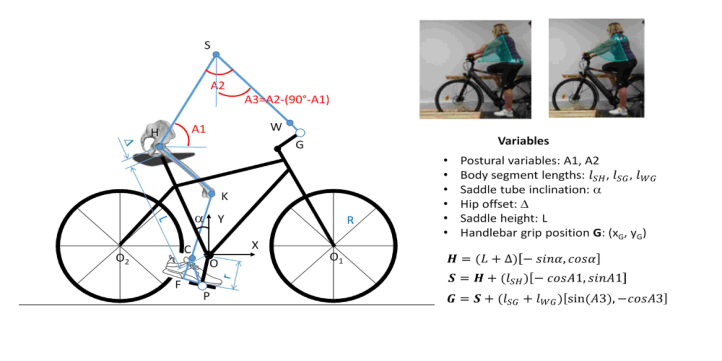
(with respect to the vertical). For all models except one, participants tested either the large or medium size depending on body height for 10 minutes in an outdoor tour during which they could adjust saddle height. They were then asked to adopt a reference riding posture inside a room with the arms being fully extended and two pedals on their vertical positions (Figure 1). A photo was taken to measure the corresponding trunk (A1) and trunk to arm (A2) angles as well as the hip to shoulder (HS) and shoulder to wrist (SW) lengths. Markers were atta- ched on the surface positions of wrist, acromion, greater trochanter, knee and ankle to help locate joint position from photos. The adopted saddle height L was measured with a tape. At the end, participants were asked to answer a questionnaire about their feeling on handlebar and saddle position and its
Figure 1: Main bicycle design parameters and postural angles.
A Simplified Human Body Model for Assisting in Electric Bicycle Design 59 acceptability for everyday use. For the 4th test bicycle, only the indoor test was performed without outdoor testing.
Upper Body Kinematic Model For the reference posture, body posture was mainly characterized by trunk (A1) and trunk to arm (A2) angles (Figure 1). We made the following simplification hypotheses:
Saddle position is only dependent on its tube orientation (α) and body height (or inside leg length/crotch height).
Upper body is simplified as a 2D linkage of hip, shoulder and grip points. The lengths of these two segments (hip to shoulder and shoulder to grip) are only dependent on body height, and the wrist to grip length lWG is a constant to be determined.
The offset 1 between saddle and hip joint center H is a constant along the saddle tube axis to be determined.
To better account the effects of riding posture, the hip to shoulder and shoulder to wrist lengths measured from the photos of reference posture were used to establish the regression equations from the experimental data (Table 1).
Table 1. Coefficients of regression equations without constant for the simplified kinematic model. H, Se and R2 adj are body (or crotch) height, standard error of estimate and adjusted R-squared value.
Table available in the original PDF paper.
Variable Height (H) Se (cm) R2
adj(%) Saddle height (L) 0.412 2.79 99.8 Saddle height (L)* 0.898* 3.15 99.8 Hip to shoulder length lSH 0.313 3.43 99.6 Shoulder to wrist length lSW 0.318 2.58 99.8
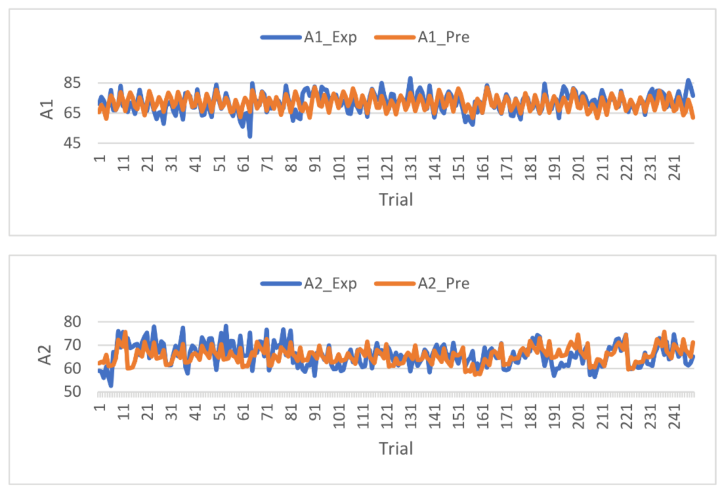
*coefficient of crotch height For a given bicycle with known saddle and handlebar positions, the trunk (A1) and trunk to arm (A2) angles are fully determined for a rider assuming that two constants 1 and lWG are known. 1 and lWG of 2.8 and 4 cm were found by trial and error using the experimental data. To validate the pro- posed model, the predicted trunk (A1) and trunk to arm (A2) angles were compared with experimental ones using the regression equations in Table 1 (Figure 2). The mean errors were −0.38 (±4.82) and −0.27 (±4.0) degrees for A1 and A2.
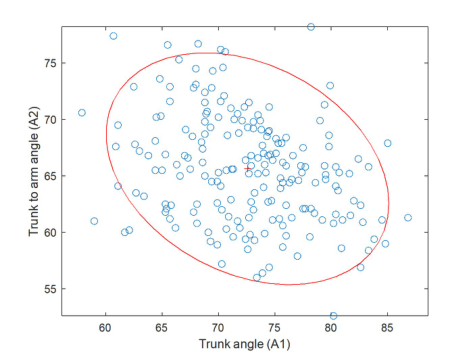
APPLICATION One of important design problem is to find an appropriate saddle tube angle α and handlebar position G to fit a target population with a large variation in body height. From the collected data, we observed that trunk (A1) and trunk to arm (A2) angles were significantly correlated, as shown in Figure 3. A contour curve of the bivariate Gaussian distribution of A1 and A2
60 Wang and Peng
Figure 2: Comparison between experimental and predicted trunk (A1) and trunk to arm (A2) angles in degrees.Figure 3: 90% confidence ellipse of the distribution of the trunk to arm (A2) and trunk (A1) angles observed from the trials for which the test bicycles were considered as ‘acceptable’ by participants.
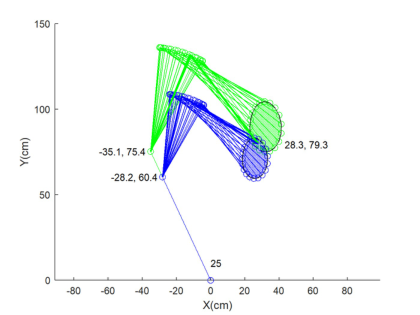
was thus used to define the acceptable postural region. Figure 4 shows the ‘acceptable’ saddle and handlebar positions for two 155cm and195cm tall persons and two tube angles (15
and 25
) when applying the 90% confide- nce ellipse of acceptable postural angles. One can see that a design with an adjustable saddle and a fixed handlebar position could fit both short and tall riders for the two saddle tube angles. A more inclined saddle tube increases
A Simplified Human Body Model for Assisting in Electric Bicycle Design 61
Figure 4: Simulated saddle and handlebar positions for a short (155 cm, bleu) and a tall (195 cm, green) rider corresponding to the ‘acceptable’ ellipse of the trunk to arm (A2) and trunk (A1) angles defined in Figure 3 for saddle tube angles of 15◦and 25◦. ‘+’ is the barycentre of the common area of the simulated handlebar positions of both extreme persons.
the superimposed area of acceptable handlebar positions between the two extreme riders. This suggests a more reclined saddle tube is preferred for a better accommodation of a target population.
DISCUSSION
In the present work, we proposed a simplified upper body geometric model to assist bicycle design. The segment lengths were determined from a refere- nce riding posture for city use as well as corresponding regression equations with respect to body height. Applying the ‘acceptable’ range of trunk and trunk to arm angles observed from 63 volunteers testing 4 bicycle models, we found that a more reclined saddle tube could provide a larger common area of acceptable handlebar positions for both short and tall users.
Compared to a similar study by Hsiao et al (2015), the handlebar position predicted by the proposed model to fit both short and tall persons is closer and higher with respect to the saddle. For the city bicycle type, Hsiao et al pro- posed a handlebar position at (38.3cm, 66.0cm) with the tube angle varying
62 Wang and Peng
from 23.6
to 19
. For a tube angle of 22
, our model predicts a position of (31.2cm, 78.8cm) for two 155 and 185cm tall persons, the same height range as tested in Hsiao et al. This implies that the comfortable range of riding posture defined in the present study corresponds a more upright trunk and smaller trunk to arm angle. This could be explained at least partly by differe- nce in body size between two studies (participants from France and Taiwan) as well as in experimental protocol. The comfortable riding postural range used in the present study was based on the ‘acceptable’ ellipse of trunk and trunk to arm angles obtained by testing only 4 existing bicycle models. Fur- ther investigations are needed to define comfortable postural range for riding electrical bicycles especially by testing a larger number of existing models and/or through a parametric study with an adjustable experimental bicycle setup allowing larger range of adjustment of bicycle design parameters.
ACKNOWLEDGEMENT
We would like to thank Maxence Yard and Corentin Deribreux who partici- pated in the collection of experimental data.
REFERENCES
Burt, P. (2014). Bike Fit 1st Edition: Optimise Your Bike Position for High Performance and Injury Avoidance. Bloomsbury Publishing. Hsiao, S. W., Chen, R. Q., Leng, W. L. (2015). Applying Riding-Posture Optimization
on Bicycle Frame Design. Applied Ergonomics 51: 69–79. Price, D., Donne, B. (1997) Effect of Variation in Seat Tube Angle at Different Seat Heights on Submaximal Cycling Performance in Man. Journal of Sports Sciences 15: 395–402.
LISTED IN THE AHFE DIGITAL BOOKSTORE CATALOGUE
Explore the complete digital volume
Digital Human Modeling and Applied Optimization
Read this individual research paper free through the original publisher, or explore the full digital proceedings book.
ISBN 978-1-958651-52-0
Explore this ISBN in the AHFE Bookstore ↗Listed in the July 2026 bookstore catalogue; search by ISBN to confirm current availability · Digital book purchase optional