Sunwoo Choi, Heecheon You, Sujin Kim, Xin Cui (2026). Anthropometric-Driven Ergonomic Framework for Regionally Specialized Seat Design: A Multi-Stage Study on the Brazilian Market. In: Human Systems Engineering and Design (IHSED2026): Future Trends and Applications. AHFE Open Access, vol. 237, pp. 150–157. https://doi.org/10.54941/ahfe1008155
Current vehicle seat design often relies on standardized global anthropometric data, which may fail to account for regional variances in human dimensions, environmental conditions, and cultural driving habits. This study proposes a comprehensive methodology for developing regionally specialized seats, specifically focused on the Brazilian market. The research integrates a three-stage approach: (1) systematic desk research of 25 papers and 13 patents to identify design variables; (2) stakeholder workshops with 31 local experts from HMB and Hyundai Transys Brazil to align engineering strategies; and (3) empirical 3D anthropometric analysis (N=631 for survey, N=17 for 3D scanning) to quantify body deformation across standing, sitting, and driving postures. Results revealed significant differences in the "Height Ratio" between Brazilian and Korean populations, with Brazilians showing greater diversity in body mass distribution (BMI). Furthermore, 3D scan data indicated a 30%–42% width expansion in the thigh and hip regions during driving, leading to the development of seven specialized seat comfort strategies, including enhanced lateral support for unpaved roads and rapid-ventilation systems for tropical climates. This methodology provides a robust framework for improving seat comfort and safety in global markets through regionalization.
The automotive seat is the primary physical interface between the vehicle and the occupant, significantly impacting long-term health, safety, and brand perception. Ergonomically suboptimal seat designs concentrate loads on the lumbar and pelvic regions, resulting in musculoskeletal fatigue and decreased cognitive performance, which are leading factors in traffic accidents. While the automotive industry has long utilized ergonomic standards, these are often based on “average” global data that overlooks regional specificities.
As the global automotive market expands, manufacturers face the challenge of satisfying diverse customer bases. The Brazilian market presents a unique case for regional specialization due to its vast territory, Received May 14, 2026 Revised June 11, 2026 Accepted June 24, 2026 Available online September 25, 2026
Anthropometric-Driven Ergonomic Framework 151 poor road infrastructure (approximately 79% of roads are unpaved), and a tropical climate characterized by high temperature and humidity. These factors generate different biomechanical and thermal requirements for seats compared to East Asian or European markets. This study establishes a data- driven methodology to create a “Seat Comfort Guide” tailored to Brazil by integrating macroscopic regional factors with microscopic 3D morphological analysis.
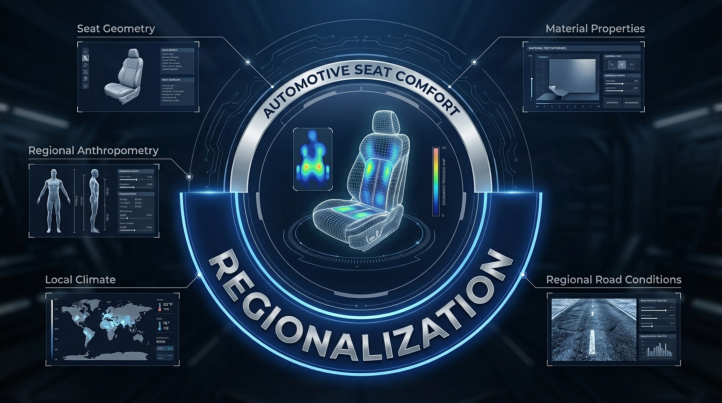
Figure 1: Factors affecting seat comfort.
METHODOLOGY: DATA SURVEY AND VARIABLE IDENTIFICATION Literature Mapping and Patent Analysis
To establish a scientific foundation for the study, a rigorous analysis of academic literature and global patents was conducted. Over the past 15 years, 25 high-relevance journal papers and 13 patents were selected from databases such as Scopus and ScienceDirect. The primary objective was to identify the critical engineering variables that dictate seat comfort. The research extracted 12 primary seat design variables—including cushion width, backrest height, bolster protrusion, and H-point trajectory. These were subsequently mapped to 9 core anthropometric dimensions to ensure that any modification in seat geometry is directly supported by human physical characteristics. This mapping phase serves as the conceptual bridge between human body shape and seat mechanical design.
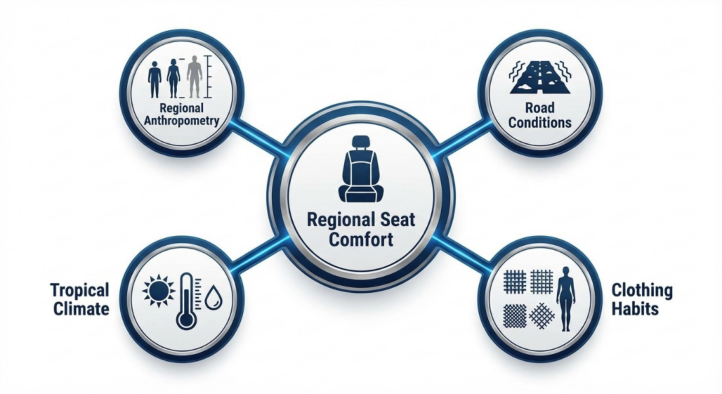
Definition of Regionalization Factors To operationalize the concept of “Regionalization,” the study defined four distinct pillars based on the Brazilian environment. First, Regional
Anthropometry was investigated to determine the variance in BMI and body proportions compared to the Korean population. Second, Road Conditions were analyzed; Brazil’s low road quality index (ranking in the 120s globally) necessitates superior lateral stability to prevent occupant swaying. Third, Regional Climate factors, such as high humidity and intense solar radiation, were studied to define requirements for thermal regulation and material insulation. Finally, Local Clothing Habits were considered, as regional attire affects skin-to-seat friction, moisture wicking, and the overall perception of seat material touch.
Figure 2: Four distinct pillars based on the Brazilian environment.
STAKEHOLDER ALIGNMENT: LOCAL EXPERT WORKSHOPS Workshop Structure and Professional Feedback
To validate the theoretical strategies, two workshops were held in August 2024 at Hyundai Motor Brazil (HMB) and Hyundai Transys Brazil. A total of 31 senior engineers participated in three structured sessions: General Ideation, Strategy Feedback, and Additional Idea Generation. The experts emphasized that Brazilian customers prefer a “tighter feeling” in their seats to ensure stability when navigating irregular road surfaces. Furthermore, the socioeconomic context of the Brazilian market makes “Cost-effectiveness” a decisive KPI. Feedback indicated that while the “Enhanced Side Bolster” strategy received a 72.7% approval rate, engineering adjustments were required to ensure that larger bolsters do not impede ingress and egress for the growing senior driver demographic.
Anthropometric-Driven Ergonomic Framework 153 ANTHROPOMETRIC COMPARATIVE ANALYSIS: BRAZIL VS. KOREA
Sample Bias Correction and Statistical Weighting Anthropometric data collected from 631 Brazilian employees showed an initial sample bias toward younger males. To ensure the results represented the broader Brazilian driver population (aged 20 to 60), statistical weighting factors were applied based on national census data from the Brazilian Institute of Geography and Statistics (IBGE). This adjustment allowed for a more accurate estimation of P5 to P95 percentiles across diverse racial and age groups, providing a reliable baseline for the 3D scanning phase.
Table 1: Demographic weighting factors for bias correction.
Table available in the original PDF paper.
Equation reproduced from the original PDF.
IBGE Census (Target) [%]
Weighting Factor (Wi) Male 81.1 48.5 0.598
Gender
Female 18.9 51.5 2.725 White (Branca) 66.2 47.7 0.721
Pardo (Mixed) 24.7 43.1 1.745
Race
Black (Preta) 8.2 7.6 0.927 Others 0.8 1.6 2
20–29 37.8 32 0.847
Age Group
30–39 39.2 27.6 0.704
40–59 23 40.4 1.756
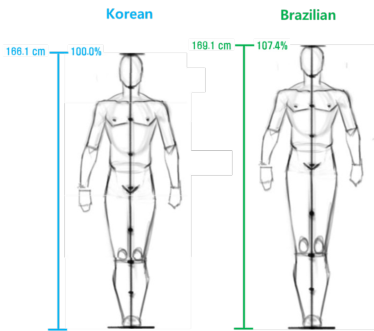
Comparative Results of the “Height Ratio” A pivotal discovery of this study was the disparity in body proportions between the two regions. The “Height Ratio” analysis revealed that South Koreans generally possess shorter lower-body proportions and longer upper- body proportions compared to Brazilians. This difference is most pronounced at the hip and knee levels. Consequently, a seat designed for the Korean market may feel “too short” or offer “insufficient under-thigh support” for a Brazilian driver. This biomechanical evidence justifies the need to recalibrate the H-point trajectory and extend the seat cushion length for the Brazilian regional guide.
Figure 3: Anthropometric ratio between Brazilian and Korean.Table 2: Comparative anthropometric ratios between Brazilian and South Korean drivers.
EMPIRICAL 3D SCANNING EXPERIMENT AND POSTURE ANALYSIS Experimental Setup and BMI Stratification
To quantify morphological changes under active loads, a 3D scanning experiment was conducted with 17 participants stratified into four BMI groups: Underweight, Normal, Overweight, and Obese. The experiment utilized a high-fidelity seating buck that accurately replicated the package layout of the HB20, a strategic regional model. The buck was configured with a 23.0° torso angle and a 96.7° thigh angle to simulate the specific biomechanical stress experienced dsuring local driving conditions.
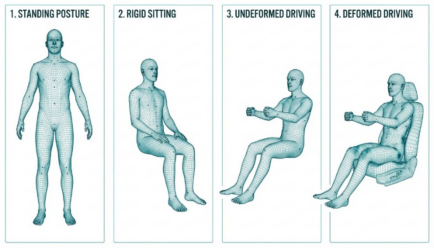
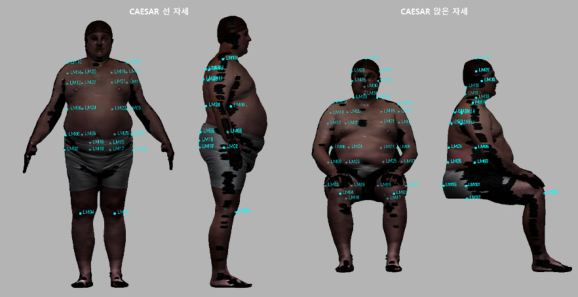
Multi-Postural Scanning Protocol The study employed a four-stage postural protocol to capture the dynamic interaction between the body and the seat. (1) The Basic Standing Posture served as a baseline for comparison with global CAESAR data. (2) The Rigid Sitting Posture measured pure body dimensions on a non- deformable surface. (3) The Undeformed Driving Posture captured muscle tension in the driving position before seat contact. Finally, (4) the Deformed Driving
Figure 4: Four-stage postural protocol.
Anthropometric-Driven Ergonomic Framework 155 Posture utilized square polyurethane foam specimens (ILD 27.4–27.9) to scan the simultaneous deformation of human tissue and the seat material. This comprehensive approach allowed for the calculation of exact displacement and compression rates.
3D Data Processing and Curvature Analysis Using Artec Studio 19 and Geomagic Design X, 66 anatomical landmarks were inserted into the 3D scans. 54 refined variables, including width, height, thickness, and curvature, were extracted for each subject. A MATLAB-based cubic spline interpolation method was used to calculate the curvature radii of the spine and thighs. This data provides a quantitative target for seat contouring, indicating how much the seat surface should accommodate the natural “flattening” or “spreading” of the body during the transition from standing to driving.
Figure 5: 3D data processing.
RESULTS AND ENGINEERING DISCUSSION Posture-Induced Morphological Deformation
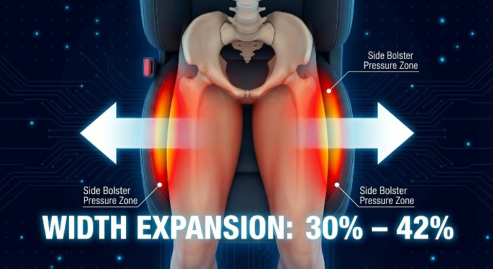
The experiment quantified significant shape changes, most notably the “Flesh Spread” phenomenon. Upon sitting in the driving position, the hip and thigh widths increased by 30% to 42%. This suggests that determining seat width based solely on standing measurements will result in bolsters that are too narrow, causing discomfort. The study proposed optimized bolster spacing and cushion widths based on these regional deformation rates.
Figure 6: Hip and thigh width increase.
Bolster Spread and Support Integrity 3D scans also captured “Bolster Spread,” where occupant weight causes lateral supports to deflect outward, losing their holding capability. In Brazil, where unpaved roads cause frequent lateral G-forces, this loss of support leads to increased driver fatigue. To resolve this, a “Spread Prevention Frame” was proposed for the seat interior, combined with high-density foam to maintain support integrity under high lateral loads.
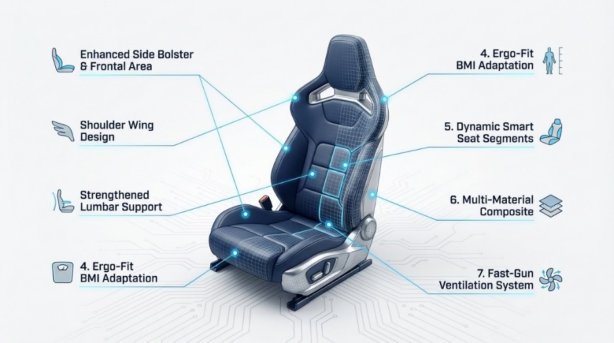
Technical Validation of the 7 Strategies The integrated analysis validated seven core strategies. The “Fast-Gun Ventilation” and “Ergo-Fit” systems were identified as the most urgent requirements for the tropical climate and diverse BMI profiles. By combining 3D data and expert feedback, the study established that Brazilian-specific seats should feature 15% stronger lateral support and a 10% larger cushion contact area compared to standard Korean models.
Figure 7: 7 strategies for Brazilian automotive seat.
CONCLUSION AND FUTURE ROADMAP This study has successfully established a data-driven methodology for regional seat design by integrating environmental analysis, expert feedback, and 3D morphological scanning. The quantitative findings regarding the “Height Ratio” and “Flesh Spread” provide immediate engineering targets for global product development.
As a multi-year project, the next steps include:
1. Mock-up Fabrication: Producing physical seat prototypes incorporating the 7 strategies. 2. Validation Clinics: Conducting subjective comfort clinics and objective pressure mapping with local Brazilian drivers to refine the predictive equations for seated body shape changes.
Global Expansion: Applying this framework to other strategic regions, such as India and Mexico, to standardize the regional specialization process across the automotive industry.
ACKNOWLEDGMENT
This research was conducted in collaboration with the research group of Professor Hee-Cheon Yu at Pohang University of Science and Technology (POSTECH).
REFERENCES
Chimote, K., & Gupta, M. (2013). Integrated Approach of Ergonomics and FEM into Truck Drivers Seat Comfort. iNaCoMM 2013. Fazlollahtabar, H., et al. (2010). A Subjective Framework for Seat Comfort based
on Heuristic Multi-Criteria Decision-Making Technique and Anthropometry. Applied Ergonomics. Kumar, R. D. S., et al. (2020). Ergonomic Evaluation of Passenger Car Vehicle Seat Design. IOP Conference Series: Materials Science and Engineering. Lee, S., et al. (2013). An anthropometric analysis of Korean male helicopter pilots for
helicopter cockpit design. Ergonomics, 56(6), 879−888. Muralitharan, M., et al. (2018). Design Automotive Driver Seat Ergonomically for Malaysian Anthropometry. Malaysian Journal of Public Health Medicine. World Economic Forum (2023). Road Quality Index: Global Comparisons and
Infrastructure Trends.
FIND THE COMPLETE VOLUME IN THE AHFE DIGITAL BOOKSTORE
Explore the complete digital volume
Human Systems Engineering and Design (IHSED2026): Future Trends and Applications
Read this individual research paper free through the original publisher, or explore the full digital proceedings book.