Yuka Miyazawa, Osamu Yoshie (2026). Designing Digitally Mediated Networks for Pet-Inclusive Disaster Evacuation: A Socio-Technical Perspective. In: Human Systems Engineering and Design (IHSED2026): Future Trends and Applications. AHFE Open Access, vol. 237, pp. 131–137. https://doi.org/10.54941/ahfe1008153
Disaster evacuation planning has traditionally prioritized human safety, while companion animals remain ambiguously positioned within emergency response frameworks. Given the strong bonds between people and their animals, excluding them from evacuation planning can influence human behaviour, leading some to delay or avoid evacuation and thereby increasing risks to their safety. Although the importance of pet-inclusive evacuation has gained recognition following repeated disasters, support practices remain fragmented and largely dependent on local and volunteer-based coordination, particularly in Japan where responsibility is delegated to local governments. As a result, evacuees with companion animals face significant constraints due to limited access to timely and reliable information on shelters, temporary care, and support resources. To address these challenges, this study proposes a socio-technical design framework for a digitally mediated evacuation support network. Unlike prior approaches that focus primarily on policy development or localized practices, this study conceptualizes pet-inclusive evacuation as a system-level coordination problem mediated by real-time information infrastructure. The proposed framework incorporates a real-time mapping system that enables stakeholders to register, update, and access information dynamically. By integrating heterogeneous resources into a unified information layer, the system enhances coordination, situational awareness, and adaptive decision-making across multiple actors. The study further identifies key design requirements, including scalability, accessibility, and trust, contributing to the development of more inclusive and adaptive disaster preparedness systems.
Disaster evacuation planning has traditionally prioritized human safety, while companion animals have remained ambiguously positioned within emergency response frameworks. However, the increasing recognition of companion animals as integral members of the family has fundamentally influenced evacuation behavior in the context of pet-inclusive evacuation. Previous research has shown that a significant proportion of pet owners may delay or avoid evacuation due to concerns about their animals, thereby increasing risks to their own safety (Heath et al., 2001a).
132 Miyazawa and Yoshie This highlights a critical challenge in disaster response and underscores the need for socio-technical approaches to support more effective evacuation decision-making. In recent years, the importance of pet-inclusive evacuation has gained increasing attention, particularly following repeated large-scale disasters across different regions. In Japan, policies promote “co-evacuation” with companion animals; however, the implementation of such policies is largely delegated to local governments, resulting in considerable regional variation in disaster response practices and support systems. Following major disasters such as the Fukushima incident, guidelines for companion animal evacuation have gradually developed; yet, practical coordination often remains heavily dependent on volunteer-based and locally organized efforts, highlighting persistent challenges in socio-technical coordination and effective, timely information sharing across multiple stakeholders (Holthus, 2025). In contrast, some countries have established more institutionalized frameworks for integrating companion animals into disaster response systems, such as the PETS Act in the United States (United States Congress, 2006). Despite these developments, challenges related to coordination and information sharing persist across contexts, highlighting the complexity of integrating human and animal needs within disaster systems (Kato, 2013).
A critical issue lies in the fragmentation of information and the lack of coordination among stakeholders. Evacuees, local authorities, shelters, and support organizations frequently operate based on incomplete or localized information, resulting in mismatches between needs and available resources. This problem is particularly severe for evacuees living with companion animals, who require access to specific resources such as pet-friendly shelters, temporary care facilities, veterinary services, and supply distribution points. Without timely and reliable information, their evacuation decisions and support options are significantly constrained. Furthermore, studies have suggested that the loss of companion animals in disaster contexts may lead to significant long-term psychological distress among affected individuals, indicating that inadequate support systems can have substantial and lasting human impacts beyond immediate evacuation outcomes (Irvine, 2009). To address these challenges, this study proposes a socio-technical design framework for a digitally mediated evacuation support network. The framework aims to enable real-time coordination among evacuees, local authorities, and support organizations through an integrated information infrastructure. A central component of this framework is a real-time mapping system that visualizes both the needs of affected populations and the availability of local resources, thereby facilitating more effective matching and improving situational awareness during disasters (Meier, 2015).
By reframing pet evacuation as a socio-technical coordination problem rather than solely an issue of individual responsibility, this study contributes to the design of more inclusive and adaptive disaster response systems.
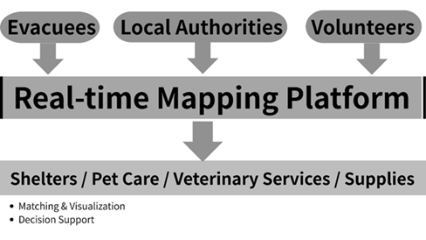
Figure 1: Socio-technical architecture of the digitally mediated evacuation network.
Figure 1 illustrates the proposed socio-technical architecture. The system connects multiple stakeholders through a real-time mapping platform, enabling dynamic information sharing and coordination. By integrating diverse resources into a unified layer, it supports the visualization of needs and availability, facilitating effective matching and decision-making.
Problem Definition and Challenges Despite increasing recognition of the importance of pet-inclusive evacuation, existing evacuation support systems face significant structural limitations. These limitations can be understood as a socio-technical coordination problem involving multiple stakeholders, fragmented information, and dynamic resource constraints.
First, evacuees living with companion animals face additional constraints compared to the general population. Their evacuation decisions depend not only on general shelter availability but also on access to pet-friendly facilities and services. Previous studies have shown that pet ownership significantly influences evacuation behavior, often leading to delayed or failed evacuation when adequate support is unavailable (Thompson, 2013; Hunt et al., 2012; Heath et al., 2001b). The lack of reliable and accessible information regarding such resources limits their ability to make timely and appropriate decisions under uncertain conditions.
Second, institutional responses have attempted to address these issues by incorporating diverse needs into evacuation planning frameworks. For example, guidelines such as those provided by FEMA emphasize the importance of accommodating functional needs, including those associated with companion animals, within general population shelters (Federal Emergency Management Agency (FEMA), 2010). However, despite these efforts, practical implementation often remains limited and uneven across regions.
Third, there is a persistent mismatch between needs and available resources. During disasters, support efforts frequently rely on voluntary contributions and decentralized coordination, resulting in oversupply in some areas and shortages in others. Research on crisis informatics and volunteered geographic information has demonstrated the importance of real-time data integration for improving resource allocation (Zook et al., 2010).
134 Miyazawa and Yoshie Fourth, information related to evacuation support is highly fragmented. Critical data—such as the availability of shelters, temporary care facilities for companion animals, veterinary services, and supply distribution points—is often dispersed across different organizations and platforms. This fragmentation prevents evacuees and support actors from obtaining a comprehensive and up-to-date understanding of the situation. Previous studies on disaster response have highlighted that such fragmentation of information is a major barrier to effective coordination, particularly in large- scale emergencies (Palen and Anderson, 2016).
Finally, existing support practices are predominantly local, face-to- face, and dependent on ad hoc coordination. While these approaches may function in small-scale situations, they do not scale effectively in large-scale or prolonged disasters, where rapid and wide-area coordination is required.
These challenges highlight the need for an integrated approach that enables real-time information sharing, resource coordination, and decision support across multiple actors. Addressing this problem requires not only technological solutions but also a socio-technical design perspective that considers the interactions between people, organizations, and systems.
System Design and Use Scenario To operationalize the proposed socio-technical framework, this study conceptualizes a digitally mediated evacuation support system that integrates multiple stakeholders through a real-time information infrastructure. The system is designed to enable dynamic information sharing, coordination, and decision support during disaster situations.
System Architecture The proposed system is structured around a centralized yet distributed data platform that aggregates and visualizes information from diverse sources. Stakeholders can register and update relevant information through a shared interface, which is reflected in real time on a mapping system.
Key data inputs include:
Evacuation shelters: location, capacity, pet accommodation policies, and current availability
Temporary animal care facilities: availability, capacity, and service conditions
Veterinary services: operational status and emergency support capabilities
Volunteers and support organizations: transportation support, supply distribution, and assistance availability
Pet owners (evacuees): current location, evacuation status, and specific needs related to companion animals The system integrates these heterogeneous data streams into a unified visualization layer, allowing users to access up-to-date information and supporting more informed decision-making under time constraints.
Designing Digitally Mediated Networks for Pet-Inclusive Disaster Evacuation 135 Stakeholder Roles and Interactions
The system facilitates interaction among multiple actors, each with distinct roles and responsibilities:
Pet owners (evacuees): search for pet-friendly evacuation options, register needs, and access support services
Local governments: provide official information on shelters and coordinate regional evacuation strategies
Animal welfare organizations: manage temporary care facilities and provide specialized support for companion animals
Veterinary services: offer medical support and update operational availability
Volunteers: contribute to transportation, resource distribution, and on-site assistance By enabling these stakeholders to interact within a shared digital environment, the system reduces information asymmetry and enhances coordination efficiency.
Use Scenario To illustrate the functionality of the proposed system, consider a flood evacuation scenario involving a pet owner. Upon receiving an evacuation alert, the individual accesses the system via a mobile device and searches for nearby shelters that accept companion animals. The system displays real- time information on shelter capacity and pet accommodation policies.
If no suitable shelter is available within immediate reach, the user can identify temporary animal care facilities or request transportation support through registered volunteers. At the same time, local authorities and organizations can monitor demand patterns and allocate resources accordingly.
Through continuous updates from all participants, the system dynamically reflects changes in availability and needs, enabling adaptive decision-making throughout the evacuation process.
Design Requirements Based on the identified challenges, system design incorporates several key requirements:
Scalability: the ability to operate effectively across different geographic scales, from local to regional levels
Accessibility: usability for diverse populations, including elderly users and those with limited technical proficiency
Trust and data reliability: mechanisms to ensure the accuracy and credibility of shared information
Real-time updating: continuous synchronization of data to reflect rapidly changing conditions
Interoperability: compatibility with existing disaster management systems and communication platforms These requirements are essential for ensuring that the system functions effectively in complex and uncertain disaster environments.
DISCUSSION
The proposed framework addresses the limitations of existing evacuation support systems by introducing an integrated, socio-technical approach to coordination. Unlike conventional practices that rely on localized and face- to-face interactions, the framework enables real-time information sharing and system-level visibility across multiple stakeholders. This shift from fragmented coordination to an integrated information infrastructure is essential for responding to large-scale and prolonged disasters.
In contrast to prior studies that primarily focus on policy development, animal welfare perspectives, or localized support practices, this study reframes pet-inclusive evacuation as a system-level coordination problem mediated by real-time information infrastructure. This perspective bridges a critical gap between social needs and technological design, positioning evacuation support as an information integration challenge rather than solely an institutional or behavioral issue.
A key contribution of this study lies in the integration of diverse resources into a unified mapping system. By visualizing both evacuees’ needs and available resources, the system supports more effective matching and reduces inefficiencies in resource allocation. In particular, the framework highlights the importance of addressing the specific constraints faced by evacuees living with companion animals, whose decision-making depends on access to specialized facilities and services. This perspective extends existing disaster response models by incorporating animal-related needs into system design.
Furthermore, the framework contributes to the field of disaster response by applying a socio-technical design perspective. Rather than focusing solely on technological solutions, the proposed approach considers the interactions between individuals, organizations, and information systems. This perspective is critical for ensuring that digital systems function effectively in complex and uncertain environments.
At the same time, several limitations should be acknowledged. The proposed framework is conceptual and has not yet been implemented or empirically validated. Future research is needed to examine its practical feasibility, including issues related to data reliability, user participation, and system governance. In addition, the effectiveness of the framework may vary depending on local contexts, requiring adaptation to different institutional and cultural environments.
Future studies should also evaluate the effectiveness of the proposed framework through quantitative measures, such as evacuation response time, resource allocation efficiency, and user satisfaction. Comparative analyses between regions with and without digitally mediated support systems may also provide valuable evidence regarding the practical benefits and limitations of the proposed socio-technical approach.
Despite these limitations, the framework provides a foundation for developing scalable and adaptive evacuation support systems. By leveraging digital technologies for real-time coordination, it offers a pathway toward more inclusive disaster response strategies that account for both human and animal needs.
CONCLUSION
This study proposed a socio-technical design framework for a digitally mediated evacuation support network to improve coordination and decision- making in pet-inclusive disaster evacuation. By addressing the fragmentation of information and the mismatch between needs and available resources, the framework enhances situational awareness and supports more effective evacuation processes.
A central contribution of this study is the reframing of pet-inclusive evacuation as a system-level coordination problem mediated by real-time information infrastructure. By integrating diverse resources into a unified mapping system, the proposed approach enables dynamic information sharing and more efficient coordination among multiple stakeholders.
These findings contribute to the development of scalable, adaptive, and inclusive disaster response systems that account for both human and animal needs. Future work will focus on the implementation and empirical validation of the proposed framework in real-world contexts.
REFERENCES
Federal Emergency Management Agency (FEMA) (2010) Guidance on Planning for Integration of Functional Needs Support Services in General Population Shelters. Washington, DC: FEMA. Heath, S.E., Kass, P.H., Beck, A.M. and Glickman, L.T. (2001b) ‘Human and pet-
related risk factors for household evacuation failure during a natural disaster’, American Journal of Epidemiology, 153(7), pp. 659–665. Heath, S.E., Voeks, S.K. and Glickman, L.T. (2001a) ‘Epidemiologic features of pet evacuation failure in a rapid-onset disaster’, Journal of the AmericanVeter inary Medical Association, 218(12), pp. 1898–1904. Holthus, B. (2025) Disaster Preparedness and Response for Companion Animals in
Japan. Cham: Springer. Hunt, M.G., Bogue, K. and Rohrbaugh, N. (2012) ‘Pet ownership and evacuation prior to Hurricane Irene’, Anthrozoös, 25(2), pp. 195–208. Irvine, L. (2009) Filling the Ark: Animal Welfare in Disasters. Philadelphia: Temple
University Press. Kato, K. (2013) ‘Disaster response and companion animals in Japan: Social structure of animal rescue’, Journal of Animal Welfare Studies, 15(2), pp. 45–60. Meier, P. (2015) Digital Humanitarians: How Big Data is Changing the Face of
Humanitarian Response. Boca Raton: CRC Press. Palen, L. and Anderson, K.M. (2016) ‘Crisis informatics—New data for extraor dinary times’, Science, 353(6296), pp. 224–225. Thompson, K. (2013) ‘Save me, save my dog: Increasing natural disaster prepar-
edness and survival by addressing human–animal relationships’, Australian Journal of Communication, 40(1), pp. 123–136. United States Congress (2006) Pets Evacuation and Transportation Standards Act of 2006 (PETS Act), Public Law 109–308. Available at: https://www.congress. gov/109/plaws/publ308/PLAW-109publ308.pdf (Accessed: 20 April 2026). Zook, M., Graham, M., Shelton, T. and Gorman, S. (2010) ‘Volunteered geographic
information and crowdsourcing disaster relief: A case study of the Haitian earthquake’, World Medical & Health Policy, 2(2), pp. 7–33.
FIND THE COMPLETE VOLUME IN THE AHFE DIGITAL BOOKSTORE
Explore the complete digital volume
Human Systems Engineering and Design (IHSED2026): Future Trends and Applications
Read this individual research paper free through the original publisher, or explore the full digital proceedings book.