Tasnim Hasan, Natalie Enman, Zhichao Yang, Kerwin Tu, Kimberly Perkins (2026). Beyond Endurance: Integrating Emotional Intelligence and Systemic Support to Strengthen Resilience in Aviation. In: Human Systems Engineering and Design (IHSED2026): Future Trends and Applications. AHFE Open Access, vol. 237, pp. 587–596. https://doi.org/10.54941/ahfe1008198
This mixed-methods study examines mental health support avoidance among pilots and air traffic controllers as a socio-technical systems issue in safety-critical aviation. Using survey data from 1,362 aviation professionals, closed-ended responses were analyzed with descriptive statistics and open-ended responses through thematic coding. Findings show that avoidance of formal support is shaped by fear of career consequences, low institutional trust, confidentiality concerns, and regulatory uncertainty. Many participants relied on self-directed coping strategies, including exercise, peer conversations, and personal stress management, as adaptive responses to systems perceived as punitive or unclear. Thematic findings identified concerns about medical disqualification, inconsistent review processes, and limited trusted early-intervention pathways. These results suggest that mental health avoidance is not only an individual or clinical issue, but also an outcome of organizational design, regulatory opacity, and perceived system risk. From a human systems engineering perspective, aviation safety depends on support structures that encourage transparency, early reporting, and trust. The study recommends redesigning confidential support pathways, integrating resilience and emotional intelligence training into professional development, and improving medical review transparency. Overall, the findings contribute to safety engineering and systems complexity by reframing aviation mental health support as a human performance and organizational resilience challenge.
Aviation is a safety-critical socio-technical system where human performance, regulatory oversight, organizational culture, and institutional trust shape operational safety. Pilots and air traffic controllers operate under high cognitive and operational demands, yet many avoid or delay formal mental health support because disclosure may be perceived as a risk to certification, employment, or professional identity. In this context, mental health avoidance is a systems-level safety concern shaped by policy design, organizational norms, and trust in regulatory processes.
Received May 27, 2026 Revised June 12, 2026 Accepted June 25, 2026 Available online September 25, 2026
Prior research suggests that FAA disclosure requirements and aviation culture can discourage help-seeking by creating uncertainty around professional consequences (Cross et al., 2024; Walden & Thomas, 2025). Pilots have reported fear of suspension, dismissal, grounding, or regulatory scrutiny after disclosure, leading some to avoid treatment or conceal concerns (DeHoff & Cusick, 2018; Hoffman et al., 2022). Aviation norms emphasizing reliability, emotional control, and resilience may further discourage vulnerability and formal support-seeking (Bor et al., 2002; Cahill et al., 2021; Wu et al., 2016).
This mixed-methods study examines how pilots and air traffic controllers perceive mental health support, self-management, emotional intelligence, resilience, and institutional trust within aviation systems. Rather than treating mental health solely as a clinical concern, this paper positions disclosure, trust, and support-seeking as human systems engineering issues with implications for safety culture, organizational design, and regulatory reform.
BACKGROUND
Aviation safety depends on the interaction between human performance, regulatory oversight, organizational culture, and institutional trust. Mental health disclosure policies are intended to protect operational safety by identifying conditions that may impair judgment, decision-making, or performance; however, when these policies are perceived as punitive or unclear, they may discourage early help-seeking and reduce transparency within the safety system.
The FAA requires pilots and air traffic controllers to meet strict physical and psychological fitness standards, including disclosure of diagnoses, treatments, and medications to Aviation Medical Examiners. FAA standards classify conditions such as bipolar disorder, severe depression, and substance abuse as disqualifying unless managed through a special issuance process (Federal Aviation Administration [FAA], 2023). Although designed to manage safety risk, these requirements may contribute to avoidance behaviors when pilots fear career loss, grounding, or regulatory consequences (Cross et al., 2024; Wu et al., 2016). From a safety management perspective, this reluctance can undermine Safety Management Systems, which depend on timely reporting, early intervention, and non-punitive safety cultures (ICAO, 2018).
Pilot culture also shapes disclosure behavior. Expectations of resilience, control, and reliability are associated with the aviation “Right Stuff” ideal (Cullen, 2020; Bor & Hubbard, 2006). Avoidance is widespread: Hoffman et al. (2022) found that 56.1% of U.S. pilots avoided medical care and 26.8% withheld health information during screenings, while Hoffman et al. (2023) reported similar avoidance rates among Canadian and U.S. pilots. The “pilot healthcare barrier” describes avoidance driven by fear of certification loss, professional consequences, stigma, and reduced autonomy (Hoffman, Bjerke, & Tvaryanas, 2022). Together, these findings suggest that avoidance is a predictable response to system conditions that make disclosure feel risky.
Beyond Endurance: Integrating Emotional Intelligence 589 Other high-risk professions face similar challenges related to confidentiality, stigma, underreporting, and expectations of constant resilience (Knaak et al., 2017; Sharp et al., 2015). Research from healthcare and military settings highlights resilience workshops, counseling access, mindfulness- based interventions, and resilience training as strategies that support stress regulation and recovery (Rawlings Chidi et al., 2024; Zueger et al., 2022). For aviation, these approaches frame resilience and emotional intelligence not only as wellbeing interventions but also as human performance and safety engineering tools.
LITERATURE REVIEW
Prior research shows that mental health support avoidance in aviation is shaped by regulatory uncertainty, professional identity, institutional distrust, and limited proactive training. Pilots often rely on avoidance or self-management rather than formal support when institutional pathways are perceived as risky or unclear. Cross et al. (2024) found that commercial pilots sometimes avoided formal resources by paying privately for therapy or concealing treatment, while Walden and Thomas (2025) identified avoidance strategies such as withholding treatment histories or discontinuing medications. Quantitative studies similarly show that self-directed coping is common; Cahill et al. (2021) found that nearly 60% of pilots used strategies such as exercise and relaxation, while Wu et al. (2016) found reluctance to disclose concerns due to norms discouraging vulnerability.
Emotional Intelligence (EI) is relevant to aviation because pilots and ATCs operate under pressure, uncertainty, and safety-critical decision demands. Although FAA Crew Resource Management training emphasizes communication, teamwork, and stress management, EI is not explicitly integrated into CRM requirements (Federal Aviation Administration, 2004). Research links EI to stress regulation, adaptive decision-making, resilience, leadership, performance, and flight safety (Mayer & Salovey, 1997; Schneider et al., 2013; Harms & Credé, 2010; Zhao et al., 2025; Cherng et al., 2022; Zhao et al., 2024; Liao et al., 2025; Wu et al., 2025). Within a safety engineering framework, EI should be understood as a trainable human performance capability.
Evidence-based resilience interventions, including CBT, mindfulness- based approaches, and stress inoculation training, may support emotional regulation, cognitive flexibility, and recovery from stress. Venus et al. (2022) reported high fatigue, poor sleep, and stress among commercial pilots, while Joyce et al. (2018) found that CBT, mindfulness, or combined resilience programs across high-stress fields produced moderate improvements in self- reported resilience. Although aviation-specific evidence remains limited, these interventions target capabilities relevant to flight operations, including composure, fatigue management, adaptation under pressure, and recovery after stressful events.
Despite the relevance of EI and resilience to aviation safety, these skills remain inconsistently integrated into training. Current programs emphasize technical mastery, emergency procedures, and regulatory compliance but provide limited preparation for emotional regulation, chronic stress, or disclosure-related decision-making. Pilot selection and licensing have traditionally prioritized physical and cognitive fitness, while emotional competence and psychosocial readiness remain less formally addressed (Bor & Hubbard, 2006). Embedding EI and resilience training into aviation education, policy, and organizational systems may better align mental health support with aviation safety goals.
METHODOLOGY
This study used a mixed-methods design to examine self-management, avoidance behaviors, and perceptions of mental health support among commercial pilots and air traffic controllers. Closed-ended responses were analyzed with descriptive statistics in Microsoft Excel and Python. Open-ended responses were analyzed using combined inductive and deductive thematic coding, with participant quotations labeled by survey question, such as “Q7 respondent,” to preserve anonymity.
Participants were recruited through professional aviation networks, university contacts, and digital outreach. Eligibility required an active commercial pilot license or current ATC status. Participation was voluntary and anonymous. The final dataset included 1,362 responses from participants aged 18 to over 65 across six global regions, with the largest groups from North America (n = 511), Europe (n = 360), and Australia/ New Zealand (n = 177).
Table 1: Participant demographics (N = 1,362).
Table available in the original PDF paper.
Gender Distribution Gender Count
Male 923 Female 391
Prefer not to disclose 22 Another gender 4
Geographic Distribution Region Count
North America 511 Europe 360
Australia / New Zealand 177 Other 314
Beyond Endurance: Integrating Emotional Intelligence 591 The 17-question Qualtrics survey averaged 7.8 minutes and included multiple-choice, Likert-scale, and open-ended items on mental health reporting, self-management, institutional or peer-support programs, and recommendations for improving support. Data were collected online from February 1 to May 15, 2025, through anonymous survey links. No identifying information was collected, and participants were informed of the study purpose, voluntary participation, and right to withdraw.
Closed-ended responses were analyzed using frequencies, means, and standard deviations. Open-ended responses were analyzed using Braun and Clarke’s (2006) six-phase thematic analysis method. Three researchers developed and refined a codebook, assessed coding reliability through percent agreement, resolved discrepancies by consensus, and triangulated qualitative themes with quantitative findings.
RESULTS
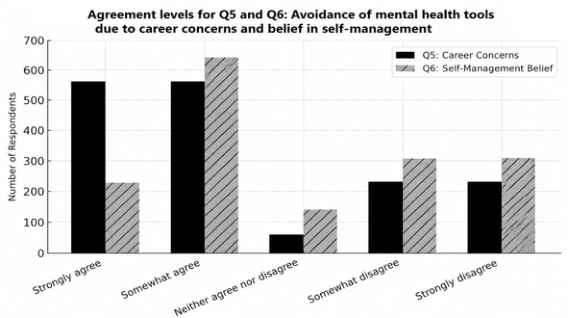
Survey results showed consistent avoidance, self-reliance, disclosure hesitancy, and low trust in formal support systems. For Q5, 65% of respondents agreed that they avoided mental health care due to career concerns (1,082 of 1,658). For Q6, 53% agreed that they preferred managing concerns independently (873 of 1,657).
Figure 1: Agreement levels for avoidance and self-management.
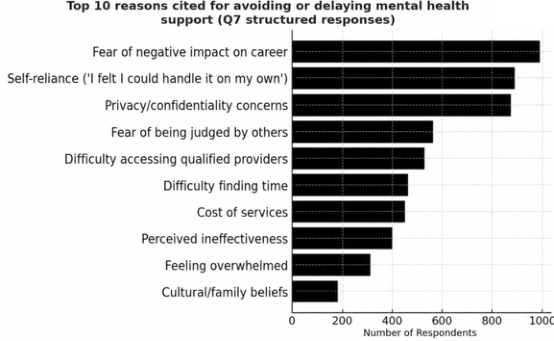
For Q7, participants selected reasons for avoiding or delaying mental health support from a multi-select list (N = 1,639). The most cited barriers were fear of negative career impact (n = 987), self-reliance (n = 888), and privacy or confidentiality concerns (n = 874). Other barriers included fear of judgment (n = 561), difficulty accessing qualified providers (n = 526), difficulty finding time (n = 459), cost (n = 449), perceived ineffectiveness (n = 395), feeling overwhelmed (n = 311), and cultural or family beliefs (n = 179).
Figure 2: Top barriers to support-seeking.
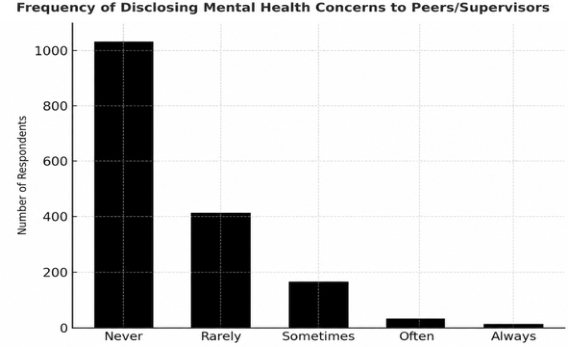
Responses to Q9 showed high non-disclosure: 87% of respondents, or 1,442 of 1,653, reported rarely or never disclosing mental health concerns to peers or supervisors. In Q17, only 35% of respondents, or 465 of 1,317, felt comfortable discussing concerns with employers or FAA medical staff. These findings show that disclosure behavior is shaped by perceived career risk, confidentiality concerns, and low institutional trust.
Figure 3: Disclosure frequency.
Open-ended responses from Q7 and Q10 produced three themes: fear of career consequences, distrust in employer and regulatory support, and the need for early confidential support pathways. Respondents described fear that disclosure could jeopardize certification, pay, job security, or career progression. One Q7 respondent stated, “I didn’t trust that I wouldn’t lose my medical. It wasn’t worth the risk.” Others described distrust in FAA, CAA, AME, or employer systems due to opaque procedures and inconsistent decisions. One Q10 respondent explained, “There’s no clear process or reassurance that if you get help, you won’t be punished for it.” Participants also wanted confidential early-intervention pathways separated from punitive employer or regulatory action.
Table 2: Thematic summary of open-text responses.
Table available in the original PDF paper.
Theme Description Frequency
594
Fear of career consequences
Concerns over medical disqualification, grounding, job loss, or pay loss Distrust in institutions Lack of trust in FAA, CAA, AMEs, or employer
473
support systems
468
Need for confidential support
Desire for anonymous, safe, and early-access support mechanisms
DISCUSSION
The findings show that avoidance of mental health support among pilots and air traffic controllers is shaped by systemic, cultural, and regulatory conditions. Quantitative and qualitative results converged around three issues: fear of career consequences, reliance on self-management, and low trust in formal support pathways. Rather than reflecting lack of concern for wellbeing, these behaviors suggest that aviation professionals are navigating a safety system in which disclosure can feel professionally risky.
Career-related fear was the strongest barrier to support-seeking. More than 75% of respondents avoided or delayed support due to career concerns, aligning with prior research showing that pilots underreport symptoms or avoid diagnoses because of perceived regulatory consequences (Cross et al., 2024; Bor & Hubbard, 2006). From a safety engineering perspective, this creates a design contradiction: policies intended to protect safety may unintentionally reduce transparency by discouraging early reporting and intervention.
Self-management strategies such as exercise, sleep hygiene, and peer discussion were common. While these behaviors can support resilience and performance, they may also substitute for formal care when institutional pathways are viewed as unsafe or untrustworthy. Formal support programs were also underused, with only 12% of respondents reporting use. For human systems engineering, this points to trust as a core design requirement: support programs must be understandable, accessible, credible, and perceived as safe by the people expected to use them.
This study supports prior research identifying stigma, regulatory fear, and organizational inertia as barriers to aviation mental health support (Bor et al., 2002; Cahill et al., 2021). However, it reframes these barriers as socio-technical system issues. Pilots and ATCs are not simply avoiding care; they are responding to incentives, norms, and uncertainties embedded in the aviation safety system. In safety-critical aviation systems, trust, transparency, and non-punitive support pathways are essential components of operational safety and organizational resilience.
CONCLUSION
This study highlights a disconnect between aviation’s safety goals and the systems intended to support pilot and air traffic controller wellbeing. Respondents often relied on self-directed strategies not only by preference,
but because formal support pathways were perceived as risky, unclear, or untrustworthy. These findings suggest that mental health support avoidance is a systems-level outcome shaped by regulatory opacity, professional norms, and fear of punitive consequences.
From a human systems engineering perspective, disclosure behavior should be treated as part of the broader safety system. Regulators and organizations should prioritize transparent reporting protections, trusted non-punitive support pathways, resilience and emotional intelligence training as human performance capabilities, and standardized medical review processes. Overall, this study contributes to safety engineering and systems complexity by reframing mental health avoidance as a socio-technical systems issue: in safety-critical aviation, resilience cannot depend only on individual endurance, but must be supported by organizational design, regulatory transparency, and trusted early-intervention pathways.
REFERENCES
Bor, R., Field, G., & Scragg, P. (2002). The mental health of pilots: An overview. Counselling Psychology Quarterly, 15(3), 239–256. https://doi. org/10.1080/09515070210143471 Bor, R., & Hubbard, T. (2006). Aviation mental health: Psychological implications for
air transportation. Ashgate Publishing. https://doi.org/10.4324/9781315245161 Braun, V., & Clarke, V. (2006). Using thematic analysis in psychology.
Qualitative Research in Psychology, 3(2), 77–101. https://doi. org/10.1191/1478088706qp063oa Cahill, J., Cullen, P., Anwer, S., Wilson, S., & Gaynor, K. (2021). Pilot work related stress (WRS), effects on wellbeing and mental health, and coping methods. The International Journal of Aerospace Psychology, 31(2), 87–109. https://doi.org/10 .1080/24721840.2020.1858714 Cherng, C. F. G., Sher, J. S., Chu, H., & Yu, L. (2022). The relationship between civil
pilots’ resilience, psychological well-being and work performance. Transportation Research Procedia, 66, 16–25. https://doi.org/10.1016/j.trpro.2022.12.003 Cross, D. S., Wallace, R., Cross, J., & Mendonca, F. C. (2024). Understanding pilots’ perceptions of mental health issues: A qualitative phenomenological investigation among airline pilots in the United States. Cureus, 16(8), e66277. https://doi. org/10.7759/cureus.66277 Cullen, P. (2020). The role of pilot mental health in accidents: The lived experience
of a pilot. HindSight, 30. EUROCONTROL. DeHoff, M. C., & Cusick, S. K. (2018). Mental health in commercial aviation – Depression & anxiety of pilots. International Journal of Aviation, Aeronautics, and Aerospace, 5(5), Article 1287. https://doi.org/10.58940/2374-6793.1287 Federal Aviation Administration (FAA). (2004). Crew resource management training
(Advisory Circular AC 120-51E). https://www.faa.gov/documentLibrary/media/ Advisory_Circular/AC_120-51E.pdf Federal Aviation Administration (FAA). (2023). Guide for aviation medical examiners: Item 47 – Psychiatric conditions. U.S. Department of Transportation. https://www.faa.gov/about/office_org/headquarters_offices/avs/offices/aam/ame/ guide/app_process/exam_tech/item47/amd/
Beyond Endurance: Integrating Emotional Intelligence 595 Harms, P. D., & Credé, M. (2010). Emotional intelligence and transformational and
transactional leadership: A meta-analysis. Journal of Leadership & Organizational Studies, 17(1), 5–17. https://doi.org/10.1177/1548051809350894 Hoffman, W. R., Aden, J., Barbera, R. D., Mayes, R., Willis, A., Patel, P., & Tvaryanas, A. (2022). Healthcare avoidance in aircraft pilots due to concern for aeromedical certificate loss: A survey of 3,765 pilots. Journal of Occupational and Environmental Medicine, 64(4), e245–e248. https://doi.org/10.1097/ JOM.0000000000002519 Hoffman, W. R., Patel, P. K., Aden, J., Willis, A., Acker, J. P., Bjerke, E., Miranda, E.,
Luster, J., & Tvaryanas, A. (2023). Multinational comparison study of aircraft pilot healthcare avoidance behaviour. Occupational Medicine, 73(7), 434–438. https://doi.org/10.1093/occmed/kqad091 Hoffman, W., Bjerke, E., & Tvaryanas, A. (2022). Breaking the pilot healthcare barrier. Aerospace Medicine and Human Performance, 93(8), 649–650. https:// doi.org/10.3357/AMHP.6063.2022 International Civil Aviation Organization (ICAO). (2018). Safety management
manual (Doc 9859, 4th ed.). https://www.icao.int/APAC/Meetings/2019%20 COSCAPSEA%20iSTARS/9859_cons_en.pdf Joyce, S., Shand, F., Tighe, J., Laurent, S. J., Bryant, R. A., & Harvey, S. B.
(2018). Road to resilience: A systematic review and meta-analysis of resilience training programmes and interventions. BMJ Open, 8(6), e017858. https://doi. org/10.1136/bmjopen-2017-017858 Knaak, S., Mantler, E., & Szeto, A. (2017). Mental illness-related stigma in healthcare: Barriers to access and care and evidence-based solutions. Healthcare Management Forum, 30(2), 111–116. https://doi.org/10.1177/0840470416679413 Liao, M., Lai, X., Wang, Y., & Zhang, Q. (2025). Rumination and psychological
resilience in Chinese civil aviation flight students: The chain mediating role of proactive coping and generalized anxiety. Frontiers in Psychology, 16, 1606045. https://doi.org/10.3389/fpsyg.2025.1606045 Mayer, J. D., & Salovey, P. (1997). What is emotional intelligence? In D. J. Sluyter (Ed.), Emotional development and emotional intelligence: Educational implications (pp. 3–34). Basic Books. Rawlings Chidi, A., Adekunle, N., Okolo, A., Babawarun, O. T., & Olawumi, J.
(2024). Psychological resilience in healthcare workers: A review of strategies and intervention. World Journal of Biology Pharmacy and Health Sciences, 17(2), 387–395. https://doi.org/10.30574/wjbphs.2024.17.2.0088 Schneider, T. R., Lyons, J. B., & Khazon, S. (2013). Emotional intelligence and resilience. Personality and Individual Differences, 55(8), 909–914. https://doi. org/10.1016/j.paid.2013.07.460 Sharp, M.-L., Fear, N., Rona, R., Wessely, S., Greenberg, N., Jones, N., & Goodwin,
L. (2015). Stigma as a barrier to seeking health care among military personnel with mental health problems. Epidemiologic Reviews, 37(1), 144–162. https:// doi.org/10.1093/epirev/mxu012 Venus, M., Greder, D., & Gross-Holtforth, M. (2022). How professional pilots perceive interactions of working conditions, rosters, stress, sleep problems, fatigue and mental health: A qualitative content analysis. European Review of Applied Psychology, 72(3), 100762. https://doi.org/10.1016/j.erap.2022.100762 Walden, A., & Thomas, J. (2025). Unveiling the narrative around pilot mental health
and aviation: A content analysis of FAA and mental health-related social media content. Collegiate Aviation Review International, 43(1), 19–35. https://ojs. library.okstate.edu/osu/index.php/CARI/article/view/9997/8944
Wu, A. C., Donnelly-McLay, D., Weisskopf, M. G., McNeely, E., Betancourt, T. S., & Allen, J. G. (2016). Airplane pilot mental health and suicidal thoughts: A cross- sectional descriptive study via anonymous web-based survey. Environmental Health, 15(1), Article 121. https://doi.org/10.1186/s12940-016-0200-6 Wu, F., Lai, M., & Li, M. (2025). Knowledge as “wings” and resilience as
“armor”: A study on the impact of civil aviation pilots’ personal knowledge management abilities on career resilience. Frontiers in Psychology, 16, 1499946. https://doi.org/10.3389/fpsyg.2025.1499946 Zhao, Y., Wang, L., & Zhang, H. (2024). Exploring the measurement of psychological resilience in Chinese civil aviation pilots based on generalizability theory and item response theory. Scientific Reports, 14, Article 52229. https://doi.org/10.1038/ s41598-024-52229-7 Zhao, Y., Zhu, K., Cai, H., Liu, Z., Xiong, R., & Wang, L. (2025). Mediating roles
of resilience and stress in emotion regulation strategies and pilot job burnout. Aerospace Medicine and Human Performance, 96(3), 219–227. https://doi. org/10.3357/AMHP.6581.2025 Zueger, R., Niederhauser, M., Utzinger, C., Annen, H., & Ehlert, U. (2022). Effects of resilience training on mental, emotional, and physical stress outcomes in military officer cadets. Military Psychology, 35(6), 1–11. https://doi.org/10.1080/089956 05.2022.2139948
FIND THE COMPLETE VOLUME IN THE AHFE DIGITAL BOOKSTORE
Explore the complete digital volume
Human Systems Engineering and Design (IHSED2026): Future Trends and Applications
Read this individual research paper free through the original publisher, or explore the full digital proceedings book.