Hüsre Gizem Akalp, Nurettin Yamankaradeniz, Sevinc Serpil Aytac (2026). A Gender-Sensitive Human Systems Engineering Approach to Personal Protective Equipment Design in the Textile Industry: A Sociotechnical Analysis. In: Human Systems Engineering and Design (IHSED2026): Future Trends and Applications. AHFE Open Access, vol. 237, pp. 597–608. https://doi.org/10.54941/ahfe1008199
The research is based on focus group interviews with 25 unionized female textile workers. The data obtained were analyzed using thematic analysis and network analysis methods; the most significant finding of the study is that merely distributing PPE is insufficient to create a safe working environment. The key factors determining safe behavior are the suitability of the equipment to the body and the task, the quality of managerial supervision, and the psychosocial environment at the workplace. For example, thick gloves, protective goggles that do not fit the face properly, difficult-to-use hand tools, uncomfortable masks and workwear unsuitable for the female body both reduce PPE usage and weaken workers’ perception of risk. Furthermore, managerial pressure, workplace bullying and inadequate supervision also have negative effects on safety culture. Based on these findings, this study proposes a socio-technical model that views PPE not merely as equipment, but as a link between the individual and the system. According to this model, ergonomic fit, perceived comfort, quality of control and psychosocial working conditions interact to shape the risk of workplace accidents.Consequently, the research emphasizes that occupational health and safety policies should not focus solely on providing protective equipment. Instead, designs that consider the needs of female workers, ergonomic approaches based on worker participation, and a more holistic understanding of the system should be adopted.
The textile and garment industry is one of the main areas of work that women do a lot of. Women are very important to the production process because they sew, check for quality, iron, and put things together (International Labour Organization [ILO], 2022). The sector also has high ergonomic demands, such as repetitive movements, long periods of standing still, the use of sharp tools, and high production pressure. These working conditions have been linked to a higher rate of musculoskeletal disorders, especially in the neck, lower back, shoulders, and upper limbs (Ahmad et al., 2021;
Received April 10, 2026 Revised June 23, 2026 Accepted July 5, 2026 Available online September 25, 2026
İmamoğlu & Esi, 2024; Okareh et al., 2021; Seidu et al., 2024). In this situation, occupational health and safety (OHS) practices are very important for keeping workers healthy. The literature indicates that OHS systems are frequently developed without adequate consideration of gender-specific variations in exposure, physiology, and biomechanics. Women and men may face disparate risks within identical occupational environments, potentially resulting in divergent health outcomes (Biswas et al., 2022; Lee et al., 2025). So, the places where women work, the tools they use, and the safety measures they take should all be made with their needs and traits in mind.
When workplace dangers can’t be completely gotten rid of, personal protective equipment (PPE) is usually seen as the last line of defense. However, PPE’s effectiveness depends on more than just how easy it is to get; it also depends on how well it fits, how easy it is to use, and how comfortable it is. An increasing amount of evidence indicates that a significant portion of personal protective equipment (PPE) is predominantly designed using male anthropometric data, potentially leading to inadequate fit, limited mobility, and diminished usability for female workers (Ada et al., 2025; Fullenkamp et al., 2008; Del Castillo, 2015). Badly designed equipment can also make people less likely to follow the rules and make protective performance worse (Biswas et al., 2022; Metgud et al., 2008; Okareh et al., 2021).
PPE use should not only be seen as a technical issue. Organizational culture, supervisory practices, production pressure, and the psychosocial work environment also affect how safety rules are understood and followed at work every day. Studies in the textile industry demonstrate that employees’ health and safety experiences are significantly affected by organizational and environmental factors, rather than solely by the existence of technical controls (Nabi et al., 2023). This indicates that the utilization of personal protective equipment (PPE) ought to be analyzed within a comprehensive socio-technical framework that encompasses technical, organizational, and social aspects.
In this context, the current study investigates the experiences of female textile workers concerning the utilization of personal protective equipment through the framework of human systems engineering and the socio- technical systems approach. The study seeks to enhance the formulation of more gender-sensitive occupational health and safety policies and personal protective equipment (PPE) design practices by identifying the ergonomic, organizational, and psychosocial factors that influence the safety experiences of female workers.
METHOD
This study employed a qualitative design to examine female textile workers’ experiences with personal protective equipment (PPE) and their perceptions of occupational health and safety from a human systems engineering perspective. The study focused specifically on how ergonomic fit, the psychosocial work environment, and managerial practices shape safety behavior. A qualitative approach was considered appropriate because it allows for an in-depth exploration of participants’ experiences, perceptions, and behaviors within their social context (Yıldırım & Şimşek, 2021).
A Gender-Sensitive Human Systems Engineering Approach 599 Data were collected through focus group interviews. This method was selected because it enables the exploration of work-related experiences and perceptions in an interactive setting and is particularly useful for examining socially embedded processes in occupational contexts (Çokluk et al., 2011; Krueger & Casey, 2000; Morgan, 1997).
Participants and dataset. The study was based on focus group discussions with 25 unionized female textile workers employed in textile enterprises in Bursa, Türkiye. Participants were selected through purposive sampling to include individuals capable of providing rich and relevant accounts of the phenomenon under investigation (Yıldırım & Şimşek, 2021). Volunteer participants were invited through union representatives from textile enterprises. They represented a range of production-line roles, including sewing, ironing, packaging/assembly, quality control, and other shop-floor tasks. All participants were women actively involved in textile production and familiar with the routine use of PPE. Participant characteristics are presented in Table 1.
Table 1: Distribution of participants’ demographic and professional characteristics.
Table available in the original PDF paper.
Variable Category n Age range 18–24 7
25–34 9
35–44 4
45 and above 5
Length of employment 1–5 years 10 6–10 years 8
11 years and above 7
Job/production line role Sewing operator 6 Quality control 2
Ironing 6 Packaging/assembly 5
Other 6 As shown in Table 1, the participant group included workers from different age ranges, lengths of employment, and production-line roles, enabling the study to capture variation in both occupational experience and PPE-related practices.
A total of 25 women participated in focus group interviews conducted on two separate days in November 2024. Each session included approximately 8 to 10 participants and lasted 60 to 90 minutes. Demographic and occupational information, including age, length of employment, and production-line role, was recorded during the interview process. To ensure anonymity, participants were assigned codes such as K1, K2, and K3. Before each session, the aim of the study was explained, and participants were informed that participation was voluntary and that all responses would remain confidential.
A semi-structured interview guide developed by the researchers was used during data collection. The guide drew on previous research on risk perception and safety behavior in occupational health and safety. Questions were phrased in a clear and accessible manner to encourage open discussion. The interviews addressed occupational health and safety training and practices, perceived workplace risks, PPE use, workload, time pressure, production pace, shift arrangements, and working conditions. Data collection continued until thematic saturation was reached, that is, until no substantially new themes emerged.
Ethical approval was granted by the Bursa Uludağ University Ethics Committee on October 25, 2024, under Decision No. 36. All participants were informed about the purpose of the study before the interviews began.
The data were analyzed using thematic analysis and content analysis. Thematic analysis was used to identify recurring patterns of meaning and organize these patterns into broader themes, while content analysis supported the systematic coding and interpretation of salient concepts in participants’ narratives (Braun & Clarke, 2006; Krippendorff, 2018). The analytic process involved repeated review of the interview notes, open coding, the clustering of similar codes into higher-order categories, and the organization of these categories into broader themes. Particular attention was paid to PPE use, ergonomic mismatch, risk perception, workload, supervision, and psychosocial working conditions.
The analysis identified five primary thematic domains: ergonomic appropriateness of PPE, monitoring and compliance mechanisms, psychosocial risk factors, workload and ergonomics, and occupational safety training. These themes demonstrate that occupational health and safety experiences were influenced by both physical hazards and organizational and psychosocial factors. To enhance the analytical framework, the interrelationships among themes were scrutinized via conceptual network analysis, facilitating the interpretation of the interactions between PPE usage, risk perception, training, supervision, and working conditions from a socio-technical systems perspective. Table 2 summarizes the main themes, subdimensions, and content focus identified through this process.
Table 2: Thematic analysis revealed principal themes and subdimensions.
Table available in the original PDF paper.
Main Theme Subdimensions Focus of Content Ergonomic suitability of PPE Fit, ease of use, comfort The extent to which equipment is compatible with the physical characteristics of female workers
Supervision, rule adherence, sanctions
Monitoring and compliance mechanisms
The relationship between compliance with safety rules and organizational monitoring
Psychosocial risk factors
Stress, pressure, communication problems
The influence of psychological and social conditions on safety behavior
Workload and ergonomics
Work pace, repetition, fatigue, shift work
Production pressure and physical strain
Occupational safety training
Awareness, level of knowledge, practice
The role of training in promoting safe behavior
A Gender-Sensitive Human Systems Engineering Approach 601 To enhance the trustworthiness of the analysis, multiple researchers were involved in the coding process, coding decisions were reviewed comparatively, and all participant statements were reported using anonymous identifiers. These procedures were adopted to strengthen the consistency of the analysis and the credibility of the interpretations.
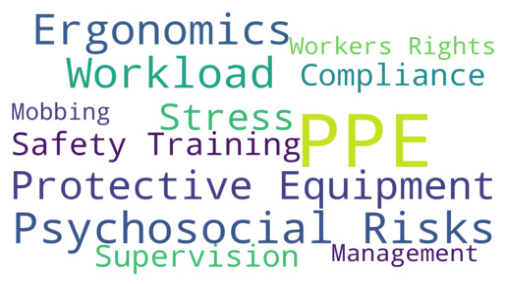
To complement the thematic analysis, a word frequency analysis was conducted to identify the concepts most strongly emphasized across the focus group discussions. As shown in Figure 1, terms related to personal protective equipment, psychosocial risks, and workload/ergonomics were the most prominent. This pattern suggests that participants understood safety not only in relation to the availability of protective equipment, but also in connection with working conditions and organizational processes. In particular, the prominence of concepts associated with psychosocial risks and workload indicates that safety perception extended beyond physical hazards alone. This interpretation is consistent with the occupational health literature, which highlights the role of psychosocial risks, time pressure, and organizational communication in shaping safety behavior and accident risk (Bach et al., 2023; Leka & Jain, 2010).
Figure 1: Word frequency cloud made from data from a focus group.
Note: Concepts shown in bigger font show themes that came up more often in what participants said.
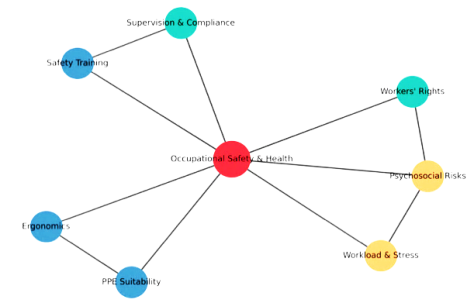
To further clarify the relationships among the main themes, thematic network analysis was used. As illustrated in Figure 2, the findings pointed to strong interconnections among occupational safety training, supervision, ergonomic fit of PPE, and psychosocial pressures. More specifically, insufficient training and weak supervision appeared to reduce compliance with safety rules, while poor ergonomic fit limited the usability and protective function of PPE. At the same time, psychosocial factors such as time pressure, overtime, and management-related pressure were found to negatively influence safety behavior. These patterns show that occupational health and safety practices were not shaped by just one factor, but by many technical, organizational, and psychosocial factors that all worked together (Attride-Stirling, 2001; Braun & Clarke, 2006; Hale & Hovden, 1998).
When looked at, these analytical patterns show that the occupational health and safety experiences of female textile workers grouped into five interrelated thematic areas: these are the ergonomic suitability of PPE,
monitoring and compliance mechanisms, psychosocial risk factors, workload and ergonomics, and occupational safety training. These results align with previous studies indicating that health and safety outcomes in the textile industry are influenced by ergonomic risks as well as organizational and psychosocial factors (Seidu et al., 2024). Based on these analytical patterns, the results are organized below into five interrelated thematic domains.
Figure 2: Thematic network analysis: Relationships between PPE use, supervision, training, and psychosocial.
FINDINGS The results show that the personal protective equipment (PPE) provided to female textile workers does not fully explain their experiences with occupational health and safety. Instead, safety behavior arose from the interplay of technical conditions, organizational structures, and the psychosocial work environment, reinforcing a socio-technical perspective on workplace safety (Carayon, 2006).
Preliminary analytical results further corroborated the thematic framework of the findings. The word frequency cloud showed how important ideas about PPE, psychosocial risks, and workload were, and the thematic network analysis showed how closely related supervision, training, ergonomic fit, and safety behavior were. These patterns suggest that experiences of occupational health and safety were influenced by the interplay of technical, organizational, and psychosocial conditions, rather than by individual factors in isolation.
Safety Practices and the Way an Organization is Set Up Participants have been shown to characterize workplace safety formally versus operationally within their workplace. Workers often perceive workplace safety measures as being inconsistent with how they do their jobs, or the physical demands of those jobs, or the reality of producing a product. Workers have identified that issues such as subcontracting, employment insecurity and the male-female hierarchy of the organization contribute to a negative safety climate. One worker stated, “the machine stops working but the work does not”, further identifying production as an additional
A Gender-Sensitive Human Systems Engineering Approach 603 hazard. A second worker stated “men’s views will be given greater weight then women’s views”, identifying men dominate the decision-making process for safety in the organization. The comments from participants identify that safety performance is impacted by factors beyond just control measures related to the technology used to produce products. The findings support the assertion that workplace culture and workplace power structures impact safety performance (Dekker, 2017; Hale & Hovden, 1998; Reason, 2016).
Training, Risk Awareness, and the Ergonomic Suitability of Personal Protective Equipment (PPE) A common theme was that training for health and safety at work doesn’t work very well. Participants characterized the training as inconsistent, superficial, and primarily focused on procedural adherence rather than authentic risk awareness. One participant said, “We know how important health and safety are, but our company doesn’t provide enough training or doesn’t provide it at all so that work doesn’t stop” (K3). Another person said, “Even though we weren’t really trained, we were asked to sign a paper saying we had been trained” (K18). These accounts indicate that risk perception was not consistently reinforced by institutional learning and, in certain instances, was supplanted by more fatalistic interpretations.
Another important finding was that PPE didn’t fit women well ergonomically. People often said that gloves, shoes, work clothes, and goggles were too thick, too stiff, or didn’t fit women’s body types or the precision needs of textile work. One person said, “The gloves we were given are too thick, and we have to do very delicate work.” It is very hard to do our job when we wear the gloves (K20). Another person said, “The sizes of the clothes given are not right for women.” “We are given materials based on men’s measurements” (K6). These results show that just giving workers PPE is not enough if the equipment doesn’t fit them well. This interpretation aligns with studies indicating that inadequate equipment fit diminishes comfort, usability, and protective efficacy (Sanders & McCormick, 1993; Dul & Weerdmeester, 2008; Del Castillo, 2015; Okareh et al., 2021). It also agrees with research that shows that the same job can be more dangerous for women and men in different ways (Biswas et al., 2022; Lee et al., 2025).
Incidents, Close Calls, and Learning Within the Organization Participants’ accounts indicated that numerous workplace accidents were not caused by abrupt, unforeseen occurrences, but rather by recognized hazards that remained unaddressed. Broken equipment, slow corrective action, and the acceptance of near misses all pointed to weak organizational learning processes. One participant said, “Safety measures are not taken until an accident actually happens” (K17), and another said that broken chairs in the sewing department were not replaced “until an engineer falls” (K24). These accounts suggest a reactive safety regime, which is the opposite of what the literature says about proactive monitoring, continuous learning, and early intervention to keep safety performance high (Reason, 2016; Dekker, 2017).
Communication and the Psychosocial Workplace Environment The psychosocial work environment became another important factor in determining safety behavior. Participants indicated that grievances and recommendations frequently went unaddressed, potentially resulting in reassignment, exclusion, or indirect penalties. Time pressure, overtime, close monitoring of production speed, and management-related psychological pressure were described as routine features of work organization. One participant said, “When we complain, we might be given more work or our workstations might be moved” (K9). Another person said, “We feel pressure because our work is timed.” People may even question going to the bathroom (K7). These accounts suggest that safety risks were exacerbated by psychosocial stressors, rather than solely by physical hazards. This aligns with evidence indicating that psychosocial strain, work pressure, and inadequate communication can directly compromise safe behavior and elevate accident risk (Clarke, 2010; Leka & Jain, 2010).
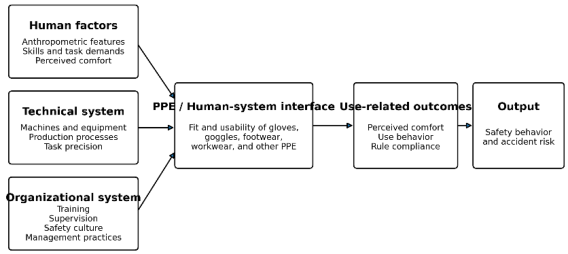
Interpretation That Brings Things Together The findings indicate that occupational health and safety in women’s textile work should be perceived as a socio-technical issue rather than merely a concern of equipment provision or individual compliance. Incompatible PPE, poor supervision, low worker involvement, maintenance issues, and bad psychosocial conditions all worked together to create risk. In this context, PPE should be understood not only as protective gear but also as an essential human-system interface linking the worker to the production system. When this interface does not fit well with women’s bodies and the demands of their jobs, they are less protected and more likely to have accidents. This understanding is in line with socio-technical approaches that say safety performance comes from the interaction of technical design, organizational processes, and human factors (Carayon, 2006; Trist & Bamforth, 1951). Figure 3 shows that the effectiveness of PPE is affected by how human factors, technical system demands, and organizational conditions work together. These three things affect safety behavior and the risk of accidents.
Figure 3: Human-system interface model: the role of personal protective equipment. Note: The function of personal protective equipment note. The model shows that PPE is an important link between the worker and the production system. It also shows that human factors, the technical system, and the organizational system all affect how PPE is used and, as a result, safety outcomes.
DISCUSSION
This study demonstrates that the occupational health and safety experiences of female textile workers cannot be explained solely by the provision of personal protective equipment (PPE). The findings indicate that safe behavior is shaped by the interplay of ergonomic fit, organizational structures and psychosocial working conditions. Within this framework, PPE must be considered not merely as protective equipment, but also as a critical human- system interface functioning between the worker and the production system. This assessment is also theoretically consistent with socio-technical approaches that argue safety performance arises from the holistic interaction of technical design, organizational processes and human factors (Carayon, 2006; Trist & Bamforth, 1951). One of the study’s most notable findings is that female workers experience significant ergonomic mismatches, particularly with protective equipment such as gloves, work boots and workwear. Such mismatches not only make the equipment difficult to use; they also negatively affect its regular and willing use, thereby potentially weakening its protective function. This finding is consistent with the ergonomics literature, which emphasizes that PPE usage may decrease and, consequently, the risk of workplace accidents may increase if equipment design does not align with user characteristics (Sanders & McCormick, 1993; Dul & Weerdmeester, 2008). Furthermore, the study supports the broader discussion that the historical development of personal protective equipment, which has largely been based on male body measurements, creates a structural mismatch for female workers (Criado Perez, 2019; Lee et al., 2025; Langford et al., 2013).
The findings clearly demonstrate that issues relating to occupational health and safety cannot be explained solely by technical shortcomings. Inadequate training, weak supervision, production pressures and psychosocial stress factors do not influence safety behavior independently; rather, they are intertwined elements. In particular, it is understood that overtime, time pressure and communication problems make it difficult for workers to maintain their attention and weaken their capacity to carry out work safely. This assessment is consistent with studies highlighting the decisive role of psychosocial risks on safety performance (Clarke, 2010; Leka & Jain, 2010).
Furthermore, the fact that safety measures are often only implemented following an incident or accident suggests that a reactive rather than a preventive approach to safety prevails in the workplace. However, the literature emphasizes that a sustainable safety culture can only be strengthened through proactive risk management, regular monitoring and continuous oversight mechanisms (Reason, 2016; Dekker, 2017). From this perspective, safety practices must be structured to be implemented not only after a problem has arisen, but before risks have materialized.
This research is consistent with previous findings obtained in the Turkish context. The results indicating that ergonomic risks and working conditions directly influence female workers’ perception of safety are consistent with earlier studies in the sector (Aytaç et al., 2018). Viewed from a broader perspective, these findings once again highlight the need to evaluate occupational health and safety practices within sectors where female labour is concentrated using a socio-technical systems approach. In other words,
effective safety management should not be limited to merely providing protective equipment; it must also encompass ergonomic design, worker participation, monitoring and control mechanisms, and the management of psychosocial risks. In this regard, it can be argued that gender-sensitive personal protective equipment designs—developed by taking into account the physical characteristics of female workers, the requirements of the job, and the organizational conditions in which they work—have the potential to enhance the effectiveness of safety practices in the workplace.
CONCLUSION
This study concludes that occupational health and safety in women’s textile work should be regarded as a socio-technical issue rather than solely a matter of personal protective equipment (PPE) provision. The results demonstrate that ergonomically unsuitable equipment, inadequate supervision, restricted worker involvement, and detrimental psychosocial conditions collectively influence safety behavior and accident risk. Consequently, occupational health and safety policies ought to embrace a more comprehensive strategy that incorporates gender-sensitive PPE design, participatory ergonomics, efficient monitoring, and psychosocial risk management.
Limitations and Future Research This study contributes to existing literature in three main ways. First, it examines PPE use from a human systems engineering perspective. Second, it addresses the ergonomic challenges experienced by female workers in the textile industry. Third, it proposes a gender-sensitive model for PPE design.
However, the study is based on qualitative focus group interviews conducted with a limited group of female textile workers in a single regional context. Therefore, the findings should be interpreted within these contextual limitations. Since the data reflect participants’ perceptions and experiences, the results should be regarded as an in-depth exploration of workers’ perspectives rather than as broadly generalizable evidence.
Future research should employ quantitative and mixed methods approaches with larger samples drawn from different sectors and regions. Further applied ergonomics studies are also needed to evaluate PPE designs that better correspond to the anthropometric characteristics, task requirements, and working conditions of female employees.
REFERENCES
Ada, Y. R., Surono, A., Supriyati, S., & Pribadi, A. P. (2025). Strategies to improve compliance with personal protective equipment use in the textile industry: A scoping review. BMC public health, 25(1), 2743. https://doi.org/10.1186/s12889- 025-24037-9 Ahmad, A., Ahmad, A., Javed, I., Jaffri, N. R., Abrar, U., & Hussain, A. (2021).
Investigation of ergonomic working conditions of sewing and cutting machine operators of clothing industry. Industria Textila, 72(3), 309–313. https://doi. org/10.35530/IT.072.03.17
A Gender-Sensitive Human Systems Engineering Approach 607 Attride-Stirling, J. (2001). Thematic networks: An analytic tool for qualitative research. Qualitative Research, 1(3), 385–405. https://doi. org/10.1177/146879410100100307 Aytaç, S. S., Özok, A. F., Yamankaradeniz, N., Çankaya, O., Gökçe, A., &
Akalp, H. G. (2018). Ergonomic risk perception of women working in the metal industry: A study. Ergonomi, 1(1), 29–38. https://doi.org/10.33439/ ergonomi.473023 Bach, A. J. E., Palutikof, J. P., Tonmoy, F. N., Smallcombe, J. W., Rutherford, S., Joarder, A. R., Hossain, M., & Jay, O. (2023). Retrofitting passive cooling strategies to combat heat stress in the face of climate change: A case study of a ready-made garment factory in Dhaka, Bangladesh. Energy and Buildings, 286, Article 112954. https://doi.org/10.1016/j.enbuild.2023.112954 Biswas, A., Harbin, S., Irvin, E., Johnston, H., Begum, M., Tiong, M., Apedaile,
D., Koehoorn, M., & Smith, P. (2022). Differences between men and women in their risk of work injury and disability: A systematic review. American Journal of Industrial Medicine, 65(7), 576–588. https://doi.org/10.1002/ajim.23364. Braun, V., & Clarke, V. (2006). Using thematic analysis in psychology.
Qualitative Research in Psychology, 3(2), 77–101. https://doi. org/10.1191/1478088706qp063oa Carayon, P. (2006). Human factors of complex sociotechnical systems. Applied Ergonomics, 37(4), 525–535. https://doi.org/10.1016/j.apergo.2006.04.011 Clarke, S. (2010). An integrative model of safety climate: Linking psychological
climate and work attitudes to individual safety outcomes using meta-analysis. Journal of Occupational and Organizational Psychology, 83(3), 553–578. https:// doi.org/10.1348/096317909X452122 Criado Perez, C. (2019). Invisible women: Data bias in a world designed for men.
Abrams Press. Çokluk, Ö., Yılmaz, K., & Oğuz, E. (2011). A qualitative interview method: Focus group interview. Kuramsal Eğitimbilim, 4(1), 95–107. Dekker, S. (2017). The field guide to understanding human error (3rd ed.). CRC
Press. https://doi.org/10.1201/9781315239675 Del Castillo, A. P. (2015). Personal protective equipment: Getting the right fit for women. HesaMag, 12, 34–37. Dul, J., & Weerdmeester, B. (2008). Ergonomics for beginners: A quick reference
guide (3rd ed.). CRC Press. https://doi.org/10.1201/9781420077520 Fullenkamp, A. M., Robinette, K. M., & Daanen, H. A. M. (2008). Gender differences in NATO anthropometry and the implication for protective equipment (Report No. AFRL-RH-WP-JA-2008-0014). Air Force Research Laboratory. https://apps. dtic.mil/sti/pdfs/ADA491083.pdf Hale, A. R., & Hovden, J. (1998). Management and culture: The third age of safety. A
review of approaches to organizational aspects of safety, health and environment. In A. M. Feyer & A. Williamson (Eds.), Occupational injury: Risk, prevention and intervention (pp. 129–166). Taylor & Francis. İmamoğlu, G., & Esi, B. (2024). Ergonomic risk analysis of working postures for a textile factory worker. Journal of Advanced Research in Natural and Applied Sciences, 10(3), 761–770. https://doi.org/10.28979/jarnas.1502292 International Labour Organization. (2022). Safety and health in textiles, clothing,
leather and footwear industries. https://www.ilo.org/resource/other/safety-and- health-textiles-clothing-leather-and-footwear. Krippendorff, K. (2018). Content analysis: An introduction to its methodology (4th ed.). SAGE. https://doi.org/10.4135/978107187878
Krueger, R. A., & Casey, M. A. (2000). Focus groups: A practical guide for applied research (3rd ed.). Sage Publications. Langford, M., Beaumont, M. S., & Annett, D. H. (2013). Ergonomics, risk
management and injury prevention in textiles conservation. Journal of the Institute of Conservation, 36(1), 81–101. https://doi.org/10.1080/19455224.2013.774288 Lee, G., Messing, K., Lee, W., Kim, J.-H., Lee, H., & Kim, S.-S. (2025). Gender differences in occupational hazard exposures within the same occupation: A nationally representative analysis in South Korea. Scandinavian Journal of Work, Environment & Health, 51(2), 111–118. https://doi.org/10.5271/ sjweh.4204 Leka, S., & Jain, A. (2010). Health impact of psychosocial hazards at work:
An overview. World Health Organization. https://iris.who.int/items/32806e00- e5b0-40f7-939c-43bdcd912dea. Metgud, D. C., Khatri, S., Mokashi, M. G., & Saha, P. N. (2008). An ergonomic study of women workers in a woolen textile factory for identification of health- related problems. Indian Journal of Occupational and Environmental Medicine, 12(1), 14–19. https://doi.org/10.4103/0019-5278.40810 Morgan, D. L. (1997). Focus groups as qualitative research (2nd ed.). SAGE. https://
doi.org/10.4135/9781412984287. Nabi, M. H., Hasan, M., Chowdhury, A. T., Naz, F., & Hossian, M. (2023).
The impact of climate change on the lives and livelihoods of readymade garment (RMG) workers: An exploratory study in selected readymade garment factories in Bangladesh. BMC Public Health, 23(1), Article 2292. https://doi.org/10.1186/ s12889-023-17165-7 Okareh, O. T., Solomon, O. E., & Olawoyin, R. (2021). Prevalence of ergonomic hazards and persistent work-related musculoskeletal pain among textile sewing machine operators. Safety Science, 136, Article 105159. https://doi.org/10.1016/j. ssci.2021.105159 Reason, J. (2016). Managing the risks of organizational accidents. Routledge. https://
doi.org/10.4324/9781315543543 Sanders, M. S., & McCormick, E. J. (1993). Human factors in engineering and design (7th ed.). McGraw-Hill. Seidu, R. K., Ofori, E. A., Eghan, B., Fobiri, G. K., Afriyie, A. O., & Acquaye, R.
(2024). A systematic review of work-related health problems of factory workers in the textile and fashion industry. Journal of Occupational Health, 66(1), Article uiae007. https://doi.org/10.1093/joccuh/uiae007. Trist, E. L., & Bamforth, K. W. (1951). Some social and psychological consequences of the longwall method of coal-getting: An examination of the psychological situation and defences of a work group in relation to the social structure and technological content of the work system. Human Relations, 4(1), 3–38. https:// doi.org/10.1177/001872675100400101. Yıldırım, A., & Şimşek, H. (2021). Qualitative research methods in the social sciences
(12th ed.). Elite Publishing.
FIND THE COMPLETE VOLUME IN THE AHFE DIGITAL BOOKSTORE
Explore the complete digital volume
Human Systems Engineering and Design (IHSED2026): Future Trends and Applications
Read this individual research paper free through the original publisher, or explore the full digital proceedings book.