Sevil Çirakoğlu Kelleci, Hüsre Gizem Akalp, Ugur Saklangıc (2026). The Impact of Workstation Ergonomics on Digital Fatigue in Information Technology Workers. In: Human-Computer Interaction & Emerging Technologies. AHFE Open Access, vol. 233, pp. 205–217. https://doi.org/10.54941/ahfe1007520
With increasing digitalization, information technology employees are experiencing digital fatigue from prolonged screen time, static posture, and inadequate ergonomics.This course aims to examine the effects of work environment ergonomics and screen exposure on digital fatigue in IT employees and the regulatory role of organizational conditions in this relationship.In the cross-sectional, quantitative research design, data were collected from 217 public- and private-sector IT professionals in Turkey via an online questionnaire. NIOSH Computer Work Environment Ergonomics Checklist and Digital Fatigue Scale were used; correlation and hierarchical regression analyses were conducted. In addition, an observational ergonomic evaluation using the ROSA method was performed in a subsample (n=10).Ergonomic risk has a strong, positive effect on digital fatigue, while age has a significant negative effect. It was determined that screen exposure did not have a direct effect. Moderation analyses show that workload perception weakens the ergonomic risk-digital fatigue relationship; ergonomic support facilities and break programs significantly differentiated the effect of screen exposure.Digital fatigue cannot be explained by screen usage time alone; It is a multidimensional occupational health risk shaped by the interaction of ergonomic and organizational conditions.
Information technology (IT) sector workers are heavily exposed to both physiological and psychosocial stressors due to prolonged screen-based tasks, sedentary work habits, and ergonomically inadequate workstations.
Prolonged exposure to digital vision is one of the key determinants of computer-induced visual symptoms (Computer Vision Syndrome, CVS). CVS: It is characterized by symptoms such as dry eyes, burning, blurred vision, headache, and difficulty concentrating (Rosenfield, 2011). The prevalence of CVS among office and IT workers is reported to range from 60% to 95% (Sheppard & Wolffsohn, 2018). The widespread adoption of remote and hybrid work arrangements after COVID-19 has significantly increased screen-based workload and the risk of digital fatigue (Al Ashkar et al., 2024; Alatawi et al., 2022; Almarzouki et al., 2021). Studies conducted in Turkey Received February 6, 2026; Revised March 30, 2026; Accepted April 16, 2026; Available online July 20, 2026
also show that digitalization increases visual fatigue and head and neck complaints among workers (Koç, 2022).
Ergonomic work design plays a central role in protecting worker health. The International Ergonomics Association defines ergonomics as “a scientific discipline that studies the interactions between people and system components and aims to improve human well-being and system performance” (IEA, 2000). In IT workstations, physical parameters such as anthropometric fit, monitor height, seating equipment, keyboard-mouse layout, lighting, and break schedule are key components of ergonomic risk. Tools like the Rapid Office Strain Assessment (ROSA) quantitatively classify posture and equipment fit in office workers and provide measurements sensitive to the impact of ergonomic interventions (Sonne et al., 2012). Similarly, the NIOSH Computer Workstation Checklist evaluates basic ergonomic requirements in a workstation from a user-based perspective (NIOSH, 2017). Ergonomic risks in the IT sector are not limited solely to hardware incompatibility. ROSA offers an advantage in evaluating the effectiveness of ergonomic interventions by enabling targeted identification of these risks (de Barros et al., 2022; Matos & Arezes, 2015; Sonne et al., 2012). It has been reported that even small changes, such as monitor alignment, workstation layout, and neck neutrality, significantly affect CSI complaints in IT workers (Alghadir et al., 2022; Prasetya et al., 2024a; Prasetya et al., 2024b). Digital fatigue manifests as visual discomfort, distractibility, cognitive overload, emotional tension, decreased performance, and sleep disturbances. The Digital Fatigue Scale (DFS), developed in Turkey, is a valid and reliable tool for measuring this construct in a multidimensional manner (Tutar & Mutlu, 2024). In international literature, scales such as the Zoom Exhaustion & Fatigue Scale document cognitive and emotional exhaustion resulting from online interaction (Fauville et al., 2021).
It has been shown that working more than 6-8 hours a day on screens increases physical complaints and cognitive exhaustion and raises the risk of distractibility and sleep disturbances (Meo & Al-Drees, 2005). Remote work, with its reduced breaks and blurred work-life boundaries, has been identified as an additional factor that reinforces digital fatigue (Waizenegger et al., 2020). While the existing literature has addressed the relationships among ergonomic risks, screen time, and digital fatigue separately, studies that examine these variables together within the same model and in the context of organizational conditions (perceived workload, ergonomic support, break schedules) are limited. The pressure to be constantly online, performance monitoring, and camera surveillance creates a social and psychological demand for digital fatigue (Constantin, 2024; Fauville et al., 2021; Park et al., 2025). Therefore, measuring digital fatigue in the work environment is of great importance not only for health protection but also for productivity and sustainable work design. This study aims to quantify ergonomic risk levels in IT workers using the NIOSH Computer Workstation Ergonomics Self-Assessment Checklist and ROSA, to assess digital fatigue in a multidimensional way through the DAF (Digital Fatigue Assessment) method, and to examine the moderating roles of screen exposure, workload perception, ergonomic support, and break schedule in these relationships. Thus, by addressing the ergonomic risk-digital exposure-digital fatigue relationship within a holistic framework, the goal is to provide an evidence- based foundation for preventive and remedial interventions for IT workers.
MATERIAL AND METHOD This research was conducted within the scope of a cross-sectional, quantitative design to examine the relationships among workstation ergonomics, screen exposure, and digital fatigue among individuals working in the information technology sector.
Research Population and Sample The research population consists of professionals working in the IT sector in Turkey. The sample includes workers working in various technical and non-technical fields, including software development, system and network administration, data engineering/analytics, technical support, cybersecurity, and product management. Convenience sampling and snowball sampling methods were used together in the sampling process. The data collection process was carried out online; participants were provided with an information text, and their voluntary consent was obtained. The study was conducted with the approval of the Bursa Uludağ University Social and Human Sciences Ethics Committee, dated November 28, 2025, and numbered 2025-10.
Data Collection Tools The data collection tool consists of four components. In the first component, demographic and occupational information was collected regarding participants’ age, gender, occupational role, length of service in the sector, and current position, working style (office, remote, hybrid), break schedule, perceived workload, and ergonomic support status.
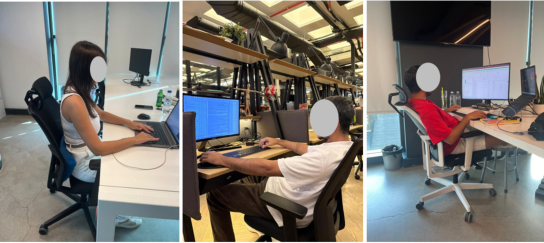
In the second component, workstation ergonomics were evaluated. All participants were given the NIOSH Computer Workstation Ergonomics Self-Assessment Checklist, and ergonomic risks related to hardware features, posture, seating arrangements, and environmental factors were assessed via self-report. In addition, a limited number of participants (n = 10) selected from the main sample based on their occupational roles and work styles were asked to provide standard photographs of the front and side views of their workspaces. These images were scored using the ROSA (Rapid Office Strain Assessment) method, and supporting findings were obtained for observational ergonomic risk assessment. ROSA scoring was performed on standard photographs showing the workstation in a seated position from the front and side (Figure 1).
Figure 1: Example of standard workstation photographic perspectives used in ROSA assessment.
In the third component, participants’ digital fatigue levels were assessed using the Digital Fatigue Scale (DFS), which measures cognitive, emotional, and physical exhaustion associated with digital device use (Tutar & Mutlu, 2024). The fourth component relates to screen exposure. Participants’ daily screen time, device types used, task screen-based intensity, and behavioral habits related to screen use were measured using structured questions.
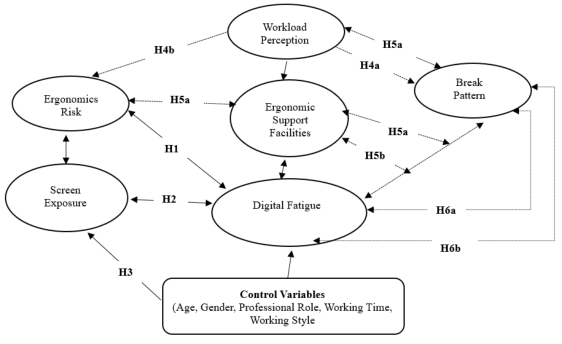
Research Model and Hypotheses This research model is based on a multivariate structure examining the effects of workstation ergonomics and screen exposure on digital fatigue in individuals working in the IT sector.
In this context, the model aims to examine the direct effects of ergonomic risk and screen exposure on digital fatigue, and how these effects differ across working conditions (Figure 2).
Figure 2: Conceptual model of the research.
Within this framework, the hypotheses regarding the relationships and moderating effects among workstation ergonomics, screen exposure, and digital fatigue, as outlined in the research model, are summarized below.
Research Hypotheses H1: Ergonomic risk level has a positive and significant effect on digital fatigue. H2: Screen exposure duration has a positive and significant effect on digital
fatigue.
Hypotheses Regarding Control Variables H3a: Age has a significant effect on the level of digital fatigue. H3b: Gender has a significant effect on the level of digital fatigue. H3c: Occupational role has a significant effect on the level of digital
fatigue.
The Impact of Workstation Ergonomics on Digital Fatigue in Information Technology 209 H3d: Working time in the sector has a significant effect on the level of digital
fatigue. H3e: Working style (remote, hybrid, face-to-face) has a significant effect on the level of digital fatigue.
Moderating Role of Workload Perception H4a: Workload perception moderates the relationship between ergonomic risk and digital fatigue. H4b: Workload perception moderates the relationship between screen
exposure and digital fatigue.
Moderating Role of Ergonomic Support Facilities H5a: Ergonomic support facilities moderate the relationship between ergonomic risk and digital fatigue. H5b: Ergonomic support facilities moderate the relationship between screen
exposure and digital fatigue.
Moderating Role of Break Schedule H6a: Break schedule moderates the relationship between ergonomic risk and digital fatigue. H6b: Break schedule moderates the relationship between screen exposure
and digital fatigue.
FINDINGS AND INTERPRETATION This section presents the results of the statistical analysis used to test the hypotheses developed within the research model.
Demographic Characteristics of Participants The study sample consisted of 217 information technology professionals. 73.3% of the participants were male (n = 159), while 26.7% were female (n = 58). In terms of educational background, 63.1% held an associate’s degree, 26.7% held a bachelor’s degree, and 8.8% held a master’s degree. In terms of work models, 43.8% of the sample works in a hybrid environment, 38.2% in an office-based environment, and 18% works entirely remotely. In terms of sectoral experience, the majority of participants (69.6%) have 1–2 years of experience. The internal consistency coefficients of all scales used in the study are above the acceptable threshold. The reliability coefficient of the three-item perceived workload dimension, included as a control variable, was calculated as α = 0.619. In the literature on scale development and psychometrics, particularly in exploratory studies using scales with a small number of items, Cronbach’s Alpha values of 0.60 or higher are considered acceptable (DeVellis, 2017; Hair et al., 2014). Additionally, it is emphasized that the alpha coefficient is sensitive to the number of items and may yield relatively low values in scales with a small number of items (Tavakol & Dennick, 2011). Accordingly, the perceived workload scale was deemed appropriate for the research design and included in the analyses. The results of the reliability analysis for the research variables are presented in Table 1.
Descriptive Statistics and Correlations The participants’ levels of digital fatigue were close to moderate (Mean = 2.99). Screen time exceeding 6 hours per day (Mean = 6.35) indicates that the sample group works under conditions requiring intense screen exposure.
The direction and strength of the relationships between the research variables were assessed using Pearson correlation analysis. Table 2 presents descriptive statistics and correlation analysis results for the variables Digital Fatigue, Ergonomic Risk, Screen Time, Break Schedule, Ergonomic Support, and Workload.
6. Workload 3,45 1,07 0,09 0,50 −0,18 0,59 0,53 1 ** p <0 ,01; * p < 0,05
Hierarchical Regression Analysis and Hypothesis Testing The three-stage hierarchical regression analysis revealed that the final model explained 27.3% of the total variance in digital fatigue (R² = 0.273) and that the inclusion of interaction terms increased the explained variance by 0.069 (ΔR² = 0.069; p = 0.006). This finding confirms that the moderating variables included significantly enhanced the model’s explanatory power. The results of the analyses conducted to test the research hypotheses and the obtained regression coefficients are presented in Table 3.
Table 3: Regression analysis results of research hypotheses.
Table available in the original PDF paper.
Hypothesis Structural Relationships Relationship
β Value p Value Conclusion Direction
H1 Ergonomic Risk → Digital Fatigue
+ 0,458 < 0,001 Supported
H2 Screen Exposure → Digital Fatigue
+ 0,122 0,094 Not supported H3a Age → Digital Fatigue − − 0,206 0,049 Supported
H3b Gender → Digital Fatigue
0,392 Not supported
H3c Professional Role → Digital Fatigue
0,877 Not supported 0,124 Not supported
H3d Working Time → Digital Fatigue in the Industry H3e Work Style → Digital Fatigue
> 0,05 Not supported − 0,233 0,007 Supported
H4a Ergonomic Risk x Workload Perception → Digital Fatigue
0,175 Not supported
H4b Screen Exposure x Workload Perception → Digital Fatigue
0,293 Not supported
H5a Ergonomic Risk x Ergonomic Support → Digital Fatigue
+ 0,184 0,023 Supported
H5b Screen Exposure x Ergonomic Support → Digital Fatigue
0,647 Not supported
H6a Ergonomic Risk x Break Schedule → Digital Fatigue
+ 0,270 0,007 Supported
H6b Screen Exposure x Break Schedule → Digital Fatigue According to the findings of the hierarchical regression analysis, the established model explains the variance in digital fatigue to a significant degree, and ergonomic risks serve as a key predictor within this framework. Indeed, the strong and positive effect of the level of ergonomic risk on digital fatigue (β = 0.458; p < 0.001) confirms Hypothesis H1. On the other hand, the absence of a direct and significant effect of screen exposure on digital fatigue (β = 0.122; p = 0.094) demonstrates that this type of fatigue is not merely a quantitative outcome dependent on screen time alone; rather, it is a multidimensional construct shaped by the work context and ergonomic conditions. Among the control variables, the significant negative effect of age (β = −0.206; p = 0.049) suggests that older workers may have developed more effective strategies for coping with digital demands; however, gender,
occupational role, sectoral experience, and work model were found to have no statistically significant effect.
In the moderation analyses, perceived workload was found to weaken the relationship between ergonomic risk and digital fatigue (β = −0.233; p = 0.007), whereas ergonomic hardware support (β = 0.184; p = 0.023) and break schedules (β = 0.270; p = 0.007) were found to amplify the effect of screen exposure on digital fatigue. These interactions confirm that digital fatigue is not merely a result of individual exposure but rather an integrated process involving organizational dynamics.
Considering the overall findings, it is understood that the primary determinant of digital fatigue is ergonomic risks, and that the effect of screen exposure manifests not directly, but within an organizational and behavioral context. It appears that various organizational practices, such as ergonomic supports and break programs, indirectly contribute to an increase in digital fatigue by making screen-based work more sustainable. Additionally, the results of the ROSA-based observational assessment indicated moderate to high-level risks, particularly regarding monitor alignment, neck angle, and static sitting posture; these data align with the risk scores based on participants’ self-reports. The use of ROSA data in this confirmatory manner supports measurement reliability within the study’s multi-method approach.
DISCUSSION
This study reveals that participants’ levels of digital fatigue are close to moderate and that their average daily screen time exceeds six hours. The findings are consistent with previous studies showing that increased use of digital devices leads to the proliferation of eye strain, cognitive exhaustion, and various physical ailments (Al Ashkar et al., 2024; Coles-Brennan et al., 2019). The research results also indicate that the level of ergonomic risk is the strongest predictor of digital fatigue. This finding aligns with the ergonomics literature, which emphasizes that ergonomically inadequate work environments are not limited to musculoskeletal issues but are also closely related to cognitive and emotional fatigue (Hedge, 2016; Oakman et al., 2017). It is thought that prolonged sitting, improper screen positioning, and unsuitable environmental conditions negatively affect attention and concentration, thereby increasing digital fatigue. In addition, an observational assessment using the ROSA method was conducted on a limited number of participants. A study conducted with young adults reported that, in addition to moderate and high levels of ergonomic risk identified through posture analysis, eye strain, headaches, and neck and shoulder pain were frequently observed (Bagaji & Rao, 2025). Similarly, it is noted that both visual fatigue and musculoskeletal complaints are common among workers with ergonomically unfavorable conditions in computer and digital device use (Zlateva, 2024). It is stated that even relatively short periods of sitting in front of a computer in an office environment can lead to an increase in physical discomfort, deterioration in mental state, and an increase in problem-solving errors; in particular, prolonged sitting and static posture negatively affect cognitive performance (Baker et al., 2018). Studies on digital eye strain also
The Impact of Workstation Ergonomics on Digital Fatigue in Information Technology 213 emphasize that incorrect screen distance and angle, inadequate lighting, and improper posture increase both eye strain and general fatigue (Kaur et al., 2022). Although many studies have found a relationship between screen time and fatigue, the strength and consistency of this relationship vary depending on the context, usage patterns, and individual factors (Kaur et al., 2022; Mubashir Rehman et al., 2024; Naz & Qamar, 2025). Therefore, it is emphasized that interventions focused solely on reducing screen time have limited impact; digital fatigue can be reduced more effectively when ergonomics, cognitive load, job demands, and coping strategies are addressed together (Hilty et al., 2022; Zimmermann & Sobolev, 2023; Supriyadi et al., 2025). The fact that screen exposure time does not show a direct and significant effect on digital fatigue indicates that screen time alone is not a determining factor. This finding is consistent with studies emphasizing that digital fatigue is shaped not only by the amount of exposure but also by the context of the task, ergonomic conditions, and individual coping strategies (Rosenfield, 2011). Therefore, interventions focused solely on reducing screen time appear to have limited impact. Indeed, Dong and colleagues (2025), using the Fuzzy Cluster Qualitative Comparative Analysis method, showed that digital fatigue arises from different combinations of personal resources and job demands. Similarly, while Supriyadi and colleagues (2025) highlight the negative effects of digital fatigue on worker well-being and performance, Jain and colleagues’ (2025) multi-level model addresses digital fatigue as a job demand shaped at the individual, team, and organizational levels. This framework aligns with our findings, which reveal that the impact of ergonomic risks on digital fatigue only becomes meaningful when evaluated alongside organizational conditions such as workload, ergonomic support, and break arrangements. One of the study’s notable findings is that the perception of workload weakens the relationship between ergonomic risk and digital fatigue. In the context of the Job Demands–Job Resources model, this suggests that how workers perceive job demands can be a determining factor in burnout processes (Bakker & Demerouti, 2007; Demerouti et al., 2001). Individuals with a high perception of workload may accept ergonomic problems as a natural part of the job, which may make the impact of these risks on digital fatigue less pronounced. The inverse relationship between age and digital fatigue suggests that older workers may have developed coping and self-regulation skills in dealing with digital demands; studies reporting that technology-related stress decreases with age support this interpretation (Chen et al., 2025; Hauk et al., 2019; Reinecke et al., 2017; Scheibe & Moghimi, 2021). In contrast, the limited regulatory role of ergonomic supports and break practices in the ergonomic risk–digital fatigue relationship suggests that ergonomic risks may have more direct and contextually independent effects (Mazmanian et al., 2013; Riedl, 2012). The findings highlight the need for holistic approaches to managing digital fatigue, while supporting the Job Demands–Job Resources model as a robust framework for the digital work context (Bakker & Demerouti, 2017; WHO, 2022). The identification of moderate to high ergonomic risks, particularly regarding monitor alignment and sitting posture, in ROSA-based observational assessments indicates that self-report findings are consistent with objective observations (see Figure 1).
Limitations and Future Research The causal interpretability of the findings is limited. The fact that the data are predominantly self-reported and that ROSA-based observational measurements were conducted with a limited subsample are methodological limitations that restrict the generalizability of the results. Future research should test these findings using longitudinal research designs, larger sample sizes, and objective ergonomic evaluation methods.
CONCLUSION AND RECOMMENDATIONS This study demonstrates that ergonomic risks are one of the key determinants of digital fatigue among information technology workers, and that this effect is shaped by organizational factors such as perceived workload, ergonomic equipment support, and break schedules. The findings demonstrate that digital fatigue cannot be reduced to merely individual or technical variables; rather, it is a multidimensional occupational health issue encompassing ergonomic, organizational, and psychosocial components. Furthermore, the negative correlation between age and digital fatigue suggests that older workers may be more proficient in self-regulation and setting digital boundaries; this underscores the importance of developing these competencies in digital well-being programs targeting younger workers. In conclusion, this study, which presents a holistic framework consistent with the Job Demands- Job Resources model, demonstrates that ergonomic interventions aimed at reducing digital fatigue must be integrated with work-load balancing and structured brake systems.
ACKNOWLEDGMENT
There is no conflict of interest among the authors.
REFERENCES
Al Ashkar, I. F., Alhammadi, A. S., Bayram, O. S., Ammari, M., Binashour, A. S., Mohamed, A., Hussein, A., & Talaat, I. (2024). Prevalence of Computer Vision Syndrome Among University Students and Faculty During COVID-19 Pandemic. https://doi.org/10.1101/2024.12.20.24319354 Alan Hedge. (2016). Ergonomic Workplace Design for Health, Wellness, and
Productivity (A. Hedge, Ed.). CRC Press. https://doi.org/10.1201/9781315374000 Alatawi, S. K., Allinjawi, K., Alzahrani, K., Hussien, N. K., Bashir, M., & Ramadan, E. N. (2022). Self-Reported Student Awareness and Prevalence of Computer Vision Syndrome During COVID-19 Pandemic at Al-Baha University. Clinical Optometry, Volume 14, 159–172. https://doi.org/10.2147/OPTO.S374837 Alghadir, A., Khalid, S., & Iqbal, Z. (2022). Work-related musculoskeletal disorders
among information technology professionals in Riyadh, Saudi Arabia. Medycyna Pracy, 73(5), 397–406. https://doi.org/10.13075/mp.5893.01281 Almarzouki, N., Faisal, K., Nassief, A., Najem, N., Eid, R., Albakri, R., Alhibshi, D., Alwethinani, S., & Ashi, H. (2021). Digital Eye Strain During COVID-19 Lockdown in Jeddah, Saudi Arabia. Journal of Contemporary Medical Sciences, 7(1), 40–45. https://doi.org/10.22317/jcms.v7i1.937
The Impact of Workstation Ergonomics on Digital Fatigue in Information Technology 215 Bagaji, S., & Rao, R. (2025). Dıgıtal Fatıgue In The Age Of Screens: Eye And
Postural Straın Among 18–35-Year-Old Screen Users. International Journal of Research -GRANTHAALAYAH, 13(5). https://doi.org/10.29121/granthaalayah. v13.i5.2025.6191 Baker, R., Coenen, P., Howie, E., Williamson, A., & Straker, L. (2018). The Short Term Musculoskeletal and Cognitive Effects of Prolonged Sitting During Office Computer Work. International Journal of Environmental Research and Public Health, 15(8), 1678. https://doi.org/10.3390/ijerph15081678 Bakker, A. B., & Demerouti, E. (2007). The Job Demands-Resources model: state
of the art. Journal of Managerial Psychology, 22(3), 309–328. https://doi. org/10.1108/02683940710733115 Bakker, A. B., & Demerouti, E. (2017). Job demands–resources theory: Taking stock and looking forward. Journal of Occupational Health Psychology, 22(3), 273–285. https://doi.org/10.1037/ocp0000056 Chen, S., Ebrahimi, O. V, & Cheng, C. (2025). New Perspective on Digital Well-Being
by Distinguishing Digital Competency From Dependency: Network Approach. Journal of Medical Internet Research, 27, e70483. https://doi.org/10.2196/70483 Coles-brennan, C., Sulley, A., & Young, G. (2019). Management of digital eye strain.
Clinical and Experimental Optometry, 102(1), 18–29. https://doi.org/10.1111/ cxo.12798 Constantin, A.-M. (2024). The Impact Of Burnout And Zoom Fatıgue On Onlıne Work. Journal Of Communication And Behavioural Sciences, 5(1), 5–20. de Barros, F. C., Moriguchi, C. S., Chaves, T. C., Andrews, D. M., Sonne, M., & de
Oliveira Sato, T. (2022). Usefulness of the Rapid Office Strain Assessment (ROSA) tool in detecting differences before and after an ergonomics intervention. BMC Musculoskeletal Disorders, 23(1), 526. https://doi.org/10.1186/s12891-022- 05490-8 Demerouti, E., Bakker, A. B., Nachreiner, F., & Schaufeli, W. B. (2001). The job demands-resources model of burnout. Journal of Applied Psychology, 86(3), 499–512. https://doi.org/10.1037/0021-9010.86.3.499 DeVellis, R. F. (2017). Scale Development: Theory and Applications . (C. S. Thousand
Oaks, Ed.; (4th ed.)). Dong, Y., Wang, M., Liu, E., & Xing, L. (2025). Causes of digital fatigue among hotel employees in the digital age: configuration study based on fsQCA. Asia Pacific Journal of Marketing and Logistics. https://doi.org/10.1108/APJML-01- 2025-0181 Fauville, G., Luo, M., Queiroz, A. C. M., Bailenson, J. N., & Hancock, J. (2021).
Zoom Exhaustion & Fatigue Scale. Computers in Human Behavior Reports, 4, 100119. https://doi.org/10.1016/j.chbr.2021.100119 Hair, J. F., Black, W. C., Babin, B. J., & Anderson, R. E. (2014). Multivariate Data Analysis (dition). Pearson Education, Upper Saddle River. Hauk, N., Göritz, A. S., & Krumm, S. (2019). The mediating role of coping behavior
on the age-technostress relationship: A longitudinal multilevel mediation model. PLOS ONE, 14(3), e0213349. https://doi.org/10.1371/journal.pone.0213349 Hilty, D. M., Armstrong, C. M., Smout, S. A., Crawford, A., Maheu, M. M., Drude, K. P., Chan, S., Yellowlees, P. M., & Krupinski, E. A. (2022). Findings and Guidelines on Provider Technology, Fatigue, and Well-being: Scoping Review. Journal of Medical Internet Research, 24(5), e34451. https://doi. org/10.2196/34451 IEA. (2000). What Is Ergonomics (HFE)? Https://Iea.Cc/about/What-Is-Ergonomics/. Kaur, K., Gurnani, B., Nayak, S., Deori, N., Kaur, S., Jethani, J., Singh, D., Agarkar,
S., Hussaindeen, J. R., Sukhija, J., & Mishra, D. (2022). Digital Eye Strain- A Comprehensive Review. Ophthalmology and Therapy, 11(5), 1655–1680. https:// doi.org/10.1007/s40123-022-00540-9
Koç, N. E. (2022). An Example of Digital Diseases: Causes of “Zoom” Fatigue and Its Effects on Employees. The Turkish Online Journal of Design, Art and Communication-TOJDAC, 12(2), 383–400. https://doi. org/10.7456/11202100/0012 Matos, M., & Arezes, P. M. (2015). Ergonomic Evaluation of Office Workplaces with
Rapid Office Strain Assessment (ROSA). Procedia Manufacturing, 3, 4689–4694. https://doi.org/10.1016/j.promfg.2015.07.562 Mazmanian, M., Orlikowski, W. J., & Yates, J. (2013). The Autonomy Paradox: The Implications of Mobile Email Devices for Knowledge Professionals. Organization Science, 24(5), 1337–1357. https://doi.org/10.1287/orsc.1120.0806 Meo, S. A., & Al-Drees, A. M. (2005). Mobile phone related-hazards and subjective
hearing and vision symptoms in the Saudi population. International Journal of Occupational Medicine and Environmental Health, 18(1), 53–57. Mubashir Rehman, Faisal Khan, Jahanzaib Khan, Adnan Ahmad, & Mohammad Zeeshan Tahir. (2024). Assessment of Visual Fatigue While Watching Digital Screens. Journal of Clinical and Community Ophthalmology, 2(01), 17–22. https://doi.org/10.71177/jcco.v2i01.59 Naz, I., & Qamar, A. (2025). The Silent Strains and Blurred Minds: A Study of Digital
Screen Time, Mental Fatigue and Brain Fog among University Students. Journal of Regional Studies Review, 4(2), 71–79. https://doi.org/10.62843/jrsr/2025.4b111 NIOSH. (2017). Computer Workstation Ergonomics: Self-Assessment Checklist. Oakman, J., Neupane, S., Proper, K. I., Kinsman, N., & NygÃ¥rd, C.-H. (2017).
Workplace interventions to improve work ability: A systematic review and meta- analysis of their effectiveness. Scandinavian Journal of Work, Environment & Health. https://doi.org/10.5271/sjweh.3685 Oakman, J., Weale, V., Kinsman, N., Nguyen, H., & Stuckey, R. (2022). Workplace physical and psychosocial hazards: A systematic review of evidence informed hazard identification tools. Applied Ergonomics, 100, 103614. https://doi. org/10.1016/j.apergo.2021.103614 Park, M. J., Calistro, T., & Lipnevich, A. A. (2025). Zooming to work or working to
Zoom: relations between Zoom fatigue, cognitive load, and boredom. Research Papers in Education, 40(6), 822–850. https://doi.org/10.1080/02671522.2025.2 507592 Prasetya, T. A. E., Samad, N. I. A., Rahmania, A., Arifah, D. A., Rahma, R. A. A., & Mamun, A. Al. (2024). Workstation Risk Factors for Work-related Musculoskeletal Disorders Among IT Professionals in Indonesia. Journal of Preventive Medicine and Public Health, 57(5), 451–460. https://doi.org/10.3961/jpmph.24.214 Prasetya, T. AE., Mamun, A. A., Rahmania, A., Ahmed, M., Uddin, A. SMS.,
Nilamsari, N., & Wardani, R. WK. (2024). Prevalence and associated risk factors of musculoskeletal disorders among information technology (IT) professionals: A systematic review. Narra J, 4(3), e1100. https://doi.org/10.52225/narra.v4i3.1100 Reinecke, L., Aufenanger, S., Beutel, M. E., Dreier, M., Quiring, O., Stark, B., Wölfling, K., & Müller, K. W. (2017). Digital Stress over the Life Span: The Effects of Communication Load and Internet Multitasking on Perceived Stress and Psychological Health Impairments in a German Probability Sample. Media Psychology, 20(1), 90–115. https://doi.org/10.1080/15213269.2015.1121832 Riedl, R. (2012). On the biology of technostress. ACM SIGMIS Database: The
DATABASE for Advances in Information Systems, 44(1), 18–55. https://doi. org/10.1145/2436239.2436242 Rosenfield, M. (2011). Computer vision syndrome: a review of ocular causes and potential treatments. Ophthalmic and Physiological Optics, 31(5), 502–515. https://doi.org/10.1111/j.1475-1313.2011.00834.x
The Impact of Workstation Ergonomics on Digital Fatigue in Information Technology 217 Scheibe, S., & Moghimi, D. (2021). Age and Context Effects in Daily Emotion
Regulation and Well-Being at Work. Work, Aging and Retirement, 7(1), 31–45. https://doi.org/10.1093/workar/waz014 Shariat, A., Cleland, J. A., Danaee, M., Kargarfard, M., Sangelaji, B., & Tamrin, S.
B. M. (2018). Effects of stretching exercise training and ergonomic modifications on musculoskeletal discomforts of office workers: a randomized controlled trial. Brazilian Journal of Physical Therapy, 22(2), 144–153. https://doi.org/10.1016/j. bjpt.2017.09.003 Sheppard, A. L., & Wolffsohn, J. S. (2018). Digital eye strain: prevalence, measurement and amelioration. BMJ Open Ophthalmology, 3(1), e000146. https://doi. org/10.1136/bmjophth-2018-000146 Shriyak Jain, Deepak Kumar, Megha Grover, & Mamta Rani. (2025). Digital Fatigue
and Employee Engagement in Hybrid Work: A Multilevel Perspective. Economic Sciences, 21(1), 795–803. https://doi.org/10.69889/a1my9b22 Sonne, M., Villalta, D. L., & Andrews, D. M. (2012). Development and evaluation of an office ergonomic risk checklist: ROSA – Rapid office strain assessment. Applied Ergonomics, 43(1), 98–108. https://doi.org/10.1016/j.apergo.2011.03.008 Supriyadi, T., Sulistiasih, S., Rahmi, K. H., Fahrudin, A., & Pramono, B. (2025).
The impact of digital fatigue on employee productivity and well-being: A scoping literature review. Environment and Social Psychology, 10(2). https://doi. org/10.59429/esp.v10i2.3420 Tavakol, M., & Dennick, R. (2011). Making sense of Cronbach’s alpha. International Journal of Medical Education, 2, 53–55. https://doi.org/10.5116/ijme.4dfb.8dfd Tutar, H., & Mutlu, H. T. (2024). Digital Fatigue Scale (DIFL): Validity and Reliability
Study. Journal of Communication Theory and Research, (67), 56–74. https://doi. org/10.47998/ikad.1426571 Waizenegger, L., McKenna, B., Cai, W., & Bendz, T. (2020). An affordance perspective of team collaboration and enforced working from home during COVID-19. European Journal of Information Systems, 29(4), 429–442. https://doi.org/10.1 080/0960085X.2020.1800417 WHO. (2022). WHO guidelines on mental health at work. Zimmermann, L., & Sobolev, M. (2023). Digital Strategies for Screen Time
Reduction: A Randomized Field Experiment. Cyberpsychology, Behavior, and Social Networking, 26(1), 42–49. https://doi.org/10.1089/cyber.2022.0027 Zlateva, R. I. (2024). The Vısual Load Due To Man-Machıne Work (Computer, Dıgıtal Devıces). ANNUAL JOURNAL OF TECHNICAL UNIVERSITY OF VARNA, BULGARIA, 8(1), 1–11. https://doi.org/10.29114/ajtuv.vol8.iss1.292
Read this individual research paper free through the original publisher, or explore the full digital proceedings book.
ISBN 979-8-950676-09-3
Explore this ISBN in the AHFE Bookstore ↗Listed in the July 2026 bookstore catalogue; search by ISBN to confirm current availability · Digital book purchase optional