Visually impaired individuals often encounter uncertainty and limited autonomy when navigating complex indoor environments, such as museums,sports centers. While tactile cues have been proposed as compensatory aids, few studies examine how tactile guidance influences psychological security and actively motivates exploration behaviors in such contexts. This research investigates the mechanism by which tactile interaction supports trust, emotional security, and spatial agency. Study 1 employed formative interviews with ten visually impaired participants and two accessibility designers to extract design needs and key tactile guidance elements.Study 2 implemented a lightweight tactile-guidance prototype within a simulated museum environment and collected 227 survey responses to examine how tactile design influences users’ sense of security, exploration intention, and spatial dominance. Results show that tactile guidance increases users’ exploration intention and spatial dominance primarily through sense of security as a key mediating mechanism. This highlights how emotional reassurance enables tactile cues to support more confident and self-directed navigation behaviors, offering actionable implications for inclusive museum wayfinding systems.
Museums increasingly seek to provide inclusive visitor experiences (Brock et al., 2023); however, blind and low-vision (BLV) individuals still encounter substantial barriers in navigation, orientation, and independent exploration within complex exhibition environments. While accessibility interventions have traditionally focused on ensuring basic reachability and functional guidance, recent work suggests that effective wayfinding support must also address users’ psychological experience, particularly feelings of safety and confidence in unfamiliar public spaces.
Tactile wayfinding systems—including tactile maps, continuous guidance strips, vibrotactile feedback, and symbolic textures—offer a promising design approach for supporting non-visual navigation in museums. Prior research
Inclusive Navigation Design 115 has demonstrated that tactile and multimodal interfaces can enhance BLV visitors’ autonomy and spatial understanding (Ahmetovic et al., 2021). However, most existing studies remain oriented toward usability outcomes, leaving the affective mechanisms that motivate exploration and spatial agency underexplored.
To address this gap, this study investigates how tactile guidance shapes BLV users’ exploration-related behaviors through an emotional–cognitive pathway. We propose that tactile guidance does not directly promote exploration, but rather operates through sense of security as a key psychological mediator. In addition, we examine whether spatial perception ability moderates the extent to which tactile cues translate into perceived safety.
Empirically, this study combines a formative qualitative inquiry with a controlled experimental study in a simulated museum environment. Using PLS-SEM, we examine how tactile guidance influences security, exploration intention, and spatial dominance, while also testing the moderating role of spatial perception ability. Overall, the study contributes design knowledge for inclusive museum wayfinding by positioning security as a central affective mechanism underlying tactile navigation and deriving actionable implications for supporting BLV users’ spatial agency beyond basic passability.
RELATED WORK
Tactile Wayfinding for Blind and Low-Vision Visitors in Museums Museums are information-rich public environments (Kayukawa et al., 2023) in which blind and low-vision (BLV) visitors often face barriers to independent navigation and exhibit engagement. To address this, prior studies have explored tactile and multimodal wayfinding systems that extend beyond visual signage, including tactile maps (Wang et al., 2022), audio-supported navigation, and sensory-based spatial cues. These systems aim not only to provide directional assistance, but also to support visitors’ understanding of surrounding spatial structures and exhibit contexts.
Recent work in museum accessibility further emphasizes that enhancing autonomy requires integrating tactile exploration (Avni et al., 2025) and customizable guidance features (García Vizcaíno, 2024), suggesting that navigation support should also consider experiential and psychological dimensions of visiting cultural spaces.
Beyond Accessibility: Psychological Experience in Inclusive Wayfinding While tactile guidance has often been evaluated through usability and functional accessibility outcomes, emerging inclusive design research argues that effective wayfinding should also address visitors’ affective experience— particularly feelings of safety, confidence, and trust in unfamiliar environments (Blokland et al., 2025). This aligns with the broader shift from designing for basic passability toward supporting spatial agency and meaningful participation.
Moreover, tactile map design guidelines highlight that predictability, continuity, and standardized tactile encoding (Wabiński and Touya, 2022) are critical for enabling users to build coherent spatial representations, which may serve as a prerequisite for security and exploratory behavior.
Together, these studies motivate the need to examine tactile guidance not merely as an assistive tool, but as an experiential infrastructure shaping Sense of Security, and ultimately influencing Exploration Intention and Spatial Dominance in museum navigation contexts.
RESEARCH MODEL AND HYPOTHESIS DEVELOPMENT This study proposes a structural model to examine how Tactile Guidance (TG) influences blind and low-vision (BLV) visitors’ spatial behaviors in museum environments. Rather than treating tactile wayfinding as purely functional navigation support, we conceptualize TG as an experiential infrastructure that shapes psychological and behavioral outcomes through an affective mechanism. Specifically, the model positions Sense of Security (SS) as a key mediator linking tactile guidance to both Exploration Intention (EI) and Spatial Dominance (SD).
Prior museum accessibility research has shown that tactile and multimodal navigation systems can enhance autonomy and independent mobility for BLV visitors. However, much of the existing work remains focused on usability and task performance, leaving the psychological pathways (Avni et al., 2025) that motivate active exploration less clearly articulated. Extending inclusive design perspectives that emphasize emotional comfort and trust in navigation contexts, this study argues that tactile guidance contributes to a predictable and reliable environmental perception, thereby fostering security as an action-enabling psychological resource.
Tactile Guidance and Sense of Security Tactile guidance systems provide structured spatial cues—such as tactile maps, guidance strips, and feedback nodes—that help users anticipate spatial continuity and reduce uncertainty. Predictable tactile encoding has been identified as essential for building coherent non-visual spatial representations (Trinh et al., 2023). Therefore, we hypothesize:
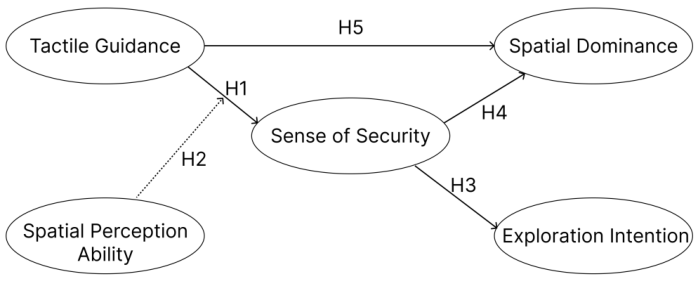
H1: Tactile Guidance (TG) positively influences Sense of Security (SS).
Moderating Role of Spatial Perception Ability Individual differences in spatial cognition may shape how effectively tactile cues are interpreted (Schinazi et al., 2016). Spatial navigation studies suggest that BLV users adopt heterogeneous strategies depending on their spatial perception skills. Accordingly, we propose that spatial perception ability strengthens the effect of tactile guidance on security:
H2: Spatial Perception Ability (SP) moderates the relationship between TG and SS, such that the effect is stronger for users with higher SP.
Inclusive Navigation Design 117 Sense of Security as a Driver of Exploration and Spatial Dominance
Security represents not only an emotional outcome but also a psychological prerequisite for proactive behavior (Golledge, 1993). Visitors who feel secure are more likely to engage in exploration and develop a stronger sense of spatial control. Thus, we hypothesize(see Figure 1): H3: Sense of Security (SS) positively influences Exploration Intention (EI). H4: Sense of Security (SS) positively influences Spatial Dominance (SD). Finally, combining these pathways, the model suggests that tactile guidance impacts exploration-related outcomes primarily through security:
Figure 1: Conceptual model of the proposed relationships among tactile guidance, sense of security, exploration intention, spatial dominance, and spatial perception ability. Sense of security functions as the key mediating mechanism, while spatial perception ability moderates the relationship between tactile guidance and sense of security. A direct path from tactile guidance to spatial dominance was also tested.
Overall, this research model provides an empirically testable framework for understanding tactile wayfinding as an affective–behavioral mechanism supporting inclusive museum experiences.
METHOD
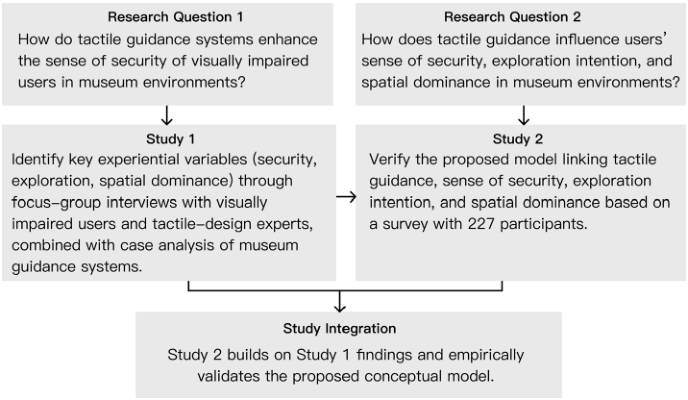
This study employed a mixed-method research design to investigate affective– behavioral mechanism through which Tactile Guidance (TG) influences blind and low-vision (BLV) visitors’ exploration-related outcomes in museum environments (Kayukawa et al., 2023). The overall procedure consisted of two sequential components: a formative qualitative inquiry (Study 1) and a controlled experimental study with structural model testing (Study 2) (see Figure 2).
Figure 2: Overall research framework linking the two study stages, corresponding research questions, and the logical integration between study 1 and study 2.
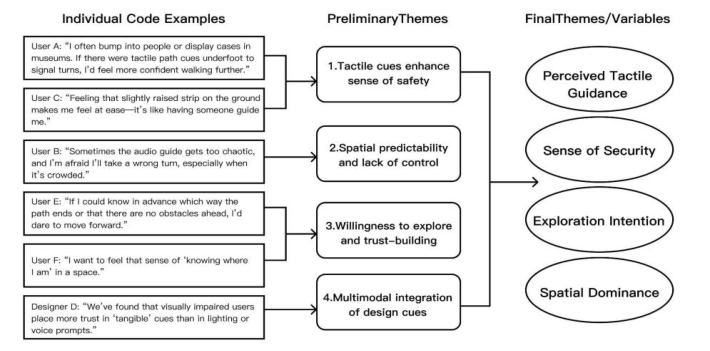
Study 1: Formative Inquiry and Construct Development To ensure the proposed structural model captured BLV users’ lived navigation experience, Study 1 was conducted as a formative inquiry (Avni et al., 2025). Focus group discussions were conducted with visually impaired participants and wayfinding designers to identify key perceptual and psychological factors associated with tactile navigation (see Figure 3). Findings from Study 1 informed the operationalization of the core latent constructs used in Study 2, including Tactile Guidance (TG), Sense of Security (SS), Exploration Intention (EI), and Spatial Dominance (SD). This approach aligns with inclusive design research emphasizing, accessibility interventions should be grounded in users’ experiential needs rather than purely functional assumptions (Kayukawa et al., 2023).
All focus group and interview sessions were audio-recorded with participants’ consent and transcribed for analysis. To make the construct development process more transparent, we conducted iterative thematic coding focusing on recurring experiences related to tactile cue interpretation, route continuity, decision-point confirmation, perceived safety, exploratory willingness, and perceived spatial control in museum- like environments. Case analysis of existing tactile guidance systems was used to compare how these experiential concerns were addressed in practice. The convergence of user narratives, expert perspectives, and case observations informed the proposed relationships and construct definitions examined in Study 2.
Inclusive Navigation Design 119
Figure 3: Focus group discussion and construct extraction process.
Study 2: Experimental Scenario and Procedure Study 2 was conducted in a simulated museum environment designed as a controlled tactile wayfinding context. The setting incorporated tactile maps, continuous guidance strips, vibrotactile feedback nodes (Banaei et al., 2007), and symbolic tactile textures, corresponding to typical navigation sequences in museum visits (Khusro et al., 2022). Participants were asked to complete a structured task flow: entering the space, identifying pathways, locating transitional nodes, exploring exhibition areas, and returning to the exit. This workflow provided a consistent contextual basis for assessing psychological and behavioral responses to tactile guidance.
A total of 227 blind and low-vision participants were recruited through accessibility service organizations and museum visitor networks. All participants experienced a unified tactile-guidance condition in the simulated environment.
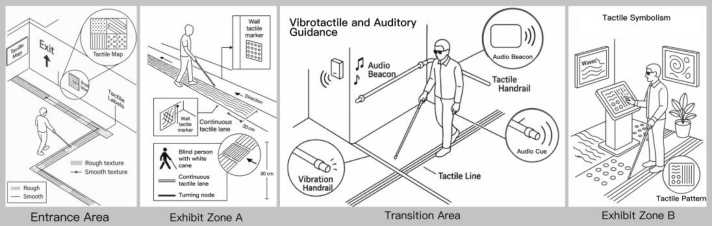
To empirically test hypotheses H1–H5, the experimental setting implemented a structured tactile wayfinding system, including raised floor guidance strips, wall-mounted relief and Braille signage, vibrotactile handrails, and audio beacons (National Academies of Sciences, Engineering, and Medicine, 2025). These elements were designed to support non-visual orientation, route confirmation, and exploratory engagement.
The environment consisted of four functional zones: an entrance area, Exhibit Zone A, a transition area, and Exhibit Zone B. The entrance zone provided tactile maps and floor-texture contrasts to establish initial spatial understanding. Zone A emphasized continuous tactile guidance and relief confirmation to enhance Sense of Security (SS). The transition area incorporated vibrotactile feedback and auditory cues to strengthen directional reassurance. Exhibit Zone B introduced symbolic tactile textures intended to reinforce Spatial Dominance (SD) and exploratory motivation (see Figure 4).
Figure 4: Experimental tactile wayfinding scenarios across four zones in the simulated museum, illustrating tactile maps, route guidance, multimodal cues, and symbolic textures.
Participants completed navigation tasks along a predefined route (“Entrance → Zone A → Transition → Zone B → Exit”), after which they filled out a structured questionnaire measuring Tactile Guidance (TG), Sense of Security (SS), Exploration Intention (EI), and Spatial Dominance (SD) for subsequent SEM analysis.
Measures All constructs were measured using reflective multi-item scales adapted to the tactile museum navigation context. TG captured users’ perceived continuity, reliability, and interpretability of tactile cues. SS assessed the extent to which participants felt safe and confident during navigation. EI reflected visitors’ willingness to proactively explore, while SD represented perceived spatial control and agency. Spatial Perception Ability (SP) was included as an individual-level moderating variable.
Data Analysis Procedure All data were analyzed using SmartPLS 4.0. Following standard PLS- SEM procedures (Ringle et al., 2023), the measurement model was first evaluated through internal consistency reliability and convergent validity, including Cronbach’s alpha, composite reliability (CR), and average variance extracted (AVE) (Henseler et al., 2016). Threshold values above 0.70 for reliability and above 0.50 for AVE were considered acceptable, in line with established guidelines. The structural model was subsequently assessed to test hypotheses H1–H5. Path significance and moderation effects were estimated via bootstrapping with 5,000 resamples (Becker et al., 2018), applying two- tailed testing at p < .05, consistent with recommended reporting practices for moderation in PLS-SEM.
Model explanatory power was interpreted using the coefficient of determination (R²), where values around 0.25, 0.50, and 0.75 may be considered weak, moderate, and substantial depending on context.
Inclusive Navigation Design 121
RESULTS
After validating the measurement model, the structural relationships among Tactile Guidance (TG), Sense of Security (SS), Exploration Intention (EI), and Spatial Dominance (SD) were examined using SmartPLS 4.0. Path significance was assessed via bootstrapping with 5,000 resamples, consistent with recommended PLS-SEM inference procedures (Becker et al., 2018).
Measurement Model Summary All constructs demonstrated satisfactory internal consistency and convergent validity. As shown in Table 1, Cronbach’s α values ranged from 0.872 to 0.913, composite reliability exceeded the recommended 0.90 threshold, and AVE values were all above 0.74, indicating strong construct reliability at the measurement level, consistent with established PLS-SEM evaluation criteria.
Structural Model and Hypothesis Testing Bootstrapping with 5,000 resamples was conducted to evaluate the proposed hypotheses. Table 2 shows that Tactile Guidance (TG) exerted a significant positive effect on Sense of Security (SS) (β = 0.505, p < .001), supporting H1. Sense of Security further predicted both Exploration Intention (EI) (β = 0.518, p < .001) and Spatial Dominance (SD) (β = 0.586, p < .001), confirming SS as the mechanism driving exploration-related outcomes. In addition, the interaction term TG × SP significantly strengthened the TG → SS relationship (β = 0.148, p < .01), indicating a moderating role of Spatial Perception Ability (SP).In an extended model that additionally included a direct TG → SD path, tactile guidance showed a significant positive effect on spatial dominance (β = 0.266, t = 5.203, p < 0.001).”
Table 2: Bootstrapping results for the baseline structural model. The direct effect of TG on SD (H5) was additionally tested in an extended model including the TG → SD path.
Control SP → SS 0.118 0.056 2.128 =0.033 H3 SS → EI 0.518 0.051 10.251 <.001 H4 SS → SD 0.586 0.047 12.371 <.001
H5 TG → SD 0.266 0.051 5.203 <.001
Model Explanatory Power Global model fit indices suggested an acceptable approximation of the empirical covariance structure. The estimated SRMR was 0.068, below the commonly reported cut-off of 0.08, while NFI indicated satisfactory incremental fit (0.866) (Henseler et al., 2016).
Regarding explanatory power, the model accounted for moderate variance in the endogenous constructs (R² = 0.276 for SS, 0.269 for EI, and 0.343 for SD), supporting the proposed affective–behavioral pathway in tactile-guided museum navigation.
Table 3: Model fit indices (smart PLS estimated model).
Table available in the original PDF paper.
Fit Index Value Recommended Threshold Interpretation SRMR 0.068 <0.08 Acceptable model fit
d_ULS 0.096 Lower is better Indicates small discrepancy d_G 0.032 Lower is better Indicates good overall fit
Chi-square 38.386 Descriptive only in PLS Not primary criterion NFI 0.866 >0.80 acceptable Satisfactory incremental fit
DISCUSSION
The findings suggest that tactile wayfinding in museums functions not only as an assistive aid but also as an experiential condition shaping how blind and low-vision visitors engage with space. Sense of Security (SS) emerged as the central mechanism through which Tactile Guidance (TG) influenced exploration-related outcomes. Rather than primarily operating through direct behavioral activation, tactile cues appeared to enhance environmental predictability and trust, enabling more proactive spatial engagement. The moderating role of Spatial Perception Ability (SP) further indicates that tactile guidance does not operate uniformly across users, as those with stronger spatial perception skills may derive greater security from tactile information. Overall, these results suggest that inclusive museum wayfinding should move beyond basic passability and instead support confidence, agency, and meaningful participation through continuous and interpretable tactile environments (Wang et al., 2023).
DESIGN IMPLICATIONS Based on the validated affective–behavioral mechanism, our findings suggest that tactile wayfinding systems in museums and cultural public spaces should be designed not merely to increase navigational information, but to cultivate a stable Sense of Security as the emotional prerequisite for confident exploration. Continuous and predictable tactile routes—such as guidance strips and feedback nodes—can help construct a trustworthy environment that supports agency and reduces uncertainty (Avni et al., 2025). In addition, coherent tactile encoding through tactile maps, texture zoning, and anticipatory node cues can enable visitors to form an overview of spatial structure before movement, strengthening path understanding and navigational confidence. Given the moderating role of Spatial Perception Ability, tactile systems should further provide layered feedback, ranging from
Inclusive Navigation Design 123 basic orientation confirmation (e.g., vibrotactile nodes) to richer semantic textures that support spatial meaning-making and engagement across diverse users. Finally, inclusive museum navigation should move beyond basic passability toward fostering spatial dominance and proactive participation, where multimodal integration of tactile and audio support may enable BLV visitors not only to navigate safely but also to explore cultural environments with greater confidence and autonomy (Ahmetovic et al., 2021).
CLOSING PARAGRAPH In summary, this study demonstrates that tactile wayfinding in museums shapes exploration-related outcomes primarily through Sense of Security, with the individual spatial perception ability moderating this mechanism. By reframing tactile guidance as an affective infrastructure that supports trust, agency, and engagement, the proposed model offers empirical evidence and actionable principles for designing inclusive cultural environments in which BLV visitors can explore with confidence and autonomy.
REFERENCES
Ahmetovic, D., Gleason, C., Ruan, C., Kitani, K., Takagi, H. and Asakawa, C. (2021).
NavCog3: An evaluation of a smartphone-based indoor navigation assistant for blind users. ACM Transactions on Accessible Computing (TACCESS). Avni, Y., et al. (2025). Enhancing museum accessibility for blind and low vision individuals (through interactive multimodal tangible interfaces). International Journal of Human–Computer Studies. BAbidi, M.H., et al. (2024). A comprehensive review of navigation systems for
visually impaired people. Heliyon, 10(3). Banaei, M., et al. (2007). Vibrotactile feedback to aid blind users of mobile museum guides. Universal Access in the Information Society. Becker, J.-M., Ringle, C.M. and Sarstedt, M. (2018). Estimating moderating effects
in PLS-SEM and PLSc-SEM: Interaction term generation and data treatment. Journal of Applied Structural Equation Modeling, 2(2), 1–21. Blokland, D.P.H., et al. (2025). Wayfinding with impaired vision: Preferences for cues and strategies. Brain Sciences, 16(1), 13. Brock, A.M., Truillet, P., Oriola, B., Picard, D. and Jouffrais, C. (2023). Inclusive
museum accessibility: Multisensory mediation for blind and low-vision visitors. Proceedings of CHI 2023. García Vizcaíno, M.J. (2024). Access for the blind in the art setting: tactile paintings as inclusive tools. Museum Management and Curatorship. Golledge, R.G. (1993). Geography and the disabled: A survey with special reference
to vision impaired and blind populations. Transactions of the Institute of British Geographers. Hair, J.F., Risher, J.J., Sarstedt, M. and Ringle, C.M. (2019). When to use and how to report the results of PLS-SEM. European Business Review, 31(1), 2–24. Hair, J.F., Hult, G.T.M., Ringle, C.M. and Sarstedt, M. (2022). A Primer on Partial
Least Squares Structural Equation Modeling (PLS-SEM) (3rd ed.). Sage. Henseler, J., Hubona, G., & Ray, P. A. (2016). Using PLS path modeling in new technology research: Updated guidelines. Industrial Management & Data Systems, 116(1), 2–20.
Kayukawa, S., Sato, D., Murata, M., Ishihara, T., Takagi, H., Morishima, S. and Asakawa, C. (2023). Enhancing blind visitors’ autonomy in a science museum using an autonomous navigation robot. Proceedings of the CHI Conference on Human Factors in Computing Systems (CHI ’23). ACM. National Academies of Sciences, Engineering, and Medicine. (2025). Tactile
Wayfinding in Transportation Settings for Travelers Who Are Blind or Visually Impaired. TCRP Research Report 248. Washington, DC: The National Academies Press. Ringle, C.M., Sarstedt, M. and Straub, D. (2023). A perspective on using partial least squares structural equation modelling (PLS-SEM). Data in Brief. Schinazi, V.R., Thrash, T. and Chebat, D.-R. (2016). Spatial navigation by congenitally
blind individuals. Wiley Interdisciplinary Reviews: Cognitive Science, 7(1), 37–58. Trinh, V., et al. (2023). Experimental evaluation of multi-scale tactile maps for indoor wayfinding. Sensors, 23(12), 1–18. Wabiński, J. and Touya, G. (2022). Guidelines for standardizing the design of tactile
maps: A review of research and best practice. The Cartographic Journal. Wang, X., Kayukawa, S., Takagi, H. and Asakawa, C. (2022). BentoMuseum: 3D and layered interactive museum map for blind visitors. Proceedings of the 24th International ACM SIGACCESS Conference on Computers and Accessibility (ASSETS ’22), Article 35, 1–14. ACM. Wang, X., Kayukawa, S., Takagi, H. and Asakawa, C. (2023). TouchPilot: Designing
a Guidance System that Assists Blind People in Learning Complex 3D Structures. Proceedings of ASSETS ’23. ACM.
Read this individual research paper free through the original publisher, or explore the full digital proceedings book.
ISBN 979-8-950676-09-3
Explore this ISBN in the AHFE Bookstore ↗Listed in the July 2026 bookstore catalogue; search by ISBN to confirm current availability · Digital book purchase optional